Concrete Prices in 2026: Cost Per Yard, Square Foot & Project
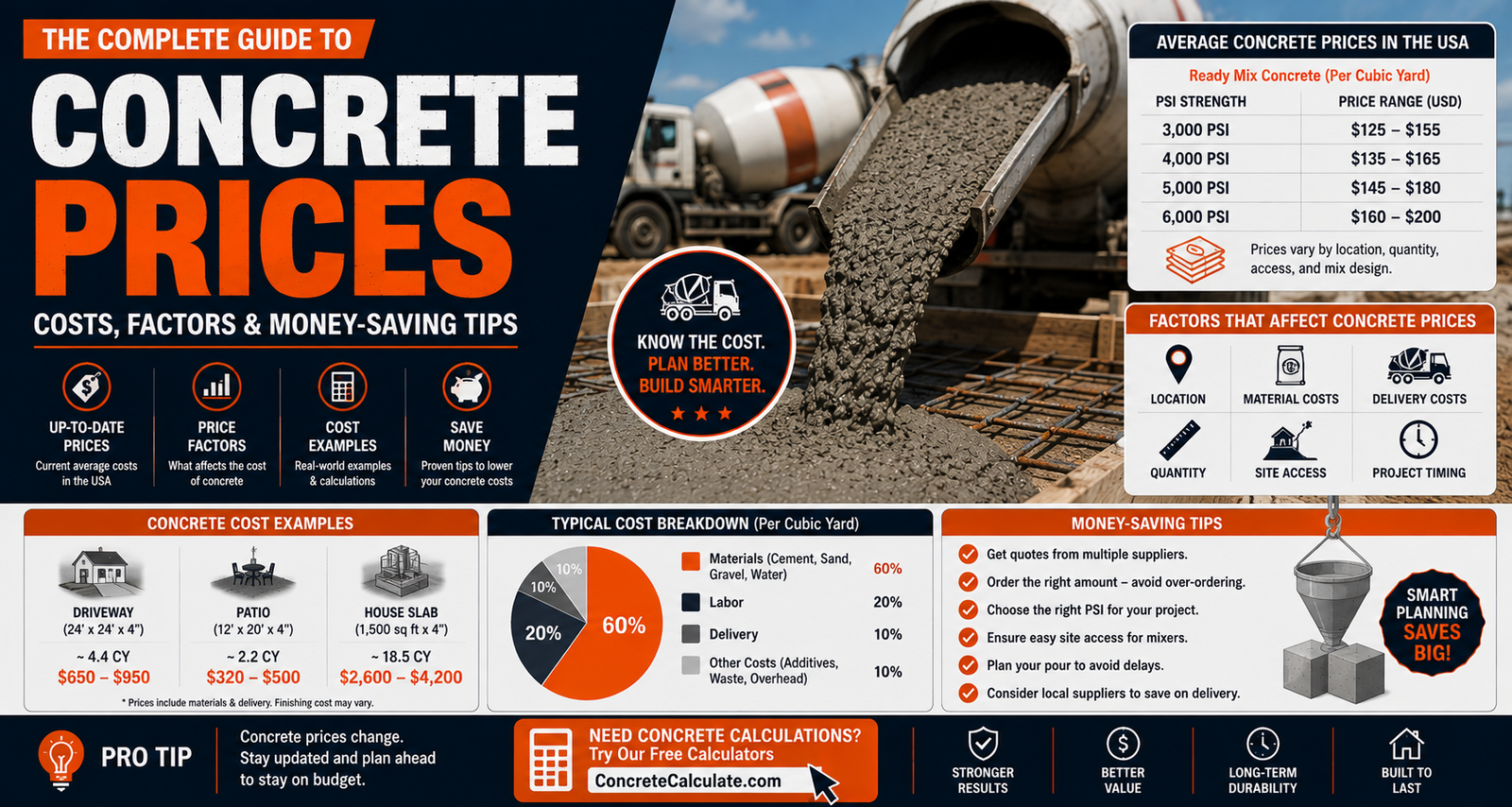
The main U.S. concrete pricing reference: what a cubic yard costs, what drives the price, and how to turn that number into a real project budget.
Quick Answer
Ready-mix concrete commonly falls within a broad national range of roughly $120 to $200 per cubic yard delivered in 2026, depending on your location, specified strength, order size, and delivery terms. Material-only pricing, before delivery and fees, often runs somewhat lower, roughly $100 to $165 per yard in many markets.
Installed cost for finished flatwork, meaning concrete plus labor, preparation, and finishing, typically runs considerably higher than the material price alone, often in the range of $4 to $10 or more per square foot depending on the project.
Concrete Prices Are Local
National ranges are planning figures, not guaranteed supplier quotes. Your actual price depends on your specific region, supplier, mix specification, and order size. Use the ranges in this guide to plan a realistic budget, then confirm the real number with local suppliers.
In This Guide
- Concrete Price Calculator
- 2026 Concrete Price Snapshot
- How Much Does Concrete Cost Per Cubic Yard?
- How Much Does Concrete Cost Per Square Foot?
- Concrete Price by Slab Thickness
- Concrete Price by PSI
- Concrete Price by Mix Type
- Ready-Mix Concrete vs. Bagged Concrete Prices
- Concrete Prices by Order Size
- Concrete Delivery Costs and Fees
- What Is a Short-Load Fee?
- Concrete Prices by Region
- Concrete Prices by State
- Concrete Prices by Major U.S. Cities
- Why Concrete Prices Vary by Location
- Concrete Price by Project Type
- How Much Does a Concrete Driveway Cost?
- How Much Does a Concrete Patio Cost?
- How Much Does a Concrete Slab Cost?
- How Much Does a Concrete Foundation Cost?
- How Much Does a Concrete Sidewalk Cost?
- Concrete Cost Components
- Material Cost vs. Installed Cost
- How to Calculate Concrete Cost
- Concrete Price Example: 1 Cubic Yard
- Concrete Price Example: 5 Cubic Yards
- Concrete Price Example: 10 Cubic Yards
- Concrete Price Example: 20 × 20 ft Slab
- What Makes Concrete More Expensive?
- How to Save Money on Concrete
- How to Get an Accurate Concrete Price Quote
- Questions to Ask a Ready-Mix Supplier
- Concrete Price Trends: 2024 to 2026
- Will Concrete Prices Increase in 2027?
- Concrete Pricing Checklist
- Common Concrete Pricing Mistakes
- Concrete Prices: Quick Reference
- Concrete Prices FAQs
Concrete Price Calculator
Once you understand what drives concrete pricing, get a project-specific number with the Concrete Price Per Yard Calculator. Enter your volume, select your PSI, enter your local price, and add delivery and any applicable fees.
The calculator answers “what does my project cost?” This article answers “what do these numbers actually mean, and why do they vary so much?” Read the guide first, then use the calculator to turn the concepts into your own number.
2026 Concrete Price Snapshot
| Price Category | 2026 Planning Range | What It Represents |
|---|---|---|
| Standard ready-mix, material only | $100 to $165/yd³ | Base concrete mix, plant price before delivery |
| Delivered concrete (3,000 to 4,000 PSI) | $120 to $200/yd³ | Material plus typical full-load delivery |
| Specialty/higher-strength concrete | $150 to $250+/yd³ | Higher-performance or specialty mixes, delivered |
| Installed flatwork | $4 to $10+/ft² | Material plus labor, preparation, and finishing |
These are broad planning ranges compiled from multiple current 2026 industry sources, which themselves report meaningfully different figures depending on methodology and region. They are not a guaranteed price for your project.
2026 Concrete Price Range: What Are You Actually Comparing?
Published price ranges disagree partly because different sources measure different things. One widely cited 2026 industry figure places the national average ready-mix price near $180 per cubic yard delivered, while other current sources report broader ranges from roughly $120 to $250 depending on region, strength, and order size. Neither figure is wrong; they’re measuring different combinations of the four price types below.
How Much Does Concrete Cost Per Cubic Yard?
1 yd³ = 27 ft³
Within that base unit of measure, cost varies by mix strength, whether the mix includes specialty admixtures, whether the quote includes delivery, and how large your order is relative to a full truckload. Standard 3,000 to 4,000 PSI ready-mix, delivered as a full load, commonly falls in the middle of the broad ranges shown in the snapshot table above.
For the complete economics of cubic-yard pricing, including material versus delivered versus effective pricing and a deep dive into order-size behavior, see the Concrete Cost Per Yard Guide.
How Much Does Concrete Cost Per Square Foot?
Price per square foot depends heavily on slab thickness, since a thicker slab needs more cubic yards to cover the same footprint. For a 4-inch slab, one cubic yard covers approximately 81 square feet.
Material cost/ft² = price/yd³ ÷ 81 (for a 4-inch slab)
Example
At $150/yd³, a 4-inch slab costs approximately $150 ÷ 81 ≈ $1.85 per square foot in material alone, before delivery, labor, or finishing.
For other thicknesses, recalculate coverage separately, since the 81 figure only applies at 4 inches. See How Much Does Concrete Cost Per Square Foot? for the complete breakdown, including installed pricing.
Concrete Price by Slab Thickness
| Thickness | Approx. Sq Ft per yd³ | Illustrative Material Cost/ft² at $150/yd³ |
|---|---|---|
| 3 in | 108 | $1.39 |
| 4 in | 81 | $1.85 |
| 5 in | 64.8 | $2.31 |
| 6 in | 54 | $2.78 |
| 8 in | 40.5 | $3.70 |
Increasing thickness doesn’t necessarily change the supplier’s price per cubic yard, but it increases the number of yards required to cover your project, which raises your total cost per square foot proportionally.
Concrete Price by PSI
Higher specified strength generally costs more, since it typically requires more cementitious material, admixtures, and tighter production control. There is no single universal national price premium for moving from one PSI level to the next; the exact difference depends on your specific supplier and mixture.
| PSI | Relative Pricing Position | Typical Use |
|---|---|---|
| 2,500 PSI | Lower end of the pricing range | Selected nonstructural applications |
| 3,000 PSI | Standard baseline pricing | General residential work |
| 3,500 PSI | Modestly above baseline | Driveways/flatwork depending on specification |
| 4,000 PSI | Above baseline | Higher-demand applications, freeze-thaw exposure |
| 5,000 PSI | Meaningfully above baseline | Specialty/structural applications |
See the Concrete PSI Guide, 3000 PSI Concrete Guide, 4000 PSI Concrete Guide, and 5000 PSI Concrete Guide for how each strength level is actually selected and used, rather than chosen for price alone.
Concrete Price by Mix Type
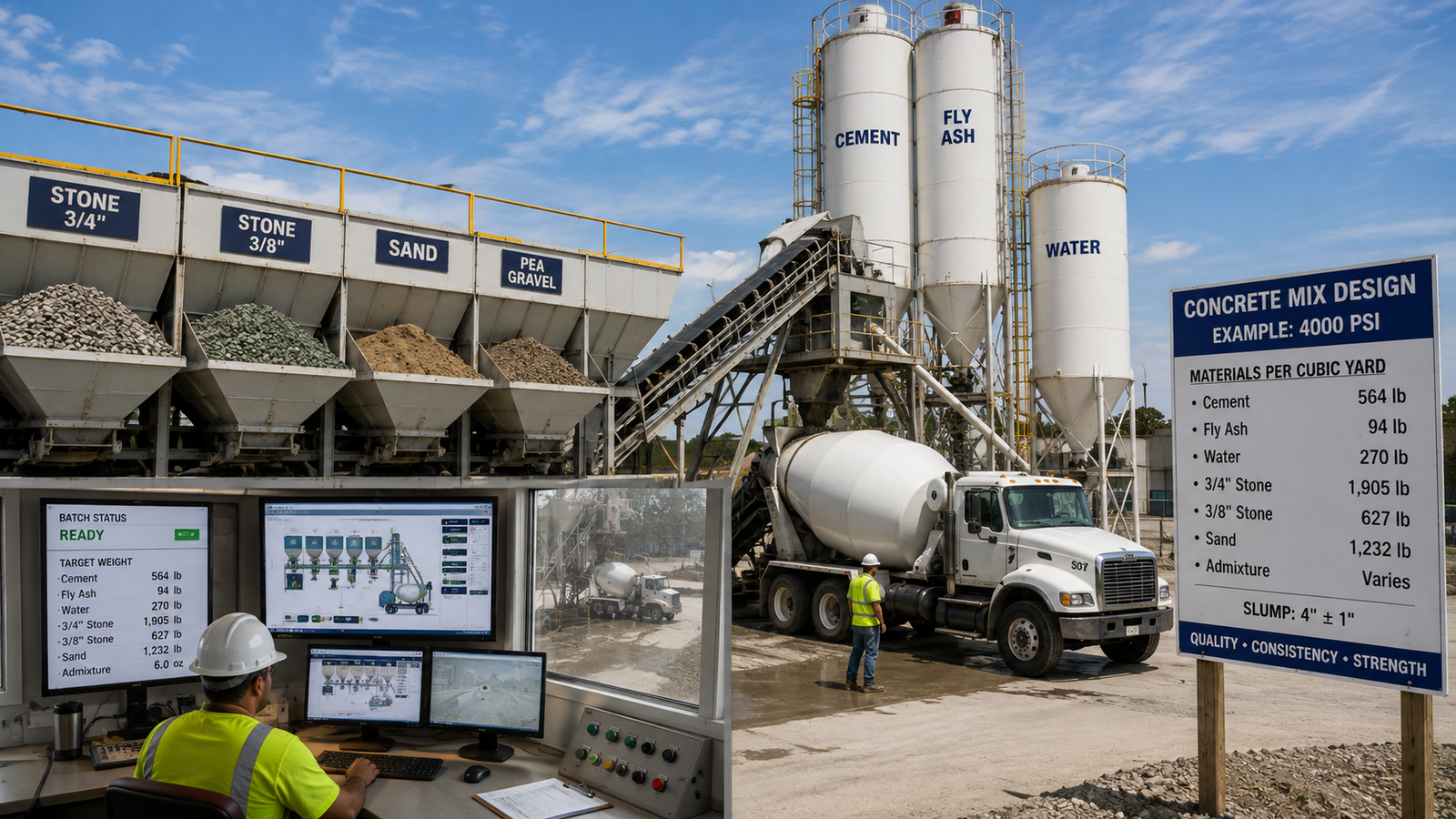
Beyond strength alone, mix type affects price. Standard ready-mix, air-entrained concrete, fiber-reinforced concrete, high-strength concrete, rapid-setting mixtures, colored concrete, and other admixture-enhanced mixes are typically priced differently from a plain standard mix.
- Standard ready-mix: the baseline pricing tier most residential quotes are built from
- Air-entrained concrete: a modest premium for the admixture and quality control involved, used where freeze-thaw exposure applies
- Fiber-reinforced concrete: added cost for the fiber material and dosage, priced differently by supplier
- High-strength concrete: a real premium reflecting additional cementitious material and control
- Rapid-setting mixtures: often carry a premium for the specialized cement or admixture package
- Colored concrete: added cost for the pigment and batching adjustment
Every supplier prices these additives somewhat differently, so ask for an itemized quote rather than assuming a uniform markup across suppliers.
Ready-Mix Concrete vs. Bagged Concrete Prices
Ready-mix is generally the more economical choice for slabs, driveways, patios, foundations, and any larger pour, since bagged concrete carries a retail packaging and handling premium on a volume-equivalent basis. Bagged concrete tends to make more sense for small repairs, fence posts, very small pours, and locations a delivery truck can’t reach.
See Ready-Mix vs. Bagged Concrete for a complete side-by-side comparison.
Concrete Prices by Order Size
A 1-yard order can carry a much higher effective price per yard than a full truck, because minimum order charges, short-load fees, and delivery costs are largely fixed regardless of load size, and get spread across fewer yards on a small order.
| Order Size | Typical Pricing Behavior | Main Reason |
|---|---|---|
| 1 to 2 yd³ | Highest effective $/yd³ | Short-load fees, minimum charges |
| 3 to 5 yd³ | Still elevated for many suppliers | Below many full-load thresholds |
| 6 to 9 yd³ | Improving unit economics | Approaching full-truck capacity |
| 10+ yd³ | Often the best unit economics | Fills a standard drum truck |
See the Concrete Cost Per Yard Guide for the detailed economics of order-size pricing, including worked effective-price examples.
Concrete Delivery Costs and Fees
Delivery cost depends on distance from the batch plant, short-load status, standby or waiting time, fuel surcharges, and whether delivery falls on a weekend or after standard hours. Pump rental and other specialty charges are typically separate line items from the base delivery fee.
See How Much Does Concrete Cost Per Yard Delivered? and Concrete Delivery Cost for a complete breakdown of delivery-specific pricing.
What Is a Short-Load Fee?
A supplier may charge an additional fee when an order is below the quantity needed to make a delivery economically efficient for their truck and driver. There is no single universal threshold; some suppliers apply this below 10 yards, others below 5, and the fee structure itself varies between a per-yard surcharge, commonly cited around $15 to $75 per yard in current 2026 industry guidance, and a flat delivery fee, commonly cited in a range of roughly $40 to $350 depending on the source and supplier.
Concrete Prices by Region
| Region | General Pricing Pattern | Primary Drivers |
|---|---|---|
| Northeast | Commonly among the higher-cost regions nationally | Labor costs, congestion, tolls, logistics |
| Southeast | Often more moderate, though variable by state | Regional cement/aggregate supply, though shortages can raise costs in some states |
| Midwest | Moderate, varies by proximity to production | Distance from cement plants, seasonal demand |
| Southwest | Often near or below the national average | Aggregate availability, growth-driven demand |
| Mountain West | Variable, affected by haul distances in some areas | Longer transport distances, lower supplier density |
| West Coast | Commonly among the higher-cost regions nationally | Labor costs, urban density, environmental compliance costs |
| Pacific Northwest | Variable by urban density and labor costs | Labor rates, material transport |
Multiple independent 2026 industry sources consistently place the Northeast and West Coast among the higher-cost regions, and the Southeast and South Central markets among the more moderate ones, though specific figures vary meaningfully by source and methodology. See Ready Mix Concrete Prices for a deeper regional breakdown.
Concrete Prices by State
Rather than publishing fifty state-specific prices with false precision, this section explains the pattern behind state-level variation and gives a small number of representative examples, clearly labeled as planning estimates drawn from currently published industry sources, which themselves disagree by supplier and methodology.
| State Example | Reported 2026 Planning Range* | General Pattern |
|---|---|---|
| Mississippi | Reported near the lower end of national ranges | Lower labor costs, regional supply conditions |
| Texas | Reported near or below the national average | Strong supplier competition in major metro areas |
| Illinois | Reported near or above the national average | Urban demand, seasonal swings |
| California | Reported among the higher end nationally | Labor costs, environmental compliance, urban density |
| New York | Reported among the higher end nationally | Logistics, tolls, crew time, urban congestion |
| Hawaii | Reported among the highest nationally | Shipping and import costs for cement and aggregate |
*These are directional planning patterns based on currently published 2026 industry sources, which vary in their specific dollar figures by tens of dollars per yard depending on methodology. They are illustrative, not a guaranteed price for any specific supplier in that state. For state-level detail tracked over time, see the dedicated Ready Mix Concrete Prices guide.
Concrete Prices by Major U.S. Cities
Major metro markets each have their own local supplier landscape, and prices in these markets should be treated as typical planning ranges or reported market examples, not as a single fixed number every supplier in that city charges.
| City | Typical 2026 Planning Range (per yd³)* | General Notes |
|---|---|---|
| New York, NY | $150 to $185 | Premium for logistics, tolls, and crew time |
| Los Angeles, CA | $135 to $182 | Urban haul distances, higher labor and fuel costs |
| Chicago, IL | $125 to $183 | Wide range depending on supplier and season |
| Houston, TX | $120 to $140 | Strong supplier competition, shorter haul distances |
| Phoenix, AZ | $125 to $160 | Growth-area demand keeps prices elevated in places |
| Miami, FL | $125 to $150 | Strong local competition holds prices near the national average |
| Atlanta, GA | $140 to $168 | Higher demand and traffic add to delivery cost |
| Seattle, WA | $135 to $182 | Higher material and labor costs in the Pacific Northwest |
*These are reported market examples compiled from multiple current 2026 industry pricing sources, which themselves show meaningful spread within the same city depending on supplier, order size, and delivery terms. Confirm actual pricing with local suppliers before budgeting.
Why Concrete Prices Vary by Location
Distance from the nearest batch plant, local aggregate availability, cement supply conditions, fuel costs, labor rates, construction demand, urban congestion, supplier competition, and overall local construction activity all combine to determine your local price. No single factor explains regional or city-level variation on its own; it’s the combination that matters, which is why two cities with similar populations can still show meaningfully different pricing.
Concrete Price by Project Type
| Project | Typical Thickness Range* | Main Pricing Factors |
|---|---|---|
| Sidewalk | Around 4 in | Access, forming |
| Patio | Around 4 in | Finish, access |
| Driveway | Around 4 to 6 in | Thickness, reinforcement |
| Garage floor | Project-specific | Loads, reinforcement |
| Slab | Project-specific | Thickness, subbase |
| Foundation | Design-specific | Engineering, reinforcement |
| Footing | Design-specific | Size, reinforcement |
*These thickness ranges are illustrative common patterns, not universal structural requirements. Your project’s actual required thickness comes from its specific design and applicable code.
How Much Does a Concrete Driveway Cost?
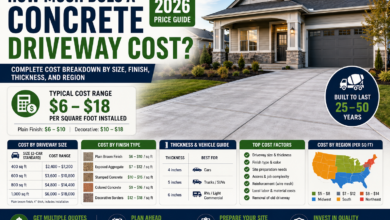
Driveway cost depends on volume, specified PSI, thickness, reinforcement, site preparation, and finishing, on top of the base concrete material price. See the Concrete Driveway Cost Guide for a complete 2026 planning range and cost breakdown.
How Much Does a Concrete Patio Cost?
Patio pricing depends on whether the finish is plain or decorative, overall size, thickness, site access, and excavation needs. See Concrete Patio Cost for details.
How Much Does a Concrete Slab Cost?
Slab cost depends on size, thickness, reinforcement, subbase preparation, labor, and finishing. See Concrete Slab Cost Guide for a complete breakdown.
How Much Does a Concrete Foundation Cost?
Foundation pricing is much more than the concrete material price. Excavation, reinforcement, forms, waterproofing, engineering, labor, and site conditions all factor in significantly. See Concrete Foundation Cost for the complete picture.
How Much Does a Concrete Sidewalk Cost?
Sidewalk cost depends on total area, thickness, formwork, excavation, reinforcement, and finishing. Use the general cost framework in this guide, combined with the volume formulas in How to Calculate Concrete, to build a project-specific estimate.
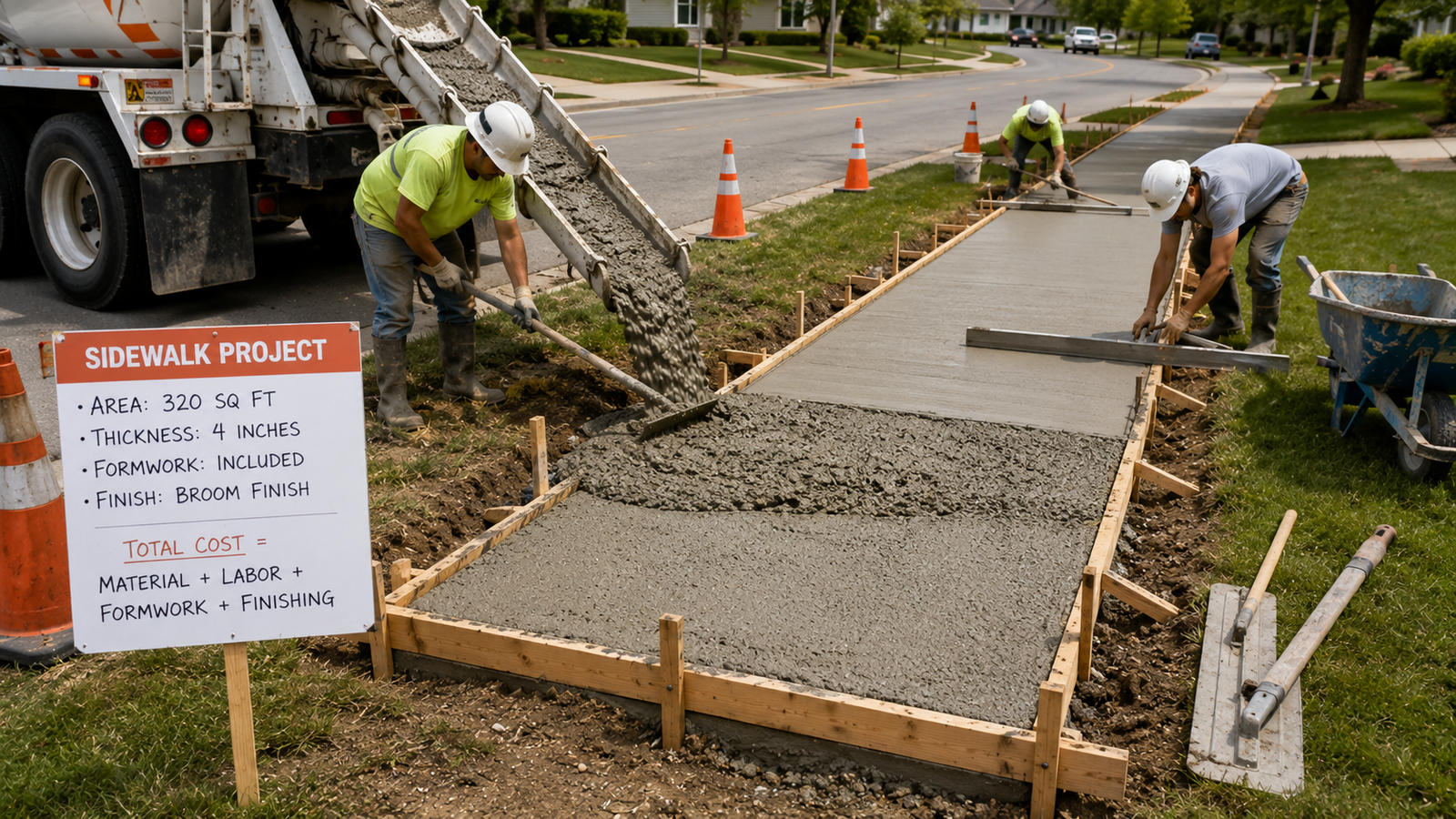
Concrete Cost Components
- Material: the concrete mixture itself
- Delivery: truck transportation from plant to jobsite
- Site preparation: excavation and subbase
- Formwork: forms and the labor to build them
- Reinforcement: rebar, wire mesh, or fiber
- Placement: labor and equipment for pouring the concrete
- Finishing: broom, smooth trowel, exposed aggregate, stamped, or other decorative finishes
- Curing/sealing: where applicable to the project
Material Cost vs. Installed Cost
These Are Not the Same Number
Material cost ≠ Installed project cost
Installed cost typically includes concrete, delivery, site preparation, forms, reinforcement, labor, equipment, and finishing, all combined, not just the concrete itself.
| Cost Type | What It Includes |
|---|---|
| Material | Concrete mix only, produced at the batch plant |
| Delivered | Concrete plus standard delivery terms |
| Installed | Concrete plus site preparation, formwork, reinforcement, labor, equipment, and finishing |
ASTM C94/C94M, the standard specification for ready-mixed concrete, covers concrete manufactured and delivered to a purchaser in a freshly mixed and unhardened state. The standard explicitly does not cover the placement, consolidation, curing, or protection of the concrete after delivery to the purchaser, and it states that when the purchaser’s requirements differ from the standard, the purchaser’s requirements govern.
The Key Takeaway
The price of ready-mix concrete is the price of the supplied material, not automatically the cost of placing and finishing it. Everything that happens after the truck leaves the jobsite is a separate cost category entirely, and it’s not covered by the standard that governs the concrete itself.
How to Calculate Concrete Cost
Material cost = cubic yards × price per yard
Estimated total = material + delivery + applicable fees + labor + other project costs
Concrete Price Example: 1 Cubic Yard
Hypothetical Supplier Quote
Base price: $150/yd³
Concrete: 1 × $150 = $150
Short-load fee (illustrative): $50
Total: $200
Effective cost: $200/yd³, well above the advertised $150 base rate
Concrete Price Example: 5 Cubic Yards
Hypothetical Supplier Quote
Concrete: 5 × $150 = $750
Short-load fee (illustrative, if still below full-load threshold): $150
Total: $900
Effective cost: $180/yd³, still elevated but improved from the 1-yard example
Concrete Price Example: 10 Cubic Yards
Hypothetical Supplier Quote
Concrete: 10 × $150 = $1,500
Short-load fee: generally none, since this fills a standard truck
Total: approximately $1,500 to $1,600 depending on delivery terms
Effective cost: close to the advertised $150/yd³ rate
Concrete Price Example: 20 × 20 ft Slab
Worked Example
Given: A 20 ft × 20 ft slab at 4 inches thick.
20 × 20 × (4÷12) = 133.33 ft³
133.33 ÷ 27 ≈ 4.94 yd³
Illustrative material cost at $150/yd³: 4.94 × $150 ≈ $741
This volume may or may not trigger a short-load fee depending on your specific supplier’s threshold, so confirm before finalizing your budget.
What Makes Concrete More Expensive?
- Higher specified PSI
- Specialty additives such as fiber, color, or accelerators
- Longer delivery distance from the batch plant
- Small order quantities below a full-load threshold
- Difficult site access
- Pump requirements
- Extensive site preparation
- Reinforcement
- Decorative finishes
- Labor rates in your local market
- Broader material and market conditions
How to Save Money on Concrete
- Calculate your volume accurately before requesting quotes
- Get multiple supplier quotes for comparison
- Compare total delivered price, not just the advertised $/yd³
- Avoid unnecessary PSI upgrades beyond your project’s actual requirements
- Plan delivery timing carefully to avoid standby charges
- Prepare the site fully before the truck arrives
- Combine compatible small pours where practical
- Compare ready-mix versus bags for very small jobs
- Avoid unnecessary specialty additives
- Ask about all fees before placing your order
How to Get an Accurate Concrete Price Quote
Provide your supplier with the project address, estimated volume, required strength, slump or other specification details, aggregate requirements, air requirements where applicable, delivery date, access conditions, and pump requirements. Then ask directly: “What is my total delivered price including all applicable fees?” That single question is far more useful than simply asking for a per-yard rate.
Questions to Ask a Ready-Mix Supplier
| Question | Why It Matters |
|---|---|
| What is your current price per yard? | Establishes the baseline |
| Does that include delivery? | Avoids double-counting or missing a major cost |
| What is your minimum order? | Determines short-load exposure |
| Is there a short-load fee? | Directly affects your effective price |
| What is the delivery radius? | Extra distance often costs extra |
| Are there fuel surcharges? | Can add meaningfully to your total |
| Are specialty mixes extra? | Confirms additive pricing upfront |
| What are standby charges? | Waiting too long can trigger fees |
| What is the included unloading time? | Helps you plan your crew’s schedule |
| Is weekend delivery available? | Affects scheduling flexibility |
| What PSI mixes are available? | Confirms the mix matches your specification |
| What is the total delivered quote? | The number that actually matters |
Concrete Price Trends: 2024 to 2026
Ready-mix concrete pricing has generally trended upward across recent years, driven by cement and aggregate material costs, trucking and fuel costs, labor rates, and regional construction demand. Different regions have experienced different rates of increase, and some 2026 industry sources have specifically flagged cement supply constraints affecting Southeast pricing more than other regions during parts of the year.
This Guide Is Updated, Not Replaced, Each Year
This page is designed to be updated annually at the same URL rather than replaced with a new year-specific page every year. That keeps the page’s search visibility intact while keeping the pricing information current. This page previously existed at a year-specific URL and has been consolidated here as the permanent pricing hub.
Will Concrete Prices Increase in 2027?
Future concrete pricing will depend on energy costs, cement and aggregate supply conditions, transportation costs, labor markets, and overall construction demand. This guide will not attempt to predict a specific 2027 figure, since these variables can shift meaningfully within a single year. Check back on this page as it’s updated with current data closer to that time.
Concrete Pricing Checklist
| Stage | What to Confirm |
|---|---|
| Before requesting a quote | Measure the project |
| Before requesting a quote | Calculate cubic yards |
| Before requesting a quote | Determine the specified PSI |
| Before requesting a quote | Determine thickness |
| Before requesting a quote | Check site access |
| Before requesting a quote | Determine whether a pump is needed |
| Before ordering | Confirm price per cubic yard |
| Before ordering | Confirm whether delivery is included |
| Before ordering | Ask about short-load fees |
| Before ordering | Ask about standby charges |
| Before ordering | Confirm the mix specification |
| Before ordering | Confirm the total invoice estimate |
Common Concrete Pricing Mistakes
- Using an outdated national average as your actual local price
- Confusing material cost with installed project cost
- Ignoring delivery charges when budgeting
- Ignoring short-load fees on small orders
- Assuming one PSI price premium applies everywhere
- Treating state or regional averages as an actual supplier quote
- Failing to calculate volume accurately before ordering
- Comparing quotes that specify different mixes as if they were equivalent
- Forgetting to budget for reinforcement and site preparation
- Relying on a single supplier quote without comparison
Concrete Prices: Quick Reference
| Measure | 2026 Planning Range |
|---|---|
| Per cubic yard (material only) | $100 to $165 |
| Per cubic yard (delivered) | $120 to $200 |
| Per cubic yard (specialty/high-strength, delivered) | $150 to $250+ |
| Per square foot (4 in slab, material only) | $1.25 to $2.50 |
| Installed flatwork per square foot | $4 to $10+ |
| Short-load surcharge | $15 to $75/yd³, or a flat fee of roughly $40 to $350 |
Planning estimates only, compiled from multiple current industry sources. Confirm actual pricing with local suppliers.
Concrete Prices FAQs
How much does concrete cost per yard in 2026?
Commonly somewhere in a broad range of roughly $120 to $200 per cubic yard delivered, with material-only pricing often somewhat lower, around $100 to $165. Actual price depends heavily on your location, mix, and order size.
How much is a cubic yard of concrete?
It depends on whether you’re comparing material-only, delivered, or installed pricing. See the price snapshot and material-vs-installed sections earlier in this guide.
How much does concrete cost per square foot?
It depends on slab thickness. For a 4-inch slab, divide the price per cubic yard by approximately 81 to get material cost per square foot; installed cost, including labor and finishing, runs considerably higher.
How much does a 10-yard truck of concrete cost?
Multiply your local price per yard by 10. At an illustrative $150/yd³, that’s approximately $1,500, though delivery inclusion depends on your specific supplier.
Does concrete price per yard include delivery?
Sometimes. Some suppliers quote an all-in delivered price, while others quote material and delivery separately. Always confirm which structure applies.
What is a short-load fee?
A surcharge some suppliers apply to orders below their full-load threshold, compensating for the fixed cost of dispatching a truck regardless of order size. Rates vary widely by supplier.
How much does concrete delivery cost?
It varies by distance, order size, and whether delivery is bundled into the per-yard price. See How Much Does Concrete Cost Per Yard Delivered? for details.
Does PSI affect concrete price?
Generally yes, higher specified strength tends to cost more, but there is no universal fixed premium across every supplier.
Is 4,000 PSI concrete more expensive than 3,000 PSI?
Usually somewhat, yes, though the exact difference depends on your specific supplier and market rather than one fixed national figure.
How much does ready-mix concrete cost?
Broadly $120 to $200 per cubic yard delivered in many U.S. markets in 2026, though local pricing varies meaningfully by region and supplier.
Is ready-mix cheaper than bagged concrete?
Generally yes, for any project beyond a very small volume, since bagged concrete carries a retail packaging premium.
How much concrete do I need for a 20 × 20 slab?
At 4 inches thick, approximately 4.94 cubic yards, based on the standard volume formula.
How much does a concrete driveway cost?
It depends on size, thickness, reinforcement, and site preparation. See the Concrete Driveway Cost Guide for a complete breakdown.
How much does a concrete patio cost?
It depends on size, thickness, and whether the finish is plain or decorative. See Concrete Patio Cost for details.
Why are concrete prices different by state?
Labor costs, transportation distances, local material availability, and construction demand all vary by state and region, producing meaningfully different local pricing.
Why does a small concrete order cost more per yard?
Because short-load fees and minimum charges are largely fixed costs that get spread across fewer yards, raising the effective price per yard.
What is included in concrete price per yard?
Typically the cementitious materials, aggregates, water, and standard admixtures, with delivery included or separate depending on the supplier.
How can I get a better concrete price?
Get multiple quotes, order accurately, avoid unnecessary upgrades, and always compare total delivered price rather than the advertised rate alone.
How accurate are online concrete price estimates?
They’re useful for planning purposes but not a substitute for a local supplier quote, since published ranges vary by source and don’t reflect your specific market or project.
How often should concrete prices be updated?
Concrete pricing data should be reviewed and refreshed at least annually, since material, labor, and transportation costs shift meaningfully year to year.
Calculate Your Exact Estimate
Use the price per yard calculator to turn these planning ranges into a number based on your actual project.
Use the Price Calculator