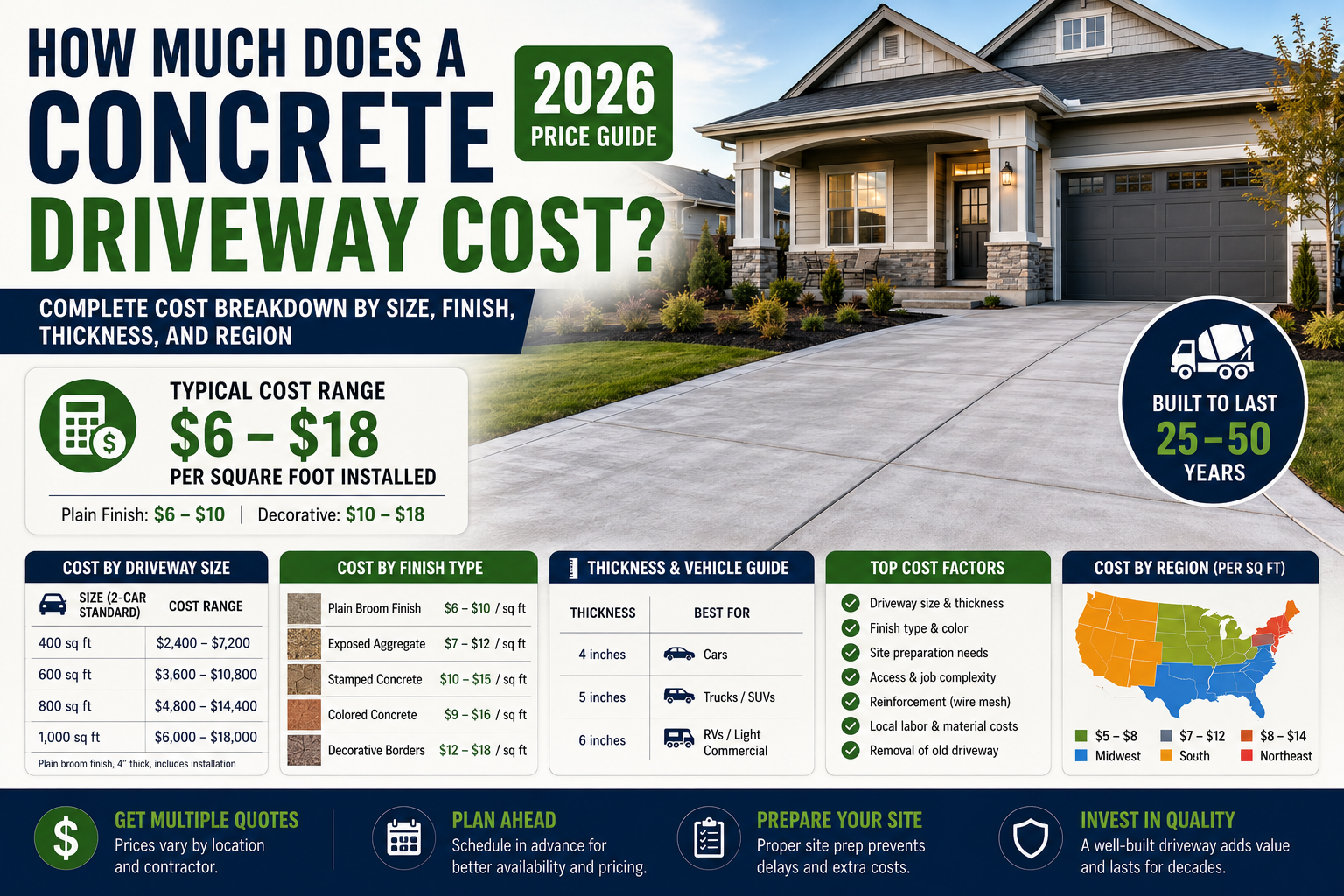
A concrete driveway costs $6 to $18 per square foot installed in 2026. For a standard 2-car driveway, that puts the total between $4,000 and $10,800 for a plain finish – and up to $18,000 or more for stamped or decorative work. But square footage alone does not determine your price. Thickness, site conditions, tear-out of an old driveway, local labor rates, and finish type all move the number significantly. This guide breaks every cost component down so you can build an accurate budget before getting a single contractor quote.
Cost at a Glance
Here are the key numbers for 2026. All figures are for fully installed driveways – material, labor, base preparation, forming, pouring, and finishing included.
Plain Broom Finish
Standard gray concrete, 4-inch slab, wire mesh or rebar
Mid-Range (Color or Border)
One color, decorative border, 5-inch rebar-reinforced slab
Stamped or Decorative
Stamped patterns, multiple colors, exposed aggregate
Typical 2-Car Driveway
600 sq ft, plain broom finish, fully installed
Use the Concrete Driveway Cost Calculator to get an instant estimate based on your actual dimensions and finish type, or the Concrete Driveway Calculator to find out exactly how many cubic yards of concrete your project requires before calling suppliers.
Cost by Driveway Size
Driveway size is the primary driver of total project cost. The larger the footprint, the more concrete, labor, forming, and base material you need. The table below covers the most common US residential driveway sizes for both plain and stamped finishes in 2026.
| Driveway Size | Square Footage | Plain Finish Cost | Stamped Finish Cost | Concrete Needed |
|---|---|---|---|---|
| Single car (10×20 ft) | 200 sq ft | $1,200 – $2,400 | $3,600 – $6,000 | ~2.5 yards |
| Single car (12×24 ft) | 288 sq ft | $1,700 – $3,500 | $5,200 – $8,600 | ~3.6 yards |
| 2-car (20×20 ft) | 400 sq ft | $2,400 – $4,800 | $7,200 – $12,000 | ~5 yards |
| 2-car (20×24 ft) | 480 sq ft | $2,900 – $5,800 | $8,600 – $14,400 | ~6 yards |
| Standard 2-car (24×24 ft) | 576 sq ft | $3,500 – $6,900 | $10,400 – $17,300 | ~7.2 yards |
| Large 2-car (20×30 ft) | 600 sq ft | $3,600 – $7,200 | $10,800 – $18,000 | ~7.5 yards |
| 3-car (30×30 ft) | 900 sq ft | $5,400 – $10,800 | $16,200 – $27,000 | ~11.1 yards |
| Long driveway (12×60 ft) | 720 sq ft | $4,300 – $8,600 | $13,000 – $21,600 | ~9 yards |
Not sure what size your driveway will be? A single-car driveway needs a minimum width of 10 feet but 12 feet is more comfortable. A 2-car driveway should be at least 20 feet wide with 24 feet preferred. For length, measure from the garage door to the street or the end of the pour area. Add a concrete apron (the flared section at the street) if your driveway connects to a public road – the Concrete Apron Calculator handles that volume separately.
For common standard sizes, use the dedicated calculators: 24×24 Concrete Slab Calculator and 20×30 Concrete Slab Calculator.
Cost by Finish Type
The finish you choose is the second biggest cost variable after square footage. A plain broom finish and a stamped concrete finish can differ by $10 to $18 per square foot on the same driveway.
Plain Broom Finish ($6 – $12/sq ft)
The most common residential concrete finish in the US. After screeding and floating, the contractor drags a stiff broom across the surface while the concrete is still plastic, creating a light texture that improves traction. Plain broom finish is gray by default, durable, and the most affordable option. It has a clean, utilitarian look that suits most homes. This is the best choice if budget is the priority or if you plan to reseal and maintain the driveway over time.
Exposed Aggregate ($8 – $15/sq ft)
The top surface layer of cement paste is washed away while the concrete is still green, revealing the decorative aggregate – usually pea gravel, river stone, or crushed granite – beneath. The result is a textured, slip-resistant surface with natural color variation. Exposed aggregate costs more than broom finish because of the additional washing step and the need for decorative aggregate in the mix, but it ages better and hides tire marks and stains well.
Colored Concrete ($10 – $17/sq ft)
Integral color pigment is added to the mix at the plant, tinting the entire slab – not just the surface – a uniform color. Tan, buff, red, charcoal, and slate are the most popular colors for residential driveways. Color adds $15 to $40 per cubic yard to the concrete cost and requires a sealer to maintain the color’s vibrancy over time. A single-color, broom-finish slab with one decorative saw-cut border is one of the best value upgrades for improving curb appeal without major cost.
Stamped Concrete ($18 – $30/sq ft)
Rubber stamps are pressed into the concrete surface while it is still workable, creating patterns that mimic slate, flagstone, cobblestone, brick, or wood. Stamped concrete typically includes one or two color applications – a base color in the mix and a release agent or antiquing stain on the surface. It is the most expensive residential driveway option but produces the most dramatic visual result. Stamped concrete requires more skilled labor and longer installation time, which drives the higher per-square-foot cost.
| Finish Type | Cost Per Sq Ft | 600 Sq Ft Total | Lifespan | Maintenance |
|---|---|---|---|---|
| Plain broom finish | $6 – $12 | $3,600 – $7,200 | 25 – 50 years | Seal every 3-5 years |
| Exposed aggregate | $8 – $15 | $4,800 – $9,000 | 25 – 50 years | Seal every 3-5 years |
| Colored (integral) | $10 – $17 | $6,000 – $10,200 | 25 – 40 years | Seal every 2-3 years |
| Stamped concrete | $18 – $30 | $10,800 – $18,000 | 20 – 30 years | Seal every 1-3 years |
For more detail on stamped vs. plain options and cost comparisons with pavers, see Stamped Concrete vs. Pavers and Concrete Driveway vs. Paver Driveway. Use the Stamped Concrete Cost Calculator for a decorative driveway estimate.
Full Cost Breakdown
A concrete driveway installation involves several distinct cost components. Understanding each one helps you verify whether contractor quotes are reasonable and where cost overruns are most likely.
| Cost Component | Typical Cost | Notes |
|---|---|---|
| Concrete material | $125 – $175/yard | 3,000-4,000 PSI, delivered within 20 miles |
| Labor (pour and finish) | $3 – $6/sq ft | Forming, pouring, screeding, floating, troweling, curing |
| Base preparation | $1 – $2.50/sq ft | Excavation to depth, compacted gravel sub-base |
| Gravel sub-base | $0.50 – $1.50/sq ft | 4 inches of compacted crushed stone recommended |
| Reinforcement (rebar) | $0.75 – $1.50/sq ft | #4 rebar at 18-inch grid; standard for driveways |
| Reinforcement (wire mesh) | $0.30 – $0.75/sq ft | Less expensive than rebar; adequate for light-use driveways |
| Forming and stripping | $0.50 – $1.00/sq ft | Wood or steel forms set, poured, and removed |
| Control joints (saw cuts) | $1 – $2 per linear foot | Cut every 10-12 feet to control crack placement |
| Sealer (first coat) | $0.50 – $1.50/sq ft | Penetrating or acrylic sealer applied after curing |
| Color pigment (if applicable) | $15 – $40/yard of concrete | Integral color added at plant; price per yard of mix |
| Stamping labor (if applicable) | $10 – $18/sq ft add-on | Over and above plain pour cost |
Example: Full Cost Breakdown – 20×24 Plain Driveway in Ohio
Size: 20 x 24 ft = 480 sq ft, 5 inches thick = 7.4 yards
Concrete material (7.4 yards x $140): $1,036
Delivery and fuel surcharge: $80
Labor – pour and finish ($4/sq ft x 480): $1,920
Excavation and gravel sub-base ($1.50/sq ft x 480): $720
Rebar (#4, 18-inch grid, $1/sq ft x 480): $480
Forming and stripping ($0.75/sq ft x 480): $360
Saw-cut control joints (4 cuts x 20 ft x $1.50): $120
Sealer ($0.75/sq ft x 480): $360
Total estimated cost: $5,076
Per square foot: $10.58
To estimate your material cost independently, use the Concrete Driveway Calculator for cubic yards, the Concrete Rebar Calculator for reinforcement, and the Concrete Sealer Calculator for sealer coverage. The Concrete Labor Cost Calculator handles the labor side.
How Thickness Affects Cost
Thickness is a major lever in both durability and cost. Most residential contractors default to 4 inches for passenger cars. Upgrading to 5 or 6 inches adds 20-50% to the concrete material cost for that job, but it significantly extends the driveway’s useful life under heavier loads.
| Thickness | Best For | Extra Concrete Cost (vs 4 in) | Lifespan Impact |
|---|---|---|---|
| 4 inches | Passenger cars, SUVs, light use | Base price | 25 – 35 years with proper base |
| 5 inches | Pickups, heavy SUVs, regular use | +25% | 30 – 40 years |
| 6 inches | RVs, delivery trucks, heavy vehicles | +50% | 35 – 50 years |
For a 600 sq ft driveway, moving from 4 inches to 5 inches adds approximately 1.9 cubic yards of concrete. At $150/yard, that’s about $285 more in material cost – a worthwhile investment for most homeowners. Use the Concrete Slab Thickness Calculator to verify the right thickness for your vehicle types and soil conditions.
Tear-Out and Removal Costs
If you’re replacing an existing driveway, demolition and disposal add $1 to $3 per square foot to the project cost – sometimes more for thick slabs with heavy rebar. For a 600 sq ft driveway, expect to pay $600 to $1,800 for removal alone.
| Removal Type | Cost Per Sq Ft | 600 Sq Ft Total | Notes |
|---|---|---|---|
| Concrete demolition only | $1.00 – $1.50 | $600 – $900 | Breaking up existing slab |
| Concrete removal and haul-off | $1.50 – $2.50 | $900 – $1,500 | Breaking, loading, and disposing of debris |
| Heavy rebar-reinforced removal | $2.50 – $3.50 | $1,500 – $2,100 | Commercial-grade slabs with dense rebar |
| Asphalt removal | $1.00 – $2.00 | $600 – $1,200 | Often easier than concrete removal |
The Concrete Removal Cost Calculator and Concrete Demolition Cost Calculator give project-specific estimates for tear-out work. If you also need a dumpster for the debris, the Concrete Dumpster Calculator estimates the container size you will need based on slab volume.
Cost by State and Region
Labor rates account for roughly 40-50% of a total driveway installation cost. Because labor rates vary significantly by state, a 600 sq ft driveway can cost $5,000 in Ohio and $14,000 in Los Angeles for the exact same work. The table below covers installed costs for a standard plain broom-finish 600 sq ft driveway by region.
| State / Region | Cost Per Sq Ft (Plain) | 600 Sq Ft Total (Plain) | Key Markets |
|---|---|---|---|
| California | $12 – $20 | $7,200 – $12,000 | LA: $14-$20, Bay Area: $15-$22 |
| New York | $12 – $18 | $7,200 – $10,800 | NYC: $15-$22, Upstate: $10-$14 |
| Florida | $9 – $15 | $5,400 – $9,000 | Miami: $11-$16, Orlando: $9-$13 |
| Texas | $7 – $13 | $4,200 – $7,800 | Dallas/Houston: $7-$12, Austin: $9-$14 |
| Georgia | $7 – $12 | $4,200 – $7,200 | Atlanta: $8-$13 |
| Ohio | $6 – $11 | $3,600 – $6,600 | Columbus: $7-$12, Cleveland: $7-$12 |
| Arizona | $8 – $14 | $4,800 – $8,400 | Phoenix: $8-$13, Tucson: $7-$12 |
| Midwest (general) | $6 – $11 | $3,600 – $6,600 | IN, IA, MO, KS, WI, MI |
| Southeast (general) | $7 – $12 | $4,200 – $7,200 | NC, SC, TN, AL, MS |
| Pacific Northwest | $10 – $16 | $6,000 – $9,600 | Seattle: $12-$18, Portland: $10-$15 |
For state-specific cost estimates, use the dedicated calculators: California, Texas, Florida, New York, Ohio, Georgia, and Arizona.
Concrete vs. Asphalt Driveway Cost
Asphalt is typically cheaper upfront but costs more over a driveway’s lifetime. The decision between the two usually comes down to climate, budget, and how long you plan to stay in the home.
| Factor | Concrete | Asphalt |
|---|---|---|
| Install cost per sq ft | $6 – $18 | $3 – $7 |
| 600 sq ft installed | $3,600 – $10,800 | $1,800 – $4,200 |
| Lifespan | 25 – 50 years | 15 – 20 years |
| Maintenance cost | Seal every 3-5 years; $150-$400 | Seal every 1-3 years; $100-$300; resurface at year 10-15 |
| Hot weather performance | Excellent – does not soften | Poor – can soften and rut in extreme heat |
| Cold weather performance | Good with air-entrained mix; requires 4,000 PSI in freeze-thaw zones | Better flexibility in freeze-thaw cycles |
| Resale value impact | Higher – concrete is perceived as premium | Lower – asphalt is considered standard |
| Repair cost | $300 – $1,000 per crack repair | $50 – $300 per crack; easier to patch |
In hot states like Texas, Arizona, and Florida, concrete is almost always the better long-term investment because asphalt softens in summer heat and requires more frequent resealing. In the upper Midwest and Northeast where freeze-thaw cycles are severe, both materials require specific treatment – air-entrained 4,000 PSI concrete in freeze-thaw regions, and thicker asphalt with proper base preparation in the North.
For a full side-by-side comparison, read Concrete vs. Asphalt Driveways and Concrete vs. Asphalt Cost. If you are considering gravel instead, Gravel vs. Concrete Driveway covers that comparison as well.
DIY vs. Contractor
Pouring a concrete driveway yourself can cut labor costs by 40 to 60%, but it comes with real risks on a job this size. Here is an honest breakdown of both options.
DIY Concrete Driveway
A 600 sq ft driveway requires 7-8 cubic yards of concrete – arriving in one or two ready-mix trucks. You will have 60-90 minutes from first discharge to get everything screeded, floated, and edged before the concrete stiffens too much to finish. This requires a crew of at least 4-6 people, all moving simultaneously. Mistakes – low spots, poor troweling, inadequate curing – cannot be undone once the concrete sets. Most residential homeowners are not equipped for a pour this large.
DIY is most practical for small projects: a single-car approach apron, a pad, or a short section of walkway. For anything over 3 cubic yards, seriously consider hiring a contractor unless you have concrete experience.
Hiring a Contractor
A professional concrete contractor handles forming, pouring, finishing, and curing. Labor typically runs $3 to $6 per square foot for a plain driveway. For a 600 sq ft project, that is $1,800 to $3,600 in labor on top of material costs. A reputable contractor will also warrant the work against defects – typically one year for workmanship and two to five years on some material issues. Always get at least three quotes, check references, and verify liability insurance before signing a contract.
What Drives Cost Up or Down
Beyond size and finish type, several project-specific factors can push your final quote significantly above or below the averages.
- Slope and grading. A sloped site requires more excavation and grading work to create a level pour surface. Steep slopes can add $1 to $3 per square foot to site preparation costs.
- Soil conditions. Soft, sandy, or expansive clay soils require deeper excavation and thicker gravel sub-base. Poor soil can add $500 to $2,000 in base preparation costs on a standard driveway. See the Subbase Calculator to estimate your gravel needs.
- Curved or irregular shapes. Curved driveways need custom forms and take longer to set up and finish. Curved driveways typically cost $1 to $3 per square foot more than straight rectangular driveways.
- Difficult site access. If a ready-mix truck cannot back in to the pour area, you need a pump truck or multiple wheelbarrow relays. A pump truck adds $300 to $800 to the job. Use the Concrete Pumping Cost Calculator for an estimate.
- Tree roots. If tree roots have to be cut or worked around, root removal adds $200 to $600 and can require tree-care consultation to avoid damaging mature trees.
- Permits. Some municipalities require a permit for driveway replacement, especially for new driveway aprons connecting to public roads. Permit fees range from $50 to $300 depending on location.
- Season. Winter concrete pours in northern states require heated water, insulating blankets, and potentially accelerating admixtures. Cold-weather pouring adds $1 to $3 per square foot to the total cost. Read the guide to Pouring Concrete in Winter for full details.
How to Save Money on a Concrete Driveway
You cannot cut corners on mix design or thickness without paying for it in repairs later. But there are legitimate ways to reduce cost without sacrificing quality.
- Choose plain broom finish. The single biggest cost variable after size. Skipping color and stamping and going with a plain broom finish saves $6 to $18 per square foot over decorative options. You can always add a stain or coating later at lower cost than stamping up front.
- Get three contractor quotes. Pricing for the same job routinely varies by $2 to $5 per square foot between contractors in the same market. On a 600 sq ft driveway, that is a $1,200 to $3,000 difference. Always compare at least three itemized quotes.
- Do your own demolition. If you are replacing an existing driveway, renting a jackhammer and disposing of the old concrete yourself saves $600 to $1,500 on a standard job. Confirm with your contractor that this is acceptable before the job starts.
- Schedule off-peak. Contractors are less busy in late fall and early winter in most of the US. You may get a 5 to 15% discount by scheduling a November or December pour in mild-climate states rather than booking during the peak spring season.
- Use wire mesh instead of rebar for light-use driveways. For a driveway that will only see passenger cars, #10 wire mesh (6×6 grid) is adequate reinforcement and costs $0.30 to $0.75 per square foot vs. $0.75 to $1.50 for rebar. The savings on a 600 sq ft driveway is $270 to $450. For any driveway that will carry heavier vehicles, use rebar.
- Skip the first-year sealer. Some contractors upsell a sealer application at final completion, but concrete cured for less than 28 days should not be sealed with most film-forming sealers. Plan to seal at 30 to 90 days post-pour and apply it yourself with a pump sprayer – it costs $50 to $150 in materials vs. $300 to $600 for a contractor application on a standard driveway.
- Calculate your material needs exactly. Use the Concrete Driveway Calculator before your contractor orders. Contractors sometimes estimate high to avoid running short – knowing your exact yardage prevents over-ordering and lets you verify the delivery ticket when the truck arrives.
Tools to Build Your Driveway Budget
Run these calculators before talking to contractors. Showing up with accurate numbers makes you a harder customer to overcharge.
- Concrete Driveway Calculator – Exact cubic yards for your dimensions
- Concrete Driveway Cost Calculator – Full installed cost estimate
- Concrete Slab Thickness Calculator – Right thickness for your vehicle types
- Concrete Rebar Calculator – Reinforcement quantity and cost
- Concrete Wire Mesh Calculator – Wire mesh rolls needed
- Concrete Removal Cost Calculator – Tear-out and disposal estimate
- Concrete Pour Cost Calculator – Material plus labor combined
- Stamped Concrete Cost Calculator – If you choose a decorative finish