How to Fix Standing Water on a Concrete Patio Naturally: Drainage, Slope and Low-Spot Solutions
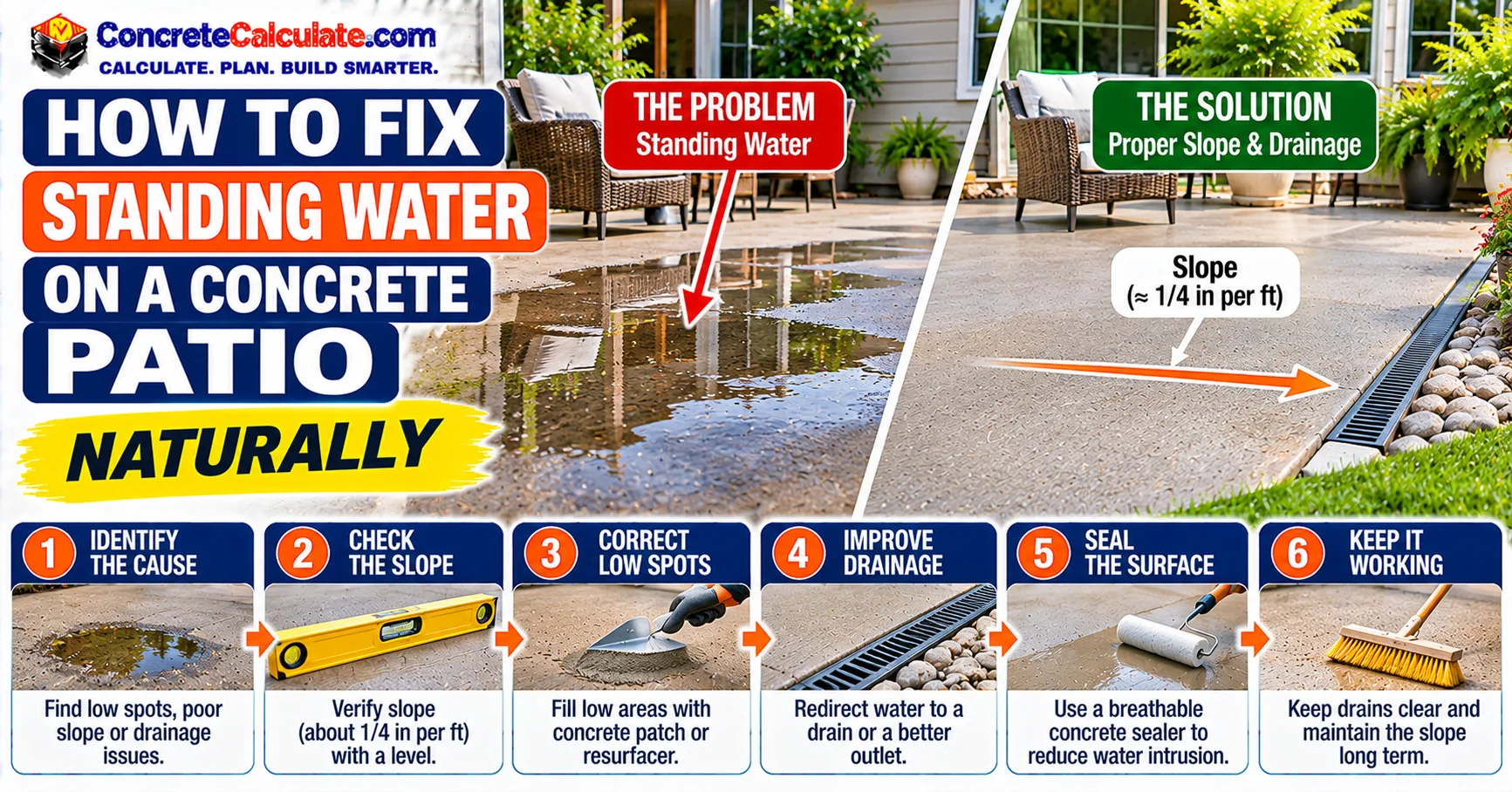
A practical, no-chemical approach to patio puddles: find the water source, measure the slope, try the least invasive fixes first, and choose a permanent correction that gives water somewhere to go.
Standing water is primarily a drainage-geometry problem, not a cleaning problem. To fix it naturally, change the water path: reduce incoming runoff, clear blockages, and correct the low spot or slope so water can reach a real outlet.
ACI notes that ponded water can let harmful solutions penetrate concrete and, when it freezes, contribute to cracking and spalling, so persistent puddles are worth fixing.
- Find where the water comes from and where it collects.
- Locate the low point and measure the patio slope.
- Clear leaves, dirt and debris from drainage paths and drains.
- Redirect downspouts and reshape soil that traps water.
- Choose a concrete fix only if needed: grinding, resurfacing, a drain, lifting or replacement.
- Confirm the outlet and keep water away from the foundation.
A. Diagnose the problem
- Why Is Water Standing on My Concrete Patio?
- Is Standing Water Bad for a Concrete Patio?
- How Long Is Too Long for Water to Sit on Concrete?
- Where Is the Water Coming From?
B. Measure the patio
- How to Find the Patio’s Low Point
- How to Measure Concrete Patio Slope
- What Slope Should a Concrete Patio Have?
- How to Tell a Low Spot From Slab Settlement
C. Try the simplest natural fixes
- Fix 1: Remove Leaves, Dirt and Debris From Drainage Paths
- Fix 2: Clean a Patio Drain or Channel Drain
- Fix 3: Redirect Roof Downspouts Away From the Patio
- Fix 4: Correct Adjacent Soil That Is Trapping Water
- Fix 5: Use a Vegetated Swale or Rain Garden Where Appropriate
D. Correct small concrete problems
- Can You Grind a High Spot to Let Water Drain?
- Can You Cut a Small Drainage Groove in the Concrete?
- Can You Fill a Low Spot With Concrete?
- When Is Concrete Resurfacing a Good Fix for Patio Ponding?
- Why a Thin Patch Over the Lowest Point Can Fail
E. Use drainage when needed
- When Does a Concrete Patio Need a Channel Drain?
- Channel Drain vs. Area Drain
- Where Should Patio Drain Water Go?
- Why a Drain Without an Outlet Does Not Fix Ponding
F. Settlement and bad slopes
- Can a Sunken Patio Slab Be Lifted?
- When Should You Replace a Patio Section?
- How to Prevent the New Patio Section From Ponding Again
G. Protect the foundation
Why Is Water Standing on My Concrete Patio?
Water stands on a patio when it cannot find a way off. That usually comes down to one or more of these conditions:
- A low spot or shallow depression in the slab
- Too little slope overall
- A reverse slope that tilts toward the house
- A slab section that has settled
- A blocked or missing outlet
- Roof runoff or uphill landscaping adding extra water
- A raised patio edge, soil or mulch acting as a dam
The central rule is simple: find where the water comes from, where it wants to go, and what keeps it from getting there.
That makes ponding a drainage-geometry problem, not a cleaning problem. Household cleaners can lift a stain, but they cannot change the elevations that hold the water in place.
So in this guide, fixing it naturally means fixing the water path with no chemicals: source, surface path, low point, then outlet.
Is Standing Water Bad for a Concrete Patio?
A short-lived film of water after rain is not automatically a problem. Concern grows when water stays for long periods, freezes repeatedly, enters joints and cracks, reaches the foundation or erodes the edge support.
ACI explains why. Poor drainage allows ponding, and harmful solutions such as deicing salts can then penetrate the concrete. In cold climates, trapped water expands as it freezes and can cause cracks or spalling (ACI technical FAQ).
The same ACI answer notes that undrained water at the base of a structure can erode support and undermine it. On a patio, that means a persistent puddle at an edge deserves attention.
How Long Is Too Long for Water to Sit on Concrete?
There is no single number of minutes or hours that works for every patio. Observation tells you more than a stopwatch.
- Water that disappears soon after rain is usually minor.
- Water that lingers long after the surrounding concrete is dry points to a real low spot.
- Water that leaves only by evaporation suggests it has no drainage path.
- Water that returns after every rainfall is a pattern, not an accident.
Some puddling is normal even on a well-built slab. An ACI Q&A states that positive drainage needs about 1/4 in. per foot, yet some birdbaths should still be expected after rain because of construction tolerances (ACI Concrete International).
Persistent ponding, though, usually signals a meaningful low point or a drainage-path problem.
Where Is the Water Coming From?
Before you touch the concrete, decide whether the patio itself is wrong or too much water is arriving. A patio that drains fine under direct rainfall can still pond for other reasons.
- Direct rain and roof-edge drip
- A downspout discharging onto or beside the patio
- An uphill lawn or garden draining toward the slab
- Irrigation that oversaturates the area
- An adjacent driveway or walk feeding water in
- Runoff from a neighboring property, where that is legally relevant
Table 1 pairs common observations with the first thing to check.
| Observation | Likely issue | First thing to investigate |
|---|---|---|
| One small puddle | Local depression | Straightedge or laser |
| Entire patio drains toward the house | Reverse slope | Overall elevations |
| Water only appears during roof runoff | Downspout or gutter contribution | Roof drainage |
| Water enters from the uphill lawn | Landscape runoff | Adjacent grading |
| Water collects beside a raised garden edge | Blocked edge outlet | Soil, mulch and edging |
| Drain fills but water remains | Clogged or poor outlet | Drain line |
| One slab panel is visibly lower | Settlement | Support beneath the slab |
| Ponding started recently | Movement or blockage | Compare current and past condition |
How to Find the Patio’s Low Point
Several simple methods work, and you can combine them.
- Watch the patio after a light rain and note where water collects.
- Run a controlled hose test and trace where the water travels.
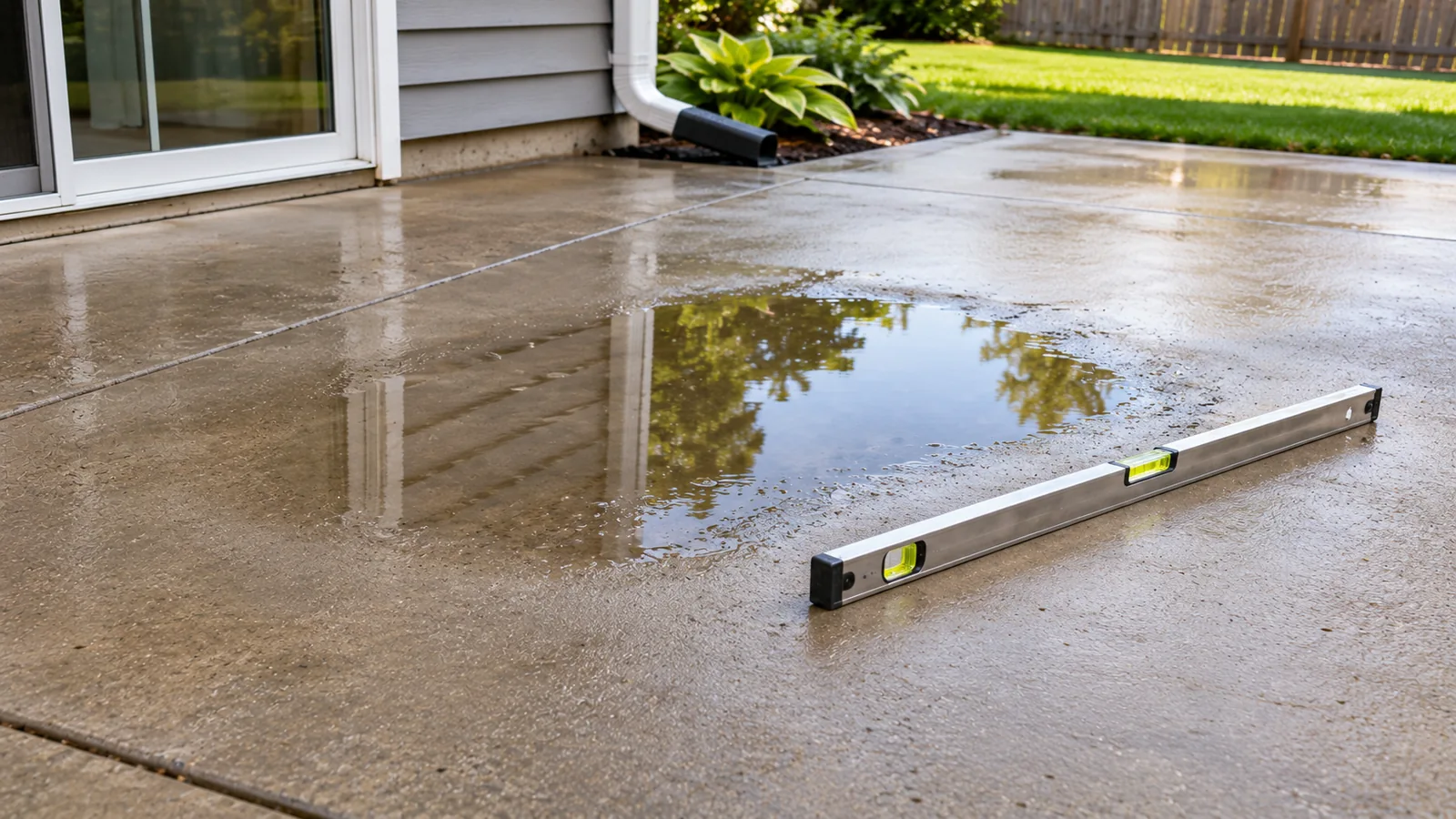
- Lay a long straightedge and level across suspect areas.
- Use a laser level or stringline to compare elevations.
Mark three things with chalk or tape: the edge of the water, the deepest point and the nearest possible outlet. Those marks show the path the water must follow.
How to Measure Concrete Patio Slope
Slope is the fall divided by the horizontal run. Measure the run along the direction water should travel, then measure the vertical drop over that distance.
Example: 2% slope over different runs
Fall = Run × 12 × 0.02. For a 4 ft run: 4 × 12 × 0.02 = 0.96 in. For 6 ft: 1.44 in. For 10 ft: 2.4 in.
The Elevation Grade Calculator does these conversions for you. For a related driveway-focused discussion, see concrete driveway slope.
What Slope Should a Concrete Patio Have?
The answer depends on where the patio sits. The International Residential Code, in Section R401.3, calls for impervious surfaces within 10 ft of a building foundation to slope at least 2% away from the building.
That is a foundation-drainage provision, not a blanket rule for every part of every patio. It applies subject to the code edition your jurisdiction has adopted and its exceptions.
The same section lets drains or swales be used where lot lines, walls or slopes prevent the normal fall. For patios attached to the house, the provision is still highly relevant.
ACI points the same direction. An ACI Q&A cites ACI 302.1R, which says positive drainage on an exterior patio slab takes a slope of 1/4 in. per foot, about 2.1%.
More Slope Is Not Always Better
For accessible walking surfaces, the U.S. Access Board limits cross slope to 1:48 (about 2.1%) and running slope to 1:20 (5%) before a surface is treated as a ramp. A patio on an accessible route may have maximum slope limits, and door thresholds can limit how much you can correct.
| Slope | Drop per foot | Drop across 4 ft | Drop across 10 ft |
|---|---|---|---|
| 1% | 0.12 in | 0.48 in | 1.20 in |
| 1.5% | 0.18 in | 0.72 in | 1.80 in |
| 2% | 0.24 in | 0.96 in | 2.40 in |
| 1:48 (about 2.08%) | 0.25 in | 1.00 in | 2.50 in |
How to Tell a Low Spot From Slab Settlement
A surface low spot and a settled slab are different problems. A low spot is a shallow depression in a generally stable slab, often from finishing or small elevation variation.
Settlement means a section of concrete has moved down because the support beneath it changed. Signs include joint edges at different heights, cracks through the low area, a whole panel tilting, and voids or erosion at the slab edge.
| Clue | Surface low spot | Settled slab |
|---|---|---|
| Depression localized within a panel | Common | Possible |
| Entire panel tilted | Less likely | Common |
| Joint edges mismatched | Rare | Strong clue |
| Crack accompanies the low area | Possible | More concerning |
| Edge void or erosion | Not required | Possible |
| Has worsened over time | Less typical | Stronger settlement clue |
| Resurfacing candidate | Often, if shallow and sound | Only after the stability issue is resolved |
If cracking comes with the low area, read why concrete cracks and how to fix cracked concrete for background on movement.
Standing water can result from a local low spot, reverse slope or actual slab settlement, and each requires a different fix.
Fix 1: Remove Leaves, Dirt and Debris From Drainage Paths
Start with the lowest-risk step. Debris can block runoff at the slab edge, clog drain grates, fill joints near drainage channels and plug landscaped outlets.
Sweep the surface, clear the slab edge and check the places where water is supposed to leave. If the puddle drains afterward, the problem was a blocked path, not the concrete.
Fix 2: Clean a Patio Drain or Channel Drain
- Remove the grate and clear debris from the inlet.
- Flush the line gently with a hose.
- Confirm where the outlet discharges.
- Check that the pipe really carries water away.
Cleaning a drain does not help if the patio surface never slopes toward it. A spotless drain at the wrong elevation still leaves a puddle next door.
Fix 3: Redirect Roof Downspouts Away From the Patio
A downspout emptying onto a patio can overwhelm even a decent slab. EPA supports redirecting roof runoff to a lawn, garden, rain barrel or other landscaped area where it can soak in (EPA Soak Up the Rain).
EPA also cautions that disconnection may not suit every site. Consider local regulations and where the water will go so you do not create property damage or unsafe conditions.
Never discharge beside the house foundation. Carry the water well away from the wall.
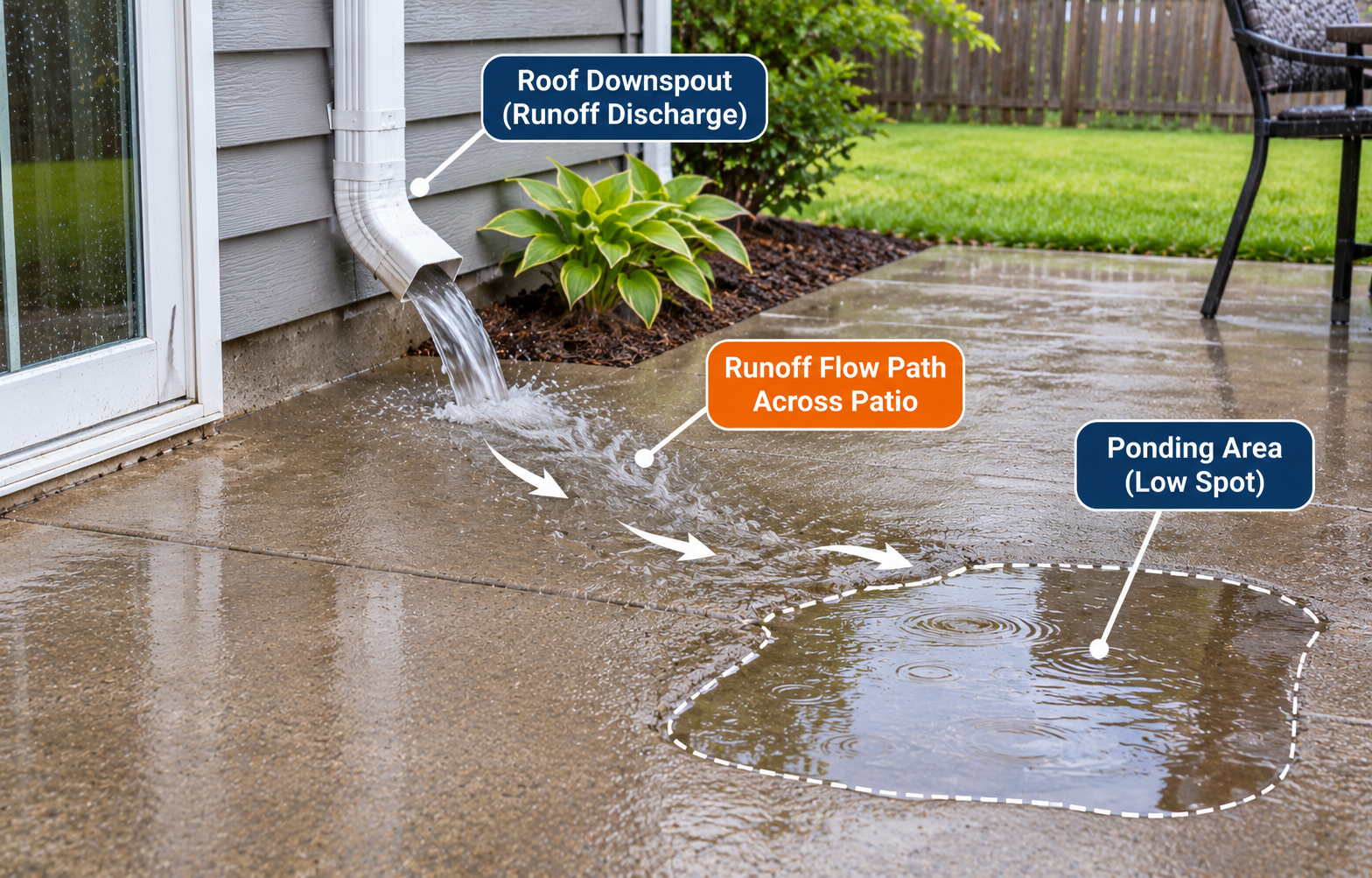
Fix 4: Correct Adjacent Soil That Is Trapping Water
Sometimes the concrete is fine and the surroundings are the dam. Soil built higher than the slab, thick mulch, rigid edging and small landscape berms can all trap water at the patio edge.
Lowering or reshaping the soil may restore an existing drainage route without touching the concrete. Keep the finished soil slightly below the patio edge so water can leave the slab.
Fix 5: Use a Vegetated Swale or Rain Garden Where Appropriate
Swales and rain gardens slow, absorb or redirect runoff. They work best when they sit downslope of the water source and well away from the building.
EPA’s rain garden guidance says to place them away from utility connections and to avoid any chance of water entering basements or crawlspaces.
Soil permeability must be checked, since a rain garden typically needs an infiltration rate of about 0.5 in. per hour or more to drain within 6 to 12 hours (EPA Region 8).
- Test that the soil actually infiltrates.
- Plan an overflow route for large storms.
- Keep infiltration features a safe distance from foundations.
- Check local rules before you dig.
Separation guidance varies. One USDA NRCS site assessment card says at least 20 ft from the foundation, while other extension guidance uses 10 ft where there is a basement. Follow your local rules.
Reducing runoff before it reaches the patio can solve ponding without modifying the concrete surface.
| Fix | Cost and disruption | Best use |
|---|---|---|
| Remove debris | Very low | Blocked surface path |
| Clean drain | Low | Clogged inlet or outlet |
| Redirect downspout | Low to moderate | Roof runoff |
| Lower mulch or soil edge | Low | Edge dam |
| Create a swale | Moderate | Yard runoff |
| Rain garden | Moderate | Suitable runoff and infiltration site |
| Rain barrel or cistern | Moderate | Capture roof runoff |
Can You Grind a High Spot to Let Water Drain?
Sometimes. Grinding removes concrete, so it only helps when a high point is what blocks the water.
- A high ridge or lip is trapping water that would otherwise leave.
- A slightly raised joint is acting as a small dam.
- The surface has enough depth for a controlled correction.
Pavement preservation guidance from FHWA covers diamond grinding as a treatment that changes surface elevations and profile (FHWA Concrete Pavement Preservation Guide). That is pavement guidance used here to explain the mechanics, not a residential patio specification.
Grinding cannot raise a low area. If the puddle already sits at the lowest point, or the whole slab pitches the wrong way, grinding will not fix it and may thin the surface too far.
Can You Cut a Small Drainage Groove in the Concrete?
Rarely a good default. A shallow, well-planned drainage path is occasionally practical, but improvised saw grooves bring real drawbacks.
- Trip hazards for people and furniture legs
- Debris that collects and is hard to clean
- More exposure to freeze-thaw cycles
- An unattractive appearance
- Weakening of a thin slab
- Accessibility problems on a route that must meet slope limits
Find the cause of the ponding first. Fixing the slope or the outlet is almost always better than cutting a trench through the surface.
Can You Fill a Low Spot With Concrete?
Pouring ordinary fresh concrete over hardened concrete is often a poor thin repair. A thin layer tends to bond weakly and break up at its feathered edges.
- A compatible bonded repair mortar
- A polymer-modified overlay
- A complete resurfacing system
Whichever product you choose, the existing slab must be sound, clean and properly prepared, and the instructions of the manufacturer apply.
Use the Concrete Overlay Calculator and the Concrete Resurfacing Calculator to estimate material for a shallow area.
When Is Concrete Resurfacing a Good Fix for Patio Ponding?
Resurfacing is a good candidate when the geometry problem is small and the concrete underneath is healthy.
- A shallow depression
- A sound slab with no active settlement
- Enough elevation room at doors and edges
- A clear outlet once the correction is finished
Overlays should not be expected to bridge unsound concrete, so deal with spalling, scaling, dusting and contamination first. The Concrete Resurfacing Guide covers preparation, and these pages help diagnose damage: concrete spalling, concrete scaling and concrete delamination.
The finished overlay must also create a real downhill route to a valid outlet. A smooth surface with no fall just moves the puddle.
Why a Thin Patch Over the Lowest Point Can Fail
Patching only the bottom of a puddle is tempting and often disappointing. Several things go wrong:
- Feather edges are thin and break away.
- Bond is poor to dirty, glazed or contaminated concrete.
- The slab underneath is still moving.
- The patch is too thin for the product.
- No real drainage path exists afterward.
A patch that ignores the water path may fill the birdbath and simply shift the pond to the edge of the patch.
When Does a Concrete Patio Need a Channel Drain?
A channel drain is a long, narrow grate and trough that catches water along a line. It suits patios where slope correction alone is impractical.
- A patio trapped between the house and a higher yard
- A long low line instead of a single birdbath
- Runoff that cannot be redirected upstream
- Door or foundation elevations that prevent adding enough slope
The drain must sit below the surrounding concrete surface, or water will skip past it. Setting it correctly means the patio slab must also fall toward the grate.
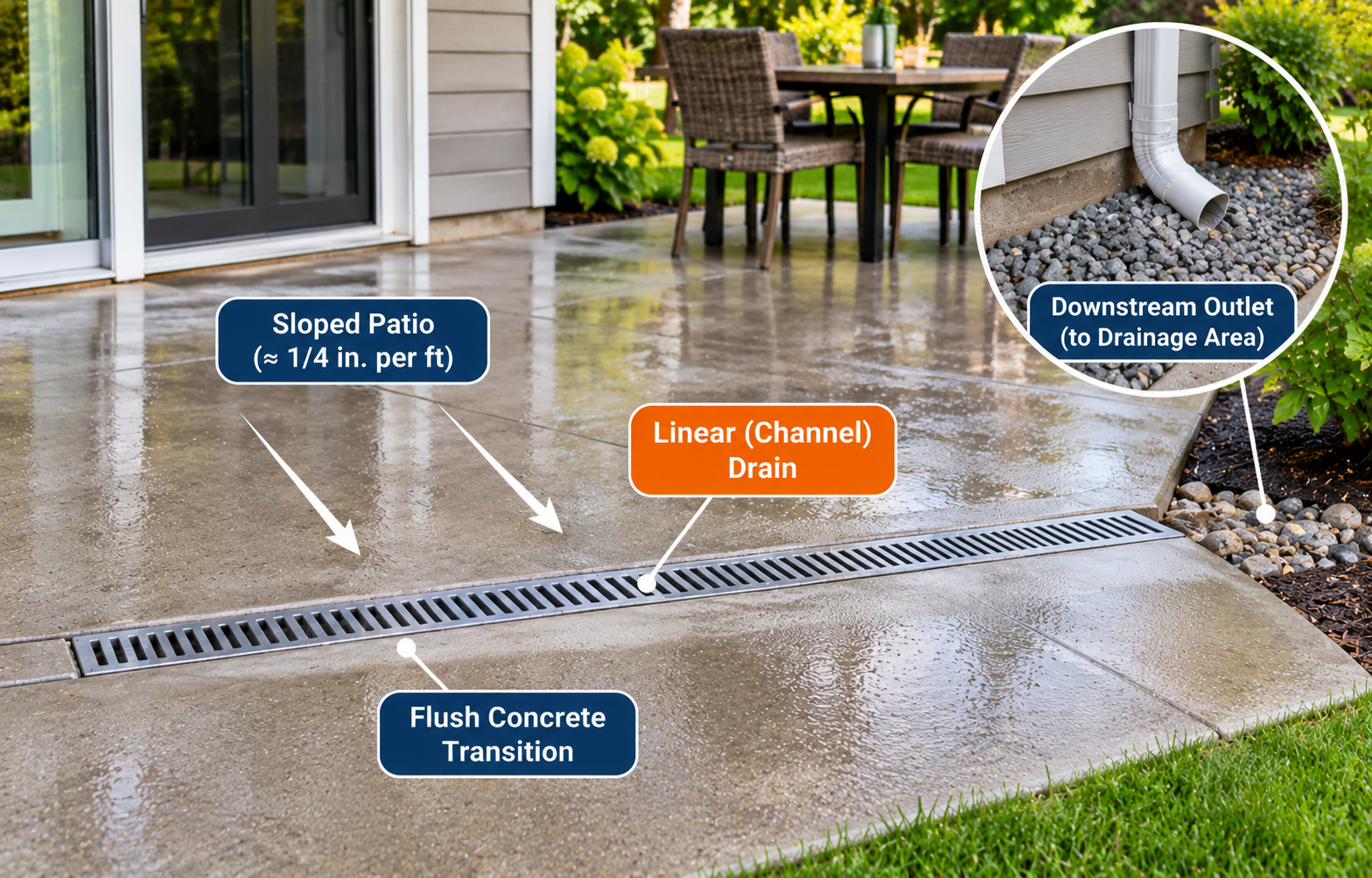
Channel Drain vs. Area Drain
A channel drain collects water along a line, while an area drain collects it at one local low point. Both need a viable outlet, and neither fixes a slab that falls away from the drain.
| Fix | Best for | Concrete removal? | Main limitation |
|---|---|---|---|
| Redirect downspout | Extra roof runoff | No | Needs a suitable discharge area |
| Regrade soil edge | Blocked patio outlet | No | Limited by site elevations |
| Swale or rain garden | Landscape runoff | No | Soil and site suitability required |
| Grind a high spot | Ridge blocking runoff | Minor | Cannot raise a low area |
| Bonded overlay | Shallow stable depression | Surface prep | Needs a sound slab and elevation room |
| Area drain | Local low point | Usually some | Requires an outlet |
| Channel drain | Linear collection point | Usually some | Requires an outlet and capacity |
| Slab lifting | Settled panel | Usually no full removal | Cause and stability must be assessed |
| Replacement | Severe grade or settlement | Yes | Highest disruption and cost |
Where Should Patio Drain Water Go?
Where local rules and the site allow it, collected water can go to several places:
- A storm drainage system
- An approved dry well or infiltration system
- A vegetated swale
- A rain garden
- A suitable landscaped area away from the building
Never send runoff toward a neighboring property, discharge it beside the foundation, or tie it into a sanitary sewer. Local drainage rules control the legal destination.
Why a Drain Without an Outlet Does Not Fix Ponding
Collection is not drainage. A functioning system needs an inlet, a pipe or channel, positive grade and a discharge point.
If the outlet pipe is clogged, pitches uphill, ends in saturated soil or discharges where it is prohibited, the drain just becomes a bucket that fills and overflows.
Confirm the entire route before you cut any concrete. Run a hose into the inlet and watch where the water actually ends up.
The best patio drainage fix depends on whether the problem is incoming runoff, a local surface defect, settlement or the slab’s overall grade.
Can a Sunken Patio Slab Be Lifted?
Often, yes, for selected settled slabs. Slab lifting methods include slabjacking and polyurethane lifting, and FHWA’s guide covers slab stabilization and slab jacking using cement grout or polyurethane (FHWA).
This is not a do-it-yourself fix without assessment. The cause matters: if soil washout or movement continues, a lifted slab can settle again.
A qualified contractor should evaluate the slab and the soil beneath it. See sinking concrete repair for background on options.
When Should You Replace a Patio Section?
Replacement makes sense when the grade or damage is beyond a surface fix. Consider it when:
- The slab has settled substantially.
- A severe reverse slope drains toward the house.
- Widespread cracking accompanies movement.
- Several patches have already failed.
- Door or threshold geometry leaves no room for an overlay.
- Drainage needs a new finished elevation.
Estimate the pour with the Concrete Patio Calculator and the Concrete Slab Calculator.
How to Prevent the New Patio Section From Ponding Again
A new section should be built so the water problem is solved at the source, not hidden. Several things matter most:
- A properly prepared subgrade
- Uniform support under the whole slab
- Accurate form elevations
- A deliberate drainage slope
- A controlled outlet for the water
- Managed roof runoff
- Careful finishing, since small tolerances can leave birdbaths
The sidewalk forms guide explains how forms set grade and cross slope, and the concrete slab guide covers placement. Use the material takeoff guide to plan quantities, and see control joints and leveling ground for a slab.
Standing Water Between a Patio and House Foundation
This is the highest-priority case, because water against a foundation can lead to moisture problems inside the building. The IRC requires impervious surfaces within 10 ft of a residential foundation to slope at least 2% away, subject to local adoption and exceptions.
- Check the joint between the patio and the house.
- Inspect downspouts and gutters.
- Do not create drainage toward the wall.
- Investigate repeated basement or crawlspace moisture.
Treat Foundation Moisture Seriously
If water keeps reaching the wall or you see moisture indoors, get a qualified professional to assess the site. A cosmetic fix on the patio will not solve a foundation water problem.
Common Patio Drainage Mistakes
- Drilling random holes in the slab
- Coating puddles with sealer
- Filling a low spot without checking the outlet
- Creating too much cross slope
- Dumping water beside the foundation
- Installing a drain with nowhere to discharge
- Directing runoff to a neighbor
- Covering an actively settling slab
| Mistake | Why it fails | Better approach |
|---|---|---|
| Sealing the patio | Does not change elevation | Fix the water path |
| Adding thin mortar randomly | Poor bond and feather edges | Use a compatible repair system |
| Grinding the low point | Makes the depression deeper | Grind the blocking high point only |
| Installing a drain with no outlet | Water still has nowhere to go | Design the full drainage route |
| Redirecting water beside the foundation | Raises building moisture risk | Discharge away from the structure |
| Making the slope excessively steep | Comfort and accessibility issue | Follow applicable limits |
| Resurfacing a settled slab | Movement can continue | Stabilize first |
| Sending runoff to a neighbor | May create a legal or site problem | Use an approved discharge |
Sealing is worth a note. A sealer may help protect a surface, but it does not change where water sits. See how to seal concrete for that separate topic, and how to clean concrete naturally for cleaning only.
Standing Water on Concrete Patio FAQs
How do I stop water pooling on my patio?
Find where the water comes from, where it is trying to go, and what blocks it. Then try the least invasive fixes first, such as clearing debris, redirecting a downspout and lowering soil that acts as a dam, before changing the concrete.
Can I fix a low spot without replacing the slab?
Often yes, if the slab is stable. Options include grinding a high point that blocks water, a bonded repair or resurfacing for a shallow depression, or adding a drain with a confirmed outlet. A slab that is settling needs stabilizing first.
Can I grind concrete to improve drainage?
Only when a high spot is blocking the water. Grinding removes concrete, so it cannot raise a low area, and it will not help if the whole slab pitches the wrong way.
Can I add concrete over a low area?
Ordinary fresh concrete poured thinly over old concrete is usually a poor repair. A compatible bonded repair mortar, polymer-modified overlay or resurfacing system on a sound, prepared slab is the better route.
How much slope does a patio need?
It depends on location and local code. The IRC calls for at least 2% slope away from the building for impervious surfaces within 10 ft of the foundation, where adopted. Accessible routes have a maximum cross slope of 1:48 (about 2.1%).
Should a patio slope away from the house?
Yes, near the foundation. Impervious surfaces within 10 ft of a residential foundation are meant to slope away from the building at 2% or more, subject to local adoption and exceptions.
Can I install a channel drain?
Yes, when slope correction alone is impractical. The drain must sit below the surrounding concrete and have a working outlet, and local rules may limit where the water can be discharged.
Will sealing concrete stop standing water?
No. A sealer does not change elevations or the drainage path, so puddles will return. Fix the slope, the low spot or the outlet instead.
Can a settled patio be lifted?
Often, for selected slabs, using methods such as slabjacking or polyurethane lifting. A qualified contractor should assess the cause first, because continuing soil movement can let the slab sink again.
Is a rain garden a good natural drainage solution?
It can be, where the soil drains well and the site is suitable. It should sit downslope of the water source, away from the foundation and utilities, with an overflow route and local approval where required.
Conclusion
Fix standing water by following the water. Reduce incoming runoff, measure the actual grade, find the low point, confirm a legitimate outlet, and then choose the least invasive correction that creates a continuous downhill path.
If the repair means a new pour, work out your quantity first.
Open the Concrete Patio Calculator