Soil Bearing Capacity Chart – IBC Presumptive Values & Allowable Pressure
Soil Bearing Capacity Chart
IBC Presumptive Values & Allowable Pressure
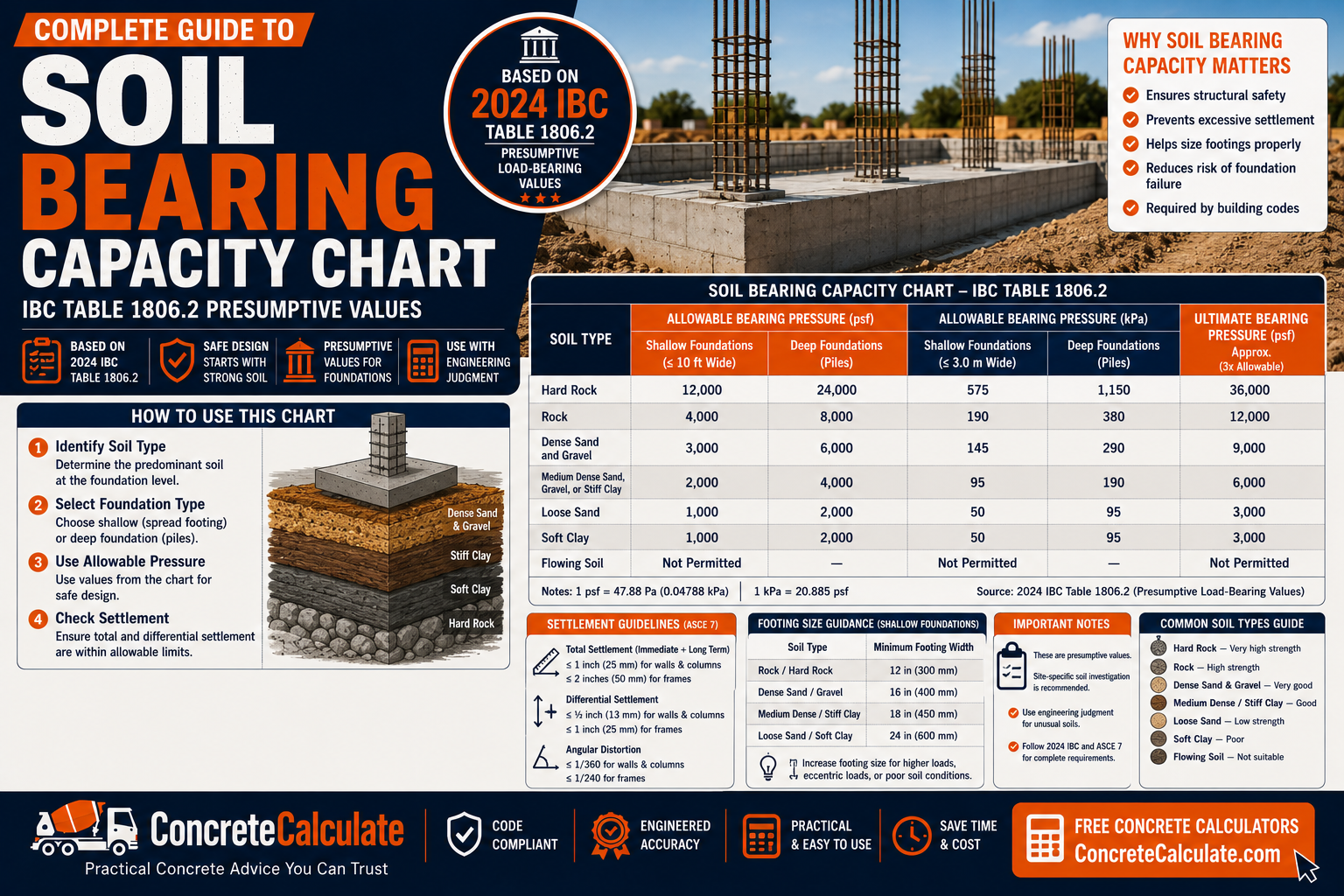
The complete soil bearing capacity reference: 2024 IBC Table 1806.2 presumptive values in psf and kPa, allowable versus ultimate capacity, settlement, and footing size guidance.
 Reviewed by Muhammad Ramzan Babar, PhD Researcher (Plasma Physics) & Calculator Developer, View Profile
This chart affects structural safety, read the limitations
The values below are 2024 IBC Table 1806.2 presumptive load-bearing values, a code-based reference for use under specific conditions, not a substitute for site-specific geotechnical investigation. Local jurisdictions can amend the model code, and questionable soil conditions require additional evaluation. A geotechnical engineer should be consulted for actual foundation design.
Soil Bearing Capacity Chart, Quick Reference
These are 2024 IBC Table 1806.2 presumptive load-bearing values, a code-based reference for use under specific conditions, not universally measured site capacities.
| Soil/Rock Class | USCS Symbols | Vertical Foundation Pressure (psf) | kPa | General Description |
|---|---|---|---|---|
| Crystalline bedrock | – | 12,000 | 575 | Hard, unweathered igneous or metamorphic rock |
| Sedimentary and foliated rock | – | 4,000 | 192 | Layered rock such as sandstone, shale, schist |
| Sandy gravel and gravel | GW, GP | 3,000 | 144 | Well-graded or poorly-graded gravel |
| Sand, silty sand, clayey sand, silty gravel, clayey gravel | SW, SP, SM, SC, GM, GC | 2,000 | 96 | Granular soils with varying fines content |
| Clay, sandy clay, silty clay, clayey silt, silt, sandy silt | CL, ML, MH, CH | 1,500 | 72 | Fine-grained cohesive and silty soils |
Source: 2024 International Building Code, Table 1806.2, Presumptive Load-Bearing Values. kPa conversion using the IBC’s own factor, 1 psf equals 0.0479 kPa. Local jurisdictions may amend this table; verify the adopted edition and any local amendments for your project location.
What Is Soil Bearing Capacity?
Soil bearing capacity describes how much load soil can support beneath a foundation before shear failure or excessive settlement occurs.
FHWA defines bearing capacity failure as foundation soil failure caused by insufficient soil strength, with the corresponding load called the ultimate bearing capacity. As a foundation transfers building load into the ground, the soil beneath must resist that pressure through internal shear strength and resistance to deformation. When soil resistance is exceeded, bearing capacity failure occurs; when soil deforms excessively without full shear failure, settlement problems occur instead.
Soil Bearing Capacity vs Allowable Bearing Pressure
Ultimate capacity, allowable pressure, and presumptive value are three distinct terms that should never be used interchangeably.
| Term | Definition |
|---|---|
| Ultimate bearing capacity | The theoretical/engineering capacity associated with soil failure |
| Allowable bearing pressure | Pressure permitted for design after safety considerations and/or settlement limitations |
| Presumptive load-bearing value | A code-based reference value usable within an applicable prescriptive framework |
- q_allow = allowable bearing pressure
- q_ult = ultimate bearing capacity
- FS = factor of safety
Presumptive Soil Bearing Capacity vs Site-Specific Capacity
A presumptive value is not the same thing as a geotechnically measured site capacity, and the two should never be confused.
When presumptive values apply
The 2024 IBC permits presumptive values only within its applicable conditions and requires supporting data when higher values are proposed, or when the building official has concerns about soil classification, strength, or compressibility. Site-specific factors including soil variability, groundwater, soil layering, undocumented fill, and structural importance can all mean the actual site capacity differs substantially from a presumptive table value.
IBC Soil Bearing Capacity Chart, Table 1806.2
Understanding the source of the primary chart on this page adds transparency and authority to how these values should be used.
| Reference | Content |
|---|---|
| 2024 IBC | International Building Code, current model code edition |
| Chapter 18 | Soils and Foundations |
| Section 1806.2 | Presumptive load-bearing values |
| Table 1806.2 | Vertical foundation pressure, lateral bearing pressure, and lateral sliding resistance by soil/rock class |
2024 IBC Presumptive Load-Bearing Values
The complete Table 1806.2 reference, including lateral bearing pressure and sliding resistance, not just vertical pressure.
| Class | Material | Vertical Foundation Pressure (psf) | Lateral Bearing Pressure (psf/ft below grade) | Coefficient of Friction | Cohesion (psf) |
|---|---|---|---|---|---|
| 1 | Crystalline bedrock | 12,000 | 1,200 | 0.70 | – |
| 2 | Sedimentary and foliated rock | 4,000 | 400 | 0.35 | – |
| 3 | Sandy gravel and gravel (GW, GP) | 3,000 | 200 | 0.35 | – |
| 4 | Sand, silty sand, clayey sand, silty gravel, clayey gravel (SW, SP, SM, SC, GM, GC) | 2,000 | 150 | 0.25 | – |
| 5 | Clay, sandy clay, silty clay, clayey silt, silt, sandy silt (CL, ML, MH, CH) | 1,500 | 100 | – | 130 |
Verify your adopted code edition
Local jurisdictions can amend the model code. The 2025 California Building Code, for example, is based on the 2024 IBC but includes its own amendments, which is why the applicable edition and any local amendments should always be confirmed with your local building department before relying on this table.
Soil Bearing Capacity in psf, kPa and Tons per Square Foot
Unit conversions for the vertical foundation pressure values, using the IBC’s own conversion factor and the standard short ton definition.
| Material | psf | kPa | tsf (2,000 lb ton) |
|---|---|---|---|
| Crystalline bedrock | 12,000 | 575 | 6.0 |
| Sedimentary/foliated rock | 4,000 | 192 | 2.0 |
| Sandy gravel and gravel | 3,000 | 144 | 1.5 |
| Sand/silty sand/clayey sand group | 2,000 | 96 | 1.0 |
| Clay/silt group | 1,500 | 72 | 0.75 |
Conversion factor per the IBC: 1 psf = 0.0479 kPa. Tons per square foot shown here use the U.S. short ton (2,000 lb), since “tons” can otherwise ambiguously refer to metric tonnes or long tons; always confirm which ton definition a given source intends before comparing values.
Soil Bearing Capacity by Soil Type
Broad soil names alone are not sufficient to establish a site-specific design value; each soil group requires its own evaluation context.
| Soil Group | IBC Presumptive Class | Key Consideration |
|---|---|---|
| Gravel, sandy gravel | 3,000 psf (GW, GP) | Density and drainage affect actual capacity |
| Sand, silty sand, clayey sand | 2,000 psf (SW, SP, SM, SC) | Relative density strongly affects settlement and capacity |
| Silt, sandy silt | 1,500 psf (ML, MH) | Compressibility and moisture sensitivity vary widely |
| Clay, sandy clay, silty clay, clayey silt | 1,500 psf (CL, CH) | Consistency and expansive potential vary widely |
| Organic soils, fill | Not covered by presumptive table without substantiating data | Requires geotechnical investigation |
USCS Soil Classification and Bearing Capacity
The IBC presumptive table uses USCS symbols, so understanding the classification system helps interpret which category a given soil report falls into.
| USCS Symbol | Soil Description | IBC Category |
|---|---|---|
| GW, GP | Well-graded gravel, poorly-graded gravel | Sandy gravel and gravel, 3,000 psf |
| SW, SP | Well-graded sand, poorly-graded sand | Sand group, 2,000 psf |
| SM, SC | Silty sand, clayey sand | Sand group, 2,000 psf |
| GM, GC | Silty gravel, clayey gravel | Sand group, 2,000 psf |
| CL, CH | Lean clay, fat clay | Clay/silt group, 1,500 psf |
| ML, MH | Silt, elastic silt | Clay/silt group, 1,500 psf |
Gravel Bearing Capacity
Sandy gravel and gravel (GW, GP) carry a 2024 IBC presumptive vertical pressure of 3,000 psf, the second-highest soil category after rock.
Gravel generally performs well as a bearing material due to its high friction angle and good drainage characteristics, but actual capacity still depends on density, compaction, and groundwater conditions at the specific site. The IBC presumptive category should not be treated as a universal gravel capacity that applies regardless of these site-specific factors.
Sand Bearing Capacity
Clean sand, silty sand, and clayey sand (SW, SP, SM, SC) carry a 2024 IBC presumptive vertical pressure of 2,000 psf, but relative density strongly affects actual field performance.
| Factor | Effect |
|---|---|
| Relative density | Denser sand generally provides higher capacity and lower settlement |
| Fines content | Silty or clayey sand behaves differently than clean sand under load |
| Settlement | Loose sand can experience significant settlement under load even without shear failure |
Clay Bearing Capacity
Clay, sandy clay, silty clay, and clayey silt (CL, CH) fall into the 2024 IBC’s lowest presumptive category at 1,500 psf, but this is a code default, not a universal engineering truth about every clay deposit.
Clay behavior varies enormously by consistency
Clay consistency (soft, medium, stiff, hard), undrained shear strength, compressibility, and expansive potential all vary widely between deposits, even within the same broad USCS classification. Treating “clay equals 1,500 psf” as a fixed engineering fact ignores this variability; the IBC value is a conservative presumptive default intended for use only under its stated conditions.
Silt Bearing Capacity
Silt and sandy silt (ML, MH) share the IBC’s 1,500 psf presumptive category with clay, but silt often requires more careful evaluation due to its moisture sensitivity.
Silt can be highly compressible and moisture sensitive, meaning its bearing behavior can change significantly with changes in water content or drainage conditions. This makes silt a soil type where a simple soil-type table can understate the need for site-specific evaluation, particularly for settlement-sensitive structures.
Rock Bearing Capacity
Rock carries the highest presumptive values in the IBC table, but actual rock capacity depends heavily on jointing, fracturing, weathering, and rock quality, not just the rock type name.
| Rock Category | IBC Presumptive Value | Key Consideration |
|---|---|---|
| Crystalline bedrock | 12,000 psf | Hard, unweathered igneous/metamorphic rock |
| Sedimentary and foliated rock | 4,000 psf | Layered rock, more prone to weathering and discontinuities |
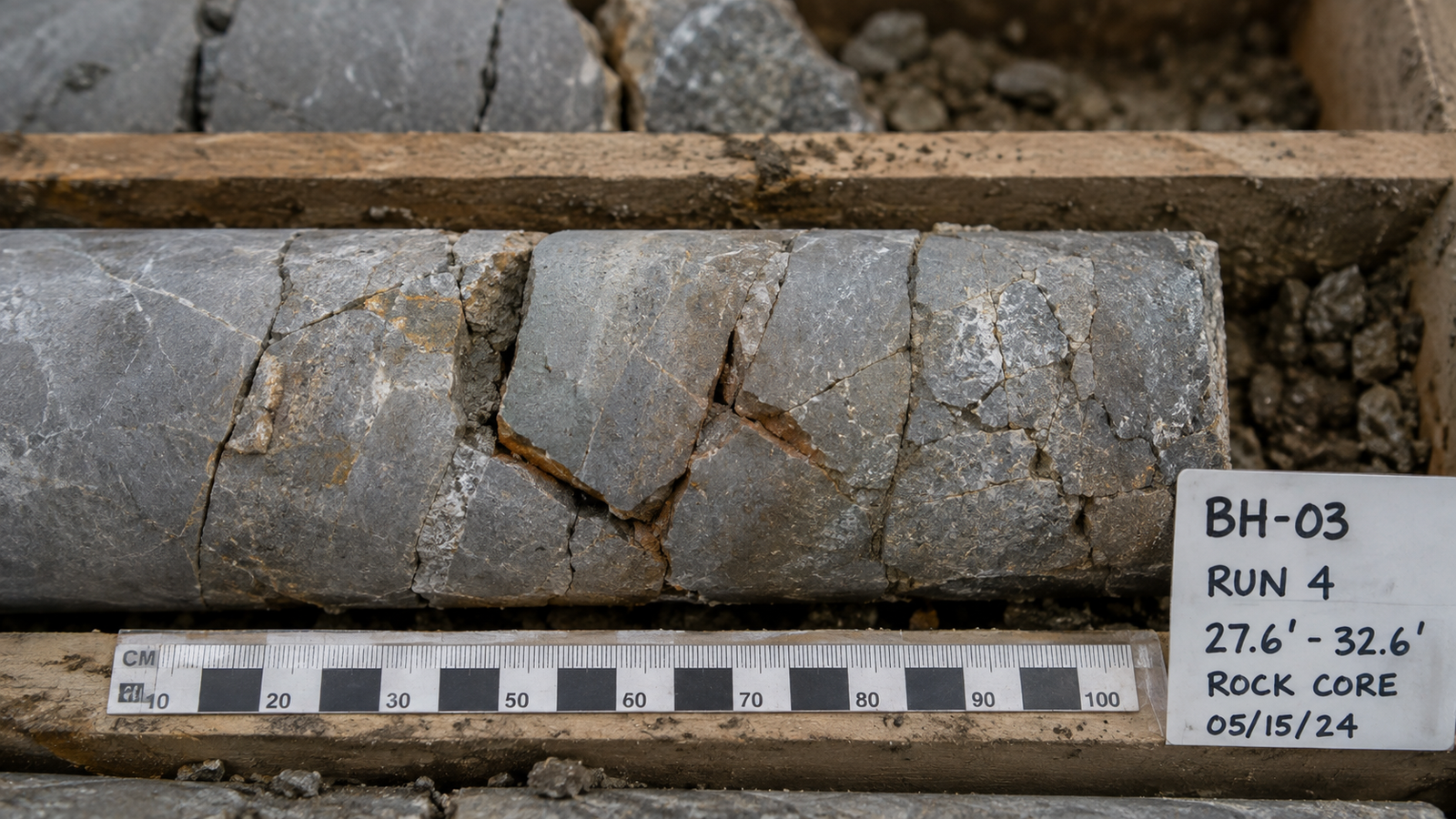
FHWA’s rock guidance demonstrates how allowable bearing pressure can vary substantially with rock type and Rock Quality Designation (RQD), which measures the degree of jointing and fracturing in a rock core sample. Weathered or heavily fractured rock can perform very differently than the intact rock category name suggests.
Organic Soil, Peat and Unprepared Fill
These materials should not be assumed to have a presumptive load-bearing capacity without substantiating data.
The IBC excludes these materials from presumptive values
The 2024 IBC specifically states that peat, organic soils, and undocumented or unprepared fill should not be assumed to have a presumptive load-bearing capacity without substantiating data, subject to the code’s stated exception for certain lightweight or temporary structures. This means these materials require geotechnical investigation rather than defaulting to a table value.
Organic soils and peat are typically highly compressible and can continue settling long after construction, while undocumented fill may contain variable, unknown, or unsuitable material that was never engineered for bearing purposes.
Factors That Affect Soil Bearing Capacity
FHWA identifies subsurface conditions, water elevation, foundation geometry, and settlement limits as factors affecting bearing capacity, among many other variables.
| Factor | Effect |
|---|---|
| Soil type, density, consistency | Determines fundamental strength characteristics |
| Cohesion and friction angle | Directly used in bearing capacity formulas |
| Foundation width, length, depth | Changes bearing capacity factors and overburden effects |
| Groundwater | Reduces effective unit weight and can reduce strength |
| Soil layering | Different strata can control capacity differently |
| Load inclination, eccentricity | Can substantially reduce effective bearing capacity |
| Ground slope, adjacent foundations | Can affect failure surface geometry and capacity |
| Compaction, settlement criteria | Affects both achievable density and acceptable pressure |
Soil Bearing Capacity and Foundation Size
The basic relationship connecting soil capacity to foundation area is straightforward, but real foundation design involves much more.
- Q = supported load
- q = bearing pressure
- A = foundation bearing area
While this equation looks simple, real foundation design must also account for settlement limits, eccentric loading, foundation depth effects, groundwater, and the applicable code’s specific design methodology, none of which are captured in this basic area relationship alone.
Soil Bearing Capacity and Footing Width
Footing width itself influences bearing behavior and settlement, not just the total supported load.
FHWA guidance shows that allowable bearing capacity can change with footing width, since wider footings distribute load differently and can be governed by settlement rather than shear failure. Shear failure and settlement can control the design at different foundation dimensions, meaning a wider footing is not automatically the safer or better choice without evaluating both failure modes.
Soil Bearing Capacity and Foundation Depth
Embedment depth affects overburden pressure and bearing resistance, but deeper footings do not automatically solve weak-soil problems.
Increasing foundation depth generally increases overburden pressure, which can increase bearing resistance in the Nq bearing capacity term, but frost depth requirements, excavation conditions, and underlying weaker soil layers all factor into whether a deeper footing actually improves performance. Depth alone is not a universal solution to inadequate soil capacity.
Soil Bearing Capacity and Groundwater
Groundwater conditions are explicitly incorporated into bearing capacity calculations because water table position affects effective stress and soil strength.
| Effect | Mechanism |
|---|---|
| Reduced effective unit weight | Buoyant weight below the water table lowers overburden contribution |
| Reduced effective stress | Pore water pressure reduces the effective stress carrying soil strength |
| Settlement | Groundwater fluctuation can influence consolidation behavior |
Soil Bearing Capacity and Settlement
A footing can be below the theoretical ultimate bearing capacity and still experience unacceptable settlement, making settlement one of the most important concepts on this page.
| Settlement Type | Description |
|---|---|
| Immediate settlement | Elastic deformation occurring during or shortly after loading |
| Consolidation settlement | Gradual settlement from pore water expulsion in fine-grained soils |
| Total settlement | Overall vertical movement of a single foundation element |
| Differential settlement | Uneven settlement between different parts of a structure |
The USACE foundation manual notes that settlement limitations often control the pressure that can actually be applied to foundation soil, meaning the allowable bearing pressure used in design is frequently governed by acceptable settlement rather than by the soil’s ultimate shear strength.
Bearing Capacity Failure vs Settlement Failure
These are two fundamentally different problems with different characteristics and different design implications.
| Aspect | Bearing Capacity Failure | Settlement Problem |
|---|---|---|
| Nature | Soil strength problem | Deformation problem |
| Mechanism | Shear failure | Excessive movement |
| Governing concept | Ultimate capacity | Serviceability |
| Onset | Potentially sudden failure | Often gradual |
| Controlling factor | Strength-controlled | Settlement-controlled |
FHWA explicitly distinguishes bearing capacity failure from settlement considerations in shallow foundation design, since a design that safely avoids shear failure can still fail to meet the project’s serviceability requirements if settlement is excessive.
Net vs Gross Bearing Pressure
Gross bearing pressure includes the full foundation load, while net bearing pressure accounts for the soil removed during excavation.
Gross bearing pressure is the total pressure applied by the foundation and its load. Net bearing pressure subtracts the weight of soil originally at that location (the excavated overburden) from the gross pressure, since that overburden weight was already accounted for in the soil’s original state before excavation. This distinction matters for basements and deep excavations where a substantial amount of soil is removed before the foundation load is applied.
Ultimate vs Allowable vs Presumptive Bearing Capacity
A practical comparison table consolidating these three terms and their typical use context.
| Term | Meaning | Typical Use |
|---|---|---|
| Ultimate capacity | Failure-level resistance | Geotechnical analysis |
| Allowable pressure | Permitted design pressure | Foundation design |
| Presumptive value | Code-based reference | Prescriptive design where applicable |
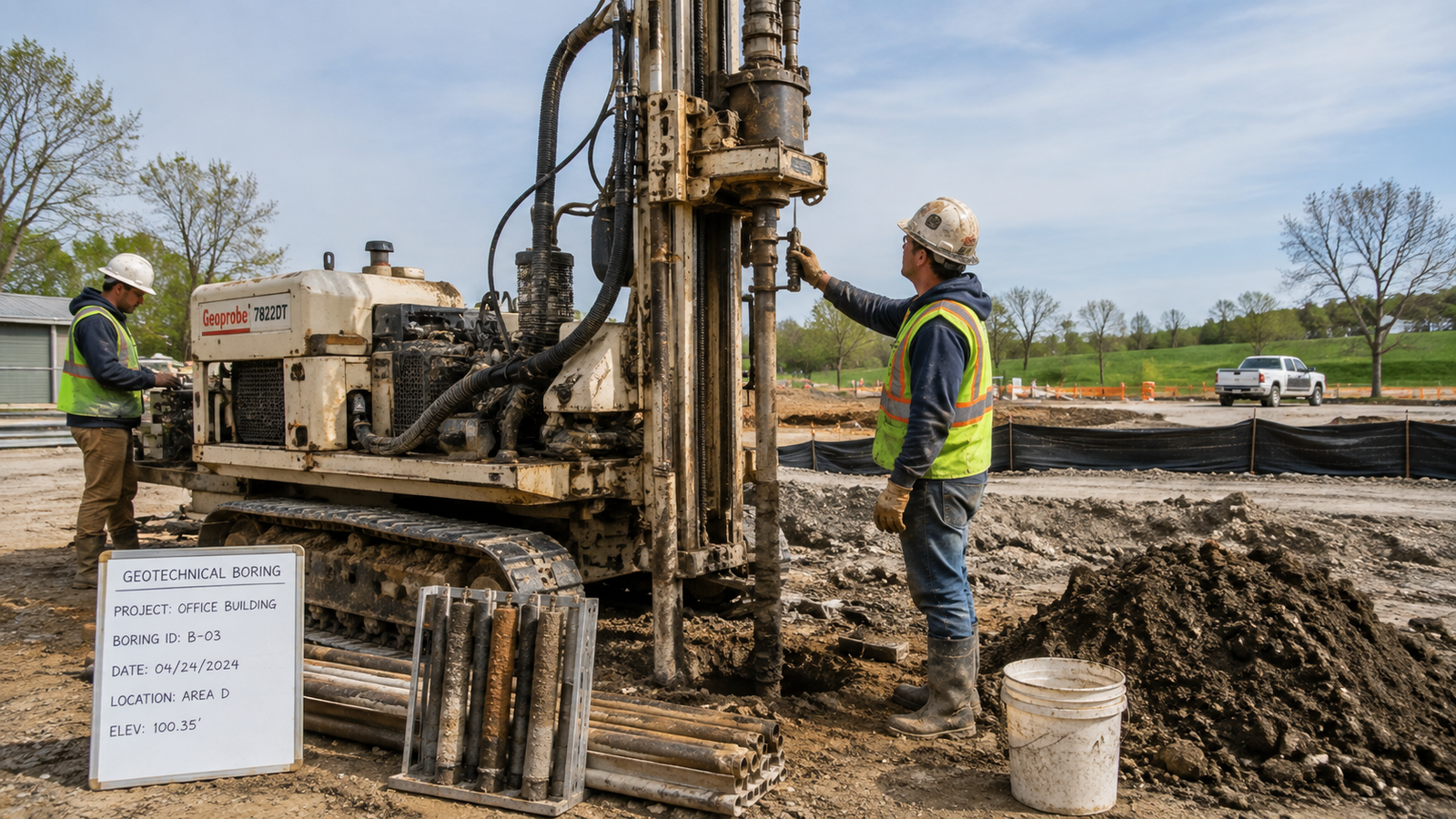
Soil Testing for Bearing Capacity
Soil classification and strength should be based on actual site information where required, obtained through a range of investigation methods.
| Method | Purpose |
|---|---|
| Soil borings | Subsurface exploration and sample collection |
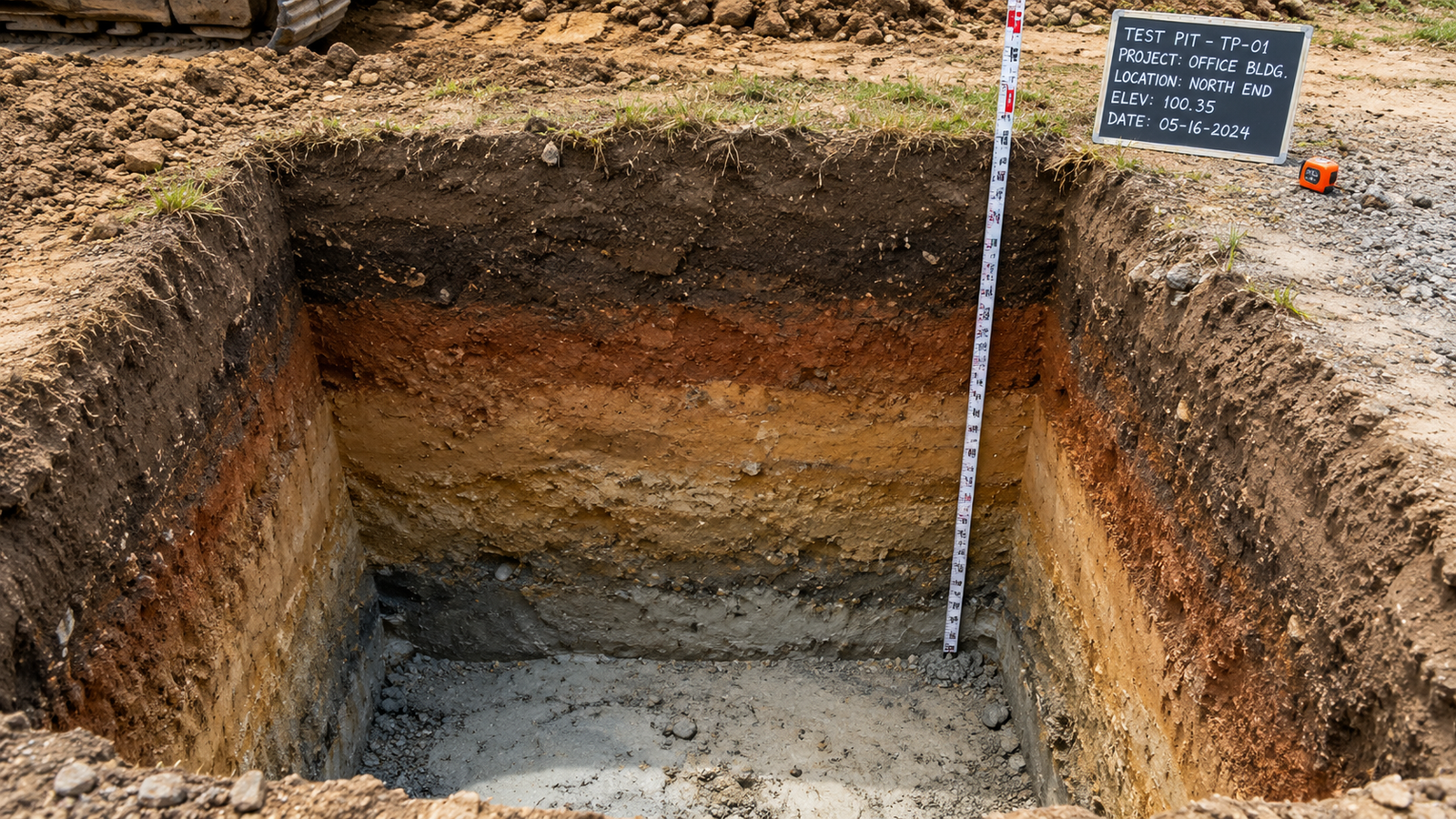
| Test pits | Shallow visual and sampling investigation |
| Laboratory testing | Strength and consolidation properties of collected samples |
| Field testing | In-situ strength and density measurements |
| Groundwater observations | Water table depth and fluctuation |
SPT and Soil Bearing Capacity
The Standard Penetration Test produces an N-value used in geotechnical correlations, but N-value alone should not be converted directly into a bearing capacity number without identifying the specific method and assumptions used.
FHWA uses SPT values in geotechnical foundation analyses, including cohesionless-soil pile calculations, where the N-value correlates with relative density and soil consistency through established but method-specific relationships. Because different correlation methods use different assumptions, this page intentionally does not provide a generic “N equals X, bearing capacity equals Y” table; any such correlation should be applied only with its source method and assumptions clearly identified by a qualified geotechnical professional.
Soil Bearing Capacity From Soil Tests
Different tests measure different soil properties, and no single test provides a complete picture of bearing capacity on its own.
| Test | What It Measures |
|---|---|
| SPT | Penetration resistance (N-value), correlated to density/consistency |
| CPT | Continuous penetration resistance and pore pressure profile |
| Laboratory shear testing | Direct shear strength parameters (cohesion, friction angle) |
| Consolidation testing | Compressibility and settlement behavior |
Plate Load Test and Bearing Capacity
A plate load test directly measures load versus settlement behavior at a small scale, but scale effects limit how directly results apply to full-size foundations.
The test applies incremental loads to a plate resting on the soil surface or at foundation depth, recording settlement at each load increment to develop a load-settlement curve. Because the test plate is much smaller than an actual foundation footprint, results require careful interpretation and scaling, since larger foundations engage a larger volume of soil and can behave differently than the small test plate suggests.
Bearing Capacity Calculation Methods
Several established theories exist for calculating ultimate bearing capacity, each with different capabilities for various foundation and soil conditions.
| Method | General Notes |
|---|---|
| Terzaghi | Foundational bearing capacity theory, strip footing basis |
| Meyerhof | Extends theory to include shape, depth, and inclination factors |
| Hansen | Further generalizes for more complex loading conditions |
| Vesic | Refinements applicable to specific foundation and soil conditions |
USACE notes that different bearing capacity models have different capabilities for foundation geometry and soil conditions and recommends considering multiple approaches where practical, rather than relying on a single formula for every situation.
Bearing Capacity Factors Nc, Nq and Nγ
These dimensionless factors combine cohesion, surcharge, and unit weight contributions with the soil’s friction angle to calculate ultimate bearing capacity.
| Friction Angle (φ) | Nc | Nq | Nγ (Meyerhof) |
|---|---|---|---|
| 0° | 5.14 | 1.0 | 0.0 |
| 20° | 14.83 | 6.40 | 2.87 |
| 30° | 30.14 | 18.40 | 15.07 |
| 40° | 75.31 | 64.20 | 109.41 |
Values calculated using Meyerhof’s general shear equations. Nc = cohesion contribution, Nq = surcharge (overburden) contribution, Nγ = unit weight contribution. FHWA examples explicitly use these three factors together in bearing capacity calculations; different theories (Terzaghi, Hansen, Vesic) can produce somewhat different factor values for the same friction angle.
Factor of Safety for Soil Bearing Capacity
Factor of safety converts ultimate capacity into a usable allowable design value, but the appropriate value depends on the governing design methodology and project circumstances.
FHWA’s typical range, not a universal rule
FHWA’s shallow foundation guidance identifies typical minimum factors of safety in the 2.5 to 3.5 range for certain allowable-stress design approaches, with the exact value depending on confidence in soil strength parameters, structural importance, and consequence of failure. Do not treat this as a simple “divide by 3” universal rule; the appropriate factor of safety is a geotechnical engineering decision specific to the project.
Soil Bearing Capacity for Residential Foundations
Residential foundations most often rely on presumptive values, but the same fundamental principles apply regardless of project scale.
| Foundation Type | Bearing Consideration |
|---|---|
| Strip footings | Continuous bearing pressure along wall lines |
| Isolated footings | Concentrated pressure beneath columns or posts |
| Slab-on-grade | Distributed pressure over the slab area |
| Basement/crawlspace foundations | Depth affects overburden and frost considerations |
Local code requirements and site-specific geotechnical conditions both matter for residential work, even when presumptive values are permitted. See the Footing Size Chart for dimensional planning once bearing pressure has been established.
Soil Bearing Capacity for Footings
Bearing pressure interacts with footing width, length, applied load, and eccentricity to determine whether a given footing design is adequate.
The practical footing design question is whether the bearing pressure generated by the column or wall load, spread over the footing’s actual area, stays within the allowable bearing pressure for the site soil, while also satisfying settlement limits and any eccentricity effects from off-center or moment loading.
Soil Bearing Capacity and Footing Size Example
A simple illustrative calculation showing the preliminary bearing area concept, not a complete footing design.
Preliminary Bearing Area Calculation
See the Footing Size Chart to continue from this preliminary area into an actual footing dimension plan.
Eccentric Loads and Effective Footing Area
When a load is applied off-center or with moment, soil pressure becomes nonuniform, and design uses a reduced effective footing area rather than the full physical footprint.
- B’ = effective footing width
- B = actual footing width
- e = eccentricity of the load from the footing centroid
FHWA’s bridge foundation examples explicitly use reduced or effective footing dimensions where loads are eccentric, since the soil pressure distribution beneath an eccentrically loaded footing is no longer uniform, and using the full footing area without this adjustment would overstate the footing’s effective bearing capacity.
Soil Bearing Capacity Chart Limitations
This chart directly affects structural safety. Read these limitations carefully before relying on any value above.
Soil type alone does not determine actual capacity
Density, consistency, and site conditions all matter beyond the broad soil name.
Presumptive values are code-specific
They apply only under the stated conditions of the adopted code edition.
Local amendments can change requirements
Always verify the code edition and any local amendments for your jurisdiction.
Groundwater and settlement can control
Both can significantly change the actual usable bearing pressure.
Foundation dimensions and soil layering matter
Footing size, depth, and underlying strata all affect real performance.
Fill and expansive soils require additional consideration
Undocumented fill and expansive clays need dedicated evaluation.
A geotechnical engineer may be required
This chart is a reference, not a substitute for a qualified site-specific evaluation.
Soil Bearing Capacity Standards and References
Four authoritative references govern most soil bearing capacity work in U.S. construction.
| Reference | Scope |
|---|---|
| 2024 International Building Code, Chapter 18 | Section 1806.2 presumptive load-bearing values and general soils/foundations provisions |
| FHWA Geotechnical Engineering Circular No. 6, Shallow Foundations | Bearing capacity theory, factors of safety, and settlement concepts |
| FHWA NHI-06-089, Soils and Foundations | Broader geotechnical foundation reference including bearing capacity and factors of safety |
| USACE EM 1110-1-1905, Bearing Capacity of Soils | Bearing capacity theory and settlement guidance for shallow foundations |
Frequently Asked Questions
Download Soil Bearing Capacity Chart PDF
Use your browser’s print function to save a curated, print-ready reference sheet: the IBC Table 1806.2 values, unit conversions, bearing capacity factors, the footing size example, and diagrams, without navigation, FAQs, or explanatory prose. This avoids broken file links and stays automatically current.