Concrete Contractor Bid Checklist: 30+ Items to Verify

A repeatable final-review system for catching scope gaps, quantity errors, stale quotes, missed addenda, weak production assumptions and incomplete bid forms before you submit.
A concrete contractor bid checklist is a final review you run after the estimate is built and before you submit. Check the documents and addenda, scope, quantities, current quotes, labor, risk and the bid form requirements in three stages: technical scope, cost and production, then compliance.
- Confirm the latest drawings and every addendum.
- Reconcile the priced scope against the drawings.
- Recheck the largest quantities, units and arithmetic.
- Verify supplier, subcontractor and equipment pricing.
- Sanity-check labor hours and production rates.
- Confirm overhead, risk, profit, alternates and allowances.
- Check forms, bonds, signatures and the deadline, then save a copy.
A. Set up the final review
- What Is a Concrete Contractor Bid Checklist?
- When Should You Run the Bid Checklist?
- Bid Checklist vs. Estimate Checklist
- Create a Bid Summary Sheet
B. Verify the bid documents
- Check the Latest Drawings and Specifications
- Confirm Every Addendum
- Read the Instructions to Bidders Again
- Confirm the Bid Deadline, Time Zone and Submission Method
C. Verify scope completeness
- Reconcile the Bid Scope Against the Drawings
- Check Demolition, Excavation and Haul-Off
- Check Subgrade and Base Preparation
- Check Forms, Reinforcement and Embedded Items
- Check Concrete Placement and Finish Scope
- Check Joints and Saw Cutting
D. Recheck quantities
- Verify Concrete Volume
- Check the Ordering Allowance Separately
- Check Reinforcement, Formwork and Base Quantities
- Check Units and Arithmetic
E. Recheck direct costs
- Verify Ready-Mix and Material Quotes
- Verify Labor and Production Rates
- Verify Equipment Costs
- Verify Subcontractor Quotes
F. Overhead, risk and terms
- Confirm Overhead, Contingency and Profit Are Not Missing
- Review Project Risks and Assumptions
- Verify Alternates, Allowances and Unit Prices
- Check Bonds, Insurance, Licenses and Required Attachments
G. Final submission QA
What Is a Concrete Contractor Bid Checklist?
A concrete contractor bid checklist is a final quality review you run after the estimate is built and before the bid goes out. It verifies the scope, quantities, pricing, production, risk, bid documents and commercial requirements.
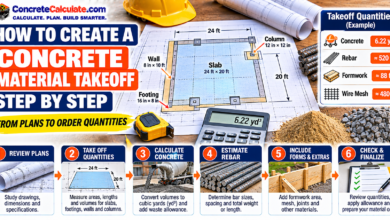
It is not another estimating guide. For building the numbers, use the material takeoff guide, how to estimate a concrete job and concrete labor cost per square foot, and for the customer document, see how to write a professional concrete estimate.
The checklist answers one question: before I click submit or hand over this bid, what do I need to check one last time? A bid can be mathematically perfect and still lose money, or be rejected, because of one missed addendum, one scope gap or one stale quote.
This page organizes the review in three stages: technical scope, cost and production, then bid compliance.
When Should You Run the Bid Checklist?
Run the checklist twice. The first pass catches big problems while there is still time to fix them, and the second confirms the package is ready to send.
- 24 to 48 hours before submission: review scope and pricing.
- Immediately before submission: check forms, signatures, addenda, attachments and the deadline.
Follow the owner’s own bid rules where they differ from this timing, such as an earlier deadline or a required pre-bid meeting.
Bid Checklist vs. Estimate Checklist
The estimate checklist asks whether you calculated the job correctly. The bid checklist asks whether the offer is complete, compliant and ready to submit.
Both matter, and they catch different mistakes. An estimate review finds an arithmetic error, while a bid review finds the missing signature or the unacknowledged addendum.
Create a Bid Summary Sheet
A bid summary sheet puts the key facts on one page, so a reviewer can check the bid without hunting through files. Table 1 lists the fields.
| Field | Entry |
|---|---|
| Project | |
| Owner or general contractor | |
| Bid number | |
| Bid date and time | |
| Estimator | |
| Latest drawing revision | |
| Latest addendum | |
| Base bid | |
| Alternate 1 | |
| Alternate 2 | |
| Concrete quantity | |
| Labor hours | |
| Major subcontractors | |
| Bid bond required? | |
| Submission method |
A reliable bid-review process checks technical scope, pricing and submission requirements separately.
Check the Latest Drawings and Specifications
Confirm that you are pricing the current drawings and specifications before anything else. Check the issue date, revision number, specification issue and bid-set status.
Do not price from an old PDF simply because it was the first one emailed. Compare the title block of every sheet with the latest transmittal.

Confirm Every Addendum
Confirm and acknowledge every addendum. A missed addendum can change scope, quantities, specifications, alternates, commercial terms or the bid date itself.
- Addendum numbers received and read
- Revised plans and specification sections
- Revised bid forms
- Deadline changes
- Acknowledgment recorded on the bid form where required
On federal sealed bids, failure to acknowledge an amendment is only a minor informality if the bid clearly shows it was received or the change had a negligible effect on price, quantity, quality or delivery (FAR Subpart 14.4). Private owners decide their own rules, so acknowledge every addendum.
Confirm the current drawing revision and every addendum before relying on quantities or pricing.
Read the Instructions to Bidders Again
Read the instructions to bidders again, even if you have bid for the owner before. Requirements change between invitations.
- Submission method and deadline
- Required forms
- Bid security
- Prequalification
- Subcontractor listing
- Alternates and unit prices
- Bid validity period
Tick each requirement off against your package, and note any item the owner expects but your bid does not include.
Confirm the Bid Deadline, Time Zone and Submission Method
Confirm the exact deadline, the time zone and how the bid must be delivered. A bid that misses the deadline may not be considered, so do not rely on calendar reminders alone.
- Date and exact time
- Physical or electronic delivery
- Portal requirements and file format
- File naming requirements
If you must upload through a portal, test the login and file size limits early. Leave time for slow uploads on the final day.
Reconcile the Bid Scope Against the Drawings
Reconcile your priced scope against the drawings, item by item. A bid can add up perfectly and still lose money if it leaves out work.
FHWA’s guidance says the construction estimate should reflect the full scope, using current costs for labor, materials, equipment, mobilization, bonds and profit (FHWA). Walk every sheet and tick each concrete item.
- Slabs and footings
- Walls and curbs
- Sidewalks and pads
- Stairs and ramps
- Housekeeping pads
Check Demolition, Excavation and Haul-Off
Confirm exactly which demolition, excavation and haul-off work your price includes. These items are often left out of flatwork bids.
- Sawcutting and removal
- Excavation and loading
- Dump fees and haul distance
- Disposal
Check Subgrade and Base Preparation
Check that grading, compaction and base material are priced to the specification. Missing base prep can erase the margin on a small job.
- Proof rolling, if required
- Grading and compaction
- Aggregate base
- Geotextile
- Imported fill
Check Forms, Reinforcement and Embedded Items
Make sure forms, reinforcement and embedded items are in the bid, because they are easy to miss when the focus is on concrete volume.
- Forms
- Rebar and mesh
- Dowels and chairs
- Anchor bolts and sleeves
- Embedded plates and waterstop
Use the Rebar Size Chart and Rebar Lap Splice Chart to check sizes and laps against the plans, and take lap lengths from the structural details.
Check Concrete Placement and Finish Scope
Confirm placement, finishing, curing and sealing are all priced. Each step has labor, material or equipment behind it.
- Ready-mix concrete
- Pump or buggy
- Placing and screeding
- Floating and the specified finish
- Curing and sealing
Check Joints and Saw Cutting
Check every joint type the drawings call for, along with the saw cutting and any filler or sealant. Joint work is a small line that causes large disputes.
- Contraction joints
- Isolation joints
- Construction joints
- Saw cutting
- Joint filler or sealant where specified
Verify Concrete Volume
Recalculate your largest concrete quantities from the drawings. Volume is the quantity most likely to be questioned.
- Slab thickness
- Footing depth
- Wall thickness
- Thickened edges
- Deductions
- Overlap and double counting
FHWA’s engineer’s estimate checklist asks reviewers to check roughly 15 to 20 percent of bid items against the plan quantities, and more if possible (FHWA estimate checklist).
Rechecking your biggest items gets you most of the benefit. See the material takeoff guide, the Concrete Cubic Yard Calculator and the Concrete Volume Conversion Chart.
Check the Ordering Allowance Separately
Confirm that the theoretical concrete volume and the ordered volume are shown as separate numbers. Do not bury the ordering allowance inside the quantity takeoff.
The takeoff is the geometry from the drawings. The order quantity adds an allowance for real placement conditions, and the two figures should be easy to tell apart on the sheet.
Check Reinforcement, Formwork and Base Quantities
Verify the other quantities with the same rigor as concrete. Each has its own unit, and mixing them up is a common error.
- Rebar weight or count
- Mesh sheets
- Form linear feet or square feet
- Base in yd³ or tons
The Concrete Formwork Calculator, Concrete Slab Calculator and Concrete Footing Calculator give a quick cross-check.
Check Units and Arithmetic
Check every unit and every formula. FHWA’s checklist asks whether the units of measure suit each pay item and whether each quantity is reasonable for the project.
| Error to check | Why it matters |
|---|---|
| Inches entered as feet | Large overestimate |
| ft³ not divided by 27 | Huge concrete quantity error |
| Wrong slab thickness | Material and labor error |
| Double-counted thickening | Overestimate |
| Missing count multiplier | Underestimate |
| Wrong unit price | Cost error |
| Quantity and unit mismatch | Pricing error |
| Formula cell overwritten | Hidden spreadsheet error |
| Alternate included in base | Double pricing |
Follow each line from drawing to quantity to unit to unit cost to extension to subtotal. Also look for ft² versus yd², ft³ versus yd³, LF versus each, and tons versus yd³.
Verify Ready-Mix and Material Quotes
Check that every supplier quote is current and matches the actual project. FHWA’s guidelines call for using current prices adjusted for quantity, location and timing, and FHWA notes that material price swings can make firm quotes hard to get.
- Quote date and expiration
- Mix type and price per yd³
- Delivery, fuel and environmental fees
- Short-load fee
- Admixtures and fibers
- Pump minimums
Use the concrete cost per yard, ready-mix concrete prices and concrete delivery cost pages for context only. The supplier’s written quote is what counts.
Verify Labor and Production Rates
Sanity-check every labor hour against realistic crew production. Underbids often hide here, so ask whether each assumption would hold on a normal day.
- Is the crew composition realistic?
- Can the crew place this volume in the assumed time?
- Is access by chute, pump, buggy or wheelbarrow?
- Is the finish simple or decorative?
- Are setup, cleanup and multiple mobilizations included?
- Is overtime possible?
FHWA defines a production rate as quantity produced over a period and recommends building rates from project records with documented crew make-up.
It also warns that rates computed from total time run low because they include startup and cleanup (FHWA TA 5080.15). Make sure you do not count setup twice, or leave it out.
See concrete labor cost per square foot and the Concrete Pour Duration Calculator for the method.
Verify Equipment Costs
Confirm that every machine the job needs is priced, with mobilization and fuel. Owned equipment still has a cost.
- Excavator and skid steer
- Compactor
- Pump
- Saw
- Power trowel
- Dump truck and generator
Check mobilization, fuel, attachments and minimum rental periods. The Equipment Rental Cost Calculator helps with rentals.
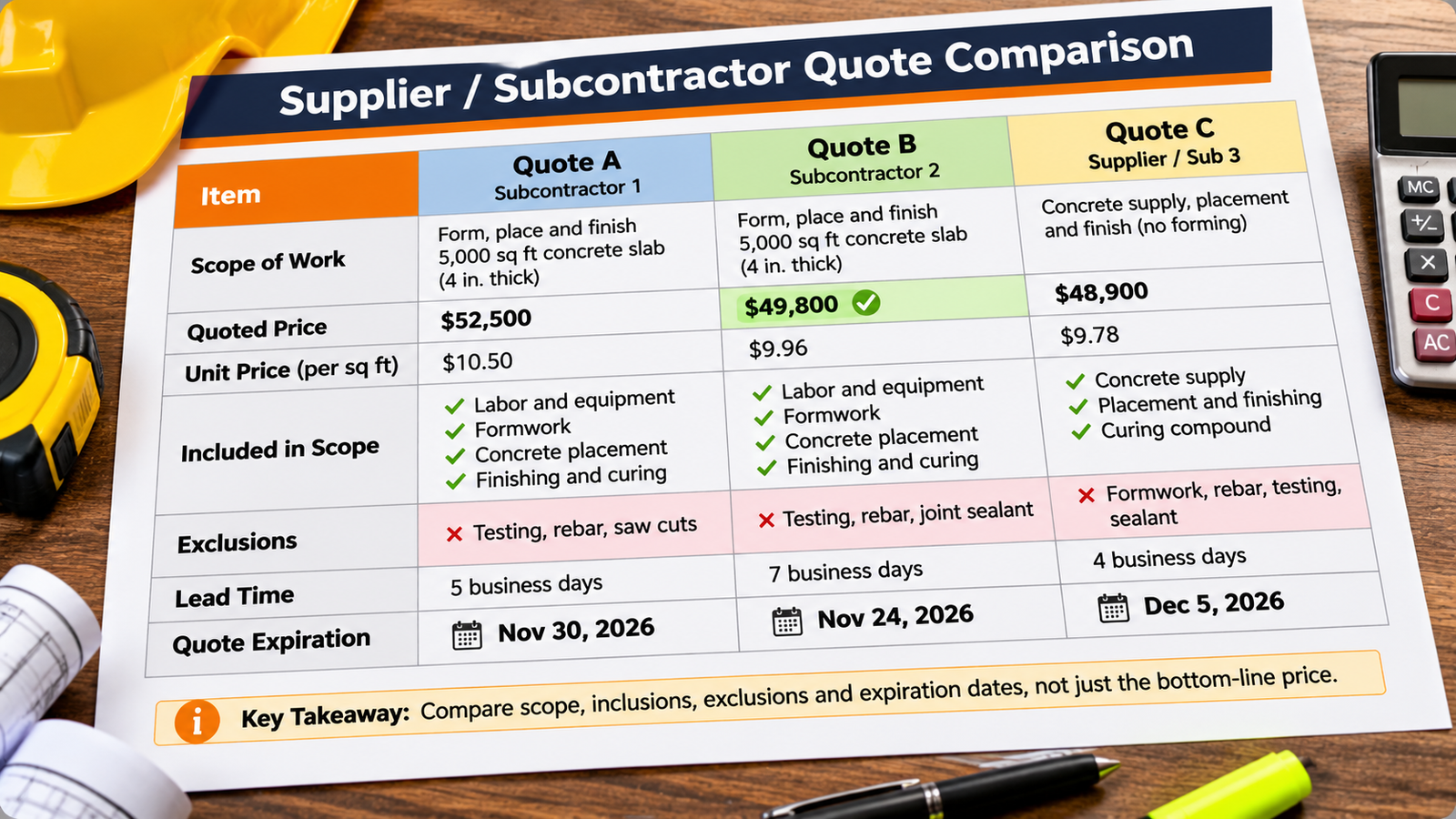
Verify Subcontractor Quotes
Compare subcontractor scope before you compare price. Two quotes with different exclusions are not comparable.
- Scope matches the bid
- Quote is still valid
- Exclusions are understood
- Tax, fees and mobilization are included
- Schedule fits yours
Confirm Overhead, Contingency and Profit Are Not Missing
Check that the bid carries direct costs, project overhead, company overhead, risk and profit as separate layers. A subtotal with no markup on top of it is a common last-minute mistake.
FHWA’s cost-based method pairs labor, equipment and materials with a reasonable amount for overhead and profit, the same way a contractor builds a bid-day estimate (FHWA-HRT-22-075). Do not copy one universal markup, and test yours with the Construction Overhead Calculator, Contractor Markup Calculator and Profit Margin Calculator.
| Category | Checked? |
|---|---|
| Concrete and materials | ☐ |
| Reinforcement | ☐ |
| Forms | ☐ |
| Labor | ☐ |
| Equipment | ☐ |
| Subcontractors | ☐ |
| Hauling and disposal | ☐ |
| Mobilization | ☐ |
| Field overhead | ☐ |
| Home-office overhead | ☐ |
| Risk and contingency | ☐ |
| Bonds and insurance | ☐ |
| Profit | ☐ |
Review Project Risks and Assumptions
Review the risks the bid depends on, and make sure each one is priced, excluded or qualified. FHWA says uncertainty and risk should be documented and costed instead of hidden.
- Unknown soil
- Weather
- Restricted working hours
- Difficult access
- Price volatility
- Multiple mobilizations
- Uncertain demolition
Be careful how you qualify a bid. On federal sealed bids, a bid must be rejected when the bidder imposes conditions that modify the invitation or limit its liability, such as protecting against future cost increases when the total possible cost cannot be determined (FAR 14.404-2).
Follow the invitation on what qualifications are allowed, and ask the owner in writing before the deadline if a clarification is permitted.
Verify Alternates, Allowances and Unit Prices
Confirm that each pricing item sits where the bid form puts it. Never bury an alternate or allowance inside the base bid.
- The base bid does not accidentally include an alternate.
- Each alternate price is complete.
- Each unit price uses the correct unit.
- Each allowance is labeled.
| Pricing item | What it means | Bid-check question |
|---|---|---|
| Base bid | Required primary scope | Is all required work included? |
| Add alternate | Optional added scope | Is it priced separately? |
| Deduct alternate | Scope removed if selected | Is the deduction complete? |
| Allowance | Placeholder for an uncertain selection or cost | Is the amount clearly identified? |
| Unit price | Price per stated unit | Is the unit correct and complete? |
FHWA describes additive and deductive alternates as defined scope packages that the owner adds to or deducts from the base in a stated priority order (FHWA alternate bidding). Price each one so it works in whatever order the owner chooses.
Check Bonds, Insurance, Licenses and Required Attachments
Check which bonds, insurance documents, licenses and forms the invitation requires, because missing one can disqualify an otherwise strong bid. Read the invitation, not a generic list.
- Bid bond
- Performance and payment bond capacity
- Certificate of insurance
- Contractor license
- W-9 or vendor forms
- Safety or prequalification forms
On federal work, FAR Part 28 sets out bid guarantees and bonds. It is a useful reference for what formal bond requirements look like, even if your bid is not federal.
Construction contracts above $150,000 require performance and payment bonds, a bid guarantee is required when a performance bond is, and noncompliance with a required bid guarantee requires rejection except in listed situations (FAR Part 28).
A bid bond signed by an attorney-in-fact must come with proof of that person’s authority.
The standard federal bid guarantee clause says that failing to furnish a guarantee in the proper form and amount by bid opening may be cause for rejection (FAR 52.228-1). For private, state and local work, follow the owner and jurisdiction.
Final 10-Minute Concrete Bid Review
Do a final pass immediately before submitting, and confirm everything on one page. Table 5 covers the bid documents and Table 6 the final check.
On a federal sealed bid, an unsigned bid can be waived only if other material shows the bidder’s intent to be bound, such as a bid guarantee (FAR 14.405). Do not count on a waiver. Sign everything.
| Bid requirement | Ready? |
|---|---|
| Correct bid form | ☐ |
| Legal company name correct | ☐ |
| Bid amount in words and numbers match | ☐ |
| Alternates completed | ☐ |
| Unit prices completed | ☐ |
| Addenda acknowledged | ☐ |
| Bid bond attached | ☐ |
| Insurance and license attachments | ☐ |
| Subcontractor list completed | ☐ |
| Signature present | ☐ |
| Date entered | ☐ |
| Required certifications attached | ☐ |
The final bid review converts a complete internal estimate into a compliant submitted offer.
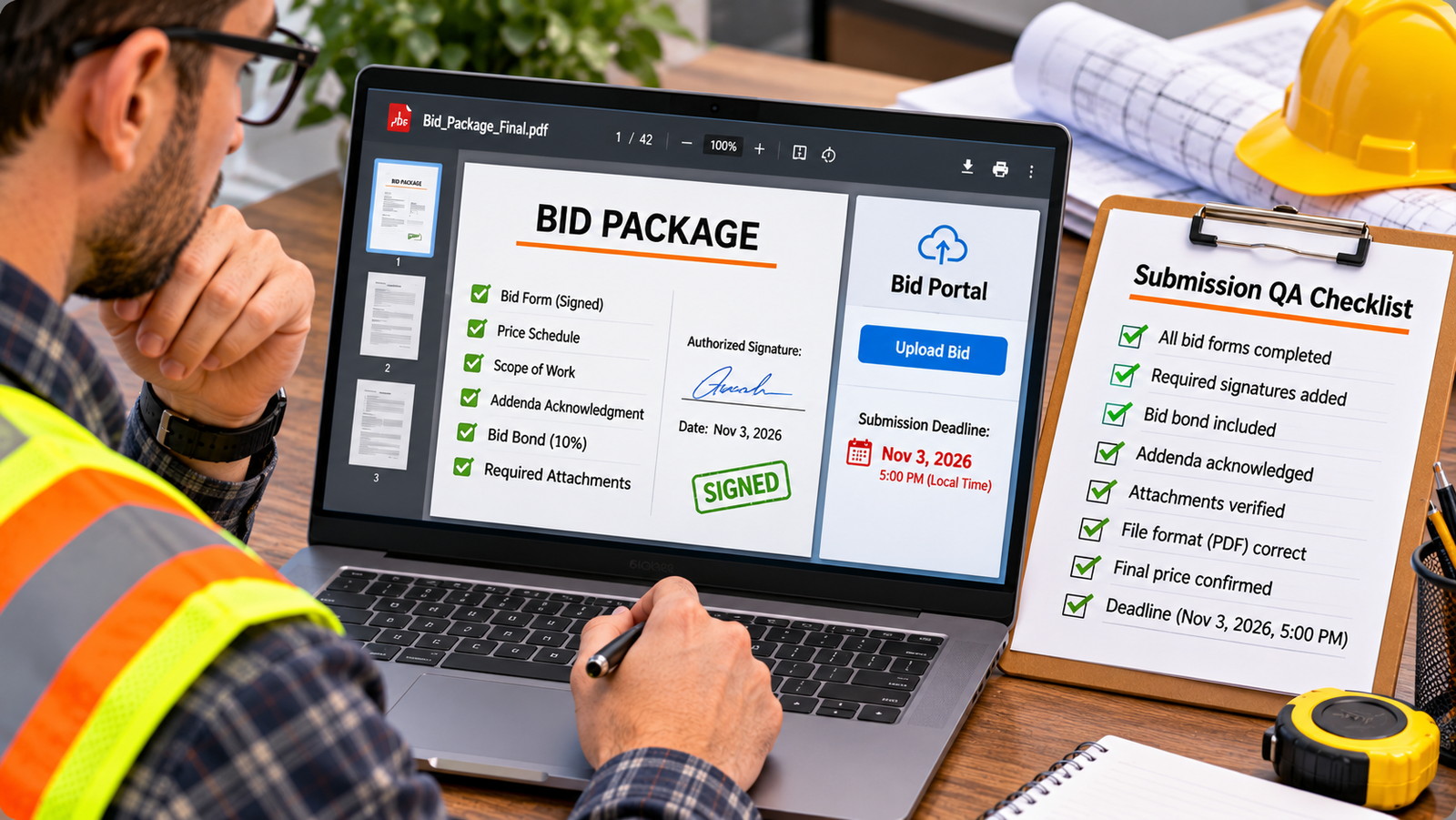
Then save a PDF or copy of exactly what was submitted, along with your worksheets and supplier quotes. If a mistake is alleged later, those records are your evidence.
FAR 14.407 shows why. A bidder claiming a mistake must support it with the file copy of the bid, original worksheets and subcontractor quotations (FAR 14.407-3). Keeping the package together protects you.
Run through Table 6 as the last step, and have someone else review it if you can.
| Final check | Complete? |
|---|---|
| Correct project | ☐ |
| Latest bid set | ☐ |
| All addenda included | ☐ |
| Scope review complete | ☐ |
| Quantities rechecked | ☐ |
| Supplier quotes current | ☐ |
| Labor hours reviewed | ☐ |
| Equipment reviewed | ☐ |
| Subcontractor scope matched | ☐ |
| Overhead and profit included | ☐ |
| Risks addressed | ☐ |
| Base bid arithmetic checked | ☐ |
| Alternates checked | ☐ |
| Bond requirements checked | ☐ |
| Bid form signed | ☐ |
| Submission deadline confirmed | ☐ |
| Upload or delivery complete | ☐ |
| Submitted copy saved | ☐ |
FHWA recommends a second, independent set of eyes on an estimate (FHWA). For a small contractor, that can be another estimator, a foreman or the owner checking the top cost drivers and the scope.
Concrete Contractor Bid Checklist FAQs
What should I check before submitting a concrete bid?
Check three things in order. First, the technical scope: current drawings, addenda and quantities. Second, cost and production: supplier quotes, labor hours, equipment, overhead, risk and profit. Third, compliance: the bid form, alternates, bonds, signatures, attachments and deadline. Then save a copy of exactly what you submitted.
How do I avoid missing scope?
Walk every drawing sheet and tick each concrete item against your priced scope, then check demolition, excavation, haul-off, base, forms, reinforcement, placement, finish, joints, curing, cleanup and mobilization. Review scope separately from arithmetic, because a bid can add up correctly and still leave out work.
Should I acknowledge every addendum?
Yes. List each addendum number on your bid summary sheet and acknowledge each one where the bid form asks. On federal sealed bids, a missed acknowledgment is excused only if the bid clearly shows receipt or the change was negligible, so the safest practice is to acknowledge every addendum.
What is the difference between base bid and alternate?
The base bid is the required primary scope. An alternate is optional scope that is added to or deducted from the base, usually in a priority order the owner sets. Price alternates separately and make sure none is accidentally included in the base.
Should concrete ordering allowance be included?
Yes, but show it separately from the theoretical takeoff quantity. NRMCA guidance is to order more than the plan volume to cover job contingencies, and that allowance is an ordering item, not profit or contingency. Keeping it visible makes the quantity easy to check.
What should I verify in supplier quotes?
Verify the quote date and expiration, the mix, the price per cubic yard, delivery and fuel fees, short-load and pump charges, admixtures or fibers, and any exclusions. Confirm the quote matches the actual project and bid date, since concrete, steel and fuel prices can change.
How do I check labor production?
Compare your crew size and hours with production from your own completed jobs, adjusted for access, finish and mobilizations. Check that setup and cleanup are counted once. A quick test is to divide the area by the crew-hours and see whether that rate is realistic.
What should be included in overhead?
Project overhead covers site costs such as supervision, mobilization and temporary facilities. Company overhead covers office, insurance, software and administration. Keep both separate from direct costs, risk and profit, and calculate them from your own records instead of using one universal percentage.
When is a bid bond required?
Only when the invitation or the governing law requires it. On federal construction, a bid guarantee is required when a performance bond is, and construction contracts above $150,000 need performance and payment bonds. Private, state and local rules differ, so read the invitation to bidders.
Should I list exclusions?
Yes, when the bid form or proposal allows it, and keep them specific to the job. On some public bids, qualifications that change the owner’s requirements can make a bid nonresponsive, so check the bid rules first and ask the owner if a clarification is allowed.
What happens if I miss a bid form?
It depends on the owner’s rules. A missing signature or form may be a minor informality that can be corrected on some bids, and a reason for rejection on others. Do not count on a waiver, and use the final checklist to confirm every required form is complete.
Should someone else review my bid?
Yes. A second reviewer catches errors the estimator no longer sees. FHWA recommends an independent set of eyes on estimates. Have another estimator, foreman or owner check the largest cost drivers, the scope and the bid form before it goes out.
Conclusion
Use this concrete contractor bid checklist as your last step before submission. Verify the documents and scope, recheck quantities and quotes, sanity-check labor, confirm overhead, risk and profit, then check every bid form requirement and keep a copy of what you submit.
Run your numbers once more before you send them.
Open the Contractor Bid Calculator