Concrete Patio vs Pavers: Which Is Better for Your Backyard? (2026)
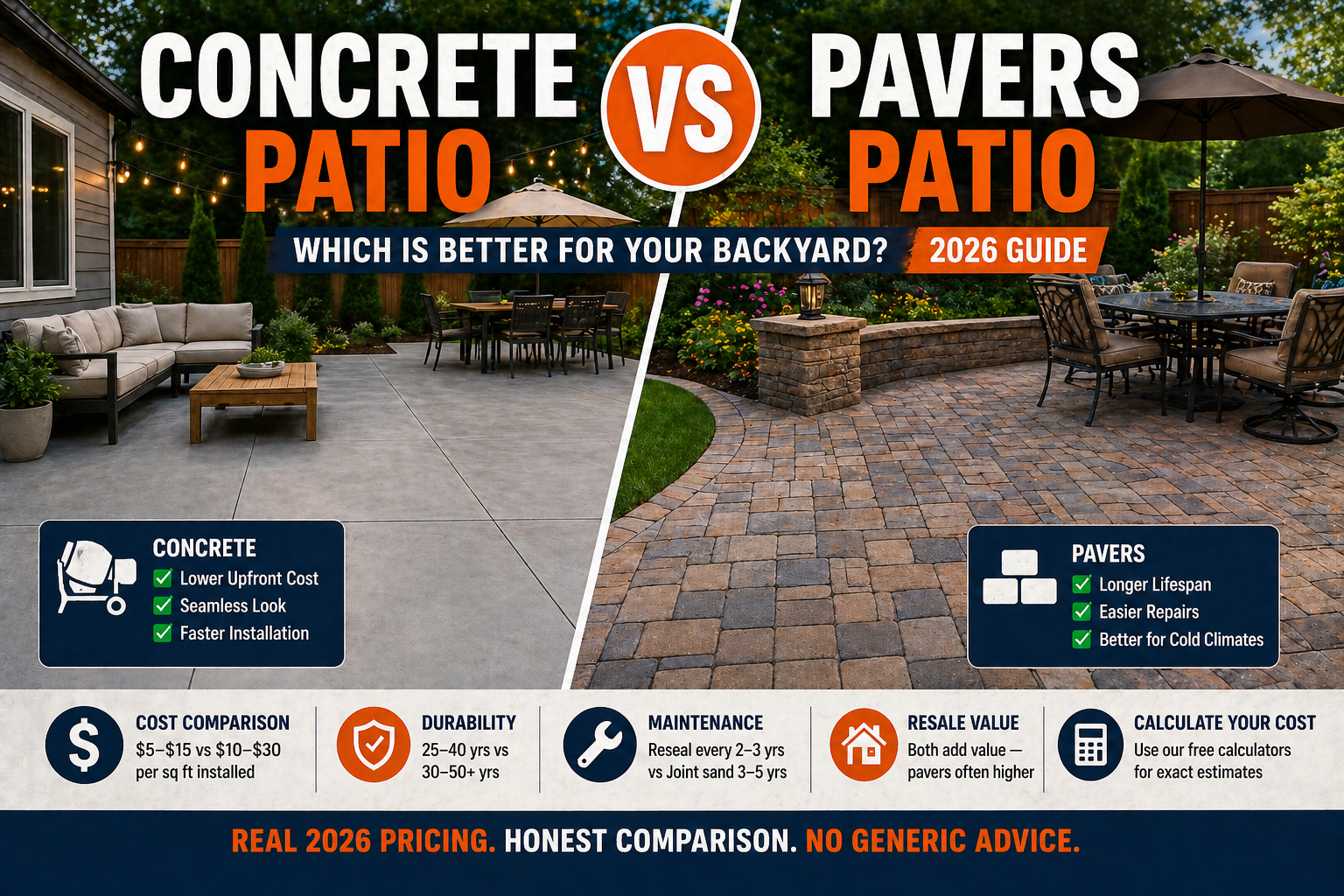
A concrete patio and a paver patio are the two most popular backyard surface choices for US homeowners. Concrete costs less to install. Pavers last longer and repair easier. But neither answer is that simple once you factor in your climate, budget, and how much maintenance you are willing to do. This guide covers everything you need to decide between the two – with real 2026 costs, honest durability data, and no generic filler.
How Each Material Is Built
A concrete patio is a single continuous slab poured directly on a prepared base of compacted gravel. Rebar or wire mesh goes in for reinforcement, then the concrete is poured, finished, and left to cure. It becomes one solid, rigid surface. Expansion joints are cut into the slab to control where cracking happens as the concrete expands and contracts with temperature changes.
A paver patio uses individual units of concrete, clay, brick, or natural stone set on a compacted gravel base and a layer of bedding sand. Each unit sits independently. They interlock together and are held in place by edge restraints and joint sand. Because each unit moves on its own, the surface as a whole can absorb soil movement and temperature stress without cracking.
The base preparation matters for both. A poorly prepared base is the number one reason patios fail early – for both material types. For pavers, base depth and compaction are especially critical because the sand layer must be uniform for the surface to stay level. The Base Material Calculator helps estimate gravel and sand quantities for paver projects before you order materials.
Cost Comparison: 2026 Numbers
Concrete is cheaper to pour and finish. Pavers cost more to install because of the labor involved in laying individual units, but they can cost less to own over the long run.
Installed Cost Per Square Foot (2026)
| Patio Type | Cost Per Sq Ft | 400 Sq Ft (20×20) | 600 Sq Ft (20×30) |
|---|---|---|---|
| Basic concrete slab | $5 – $10 | $2,000 – $4,000 | $3,000 – $6,000 |
| Colored concrete patio | $7 – $15 | $2,800 – $6,000 | $4,200 – $9,000 |
| Stamped concrete patio | $8 – $19 | $3,200 – $7,600 | $4,800 – $11,400 |
| Concrete paver patio | $10 – $20 | $4,000 – $8,000 | $6,000 – $12,000 |
| Brick paver patio | $10 – $25 | $4,000 – $10,000 | $6,000 – $15,000 |
| Natural stone paver patio | $15 – $30 | $6,000 – $12,000 | $9,000 – $18,000 |
Source: HomeGuide 2026 national cost data. Actual prices vary by region, contractor, and site conditions.
Use the Concrete Patio Cost Calculator for a precise concrete estimate and the Paver Installation Cost Calculator for a full paver project estimate. For material volume only, the Concrete Patio Calculator and the Paver Calculator give you what you need before calling a contractor.
Long-Term Cost Reality
Concrete patios need resealing every 2 to 3 years. That cost is $100 to $300 in DIY materials or $300 to $700 with a contractor. Over 20 years, you spend $800 to $4,000 on sealing alone, on top of any crack repairs. For ready-mix concrete pricing to help plan patch or resurfacing work, see the Ready-Mix Concrete Cost Per Yard Guide.
Paver patios need joint sand every 3 to 5 years (under $50 in materials for most patios) and occasional weed control. If a unit cracks or heaves, replacing it costs $20 to $100 depending on the paver type. Over 20 years, paver maintenance typically costs far less than concrete sealing and repairs combined.
💰 Example: 20-Year Total Cost on a 400 Sq Ft Patio
Basic Concrete: $3,200 install + $2,000 resealing + $800 crack repairs = approx. $6,000
Stamped Concrete: $5,000 install + $2,500 resealing + $1,200 repairs = approx. $8,700
Concrete Pavers: $5,600 install + $400 joint sand + $150 unit replacements = approx. $6,150
Takeaway: Over 20 years in a moderate US climate, basic concrete and concrete pavers come close to equal total cost. In freeze-thaw zones, concrete repair costs increase significantly, which tips the math toward pavers.
Durability and Lifespan
A properly installed concrete patio can last 25 to 40 years. That range is wide because so much depends on base preparation, concrete mix quality, expansion joint placement, and how consistently the surface gets sealed. Skip any of those steps and the lifespan shrinks fast.
Cracking is not a failure in concrete – it is expected. The goal is to control where cracks happen through proper joint spacing. When cracks appear outside the planned joints, which they often do, they are not just cosmetic. They let water in, which worsens the crack over time, especially in cold climates where that water freezes.
Pavers last 30 to 50 years or more in most conditions. The material itself is extremely dense and strong. Individual concrete pavers are manufactured under high compressive pressure to reach 8,000 PSI or higher – compared to 3,000 to 4,000 PSI for a typical residential concrete slab. Natural stone pavers have no meaningful strength limit under normal residential loads.
In states like Minnesota, Wisconsin, Ohio, Pennsylvania, and New York, freeze-thaw cycles put serious stress on solid concrete slabs. Water seeps into micro-pores, freezes, expands, and slowly breaks the surface apart. This is called spalling. A paver surface handles the same conditions much better because each unit can move slightly without transferring stress to adjacent units. If your backyard is in a frost-prone region, this factor alone is worth serious weight in your decision.
To understand how concrete gains strength during curing and why this affects long-term performance, read the Concrete Curing and Drying Time Guide. To understand why concrete cracks and what you can do about it, see Why Is My Concrete Cracking.
Appearance and Design Options
Plain gray concrete is functional but plain. Most homeowners upgrade to at least a brushed or broom finish, and many go further with color, exposed aggregate, or stamping. The variety of finishes available for poured concrete is actually quite broad. For a detailed look at surface options, read How to Finish Concrete.
Pavers offer more design variety at the unit level. You can mix sizes, colors, and patterns in ways that poured concrete cannot easily replicate. Running bond, herringbone, basketweave, and circular fan patterns all create a different look. Natural stone pavers bring organic variation that stamped concrete can approximate but never fully match.
One advantage concrete has is the seamless look. There are no visible joints cutting up the surface. For a modern minimalist backyard, a clean gray or charcoal concrete slab often looks more contemporary than a segmented paver layout.
Color retention is where pavers hold the edge long-term. Paver pigment runs through the entire unit, so it does not fade the same way a surface color hardener on stamped concrete does. A concrete patio that looked sharp on day one can look washed out by year five without consistent resealing. A paver patio generally looks close to its original appearance for 10 to 15 years with minimal care.
Maintenance Requirements
Neither material is zero-maintenance. The question is what type of upkeep you prefer and how time-sensitive it is.
Concrete Patio Maintenance
- Reseal every 2 to 3 years with a penetrating or film-forming sealer
- Clean with a mild concrete cleaner annually – avoid pressure washing at high PSI, which strips the sealer
- Fill hairline cracks promptly to prevent water intrusion and widening
- Avoid deicing salts like rock salt or calcium chloride directly on the patio surface – they accelerate scaling
- Do not use metal-edged snow removal tools – they scratch sealed or finished surfaces
The sealing schedule is non-negotiable for maintaining a concrete patio. Skipping even one cycle leaves the surface open to staining, water damage, and UV fading. Use the Concrete Sealer Calculator to plan exactly how much sealer you need each cycle based on your patio square footage.
Paver Patio Maintenance
- Replenish joint sand every 3 to 5 years as it settles or washes out
- Use polymeric sand to reduce weed growth and ant infiltration in the joints
- Pressure wash annually to remove moss, mildew, and organic staining
- Re-level individual pavers that sink or heave due to soil movement
- Optional: apply paver sealer every 3 to 5 years to enhance color and reduce weed growth
If you skip one paver joint sand cycle, the patio still looks and functions fine. If you skip two concrete resealing cycles, the surface begins to absorb stains, fade, and crack more aggressively. For homeowners who want flexibility in their maintenance schedule, pavers are the lower-risk choice year to year.
Repairs: Which Is Easier?
This is one of the most practical categories in the comparison – and pavers have a clear, undisputed advantage.
When a paver cracks, sinks, or chips, you pry up the affected unit with a flathead screwdriver, re-level the sand base underneath, and drop in a replacement unit. The repair takes 20 to 30 minutes and costs next to nothing if you saved spare pavers from the original installation. A good contractor will always recommend keeping 5 to 10 percent extra units on hand exactly for this reason.
When a concrete patio cracks, small cracks can be filled with a color-matched caulk or concrete filler. These repairs are visible up close but acceptable for many homeowners. Larger cracks, heaved sections, or spalling damage require sawcutting and removing the damaged section, pouring a new patch, and hoping the color match is close. It almost never is – because the patched section cures slightly differently than aged concrete.
If a concrete patio has widespread cracking, spalling, or surface deterioration, resurfacing with a thin overlay is sometimes a cost-effective middle option before full replacement. Use the Concrete Resurfacing Calculator to estimate coverage and material cost for a resurfacing project. For major repairs that require calculating new concrete volume, the Concrete Slab Calculator and Concrete Yardage Calculator give you the numbers you need.
Climate and Drainage Performance
Climate is one of the most overlooked factors in the concrete vs pavers decision – and it matters more than most homeowners realize.
In warm, dry climates like Phoenix, Las Vegas, San Antonio, and Southern California, concrete patios perform very well. Freeze-thaw cycles are rare or nonexistent. The slab stays stable year-round, maintenance is predictable, and concrete holds up for decades without major issues.
In cold climates like Chicago, Detroit, Denver, Minneapolis, and Boston, the story is different. Water gets into the concrete surface, freezes, expands, and chips the surface from within. Deicing salts used in winter accelerate this damage significantly. The result is spalling – a rough, pitted surface that develops within 10 to 15 years on even a well-poured slab in a northern climate.
Pavers handle these conditions better for two reasons. First, the joints between pavers allow water to drain down through the surface rather than pooling on top. Second, each unit moves independently, so freeze-thaw stress does not build up across the entire surface the way it does on a solid slab.
Drainage is also a practical issue in backyards with poor grading. A solid concrete slab sends all water to its edges. Pavers allow water to percolate through the joints, which reduces runoff, erosion around the patio edge, and standing water. In states with stormwater management requirements for residential properties, permeable pavers are an increasingly popular option.
Stamped Concrete as a Middle Option
If you want the look of pavers at a lower cost, stamped concrete is worth considering. It runs $8 to $19 per square foot installed – more than plain concrete but less than most paver installations.
Stamped concrete patterns can closely mimic brick, flagstone, slate, and cobblestone. Color is added through integral pigment or surface hardeners. For the right homeowner in the right climate, it is a smart middle ground between the two options covered in this guide.
The trade-offs are the same as plain concrete – it needs resealing, it will eventually crack, and repairs are visible. But the visual upgrade over plain gray concrete is significant, and the cost difference versus pavers is real, especially on larger patios. Use the Stamped Concrete Calculator to estimate material needs for a stamped project, and read the full Stamped Concrete vs Pavers comparison for a dedicated breakdown.
Resale Value
Both concrete patios and paver patios add resale value, but the amount depends on condition and material quality.
According to the National Association of Realtors 2023 Remodeling Impact Report, outdoor patio and hardscape projects recover between 60 and 80 percent of their installed cost at resale. A paver patio tends to recover toward the high end of that range because buyers and appraisers recognize the longer lifespan and lower future repair burden.
A basic concrete patio in good condition adds solid value and is expected by buyers in most US markets. One that is cracked, stained, or has visible patch repairs can actually reduce buyer confidence at the time of sale, because buyers will factor in the cost to repair or replace it.
In higher-end markets, a paver patio with quality material – brick, natural stone, or premium concrete pavers – can be a strong selling point that differentiates the home. In mid-range markets, a clean, freshly sealed concrete patio is often sufficient to meet buyer expectations without the added investment.
🔧 Calculate Your Patio Cost Before You Decide
Get accurate estimates for both concrete and paver patios based on your exact dimensions – no guesswork.
Use the Concrete Cost Calculator →Side-by-Side Verdict
| Category | Concrete Patio | Paver Patio | Winner |
|---|---|---|---|
| Upfront Cost | $5-$15/sq ft | $10-$30/sq ft | Concrete |
| 20-Year Total Cost | Higher with sealing and repairs | Lower long-term | Pavers |
| Lifespan | 25-40 years | 30-50+ years | Pavers |
| Freeze-Thaw Performance | Fair – surface spalls over time | Excellent – units flex | Pavers |
| Warm Climate Performance | Excellent | Excellent | Tie |
| Drainage | Runs to edges only | Percolates through joints | Pavers |
| Design Options | Good with stamping and color | More variety and patterns | Pavers |
| Color Retention | Fades without resealing | Holds color longer | Pavers |
| Repair Ease | Difficult – visible patches | Easy – replace one unit | Pavers |
| Maintenance Flexibility | Must reseal on schedule | More forgiving if delayed | Pavers |
| Installation Speed | Poured in one day, cure 28 days | Ready same day | Pavers |
| Resale Value | Good when in good condition | Strong – favored by appraisers | Pavers |
🎯 When to Choose Each Material
Choose a Concrete Patio if:
- Your upfront budget is the top priority
- You want a clean, seamless modern look without visible joints
- You live in a warm climate with no freeze-thaw cycles (South, Southwest, West Coast)
- You want a quick installation that cures in place without labor-intensive laying
- You plan to upgrade with stamped or colored finishes on a mid-range budget
Choose a Paver Patio if:
- You are in the Midwest, Northeast, or any region with regular freeze-thaw cycles
- You want easy repairs that are invisible – no patching, no color matching
- You want the longer lifespan and lower long-term maintenance burden
- You want more design variety and are willing to pay for it upfront
- You want to maximize resale value and appeal to future buyers
- Drainage and permeability matter for your site conditions