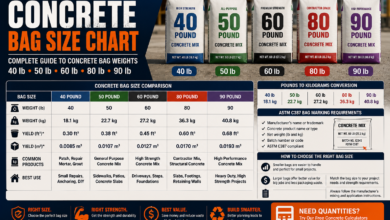
Concrete Coverage Chart – Bag Yield & Square Foot Coverage
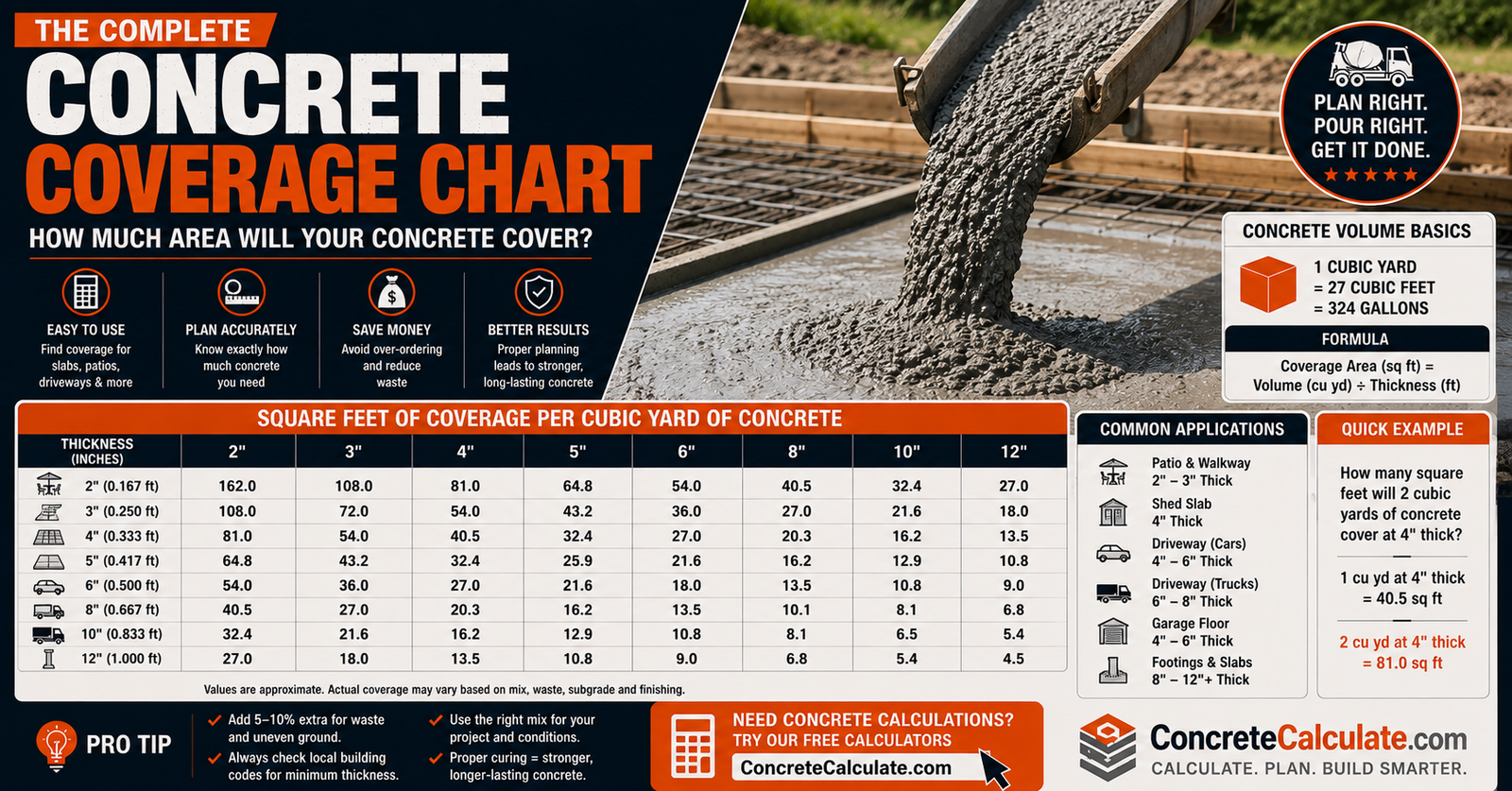
Concrete Coverage Chart
Bag Yield & Square Foot Coverage
A bag of concrete has no fixed square-foot coverage on its own. Coverage depends on the bag’s yield and the slab thickness together. This chart uses published QUIKRETE and Sakrete yield data to show real coverage by bag size and thickness.
 Reviewed by Muhammad Ramzan Babar, PhD Researcher & Calculator Developer · View Profile
This page covers how many square feet or cubic feet a bag of concrete fills. It has nothing to do with rebar concrete cover, which is the required distance between reinforcing steel and the concrete surface. See the Concrete Cover Chart for rebar cover requirements.
Planning your next concrete project?
Plan concrete materials and project costs with our downloadable Excel estimator pack. For estimating only; follow applicable technical standards for design and installation.
One-time purchase · Digital download⭐⭐⭐⭐⭐ Concrete Coverage Chart: Quick Reference
Approximate square-foot coverage per bag at common slab thicknesses, based on published standard concrete mix yield data.
| Bag Size | Yield (ft³) | Coverage at 2″ | Coverage at 3″ | Coverage at 4″ | Coverage at 5″ | Coverage at 6″ |
|---|---|---|---|---|---|---|
| 40 lb | 0.30 | 1.80 sq ft | 1.20 sq ft | 0.90 sq ft | 0.72 sq ft | 0.60 sq ft |
| 50 lb | 0.375 | 2.25 sq ft | 1.50 sq ft | 1.13 sq ft | 0.90 sq ft | 0.75 sq ft |
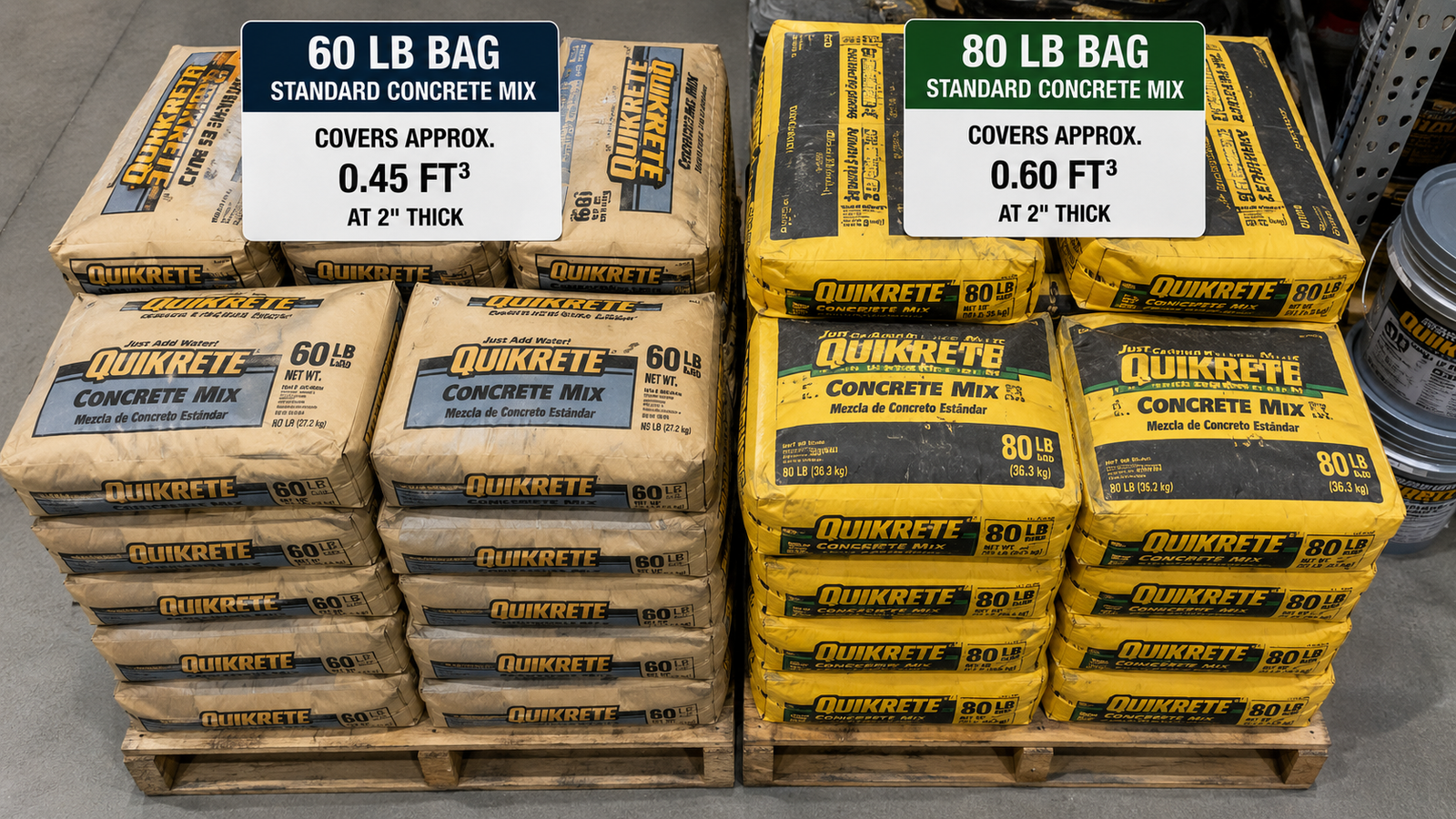
| 60 lb | 0.45 | 2.70 sq ft | 1.80 sq ft | 1.35 sq ft | 1.08 sq ft | 0.90 sq ft |
| 80 lb | 0.60 | 3.60 sq ft | 2.40 sq ft | 1.80 sq ft | 1.44 sq ft | 1.20 sq ft |
| 90 lb | 0.675 | 4.05 sq ft | 2.70 sq ft | 2.03 sq ft | 1.62 sq ft | 1.35 sq ft |
Yield values reproduce the published QUIKRETE Concrete Mix data sheet, which states a 40 lb bag yields approximately 0.30 cubic feet, a 50 lb bag approximately 0.375 cubic feet, a 60 lb bag approximately 0.45 cubic feet, an 80 lb bag approximately 0.60 cubic feet, and a 90 lb bag approximately 0.675 cubic feet. These figures apply to standard general-purpose concrete mix. High-yield formulations, covered later on this page, can differ substantially at the same bag weight.
⭐⭐⭐⭐⭐ What Does Concrete Coverage Mean?
Coverage is the surface area a fixed volume of mixed concrete can fill at a chosen thickness.
Volume yield
Each bag produces a fixed approximate volume of mixed concrete once combined with the specified amount of water.
Square-foot coverage
That same volume spreads over more or less surface area depending on how thick the slab or pour is.
Slab thickness
Thickness is the variable that converts a fixed volume into a specific square-foot coverage number.
Number of bags
Total bags needed comes from dividing total project volume by the yield of the specific bag being used.
The central relationship on this page is that a bag produces a fixed approximate volume, but its square-foot coverage changes with thickness. A thinner pour covers more area from the same bag; a thicker pour covers less.
⭐⭐⭐⭐⭐ Concrete Coverage vs Concrete Yield
These two terms describe different things and should not be used interchangeably.
| Term | What It Means | Example |
|---|---|---|
| Yield | Volume produced by one mixed bag | An 80 lb standard concrete mix bag yields approximately 0.60 cubic feet |
| Coverage | Surface area that volume can fill at a selected thickness | 0.60 cubic feet spread 4 inches thick covers about 1.8 square feet; the same volume spread 2 inches thick covers about 3.6 square feet |
Manufacturers publish bag yield in cubic feet on their technical data sheets. Coverage is then derived by dividing that yield by the chosen thickness, which is exactly how the tables on this page are built.
⭐⭐⭐⭐⭐ Concrete Bag Yield Chart
Published yield by bag weight for standard QUIKRETE Concrete Mix.
| Bag Weight | Approx. Yield (ft³) | Yield (yd³) | Approx. Liters |
|---|---|---|---|
| 40 lb | 0.30 | 0.011 | 8.5 L |
| 50 lb | 0.375 | 0.014 | 10.6 L |
| 60 lb | 0.45 | 0.017 | 12.7 L |
| 80 lb | 0.60 | 0.022 | 17 L |
| 90 lb | 0.675 | 0.025 | 19.1 L |
The 90 lb bag size is not sold in every region. Confirm local availability before planning a project around this size.
⭐⭐⭐⭐⭐ 40 lb Concrete Bag Coverage Chart
Square-foot coverage for a standard 40 lb bag at 0.30 cubic feet yield.
| Thickness | Approx. Coverage per 40 lb Bag |
|---|---|
| 2 in | 1.80 sq ft |
| 3 in | 1.20 sq ft |
| 4 in | 0.90 sq ft |
| 5 in | 0.72 sq ft |
| 6 in | 0.60 sq ft |
⭐⭐⭐⭐ 50 lb Concrete Bag Coverage Chart
Square-foot coverage for a standard 50 lb bag at 0.375 cubic feet yield.
| Thickness | Approx. Coverage per 50 lb Bag |
|---|---|
| 2 in | 2.25 sq ft |
| 3 in | 1.50 sq ft |
| 4 in | 1.13 sq ft |
| 5 in | 0.90 sq ft |
| 6 in | 0.75 sq ft |
⭐⭐⭐⭐⭐ 60 lb Concrete Bag Coverage Chart
One of the most commonly searched bag sizes, yielding approximately 0.45 cubic feet.
| Thickness | Approx. Coverage per 60 lb Bag |
|---|---|
| 2 in | 2.70 sq ft |
| 3 in | 1.80 sq ft |
| 4 in | 1.35 sq ft |
| 5 in | 1.08 sq ft |
| 6 in | 0.90 sq ft |

⭐⭐⭐⭐⭐ 80 lb Concrete Bag Coverage Chart
The most common standard bag size, yielding approximately 0.60 cubic feet.
| Thickness | Approx. Coverage per 80 lb Bag |
|---|---|
| 2 in | 3.60 sq ft |
| 3 in | 2.40 sq ft |
| 4 in | 1.80 sq ft |
| 5 in | 1.44 sq ft |
| 6 in | 1.20 sq ft |
| 8 in | 0.90 sq ft |
⭐⭐⭐⭐ 90 lb Concrete Bag Coverage Chart
Yields approximately 0.675 cubic feet, with regional availability.
| Thickness | Approx. Coverage per 90 lb Bag |
|---|---|
| 2 in | 4.05 sq ft |
| 3 in | 2.70 sq ft |
| 4 in | 2.03 sq ft |
| 5 in | 1.62 sq ft |
| 6 in | 1.35 sq ft |
⭐⭐⭐⭐⭐ Concrete Coverage by Slab Thickness
A single lookup table organized by thickness across every standard bag size.
| Thickness | 40 lb | 50 lb | 60 lb | 80 lb | 90 lb |
|---|---|---|---|---|---|
| 2 in | 1.80 | 2.25 | 2.70 | 3.60 | 4.05 |
| 3 in | 1.20 | 1.50 | 1.80 | 2.40 | 2.70 |
| 4 in | 0.90 | 1.13 | 1.35 | 1.80 | 2.03 |
| 5 in | 0.72 | 0.90 | 1.08 | 1.44 | 1.62 |
| 6 in | 0.60 | 0.75 | 0.90 | 1.20 | 1.35 |
| 8 in | 0.45 | 0.56 | 0.68 | 0.90 | 1.01 |
| 12 in | 0.30 | 0.38 | 0.45 | 0.60 | 0.68 |
All values in square feet per single bag, rounded to two decimals.
⭐⭐⭐⭐⭐ Concrete Coverage at 2 Inches Thick
Useful for thin applications where the specific product permits this placement depth.
Standard QUIKRETE Concrete Mix is designed for applications 2 inches thick or more. Minimum placement thickness is product-specific, so always confirm the applicable minimum for the exact product being used rather than assuming every concrete mix permits a 2 inch pour.
⭐⭐⭐⭐⭐ Concrete Coverage at 3 Inches Thick
Common for walkways, light-duty slabs, repairs, and small patios.
A 3 inch thickness is common for lighter-duty applications, but it is not automatically structurally suitable for every use. Confirm the appropriate thickness for the specific application, soil conditions, and any applicable load requirements before finalizing a design.
⭐⭐⭐⭐⭐ Concrete Coverage at 4 Inches Thick
Likely the single most searched thickness for residential concrete projects.
A 4 inch slab is a common baseline for many residential concrete projects, and manufacturer training examples frequently use a 4 inch slab to demonstrate calculating bag count from project volume divided by bag yield. At 4 inches, a standard 40 lb bag covers about 0.90 square feet, a 60 lb bag about 1.35 square feet, and an 80 lb bag about 1.80 square feet.
⭐⭐⭐⭐ Concrete Coverage at 5 Inches Thick
Useful for heavier residential slabs, some driveway applications, and equipment pads.
Keep application guidance general unless a specific design requirement calls for 5 inches. At this thickness, an 80 lb bag covers about 1.44 square feet.
⭐⭐⭐⭐⭐ Concrete Coverage at 6 Inches Thick
Common for heavier slabs, driveways, footings, and pads.
Manufacturer calculator tools commonly include slab calculations at both 4 inch and 6 inch thicknesses, reflecting how frequently these two depths are used. At 6 inches, an 80 lb bag covers about 1.20 square feet, and a 60 lb bag covers about 0.90 square feet.
⭐⭐⭐⭐ Concrete Coverage at 8 and 12 Inches Thick
More relevant for footings, thick pads, foundation elements, and columns than typical flatwork.
| Thickness | 80 lb Bag Coverage |
|---|---|
| 8 in | 0.90 sq ft |
| 12 in | 0.60 sq ft |
At these greater thicknesses, coverage per bag drops substantially, which is why footing and foundation-element volumes are usually estimated directly in cubic feet or cubic yards rather than square-foot coverage.
⭐⭐⭐⭐⭐ Square Feet Covered per Bag of Concrete
This question can only be answered once thickness is specified.
Asking “how many square feet does a bag of concrete cover” is incomplete without also specifying thickness. The same 80 lb bag covers 3.60 square feet at 2 inches or only 1.20 square feet at 6 inches. Always pair a coverage answer with the specific thickness used.
⭐⭐⭐⭐⭐ How to Calculate Concrete Coverage
The formula that generates every coverage value on this page.
Coverage area (ft²) = 12 x Yield (ft³) ÷ Thickness (in), where thickness is entered in inches. This is derived from Coverage = Yield ÷ Thickness in feet, converting thickness from inches to feet.
Worked calculation
⭐⭐⭐⭐⭐ How to Calculate Bags Needed from Coverage
The reverse calculation, going from project size to bag count.
Project volume V = Length x Width x (Thickness ÷ 12), in cubic feet. Bags required N = V ÷ Yield per bag, then round up to the next whole bag.
Worked calculation
⭐⭐⭐⭐⭐ Concrete Coverage by Square Footage
A reverse lookup showing 80 lb bags needed for common slab areas at several thicknesses.
| Slab Area | 3 in (80 lb bags) | 4 in (80 lb bags) | 5 in (80 lb bags) | 6 in (80 lb bags) |
|---|---|---|---|---|
| 10 sq ft | 5 | 6 | 7 | 9 |
| 25 sq ft | 11 | 14 | 18 | 21 |
| 50 sq ft | 21 | 28 | 35 | 42 |
| 100 sq ft | 42 | 56 | 70 | 84 |
| 200 sq ft | 84 | 112 | 139 | 167 |
Calculated from 80 lb bag yield of 0.60 cubic feet, rounded up to whole bags, before any waste allowance.
⭐⭐⭐ How Many Bags for 10 Square Feet?
A small project size, useful as a baseline example.
At 4 inches thick, 10 square feet requires approximately 6 standard 80 lb bags, based on the coverage-by-square-footage table above, before any waste allowance.
⭐⭐⭐ How Many Bags for 50 Square Feet?
A mid-size project such as a small pad or walkway section.
At 4 inches thick, 50 square feet requires approximately 28 standard 80 lb bags, before any waste allowance.
⭐⭐⭐⭐⭐ How Many Bags for 100 Square Feet?
A very common real-world project size, such as a 10 by 10 foot slab.
| Thickness | Approx. 80 lb Bags for 100 sq ft |
|---|---|
| 3 in | 42 bags |
| 4 in | 56 bags |
| 6 in | 84 bags |
These figures are calculated directly from the 0.60 cubic foot standard 80 lb yield and do not include waste allowance. At 100 square feet, many contractors and DIYers evaluate whether ready-mix delivery becomes more practical than bagged concrete given the bag count involved.
Equipment for Your Project
Affiliate disclosure: As an Amazon Associate, ConcreteCalculate earns from qualifying purchases. We may also earn a commission from other affiliate links at no additional cost to you.
⭐⭐⭐⭐⭐ How Many Bags for One Cubic Foot?
A direct volume-based reference independent of any specific slab dimensions.
| Bag Size | Bags per Cubic Foot |
|---|---|
| 40 lb | 3.33 |
| 50 lb | 2.67 |
| 60 lb | 2.22 |
| 80 lb | 1.67 |
| 90 lb | 1.48 |
Calculated as 1 ÷ yield per bag for each bag size, based on the published standard yields above.
⭐⭐⭐⭐⭐ How Many Bags per Cubic Yard?
Since 1 cubic yard equals 27 cubic feet, bags per yard is 27 divided by the bag’s yield.
| Bag Size | Yield (ft³) | Approx. Bags per Cubic Yard |
|---|---|---|
| 40 lb | 0.30 | 90 |
| 50 lb | 0.375 | 72 |
| 60 lb | 0.45 | 60 |
| 80 lb | 0.60 | 45 |
| 90 lb | 0.675 | 40 |
These figures are theoretical approximate bag counts based on published yields, before any allowance for waste, spillage, or mixing loss. Actual bags purchased for a project should include a reasonable waste allowance on top of these numbers.
⭐⭐⭐⭐⭐ Concrete Coverage in Cubic Feet vs Cubic Yards
Understanding these two volume units prevents a lot of estimating confusion.
Cubic feet
The unit bag yields are published in, useful for smaller bag-based projects.
Cubic yards
27 cubic feet equals 1 cubic yard, the unit ready-mix concrete is typically ordered and priced in for larger pours.
Square feet require thickness
Square footage alone does not represent volume; it must be combined with thickness to produce cubic feet or cubic yards.
Cubic yards already represent volume
Unlike square footage, a cubic yard figure already accounts for thickness, since it is a three-dimensional volume measurement.
⭐⭐⭐⭐ Concrete Coverage in Inches, Feet, and Yards
Thickness must be converted to feet before it can be used in the coverage formula.
| Thickness (in) | Thickness (ft) |
|---|---|
| 2 in | 0.167 ft |
| 3 in | 0.25 ft |
| 4 in | 0.333 ft |
| 6 in | 0.5 ft |
| 12 in | 1 ft |
⭐⭐⭐⭐⭐ QUIKRETE Concrete Coverage Chart
Published yield data specifically for standard QUIKRETE Concrete Mix.
| Bag Size | Yield |
|---|---|
| 40 lb | 0.30 ft³ |
| 50 lb | 0.375 ft³ |
| 60 lb | 0.45 ft³ |
| 80 lb | 0.60 ft³ |
| 90 lb | 0.675 ft³ |
These figures are published on the QUIKRETE Concrete Mix technical data sheet for that specific standard product family. They do not apply to every QUIKRETE product, such as fast-setting, mortar mix, or specialty structural mixes, each of which has its own published yield.
⭐⭐⭐⭐⭐ Sakrete Concrete Coverage Chart
Published yield data specifically for Sakrete standard concrete mix products.
| Bag Size | Yield |
|---|---|
| 40 lb | 0.30 ft³ |
| 60 lb | 0.45 ft³ |
| 80 lb | 0.60 ft³ |
These figures reflect Sakrete’s standard high-strength concrete mix product line at these bag weights. Sakrete’s specialty Maximizer product, covered in the next section, publishes a substantially different yield at the same bag weights.
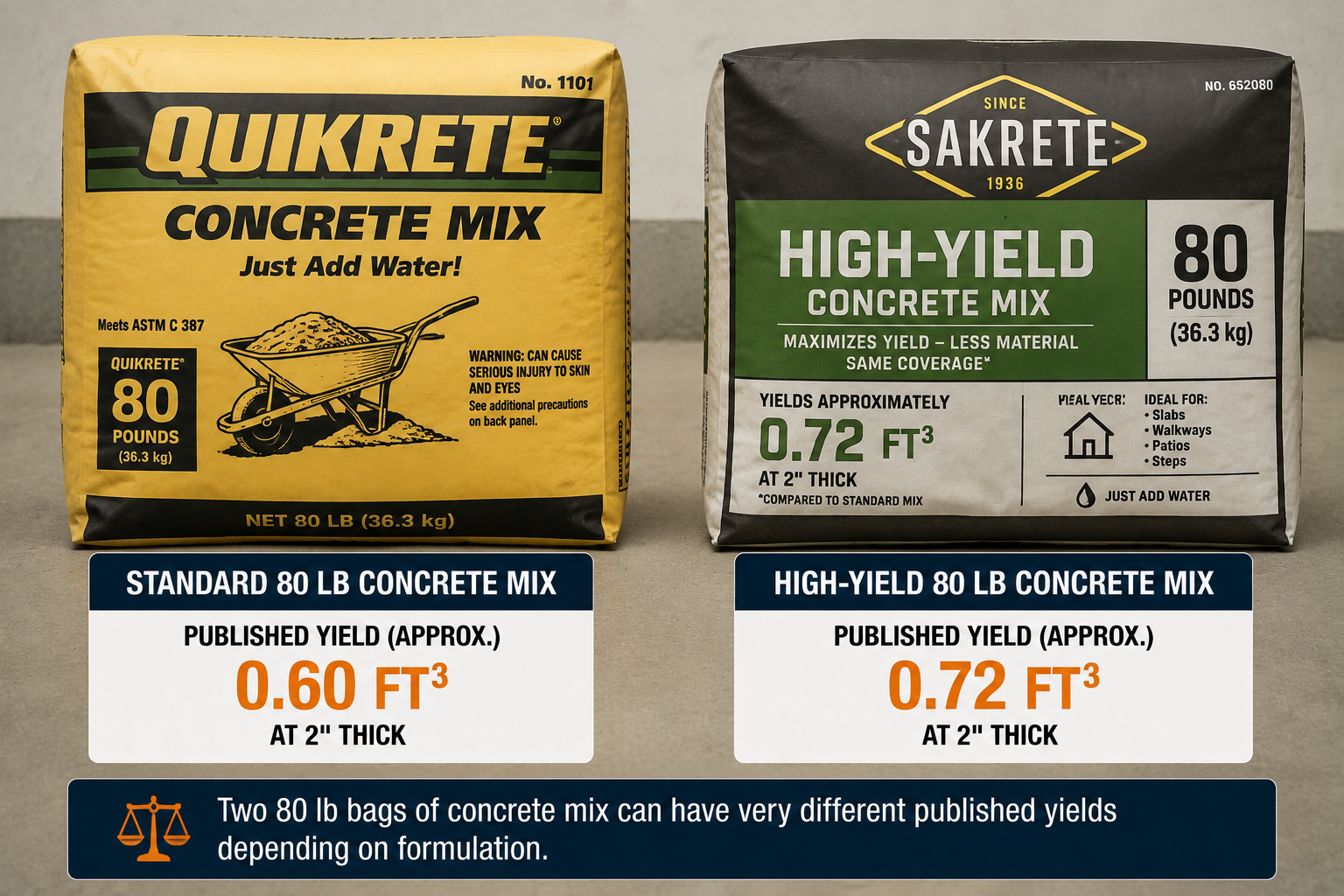
⭐⭐⭐⭐⭐ Standard vs High-Yield Concrete Mix Coverage
Never assume every 80 lb bag yields the same volume.
| Product | Bag Size | Published Yield |
|---|---|---|
| Standard QUIKRETE Concrete Mix | 80 lb | 0.60 ft³ |
| Standard Sakrete Concrete Mix | 80 lb | 0.60 ft³ |
| Sakrete Maximizer (high-yield, lightweight aggregate) | 80 lb | Approximately 1.0 ft³ per current published technical data |
Sakrete Maximizer is formulated with lightweight aggregate specifically to achieve a substantially higher yield than standard concrete mix at the same bag weight. Manufacturer marketing materials describe this as a significantly higher yield than standard mix. Always check the specific product’s own technical data sheet rather than assuming every 80 lb bag performs the same.
⭐⭐⭐⭐ Fast-Setting Concrete Coverage
Fast-setting mix has its own separate yield specifications.
| Bag Size | Fast-Setting Yield |
|---|---|
| 50 lb | 0.375 ft³ |
| 60 lb | 0.45 ft³ |
Even where fast-setting yield happens to match standard mix at a given bag weight, always confirm from the specific product’s own data sheet rather than assuming this holds true across every fast-setting product line.
⭐⭐⭐⭐⭐ Concrete Coverage for Slabs
How to calculate coverage for common slab-type projects.
Patio
Calculate patio area and thickness, then apply the coverage formula or the bag-count formula above.
Shed slab
Small shed slabs commonly use the coverage-by-square-footage table for quick bag estimation.
Garage pad
Larger garage pads often approach the point where cubic yard ready-mix ordering becomes more practical than bagged concrete.
Small equipment pad
Equipment pads follow the same volume-based calculation, adjusted for the specific thickness required by the equipment manufacturer.
See the Concrete Slab Calculator for a dedicated slab volume and bag-count tool.
⭐⭐⭐⭐ Concrete Coverage for Patios
Patio coverage calculation uses the same core inputs as any slab.
Patio coverage calculation requires length, width, thickness, and a reasonable waste allowance. See the Patio Concrete Calculator for a dedicated tool.
⭐⭐⭐⭐ Concrete Coverage for Driveways
Larger driveway projects often become impractical to mix entirely from bags.
Larger driveway projects usually become inefficient to mix from bags compared with ready-mix delivery, given the very high bag counts involved. This chart can still calculate the bag equivalent for reference or for small driveway repairs, but most full driveway pours are ordered as ready-mix by the cubic yard. See the Driveway Concrete Calculator and the Ready Mix vs Bagged Concrete guide for more on this decision.
⭐⭐⭐⭐ Concrete Coverage for Sidewalks and Walkways
A common bagged-concrete application given typically manageable project size.
Walkways and sidewalks are often sized well within the practical range for bagged concrete, using the same coverage and bag-count formulas as any other slab project.
⭐⭐⭐⭐ Concrete Coverage for Footings
Footing calculation is based on volume rather than surface coverage alone.
Footings are generally narrow and deep rather than broad and thin, so their concrete quantity is better estimated directly in cubic feet or cubic yards using length, width and depth, rather than a square-foot coverage lookup. See the Concrete Footing Calculator for a dedicated tool.
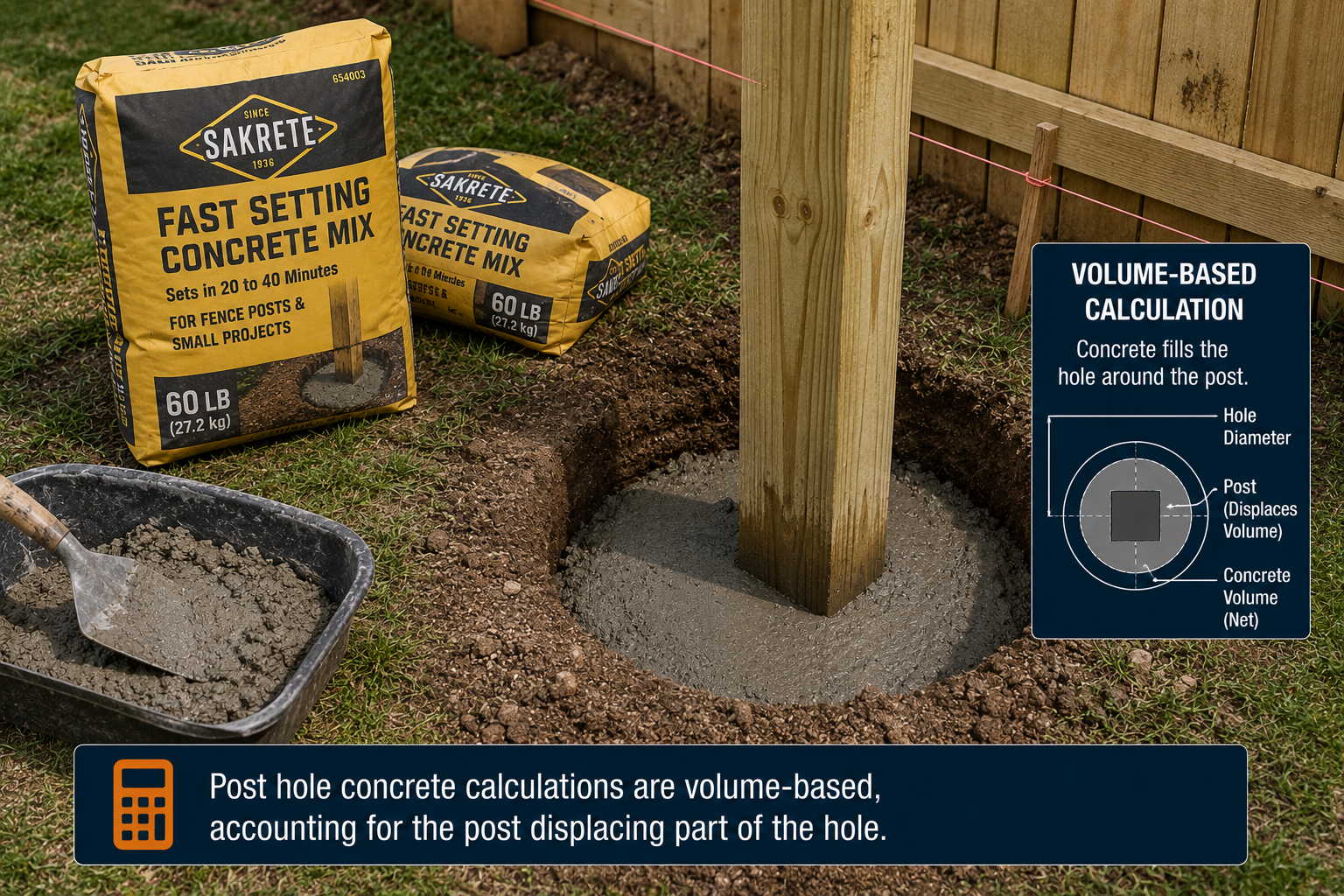
⭐⭐⭐⭐⭐ Concrete Coverage for Post Holes
Post hole coverage is expressed as volume and bags per hole, not square-foot coverage.
QUIKRETE Fast-Setting Concrete Mix’s technical data sheet states that two 50 lb bags will set a 3 inch square post in a 9 inch diameter hole 30 inches deep, and separately that two 50 lb bags will set a 4 inch diameter post in a 10 inch diameter hole 2 feet deep. These manufacturer examples reinforce that post-setting calculations are fundamentally volume-based, accounting for the post itself displacing part of the hole’s volume, rather than a square-foot coverage calculation.
See the Post Hole Concrete Calculator and Fence Post Concrete Calculator for dedicated post-hole volume tools.
⭐⭐⭐⭐⭐ Concrete Coverage and Waste Allowance
Practical estimating allowance for real-world project variability.
Uneven subgrade
A subgrade that is not perfectly flat and compacted can consume more concrete volume than the theoretical calculation assumes.
Forms and spillage
Formwork gaps and material spillage during mixing and placement both add to actual material consumed.
Thickness variation
Actual placed thickness commonly varies slightly across a pour, affecting total volume used.
Mixing loss and small quantity errors
Some material is inevitably lost during mixing, transport and placement, especially on smaller bag-based projects.
A practical estimate may add an extra allowance on top of the calculated bag count, but this percentage is a project estimating practice, not a manufacturer specification or code requirement. Adjust the allowance based on project conditions and experience.
⭐⭐⭐⭐⭐ Why Actual Concrete Coverage Can Differ
Manufacturer yield figures are approximate, not a guaranteed final field result.
Product formulation
Different concrete mix formulations, even at the same bag weight, can yield different volumes.
Water addition
Mixing with more or less water than specified changes the mixed volume and properties of the concrete.
Consolidation and aggregate composition
How thoroughly the mix is consolidated, and its specific aggregate makeup, both affect actual placed volume and density.
Mixing loss and spillage
Material lost during mixing and transport reduces the volume actually placed compared to the theoretical yield.
Uneven excavation and thickness variation
Real subgrade conditions and placement variability affect how much material a given area actually consumes.
Bag fill tolerances
Manufacturing tolerances in bag filling can produce minor variation in actual bag contents.
Manufacturer technical data sheets, including Sakrete’s, explicitly label yield and water values as approximate. Treat every coverage and bag-count figure on this page as an estimating tool, not a guaranteed exact quantity.
⭐⭐⭐⭐⭐ Adding Water Does Not Create Free Coverage
An important safety and quality point often misunderstood by first-time DIYers.
Adding water beyond the manufacturer’s specified amount does not create meaningful additional usable yield and instead changes workability, reduces strength, increases segregation risk, and can harm finishing behavior. QUIKRETE standard Concrete Mix specifies a particular starting water amount per 80 lb bag in its mixing instructions; follow the specific product’s water instructions rather than treating added water as a way to extend coverage.
⭐⭐⭐⭐⭐ Concrete Coverage Worked Examples
Practical demonstrations using stated assumptions and the reference data above.
1. A 10 by 10 ft slab at 4 inches
2. A 12 by 20 ft patio at 4 inches
3. Comparing 60 lb vs 80 lb bag count for the same slab
4. Comparing standard vs high-yield 80 lb mix
⭐⭐⭐⭐⭐ Common Concrete Coverage Mistakes
Most coverage errors trace back to one of these misunderstandings.
❌ Confusing square feet with cubic feet
Square footage alone is not a volume measurement; thickness must be included.
❌ Ignoring thickness
Coverage cannot be stated meaningfully without specifying the thickness used.
❌ Assuming every bag size has proportional yield
Yield does not scale in perfect proportion to bag weight across every product line.
❌ Assuming every 80 lb product yields the same volume
Standard and high-yield 80 lb products can differ substantially, as shown in the standard vs high-yield comparison above.
❌ Forgetting to convert inches to feet
Thickness must be converted from inches to feet before use in the volume formula.
❌ Not rounding bags up
Always round the calculated bag count up to the next whole bag, since partial bags cannot be purchased.
❌ Ignoring waste
Real-world projects typically consume somewhat more material than the theoretical calculation alone.
❌ Using dry bag weight as volume
Bag weight in pounds is not the same measurement as yield in cubic feet.
❌ Using rebar concrete cover data by mistake
Concrete cover refers to rebar clearance requirements, an entirely different topic from bag coverage.
❌ Adding extra water to stretch material
This does not create meaningful extra yield and instead harms strength and quality.
❌ Assuming one chart applies to mortar, grout, resurfacer and concrete
Each of these products has its own separate published yield; do not apply concrete mix yield to a different product type.
⭐⭐⭐⭐⭐ Concrete Coverage Chart Limitations
Understanding what this chart does not guarantee is essential for accurate project planning.
Coverage is based on approximate manufacturer yield
Published yield figures are approximate, not an exact guarantee of field results.
Product formulation matters
Different concrete mix products can have different yields even at the same bag weight.
High-yield products differ substantially
Specialty high-yield formulations can nearly double the yield of standard mix at the same bag weight.
Actual thickness can vary
Field-placed thickness is rarely perfectly uniform across an entire pour.
Waste and subgrade conditions affect bag count
Real project conditions typically require more material than the theoretical calculation alone.
Bag coverage is an estimating tool, not a structural design guide
This chart addresses material quantity estimation, not structural adequacy of a slab or footing design.
Minimum placement thickness is product-specific
Always confirm the minimum recommended thickness for the exact product being used.
Large pours may be better estimated in cubic yards
For larger projects, cubic yard-based ready-mix ordering is often more practical than bag-based estimation.
Frequently Asked Questions
📄 Download Concrete Coverage Chart PDF
This PDF is a genuine field reference. Use the print button to create a print-ready or downloadable version.
Cite or Embed This Chart
Copy the page-wide citation to reference the complete Concrete Coverage Chart.