
Concrete Weight Chart – lb, kg, Tons per Yard, Foot & Meter
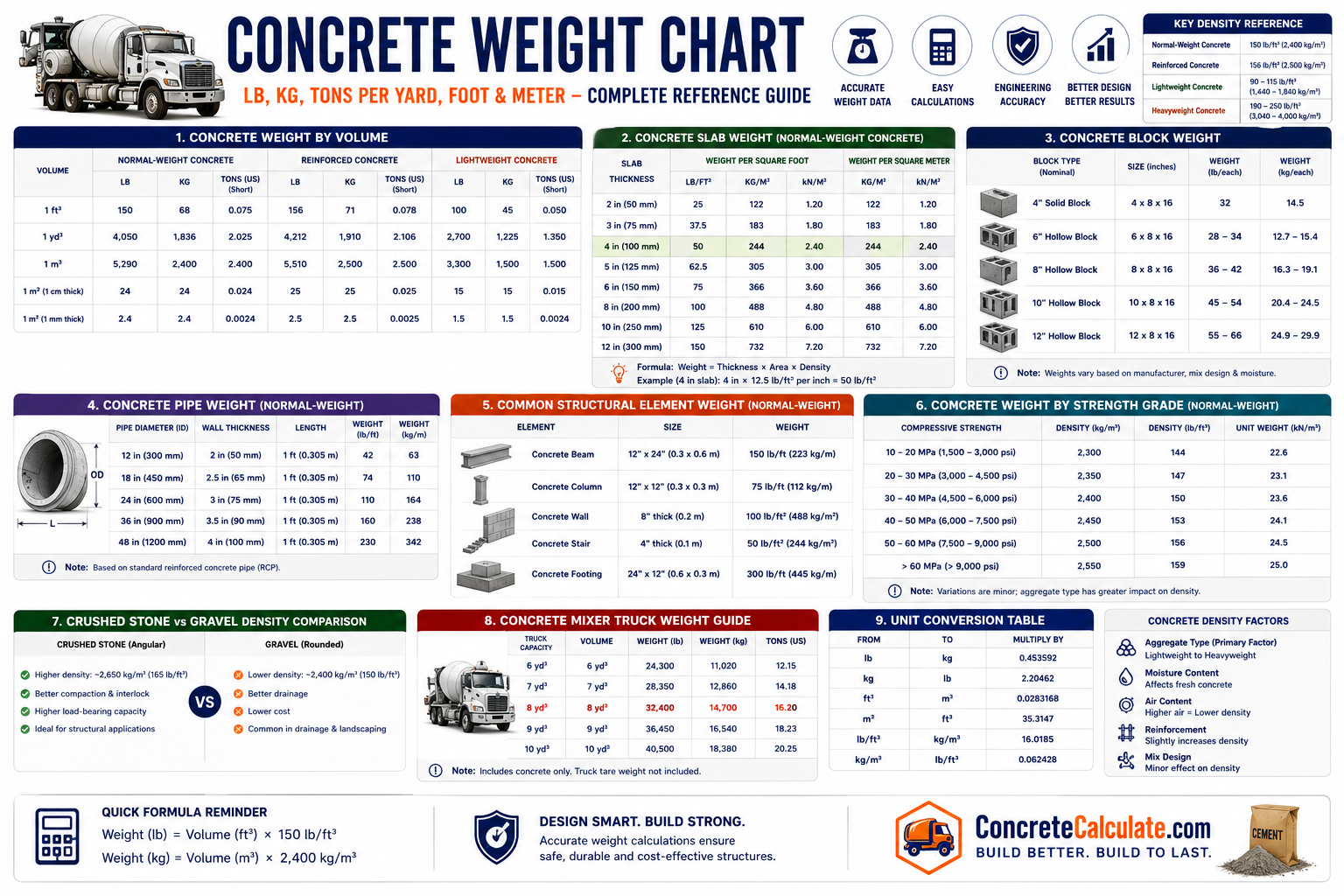
Concrete Weight Chart
lb, kg, Tons per Yard, Foot & Meter
The complete concrete weight reference — by volume, slab thickness, block size, and structural element in Imperial and Metric units.
 Reviewed by Muhammad Ramzan Babar, PhD Researcher (Plasma Physics) & Calculator Developer — View Profile
⭐ Master Concrete Weight Chart
Complete reference showing the weight of concrete by volume, slab size, block type, strength, density, and construction application in Imperial and Metric units.
How to Read This Chart
150 lb/ft³ (2,400 kg/m³) is the standard reference weight for normal concrete. Get an exact project total with our Concrete Weight Calculator.
| Reference | Value |
|---|---|
| Normal Concrete (per ft³) | 145-150 lb |
| Normal Concrete (per yd³) | 3,915-4,050 lb |
| Normal Concrete (per m³) | 2,320-2,400 kg |
| Lightweight Concrete (per ft³) | 90-115 lb |
| Reinforced Concrete (per ft³) | 150-156 lb |
| Heavyweight Concrete (per ft³) | 200-250 lb |
Source: standard concrete weight calculators and ACI density references.
⭐ Concrete Weight Chart by Volume
Convert common volume units directly to concrete weight using the standard normal-weight density of 150 lb/ft³ (2,400 kg/m³).
| Volume | Pounds (lb) | Kilograms (kg) | Tons | Metric Tons |
|---|---|---|---|---|
| Cubic Inch | 0.087 | 0.039 | 0.0000435 | 0.0000394 |
| Cubic Foot | 150 | 68 | 0.075 | 0.068 |
| Cubic Yard | 4,050 | 1,837 | 2.025 | 1.837 |
| Cubic Meter | 5,291 | 2,400 | 2.646 | 2.4 |
| Liter | 5.29 | 2.4 | 0.00265 | 0.0024 |
Source: concrete weight-per-volume references.
Concrete Weight per Cubic Foot Chart
Weight per cubic foot varies widely between lightweight and heavyweight concrete types.
| Concrete Type | Weight per ft³ (lb) |
|---|---|
| Lightweight Concrete | 90-115 |
| Normal Concrete | 145-150 |
| Reinforced Concrete | 150-156 |
| Heavyweight Concrete | 200-250 |
Source: concrete weight calculator mix-type comparison.
Concrete Weight per Cubic Yard Chart
Cubic yards are the standard ordering unit for ready-mix concrete deliveries in the US.
| Concrete Type | Weight (lb) | Weight (tons) | Typical Uses |
|---|---|---|---|
| Lightweight | 2,430-3,105 | 1.22-1.55 | Upper-floor slabs, topping slabs |
| Normal-Weight | 3,915-4,050 | 1.96-2.03 | Slabs, footings, walls, driveways |
| Reinforced | 4,050-4,212 | 2.03-2.11 | Structural beams, columns, slabs |
| Heavyweight | 5,400-6,750 | 2.7-3.4 | Radiation shielding, counterweights |
Concrete Weight per Cubic Meter Chart
Metric weight values are used internationally for concrete quantity and load specifications.
| Concrete Type | Weight (kg) | Weight (metric tons) | Unit Weight (kN/m³) |
|---|---|---|---|
| Lightweight | 1,440-1,840 | 1.44-1.84 | 14.1-18.0 |
| Normal-Weight | 2,320-2,400 | 2.32-2.4 | 22.7-23.5 |
| Reinforced | 2,400-2,500 | 2.4-2.5 | 23.5-24.5 |
| Heavyweight | 3,200-4,000 | 3.2-4.0 | 31.4-39.2 |
⭐ Concrete Weight by Thickness
Weight per square foot scales linearly with slab thickness — one of the most commonly searched reference tables in concrete work.
| Thickness | Weight per ft² (lb) | Weight per m² (kg) |
|---|---|---|
| 2 in | ~25 | ~122 |
| 3 in | ~37 | ~181 |
| 4 in | ~50 | ~244 |
| 5 in | ~62 | ~303 |
| 6 in | ~75 | ~366 |
| 8 in | ~100 | ~488 |
| 10 in | ~125 | ~610 |
| 12 in | ~150 | ~732 |
Source: concrete weight per square foot by thickness.
⭐ Concrete Slab Weight Chart
Common slab types use standardized thicknesses that determine total dead load per square foot.
| Slab Type | Thickness | Weight per ft² | Weight per m² |
|---|---|---|---|
| Sidewalk Slabs | 4 in | ~50 lb | ~244 kg |
| Garage Slabs | 4-5 in | ~50-62 lb | ~244-303 kg |
| Basement Floors | 4 in | ~50 lb | ~244 kg |
| Industrial Floors | 6-8 in | ~75-100 lb | ~366-488 kg |
| Driveways | 4-6 in | ~50-75 lb | ~244-366 kg |
| Warehouse Slabs | 6-10 in | ~75-125 lb | ~366-610 kg |
Source: slab weight guides by thickness and use case.
Concrete Weight by Density
Weight is a direct function of density multiplied by volume — see our full Concrete Density Chart for complete density references.
| Concrete Type | Density (kg/m³) | Weight (lb/ft³) |
|---|---|---|
| Lightweight Concrete | 1,440-1,840 | 90-115 |
| Normal-Weight Concrete | 2,320-2,400 | 145-150 |
| Reinforced Concrete | 2,400-2,500 | 150-156 |
| Heavyweight Concrete | 3,200-4,000 | 200-250 |
Concrete Weight by Strength Grade
Strength grade has only a minor effect on weight compared with aggregate type, which remains the primary driver of concrete weight.
| Grade | Approx. Weight (kg/m³) |
|---|---|
| M10 | ~2,300 |
| M15 | ~2,350 |
| M20 | ~2,400 |
| M25 | ~2,400 |
| M30 | ~2,400 |
| M35 | ~2,410 |
| M40 | ~2,420 |
| M50 | ~2,450 |
Concrete Weight by PSI
PSI-graded mixes generally fall within the normal-weight range, regardless of strength class.
| PSI | Weight (lb/ft³) |
|---|---|
| 2500 PSI | ~145 |
| 3000 PSI | ~145-148 |
| 3500 PSI | ~148 |
| 4000 PSI | ~148-150 |
| 5000 PSI | ~150 |
| 6000 PSI | ~150-155 |
For PSI-specific mix guidance, see our 2500 PSI Concrete Uses, 3000 PSI Guide, and 4000 PSI Guide.
⭐ Concrete Block Weight Chart
CMU block weight depends on nominal size and whether the unit is hollow or solid-core.
| Block Size | Hollow Blocks | Solid Blocks |
|---|---|---|
| 4 in | ~24 lb (11 kg) | ~34 lb (15 kg) |
| 6 in | ~25-28 lb (11-13 kg) | ~45 lb (20 kg) |
| 8 in | ~36-40 lb (16-18 kg) | ~54-76 lb (24-34 kg) |
| 10 in | ~43 lb (17.5 kg) | ~65 lb (29 kg) |
| 12 in | ~52 lb (23.5 kg) | ~80 lb (36 kg) |
Source: CMU block weight guides for hollow and solid blocks.
Concrete Pipe Weight Chart
Concrete pipe weight scales with diameter and wall thickness, critical for handling and installation planning.
| Diameter | Approx. Weight (lb/ft) |
|---|---|
| 6 in | ~35-45 |
| 8 in | ~50-65 |
| 12 in | ~90-120 |
| 18 in | ~175-230 |
| 24 in | ~290-380 |
| 36 in | ~560-745 |
Source: concrete pipe manufacturer weight tables by diameter.
Concrete Cylinder Weight Chart
Standard test cylinder weights are useful reference values for laboratories and engineering students.
| Cylinder Size | Approx. Weight (lb) |
|---|---|
| 4 x 8 in | ~8-9 |
| 6 x 12 in | ~27-28 |
Concrete Weight by Structural Element
Different structural members carry different volumes and reinforcement ratios, affecting total dead load.
| Element | Typical Weight (lb/ft³) |
|---|---|
| Footings | 150 |
| Slabs | 145-150 |
| Beams | 150-156 |
| Columns | 150-156 |
| Retaining Walls | 150 |
| Precast Panels | 150-159 |
Concrete Weight Conversion Chart
Convert between the most common weight units used across international construction standards.
| From | To | Multiply By |
|---|---|---|
| Pounds | Kilograms | × 0.4536 |
| Kilograms | Pounds | × 2.2046 |
| Pounds | US Tons | ÷ 2,000 |
| Kilograms | Metric Tons | ÷ 1,000 |
| Pounds | kN | × 0.004448 |
Concrete Weight vs Volume Chart
A quick-reference table showing corresponding weight values across common volume measurements for normal-weight concrete.
| Volume | Weight (Normal Concrete) |
|---|---|
| 1 Cubic Foot | 150 lb (68 kg) |
| 1 Cubic Yard | 4,050 lb (1.84 t) |
| 1 Cubic Meter | 2,400 kg (5,291 lb) |
Concrete Weight by Aggregate Type
Aggregate composition is the leading determinant of concrete weight across all mix designs.
| Aggregate Type | Typical Weight (kg/m³) |
|---|---|
| Limestone | 2,300-2,400 |
| Granite | 2,400-2,450 |
| Basalt | 2,450-2,550 |
| Gravel | 2,300-2,400 |
| Lightweight Aggregate | 1,400-1,850 |
| Steel Aggregate | 3,700-4,800 |
For full aggregate gradation standards, see our Aggregate Size Chart.
Concrete Weight by Construction Application
Expected total weight depends on both the concrete type and the typical volume used per application.
| Application | Typical Weight Basis |
|---|---|
| Foundations | 150 lb/ft³ |
| Footings | 150 lb/ft³ |
| Slabs | 145-150 lb/ft³ |
| Sidewalks | ~50 lb/ft² (4 in) |
| Driveways | ~50-75 lb/ft² (4-6 in) |
| Bridges | 150-156 lb/ft³ |
| Retaining Walls | 150 lb/ft³ |
| Parking Lots | ~75-100 lb/ft² (6-8 in) |
Concrete Truck Load Weight Chart
Truck payload limits vary by region and regulations — always confirm with local haulers before scheduling large pours.
| Volume | Approx. Total Weight (lb) |
|---|---|
| 1 Yard | ~4,050 |
| 2 Yards | ~8,100 |
| 5 Yards | ~20,250 |
| 8 Yards | ~32,400 |
| 10 Yards | ~40,500 |
Regulatory Note
Standard mixer trucks typically carry 8-10 cubic yards, but gross vehicle weight limits vary by state and country regulations.
⭐ Concrete Weight Estimation Guide
A quick decision reference matching project type to typical thickness and estimated weight.
| Project | Typical Thickness | Estimated Weight | Notes |
|---|---|---|---|
| Patio | 4 in | ~50 lb/ft² | Use non-reinforced normal-weight mix |
| Sidewalk | 4 in | ~50 lb/ft² | Standard residential flatwork thickness |
| Garage Floor | 4-5 in | ~50-62 lb/ft² | Add reinforcement for vehicle loads |
| Foundation | 8-12 in | ~100-150 lb/ft² | Depth depends on soil and load requirements |
| Driveway | 4-6 in | ~50-75 lb/ft² | Thicker for heavy vehicle traffic |
| Warehouse Slab | 6-10 in | ~75-125 lb/ft² | Reinforce for forklift and rack loads |
⭐ Visual Concrete Weight Comparison
Equal-sized sections scaled by relative weight illustrate how dramatically concrete type changes total mass.
1 Cubic Foot
Weighs approximately 150 lb of normal-weight concrete
1 Cubic Yard
Weighs approximately 4,050 lb, roughly the weight of a small car
1 Cubic Meter
Weighs approximately 2,400 kg, close to a small SUV
Common Concrete Weight Calculation Mistakes
These frequent errors lead to inaccurate dead-load estimates and material planning issues.
Confusing density with weight
Density is weight per unit volume; total weight requires multiplying density by the actual volume of concrete used.
Mixing Imperial and Metric units
Combining lb/ft³ with m³ without proper conversion causes significant calculation errors.
Ignoring reinforcement weight
Steel reinforcement adds measurable weight that is often overlooked in quick estimates.
Incorrect thickness measurements
Small thickness errors compound significantly over large slab areas, skewing total weight.
Using the wrong concrete type
Applying normal-weight density to a lightweight or heavyweight mix produces inaccurate weight estimates.
Rounding errors in volume calculations
Rounding cubic footage too early in multi-step calculations can meaningfully shift final weight totals.
Contractor Worked Examples
Real-world weight calculations for common job scenarios.
Sidewalk Weight Calculation
Driveway Weight Calculation
Foundation Weight Estimation
Slab Dead Load
Concrete Truck Capacity
Retaining Wall Weight
Frequently Asked Questions
📥 Download Concrete Weight Chart PDF
Use your browser’s print function to instantly save this page as a PDF — a printable engineering reference with weight-per-volume tables, slab and block weight charts, conversion tables, and a field-ready contractor guide.