PVC Conduit Fill Chart – Schedule 40 and 80 Wire Capacity
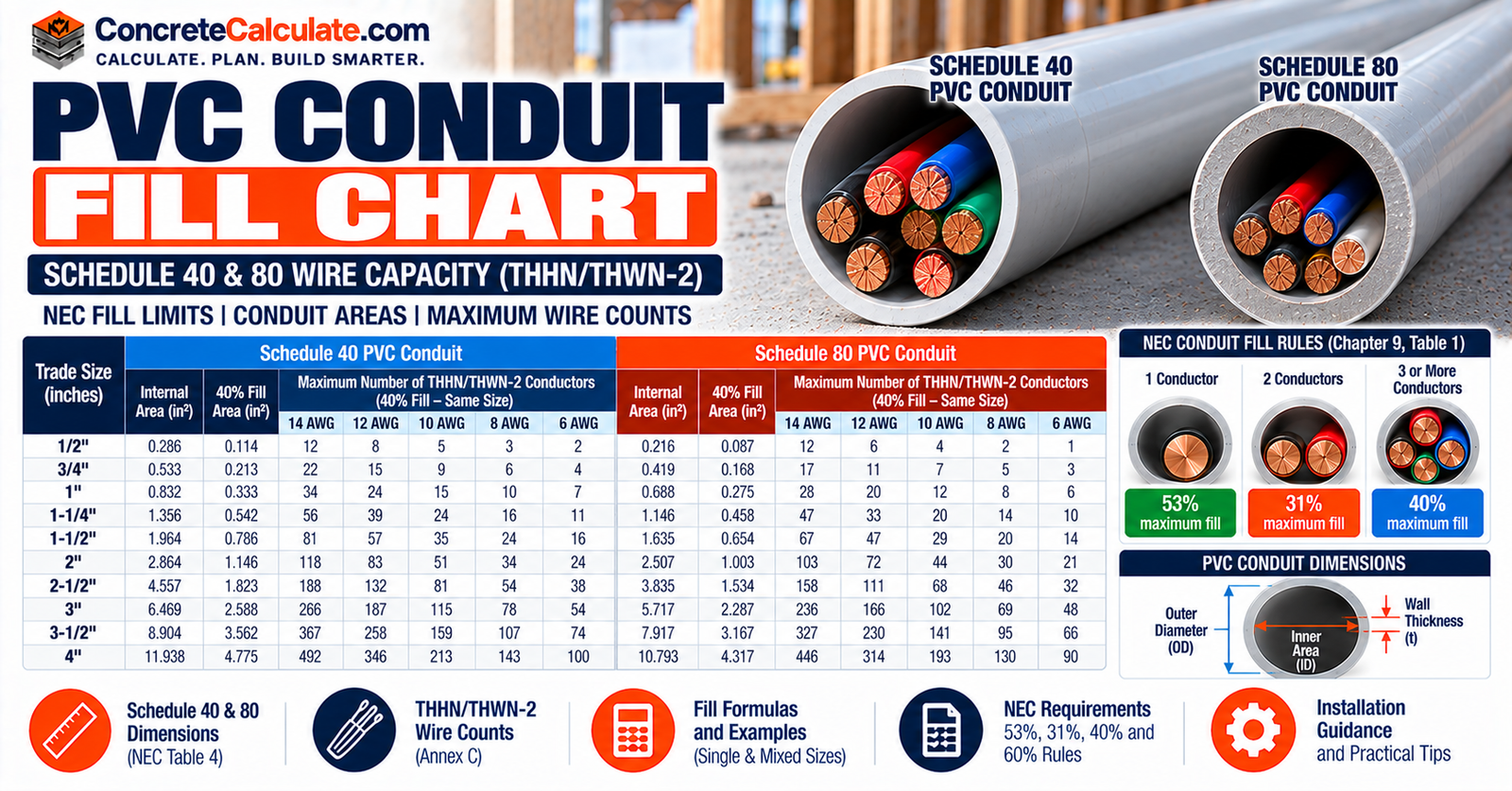
PVC Conduit Fill Chart
Schedule 40 and 80 Wire Capacity
See allowable fill areas and same-size THHN/THWN-2 conductor counts for Schedule 40 and Schedule 80 PVC electrical conduit, with the 53%, 31%, 40% and 60% limits, mixed-conductor calculations and clear limits on what fill does and does not tell you.
 Reviewed by Muhammad Ramzan Babar, PhD Researcher (Plasma Physics) & Calculator Developer – View Profile
Short Answer
PVC conduit fill uses the same NEC limits as other raceways: 53% for one conductor, 31% for two, 40% for more than two and 60% for a qualifying nipple of 24 in. or less. Schedule 80 has a thicker wall and less internal area than Schedule 40 of the same trade size, so it holds fewer conductors. Count grounding conductors, and check ampacity separately.
PVC Conduit Fill Chart
Fill is based on cross-sectional area. Use this allowable-area chart first, then the Schedule 40 and Schedule 80 conductor-count charts below.
How to Read This Chart
Each row gives the tabulated internal area and the maximum area conductors may occupy at each NEC limit. Fill is measured by cross-sectional area, and Schedule 40 and Schedule 80 are listed separately because their internal areas differ at the same trade size.
PVC Allowable Fill Area by Trade Size
| Trade Size | Schedule | Total Area (in²) | 1 Conductor 53% (in²) | 2 Conductors 31% (in²) | 3+ Conductors 40% (in²) | Qualifying Nipple 60% (in²) |
|---|---|---|---|---|---|---|
| 1/2 in. | Schedule 40 | 0.285 | 0.151 | 0.088 | 0.114 | 0.171 |
| 1/2 in. | Schedule 80 | 0.217 | 0.115 | 0.067 | 0.087 | 0.130 |
| 3/4 in. | Schedule 40 | 0.508 | 0.269 | 0.157 | 0.203 | 0.305 |
| 3/4 in. | Schedule 80 | 0.409 | 0.217 | 0.127 | 0.164 | 0.245 |
| 1 in. | Schedule 40 | 0.832 | 0.441 | 0.258 | 0.333 | 0.499 |
| 1 in. | Schedule 80 | 0.688 | 0.365 | 0.213 | 0.275 | 0.413 |
| 1-1/4 in. | Schedule 40 | 1.453 | 0.770 | 0.450 | 0.581 | 0.872 |
| 1-1/4 in. | Schedule 80 | 1.237 | 0.656 | 0.383 | 0.495 | 0.742 |
| 1-1/2 in. | Schedule 40 | 1.986 | 1.053 | 0.616 | 0.794 | 1.192 |
| 1-1/2 in. | Schedule 80 | 1.711 | 0.907 | 0.530 | 0.684 | 1.027 |
| 2 in. | Schedule 40 | 3.291 | 1.744 | 1.020 | 1.316 | 1.975 |
| 2 in. | Schedule 80 | 2.874 | 1.523 | 0.891 | 1.150 | 1.724 |
| 2-1/2 in. | Schedule 40 | 4.695 | 2.488 | 1.455 | 1.878 | 2.817 |
| 2-1/2 in. | Schedule 80 | 4.119 | 2.183 | 1.277 | 1.647 | 2.471 |
| 3 in. | Schedule 40 | 7.268 | 3.852 | 2.253 | 2.907 | 4.361 |
| 3 in. | Schedule 80 | 6.442 | 3.414 | 1.997 | 2.577 | 3.865 |
| 3-1/2 in. | Schedule 40 | 9.737 | 5.161 | 3.018 | 3.895 | 5.842 |
| 3-1/2 in. | Schedule 80 | 8.688 | 4.605 | 2.693 | 3.475 | 5.213 |
| 4 in. | Schedule 40 | 12.554 | 6.654 | 3.892 | 5.022 | 7.532 |
| 4 in. | Schedule 80 | 11.258 | 5.967 | 3.490 | 4.503 | 6.755 |
Values represent allowable occupied cross-sectional area, not conduit diameter. The 40% column for Schedule 80 follows the NFPA-published values; other percentage columns are derived from the tabulated total and may differ from the printed table by 0.001 in². Verify against the NEC edition applicable to the project.
Source: NEC Chapter 9 Table 4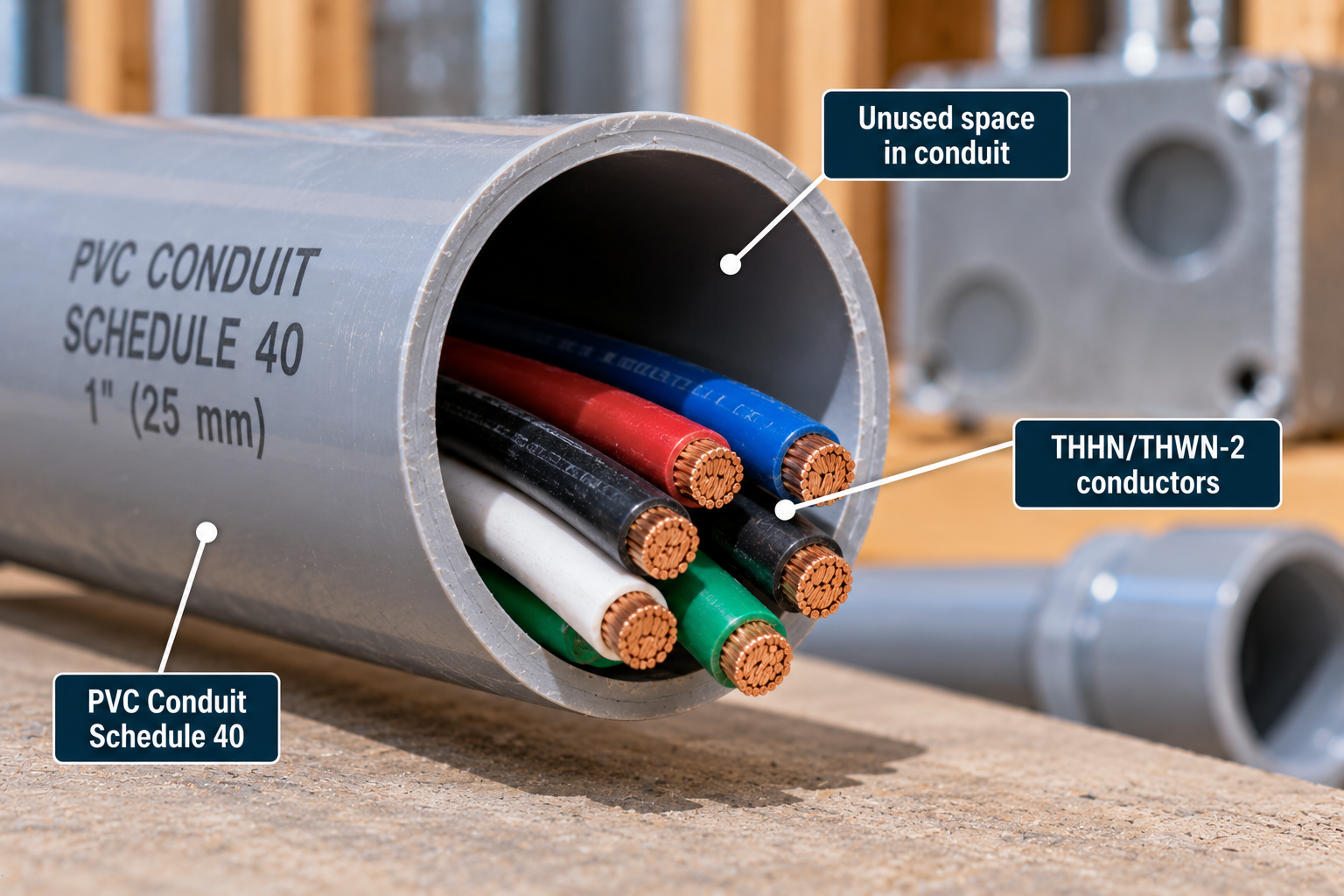
Use the NEC Edition Your AHJ Adopted
Figures follow Chapter 9 as published in recent editions, and NFPA lists the 2026 NEC as the current edition. Adoption varies by jurisdiction, so confirm the edition and local amendments. For rules that apply to every raceway type, see the Conduit Fill Chart.
Schedule 40 PVC Conduit Fill Chart
Maximum THHN/THWN-2 Conductors
| THHN/THWN-2 | 1/2 in. | 3/4 in. | 1 in. | 1-1/4 in. | 1-1/2 in. | 2 in. | 2-1/2 in. | 3 in. | 3-1/2 in. | 4 in. |
|---|---|---|---|---|---|---|---|---|---|---|
| 14 AWG | 11 | 21 | 34 | 60 | 82 | 135 | 193 | 299 | 401 | 517 |
| 12 AWG | 8 | 15 | 25 | 43 | 59 | 99 | 141 | 218 | 293 | 377 |
| 10 AWG | 5 | 9 | 15 | 27 | 37 | 62 | 89 | 137 | 184 | 238 |
| 8 AWG | 3 | 5 | 9 | 16 | 21 | 36 | 51 | 79 | 106 | 137 |
| 6 AWG | 1 | 4 | 6 | 11 | 15 | 26 | 37 | 57 | 77 | 99 |
| 4 AWG | 1 | 2 | 4 | 7 | 9 | 16 | 22 | 35 | 47 | 61 |
| 3 AWG | 1 | 1 | 3 | 6 | 8 | 13 | 19 | 30 | 40 | 51 |
| 2 AWG | 1 | 1 | 3 | 5 | 7 | 11 | 16 | 25 | 33 | 43 |
| 1 AWG | 1 | 1 | 1 | 3 | 5 | 8 | 12 | 18 | 25 | 32 |
| 1/0 AWG | 1 | 1 | 1 | 3 | 4 | 7 | 10 | 15 | 21 | 27 |
| 2/0 AWG | None | 1 | 1 | 2 | 3 | 6 | 8 | 13 | 17 | 22 |
| 3/0 AWG | None | 1 | 1 | 1 | 3 | 5 | 7 | 11 | 14 | 18 |
| 4/0 AWG | None | 1 | 1 | 1 | 2 | 4 | 6 | 9 | 12 | 15 |
How to Use the Schedule 40 Chart
Find the conductor size in the left column and read across to the trade size. For example, 1/2-in. Schedule 40 PVC holds 8 conductors of 12 AWG THHN/THWN-2, and 1-in. Schedule 40 holds 15 conductors of 10 AWG.
The counts apply only to same-size THHN/THWN/THWN-2 conductors in Schedule 40 PVC. They do not apply to other insulation types, mixed sizes, compact conductors or Schedule 80. Counts for one and two conductors follow their own limits and are not the 40% case.
Calculated from Chapter 9 Tables 1, 4 and 5 with the Note 7 rounding rule; matches a published 2020 NEC Annex C tableSchedule 80 PVC Conduit Fill Chart
Maximum THHN/THWN-2 Conductors
| THHN/THWN-2 | 1/2 in. | 3/4 in. | 1 in. | 1-1/4 in. | 1-1/2 in. | 2 in. | 2-1/2 in. | 3 in. | 3-1/2 in. | 4 in. |
|---|---|---|---|---|---|---|---|---|---|---|
| 14 AWG | 9 | 17 | 28 | 51 | 70 | 118 | 170 | 265 | 358 | 464 |
| 12 AWG | 6 | 12 | 20 | 37 | 51 | 86 | 124 | 193 | 261 | 338 |
| 10 AWG | 4 | 7 | 13 | 23 | 32 | 54 | 78 | 122 | 164 | 213 |
| 8 AWG | 2 | 4 | 7 | 13 | 18 | 31 | 45 | 70 | 95 | 123 |
| 6 AWG | 1 | 3 | 5 | 9 | 13 | 22 | 32 | 51 | 68 | 89 |
| 4 AWG | 1 | 1 | 3 | 6 | 8 | 14 | 20 | 31 | 42 | 54 |
| 3 AWG | 1 | 1 | 3 | 5 | 7 | 12 | 17 | 26 | 35 | 46 |
| 2 AWG | 1 | 1 | 2 | 4 | 6 | 10 | 14 | 22 | 30 | 39 |
| 1 AWG | None | 1 | 1 | 3 | 4 | 7 | 10 | 16 | 22 | 29 |
| 1/0 AWG | None | 1 | 1 | 2 | 3 | 6 | 9 | 14 | 18 | 24 |
| 2/0 AWG | None | 1 | 1 | 1 | 3 | 5 | 7 | 11 | 15 | 20 |
| 3/0 AWG | None | 1 | 1 | 1 | 2 | 4 | 6 | 9 | 13 | 17 |
| 4/0 AWG | None | None | 1 | 1 | 1 | 3 | 5 | 8 | 10 | 14 |
Counts are generally lower than in Schedule 40 because Schedule 80 has a thicker wall and less internal area at the same trade size. Annex C has a separate Schedule 80 table based on Chapter 9 Tables 1, 4 and 5, so do not estimate the difference from nominal pipe dimensions.
Schedule 40 vs. Schedule 80 PVC Conduit Fill
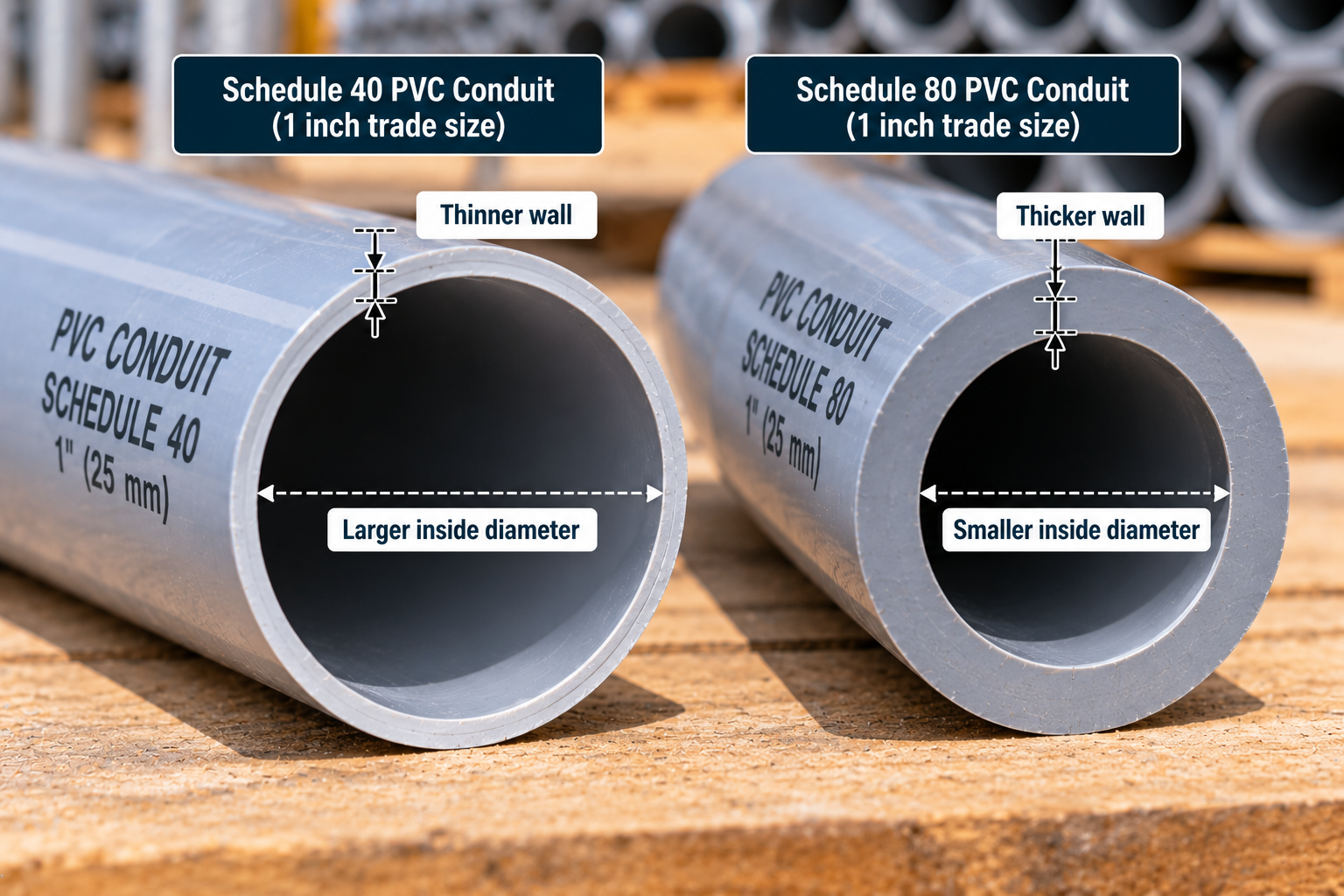
The NEC fill percentages are the same for both schedules. The difference is wall thickness, which changes the internal area.
| Trade Size | Sch. 40 40% Area (in²) | Sch. 80 40% Area (in²) | Schedule 80 Is Lower By |
|---|---|---|---|
| 1/2 in. | 0.114 | 0.087 | 23.7% |
| 3/4 in. | 0.203 | 0.164 | 19.2% |
| 1 in. | 0.333 | 0.275 | 17.4% |
| 1-1/4 in. | 0.581 | 0.495 | 14.8% |
| 1-1/2 in. | 0.794 | 0.684 | 13.9% |
| 2 in. | 1.316 | 1.150 | 12.6% |
| 2-1/2 in. | 1.878 | 1.647 | 12.3% |
| 3 in. | 2.907 | 2.577 | 11.4% |
| 3-1/2 in. | 3.895 | 3.475 | 10.8% |
| 4 in. | 5.022 | 4.503 | 10.3% |
For example, 1/2-in. Schedule 40 allows 0.114 in² at 40%, while 1/2-in. Schedule 80 allows 0.087 in². The rule is the same, and the smaller opening does the work.
What Is PVC Electrical Conduit?
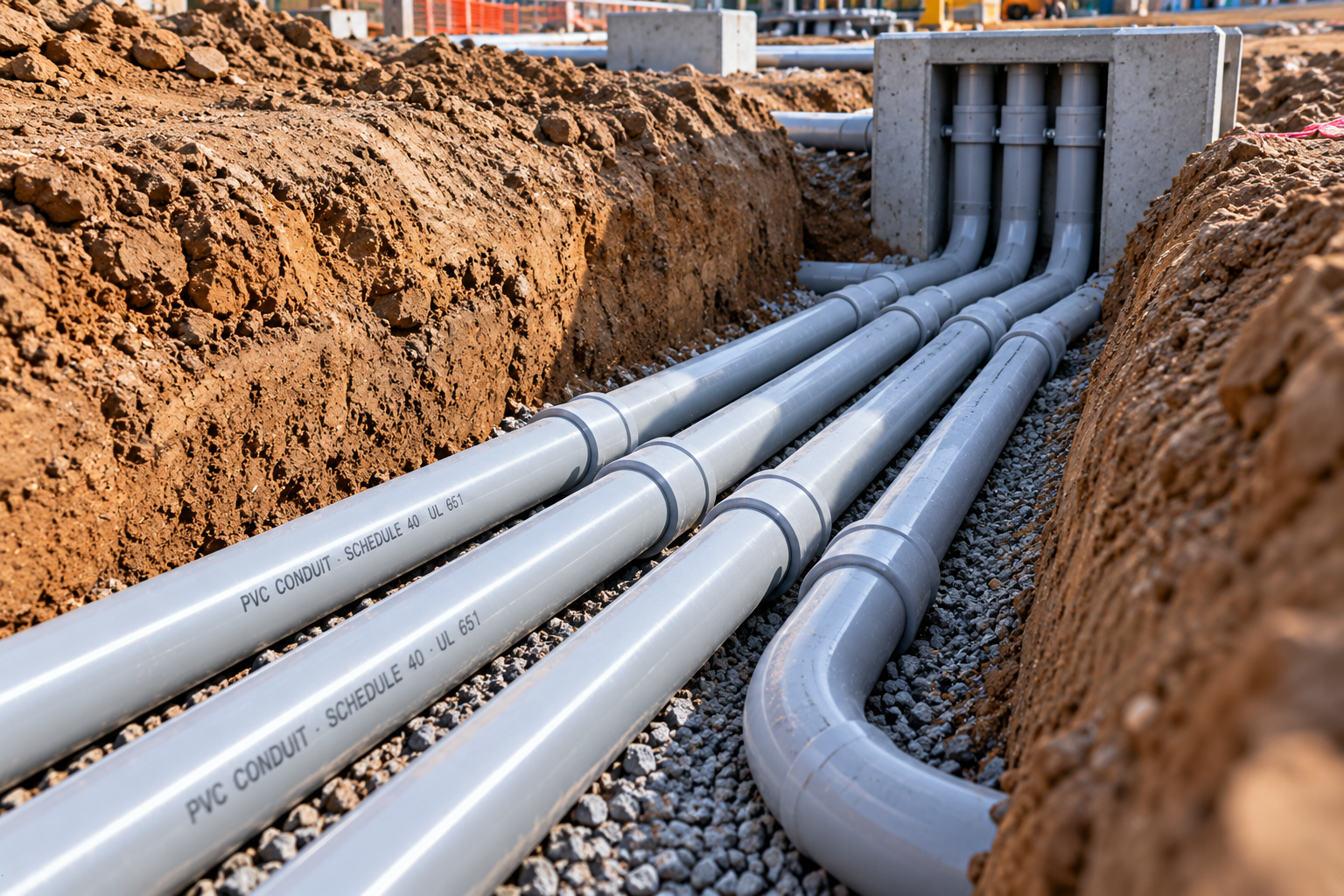
Rigid PVC electrical conduit is covered by NEC Article 352. It is a nonmetallic raceway made in Schedule 40 and Schedule 80 wall thicknesses. Article 352 permits PVC in several concealed, corrosive, wet, outdoor and underground applications, and exposed use where permitted, subject to its requirements.
Electrical PVC conduit is not the same as plumbing PVC pipe. Conduit is made to electrical product standards such as UL 651 and NEMA TC 2, and its fill dimensions come from NEC Chapter 9 Table 4, not from plumbing pipe charts.
NEC PVC Conduit Fill Rules
Chapter 9 Table 1 limits the total cross-sectional area of conductors and cables to a share of the conduit’s cross-sectional area.
| Number of Conductors or Cables | Maximum Fill | Allowed Area in 1/2-in. Sch. 40 (in²) | Allowed Area in 1/2-in. Sch. 80 (in²) |
|---|---|---|---|
| 1 | 53% | 0.151 | 0.115 |
| 2 | 31% | 0.088 | 0.067 |
| More than 2 | 40% | 0.114 | 0.087 |
One Conductor: 53%
A single conductor or cable may occupy 53% of the area.
Two Conductors: 31%
Exactly two conductors are limited to 31%.
Three or More Conductors: 40%
More than two conductors may occupy 40%. These percentages apply to the conduit cross-sectional area. Do not use 40% just because a chart is called a conduit fill chart.
PVC Conduit Fill Formula
Actual Fill Percentage
Maximum Allowable Area
Mixed-Conductor Formula
- N(i): quantity of each conductor
- A(i): area of that insulated conductor (in²)
- F: applicable fill fraction, written as a decimal
Use square inches consistently.
How to Calculate PVC Conduit Fill
- Determine Schedule 40 or Schedule 80.
- Determine the conduit trade size.
- Count conductors and cables.
- Identify each conductor size.
- Identify insulation and construction.
- Obtain conductor areas from Table 5.
- Include grounding and bonding conductors.
- Add the occupied areas.
- Determine the applicable fill percentage.
- Compare occupied area with permitted area.
- Then separately verify ampacity and installation requirements.
Worked PVC Conduit Fill Examples
Three 12 AWG Conductors
Three 12 AWG THHN/THWN-2 in 1/2-in. PVC
Practical interpretation: This checks physical fill only.
Mixed Conductor Sizes
Mixed Conductors with an EGC
Practical interpretation: The same conductors pass in one schedule and fail in the other, which is why the schedule must be set first.
NEC Annex C vs. Chapter 9
| Resource | Role |
|---|---|
| Chapter 9 Table 1 | Determines the allowable fill percentage |
| Chapter 9 Table 4 | Provides raceway dimensions, areas and allowable fill areas |
| Chapter 9 Table 5 | Provides insulated conductor dimensions and areas |
| Informative Annex C | Provides maximum counts for conductors of the same size and type |
| Table 5A and compact data | Used for compact conductors |
1/2-Inch PVC Conduit Fill
| Item | Schedule 40 | Schedule 80 |
|---|---|---|
| Total area (in²) | 0.285 | 0.217 |
| 40% area (in²) | 0.114 | 0.087 |
| 14 AWG THHN/THWN-2 | 11 | 9 |
| 12 AWG THHN/THWN-2 | 8 | 6 |
| 10 AWG THHN/THWN-2 | 5 | 4 |
| 8 AWG THHN/THWN-2 | 3 | 2 |
| 6 AWG THHN/THWN-2 | 1 | 1 |
| 4 AWG THHN/THWN-2 | 1 | 1 |
The 6 AWG and 4 AWG counts of 1 are single-conductor cases, so they follow the 53% limit and not 40%.
3/4-Inch PVC Conduit Fill
| Item | Schedule 40 | Schedule 80 |
|---|---|---|
| Total area (in²) | 0.508 | 0.409 |
| 40% area (in²) | 0.203 | 0.164 |
| 14 AWG THHN/THWN-2 | 21 | 17 |
| 12 AWG THHN/THWN-2 | 15 | 12 |
| 10 AWG THHN/THWN-2 | 9 | 7 |
| 8 AWG THHN/THWN-2 | 5 | 4 |
| 6 AWG THHN/THWN-2 | 4 | 3 |
| 4 AWG THHN/THWN-2 | 2 | 1 |
The 40% areas are 0.203 in² for Schedule 40 and 0.164 in² for Schedule 80.
1-Inch PVC Conduit Fill
| Item | Schedule 40 | Schedule 80 |
|---|---|---|
| Total area (in²) | 0.832 | 0.688 |
| 40% area (in²) | 0.333 | 0.275 |
| 14 AWG THHN/THWN-2 | 34 | 28 |
| 12 AWG THHN/THWN-2 | 25 | 20 |
| 10 AWG THHN/THWN-2 | 15 | 13 |
| 8 AWG THHN/THWN-2 | 9 | 7 |
| 6 AWG THHN/THWN-2 | 6 | 5 |
| 4 AWG THHN/THWN-2 | 4 | 3 |
The 40% areas are 0.333 in² for Schedule 40 and 0.275 in² for Schedule 80, a practical capacity difference of about 17%.
Larger PVC Conduit Sizes
Larger sizes share one table. Counts are shown as Schedule 40 / Schedule 80 for same-size THHN/THWN-2 conductors.
| Trade Size | Sch. 40 Total (in²) | Sch. 40 40% (in²) | Sch. 80 Total (in²) | Sch. 80 40% (in²) | 12 AWG | 10 AWG | 8 AWG |
|---|---|---|---|---|---|---|---|
| 1-1/4 in. | 1.453 | 0.581 | 1.237 | 0.495 | 43 / 37 | 27 / 23 | 16 / 13 |
| 1-1/2 in. | 1.986 | 0.794 | 1.711 | 0.684 | 59 / 51 | 37 / 32 | 21 / 18 |
| 2 in. | 3.291 | 1.316 | 2.874 | 1.150 | 99 / 86 | 62 / 54 | 36 / 31 |
| 2-1/2 in. | 4.695 | 1.878 | 4.119 | 1.647 | 141 / 124 | 89 / 78 | 51 / 45 |
| 3 in. | 7.268 | 2.907 | 6.442 | 2.577 | 218 / 193 | 137 / 122 | 79 / 70 |
| 3-1/2 in. | 9.737 | 3.895 | 8.688 | 3.475 | 293 / 261 | 184 / 164 | 106 / 95 |
| 4 in. | 12.554 | 5.022 | 11.258 | 4.503 | 377 / 338 | 238 / 213 | 137 / 123 |
THHN, THWN-2, XHHW and Insulation Type
AWG alone does not determine conduit fill. Two conductors of the same size can have different overall dimensions because of insulation and construction. See the Wire Gauge Chart for AWG dimensions.
| AWG | THHN / THWN-2: dia (in.) / area (in²) | XHHW / XHHW-2: dia (in.) / area (in²) |
|---|---|---|
| 14 | 0.111 / 0.0097 | 0.133 / 0.0139 |
| 12 | 0.130 / 0.0133 | 0.152 / 0.0181 |
| 10 | 0.164 / 0.0211 | 0.176 / 0.0243 |
| 8 | 0.216 / 0.0366 | 0.236 / 0.0437 |
| 6 | 0.254 / 0.0507 | 0.274 / 0.0590 |
| 4 | 0.324 / 0.0824 | 0.322 / 0.0814 |
Do not transfer THHN counts to XHHW or XHHW-2, RHH/RHW or other constructions, or to compact conductors, which use Table 5A.
Do Ground, Neutral and Spare Wires Count?
Equipment Grounding Conductor
Include its actual area. Chapter 9 Table 1 Note 3 requires installed equipment grounding and bonding conductors to be included in the fill calculation using their actual dimensions.
Neutral Conductor
A neutral physically occupies conduit space, so it contributes to fill.
Spare Conductor
A spare occupies area and counts.
Conduit-fill counting and current-carrying-conductor counting for ampacity are different questions. For example, adding a 12 AWG THHN ground to three 12 AWG conductors in 1/2-in. Schedule 40 PVC gives 4 × 0.0133 = 0.0532 in², under the 0.114 in² limit.
60% PVC Conduit Fill for Short Nipples
Chapter 9 Table 1 Note 4 allows a conduit or tubing nipple not longer than 24 in. (600 mm) between boxes, cabinets and similar enclosures to be filled to 60% of its cross-sectional area.
| Trade Size | Sch. 40 60% (in²) | Sch. 80 60% (in²) |
|---|---|---|
| 1/2 in. | 0.171 | 0.130 |
| 3/4 in. | 0.305 | 0.245 |
| 1 in. | 0.499 | 0.413 |
| 1-1/4 in. | 0.872 | 0.742 |
| 1-1/2 in. | 1.192 | 1.027 |
| 2 in. | 1.975 | 1.724 |
| 2-1/2 in. | 2.817 | 2.471 |
| 3 in. | 4.361 | 3.865 |
| 3-1/2 in. | 5.842 | 5.213 |
| 4 in. | 7.532 | 6.755 |
Not a General Short-Run Allowance
Do not present 60% as a general allowance for short PVC runs. It applies only to a qualifying nipple.
PVC Conduit Fill vs. Ampacity Derating
| Conduit Fill | Ampacity |
|---|---|
| Physical occupancy | Electrical current capacity |
| Chapter 9 fill calculation | Separate conductor requirements |
| Based on area | Based on conductor and loading conditions |
| Determines fit | Determines permissible electrical loading |
Passing the conduit-fill calculation does not establish ampacity compliance.
PVC Fill vs. Pulling and Jamming
The maximum legal fill is not always the best practical design. Pull length, the number of bends, conductor diameter, pulling tension, sidewall pressure and jamming all matter. NFPA material notes the potential for jamming, and Southwire calculates fill, pulling tension, sidewall pressure and jam probability separately.
Schedule 40 vs. Schedule 80 Applications
Do not reduce the decision to capacity. Schedule 80 PVC is identified for locations subject to physical damage, while Schedule 40 is not identified for that use. Schedule 40’s larger internal area does not mean it can simply replace Schedule 80 wherever more capacity is desirable.
Check Article 352 and the AHJ for where each schedule is permitted or required, and size the raceway for the schedule you must use.
PVC Conduit Installation Considerations
Only the points that affect selecting and filling conduit are covered here. They include underground installation, wet locations, physical damage, bends, pull points, expansion and thermal movement, support, listed fittings and solvent-cemented joints. CANTEX’s installation documentation shows belled-end conduit being prepared and solvent-cemented in underground work.
This is not a complete PVC installation guide, so follow the NEC, the manufacturer’s instructions and local rules.
PVC Conduit vs. EMT Fill
The NEC percentages can be the same while the available internal area differs. Equal trade sizes of EMT, Schedule 40 PVC and Schedule 80 PVC should not be assumed to hold the same number of conductors. For 3/4-in. raceways, Table 4 lists:
| Raceway | Total Area (in²) | 40% Area (in²) |
|---|---|---|
| EMT | 0.533 | 0.213 |
| PVC Schedule 40 | 0.508 | 0.203 |
| PVC Schedule 80 | 0.409 | 0.164 |
The EMT Conduit Fill Chart has the EMT dimensions and counts, and the Conduit Fill Chart compares all the raceway types.
How to Select the Correct PVC Conduit Size
Fill compliance does not establish ampacity or complete NEC compliance, so treat this as a sequence and not a single lookup.
PVC Fill Checker
The checker uses THHN/THWN/THWN-2 areas and a direct area comparison. Include grounding conductors, and use it for practice, not permit approval.
Common PVC Conduit Fill Mistakes
Confusing electrical conduit with plumbing PVC
Different standards and dimensions.
Assuming trade size equals actual ID
Trade size is a name.
Treating Schedule 40 and 80 as equal in area
Schedule 80 has less internal area.
Applying 40% to every situation
One conductor gets 53%, two get 31%.
Ignoring insulation type
THHN and XHHW areas differ.
Ignoring the EGC
It counts toward fill.
Using Annex C for mixed sizes
Add the actual areas instead.
Applying THHN counts to XHHW
Use the actual conductor areas.
Misusing the 60% nipple allowance
It is for qualifying nipples only.
Ignoring pulling difficulty
Fill does not address it.
Treating fill compliance as ampacity compliance
They are separate checks.
Using an unidentified or outdated NEC table
Confirm the edition.
Limitations
What This Chart Does Not Establish
This page is a PVC-only fill reference. It does not by itself establish conductor ampacity, conductor size, voltage drop, grounding-conductor size, pulling tension, bend requirements, burial or installation compliance, local amendment compliance or AHJ approval. Tables present a focused subset of NEC Chapter 9 data as published in recent editions, and counts are calculated from them. Confirm every value against the edition your AHJ has adopted. See the Construction Charts hub and the Engineering Calculators for related tools.
PVC Conduit Fill FAQs
How many wires can fit in PVC conduit?
How many 12 AWG wires fit in 1/2-inch PVC?
Is Schedule 40 or Schedule 80 larger inside?
Why does Schedule 80 hold fewer conductors?
Is PVC conduit always limited to 40% fill?
Does the ground wire count toward conduit fill?
Can different wire sizes share PVC conduit?
Can THHN and XHHW use the same fill chart?
When can PVC conduit use 60% fill?
Does conduit fill affect ampacity?
When is Schedule 80 PVC required?
Which NEC edition should I use?
Save the PVC Conduit Fill Chart as a PDF
Use your browser print function to save this reference for estimating folders, training binders and job planning.