Plywood Weight Chart – Weight by Thickness and Sheet Size
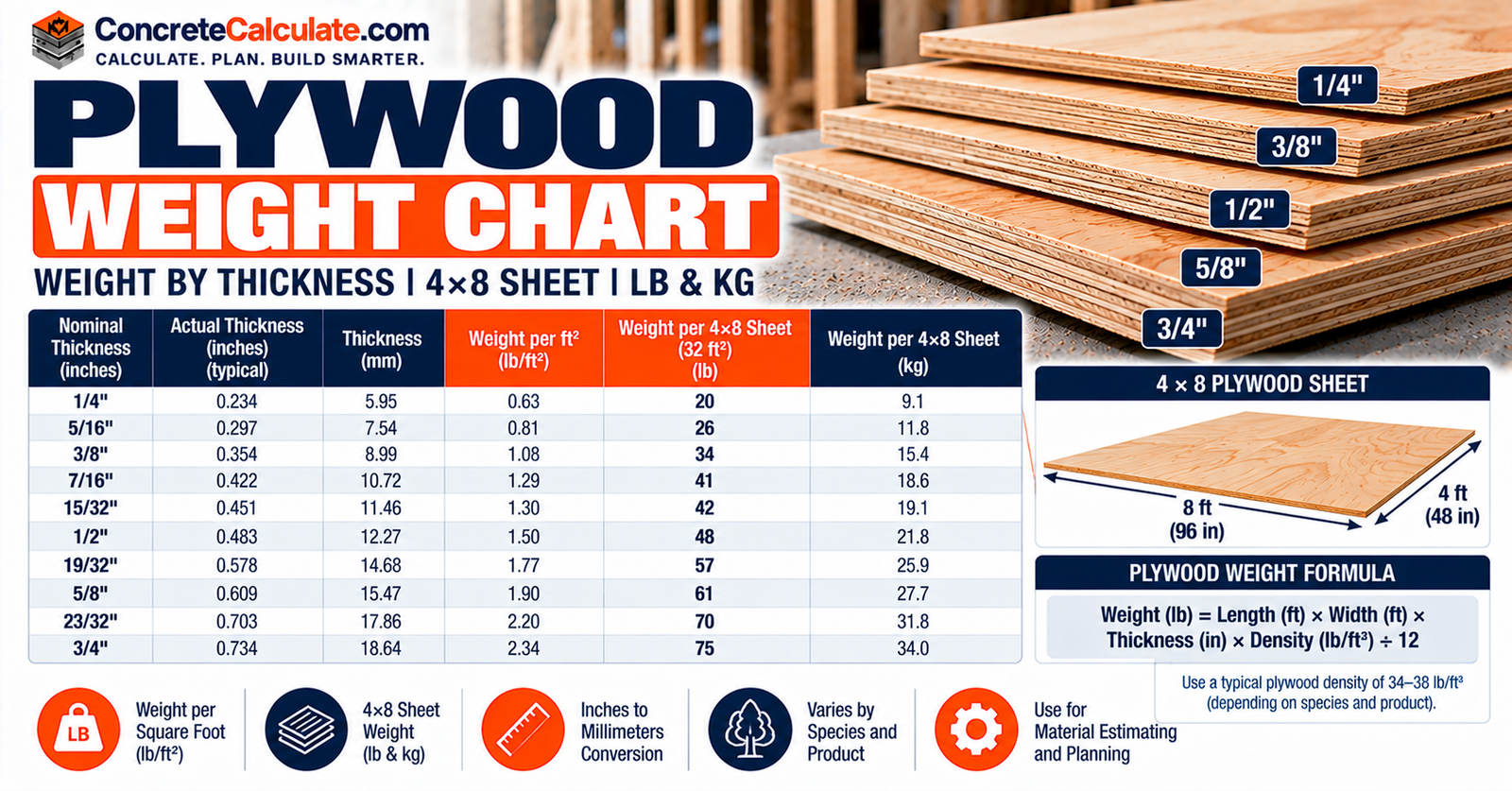
Plywood Weight Chart
Weight by Thickness and Sheet Size
See published 4 × 8 plywood weights by thickness, weight per square foot, density formulas, moisture and treatment effects, and pallet, truck and dead-load calculations, with a clear look at why no single weight fits a given thickness.
 Reviewed by Muhammad Ramzan Babar, PhD Researcher (Plasma Physics) & Calculator Developer – View Profile
Short Answer
There is no single weight for a 4 × 8 sheet of a given thickness. Published examples include about 20 lb for 1/4 in. underlayment, 41.67 lb for a 15/32 panel, 50.34 lb for a 19/32 panel and 63 lb for a 23/32 panel, and 60 to 70 lb is a general reference for 3/4 in. Weight depends on species, core, moisture, treatment and actual thickness, so use the exact product’s weight when accuracy matters.
Plywood Weight Chart: Quick Reference
Start here for published 4 × 8 plywood weights, weight per square foot and metric conversions. Plywood has no single weight for a given thickness, so every row names its product and source.
How to Read This Chart
Each row is a published product example, not a standard weight. Weight per square foot is the sheet weight divided by the panel area, so it works for any panel size. Read the source and qualification columns before you use a number.
4 × 8 Plywood Weight Chart
| Performance Category | Actual or Listed Thickness | Panel Type | Panel Size | Published Weight | lb/ft² | Source | Important Qualification |
|---|---|---|---|---|---|---|---|
| 1/4 | Not listed | SurePly Premium UL underlayment (Patriot Timber) | 4 × 8 ft | About 20 lb | 0.63 | Manufacturer response | Approximate value for one product |
| 15/32 | 0.453 in. | Southern pine ACX sanded plywood | 4 × 8 ft | 41.67 lb | 1.30 | Retailer product listing | One product |
| 19/32 | Not listed | Southern yellow pine ACX sanded plywood | 4 × 8 ft | 50.34 lb | 1.57 | Retailer product listing | One product |
| 23/32 | 0.703 in. | Southern pine ACX sanded plywood | 4 × 8 ft | 63 lb | 1.97 | Retailer product listing | One product |
| 3/4 | General reference | Plytanium plywood (Georgia-Pacific answer) | 4 × 8 ft | 60 to 70 lb | 1.88 to 2.19 | Georgia-Pacific technical services | General range, varies with material type |
| 3/4 | 0.721 in. (tested) | Softwood veneer core, maple faces | 48.5 × 96.5 in. | 54 lb | 1.66 | Columbia Forest Products | Different panel size |
| 3/4 | 0.726 in. (tested) | Classic Core, maple faces | 48.5 × 96.5 in. | 74 lb | 2.28 | Columbia Forest Products | Different panel size |
These Are Representative Examples
These are not standard or guaranteed weights. Plywood weight is not standardized by nominal thickness alone. Always use the exact manufacturer’s product weight where transport, lifting, dead load or shipping accuracy matters.
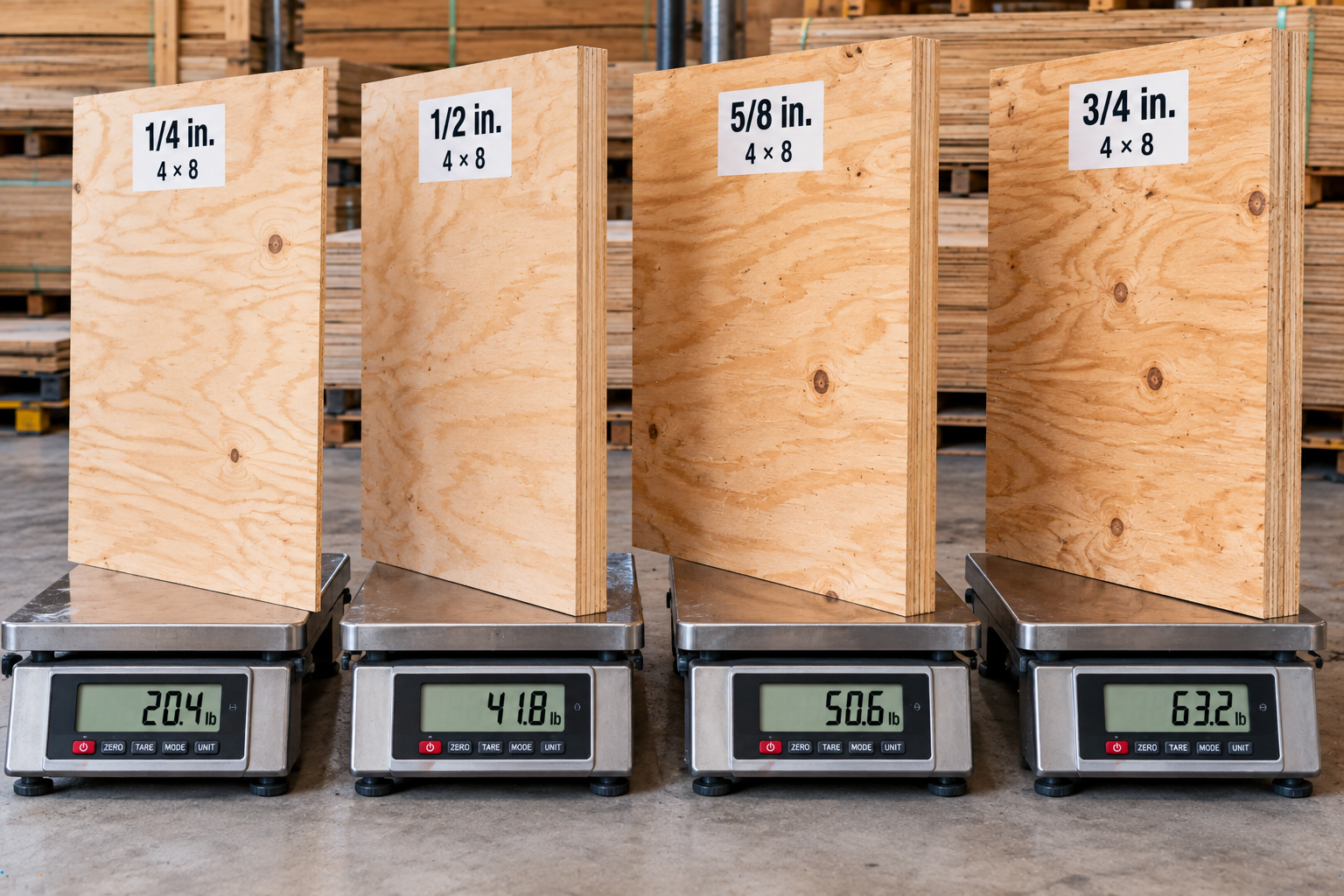
Plywood Weight per Square Foot
| Published Example (4 × 8 ft) | lb/ft² | kg/m² |
|---|---|---|
| 1/4 (about 20 lb) | 0.62 | 3.05 |
| 15/32 (41.67 lb) | 1.30 | 6.36 |
| 19/32 (50.34 lb) | 1.57 | 7.68 |
| 23/32 (63 lb) | 1.97 | 9.61 |
| 3/4 general (60 to 70 lb) | 1.88 to 2.19 | 9.15 to 10.68 |
Pounds and Kilograms
To convert, use 1 lb = 0.45359237 kg. A 63 lb sheet is 28.58 kg, and a 41.67 lb sheet is 18.90 kg.
What Determines Plywood Weight?
Plywood weight follows the basic relationship weight = volume × density. Thickness is only one input.
Thickness and Panel Area
Volume is panel area times actual thickness, so a larger or thicker panel weighs more when everything else is equal.
Density and Species
Density depends on the species of every veneer, not only the face. The USDA Wood Handbook reports that the oven-dry density of most wood species falls between about 20 and 45 lb/ft³, which is a range for the wood itself and not for a finished panel.
Core Construction
Veneer core, MDF crossbands, particleboard, composite and combination cores all change density, flatness and screw holding.
Moisture and Treatment
Water and preservative add mass. Weight at the mill, on the truck and on the job site can therefore differ for the same panel.
- Other variables: ply count and arrangement, adhesive, sanding, overlays, surface coatings and grade.
Nominal vs. Actual Thickness in Plywood Weight Calculations
A category name such as 23/32 equals 0.71875 in., but PS 1-22 permits a range of thickness for each category and structural panels carry a separate decimal label. The full range tables are on the Plywood Thickness Chart, which owns Performance Categories, PS 1 tolerances and metric conversion. Here, use thickness only to make weight calculations accurate.
For example, a 23/32 southern pine panel listed at 0.703 in. is about 2% thinner than the 0.71875 in. the fraction implies.
As with framing lumber, where the name and the real dimension differ (see the Lumber Size Chart), a plywood category name is not the measured thickness.
Order of Accuracy for Weight
- Manufacturer-published panel weight.
- Measured weight of the actual panel.
- Actual measured thickness with a known panel density.
- Decimal product label with a documented density.
- Performance Category with an assumed density, as a rough estimate only.
4 × 8 Plywood Weight Chart by Thickness
How to Use This Chart
The published column shows real product weights where they exist. The three calculated columns show weight = 32 ft² × (label thickness ÷ 12) × assumed density, so they illustrate the range that different densities produce. The assumed densities are not universal plywood densities.
| Performance Category | Typical Thickness Label (in.) | Published 4 × 8 Product Example | Calculated at 28 lb/ft³ (lb) | Calculated at 32 lb/ft³ (lb) | Calculated at 38 lb/ft³ (lb) |
|---|---|---|---|---|---|
| 1/4 | 0.225 | About 20 lb (SurePly) | 16.8 | 19.2 | 22.8 |
| 5/16 | 0.290 | Manufacturer-dependent | 21.7 | 24.7 | 29.4 |
| 3/8 | 0.354 | Manufacturer-dependent | 26.4 | 30.2 | 35.9 |
| 7/16 | 0.418 | Manufacturer-dependent | 31.2 | 35.7 | 42.4 |
| 15/32 | 0.451 | 41.67 lb (AC pine) | 33.7 | 38.5 | 45.7 |
| 1/2 | 0.483 | Manufacturer-dependent | 36.1 | 41.2 | 48.9 |
| 19/32 | 0.578 | 50.34 lb (AC pine) | 43.2 | 49.3 | 58.6 |
| 5/8 | 0.609 | Manufacturer-dependent | 45.5 | 52.0 | 61.7 |
| 23/32 | 0.703 | 63 lb (AC pine) | 52.5 | 60.0 | 71.2 |
| 3/4 | 0.734 | 60 to 70 lb (general) | 54.8 | 62.6 | 74.4 |
| 7/8 | 0.849 | Manufacturer-dependent | 63.4 | 72.4 | 86.0 |
| 1 | 0.970 | Manufacturer-dependent | 72.4 | 82.8 | 98.3 |
| 1-1/8 | 1.091 | Manufacturer-dependent | 81.5 | 93.1 | 110.6 |
Rows without a published weight say manufacturer-dependent, and the calculated range is only a rough guide. Real panels can fall outside it, since published 23/32 (63 lb) exceeds the 32 lb/ft³ estimate of 60.0 lb.
1/4-Inch Plywood Weight
Patriot Timber states that a 4 × 8 sheet of SurePly Premium UL weighs approximately 20 lb. Other 1/4 in. panels can be lighter or heavier with different species and cores. Common uses include underlayment, back panels, drawer bottoms, crafts and light finish work.
3/8- and 7/16-Inch Plywood Weight
No verified product weights are published here for these sizes. The calculated range for 3/8 is about 26 to 36 lb and for 7/16 about 31 to 42 lb across the assumed densities. These are lighter sheathing sizes, and the Roof Sheathing Thickness Chart covers panel selection for roofs.
15/32- and 1/2-Inch Plywood Weight
A southern pine ACX 15/32 panel with a listed thickness of 0.453 in. is published at 41.67 lb, about 1.30 lb/ft². 15/32 and 1/2 are separate Performance Categories, even though tradespeople sometimes say half-inch loosely.
19/32- and 5/8-Inch Plywood Weight
A southern yellow pine ACX 19/32 panel is published at 50.34 lb, about 1.57 lb/ft². 19/32 and 5/8 are separate categories with different thickness ranges. Do not scale directly from a 15/32 product unless you are making a labeled density-based estimate.
23/32- and 3/4-Inch Plywood Weight
A southern pine ACX 23/32 panel with a listed thickness of 0.703 in. is published at 63 lb, about 1.97 lb/ft². Georgia-Pacific gives 60 to 70 lb as a general reference for 3/4 in. plywood, noting that weight varies with material type. In Columbia’s comparison, 3/4 in. panels of two constructions list 54 lb and 74 lb (48.5 × 96.5 in.). Together these show a range, not one number.
1-Inch and 1-1/8-Inch Plywood Weight
Heavy floor, industrial and specialty panels vary widely by construction, so use the manufacturer’s published weight. Weight affects manual handling, shipping, roof and floor dead load, pallet capacity and crew size. Do not borrow OSB weights for plywood.
Plywood Weight per Square Foot
Weight per square foot lets you size any panel, including 4 × 9, 4 × 10 and cut pieces.
| Performance Category | Thickness Used (in.) | Example Density | lb/ft² | kg/m² | 4 × 8 Weight (lb) |
|---|---|---|---|---|---|
| 1/4 | 0.225 | 32 lb/ft³ | 0.60 | 2.93 | 19.2 |
| 5/16 | 0.290 | 32 lb/ft³ | 0.77 | 3.78 | 24.7 |
| 3/8 | 0.354 | 32 lb/ft³ | 0.94 | 4.61 | 30.2 |
| 7/16 | 0.418 | 32 lb/ft³ | 1.11 | 5.44 | 35.7 |
| 15/32 | 0.451 | 32 lb/ft³ | 1.20 | 5.87 | 38.5 |
| 1/2 | 0.483 | 32 lb/ft³ | 1.29 | 6.29 | 41.2 |
| 19/32 | 0.578 | 32 lb/ft³ | 1.54 | 7.53 | 49.3 |
| 5/8 | 0.609 | 32 lb/ft³ | 1.62 | 7.93 | 52.0 |
| 23/32 | 0.703 | 32 lb/ft³ | 1.87 | 9.15 | 60.0 |
| 3/4 | 0.734 | 32 lb/ft³ | 1.96 | 9.56 | 62.6 |
| 7/8 | 0.849 | 32 lb/ft³ | 2.26 | 11.05 | 72.4 |
| 1 | 0.970 | 32 lb/ft³ | 2.59 | 12.63 | 82.8 |
| 1-1/8 | 1.091 | 32 lb/ft³ | 2.91 | 14.20 | 93.1 |
Weight per Square Foot for a Published Panel
Practical interpretation: Use this number to scale to other panel sizes of the same product.
Plywood Weight in Pounds and Kilograms
| Weight (lb) | Weight (kg) |
|---|---|
| 20 | 9.07 |
| 30 | 13.61 |
| 40 | 18.14 |
| 50 | 22.68 |
| 60 | 27.22 |
| 70 | 31.75 |
| 80 | 36.29 |
| 100 | 45.36 |
How to Calculate Plywood Weight
Volume Formula
For a rectangular panel, multiply length, width and actual thickness in consistent units.
Density Formula
- W: weight
- ρ: panel density
- L, W: panel length and width
- t: actual thickness
Worked 4 × 8 Example
Illustrative 4 × 8 Sheet
Practical interpretation: The density is assumed, and a published 23/32 panel of 63 lb implies about 33.6 lb/ft³, so real products can differ from a guess.
Plywood Weight Calculator
The same volume-times-density idea underlies the Structural Steel Weight Chart, and unit weights for masonry are in the Concrete Block Weight Chart.
Plywood Density Chart
Density is the most important variable after dimensions. Use manufacturer values, not a single universal number.
| Product Construction | Thickness | Density | Source | Important Limitation |
|---|---|---|---|---|
| Softwood veneer core, rotary maple faces | 0.721 in. (tested, 3/4 nominal) | 27.3 lb/ft³ | Columbia Forest Products | Test sample, informational data |
| Classic Core (veneer core, thin MDF crossbands), rotary maple faces | 0.726 in. (tested, 3/4 nominal) | 38.4 lb/ft³ | Columbia Forest Products | Test sample, informational data |
| Southern pine ACX sanded, 15/32 | 0.453 in. (listed) | About 34.5 lb/ft³ | Derived from 41.67 lb, nominal 4 × 8 area | Derived, one product |
| Southern pine ACX sanded, 23/32 | 0.703 in. (listed) | About 33.6 lb/ft³ | Derived from 63 lb, nominal 4 × 8 area | Derived, one product |
| Oven-dry wood (most species) | Not applicable | About 20 to 45 lb/ft³ | USDA Wood Handbook | Solid wood, not finished panel weight |
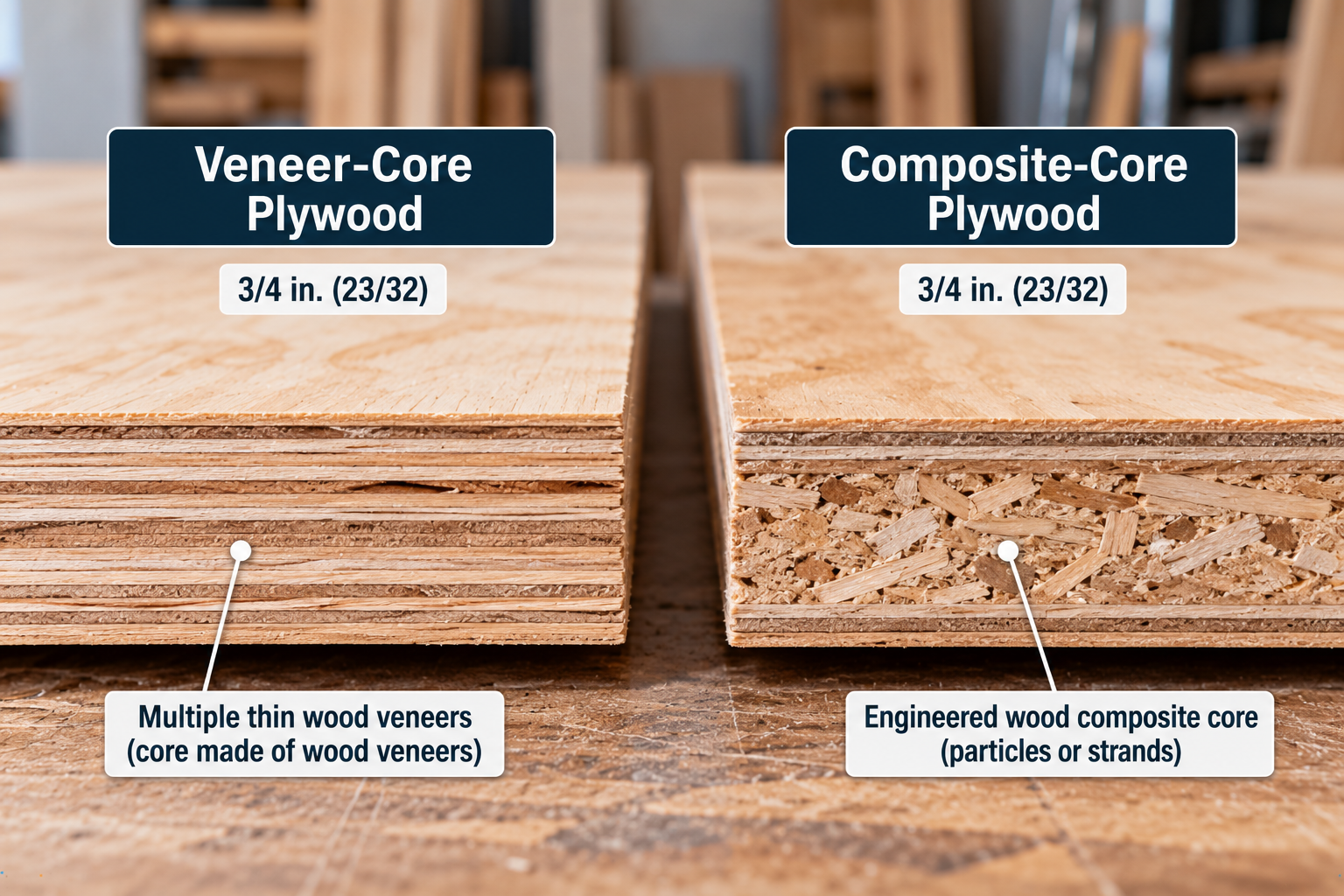
Veneer-Core Density
Columbia reports 27.3 lb/ft³ for its softwood veneer core comparison panel in 3/4 in. testing.
Composite-Core Density
Columbia reports 38.4 lb/ft³ for Classic Core, a combination panel with veneer core inner plies and thin MDF crossbands. That is about 41% denser than the veneer core comparison, even though both are nominally 3/4 in.
Softwood vs. Hardwood Plywood Weight
Hardwood plywood is not automatically heavier than every softwood panel. Face veneer species, inner core species and the core type all count.
- Face veneer species: a hardwood face adds only a thin layer of the total thickness.
- Inner core species: most of the volume is core, so core species dominates.
- Core type: veneer core, combination core, MDF core, particleboard core and composite core all differ.
In Columbia’s comparison, a combination-core panel is much denser than a softwood veneer-core panel of the same nominal thickness, which is a construction effect and not a hardwood-versus-softwood effect.
Veneer-Core vs. MDF- and Composite-Core Plywood
Cabinet and furniture plywood is sold in several core types, and the choice changes weight and handling.
| Core Type | Effect on Weight | Other Effects |
|---|---|---|
| Veneer core | Product-dependent; often the lighter option in the Columbia comparison | Good stiffness; core voids possible depending on grade |
| MDF core | Product-dependent; MDF is generally denser than veneer | Flat, smooth surface and consistent machining |
| Particleboard core | Product-dependent | Flat and consistent, but edge and screw behavior differ |
| Combination or hybrid core | Between veneer and full composite, depending on the product | Smoother face than veneer core, improved edge machining |
Core choice also affects flatness, screw holding, edge machining, stiffness and handling. Columbia notes Classic Core has superior screw holding and is lighter than composite cores of equivalent thickness. Do not assume universal density values for MDF or particleboard core without a product source.
Southern Pine vs. Douglas-Fir Plywood Weight
Southern yellow pine and Douglas-fir plywood are both offered in several thicknesses and constructions, so a species name does not fix one weight. Panel weight depends on every veneer in the panel, and retail shorthand such as AC pine can hide that the core and back may be a different species. For example, one listing describes an A-grade southern pine face with a western species core and back. Avoid publishing one pounds-per-sheet value for a whole species category.
How Moisture Changes Plywood Weight
Water adds mass, so a wet panel weighs more than the same panel dry.
The USDA Wood Handbook defines moisture content as the mass of water divided by the oven-dry mass and explains how wood weight and other properties change with moisture. Panels pick up moisture from manufacturing, storage, rain, humidity and temporary construction exposure, and they lose it as they dry.
Effect of Moisture Content (Arithmetic Illustration)
Practical interpretation: This ignores swelling and adhesive and is only an arithmetic illustration. Do not assume a wet panel keeps its dry published weight.
Pressure-Treated Plywood Weight
Pressure-treated plywood can weigh more than untreated plywood, but there is no fixed percentage. Several factors decide the difference:
- Preservative retention: more preservative adds more mass.
- Water carrier: treatment solutions add retained moisture.
- Initial post-treatment moisture: freshly treated panels are wetter.
- Species and thickness: both change how much solution a panel absorbs.
- Drying after treatment: weight falls as panels dry.
A supplier answer for treated plywood notes that exact weight varies with moisture content and the treatment process. Do not use dry untreated weight for freshly pressure-treated sheets, and weigh actual panels when accuracy matters.
Marine, Exterior and CDX Plywood Weight
Marine Plywood
Marine grade describes construction, not density. APA-based descriptions say marine plywood uses only Douglas-fir or western larch veneers, B-grade or better plies, sanded faces, an Exterior bond and restricted core gaps and repairs. Weight still varies with thickness, species mix and product.
Exterior and Exposure 1
A bond classification is not a density class. Exterior panels are not automatically heavier, and Exposure 1 panels are not automatically lighter. Weight comes from the actual product construction.
CDX Plywood
CDX has no single weight. C and D are face and back veneer grades, and the term is generally linked to Exposure 1. Species, core, thickness category and moisture all change the weight. See the Plywood Thickness Chart for CDX terminology and thickness designations.
Sanded vs. Unsanded Plywood Weight
Sanding removes a little material and changes thickness slightly, but species and core construction usually affect total weight more. Grade, surface veneer, core and moisture all matter too, so do not say sanded plywood is always lighter. PS 1-22 gives separate thickness limits for sanded and unsanded panels, which the Plywood Thickness Chart covers.
Plywood Weight by Panel Size
APA lists 4 × 8, 4 × 9 and 4 × 10 ft among common plywood panel sizes. At constant thickness, density and construction, weight is proportional to area.
| Panel Size | Area (ft²) | Weight Ratio vs 4 × 8 | Example: 63 lb 4 × 8 Product |
|---|---|---|---|
| 4 × 8 ft | 32 | 1.000 | 63.0 lb (published example) |
| 4 × 9 ft | 36 | 1.125 | 70.9 lb |
| 4 × 10 ft | 40 | 1.250 | 78.8 lb |
4 × 9 and 4 × 10 Panels
A 4 × 9 panel is 36 ÷ 32 = 1.125 times a 4 × 8, or 12.5% heavier. A 4 × 10 panel is 40 ÷ 32 = 1.25 times, or 25% heavier.
Cut Panels
| Piece | Area (ft²) | Share of a 4 × 8 | 63 lb Sheet Example |
|---|---|---|---|
| 2 × 4 ft | 8 | 25% | 15.75 lb |
| 2 × 8 ft | 16 | 50% | 31.5 lb |
| 4 × 4 ft | 16 | 50% | 31.5 lb |
Actual panels can be slightly under nominal size. One retailer listing gives actual dimensions of 3.937 ft × 7.937 ft (about 47.2 × 95.2 in.), or about 31.2 ft². Check actual dimensions when you calculate from area.
Plywood Stack and Pallet Weight Chart
| Number of Sheets | 15/32 example (41.67 lb) | 19/32 example (50.34 lb) | 23/32 example (63 lb) |
|---|---|---|---|
| 10 | 416.7 lb | 503.4 lb | 630 lb |
| 20 | 833.4 lb | 1006.8 lb | 1260 lb |
| 40 | 1666.8 lb | 2013.6 lb | 2520 lb |
| 50 | 2083.5 lb | 2517.0 lb | 3150 lb |
| 60 | 2500.2 lb | 3020.4 lb | 3780 lb |
Bundle counts vary by mill and product, so do not assume a universal number. Pallet and packaging weights also vary and are not included above.
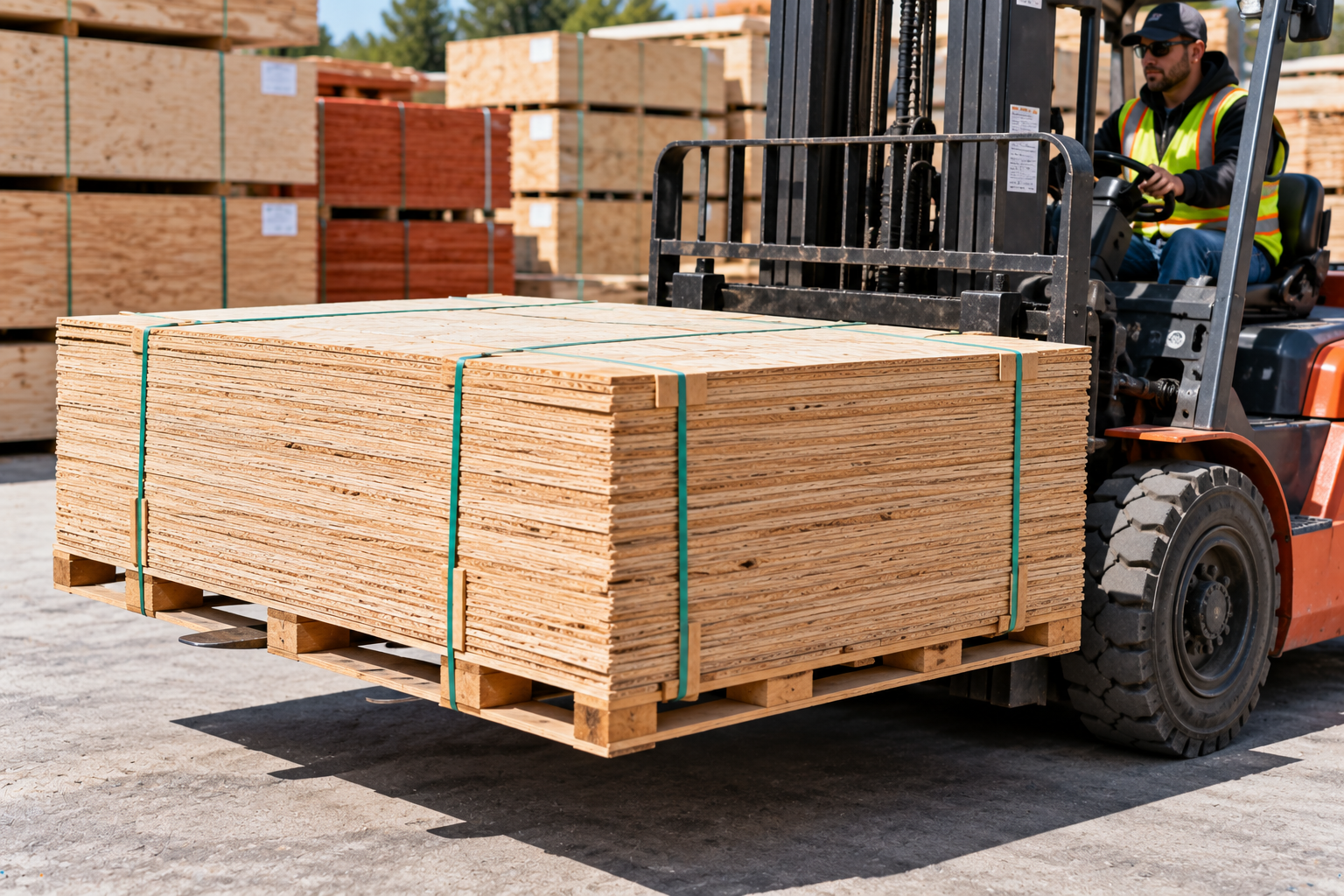
Plywood Weight for Trucks, Trailers and Material Handling
Trucks and Trailers
Plywood is heavy in bulk. Compare the load to the vehicle manufacturer’s ratings: pickup payload, trailer GVWR, axle capacity and tongue weight. Use tie-downs, and remember that moisture and treatment add weight. The Material Delivery Planner can help plan a delivery.
Load Estimate for 50 Sheets
Practical interpretation: The vehicle’s rated payload governs, and this example does not recommend loading to any limit. For a payload check, use N = floor(remaining payload ÷ sheet weight).
Manual Handling
A 4 × 8 sheet is awkward as well as heavy. Wind can catch it, stairs and overhead work add risk, and team lifting, panel carriers and good staging help. There is no universal one-person lifting limit, so follow your site safety procedures.
Plywood Weight and Structural Dead Load
Plywood self-weight matters in dead-load calculations for roof sheathing, wall sheathing, subfloors, mezzanine decks, multiple layers, concrete forms and industrial panels. Convert sheet weight to a uniform load:
Dead Load of a 23/32 Panel
Practical interpretation: Structural dead load must include every assembly component, not plywood alone. The Live and Dead Load Calculator helps total the loads.
Roof Sheathing
Sheathing weight adds to roof dead load. This page covers weight only. The Roof Sheathing Thickness Chart owns panel thickness, span ratings, rafter and truss spacing, H-clips, snow loads and fastening, and the Roof Rafter Span Chart covers the framing.
Subflooring
Subfloor panels add dead load to joists, and tongue-and-groove profiles and multi-layer floors add more. See the Floor Joist Span Chart for the joist side. APA’s Sturd-I-Floor guide is a current reference for floor panel categories and span ratings.
Multiple Panel Layers
Loads add. Two layers of the same 63 lb 4 × 8 panel give 2 × 1.97 = 3.94 psf.
Cabinet and Furniture Plywood Weight
Weight matters most in cabinet boxes, doors, shelving, furniture, RV interiors and casework, where people lift, hang and move the pieces. Compare veneer-core and composite-core products by their published densities, since two 3/4 in. constructions in the Columbia data differ by about 41% in density. Fasteners hold and edges machine differently by core, so weigh those effects along with weight.
Plywood vs. OSB Weight
Neither plywood nor OSB has one universal weight. Both depend on density, moisture content, thickness, panel construction, treatment and the specific product, so compare exact products. Do not use one OSB product as representative of all OSB, and do not substitute OSB weights for plywood.
How to Weigh or Estimate Plywood Accurately
How to Weigh Plywood Accurately
- Identify the exact panel product.
- Record the panel size and Performance Category.
- Check the manufacturer’s published weight.
- Weigh one representative sheet on a scale of known accuracy.
- Avoid panels with unusual water exposure if you need dry design weight.
- Weigh several panels where shipment accuracy matters.
- Calculate the average sheet weight.
- Multiply by the actual panel count.
A retailer’s listed weight can be an approximate catalog value rather than guaranteed shipping mass.
Estimating When Product Data Is Missing
- Best: the manufacturer’s published weight.
- Next: weigh an actual sheet.
- Next: actual thickness times a measured or known density.
- Last resort: a clearly stated approximate density assumption.
Do not mix a nominal thickness with an unrelated generic density and call the result exact.
Common Plywood Weight Mistakes and Chart Limitations
Assuming every 3/4 in. sheet weighs 60 lb
Published examples range widely.
Estimating from nominal thickness only
Actual thickness and density matter.
Ignoring actual panel thickness
PS 1-22 permits a range for each category.
Using OSB weights for plywood
They are different products.
Assuming hardwood-faced plywood is always heavier
Core and inner plies dominate.
Ignoring core construction
Veneer, MDF and combination cores differ.
Ignoring moisture
Water adds mass.
Using dry weight for freshly treated plywood
Treatment adds preservative and water.
Treating Exterior and Exposure 1 as density classes
They are bond classifications.
Assuming CDX is one standard weight
It is a grade and exposure term.
Ignoring overlays
Overlays add weight.
Assuming all 4 × 8 sheets of a thickness weigh the same
Products differ.
Calculating from nominal dimensions when actual differ
Some panels are slightly under 4 × 8.
Confusing pounds per sheet with pounds per square foot
Divide by 32 ft² for a 4 × 8.
Forgetting pallet weight
Pallets and packaging add mass.
Forgetting passengers and tools in a truck payload
They count against the rating.
Using published weight as exact structural dead load
Verify the project material.
Scaling weight by thickness across different constructions
Densities differ by product.
Using one generic plywood density
Species and core vary.
Limitations
What This Chart Does Not Establish
This page provides representative published weights, estimation formulas, density-based calculations and material-handling guidance. It does not establish exact shipment weight, guaranteed product mass, structural capacity, vehicle payload allowance, crane or lifting capacity, fastener design, roof or floor design or exact moisture content. Manufacturer documentation, actual measurements, structural design information and equipment or vehicle ratings govern where precision matters.
Plywood Weight FAQs
How much does a 4 × 8 sheet of plywood weigh?
How much does 1/4-in. plywood weigh?
How much does 3/8-in. plywood weigh?
How much does 1/2-in. plywood weigh?
How much does 5/8-in. plywood weigh?
How much does 3/4-in. plywood weigh?
How much does 23/32 plywood weigh?
How much does 1-in. plywood weigh?
How much does plywood weigh per square foot?
How much does plywood weigh per cubic foot?
Why do two sheets of the same thickness weigh differently?
Is hardwood plywood heavier than softwood plywood?
Is MDF-core plywood heavier than veneer-core plywood?
Is treated plywood heavier than untreated plywood?
How much heavier is wet plywood?
Does marine plywood weigh more?
Is plywood lighter than OSB?
How much does a 4 × 10 sheet weigh?
How much does half a sheet of plywood weigh?
How much does a pallet of plywood weigh?
How many sheets can a pickup truck carry?
How do I calculate plywood weight?
Can I calculate plywood weight from density?
Does Performance Category determine plywood weight?
Does plywood grade affect weight?
Save the Plywood Weight Chart as a PDF
Use your browser print function to save this reference for estimating folders, delivery planning and supplier conversations.