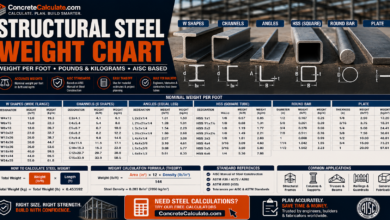
Hex Bolt Size Chart – Dimensions, Wrench Size & Thread Pitch
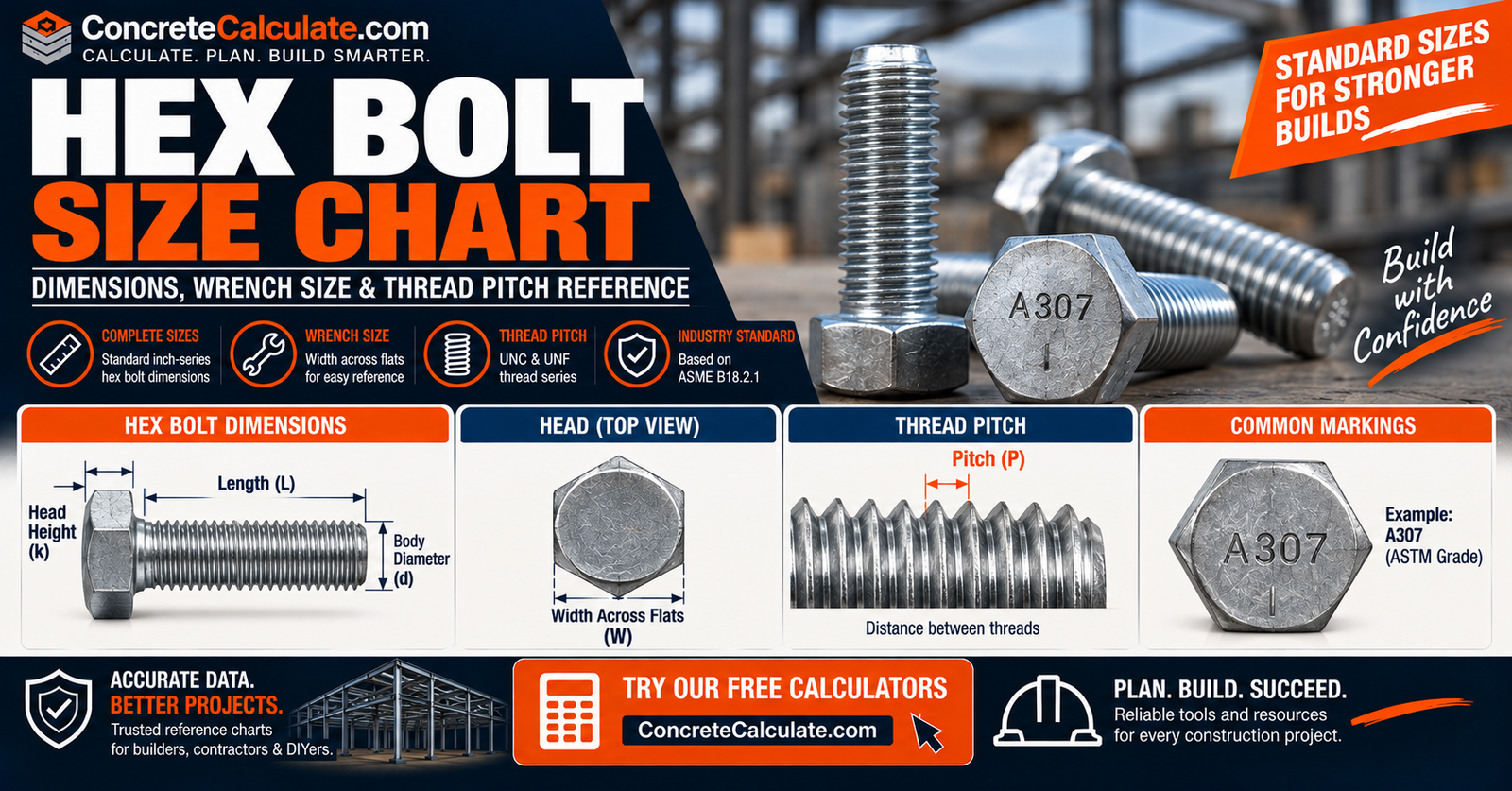
Hex Bolt Size Chart
Dimensions, Wrench Size & Thread Pitch
ASME B18.2.1 body diameter, width across flats, width across corners, head height, and wrench/socket size for standard inch-series hex bolts, plus UNC/UNF thread pitch under ASME B1.1 and the boundaries separating hex bolts, hex cap screws, heavy-hex structural bolts, and metric hex bolts.
 Reviewed by Muhammad Ramzan Babar, PhD Researcher (Plasma Physics) & Calculator Developer, View Profile
This chart covers ordinary inch-series hex bolts only
Hex cap screws, heavy-hex structural bolts, and metric hex bolts use separate dimensional standards and are not interchangeable with the ordinary hex bolt data on this page. ASME B18.2.1 covers general and dimensional data for inch-series hex bolts and screws, while heavy-hex structural bolts are covered separately under ASME B18.2.6 and ASTM F3125.
Hex Bolt Size Chart, Quick Reference
Dimensional values below follow ASME B18.2.1 for standard inch-series hex bolts.
Inch Hex Bolt Dimensions
| Nominal Diameter | Body Diameter Max (in.) | Basic Width Across Flats | Width Across Corners (Max) | Basic Head Height | UNC TPI | UNF TPI |
|---|---|---|---|---|---|---|
| 1/2 in. | 0.515 | 3/4 | 0.866 | 0.3125 | 13 | 20 |
| 5/8 in. | 0.642 | 15/16 | 1.083 | 0.3906 | 11 | 18 |
| 3/4 in. | 0.768 | 1-1/8 | 1.299 | 0.4687 | 10 | 16 |
| 7/8 in. | 0.895 | 1-5/16 | 1.516 | 0.5469 | 9 | 14 |
| 1 in. | 1.022 | 1-1/2 | 1.732 | 0.6250 | 8 | 12 |
| 1-1/8 in. | 1.149 | 1-11/16 | 1.949 | 0.7031 | 7 | 12 |
| 1-1/4 in. | 1.277 | 1-7/8 | 2.165 | 0.7812 | 7 | 12 |
| 1-3/8 in. | 1.404 | 2-1/16 | 2.382 | 0.8593 | 6 | 12 |
| 1-1/2 in. | 1.531 | 2-1/4 | 2.598 | 0.9375 | 6 | 12 |
This chart covers ordinary inch-series hex bolts. Heavy-hex structural bolts and metric hex bolts use separate standards and dimensions covered later on this page.
What Is a Hex Bolt?
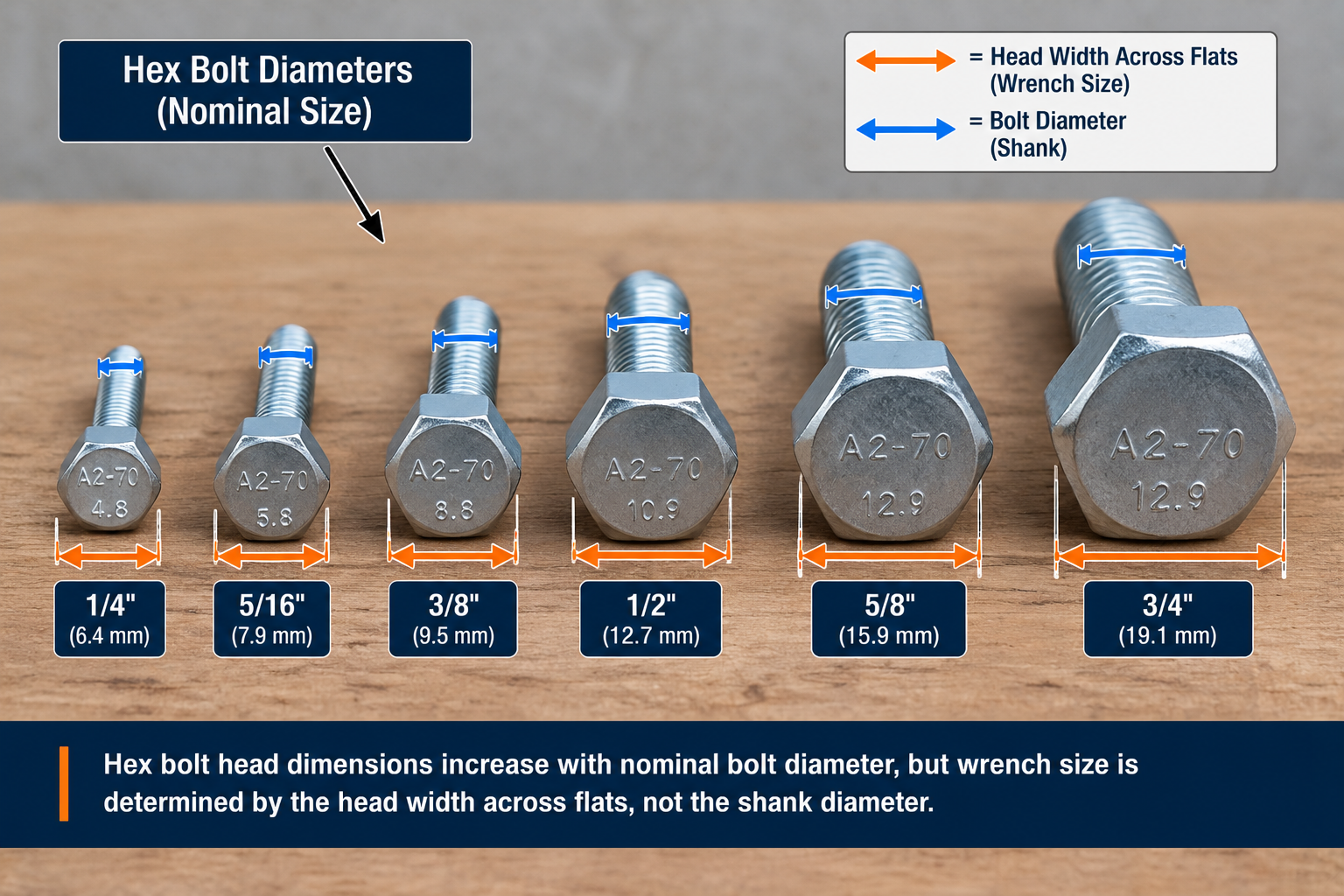
An externally threaded fastener with a six-sided head, typically used with a nut.
A hex bolt has a six-sided head, a cylindrical body or shank, and an external screw thread. Ordinary hex bolts are commonly used in construction, general fabrication, equipment, machinery, and supports and frames.
Hex Bolt vs Hex Cap Screw
Terms often used interchangeably, but technically different products.
A hex bolt is typically tightened by turning the nut while the head is held stationary. A hex cap screw is commonly tightened by turning the head, often into a tapped hole, and cap screws generally have tighter dimensional tolerances than ordinary hex bolts.
Dimensional Differences
| Feature | Hex Bolt | Hex Cap Screw |
|---|---|---|
| Body tolerance | Broader | Tighter |
| Under-head geometry | Standard bearing surface | Washer face under the head |
| Typical tightening method | Turn the nut | Turn the head |
Why This Matters
ASME B18.2.1 applies different dimensional controls to the two product forms, so hex-cap-screw dimensions should not be mixed into the primary hex-bolt chart on this page.
Standard Hex Bolt vs Heavy Hex Bolt
An essential distinction for wrench selection and structural specification.
| Type | Governing Standard |
|---|---|
| Ordinary Hex Bolt | ASME B18.2.1 |
| Heavy Hex Bolt | ASME B18.2.6 |
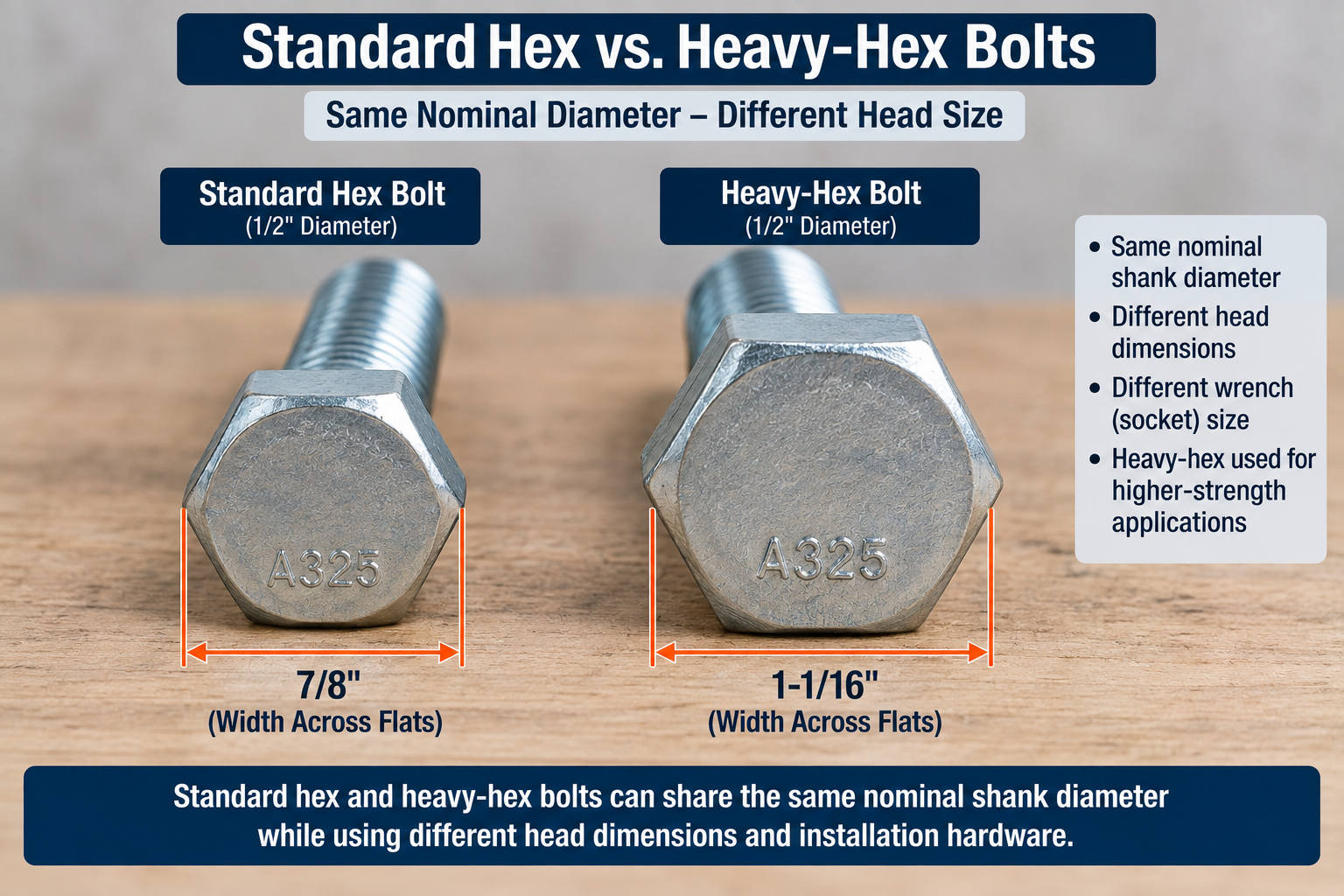
Heavy-hex structural bolts formerly covered under B18.2.1 are now covered separately under ASME B18.2.6, and heavy-hex bolts use a larger head across flats than an ordinary hex bolt of the same nominal diameter. A 3/4-in. ordinary hex bolt and a 3/4-in. heavy-hex bolt do not necessarily use the same wrench size. For mechanical grade and material strength data, see the Bolt Grade Chart.
How to Read a Hex Bolt Size
Example: 1/2-13 x 3
This designation means a nominal diameter of 1/2 in., a thread pitch of 13 threads per inch, and a nominal bolt length of 3 in.
Diameter
The first number identifies the nominal shank or thread diameter.
TPI
Threads per inch, the second number in the designation.
Length
Measured from the bearing surface under the head to the bolt end for ordinary hex-head bolts.
Hex Bolt Dimension Anatomy
The fundamental technical visual for every table on this page.
Key dimensions include nominal body diameter (D), width across flats (F), width across corners, head height (H), nominal bolt length (L), nominal thread length (LT), fillet radius, thread runout, and chamfer.
Hex Bolt Diameter Chart
A diameter-first lookup covering the full ASME-listed range, not just hardware-store sizes.
| Nominal Diameter | Decimal Equivalent (in.) |
|---|---|
| 1/4 | 0.250 |
| 5/16 | 0.3125 |
| 3/8 | 0.375 |
| 7/16 | 0.4375 |
| 1/2 | 0.500 |
| 5/8 | 0.625 |
| 3/4 | 0.750 |
| 7/8 | 0.875 |
| 1 | 1.000 |
| 1-1/8 | 1.125 |
| 1-1/4 | 1.250 |
| 1-3/8 | 1.375 |
| 1-1/2 | 1.500 |
ASME B18.2.1 includes ordinary hex bolts across this broad inch-series size range and beyond; this chart follows the standard rather than an arbitrary “common size” cutoff.
Hex Bolt Head Width / Across-Flats Chart
One of the most searched practical sections on this page.
Width across flats (F) is the distance measured between two parallel flat sides of the hex head.
| Bolt Diameter | Basic Width Across Flats |
|---|---|
| 3/4 in. | 1-1/8 in. |
| 1 in. | 1-1/2 in. |
| 1-1/4 in. | 1-7/8 in. |
| 1-1/2 in. | 2-1/4 in. |
This section directly supports wrench selection, since across-flats is the dimension a standard open-end or box wrench actually grips.
Hex Bolt Wrench and Socket Size Chart
One of the page’s flagship tables.
| Bolt Diameter | Hex Head Across Flats | Nominal Wrench/Socket Size |
|---|---|---|
| 1/2 in. | 3/4 in. | 3/4 in. |
| 5/8 in. | 15/16 in. | 15/16 in. |
| 3/4 in. | 1-1/8 in. | 1-1/8 in. |
| 7/8 in. | 1-5/16 in. | 1-5/16 in. |
| 1 in. | 1-1/2 in. | 1-1/2 in. |
Do not infer wrench size from bolt diameter alone. A 3/4-in. bolt does not take a 3/4-in. wrench; for a standard hex head, wrench and socket size correspond to the basic width across flats, which is always larger than the nominal shank diameter.
Width Across Flats vs Across Corners
Two different head-envelope measurements with different practical uses.
| Measurement | Used For |
|---|---|
| Across Flats | Wrench/socket selection |
| Across Corners | Maximum diagonal head envelope |
Across-corners matters for socket clearance, recessed installations, adjacent-part clearance, and CAD or layout work. ASME B18.2.1 provides both across-flat and across-corner limits for every standard diameter.
Hex Bolt Head Height Chart
Matters for clearance, recessed assembly, and equipment layout.
| Bolt Diameter | Basic Head Height (in.) |
|---|---|
| 1/2 in. | 0.3125 |
| 5/8 in. | 0.3906 |
| 3/4 in. | 0.4687 |
| 7/8 in. | 0.5469 |
| 1 in. | 0.6250 |
ASME B18.2.1 controls these dimensional limits, with maximum and minimum tolerances published alongside the basic value for each diameter.
Hex Bolt Body Diameter and Dimensional Tolerances
Nominal diameter is not necessarily the exact measured body diameter.
ASME B18.2.1 permits dimensional tolerances on body diameter. A 1-in. hex bolt, for example, has a body diameter maximum of 1.022 in. under the standard. This is a useful practical reason clearance holes must not be sized from nominal diameter alone.
How Hex Bolt Length Is Measured
Standard length designation for conventional hex-head bolts.
Measure from the bearing surface beneath the head to the end of the bolt. Actual production length has applicable manufacturing tolerances, so nominal length and precisely measured length can differ slightly. Selecting bolt length requires accounting for grip thickness, washer, nut, and required thread engagement or protrusion; there is no single universal “add X threads” rule that applies across every standard and application.
Grip Length vs Overall Bolt Length
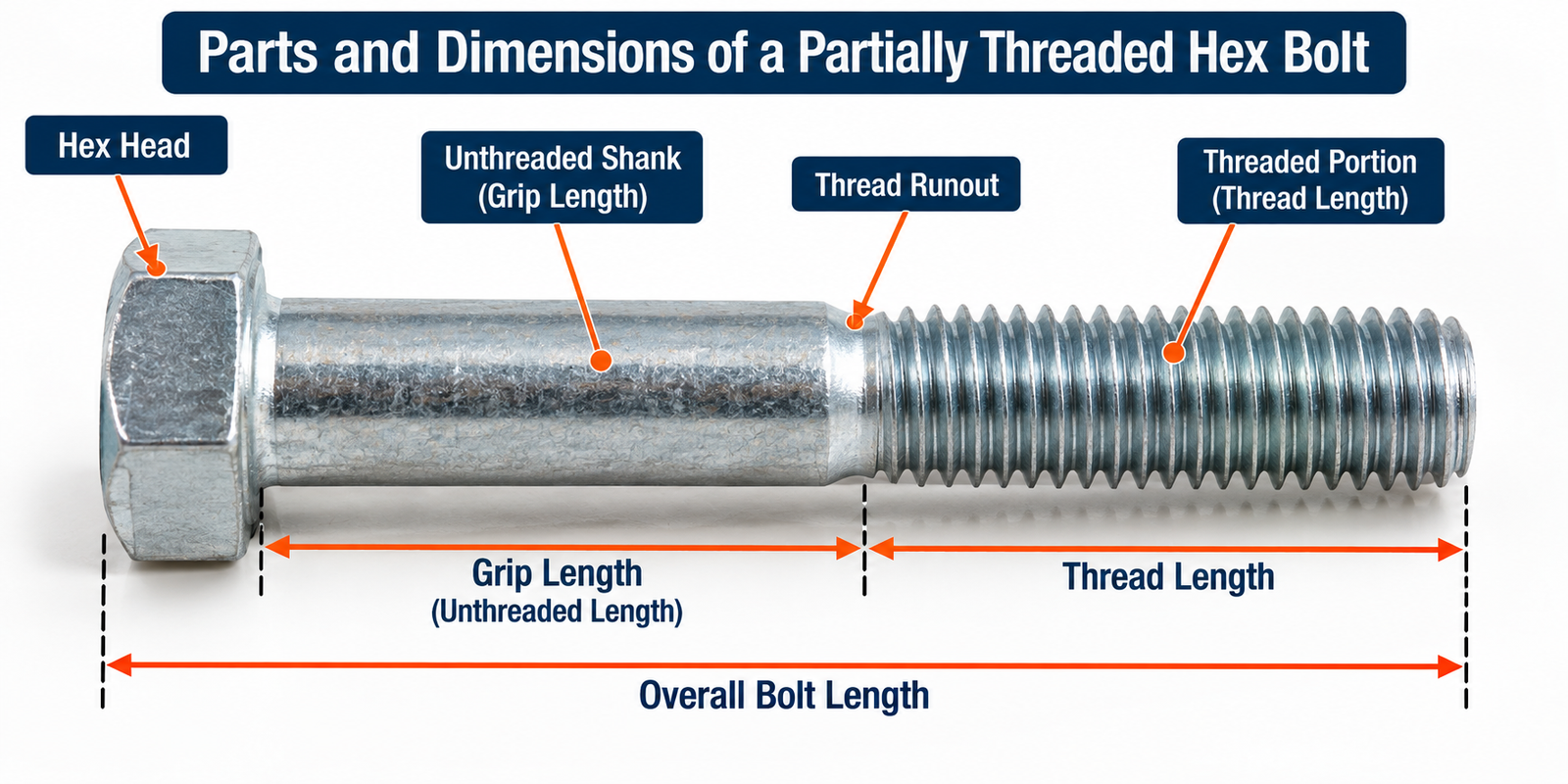
These are not the same dimension, especially for partially threaded bolts.
| Term | Definition |
|---|---|
| Bolt Length | Total under-head length |
| Grip Length | Unthreaded portion, or the thickness of material clamped, depending on application context |
Bolt length and thread length are not the same thing, which is especially important to keep straight when specifying partially threaded bolts for a clamped joint.
Hex Bolt Thread Length Chart
ASME B18.2.1 specifies a nominal thread-length formula for standard bolts.
Standard Thread Length Formula
For bolts 6 in. and shorter: LT = 2D + 1/4 in. For bolts longer than 6 in., a longer allowance applies under the standard. D is the nominal bolt diameter in inches.
| Bolt Diameter | Nominal Thread Length (Bolts ≤ 6 in.) |
|---|---|
| 1/2 in. | 1.25 in. |
| 5/8 in. | 1.50 in. |
| 3/4 in. | 1.75 in. |
| 7/8 in. | 2.00 in. |
| 1 in. | 2.25 in. |
These values are calculated directly from the standard formula and verified arithmetically. Do not apply this formula beyond its standard scope; bolts longer than 6 in. use a different allowance under ASME B18.2.1.
Fully Threaded vs Partially Threaded Hex Bolts
Matters for shear plane, grip, assembly, and ordering.
| Type | Description |
|---|---|
| Partially Threaded Bolt | Has an unthreaded shank and a threaded end |
| Fully Threaded Fastener | Threads extend nearly to the head |
This distinction affects where the shear plane falls in a bolted connection and how much of the bolt engages threads versus smooth shank, which is relevant to grip and assembly. This page focuses on size identification, not full structural connection design.
UNC Hex Bolt Thread Pitch Chart
UNC = Unified National Coarse, under current ASME B1.1-2024.
| Diameter | UNC TPI | Pitch (in.) |
|---|---|---|
| 1/4 | 20 | 0.0500 |
| 5/16 | 18 | 0.0556 |
| 3/8 | 16 | 0.0625 |
| 7/16 | 14 | 0.0714 |
| 1/2 | 13 | 0.0769 |
| 5/8 | 11 | 0.0909 |
| 3/4 | 10 | 0.1000 |
| 7/8 | 9 | 0.1111 |
| 1 | 8 | 0.1250 |
Pitch P = 1/TPI, expressed in inches. For a full dimensional UNC reference including tap drill sizes, see the UNC Thread Chart.
UNF Hex Bolt Thread Pitch Chart
UNF = Unified National Fine.
| Diameter | UNF TPI | Pitch (in.) |
|---|---|---|
| 1/4 | 28 | 0.0357 |
| 5/16 | 24 | 0.0417 |
| 3/8 | 24 | 0.0417 |
| 7/16 | 20 | 0.0500 |
| 1/2 | 20 | 0.0500 |
| 5/8 | 18 | 0.0556 |
| 3/4 | 16 | 0.0625 |
| 7/8 | 14 | 0.0714 |
| 1 | 12 | 0.0833 |
Fine threads provide more threads per inch and a smaller pitch than coarse threads at the same diameter. For a full UNF reference, see the UNF Thread Chart.
UNC vs UNF Hex Bolts
Selection depends on application and specification, not a universal ranking.
| Feature | UNC | UNF |
|---|---|---|
| Pitch | Coarser | Finer |
| TPI | Lower | Higher |
| Thread depth | Generally deeper | Generally shallower |
| Assembly sensitivity | Application-dependent | Application-dependent |
| Common usage | Very broad | Precision, automotive, and special applications |
Do not assume UNF is always stronger or UNC always better under vibration; application and failure mode determine which series is appropriate for a given joint.
Unified Thread Classes and ASME B1.1
Kept concise for a general construction audience.
Thread classes such as 1A, 2A, and 3A apply to external Unified threads, describing allowance and tolerance grade. ASME B1.1 controls thread form, series, class, allowance, tolerance, and designation rules for Unified inch threads. For deeper thread geometry and pitch data, see the Thread Pitch Chart.
Hex Bolt Clearance Holes and Threaded Holes
A useful practical section that must be carefully scoped.
Clearance-hole diameter depends on bolt diameter, required fit, applicable design or specification, and fabrication standard. This page does not use a universal “hole equals bolt plus 1/16 in.” rule, since actual clearance requirements vary by application and specification. For threaded-hole sizing specifically, see the Tap Drill Chart, noting that tap-drill size is for cutting internal threads and is not the same thing as a clearance-hole size for a through-bolt.
Matching Hex Nuts and Washers
Compatibility requires matching more than just nominal diameter.
Nut compatibility requires matching nominal diameter, thread pitch and series, and any material or grade requirement. A 1/2-13 UNC bolt requires a compatible 1/2-13 nut, not just any 1/2-in. nut. Common nut types include finished hex nuts, heavy hex nuts, and locking nuts. Washer selection similarly depends on bolt diameter, washer specification, application, and bearing requirements; not every 3/4-in. bolt uses one universal washer outside diameter or thickness, and structural high-strength systems can have specific washer requirements of their own.
Hex Bolt Grade and Head Markings
A supporting section, since strength data belongs on a dedicated grade chart.
Common head markings can indicate mechanical grade or specification. SAE J429 covers mechanical and material requirements for inch-series externally threaded steel fasteners through 1-1/2 in. and includes familiar SAE bolt grades. For complete strength and marking data, see the Bolt Grade Chart, and for torque values by grade and diameter, see the Bolt Torque Chart.
SAE Grade 2, Grade 5, and Grade 8 Hex Fasteners
Familiar SAE grades affect material and proof or tensile strength and head markings, but they do not change nominal bolt diameter or thread designation. Full strength details are covered on the dedicated Bolt Grade Chart rather than duplicated here.
SAE and ASTM Hex Bolt Specifications
Important U.S. construction context beyond dimensional standards.
Possible specifications for hex bolts include ASTM A307, ASTM A354, ASTM A449, and other application-specific standards. “Hex bolt” by itself does not identify material grade; dimensions, threads, and mechanical specification are separate layers of the fastener designation and must each be specified independently.
Heavy-Hex Structural Bolts and ASTM F3125
A clear boundary that this page does not cross.
Current ASTM F3125/F3125M covers high-strength structural bolts and assemblies, including A325 and A490 heavy-hex styles, with inch heavy-hex sizes generally from 1/2 in. through 1-1/2 in. depending on grade and style. A325/A490-style structural bolts should not be treated as ordinary hex bolts simply because both have six-sided heads; their head proportions, nut and washer systems, strength, installation, and structural design requirements are all different from a general-purpose hex bolt.
Ordinary Hex vs Heavy-Hex Head Dimensions
Prevents a major chart-use mistake.
| Feature | Standard Hex | Heavy Hex |
|---|---|---|
| Head width | Smaller | Larger |
| Bearing area | Lower | Greater |
| Typical use | General purpose | Specialized/structural |
| Dimensional standard | ASME B18.2.1 | ASME B18.2.6 / structural standards |
| Same wrench size at same diameter? | No assumption | Usually larger |
Metric Hex Bolt Size Chart
Secondary to the inch-series focus of this page, but included for completeness.
| Metric Size | Coarse Pitch (mm) | Width Across Flats (mm) | Typical Wrench Size |
|---|---|---|---|
| M8 | 1.25 | 13 | 13 mm |
| M10 | 1.5 | 16 (ISO) / 17 (DIN) | 16 or 17 mm |
| M12 | 1.75 | 18 (ISO) / 19 (DIN) | 18 or 19 mm |
| M16 | 2.0 | 24 | 24 mm |
| M20 | 2.5 | 30 | 30 mm |
| M24 | 3.0 | 36 | 36 mm |
ISO 4014:2022 covers hexagon-head bolts with metric coarse-pitch threads M1.6 through M64, product grades A and B. Some diameters, such as M10 and M12, have a different wrench size under the older DIN 931/933 standard versus current ISO 4014, so the applicable standard must be confirmed before selecting a wrench. Do not simply convert inch hex dimensions into metric; metric fasteners have their own standardized dimensions. For full thread geometry, see the Metric Thread Chart.
Metric Hex Bolt vs Metric Hex Head Screw
ISO distinguishes ISO 4014:2022 (hexagon head bolts) from ISO 4017:2022 (hexagon head screws), which parallels the inch-series bolt versus cap-screw distinction covered earlier on this page.
Inch vs Metric Hex Bolts
Never substitute across systems based on numerically close dimensions.
| Feature | Inch Hex Bolt | Metric Hex Bolt |
|---|---|---|
| Diameter | Inches/fractions | M size (mm) |
| Pitch | TPI | mm per thread |
| Thread standard | ASME B1.1 | ISO metric thread |
| Head dimension standard | ASME B18.2.1 | ISO 4014 |
| Wrench size | Inch | Metric |
Do not substitute an inch wrench or bolt combination merely because dimensions are numerically close to a metric equivalent; the thread forms are not interchangeable even when diameters appear similar.
ASME B18.2.1 Hex Bolt Dimensional Standard
The primary dimensional authority for this entire page.
ASME B18.2.1 covers general and dimensional data for inch-series square and hex bolts and screws. Heavy-hex structural bolts formerly covered under this standard are now addressed separately under ASME B18.2.6, which is why this page maintains a clear boundary between the two product categories throughout.
ASME B1.1-2024 Unified Thread Standard
The current thread standard behind every UNC/UNF value on this page.
ASME B1.1-2024 is the current Unified Inch Thread standard covering UN, UNR, and UNJ thread forms and thread-series and designation rules. All UNC and UNF pitch data on this page should be understood as reflecting the current standard rather than an outdated thread table.
How to Choose a Hex Bolt Size
A practical selection framework for identifying the right size, not for engineering a loaded connection.
Hex Bolt Selection Workflow
Common Mistakes and Chart Limitations
Confusing bolt diameter with wrench size
Wrench size is based on head width across flats, which is always larger.
Reading 1/2-13 as a 13-in. length
The second number is threads per inch, not a length.
Confusing TPI with pitch diameter
TPI is threads per inch; pitch diameter is a separate thread dimension entirely.
Confusing bolt length with thread length
Partially threaded bolts have a shorter thread length than overall length.
Measuring overall length including the hex head
Standard length is measured from under the head, not from the top of the head.
Assuming all hex bolts are fully threaded
Many standard hex bolts are partially threaded per the standard formula.
Mixing UNC and UNF nuts
A nut must match the exact thread series and pitch, not just the diameter.
Assuming head width equals nominal bolt diameter
Head width across flats is always larger than the nominal shank diameter.
Confusing width across flats with across corners
These are two different head-envelope measurements used for different purposes.
Mixing hex bolt and hex cap screw dimensions
The two product forms have different dimensional controls under ASME B18.2.1.
Mixing ordinary hex and heavy-hex heads
The two use different head width standards even at the same nominal diameter.
Treating A325/A490 as generic hex bolts
These are structural bolts under ASTM F3125 with distinct requirements.
Assuming bolt grade changes diameter
Grade affects material strength, not nominal dimensions.
Assuming Grade 8 means an 8-mm bolt
SAE Grade 8 is an inch-series strength grade, unrelated to metric sizing.
Confusing SAE Grade 8 with metric property class 8.8
These are separate grading systems that are not directly equivalent.
Mixing inch and metric fasteners
Thread forms are incompatible even when dimensions appear numerically close.
Assuming clearance-hole size equals nominal diameter
Clearance holes are sized larger to accommodate actual bolt diameter and fit.
Using tap-drill size as clearance-hole size
Tap-drill size is for cutting internal threads, a different function entirely.
Selecting bolt length without accounting for washer/nut/grip
Overall required length depends on the full stack, not the bolt alone.
Using an old thread table rather than ASME B1.1-2024
Always reference the current standard for thread series and designation rules.
Read before finalizing a hex bolt selection
This main chart covers standard inch-series hex bolts. Hex cap screws have distinct dimensional requirements, and heavy-hex structural bolts use different head proportions. Bolt grade and material specification are separate from dimensions, and threads must match the exact series and pitch. Actual body and head dimensions have manufacturing tolerances, and wrench clearance should account for the real head or socket envelope. Bolt-hole sizing depends on the application and specification, and thread engagement depends on materials and design. Corrosion or coating can affect fit and tolerance, and metric bolts follow separate ISO dimensional standards. Structural connection design requires the applicable code or specification and engineering, not just a size chart.
Hex Bolt Size FAQs
Download the Hex Bolt Size Chart
Get a printable reference including diameter, wrench size, head dimensions, and UNC/UNF thread pitch tables on this page for jobsite or shop use.