Deck Screw Size Chart – By Board Thickness, Material & Exposure
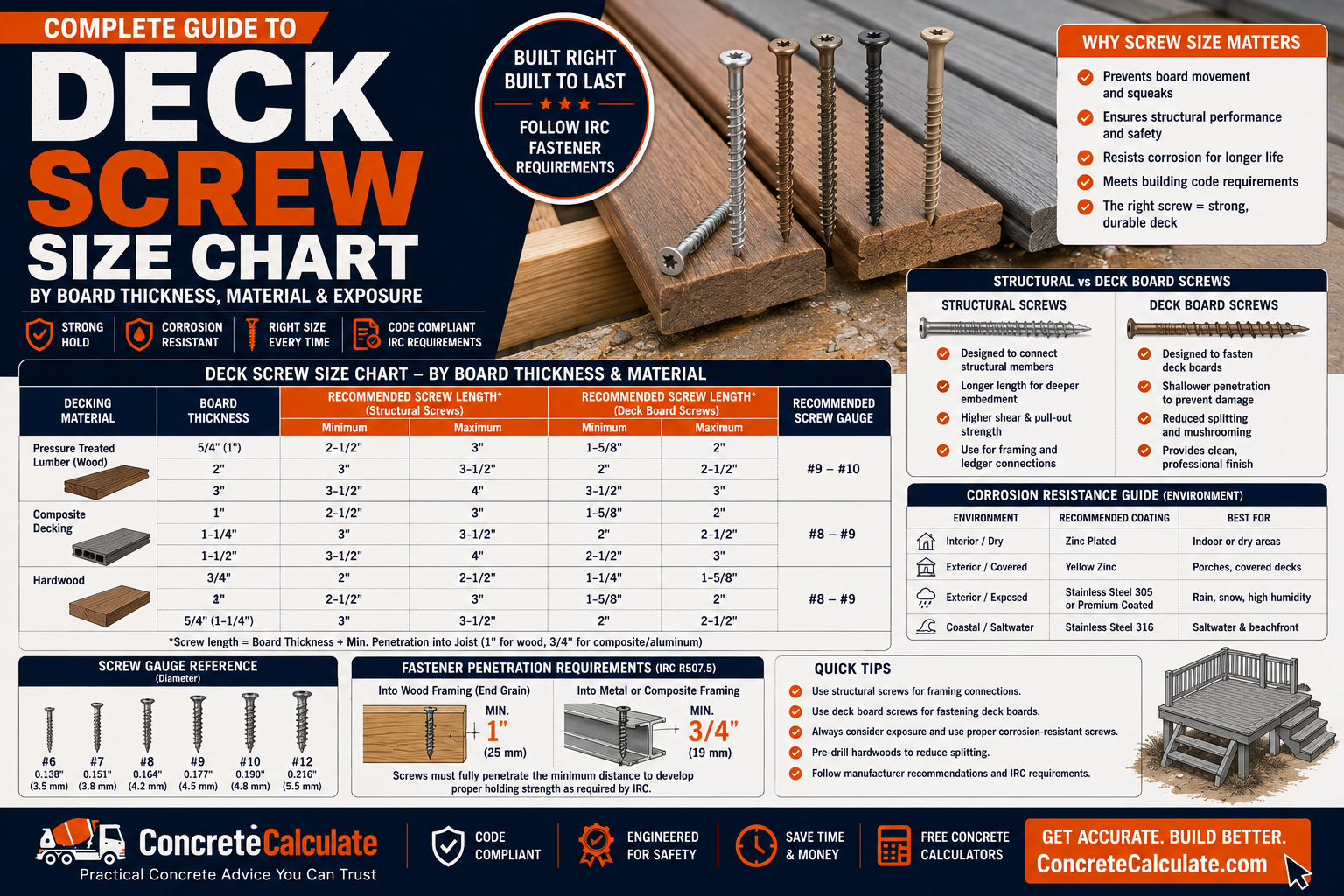
Deck Screw Size Chart
By Board Thickness, Material & Exposure
The complete deck screw sizing reference: length and gauge by decking material and thickness, corrosion resistance by environment, and the critical distinction between deck-board and structural screws.
 Reviewed by Muhammad Ramzan Babar, PhD Researcher (Plasma Physics) & Calculator Developer, View Profile
Deck-board screws are not structural connectors
This chart covers screws for attaching decking boards to joists. Ledgers, beams, posts, and guard connections require structural screws, lag screws, or bolts with tested design values, not ordinary deck screws. Always follow the decking manufacturer’s specific installation instructions and applicable code requirements.
Deck Screw Size Chart, Quick Reference
Manufacturer requirements vary substantially between decking products. These are common industry reference ranges organized by material category, not a single universal recommendation.
| Decking Material | Actual Thickness | Common Screw Length | Common Gauge | Fastener Material | Application |
|---|---|---|---|---|---|
| 5/4 pressure-treated/wood | ~1 in. | 2 to 2 1/2 in. | #8, #10 | HDG steel or stainless | Face fastening to joist |
| 2×6 wood decking | ~1 1/2 in. | 2 3/4 to 3 in. | #8, #10 | HDG steel or stainless | Face fastening to joist |
| 2×4 wood decking | ~1 1/2 in. | 2 3/4 to 3 in. | #8, #10 | HDG steel or stainless | Face fastening to joist |
| Composite decking (1 in. profile) | ~1 in. | 2 1/2 to 2 3/4 in. | #8, #10 | Manufacturer color-matched coated screw | Face or hidden fastening, per manufacturer |
| Composite decking (2×6 profile) | ~1 1/2 in. | 2 3/4 to 3 in. | #8, #10 | Manufacturer color-matched coated screw | Face fastening, per manufacturer |
| PVC decking | Varies by profile | Manufacturer specified | Manufacturer specified | PVC-specific coated/stainless screw | Face or hidden fastening, per manufacturer |
| Hardwood decking | Varies by species | Manufacturer/species specific | #8, #10 | Stainless steel recommended | Often requires pilot holes |
These are reference ranges, not a substitute for manufacturer instructions
Trex’s current installation guidance, for example, specifies 2 3/4 or 3 inch screws for its 2×6 profile and different options for its 1 inch profiles, and other manufacturers publish their own specific requirements. Always follow the actual decking manufacturer’s published installation guide for the specific product being installed.
What Is a Deck Screw?
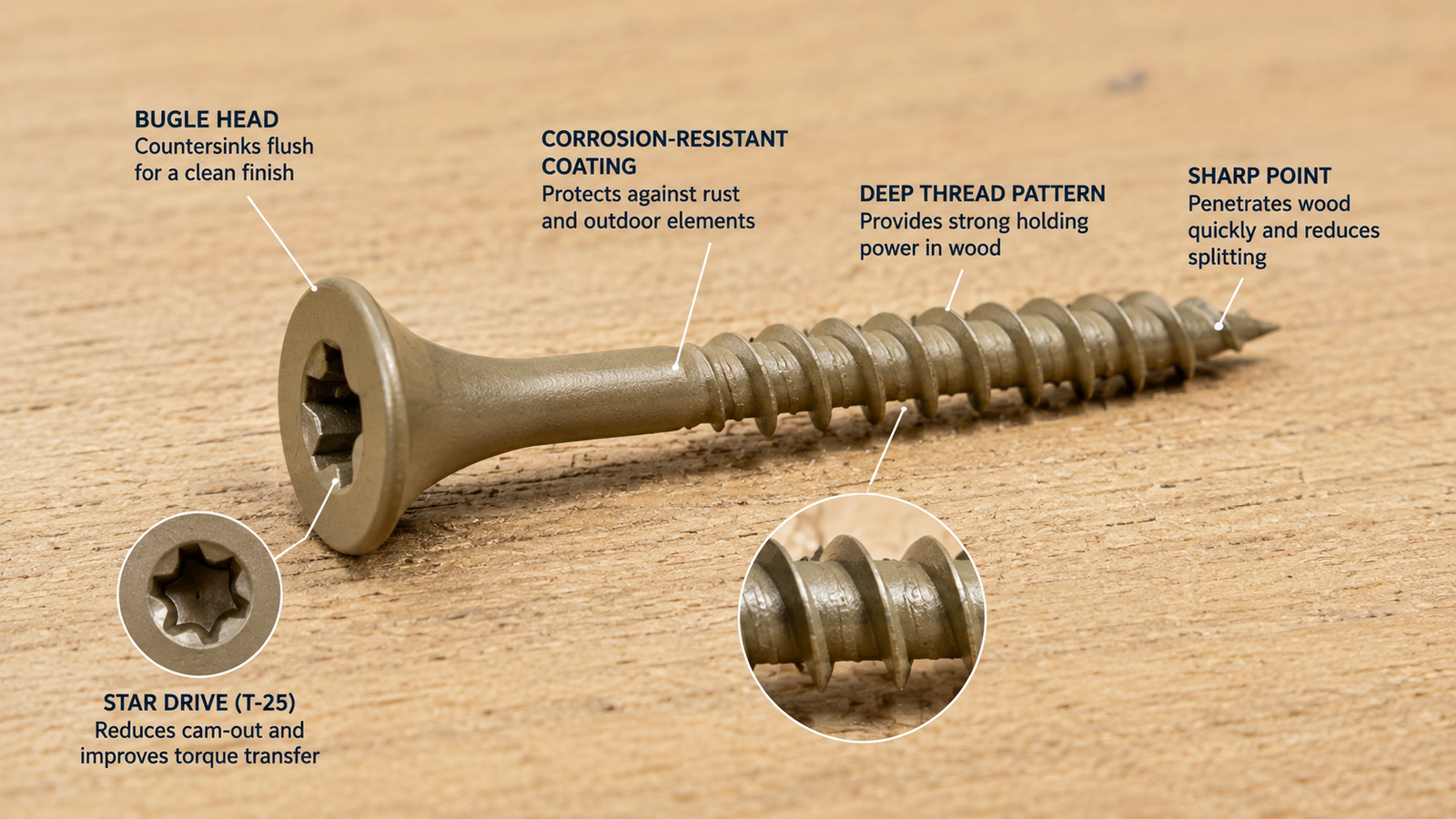
A deck screw is an exterior-rated fastener designed with corrosion resistant coatings and thread patterns suited to attaching decking boards to joists outdoors.
Deck screws differ from general wood screws primarily through their exterior corrosion resistant coatings or materials, since decking is constantly exposed to moisture, temperature swings, and in many cases pressure-treated lumber chemicals. They typically feature a bugle or trim-style head for a relatively flush appearance, an aggressive thread designed to self-drill into wood, and a drive system chosen for cam-out resistance during power-tool installation. Deck screws are distinct from drywall screws, which lack adequate exterior corrosion protection, and from structural wood screws and lag screws, which are engineered and tested for structural load-bearing connections rather than board attachment.
How Deck Screw Sizes Are Specified
A designation such as #10 x 3 inches breaks down into gauge, nominal diameter, and length, with additional identifiers for head type, drive, coating, and material.
| Component | Example | Meaning |
|---|---|---|
| Gauge | #10 | Number-series designation corresponding to shank diameter |
| Length | 3 in. | Overall screw length from tip to head bearing surface |
| Head type | Bugle, trim | Shape and profile of the screw head |
| Drive | Torx/6-lobe, square | Bit engagement pattern |
| Coating/material | Ceramic coated, 305 stainless | Corrosion resistance system |
For complete general screw dimensional reference, see the Screw Size Chart, and for wood-screw-specific identification, see the Wood Screw Size Chart.
Deck Screw Gauge vs Diameter
Gauge number and shank diameter increase together, but not every gauge is equally common for decking applications.
| Gauge | Diameter (in.) | Diameter (mm) | Common for Decking |
|---|---|---|---|
| #6 | 0.138 | 3.5 | Uncommon; too small for most decking |
| #7 | 0.151 | 3.8 | Occasionally used, less common |
| #8 | 0.164 | 4.2 | Very common for decking |
| #9 | 0.177 | 4.5 | Less common |
| #10 | 0.190 | 4.8 | Very common for decking |
| #12 | 0.216 | 5.5 | Used for heavier applications |
#8 and #10 gauge screws are by far the most common for deck-board face fastening, appearing repeatedly across manufacturer specifications. Larger gauges like #12 appear more often in heavier or structural applications rather than typical deck-board attachment.
Deck Screw Length Chart
Screw length should be tied to actual manufacturer requirements for the specific product, not treated as a universal rule.
| Screw Length | Approx. Application | Typical Decking Context |
|---|---|---|
| 1 1/2 in. | Thin material | Trim/fascia |
| 2 in. | Thin decking | Some composite/thin boards |
| 2 1/2 in. | Standard decking | Many 5/4 deck board applications |
| 2 3/4 in. | Selected composite products | Manufacturer dependent, common for 1 in. profiles and some 2×6 |
| 3 in. | Thicker decking | Common for 2×6 wood and composite applications |
| 3 1/2 in. and longer | Structural/heavy applications | Not ordinary deck-board fastening |
Trex’s current decking installation guide specifies 2 1/2 or 2 3/4 inch screws for its 1×6/1×4 profiles and 2 3/4 or 3 inch screws for its 2×6 profile, both in #8 or #10 gauge. These figures illustrate typical manufacturer ranges; always confirm the specific product’s published fastener requirements.
How Long Should a Deck Screw Be?
Screw length should provide adequate joist penetration without breaking through, based on board thickness and the manufacturer’s specific requirements, not a generic multiplier rule.
Deck board thickness
Determines how much screw length is consumed before reaching the joist.
Screw head position
Head must seat properly at or near the board surface per manufacturer instructions.
Joist thickness
Limits how much penetration is possible before risking breakthrough on the underside.
Excessive penetration risk
Screws that are too long can protrude through the joist underside, creating a hazard.
Insufficient penetration risk
Screws that are too short provide inadequate holding power and can work loose over time.
A commonly cited rule of thumb suggests screw penetration into the joist of roughly two to three times the board thickness, but this should be treated as a general guideline only. Manufacturer-specific fastening requirements for the actual decking product should always take precedence over a generic multiplier.
Deck Screw Size by Deck Board Thickness
Nominal board dimensions do not equal actual thickness, and this distinction directly affects correct screw length selection.
| Board Type | Nominal Size | Actual Thickness |
|---|---|---|
| 5/4 decking | 5/4 in. | ~1 in. |
| 2×6 decking | 2 in. | ~1 1/2 in. |
| 2×4 decking | 2 in. | ~1 1/2 in. |
Deck Screw Size for 5/4 Deck Boards
5/4 decking’s actual thickness of about 1 inch commonly uses #8 or #10 gauge screws in the 2 to 2 1/2 inch range, though wood species and manufacturer specifications affect the final choice.
Many manufacturers specify two screws per joist for face-fastened installation, with a flush finish at the board surface. Wood species considerations matter as well, since denser woods may require different pilot hole practices than typical pressure-treated pine.
Deck Screw Size for 2×6 Deck Boards
2×6 decking’s actual thickness of about 1 1/2 inches commonly uses longer screws than 5/4 decking to maintain adequate joist penetration.
Manufacturer-specific example
Trex’s current installation guide allows 2 3/4 inch or 3 inch screws for its 2×6 product, in #8 or #10 gauge, under its specified installation conditions. This illustrates why 2×6 decking commonly requires longer screws than 5/4 decking, since the board itself is thicker and consumes more screw length before reaching the joist.
Deck Screw Size for 2×4 Deck Boards
2×4 decking shares the same actual thickness as 2×6 decking, so similar screw length guidance generally applies, with attention to edge splitting given the narrower board width.
Because 2×4 boards are narrower, edge splitting near screw locations can be a greater concern than with wider boards, particularly for denser wood species. Joist spacing and the resulting number of fastening points per board should also be confirmed against the specific decking layout.
Deck Screw Size for Composite Decking
Composite decking is not simply wood with a different appearance, and its fastening requirements are manufacturer-specific rather than generic.
| Consideration | Why It Matters |
|---|---|
| Color-matched screws | Designed to blend visually with the specific composite color/finish |
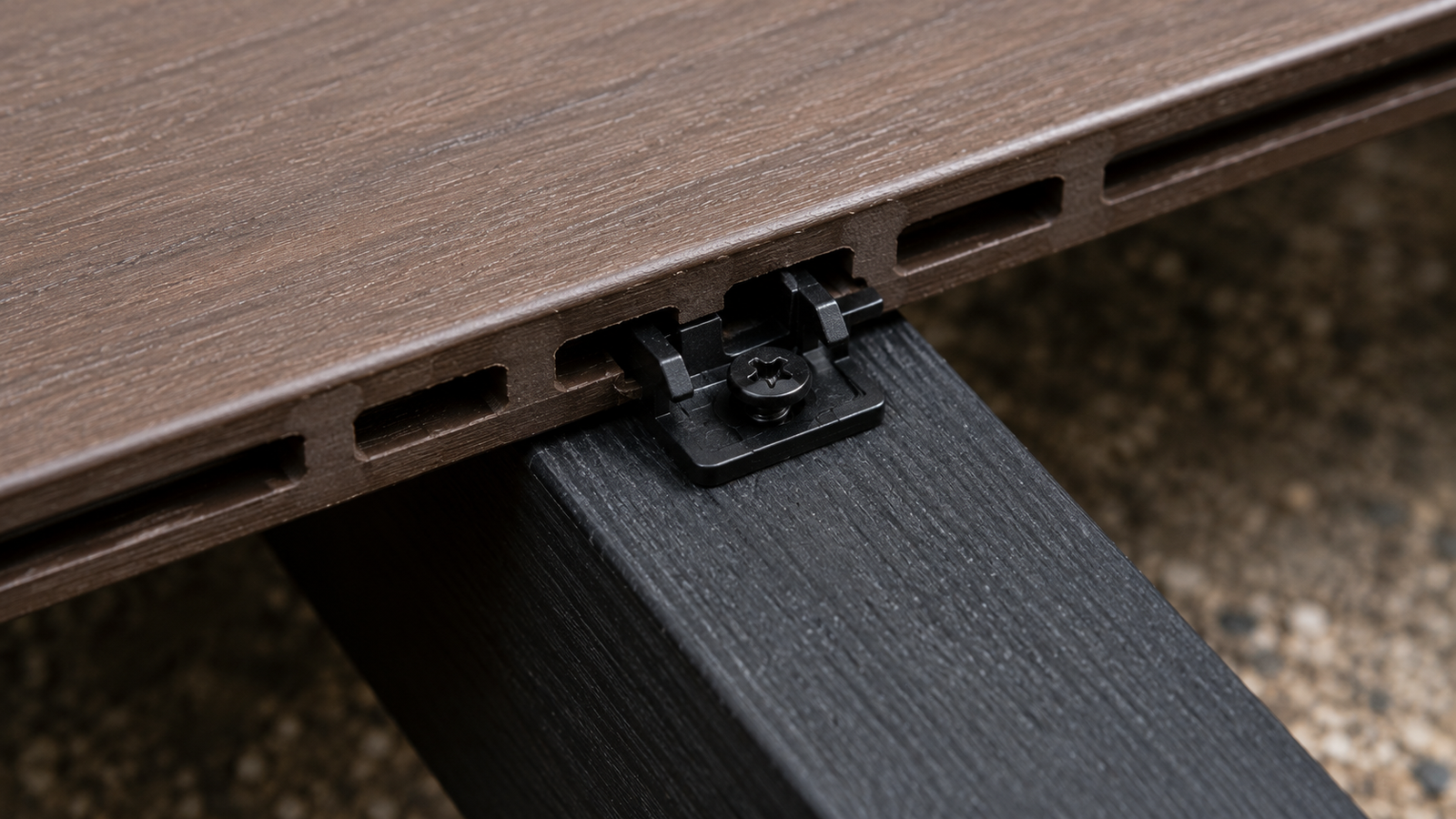
| Hidden fastener systems | Use grooved board profiles and manufacturer-specific clips |
| Board profile | Different profiles (grooved, square-edge) require different fastener approaches |
| Expansion/contraction | Composite materials move with temperature more than wood, affecting fastening method |
Trex’s current installation instructions specifically distinguish approved face-fastener and hidden-fastener systems for different composite profiles, with specific screw lengths and gauges tied to each profile. Always match the specific manufacturer and product line’s published fastener list rather than assuming any composite-compatible screw will work.
Deck Screw Size for PVC Decking
PVC decking uses its own manufacturer-specific fastening systems, distinct from composite decking fasteners even though the two materials are sometimes grouped together informally.
PVC decking’s thermal movement characteristics and head design requirements can differ from wood-plastic composite decking, so PVC-specific fasteners should be used rather than assuming interchangeability with composite decking screws. Screw length, head design, and installation method should be confirmed against the specific PVC product’s manufacturer instructions.
Deck Screw Size for Pressure-Treated Wood
Pressure-treated lumber’s chemical preservatives require corrosion resistant fasteners; ordinary uncoated or standard-coated screws can corrode prematurely in contact with treated wood.
| Fastener Type | Compatibility with Treated Lumber |
|---|---|
| Hot-dip galvanized steel | Generally compatible; common minimum requirement |
| Stainless steel (304 or 316) | Compatible, superior long-term corrosion resistance |
| Electroplated/standard coated steel | Generally not adequate for treated lumber contact |
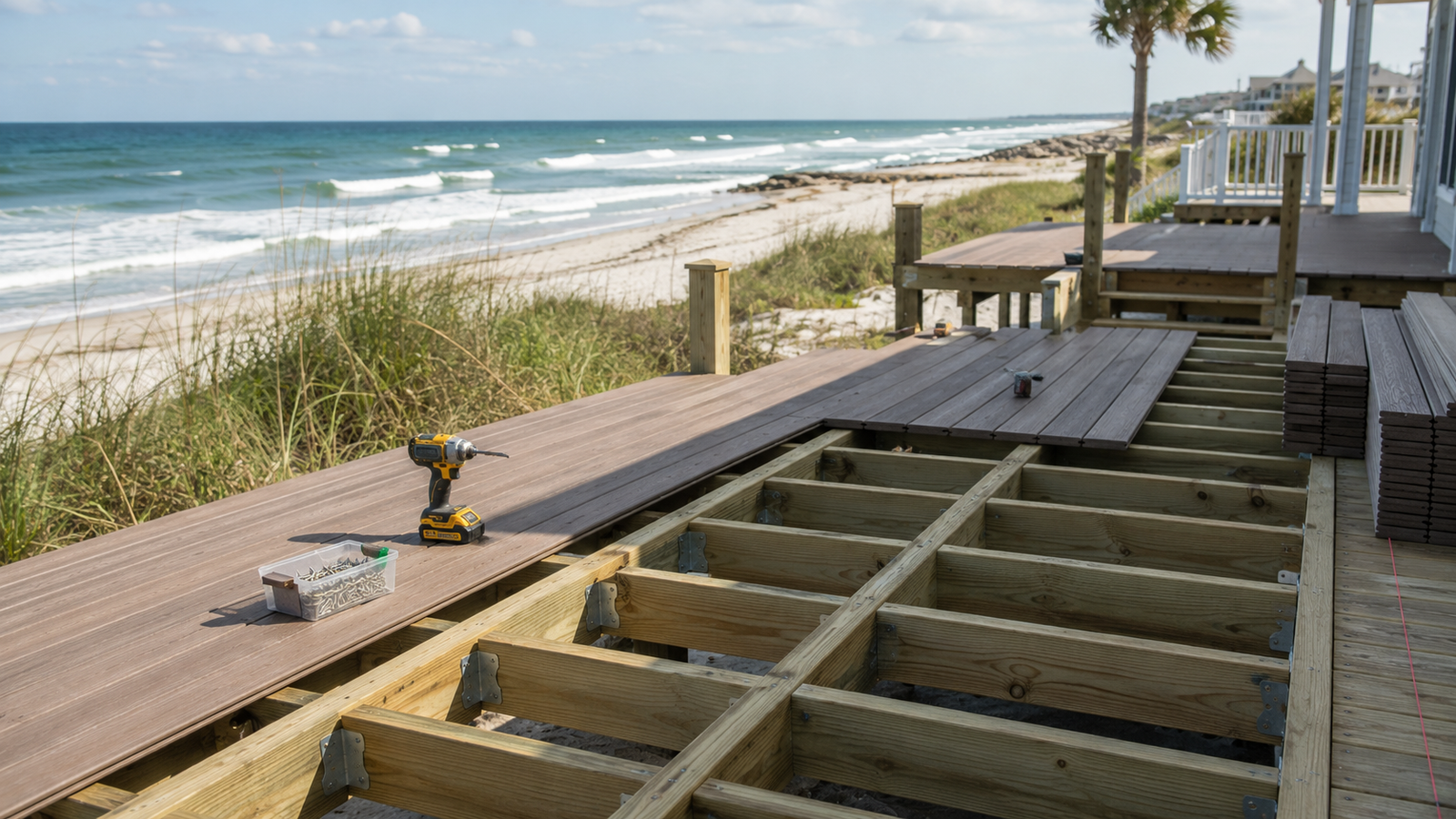
The IRC’s deck fastener provisions include corrosion resistance requirements, and fasteners exposed to saltwater or within the code’s specified distance of a saltwater shoreline require stainless steel regardless of the lumber treatment used. Always check the specific preservative chemical used in the treated lumber against the fastener manufacturer’s compatibility guidance.
Deck Screw Size for Cedar and Redwood
These softwoods have their own splitting and staining considerations that affect screw selection beyond simple length and gauge.
Cedar and redwood can be prone to splitting near board ends, making pilot holes worth considering in those locations. These woods can also react with certain fastener coatings, causing staining around the screw head, which is why stainless steel fasteners are frequently recommended for premium softwood decking to avoid discoloration over time.
Deck Screw Size for Hardwood Decking
Dense hardwood decking requires different installation practices than pressure-treated pine, and the same screw should not automatically be assumed to work for both.
Pilot holes
Often necessary in dense hardwoods to prevent splitting and reduce driving torque.
Driving torque
Dense wood requires more torque, increasing risk of screw head stripping or shank shearing.
Stainless steel
Commonly recommended for hardwood decking due to tannin reactions with some coatings.
Thread design
Some hardwood-rated screws use specific thread geometry to reduce splitting risk.
Deck Screw Material and Corrosion Resistance
Correct screw size is only half the fastening decision; corrosion compatibility with the decking material and environment is equally important.
| Material | Corrosion Resistance | Common Application |
|---|---|---|
| Carbon steel (uncoated) | Low, unsuitable for exterior use | Not recommended for decking |
| Coated steel (standard exterior coating) | Moderate | General exterior wood decking, non-treated |
| Hot-dip galvanized | Good | Pressure-treated lumber, general exterior use |
| 304 stainless steel | Very good | General exterior use, hardwood, most residential decks |
| 316 stainless steel | Excellent, superior chloride resistance | Coastal, saltwater, pool environments |
Deck Screws for Coastal and Saltwater Environments
Coastal exposure has a specific code requirement that overrides typical corrosion resistance guidance for general decking.
IRC 300-foot saltwater rule
The 2021 IRC deck provisions state that fasteners and connectors exposed to salt water or located within 300 feet (90 m) of a saltwater shoreline shall be stainless steel grade 304 or 316 in accordance with ASTM A240. This requirement applies regardless of decking material and takes precedence over general galvanized-steel recommendations. Confirm the specific code edition adopted by your local jurisdiction, since requirements can vary between editions and local amendments.
Between 304 and 316 stainless steel, 316 offers superior resistance to chloride-induced corrosion and is generally preferred for direct saltwater spray, poolside, or immediate coastal exposure, while 304 is often adequate for general outdoor use further from saltwater sources.
Deck Screw Head Types
Different head designs suit different fastening applications, from face-fastened decking to hidden fastener systems.
| Head Type | Typical Application |
|---|---|
| Flat/countersunk | General wood decking face fastening |
| Bugle-style | Common deck screw head, reduces splitting on entry |
| Trim head | Fascia and trim, smaller visible head |
| Washer-head | Some structural and hidden fastening clip applications |
Deck Screw Drive Types
Drive type affects bit engagement, cam-out resistance, and installation speed, with structural screws often specifying a particular drive bit.
| Drive Type | Characteristic |
|---|---|
| Torx/6-lobe | Strong bit engagement, resists cam-out under power driving |
| Square drive | Good bit engagement, common in deck screws |
| Phillips | Common but more prone to cam-out under high torque |
| Proprietary drives | Manufacturer-specific, often paired with a specific included bit |
Structural screw manufacturers often specify the matching drive bit precisely. Simpson’s SDWS structural wood screw documentation, for example, specifies a T40 6-lobe bit, included with every box of screws, illustrating how structural fastener installation is far more prescriptive than typical deck-board screw driving.
Deck Screw Thread Types
Thread design affects holding power, installation ease, and how the screw interacts with different wood species and board movement over time.
| Thread Feature | Effect |
|---|---|
| Coarse threads | Better holding power in softer woods, faster driving |
| Fine threads | Better performance in denser materials, reduced splitting risk |
| Partial thread (shank near head) | Allows the board to draw tight against the joist |
| Self-drilling features | Reduces or eliminates the need for pilot holes in many softwoods |
Deck Screw Length vs Penetration
The relationship between board thickness, required penetration, and joist thickness determines the correct screw length, which is more useful than a length table alone.
This calculation also accounts for the screw head thickness at the board surface, the driving angle if not perfectly vertical, and the joist’s own thickness, which limits maximum safe penetration before risking breakthrough on the underside.
Deck Screw Size for Face Fastening
Face fastening drives screws through the visible top surface of the board, with positioning and pattern controlled by manufacturer instructions.
Common practice uses two screws per joist for face-fastened boards, positioned with consistent edge distance and alignment across the deck for a clean appearance. Flush installation depth, screw head placement relative to board width, and specific edge distance all should follow the manufacturer’s published fastening pattern rather than an assumed layout.
Deck Screw Spacing and Quantity
Screw size and screw spacing are separate design variables that should never be confused with one another.
Screw size addresses the diameter and length of an individual fastener, while spacing and quantity address how many fasteners are used and how far apart they sit along a board and across the deck. Both are controlled by joist spacing, board width, and manufacturer-specific requirements, and both must be satisfied together for a properly fastened deck.
How Many Deck Screws per Board?
Common face-fastening layouts use two screws per joist, but this is manufacturer and product specific rather than a universal rule.
IRC and manufacturer requirements
The IRC states that decking shall be attached to each joist with two 8d nails, two number 8 wood screws, or per the manufacturer’s instructions, and that decking shall be secured to the top of the band joist with 8d nails or number 8 wood screws at 6 inches on center. Trex’s current guidance similarly specifies two screws per joist for certain profiles. Always check the specific product’s requirements rather than assuming this pattern applies universally.
Deck Screw Spacing at Board Ends and Edges
End and edge distance requirements help prevent splitting, particularly important with hardwoods and narrower boards.
Manufacturer instructions typically specify minimum end distance (from the cut end of a board to the nearest screw) and edge distance (from the long edge of a board to the screw location), both intended to reduce splitting risk. Screw alignment across the deck and relative to joist width also affects both appearance and structural performance of the fastening pattern.
Pilot Holes for Deck Screws
Pilot holes are sometimes necessary but not universally required, depending on wood species, screw location, and screw type.
| Situation | Pilot Hole Consideration |
|---|---|
| Dense hardwood decking | Often recommended to prevent splitting |
| Near board ends | Often recommended regardless of species |
| Standard softwood/pressure-treated decking | Often not required with self-drilling deck screws |
| Large structural screws | Manufacturer-specific; check published guidance |
Simpson’s structural screw documentation for its SDWS screw states that predrilling is typically not required, but provides specific guidance for situations where predrilling is necessary, illustrating that even manufacturer guidance on this topic is conditional rather than a single universal drill-bit-size rule.
Deck Screw Countersinking and Head Depth
Flush installation is the goal for most decking, but some composite decking manufacturers explicitly instruct against countersinking approved face screws.
Overdriving
Can crush or damage the board surface, especially on composite decking’s cap layer.
Underdriving
Leaves the screw head proud of the surface, a trip hazard and water collection point.
Water collection
Countersunk holes in some materials can collect water and accelerate deterioration.
Trex specifically instructs that its approved face screws are designed to be installed flush and states not to countersink them, since countersinking can damage the composite board’s cap layer and compromise the water resistance the flush design provides. This is a clear example of why manufacturer instructions should govern installation depth rather than a generic woodworking countersinking practice.
Deck Screw Size for Structural Connections
Structural connections require fasteners with tested design values, not ordinary deck-board screws sized for board attachment alone.
Deck-board screws are not structural fasteners
Ledgers, beams, posts, and guard-post connections require structural wood screws, lag screws, through-bolts, or other fasteners with published tension and shear design values for the specific connection and load. Simpson’s SDWS structural screw technical documentation provides specific dimensions and tested strength data precisely because these connections cannot rely on a generic deck-board screw size.
Deck Screw Size for Joist Connections
Deck-board-to-joist fastening is separate from joist-to-rim structural connections, which typically use joist hangers or structural screws rather than deck-board screws.
A screw sized correctly for attaching a decking board to the top of a joist is not automatically appropriate for connecting the joist itself to a rim board or beam, which is a structural connection typically made with joist hangers, structural screws, or nails rated for that specific application.
Deck Screw Size for Ledger Boards
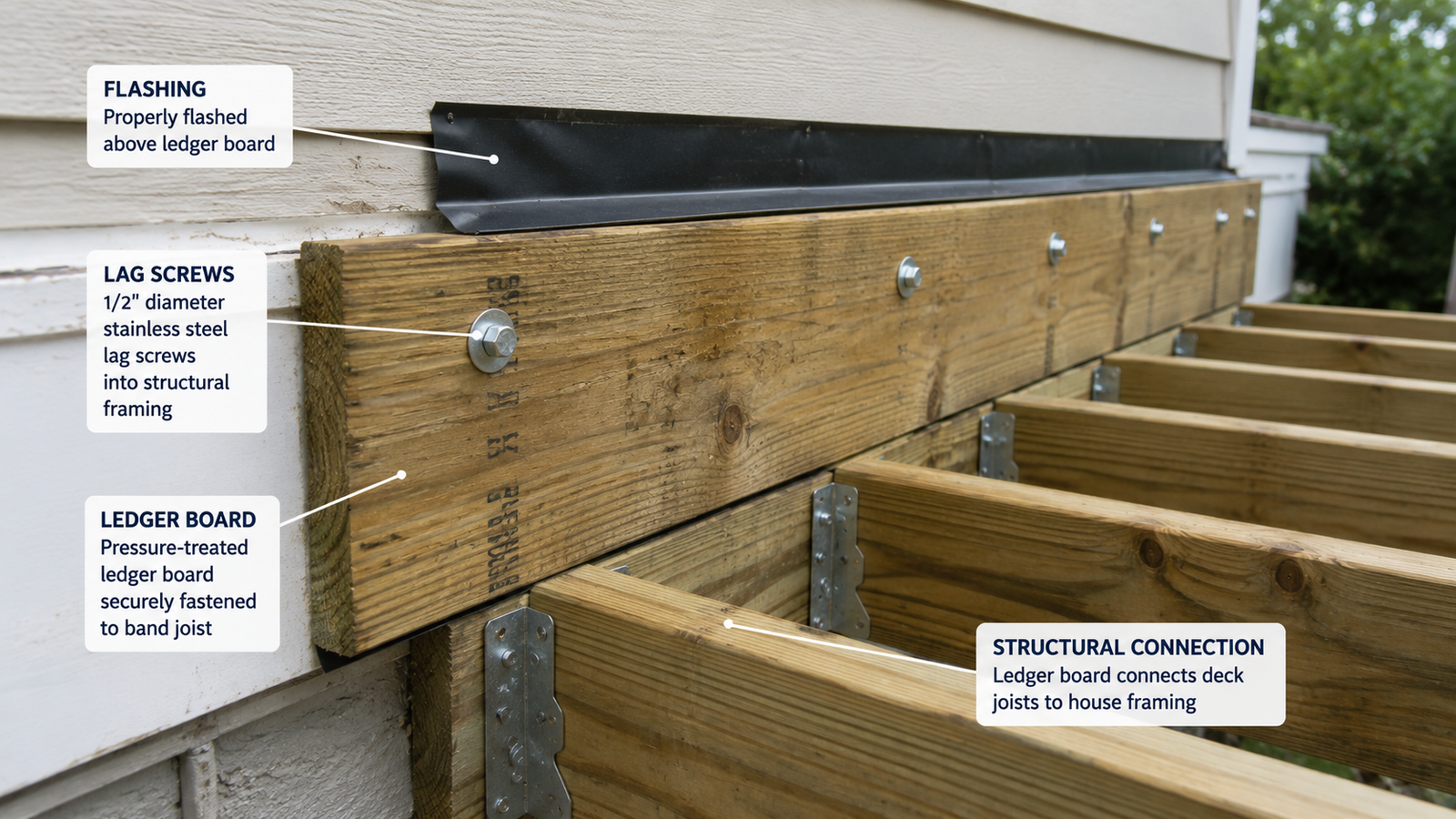
Ledger attachment is one of the most safety-critical deck connections and is never made with ordinary deck screws.
IRC ledger fastener requirements
The IRC governs deck ledger attachment with specific fastener types and spacing based on joist span and loading, using half-inch diameter lag screws or through-bolts with washers, or approved structural screws evaluated under ICC-ES criteria, installed according to a defined spacing table, not an assumed pattern. Ordinary deck screws are not an approved ledger fastener under this framework. Flashing and the condition of existing house framing also factor into a safe ledger connection.
This chart does not determine ledger fastening; consult the IRC deck provisions adopted by your jurisdiction and, where framing spans are relevant, the Deck Beam Span Chart and Deck Footing Size Chart for related framing context.
Deck Screw Size for Stairs and Stair Treads
Stair tread fastening follows similar face-fastening principles as deck boards, but stringer attachment is a structural connection requiring separate consideration.
Stair treads are typically face-fastened similarly to deck boards, with screw length matched to tread thickness and exterior corrosion resistance required for the same reasons as decking. Stringer-to-frame and stringer-to-ledger connections, however, are structural and should use appropriately rated fasteners rather than tread-fastening screws.
Deck Screw Size for Fascia
Fascia boards are typically thinner than decking, so shorter trim-head screws are common, with attention to avoiding breakthrough on the back side.
Trim-head screws are frequently used for fascia because their smaller head is less visually prominent on a finish surface. Composite fascia and wood fascia may have different manufacturer-specific fastener requirements, similar to the distinction between composite and wood decking itself.
Deck Screw Size vs Structural Screw Size
This comparison highlights why the two categories should never be substituted for each other.
| Feature | Deck-Board Screw | Structural Wood Screw |
|---|---|---|
| Primary purpose | Decking attachment | Structural connections |
| Typical diameter | Smaller (#8, #10) | Larger, often 1/4 in. or greater shank |
| Testing/design values | Product-specific, generally not load-rated for structural use | Tested and rated for specific connections |
| Ledger use | Not automatically acceptable | Only when specifically approved for that application |
| Installation guidance source | Decking manufacturer | Manufacturer and applicable code/evaluation report |
Deck Screw vs Wood Screw vs Lag Screw
Each fastener type serves a different role, distinguished by intended application, corrosion resistance, diameter, and testing.
| Fastener | Intended Application | Corrosion Resistance | Typical Diameter |
|---|---|---|---|
| Deck screw | Decking-to-joist attachment | Exterior rated (coated, galvanized, or stainless) | #8, #10 gauge |
| General wood screw | Interior woodworking, cabinetry, general joinery | Often minimal, interior use only | Varies, often #6 to #10 |
| Structural wood screw | Engineered structural connections | Exterior rated versions available | Often 1/4 in. or larger |
| Lag screw | Heavy structural connections (ledgers, posts) | Hot-dip galvanized or stainless for exterior use | Commonly 1/4 to 5/8 in. |
Deck Screw Size Worked Examples
These examples illustrate the selection process. Always defer to the actual decking manufacturer’s installation instructions for a real project.
Selecting Screws for 5/4 Wood Decking
Selecting Screws for 2×6 Decking
Choosing Screws for Composite Decking
Estimating Screw Quantity for a Deck
Common Deck Screw Sizing Mistakes
The most frequent errors seen in deck screw selection and installation.
Choosing screws that are too short
Provides inadequate joist penetration and holding power.
Choosing screws that are excessively long
Risks breaking through the joist underside.
Using drywall screws outdoors
Lacks adequate corrosion resistance and exterior durability.
Using non-corrosion-resistant fasteners
Leads to premature rust staining and fastener failure.
Ignoring pressure-treated lumber compatibility
Standard coated screws can corrode prematurely in treated wood.
Using ordinary deck screws for structural connections
Ledgers, beams, and posts require tested structural fasteners.
Overdriving screw heads
Can crush the board surface, especially on composite decking.
Ignoring manufacturer instructions
Decking products have specific, sometimes unique, fastener requirements.
Using the wrong fastener for composite decking
Composite systems often require manufacturer-specific screws or clips.
Forgetting coastal exposure requirements
Saltwater proximity triggers stainless steel requirements under the IRC.
Assuming all #10 screws have identical performance
Coating, thread design, and material all vary between products of the same gauge.
Deck Screw Standards, Codes and Manufacturer Specifications
No single standard controls every deck screw; several sources work together depending on the specific connection.
| Reference | Scope |
|---|---|
| IRC deck provisions | Residential deck construction, fastener corrosion resistance, ledger attachment requirements |
| ASTM F1667 | Driven fasteners including stainless-steel-driven fasteners referenced by the IRC |
| ICC-ES / IAPMO product evaluations | Approved structural fasteners where applicable, tested to specific criteria |
| Manufacturer technical documentation | Screw size, spacing, material compatibility, structural capacity, and installation method for a specific product |
For structural connections in particular, product evaluation reports and manufacturer instructions are often more directly applicable than a generic screw-size table, since structural fasteners must meet tested design values for the specific connection and loading condition.
Deck Screw Size Chart Limitations
This chart is a reference and educational tool. It does not replace manufacturer installation instructions or applicable code requirements.
There is no universal deck screw size
Requirements vary by decking manufacturer and product line.
Board thickness and material both matter
Actual thickness and decking material change the correct screw selection.
Corrosion environment matters
Pressure-treated lumber and coastal exposure both change fastener material requirements.
Structural connections require separate consideration
Deck-board screws are not a substitute for tested structural fasteners.
Composite decking requires manufacturer-approved systems
Hidden fastener systems and face screws are product-specific.
Code requirements vary by jurisdiction and edition
Always confirm the adopted code edition and any local amendments.
Screw diameter alone does not establish structural capacity
Tested design values, not diameter, determine structural adequacy.
Frequently Asked Questions
Download Deck Screw Size Chart PDF
Use your browser’s print function to save a curated, print-ready reference sheet: the quick-reference chart, length and gauge tables, corrosion resistance comparison, and diagrams, without navigation, FAQs, or explanatory prose. This avoids broken file links and stays automatically current.