Drywall Screw Size Chart 2026 – Type S, W, G & A Guide
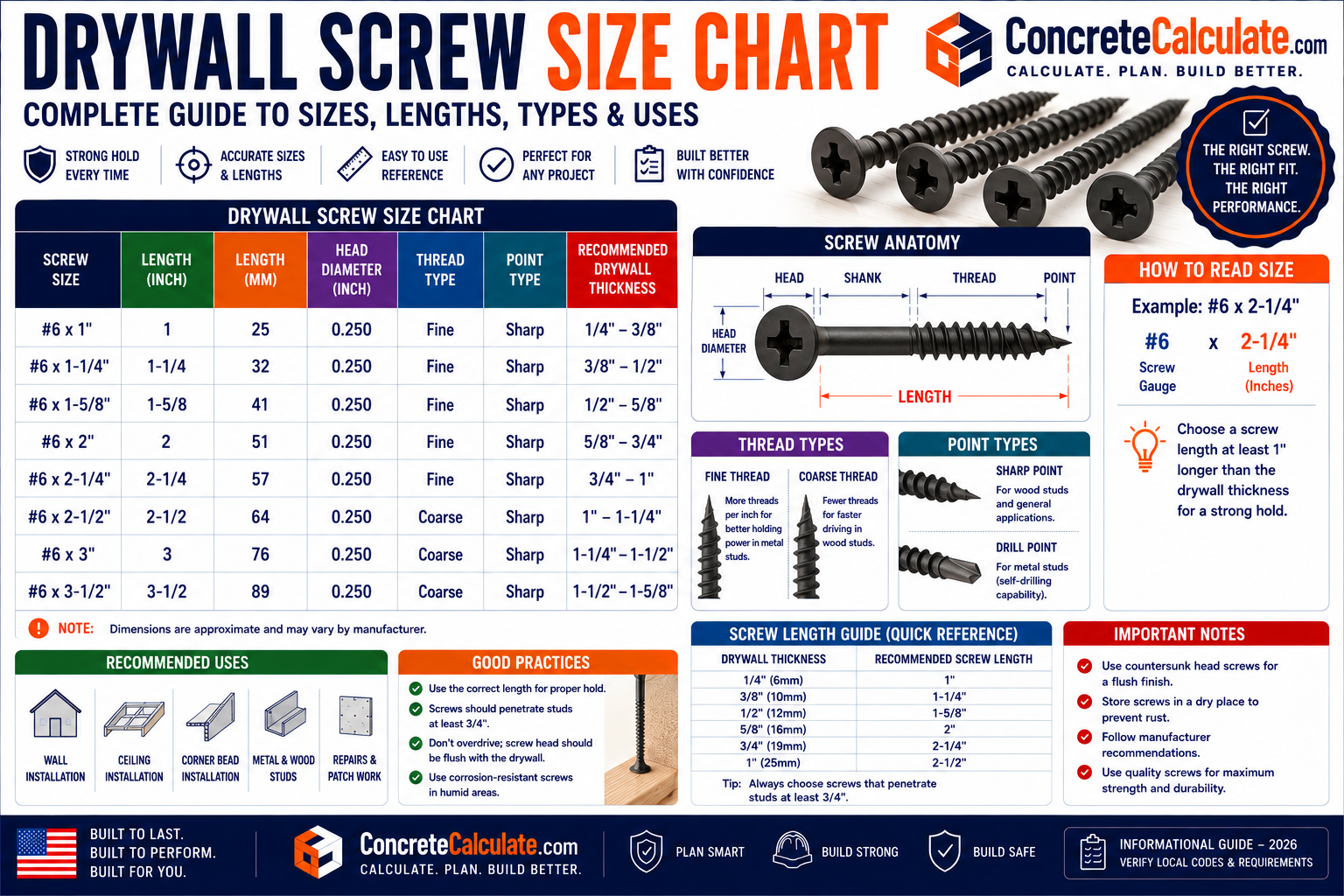
Drywall Screw Size Chart
Type S, W, G & A Guide
Choose drywall screws by gypsum thickness, framing material, Type S/W/G/A thread, screw length, head, drive and assembly requirements, not screw length alone.
 Reviewed by Muhammad Ramzan Babar, PhD Researcher & Calculator Developer — View Profile
Correct screw selection depends on gypsum thickness, number of layers, wood or steel framing, screw type, head, coating and the specific installation or tested assembly. The tables below use common product/application references and always direct you to manufacturer and assembly requirements for final selection.
⭐⭐⭐ Drywall Screw Size Chart: Quick Reference
Common #6 drywall screw lengths and ASTM C1002 types. Final fastening must match the panel manufacturer, framing and assembly requirements.
| Drywall Screw Size | Length | Screw Type | Thread | Typical Application | Head |
|---|---|---|---|---|---|
| #6 × 1″ | 1″ | Type S/W | Fine/Coarse | Thin panels, specialty/repair conditions | Bugle |
| #6 × 1-1/8″ | 1-1/8″ | Type S/W | Fine/Coarse | Thin panel/specialty conditions | Bugle |
| #6 × 1-1/4″ | 1-1/4″ | Type S/W | Fine/Coarse | Common single-layer gypsum to wood/steel framing | Bugle |
| #6 × 1-5/8″ | 1-5/8″ | Type S/W | Fine/Coarse | 5/8″ gypsum and specialty assemblies | Bugle |
| #6 × 1-7/8″ | 1-7/8″ | Type S/W | Fine/Coarse | Multiple layer/specialty assemblies | Bugle |
| #6 × 2″ | 2″ | Type S/W | Fine/Coarse | Ceilings, thicker/multiple layers where specified | Bugle |
| #6 × 2-1/4″ | 2-1/4″ | Type S/W | Fine/Coarse | Multiple-layer or specialty assemblies | Bugle |
| #6 × 2-1/2″ | 2-1/2″ | Type S/W | Fine/Coarse | Multiple-layer/fire/sound assemblies where specified | Bugle |
| #6 × 3″ | 3″ | Type S/W | Fine/Coarse | Multiple layers/specialty assemblies where specified | Bugle |
ASTM C1002 defines Type S fine-thread screws for gypsum to cold-formed steel, Type W coarse-thread screws for gypsum to wood, Type G high-thread screws for gypsum-to-gypsum laminating, and Type A coarse-pitch tapping screws for metal plaster bases. Length alone is never enough information.
⭐⭐⭐ What Is a Drywall Screw?
A drywall screw is a hardened steel self-piercing/tapping fastener designed for gypsum panel products and related metal plaster base applications.
Hardened steel
Drywall screws need enough hardness to pierce panel/framing systems and retain their thread geometry during installation.
Sharp/self-piercing point
ASTM C1002 covers self-piercing tapping screws, eliminating the need for a separate pilot hole in ordinary gypsum-panel fastening conditions.
Bugle head
Common head profile designed to rest slightly below the gypsum panel surface while protecting the paper face when properly driven.
Fine vs coarse thread
Thread configuration changes by framing material: Type S fine thread for steel framing and Type W coarse thread for wood framing.
⭐⭐⭐ What Does Drywall Screw Size Mean?
Drywall screw identification combines gauge, length, type, thread, head, drive, point and coating.
| Designation | Part | Meaning |
|---|---|---|
| #6 × 1-1/4″ Type W | #6 | Nominal drywall screw gauge/diameter |
| 1-1/4″ | Nominal head-to-tip length | |
| Type W | Coarse-thread gypsum-to-wood screw | |
| Bugle / Phillips | Head contour and No. 2 Phillips-type drive |
Drywall screws are also identified by thread type, head, drive, coating, point, panel thickness, framing material and the tested assembly requirement. Size is only one part of correct selection.
⭐⭐⭐ Drywall Screw Size by Length
USG product documentation lists screw lengths including 1″, 1-1/8″, 1-1/4″, 1-5/8″, 1-7/8″, 2″, 2-1/4″, 2-1/2″, 3″ and longer across different drywall screw products.
1″ and 1-1/8″
Common for thinner panels, curved walls, repair layers or specialty fastening conditions as specified.
1-1/4″ ⭐⭐⭐
Common product length for single-layer 1/2″ gypsum board, with Type W for wood or Type S for light-gauge steel where the assembly specifies it.
1-5/8″ ⭐⭐⭐
Common for single-layer 5/8″ gypsum board and certain ceiling or specialty conditions.
1-7/8″ and 2″
Used for thicker panels, ceilings, multiple layers or specific assembly details.
2-1/4″ through 3″
Used for multiple-layer, sound, fire-rated or other specialized assemblies where specified.
Longer screws
Available for special conditions, but length selection must follow total panel thickness, framing and tested assembly requirements.
⭐⭐⭐ Drywall Screw Types
ASTM C1002-22 defines four thread configurations by intended application.
| Type | Thread | Primary Application |
|---|---|---|
| Type S | Fine | Gypsum board to cold-formed steel members |
| Type W | Coarse | Gypsum board to wood members |
| Type G | Coarse-pitch high thread | Gypsum board to gypsum board (laminating) |
| Type A | Coarse-pitch tapping | Metal plaster bases to wood or cold-formed steel |
ASTM C1002-22 covers steel self-piercing tapping screws for fastening gypsum panel products and metal plaster bases to cold-formed steel studs less than 0.033 in thick and wood members, and for fastening gypsum panel products to gypsum board.
⭐⭐⭐ Type S vs Type W Drywall Screws
The most important thread selection distinction for drywall installers.
| Feature | Type S | Type W |
|---|---|---|
| Thread | Fine | Coarse |
| Main framing | Cold-formed steel | Wood |
| Application | Gypsum → steel | Gypsum → wood |
| ASTM C1002 | Yes | Yes |
| Point | Self-piercing | Self-piercing |
Type S vs Type G
Type S is fine-thread gypsum-to-steel; Type G is coarse-pitch high-thread gypsum-to-gypsum laminating screw. They are not interchangeable categories.
Type W vs wood screw
Type W is designed specifically for fastening gypsum board to wood members and should not automatically be treated as a general-purpose wood screw for furniture or structural connections.
Gypsum industry guidance identifies Type S for steel framing and Type W for wood framing. It notes Type S can be used with wood framing in some conditions, while use of Type W with steel framing is not recommended. Always follow the specified installation system.
⭐⭐⭐ Drywall Screw Thread Types
Fine, coarse, high-thread and tapping configurations serve different substrates and applications.
Fine-thread Type S ⭐⭐⭐
Fine threads engage cold-formed steel framing, where coarse wood-style threads are not appropriate.
Coarse-thread Type W ⭐⭐⭐
Coarse threads engage wood members, gripping wood fibers for gypsum panel installation.
High-thread Type G
Coarse-pitch, high-thread geometry designed for gypsum-to-gypsum panel lamination.
Type A tapping thread
Coarse-pitch tapping thread for attaching metal plaster bases to wood or cold-formed steel, not a generic drywall framing screw substitute.
Drywall screw fine/coarse terminology should be organized around ASTM Types S/W/G/A and intended substrate, not forced into generic UNC/UNF machine-thread categories.
⭐⭐⭐ Drywall Screw Head and Drive Types
Head and drive selection affects installation quality and finish performance.
Bugle head ⭐⭐⭐
The standard gypsum-panel head profile, with flat top and underside contour that allows the head to rest immediately below the gypsum panel surface while helping preserve the paper face when correctly driven.
Pan head
Raised head used for specialty fastening, metal framing or thin-material conditions where a bugle head is not appropriate.
Trim head
Small head profile used in selected finishing/specialty fastening applications; USG lists Type S trim-head screws in multiple lengths.
Wafer and pancake heads
Low-profile specialty heads for metal framing and other product-specific fastening conditions.
Phillips drive ⭐⭐⭐
ASTM C1002 specifies a No. 2 Phillips-type driving recess for screws covered by the standard. Use a correctly fitting bit to reduce cam-out and recess damage.
Modern proprietary drives
Square, Torx/star and other drives may be available in commercial gypsum fastener products, but their dimensions and compatibility are manufacturer-specific.
⭐⭐⭐ Drywall Screw Length by Drywall Thickness
Board thickness is important, but one universal screw length per board thickness is not technically correct.
| Gypsum Thickness | Typical Product Length Range | Selection Considerations |
|---|---|---|
| 1/4″ | 1″–1-1/4″ commonly seen | Overlay/curved/specialty use, framing, layers and system details |
| 3/8″ | 1″–1-1/4″ commonly seen | Panel use, framing and required engagement |
| 1/2″ | 1-1/4″ commonly used | Wood vs steel framing, ceiling/wall, assembly requirements |
| 5/8″ | 1-5/8″ commonly used | Wood vs steel framing, fire/sound assembly, ceiling/wall |
| Multiple layers | 2″–3″+ as specified | Total panel thickness, layer sequence, framing and tested assembly |
1/2 inch drywall ⭐⭐⭐
#6 × 1-1/4″ Type W coarse thread is a common product selection for wood studs; #6 × 1-1/4″ Type S fine thread is a common selection for light-gauge steel, subject to the specified system.
5/8 inch drywall ⭐⭐⭐
#6 × 1-5/8″ Type W or Type S screws are common product choices for single-layer 5/8″ gypsum, but final fastening needs to match framing type and tested assembly requirements.
Double-layer drywall ⭐⭐⭐
Total gypsum thickness, first/second layer fastening, framing, fire/sound rating and assembly documentation all affect screw selection. Do not simply add a fixed length without checking the system.
Fire-rated assemblies
These are tested assemblies; screw type, length, spacing, layer sequence and board type must follow approved assembly documentation, not a generic chart.
⭐⭐⭐ Drywall Screw Size for Wood and Steel Framing
Framing material is the primary trigger for Type W versus Type S selection.
| Framing Material | ASTM Screw Type | Thread | General Selection Process |
|---|---|---|---|
| Wood studs | Type W | Coarse | Select length for panel thickness/layers and specified assembly |
| Cold-formed steel studs | Type S | Fine | Select length/point for panel and steel framing system |
| Gypsum-to-gypsum | Type G | Coarse high-thread | Laminating condition, panel layers and system requirement |
| Metal plaster base | Type A | Coarse tapping | Specified base, wood/steel substrate and plaster system |
ASTM C1002 scope applies to cold-formed steel members less than 0.033 inches thick. For thicker steel framing or special systems, use the specified screw product and manufacturer installation requirements rather than assuming standard Type S selection applies.
⭐⭐⭐ Drywall Screw Depth, Spacing and Edge Distance
Correct fastener setting is as important as choosing length.
Correct depth ⭐⭐⭐
The bugle head should be slightly recessed below the gypsum surface while leaving the paper face intact. This permits joint compound finishing and preserves holding capacity.
Overdriving ⭐⭐⭐
Driving through or breaking the paper face reduces holding capacity, damages the surface and can create finishing defects. The screw should be reset nearby if overdriven according to the system requirements.
Underdriving ⭐⭐⭐
A head left above the panel surface interferes with joint compound and produces a visible finishing defect.
Spacing and edge distance
Field and edge fastening spacing depend on wall versus ceiling use, panel type, framing, layers, building code, manufacturer instructions and tested assembly. Do not apply one universal spacing to every installation.
Fastener spacing must be sourced from the applicable gypsum-board installation standard, manufacturer instructions or approved assembly. This page intentionally does not invent one generic wall/ceiling spacing chart across all panel and framing conditions.
⭐⭐⭐ Drywall Screw Material, Hardness and Coating
ASTM C1002 covers steel wire, hardness and corrosion resistance requirements for covered screw types.
Steel and hardness
Drywall screws are typically hardened steel. ASTM C1002 specifies case-hardening requirements for Types S, W and A; Type G has separate hardness requirements.
Corrosion-resistant treatment
ASTM C1002 requires corrosion-resistant treatment for covered screws that does not interfere with joint compounds or bleed through field-applied decoration.
Black phosphate-style finishes
Common in interior drywall screws, with the product coating selected for finishing compatibility and intended indoor environment.
Corrosive or exterior conditions
Ordinary interior drywall screws are not automatically suitable for wet, exterior or corrosive conditions. Use the fastener specified for the particular board/system and exposure.
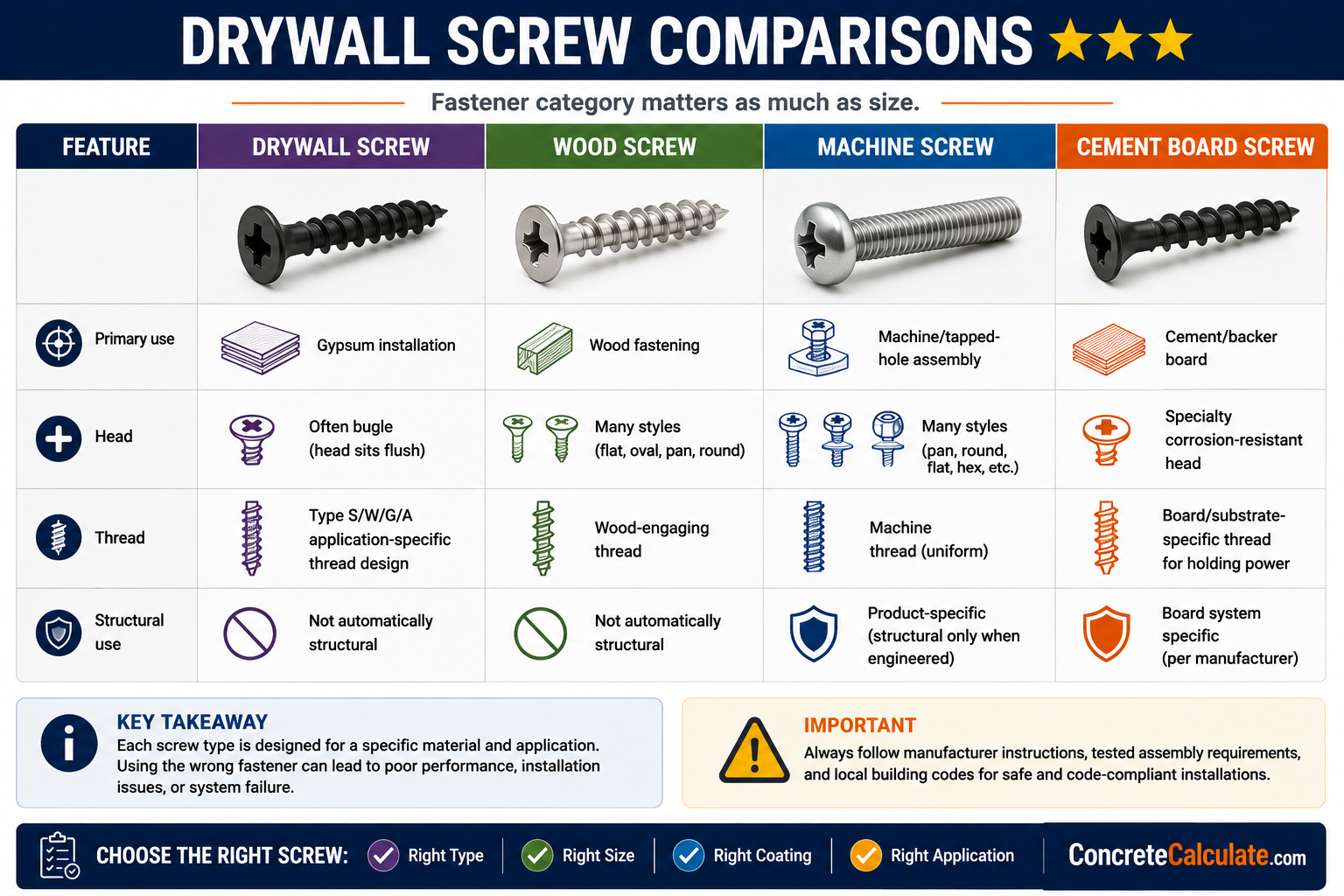
⭐⭐⭐ Drywall Screw Comparisons
Fastener category matters as much as size.
| Feature | Drywall Screw | Wood Screw | Machine Screw | Cement Board Screw |
|---|---|---|---|---|
| Primary use | Gypsum installation | Wood fastening | Machine/tapped-hole assembly | Cement/backer board |
| Head | Often bugle | Many styles | Many styles | Specialty corrosion-resistant head |
| Thread | Type S/W/G/A application-specific | Wood-engaging | Machine thread | Board/substrate-specific |
| Structural use | Not automatically structural | Not automatically structural | Product-specific | Board system specific |
Drywall screws are designed for gypsum panel fastening under ASTM C1002. They should not automatically be used for structural wood connections, exterior sheathing, cement board, decking or other applications unless a specific manufacturer-approved system permits it.
⭐⭐⭐ Drywall Screws for Ceilings, Fire-Rated and Specialty Boards
Assembly documentation controls final fastener selection.
Ceilings
Ceiling gypsum panel selection needs to consider panel thickness, framing material, framing spacing, panel weight, screw length and fastening schedule. Confirm the specified system rather than using a wall-only rule.
Fire-rated assemblies ⭐⭐⭐
Fire-rated systems are tested assemblies. Required screw type, length, spacing, layer sequence and board type must match the approved assembly documentation; do not create a generic fire-rated screw chart.
Moisture-resistant board
Bathroom/wet-area boards may require corrosion-resistant fastening and manufacturer-specific requirements. Do not assume ordinary interior drywall screws are suitable.
Exterior sheathing
Ordinary drywall screws should not automatically be used for exterior sheathing. Use the fastener specified for the actual sheathing system and exposure.
Special gypsum boards
Standard, lightweight, fire-resistant, moisture-resistant, sound-control and specialty gypsum panels can have different fastening requirements depending on the manufacturer system.
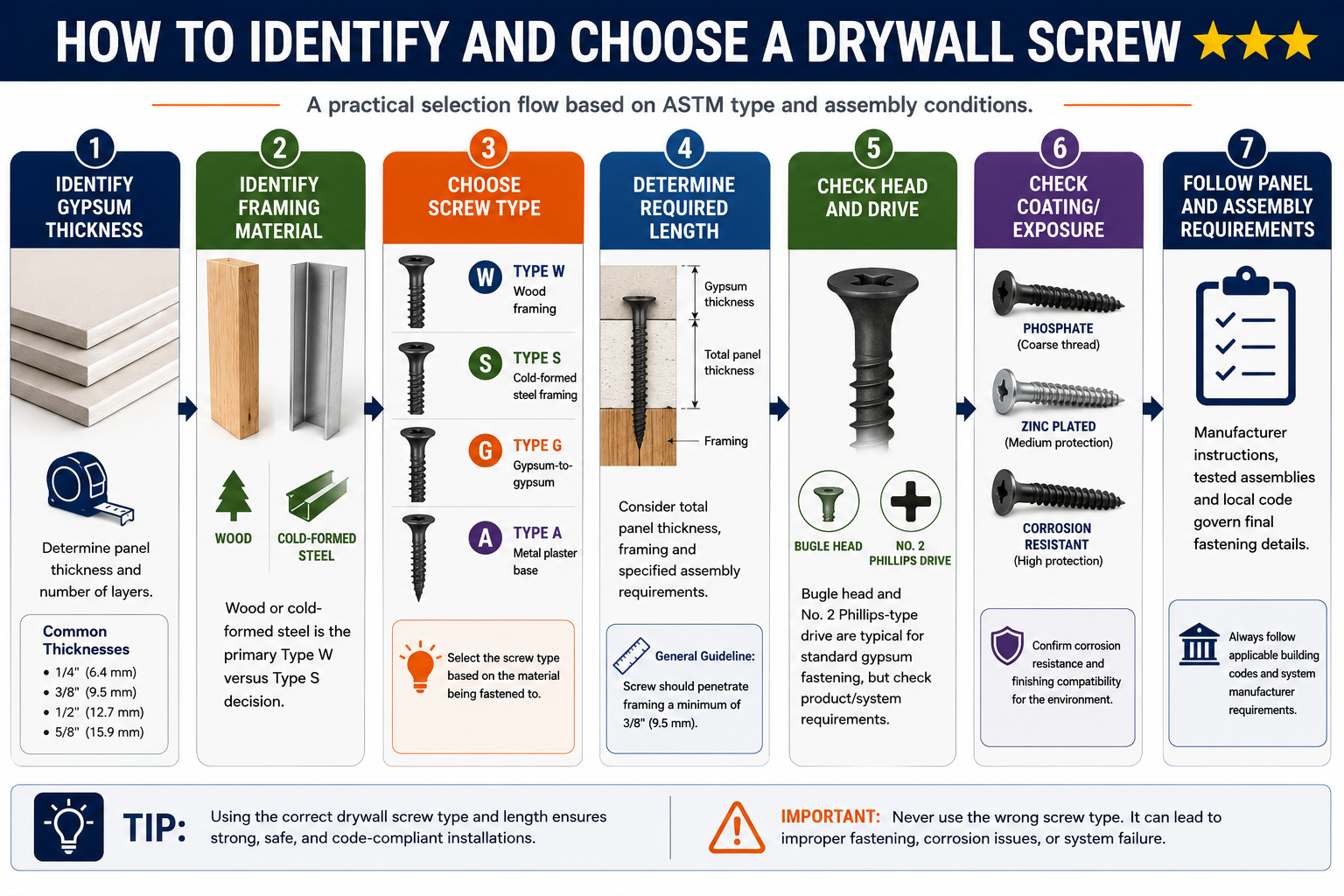
⭐⭐⭐ How to Identify and Choose a Drywall Screw
A practical selection flow based on ASTM type and assembly conditions.
Determine panel thickness and number of layers.
Wood or cold-formed steel is the primary Type W versus Type S decision.
Wood → Type W; cold-formed steel → Type S; gypsum-to-gypsum → Type G; metal plaster base → Type A.
Consider total panel thickness, framing and specified assembly requirements.
Bugle head and No. 2 Phillips-type drive are typical for standard gypsum fastening, but check product/system requirements.
Confirm corrosion resistance and finishing compatibility for the environment.
Manufacturer instructions, tested assemblies and local code govern final fastening details.
How many screws you need depends on panel size, framing spacing, wall/ceiling orientation, edges, field spacing, layers and the applicable installation standard. A future Drywall Calculator can help estimate panels and fastener quantities once the specified fastening pattern is known.
⭐⭐⭐ Drywall Screw Quantity and Spacing
Quantity is calculated from the specified fastening pattern, not a universal screw count.
Quantity inputs
Panel dimensions, framing spacing, wall versus ceiling application, edge/field fastener spacing, panel orientation and number of layers all affect screw quantity.
Illustrative quantity process
Panel area and framing layout are used with the specified fastening pattern to estimate screw count. Actual code/manufacturer spacing must be confirmed before ordering.
Wall and ceiling fastener spacing can differ by gypsum panel product, framing, layer count, assembly rating, panel orientation and local code. Use the manufacturer installation guide, gypsum board standard or tested assembly for actual spacing.
⭐⭐⭐ ASTM C1002 Drywall Screw Standard
The primary standards reference for covered gypsum panel screws.
Scope
ASTM C1002-22 covers steel self-piercing tapping screws used to fasten gypsum panel products and metal plaster bases to cold-formed steel studs and wood members, and to fasten gypsum panel products to gypsum board.
Thread configurations
Type G, Type S, Type W and Type A are the four ASTM-defined configurations, each with a stated intended application.
Head and drive requirements
The standard specifies head contour for gypsum-panel screws, including a flat top and underside contour that lets the head rest just below the panel surface, and specifies a No. 2 Phillips-type driving recess.
Corrosion resistance
Covered screws receive corrosion-resistant treatment that does not interfere with finishing compounds or bleed through field-applied decoration.
ASTM C1002 is a fastener specification. Final screw length, spacing, layer sequence and assembly requirements also come from the panel manufacturer, installation standard, tested assembly and locally adopted code.
⭐⭐⭐ Drywall Screw Visual Guide
Original diagrams explaining screw anatomy, Type S/W selection and correct depth.
⭐⭐⭐ Drywall Screw Size Worked Examples
Examples demonstrate the Type + framing + gypsum thickness selection process.
1. 1/2″ Gypsum to Wood
2. 1/2″ Gypsum to Steel
3. 5/8″ Gypsum to Wood
4. Two Layers of Gypsum
⭐⭐⭐ Common Drywall Screw Sizing Mistakes
Most installation problems trace back to one of these errors.
❌ Using wood screws instead of drywall screws
Use ASTM C1002 Type W drywall screws for gypsum-to-wood applications rather than assuming an ordinary wood screw is equivalent.
❌ Using Type W with steel studs
Type W is coarse thread for wood; Type S fine thread is designed for cold-formed steel.
❌ Using Type S with wood framing without checking the system
Type S can be used in some wood framing conditions, but Type W is the ASTM-defined gypsum-to-wood screw; follow system requirements.
❌ Choosing length by drywall thickness alone
Total layers, framing material and tested assembly all matter.
❌ Overdriving
Breaking the gypsum paper face reduces holding capacity and causes finishing defects.
❌ Underdriving
Heads left above the surface interfere with finishing.
❌ Using drywall screws structurally
Ordinary drywall screws are not automatically structural fasteners.
❌ Ignoring fire-rated assembly requirements
Tested assemblies require specific screw type, length, spacing and layer sequence.
❌ Using ordinary interior screws in corrosive environments
Use the fastener specified for wet, exterior or corrosive applications.
❌ Confusing screw gauge with length
#6 identifies diameter/gauge; 1-1/4″ identifies length.
❌ Assuming all #6 drywall screws are identical
Type, length, head, coating, point and manufacturer system matter.
❌ Ignoring manufacturer-specific screw systems
Special panels and assemblies can have proprietary fastening requirements.
Drywall Screw FAQs
📄 Download Drywall Screw Size Chart PDF
This PDF is a gypsum fastening field reference. It preserves screw type, size, length, thread, head, framing material, gypsum thickness and standards basis instead of presenting unexplained universal length rules.
Cite or Embed This Chart
Copy the page-wide citation to reference the complete Drywall Screw Size Chart.