Concrete Resurfacing vs Replacement: Which Is Better?
How to decide whether an aging driveway, patio, sidewalk, garage floor or slab still has enough sound, stable concrete to resurface, or needs to be replaced.
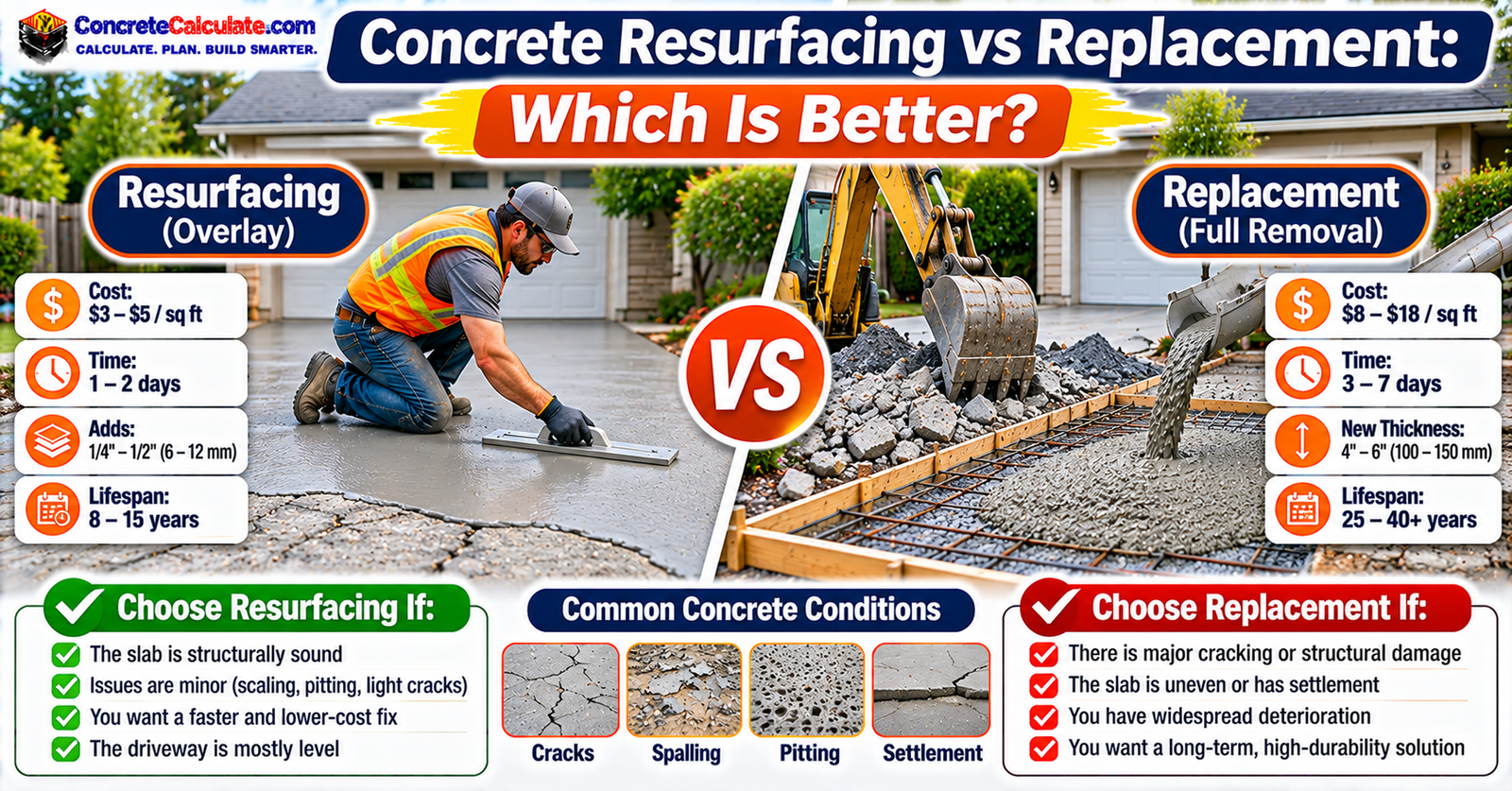
Resurfacing is only as good as the concrete beneath it. If the slab is stable and the damage is mostly shallow, concrete resurfacing may be the better value. If it is moving, deeply deteriorated, broadly delaminated or poorly drained, replacement is usually the more durable choice.
- Identify what is wrong and why it happened.
- Check whether the slab is stable.
- Measure how deep and how widespread the damage is.
- Sound the surface for hollow or delaminated areas.
- Check drainage, joints and finished height.
- Compare the real repair and prep cost with the cost of rebuilding.
A. Understand the two options
- What Is Concrete Resurfacing?
- What Does Concrete Replacement Mean?
- Concrete Resurfacing vs Replacement at a Glance
- Which Option Lasts Longer?
B. Assess the existing slab
- Is the Existing Concrete Structurally Sound?
- How Deep Is the Deterioration?
- How Much of the Slab Is Affected?
- Check for Hollow or Delaminated Concrete
C. When resurfacing makes sense
- Resurfacing Is Often Suitable for Shallow Scaling
- Resurfacing Pitted Concrete
- Resurfacing Worn or Rough Concrete
- Can You Resurface Cracked Concrete?
- Can Resurfacing Fix Small Low Spots?
D. When replacement is better
- Replace Concrete That Has Settled or Heaved
- Replace or Deep-Repair Severely Spalled Concrete
- Replacement for Widespread Freeze-Thaw Deterioration
- Replacement When Reinforcement Corrosion Is Widespread
- Replacement When Drainage or Elevation Is Fundamentally Wrong
E. Preparation and feasibility
- Why Surface Preparation Determines Resurfacing Success
- What Must Be Removed Before Resurfacing?
- Should Deep Pits and Spalls Be Repaired Before the Overlay?
- What Happens to Existing Joints?
F. Cost, speed and height
- Resurfacing vs Replacement Cost: What Actually Drives Price?
- Which Option Is Faster?
- How Height and Thresholds Affect the Decision
G. Make the final decision
What Is Concrete Resurfacing?
Concrete resurfacing means renewing an existing slab’s surface with a bonded repair or overlay system, after the concrete has been evaluated and prepared. It is not simply covering old concrete with something new.
Systems vary widely. ACI PRC-546.3-23 groups repairs and overlays by thickness: deep ones thicker than 1 in., shallow ones from 1/16 in. to under 1 in., and thin overlays under 1/16 in. that behave more like thick coatings (ACI PRC-546.3-23).
So a resurfacer is not always a skim coat. Thickness, material, finish and application method all change what the system can do, and the manufacturer’s data sheet sets the limits for a given product.
The central rule for this guide is simple: resurfacing is only as good as the concrete beneath it. See the Concrete Resurfacing Guide for the full workflow.
What Does Concrete Replacement Mean?
Replacement means removing the damaged concrete and building it again. The slab, and usually the support under it, are reset.
- Sawcut and break out the existing slab
- Remove and haul away the concrete
- Correct the subgrade and base
- Reset forms and finished elevations
- Place new concrete
Replacement can be one panel, one section or the full slab. Replacing only the worst panels can make sense when the rest of the slab is sound.
Concrete Resurfacing vs Replacement at a Glance
Resurfacing keeps the existing slab and renews its surface, while replacement removes the slab and rebuilds it. Table 1 compares the two across the factors that usually decide the choice.
| Factor | Resurfacing | Replacement |
|---|---|---|
| Existing slab required | Yes | No |
| Substrate must be sound | Yes | Existing slab is removed |
| Fixes settlement | No | Can correct support and grade |
| Fixes shallow wear | Yes | Yes |
| Handles deep deterioration | Limited, pre-repair required | Better suited |
| Demolition | Limited | Major |
| Adds surface height | Usually yes | Can reset elevation |
| What controls success | Surface preparation | New base and forms |
| Disruption | Usually lower | Usually higher |
Resurfacing preserves the existing slab and renews the surface, while replacement rebuilds the slab and support system from the ground up.
Which Option Lasts Longer?
Neither always lasts longer. A properly built replacement resets the whole slab system, while a well-installed overlay on sound concrete can extend service life substantially.
- Condition and stability of the substrate
- Moisture and drainage
- Movement of the slab or soil
- Quality of surface preparation
- Compatibility of repair material with the concrete
- Traffic and climate
Avoid universal claims such as “10 years versus 30 years.” FHWA’s guidance on distress treatment asks whether the option addresses the cause, whether the problem will return, and what the life expectancy and remaining service life are (FHWA-RD-01-164).
Is the Existing Concrete Structurally Sound?
Check stability first, because everything else depends on it. A stable slab is a candidate for resurfacing, while a moving slab is not.
- Settlement or panels at different heights
- Rocking or movement when stepped on
- Displaced or widening cracks
- Large spalls and exposed steel
- Voids or erosion at slab edges
ACI says the first step in any repair is an assessment of current conditions, followed by finding the cause of the damage (ACI technical FAQ). The decision flows from what is wrong, how deep it goes and whether the slab is stable.
How Deep Is the Deterioration?
Depth separates a surface problem from a full-depth problem. Surface-only damage can be resurfaced, while damage that reaches deep into the slab usually cannot.
- Surface-only wear, scaling or pitting
- Shallow repair depth
- Deeper partial-depth deterioration
- Full-depth deterioration
FHWA’s distress guidance limits partial-depth repair to deterioration confined to the upper third of a pavement slab, and says cores help confirm the depth (FHWA-RD-01-163). That is highway guidance, not a residential rule, but the idea carries over: know the depth before you choose.
How Much of the Slab Is Affected?
Extent matters as much as depth. Isolated defects, scattered shallow damage and widespread damage lead to different choices.
FHWA notes that localized distress suits localized repair, while widespread distress calls for more extensive treatments such as grinding, overlays or reconstruction (FHWA). There is no universal percentage that decides it, so do not trust a “replace at 25 percent” rule.
Instead, weigh the depth, the cause, the structural stability, the amount of repair needed and the expected remaining life of the slab.
Check for Hollow or Delaminated Concrete
Sounding is a simple screening test for hidden separation. Tap the surface with a hammer or drag a chain and listen for a change in tone.
ICRI describes chain drag as a method where dull or hollow sounds indicate delaminated areas, while sound concrete rings clearly (ICRI terminology). Broad hollow areas mean overlay preparation becomes extensive, and replacement may become more practical.
Read more in concrete delamination for how to find it, how to treat it and why it matters before any overlay goes on.
Resurfacing Is Often Suitable for Shallow Scaling
Shallow scaling over sound concrete is one of the better candidates for resurfacing. The weak surface layer is removed and the remaining slab gets a new wearing surface.
- Remove the weak scaled material.
- Profile the surface mechanically.
- Repair any deeper spots first.
- Apply a compatible resurfacing system.
FHWA lists surface scaling as a good candidate for diamond grinding or partial-depth repair when the deterioration is limited to the surface (FHWA). See concrete scaling for causes and prevention.
Resurfacing Pitted Concrete
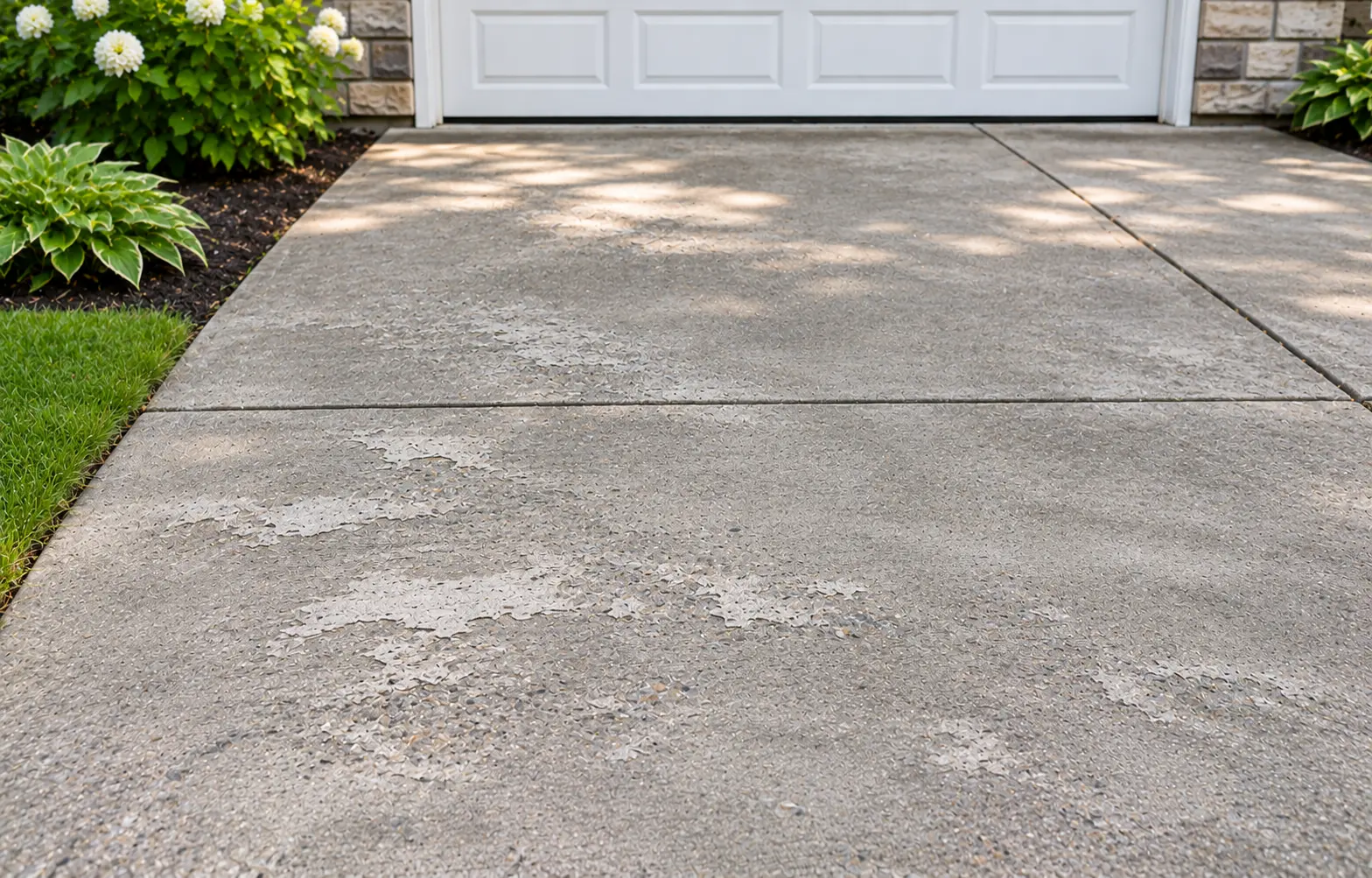
Widespread shallow pitting on a stable slab is a good candidate for resurfacing. Deeper pits should be filled first, so the overlay does not bridge an unsupported hole.
- Many shallow pits across the surface
- A stable slab with no settlement
- No broad delamination
- A surface that can be mechanically prepared
The full patching and resurfacing workflow, including how to prepare the pits, is in how to fix pitted concrete floors.
Resurfacing Worn or Rough Concrete
Cosmetic aging and shallow abrasion can often be resurfaced. Examples include a worn broom finish or a rough, weathered surface.
The substrate condition still controls the result. Check for dusting, contamination and hollow areas before you plan on a thin overlay.
A powdery surface may only need removal of the weak layer, so compare concrete dusting before you decide.
Can You Resurface Cracked Concrete?
Sometimes. It depends on why the crack formed and whether it is still moving.
- Stable, dormant cracks: may be repaired and covered.
- Active cracks: can reflect through a new surface.
- Structural cracks: need evaluation before any cosmetic work.
- Settlement cracks: point to a support problem an overlay cannot fix.
FHWA notes that distress in the underlying slab continues to affect an overlay, and that it can reflect through (FHWA). Do not expect an overlay to stop crack movement. See why concrete cracks and how to fix structural cracks.
Can Resurfacing Fix Small Low Spots?
Sometimes, if the slab is stable and the depression is shallow. The finished surface must still drain, and the product thickness must allow the correction.
- The slab is stable.
- The depression is shallow.
- The finished grade can still drain properly.
- The product thickness allows the correction.
If the whole slab slopes the wrong way, an overlay is a poor fix. Compare how to fix standing water on a concrete patio and concrete driveway drainage first.
Replace Concrete That Has Settled or Heaved
Settled or heaved concrete usually needs replacement or stabilization, not an overlay. An overlay cannot stabilize the soil beneath the slab.
- Panel elevation changes and trip hazards
- Visible slab movement
- Widespread changes in slope
- Voids or erosion under the slab
If the movement continues, cracks and height differences can show through a new surface. Slab lifting may sometimes be an alternative, as covered in sinking concrete repair, but the cause of the movement should be understood first.
Replace or Deep-Repair Severely Spalled Concrete
When deterioration reaches deep into the slab, surface resurfacing is not enough. Badly deteriorated concrete has to be removed and replaced with suitable material.
FHWA treats high-severity deterioration as needing removal and repair of the distressed area, and notes that treatments that only address the surface are no longer effective at that stage (FHWA). See concrete spalling for how deeper material loss differs from surface scaling.
Replacement for Widespread Freeze-Thaw Deterioration
Shallow scaling may be resurfaced, but deep disintegration throughout the slab is a different problem. Do not treat all winter damage as surface scaling.
FHWA explains that some freeze-thaw damage starts at the bottom of a slab and moves upward, so the surface can hide more extensive deterioration, and that an overlay can even add moisture to an existing slab (FHWA).
Cores or a professional evaluation help show how deep it really goes.
Replacement When Reinforcement Corrosion Is Widespread
Widespread corrosion of embedded steel usually calls for deeper repair or replacement. A surface overlay alone does not address active corrosion below.
- Rust staining on the surface
- Cracking that follows the steel
- Delamination over the bars
- Exposed reinforcing bars
FHWA says overlays should be used cautiously over pavements with corroding embedded steel, because the underlying problem can be just as damaging to the overlay (FHWA). Get an engineer or repair professional involved if steel is involved.
Replacement When Drainage or Elevation Is Fundamentally Wrong
If the geometry is wrong, replacement lets you rebuild it. A resurfacer can renew the surface but cannot reset a slab that drains toward the house.
- A driveway or patio sloping toward the house
- A garage slab at the wrong elevation
- Several low panels
- A doorway transition that cannot accept an overlay
Replacement gives the contractor a chance to reset the subgrade, base, finished height and drainage slope in one project.
Resurfacing renews a sound slab surface but does not correct movement or failed support beneath the concrete.
Why Surface Preparation Determines Resurfacing Success
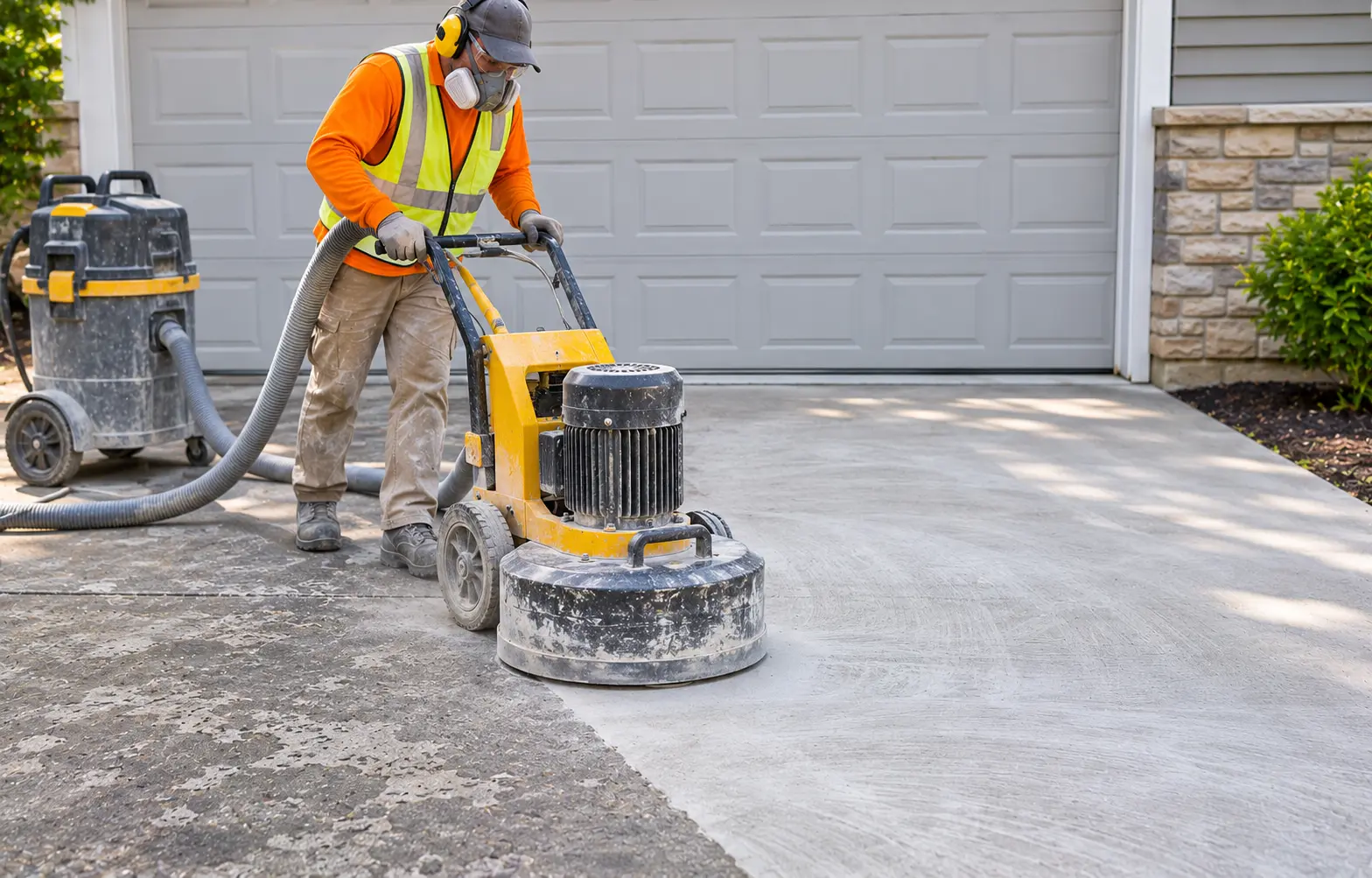
Preparation is what bonds the overlay to the old slab. The surface must be clean, sound and rough enough for the system you are using.
- Grinding
- Shot blasting
- Scarifying
- Other removal methods as the product allows
ICRI warns about a “bruised surface,” a layer weakened by microcracks that typically extends 1/8 to 3/8 in. when high-impact methods are used. If it is not removed, bond strength is often lower (ICRI terminology). Method choice matters as well as thoroughness.
What Must Be Removed Before Resurfacing?
Anything that is loose, weak or contaminated has to go, because the overlay can only bond to sound concrete.
- Loose concrete
- Weak surface paste
- Old coatings, paint and sealers
- Oil and grease
- Laitance
Oil that has soaked in needs real removal, so start with how to remove oil stains from concrete.
Should Deep Pits and Spalls Be Repaired Before the Overlay?
Usually yes. Use the overlay for broad surface renewal, not to hide deep unsupported cavities.
FHWA stresses that overlay performance depends largely on the type and amount of pre-overlay repair, and that badly deteriorated areas should be repaired first (FHWA). Patch deeper pits, then profile the whole surface, then apply the resurfacer.
What Happens to Existing Joints?
Existing joints still allow movement, so do not simply bury them. The overlay system and its detailing control how joints are carried through.
Moving cracks and active joints can reflect through a new surface. Ask the installer how joint locations will be matched in the overlay, and follow the product instructions.
| Check | Why it matters |
|---|---|
| Sounding and delamination | Overlay needs a sound substrate |
| Crack activity | Movement can reflect through |
| Settlement | Overlay cannot stabilize support |
| Oil or contamination | Reduces bond |
| Coating or sealer | May need removal |
| Drainage | Prevents recurring moisture issues |
| Joint layout | Movement must be accommodated |
| Threshold height | Overlay adds elevation |
| Moisture condition | Product and system compatibility |
Resurfacing vs Replacement Cost: What Actually Drives Price?
Cost follows the work, not the label. Suitability should come first, and then you compare the actual repair and preparation needed against the cost of rebuilding.
| Cost driver | Resurfacing | Replacement |
|---|---|---|
| Demolition | Low to moderate | High |
| Disposal | Low | High |
| Surface preparation | High importance | Lower |
| Deep repairs | May be significant | Removed with the slab |
| Base and subgrade work | Usually limited | Potentially significant |
| New concrete | Overlay quantity | Full slab quantity |
| Formwork | Limited | Full |
| Reinforcement | Usually limited | New system |
| Labor | Prep and application | Demolition and rebuild |
| Downtime | Usually lower | Usually higher |
FHWA’s preservation guide is built on picking the right treatment for the right condition, using low-cost, minimally invasive techniques where they fit, instead of defaulting to the cheapest first cost (FHWA Concrete Pavement Preservation Guide).
Use real local quotes. The Concrete Resurfacing Calculator, Concrete Overlay Calculator, Concrete Resurfacing Cost Calculator and Concrete Repair Cost Calculator help you estimate each route, and concrete cost per yard gives context for replacement.
For a replacement quantity, use the Concrete Slab Calculator, Concrete Driveway Calculator or Concrete Patio Calculator, and see the Concrete Slab Thickness Chart for general context.
Which Option Is Faster?
Resurfacing is often faster because there is less demolition and hauling, but heavy preparation can erase that advantage.
- Resurfacing: less demolition, less hauling and shorter disruption when prep is limited.
- Replacement: more site work and more curing and traffic planning.
When the slab needs extensive removal, deep repairs and long profiling, a full replacement can end up taking similar time.
How Height and Thresholds Affect the Decision
An overlay adds thickness, and that is not always acceptable. Check every place the slab meets something fixed.
- Door thresholds and garage entries
- Drains and grates
- Steps and landings
- Transitions to adjacent pavement
- Accessibility requirements
If the added height creates a trip hazard, blocks a door or breaks a required slope, replacement or partial removal may be the better route.
The resurfacing decision should be based on structural stability, deterioration depth, substrate condition, drainage and finished elevation, not appearance alone.
Concrete Resurfacing vs Replacement Decision Checklist
Answer the questions in Table 4 honestly. They are a guide, not a rigid score, because one serious problem can outweigh several good answers.
| Question | If yes |
|---|---|
| Is the slab stable with no settlement? | Supports resurfacing |
| Is the damage mostly shallow? | Supports resurfacing |
| Does most of the substrate sound solid? | Supports resurfacing |
| Is drainage already correct? | Supports resurfacing |
| Does the threshold allow added thickness? | Supports resurfacing |
| Is the slab moving or heaving? | Supports replacement |
| Is deep deterioration widespread? | Supports replacement |
| Is major corrosion present? | Supports deeper repair or replacement |
| Is the slope or elevation fundamentally wrong? | Supports replacement |
| Is extensive pre-overlay repair needed? | Compare replacement economics |
Table 5 shows which way the most common existing conditions usually point.
| Existing condition | Resurface? | Replace? |
|---|---|---|
| Shallow scaling | Often | Rarely |
| Widespread shallow pitting | Often | Sometimes |
| Cosmetic wear | Often | Usually unnecessary |
| Stable, dormant cracks | Possible | Sometimes |
| Active or widening cracks | Poor candidate | Evaluate the deeper cause |
| Panel settlement | No | Often |
| Heaving | No | Often |
| Deep spalling | Limited, after repair | Often |
| Widespread delamination | Poor candidate | Often |
| Corrosion-related damage | Not alone | Deeper repair or replacement |
| Wrong slope or elevation | Limited | Often better |
Worked Decision Examples
These four short scenarios show the logic. They are illustrations, not diagnoses of your slab.
Scenario A: Garage floor with pitting
The slab is stable, the pits are shallow, and there is no settlement or broad hollow area. That makes it a resurfacing candidate, after the deepest pits are filled and the floor is profiled.
Scenario B: Driveway with settled panels
Several panels have dropped and a crack has opened. The support has failed, so an overlay will not hold. Replacement, or lifting and stabilization first, is the safer path.
Scenario C: Patio with shallow scaling
The patio is stable, scaling is shallow, and the door threshold can take a thin overlay. Resurfacing is a good candidate after weak concrete is removed.
Scenario D: Slab with deep spalling and corrosion
Spalls are deep, rust is staining the surface and the concrete sounds hollow in many places. Surface renewal is not enough, so deeper repair or replacement is the defensible choice, with professional evaluation.
Before you commit to either route, run through Table 6 with your contractor or inspector.
| Check | Complete? |
|---|---|
| Cause of damage identified | ☐ |
| Slab stability checked | ☐ |
| Depth of deterioration checked | ☐ |
| Extent of damage mapped | ☐ |
| Hollow or delaminated areas checked | ☐ |
| Cracks classified | ☐ |
| Drainage and grade checked | ☐ |
| Surface contamination checked | ☐ |
| Joint condition checked | ☐ |
| Threshold and elevation checked | ☐ |
| Resurfacing prep estimated | ☐ |
| Deep repairs estimated | ☐ |
| Replacement cost estimated | ☐ |
| Expected service considered | ☐ |
Concrete Resurfacing vs Replacement FAQs
Is resurfacing concrete worth it?
It can be, when the slab is stable and the damage is shallow, because it can cost less and cause less disruption than replacement. It is not worth it over a moving, deeply deteriorated or hollow slab. Judge suitability first, then compare the real repair and preparation costs.
When should concrete be replaced instead of resurfaced?
Replace it when the slab is settling or heaving, deterioration is deep or widespread, large areas are delaminated, corrosion is widespread, or the slope and elevation are fundamentally wrong. In those cases an overlay cannot correct the cause and tends to fail.
Can you resurface badly cracked concrete?
Sometimes, if the cracks are stable and nonstructural and the slab is otherwise sound. Active, widening or settlement cracks can reflect through a new surface. Find out why the concrete cracked before choosing, and do not expect an overlay to stop movement.
Can resurfacing fix settlement?
No. An overlay changes the surface and does not stabilize the soil or base under the slab. Settled concrete usually needs lifting, stabilization or replacement, and the cause of the movement should be understood so it does not happen again.
Can resurfacing hide cracks?
It can cover stable cracks that have been repaired, but it does not guarantee they will stay hidden. Moving cracks can reflect through the new surface. Treat the crack and its cause first, and ask the installer how cracks and joints will be handled.
How thick is a concrete overlay?
It depends on the system. ACI groups repairs and overlays as thin (under 1/16 in.), shallow (1/16 in. to under 1 in.) and deep (over 1 in.). Real products vary, so follow the manufacturer’s data sheet for minimum and maximum thickness.
Does resurfacing add height?
Usually yes, even if only slightly. Check door thresholds, garage entries, drains, steps and adjacent pavement before choosing. If the added height creates a trip hazard or blocks a door, replacement or partial removal may be a better fit.
Can resurfacing fix pitting?
Yes, when the slab is stable and the pits are shallow and widespread. Deeper pits should be filled first, and the floor needs mechanical preparation so the overlay bonds. If the surrounding concrete is weak or hollow, remove it first.
Can you resurface a driveway?
Yes, if it is structurally sound and the damage is mainly shallow, such as scaling or wear. Drainage, joints and finished height must work with an overlay. Settled panels, widespread delamination or deep deterioration point toward replacement instead.
Which lasts longer: resurfacing or replacement?
It depends on the condition of the existing slab, the preparation, moisture, movement and traffic. Replacement resets the whole slab system, while a well-installed overlay on sound concrete can extend service life. There is no universal number of years for either.
Should I repair spalls before resurfacing?
Yes, usually. Deep spalls and pits should be repaired first so the overlay is not bridging unsupported cavities. Pre-overlay repair is a major factor in overlay performance, and badly deteriorated areas should be removed and repaired before the overlay goes on.
Can resurfacing fix drainage slope?
Only for small, shallow low spots on a stable slab. If the whole slab slopes toward the house or several panels have settled, an overlay is a poor fix. Replacement lets the contractor reset the base, elevation and drainage slope.
Conclusion
The choice between concrete resurfacing and replacement comes down to condition. If the slab is stable and the damage is mostly shallow, resurfacing may be the better value. If it is moving, deeply deteriorated, broadly delaminated, poorly supported or wrong in grade, replacement is usually more defensible.
If your slab passes the checklist, read the full resurfacing workflow next.
Read the Concrete Resurfacing Guide