Wedge Anchor Size Chart – Diameter, Drill Bit, Length & Embedment
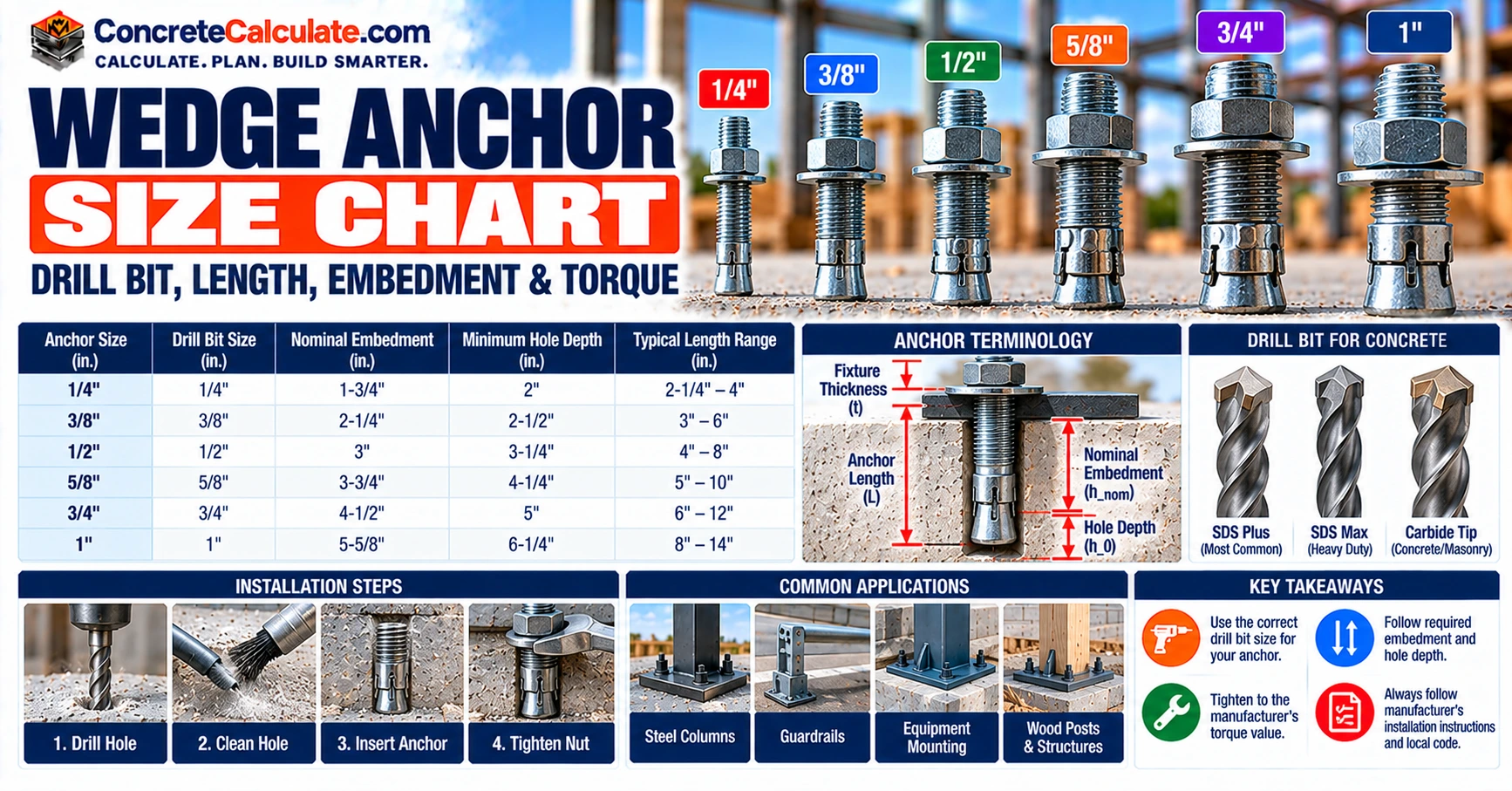
Wedge Anchor Size Chart
Diameter, Drill Bit, Length & Embedment
Match wedge-anchor diameter to the right carbide drill bit, then see why embedment, length, torque, spacing, edge distance and capacity depend on the exact evaluated product.
 Reviewed by Muhammad Ramzan Babar, PhD Researcher (Plasma Physics) & Calculator Developer, View Profile
⭐ Wedge Anchor Size Chart: Anchor Diameter and Drill Bit Size
The sizing relationship that holds across evaluated wedge-anchor systems: diameter and matching carbide bit.
How to Read This Chart
Find your nominal wedge-anchor diameter, then read the matching nominal carbide drill bit. This is the one sizing relationship that is consistent across the evaluated wedge anchors cited here. Everything else (embedment, length, torque, spacing, edge distance, member thickness and capacity) depends on the exact product and is covered below. For general bit sizes, see the drill bit sizes.
| Nominal Wedge Anchor | Decimal Diameter | Metric Conversion | Nominal Carbide Drill Bit* | Bit (mm) |
|---|---|---|---|---|
| 1/4 in. | 0.250 in. | 6.35 mm | 1/4 in.* | 6.35 mm |
| 3/8 in. | 0.375 in. | 9.53 mm | 3/8 in.* | 9.53 mm |
| 1/2 in. | 0.500 in. | 12.70 mm | 1/2 in.* | 12.70 mm |
| 5/8 in. | 0.625 in. | 15.88 mm | 5/8 in.* | 15.88 mm |
| 3/4 in. | 0.750 in. | 19.05 mm | 3/4 in.* | 19.05 mm |
| 1 in. | 1.000 in. | 25.40 mm | 1 in.* | 25.40 mm |
Scope Note for the Asterisk
*The equal-diameter drill-bit relationship is verified across evaluated wedge-anchor systems such as Hilti KB-TZ2, Simpson Strong-Tie Strong-Bolt 2 and DEWALT Power-Stud+ SD2. Always verify the exact product’s current technical data and installation instructions before drilling. Not every product family offers every size: for example, Hilti’s KB-TZ2 data list sizes from 1/4 to 3/4 in. with a 1 in. size in its product data, and Strong-Bolt 2 is offered in 1/4, 3/8, 1/2, 5/8, 3/4 and 1 in.
What Can Be Generalized, and What Cannot
| Wedge-Anchor Property | Can It Be Generalized? | Best Source |
|---|---|---|
| Nominal diameter | Yes | Product designation |
| Decimal conversion | Yes | Mathematical conversion |
| Metric conversion | Yes | Mathematical conversion |
| Matching nominal concrete bit | Often yes for the evaluated wedge systems researched | Manufacturer and ESR |
| Available overall lengths | No | Manufacturer |
| Nominal embedment | No | Manufacturer and ESR |
| Effective embedment | No | ESR |
| Hole depth | No | Installation instructions |
| Fixture thickness | No | Manufacturer |
| Installation torque | No | Manufacturer and ESR |
| Minimum spacing | No | ESR and ACI design |
| Minimum edge distance | No | ESR and ACI design |
| Minimum member thickness | No | ESR |
| Tension strength | No | ACI, ESR and design |
| Shear strength | No | ACI, ESR and design |
| Seismic qualification | No | ACI 355.2 and ESR |
| Cracked-concrete qualification | No | ACI 355.2 and ESR |
| Corrosion suitability | No | Material and environment specification |
What Is a Wedge Anchor?
A torque-controlled, post-installed mechanical expansion anchor.
A wedge anchor is a post-installed mechanical anchor set in a drilled hole in hardened concrete. It is torque-controlled: tightening the nut to the specified torque draws a tapered mandrel into an expansion clip, and the clip presses against the sides of the hole. Current wedge anchors are often qualified to resist static, wind or seismic tension and shear loads in concrete, depending on the product. They are not cast-in-place anchor bolts, which are covered separately below.
Dimension and Hole Terminology
| Dimension | Meaning | Selected From |
|---|---|---|
| Anchor diameter da | Nominal wedge-anchor size | Anchor specification |
| Concrete drill diameter d0 | Hole drilled into concrete | Anchor manufacturer and ESR |
| Fixture-hole diameter df | Hole through the attached component | Fixture, product and design requirements |
| Hole depth h0 | Depth drilled into concrete | Installation instructions |
| Nominal embedment hnom | Nominal installed depth | Evaluated product data |
| Effective embedment hef | Effective anchorage depth used in design | ESR and design data |
How Wedge Anchors Work
Five parts, one expansion mechanism.
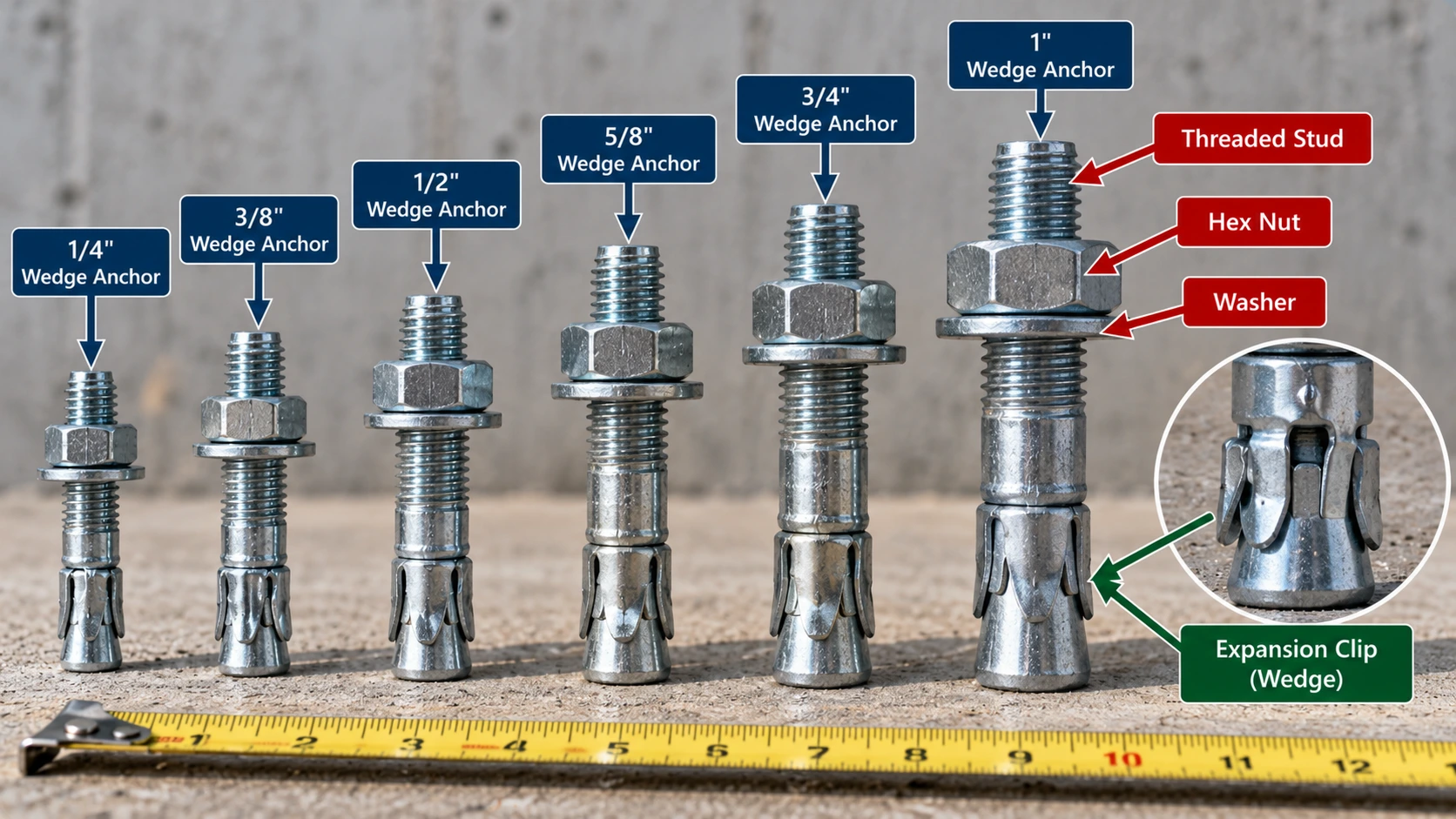
- Anchor body: the threaded stud. In Simpson’s Strong-Bolt 2, the threaded length varies but is always less than the total anchor length, and a smooth collar separates the threads from the mandrel end.
- Expansion clip: wraps around the tapered mandrel. Strong-Bolt 2 uses a three-segment clip with embossments that engage the sides of the hole.
- Tapered mandrel: the cone-shaped installed end. Torquing the nut pulls it up into the clip.
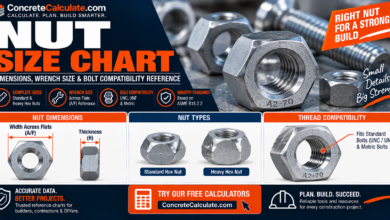
- Nut: the torque is applied to it. See the nut sizes for hex nut dimensions.
- Washer: spreads the clamping load onto the fixture. See the washer sizes.
ICC-ES describes the same mechanism for Strong-Bolt 2: applying the specified torque pulls the mandrel into the clip so the clip engages the drilled concrete.
How to Read Wedge Anchor Sizes
Nominal diameter, then overall length.
A wedge anchor is labeled by nominal diameter and overall length. For example, a 1/2 × 5-1/2 anchor has a nominal diameter of 1/2 in. and an overall length of 5-1/2 in. The overall length is not the embedment depth: part of it sits above the concrete as the fixture, washer, nut and thread projection. Some products also stamp a letter on the head that identifies length; Simpson’s Strong-Bolt 2 uses codes from A (1.5 in.) to T (13 in.) so inspectors can check embedment after installation.
Threaded-stud terminology follows ordinary inch thread conventions; see the thread size chart and UNC thread sizes for thread basics, the bolt diameter chart for nominal diameter terminology, and the screw size chart for general screw numbering.
Wedge Anchor Diameter and Drill Bit Chart
The matching bit for each diameter, with notes by size.
- For the evaluated wedge-anchor systems researched; nominal carbide bit diameter equals nominal anchor diameter
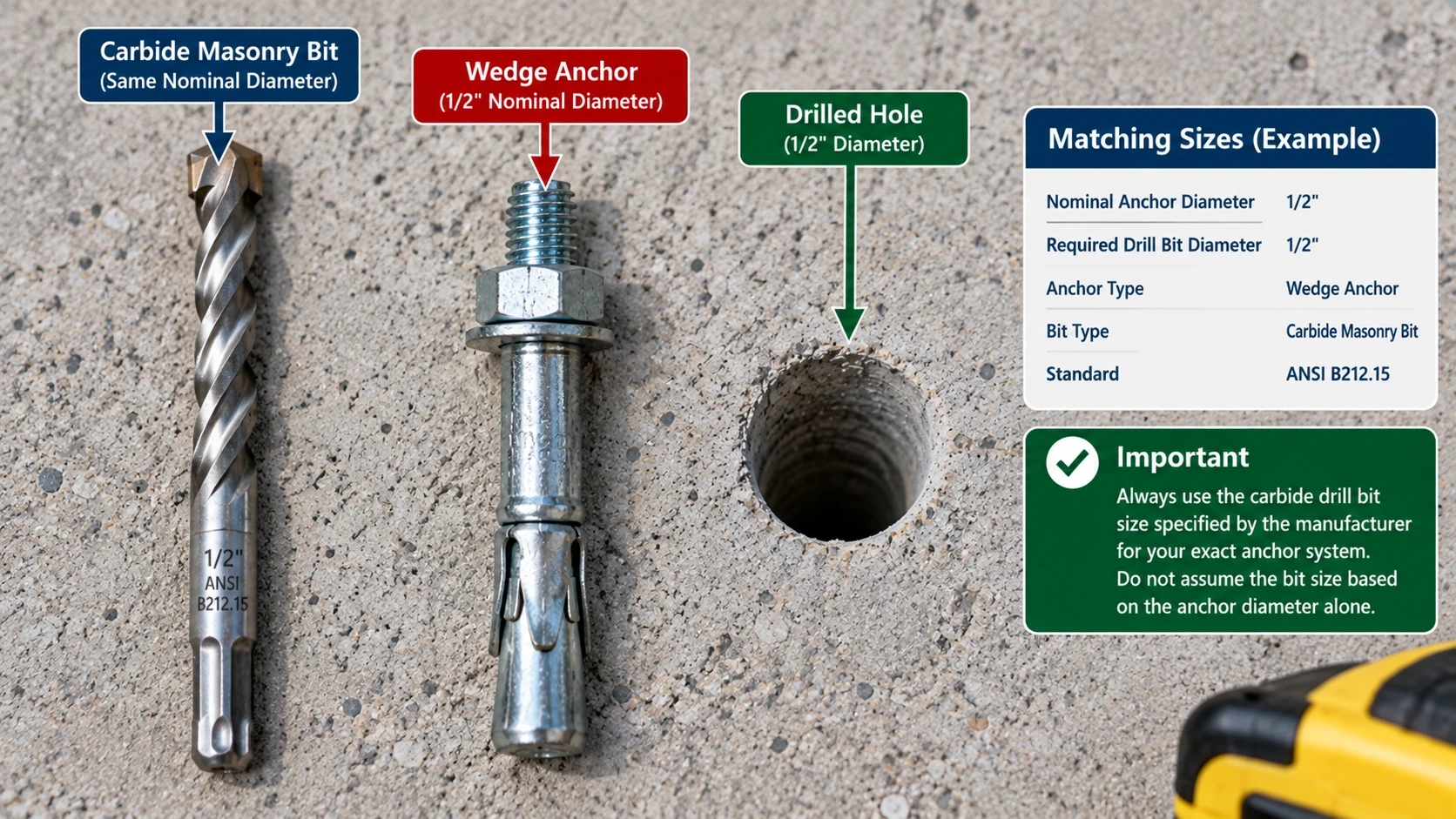
Simpson’s installation guidance requires a rotary hammer drill with a carbide-tipped bit complying with ANSI B212.15, drilled to the specified nominal embedment depth, with the bit diameter matching the nominal anchor diameter. Hilti’s KB-TZ2 data list the nominal bit diameter as equal to the nominal anchor diameter at every size, and DEWALT states the same for Power-Stud+ SD2. Matching the printed fractional size alone is not the whole requirement for an evaluated structural anchor: the bit must also satisfy the anchor’s installation requirements. For general bit tables, use the drill bit sizes.
1/4 in.
Matching 1/4 in. carbide bit. The 1/4 in. Strong-Bolt 2 is limited by its ESR to uncracked concrete; confirm cracked-concrete eligibility for your product.
3/8 in.
Matching 3/8 in. carbide bit. Simpson’s Strong-Bolt 2 3/8 in. is qualified down to a 3-1/4 in. concrete thickness.
1/2 in.
Matching 1/2 in. carbide bit. The most common size, with several evaluated embedments in some product lines.
5/8 in.
Matching 5/8 in. carbide bit.
3/4 in.
Matching 3/4 in. carbide bit.
1 in.
Matching 1 in. carbide bit, where the product family offers the 1 in. size.
Concrete Drill Hole vs. Fixture Hole
Two different holes with two different diameters.
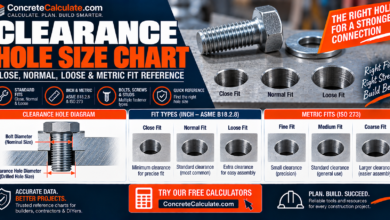
The concrete hole is drilled at the nominal bit diameter specified for the anchor. The hole through the steel plate, bracket or equipment base is a separate dimension and may need clearance for the anchor to pass through. Do not use a steel clearance-hole chart to choose a concrete-anchor drill diameter. For fixture holes, see the bolt hole sizes and the clearance hole sizes; for the concrete bore, use the anchor’s own instructions and the drill bit sizes.
Wedge Anchor Length Chart
Available lengths are product-specific, so there is no single master length table.
Overall lengths differ by manufacturer, diameter and finish. Simpson’s Strong-Bolt 2, for instance, spans length codes A (1.5 in.) through T (13 in.), and catalog designations pair a diameter with a length. The examples below show how ordering designations look; they are not a complete or universal availability list.
| Product | Example Designation | Reads As |
|---|---|---|
| Hilti KB-TZ2 | 1/4 x 2-1/8 | 1/4 in. diameter, 2-1/8 in. overall length |
| Hilti KB-TZ2 | 1/2 x 5-1/2 | 1/2 in. diameter, 5-1/2 in. overall length |
| Hilti KB-TZ2 | 5/8 x 6 | 5/8 in. diameter, 6 in. overall length |
| Simpson Strong-Bolt 2 | 1/2 x 7 | 1/2 in. diameter, 7 in. overall length |
| Simpson Strong-Bolt 2 (304 stainless) | 1/4 x 3-1/4 | 1/4 in. diameter, 3-1/4 in. overall length |
Do not assume every diameter exists in every length, or that the same length gives the same embedment in different products. Check the exact product’s catalog.
How to Choose Wedge Anchor Length
Selection logic first, product table second.
- L: overall anchor length; hnom: required nominal embedment; tfix: fixture thickness
- A starting relationship only. Select the actual length from the exact product table.
Length Selection Example
The nut sizes and washer sizes pages give hardware heights that feed into the thread allowance, but the manufacturer’s stated fixture-thickness range for each length is what governs.
Wedge Anchor Embedment Depth
No universal depth exists: embedment is selected per product.
The same diameter can have several evaluated embedments, depending on anchor length, fixture thickness and the product configuration. Hilti’s KB-TZ2 data list multiple effective and nominal embedments within individual diameters. Do not publish or use a statement like “1/2 in. wedge anchor minimum embedment = X in.” Select embedment from the current technical data or evaluation report for the exact anchor system.
| Product | Anchor Diameter | Example Nominal Embedment | Context |
|---|---|---|---|
| DEWALT Power-Stud+ SD2 | 3/8 in. | 2-3/8 in. | Evaluated configuration |
| DEWALT Power-Stud+ SD2 | 1/2 in. | 2-1/2 in. | Shallower evaluated option |
| DEWALT Power-Stud+ SD2 | 1/2 in. | 3-3/4 in. | Deeper evaluated option |
| DEWALT Power-Stud+ SD2 | 5/8 in. | 3-7/8 in. | Evaluated configuration |
| DEWALT Power-Stud+ SD2 | 5/8 in. | 4-7/8 in. | Deeper evaluated option |
| DEWALT Power-Stud+ SD2 | 3/4 in. | 4-1/2 in. | Evaluated configuration |
| DEWALT Power-Stud+ SD2 | 3/4 in. | 5-3/4 in. | Deeper evaluated option |
Not Universal Minimums
These are examples from one evaluated wedge-anchor family. They are not universal minimum embedments for all wedge anchors of the same diameter.
Nominal vs. Effective Embedment
Two different depths for two different purposes.
- These are not automatically identical
Hilti lists nominal and effective embedment separately for KB-TZ2. In general, nominal embedment is the installation-related depth used when drilling and setting the anchor, while effective embedment relates to the expansion mechanism and is the depth used in structural design. Do not treat anchor length, hole depth, nominal embedment and effective embedment as synonyms.
Hole Depth vs. Embedment
They are not the same, and the rule is product-specific.
Hole depth h0 is at least the nominal embedment, and some installation procedures call for extra depth. As one manufacturer example, Simpson’s Strong-Bolt 2 instructions say to drill to the specified nominal embedment depth, and allow drilling deeper than nominal as an alternative to cleaning, so dust has space at the bottom of the hole. That belongs to the evaluated Strong-Bolt 2 procedure; it is not a rule for every wedge anchor. Do not use a universal “hole depth = embedment + 1/2 in.” rule. Use the exact product instructions.
Fixture Thickness and Anchor Length
The attached part sets how much anchor sticks out of the concrete.
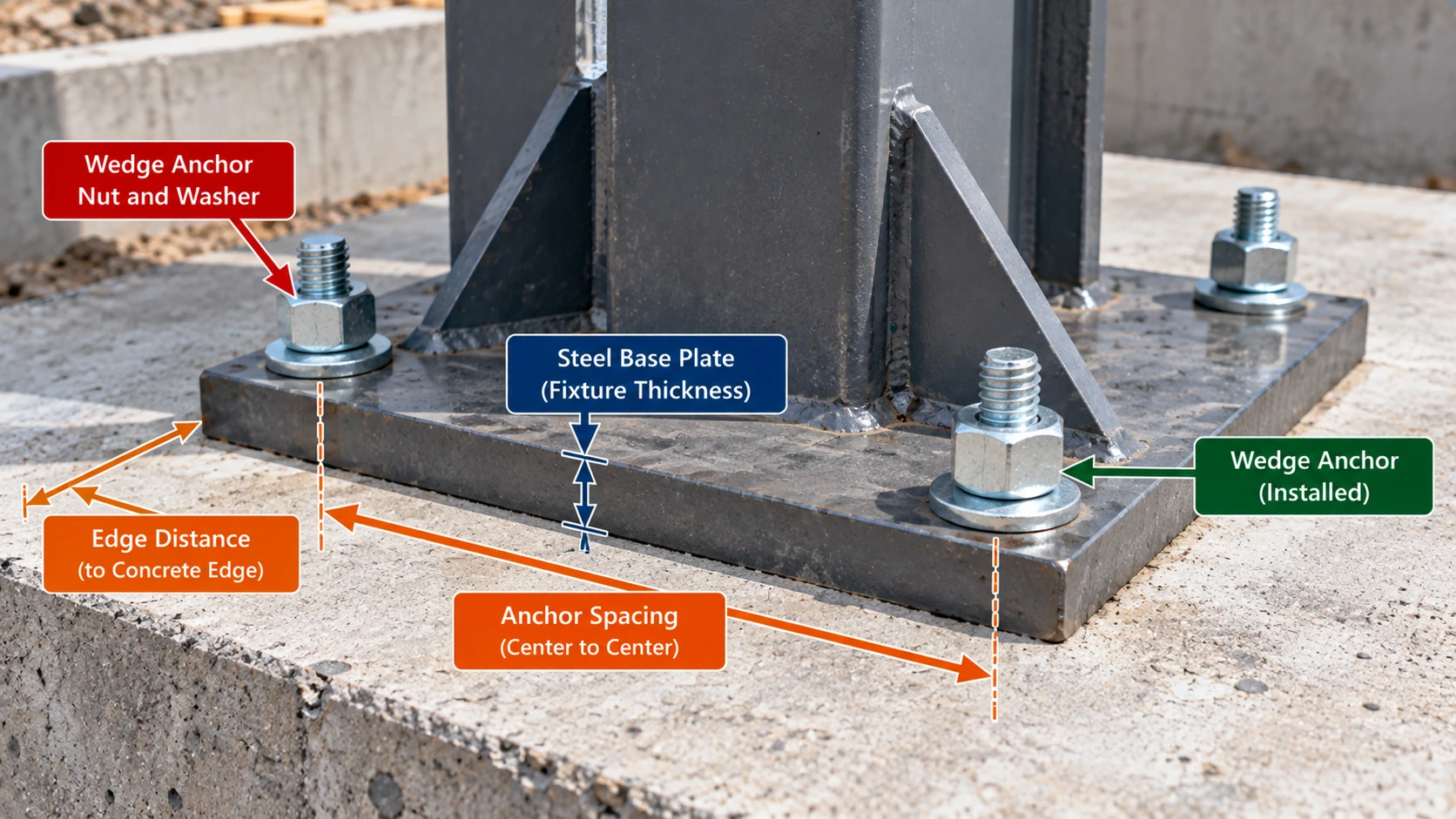
Fixture thickness is the thickness of the material clamped between the concrete surface and the washer and nut: a steel base plate, bracket, angle, equipment foot or railing plate. For the same diameter, a thicker fixture typically needs a longer anchor if embedment is to stay unchanged. Hilti notes that fixture thickness contributes to selecting the correct anchor length and embedment configuration.
Wedge Anchor Installation Torque
Product-specific. There is no universal torque by diameter.
Wedge anchors are torque-controlled expansion anchors: applying the specified torque draws the mandrel into the clip. The correct value varies with anchor diameter, material and finish, anchor system, embedment configuration and base material. Simpson states that the specific torque for Strong-Bolt 2 varies by diameter and is listed in its catalog, on a card within the box and on its website. Do not build or use a generic “1/2 in. anchor, X ft-lb” chart by mixing manufacturers. Use a calibrated torque wrench with the value for your exact product.
How to Install a Wedge Anchor
Drill, clean, drive, torque.
- Drill: use a rotary hammer drill with a carbide-tipped bit that complies with ANSI B212.15 and has the nominal diameter specified for the anchor. Drill to the specified depth.
- Clean: Simpson specifies blowing the hole clean with oil-free compressed air, with listed exceptions such as overhead installations and the deeper-hole alternative.
- Drive: with the nut and washer at the top of the shaft, insert the assembled anchor through the fixture hole and drive it with a hammer until the washer and nut are firmly seated against the fixture.
- Torque: tighten the nut to the specified installation torque with a calibrated torque wrench.
This sequence is a manufacturer example (Simpson Strong-Bolt 2) of an evaluated installation. Follow the exact instructions for your selected anchor, and do not universalize one manufacturer’s cleaning procedure.
Concrete Strength and Anchor Performance
Higher concrete strength generally raises tabulated values, within the product’s limits.
Concrete compressive strength matters, but the effect is product- and mode-specific. Evaluated wedge anchors are typically qualified over a strength range; for example, ESR-3037 covers Strong-Bolt 2 in concrete with a specified strength of 2,500 to 8,500 psi, and ICC-ES ESR-2502 covers Power-Stud+ SD2 over the same 2,500 to 8,500 psi range. For concrete strength background, see the concrete PSI.
| Concrete Strength f’c | ASD Tension (lb) |
|---|---|
| 2,500 psi | 1,005 |
| 3,000 psi | 1,070 |
| 4,000 psi | 1,175 |
| 6,000 psi | 1,345 |
| 8,000 psi | 1,480 |
From 2,500 to 8,000 psi, this product’s tabulated value rises from 1,005 lb to 1,480 lb, about 47 percent. This is shown only to demonstrate that anchor capacity is not a function of diameter alone. Do not turn these numbers into a generic 3/8 in. wedge-anchor load chart.
Cracked vs. Uncracked Concrete
Qualification is specific to the anchor system.
ACI CODE-355.2-24 prescribes testing and evaluation for post-installed mechanical anchors used in structural applications under ACI CODE-318. It sets criteria for whether an anchor is acceptable in uncracked concrete only, or in cracked as well as uncracked concrete, and assigns performance categories that ACI 318 uses for capacity reduction factors and other design parameters. Do not say “all wedge anchors work in cracked concrete.”
Even within one product line, the answer changes. Under ESR-3037, Simpson’s 3/8 through 1 in. Strong-Bolt 2 anchors are installed in cracked and uncracked concrete, but the 1/4 in. size is limited to uncracked concrete, and Simpson describes its mechanically galvanized STB2-MG as tested in uncracked concrete. Seismic qualification is likewise product-specific.
Wedge Anchor Tension and Shear Capacity
Concepts only, with no generic load table.
- Tension: load pulling the anchor away from the concrete surface.
- Shear: load acting primarily parallel to the concrete surface.
- Combined tension and shear: both acting at once, which needs an interaction check.
ACI 355.2 covers qualification under static or seismic tension, shear and combined loading. Governing variables include the evaluated product, embedment, concrete strength and cracking, edge distance, spacing, member thickness, load direction and any reductions or interactions. A full design under ACI 318 anchoring provisions belongs to a design professional.
Why Diameter Alone Does Not Set Capacity
Several failure modes can govern.
Anchor strength can be controlled by steel failure, concrete breakout, pullout, pryout, concrete edge breakout, tension-shear interaction and, where applicable, seismic conditions. That is why a 1/2 in. wedge anchor does not have one universal weight capacity.
Same Product, Different Embedment
Not a Universal Rule
This is not a rule that raising embedment by 50 percent raises any wedge anchor’s capacity by 81 percent. It is a product-specific comparison that shows why embedment must be part of anchor selection.
Wedge Anchor Edge Distance
A concept here, with numbers in the ESR.
Do not use a universal rule such as “edge distance = 5d.” Minimum values and strength reductions depend on the evaluated product, embedment, member geometry, loading and anchor spacing, with ACI 318 anchorage provisions applying. Use the ESR and product data for numbers.
Wedge Anchor Spacing
Close anchors can interact.
Closely spaced anchors can have overlapping concrete breakout regions, and ACI 355.2 defines an anchor group partly by spacing relative to effective embedment. Do not apply a rule like “all wedge anchors need 6d spacing.” Spacing for foundation and sill-plate anchor bolts is a different topic; see the anchor bolt spacing for that, and use the wedge anchor’s own ESR for post-installed anchors.
Minimum Concrete Thickness
The slab or wall must be thick enough for the embedment.
Embedment cannot be chosen without considering member thickness. Simpson states that Strong-Bolt 2 is qualified for concrete thicknesses down to 3-1/4 in., and also for lightweight concrete over steel deck; that is one product’s qualification and not a universal minimum slab thickness. Reinforcement conflicts also matter; see the concrete cover chart for cover context.
Wedge Anchor Materials and Corrosion Resistance
Choose by environment, not by a one-word rule.
| Material / Finish | Examples from Cited Products | Notes |
|---|---|---|
| Zinc-plated carbon steel | Strong-Bolt 2 (ASTM B633, SC1, Type III); Hilti KB-TZ2 (zinc plated, minimum 5 microns) | Common for dry, interior service |
| Mechanically galvanized | Strong-Bolt 2 STB2-MG | Listed as tested in uncracked concrete |
| 304 stainless | Strong-Bolt 2; Hilti KB-TZ2 SS304 | Check chlorides and exposure |
| 316 stainless | Strong-Bolt 2; Hilti KB-TZ2 SS316 | Higher corrosion resistance than 304 |
Do not reduce corrosion selection to “stainless equals outdoor.” Moisture, chlorides, chemicals, contact with treated wood, interior or exterior exposure, project specifications and galvanic compatibility all matter. Zinc-plated carbon steel is not suitable for every corrosive environment.
Wedge Anchor Size by Application
Selection variables for common uses, with no diameter assigned by application.
| Application | What Drives Selection |
|---|---|
| Equipment bases | Fixture thickness, loads, vibration, concrete condition |
| Steel base plates | Plate thickness, edge distance, spacing, tension and shear |
| Racking | Static and seismic loads, slab thickness, cracked-concrete qualification |
| Railings and brackets | Fixture hole, edge distance, corrosion exposure |
| Pipe and strut supports | Overhead use, tension, fire-protection approvals where required |
| Barriers | Impact and shear demand, edge distance |
Simpson lists applications from racking in big-box stores to resisting lateral loads from steel moment frames, and notes UL and FM approvals for its Strong-Bolt 2 where fire-suppression systems require them. DEWALT lists many similar applications for Power-Stud+ SD2. Neither list assigns a diameter by application.
Wedge Anchor vs. Concrete Screw
Different anchors, different engagement.
A wedge anchor is a torque-controlled mechanical expansion anchor. A concrete screw is a thread-forming or thread-cutting post-installed anchor that engages the concrete differently. Sizing, bit selection and embedment for Tapcon, Titen HD and similar screws are covered in the concrete screw sizes, so this page does not repeat those tables.
Wedge Anchor vs. Sleeve and Drop-In Anchors
Different expansion systems.
Sleeve anchors expand a sleeve around a bolt or stud, and drop-in anchors are internally threaded anchors set with a setting tool. Both are expansion systems that differ from the wedge clip-and-mandrel mechanism. Detailed sizing for sleeve and drop-in anchors is left to dedicated pages and to each product’s own data.
Wedge Anchor vs. Cast-in-Place Anchor Bolt
Post-installed versus cast-in.
Wedge anchors are post-installed mechanical expansion anchors. They are not interchangeable with J-bolts, headed anchor rods or ASTM F1554 cast-in-place anchor rods that are set before the concrete is placed. For cast-in-place foundation anchorage, see the anchor bolt sizes and the anchor bolt spacing. For foundation context, see the footing size chart and the foundation depth chart.
Common Wedge Anchor Sizing and Installation Mistakes
Quick checks before you drill.
Choosing diameter from load alone
Capacity needs the whole system.
Assuming every brand performs identically
Evaluated products differ.
Same diameter means same capacity
Embedment and concrete change it.
Same diameter means same embedment
Several options exist per diameter.
Same diameter means same torque
Torque is product-specific.
Same diameter means same edge distance
It depends on the ESR.
Same diameter means same spacing
Interaction depends on embedment.
Same diameter means same concrete thickness
It is configuration-specific.
Treating overall length as embedment
Hardware and fixture take length.
Treating effective as nominal embedment
They serve different purposes.
Treating hole depth as embedment
Procedures can call for more depth.
Forgetting fixture thickness
It sets the length needed.
Forgetting washer, nut and thread allowance
They add to the length.
Using the fixture hole size as the concrete bit
They are different holes.
Using a steel bolt-hole chart for concrete
It gives clearance holes only.
Using the wrong drill-bit diameter
Match the nominal size.
Using an unsuitable bit
Use the specified carbide bit.
Ignoring ANSI bit requirements
Evaluated anchors may require them.
Failing to clean the hole
Cleaning can be required.
Over- or under-drilling against instructions
Follow the product depth.
Installing into unsupported base material
Use the qualified base material.
Assuming concrete qualification covers masonry
Masonry is a separate qualification.
Assuming uncracked means cracked qualification
They are separate.
Assuming all wedge anchors are seismic-qualified
Seismic qualification is product-specific.
Using generic torque values
Use the product’s value.
Using an impact wrench without permission
Follow permitted installation methods.
Under-torquing
The clip may not set properly.
Over-torquing
It can damage the anchor or concrete.
Installing too close to an edge
Edge breakout risk.
Installing anchors too close together
Breakout zones overlap.
Ignoring slab or member thickness
It limits embedment.
Ignoring reinforcement conflicts
Rebar can block the hole.
Ignoring concrete strength
It changes tabulated values.
Ignoring cracked concrete
Check cracked qualification.
Ignoring corrosion exposure
Match material to environment.
Zinc-plated steel in a corrosive environment
It may not be suitable.
Mixing manufacturer data
Never combine different makers’ data.
Using one maker’s embedment with another’s load table
The data are not interchangeable.
Using ultimate load as allowable
Apply the proper design basis.
Confusing ASD with strength design
They are different bases.
Using a published load without reductions
Check interactions and reductions.
Assuming deeper always scales capacity
The gain is not proportional.
Reusing an anchor
Only if the product permits it.
Installing an anchor that cannot be identified
Verify product identification.
Wedge Anchor Size FAQs
Thirty-five common questions, answered without diameter-only load claims.
What size drill bit do I need for a 1/4-inch wedge anchor?
What size drill bit do I need for a 3/8-inch wedge anchor?
What size drill bit do I need for a 1/2-inch wedge anchor?
What size drill bit do I need for a 5/8-inch wedge anchor?
What size drill bit do I need for a 3/4-inch wedge anchor?
What size drill bit do I need for a 1-inch wedge anchor?
Is the drill bit the same size as the wedge anchor?
How deep should a wedge anchor be embedded?
What is the minimum embedment for a 1/2-inch wedge anchor?
How long should my wedge anchor be?
How do I calculate wedge-anchor length?
What is nominal embedment?
What is effective embedment?
Is hole depth the same as embedment?
How thick can the fixture be?
How far should wedge anchors be from a concrete edge?
How far apart should wedge anchors be?
What torque should I use?
Can wedge anchors be used in cracked concrete?
Can wedge anchors be used in concrete block?
Can wedge anchors be used in brick?
Can wedge anchors be used overhead?
Can wedge anchors be used outdoors?
Should I use galvanized or stainless wedge anchors?
What is the difference between 304 and 316 stainless?
How much weight can a 3/8-inch wedge anchor hold?
How much weight can a 1/2-inch wedge anchor hold?
How much weight can a 3/4-inch wedge anchor hold?
Does stronger concrete increase anchor capacity?
Does deeper embedment increase capacity?
Can wedge anchors be removed?
Can wedge anchors be reused?
What is the difference between wedge anchors and concrete screws?
What is the difference between wedge and sleeve anchors?
Are wedge anchors the same as anchor bolts?
Standards and References Used
| Reference | What It Covers | Used For |
|---|---|---|
| ACI CODE-355.2-24 | Qualification of post-installed mechanical anchors for use with ACI CODE-318 | Cracked/uncracked qualification, performance categories |
| ICC-ES ESR-3037 | Simpson Strong-Tie Strong-Bolt 2 wedge anchor | Evaluated conditions, cracked and uncracked use |
| ICC-ES ESR-2502 | DEWALT Power-Stud+ SD2 and related stainless anchors | Concrete strength range and qualification |
| Simpson Strong-Tie, Anchor Anatomy 101 | Strong-Bolt 2 components, installation sequence, materials | Anatomy, drilling, cleaning, torque |
| Hilti Kwik Bolt TZ2 | KB-TZ2 sizes, materials and technical data | Sizes, bit diameters, multiple embedments |
| DEWALT Power-Stud+ SD2 | Wedge anchor product data and allowable-load tables | Product-specific embedment and load examples |
All numerical product values are specific to the named product and its stated conditions. Manufacturer instructions and ICC-ES evaluation reports govern. Local codes, project drawings and the engineer of record govern structural anchorage.
📥 Download Wedge Anchor Size Chart PDF
Use your browser’s print function to save this page as a PDF for jobsite binders, estimating folders and reference.