Steel Rectangular Tube Size Chart – Dimensions, Wall Thickness & Weight
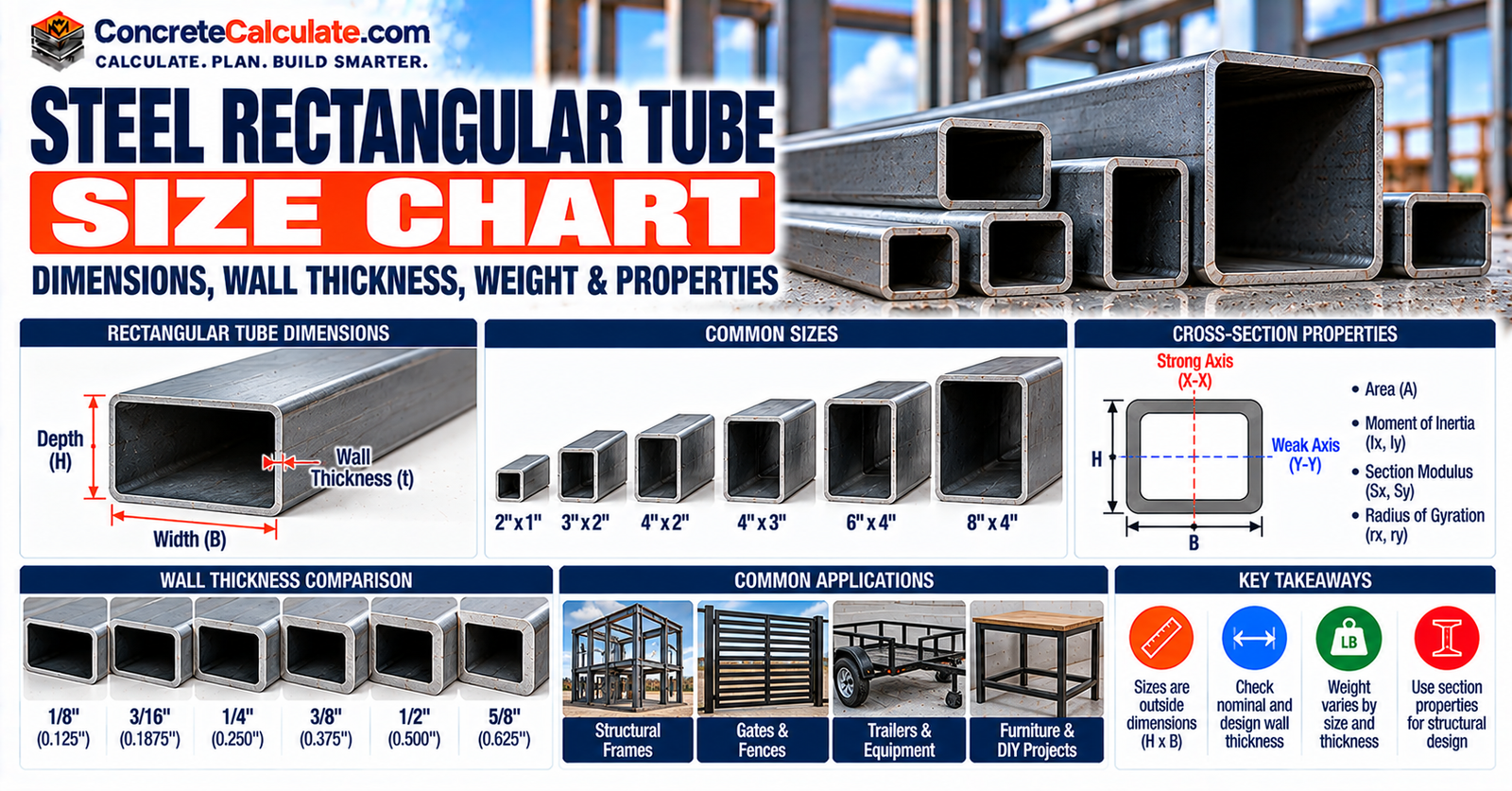
Steel Rectangular Tube Size Chart
Dimensions, Wall Thickness & Weight
Outside dimensions, nominal and design wall thickness, weight per foot, area and section properties for common rectangular HSS, plus why A500, A1085 and mechanical tube are not interchangeable.
 Reviewed by Muhammad Ramzan Babar, PhD Researcher (Plasma Physics) & Calculator Developer, View Profile
⭐ Steel Rectangular Tube Size Chart: ASTM A500 HSS Dimensions and Weight
Outside dimensions, nominal and design wall, weight per foot and area for common rectangular structural HSS.
How to Read This Chart
Depth and width are outside dimensions. Weight per foot is based on the nominal wall. Area uses the A500 design wall (0.93 times nominal, rounded to 0.001 in.), because that is the value AISC design properties use. Section properties such as Ix and Sx are in the properties chart further down. Compare with the HSS size chart for the broader HSS family.
| HSS Size | Outside Depth | Outside Width | Nominal Wall | Design Wall t | Weight (lb/ft) | Area (in²) |
|---|---|---|---|---|---|---|
| HSS2×1×1/8 | 2 in. | 1 in. | 1/8 in. (0.125) | 0.116 in. | 2.20 | 0.608 |
| HSS2×1×3/16 | 2 in. | 1 in. | 3/16 in. (0.1875) | 0.174 in. | 3.04 | 0.845 |
| HSS3×2×1/8 | 3 in. | 2 in. | 1/8 in. (0.125) | 0.116 in. | 3.90 | 1.07 |
| HSS3×2×3/16 | 3 in. | 2 in. | 3/16 in. (0.1875) | 0.174 in. | 5.59 | 1.54 |
| HSS3×2×1/4 | 3 in. | 2 in. | 1/4 in. (0.25) | 0.233 in. | 7.11 | 1.97 |
| HSS3×2×5/16 | 3 in. | 2 in. | 5/16 in. (0.3125) | 0.291 in. | 8.45 | 2.35 |
| HSS3×2×0.134* | 3 in. | 2 in. | 0.134 in. | 0.125 in. | 4.16 | 1.15 |
| HSS3×2×0.165* | 3 in. | 2 in. | 0.165 in. | 0.153 in. | 5.01 | 1.38 |
| HSS4×2×1/8 | 4 in. | 2 in. | 1/8 in. (0.125) | 0.116 in. | 4.75 | 1.30 |
| HSS4×2×3/16 | 4 in. | 2 in. | 3/16 in. (0.1875) | 0.174 in. | 6.87 | 1.89 |
| HSS4×2×1/4 | 4 in. | 2 in. | 1/4 in. (0.25) | 0.233 in. | 8.81 | 2.44 |
| HSS4×2×5/16 | 4 in. | 2 in. | 5/16 in. (0.3125) | 0.291 in. | 10.58 | 2.94 |
| HSS4×2×3/8 | 4 in. | 2 in. | 3/8 in. (0.375) | 0.349 in. | 12.17 | 3.39 |
| HSS4×3×1/8 | 4 in. | 3 in. | 1/8 in. (0.125) | 0.116 in. | 5.61 | 1.54 |
| HSS4×3×3/16 | 4 in. | 3 in. | 3/16 in. (0.1875) | 0.174 in. | 8.15 | 2.24 |
| HSS4×3×1/4 | 4 in. | 3 in. | 1/4 in. (0.25) | 0.233 in. | 10.51 | 2.91 |
| HSS4×3×5/16 | 4 in. | 3 in. | 5/16 in. (0.3125) | 0.291 in. | 12.70 | 3.52 |
| HSS4×3×3/8 | 4 in. | 3 in. | 3/8 in. (0.375) | 0.349 in. | 14.72 | 4.09 |
| HSS5×3×1/8 | 5 in. | 3 in. | 1/8 in. (0.125) | 0.116 in. | 6.46 | 1.77 |
| HSS5×3×3/16 | 5 in. | 3 in. | 3/16 in. (0.1875) | 0.174 in. | 9.42 | 2.58 |
| HSS5×3×1/4 | 5 in. | 3 in. | 1/4 in. (0.25) | 0.233 in. | 12.21 | 3.37 |
| HSS5×3×5/16 | 5 in. | 3 in. | 5/16 in. (0.3125) | 0.291 in. | 14.83 | 4.10 |
| HSS5×3×3/8 | 5 in. | 3 in. | 3/8 in. (0.375) | 0.349 in. | 17.27 | 4.78 |
| HSS5×3×1/2 | 5 in. | 3 in. | 1/2 in. (0.5) | 0.465 in. | 21.63 | 6.02 |
| HSS6×2×1/8 | 6 in. | 2 in. | 1/8 in. (0.125) | 0.116 in. | 6.46 | 1.77 |
| HSS6×2×3/16 | 6 in. | 2 in. | 3/16 in. (0.1875) | 0.174 in. | 9.42 | 2.58 |
| HSS6×2×1/4 | 6 in. | 2 in. | 1/4 in. (0.25) | 0.233 in. | 12.21 | 3.37 |
| HSS6×2×5/16 | 6 in. | 2 in. | 5/16 in. (0.3125) | 0.291 in. | 14.83 | 4.10 |
| HSS6×2×3/8 | 6 in. | 2 in. | 3/8 in. (0.375) | 0.349 in. | 17.27 | 4.78 |
| HSS6×3×1/8 | 6 in. | 3 in. | 1/8 in. (0.125) | 0.116 in. | 7.31 | 2.00 |
| HSS6×3×3/16 | 6 in. | 3 in. | 3/16 in. (0.1875) | 0.174 in. | 10.70 | 2.93 |
| HSS6×3×1/4 | 6 in. | 3 in. | 1/4 in. (0.25) | 0.233 in. | 13.91 | 3.84 |
| HSS6×3×5/16 | 6 in. | 3 in. | 5/16 in. (0.3125) | 0.291 in. | 16.96 | 4.68 |
| HSS6×3×3/8 | 6 in. | 3 in. | 3/8 in. (0.375) | 0.349 in. | 19.82 | 5.48 |
| HSS6×3×1/2 | 6 in. | 3 in. | 1/2 in. (0.5) | 0.465 in. | 25.03 | 6.95 |
| HSS6×4×1/8 | 6 in. | 4 in. | 1/8 in. (0.125) | 0.116 in. | 8.16 | 2.23 |
| HSS6×4×3/16 | 6 in. | 4 in. | 3/16 in. (0.1875) | 0.174 in. | 11.97 | 3.28 |
| HSS6×4×1/4 | 6 in. | 4 in. | 1/4 in. (0.25) | 0.233 in. | 15.62 | 4.30 |
| HSS6×4×5/16 | 6 in. | 4 in. | 5/16 in. (0.3125) | 0.291 in. | 19.08 | 5.26 |
| HSS6×4×3/8 | 6 in. | 4 in. | 3/8 in. (0.375) | 0.349 in. | 22.37 | 6.18 |
| HSS6×4×1/2 | 6 in. | 4 in. | 1/2 in. (0.5) | 0.465 in. | 28.43 | 7.88 |
| HSS8×4×1/8 | 8 in. | 4 in. | 1/8 in. (0.125) | 0.116 in. | 9.86 | 2.70 |
| HSS8×4×3/16 | 8 in. | 4 in. | 3/16 in. (0.1875) | 0.174 in. | 14.53 | 3.98 |
| HSS8×4×1/4 | 8 in. | 4 in. | 1/4 in. (0.25) | 0.233 in. | 19.02 | 5.24 |
| HSS8×4×5/16 | 8 in. | 4 in. | 5/16 in. (0.3125) | 0.291 in. | 23.34 | 6.43 |
| HSS8×4×3/8 | 8 in. | 4 in. | 3/8 in. (0.375) | 0.349 in. | 27.48 | 7.58 |
| HSS8×4×1/2 | 8 in. | 4 in. | 1/2 in. (0.5) | 0.465 in. | 35.24 | 9.74 |
| HSS8×4×5/8 | 8 in. | 4 in. | 5/8 in. (0.625) | 0.581 in. | 42.30 | 11.7 |
Chart Basis and Limits
Sizes and fractional walls follow the AISC Shapes Database rectangular HSS listing. Rows marked * (HSS3×2×0.134 and 0.165) are STI A500 decimal-wall entries. Weights match the AISC listing for every fractional row. Areas and section properties were calculated with the AISC/STI design-wall method and rounded-corner HSS geometry, and were checked against published STI and AISC values for sample sections, including the STI HSS3×2×0.134 row. A listed size is not a guarantee of current stock; see the availability section.
Metric: 1 in. = 25.4 mm; 1 lb/ft = 1.4882 kg/m. For final design, use the current AISC Steel Construction Manual or the STI dimensions and section properties brochure for ASTM A500.
✓ Weights checked against the AISC Shapes Database listing, October 2026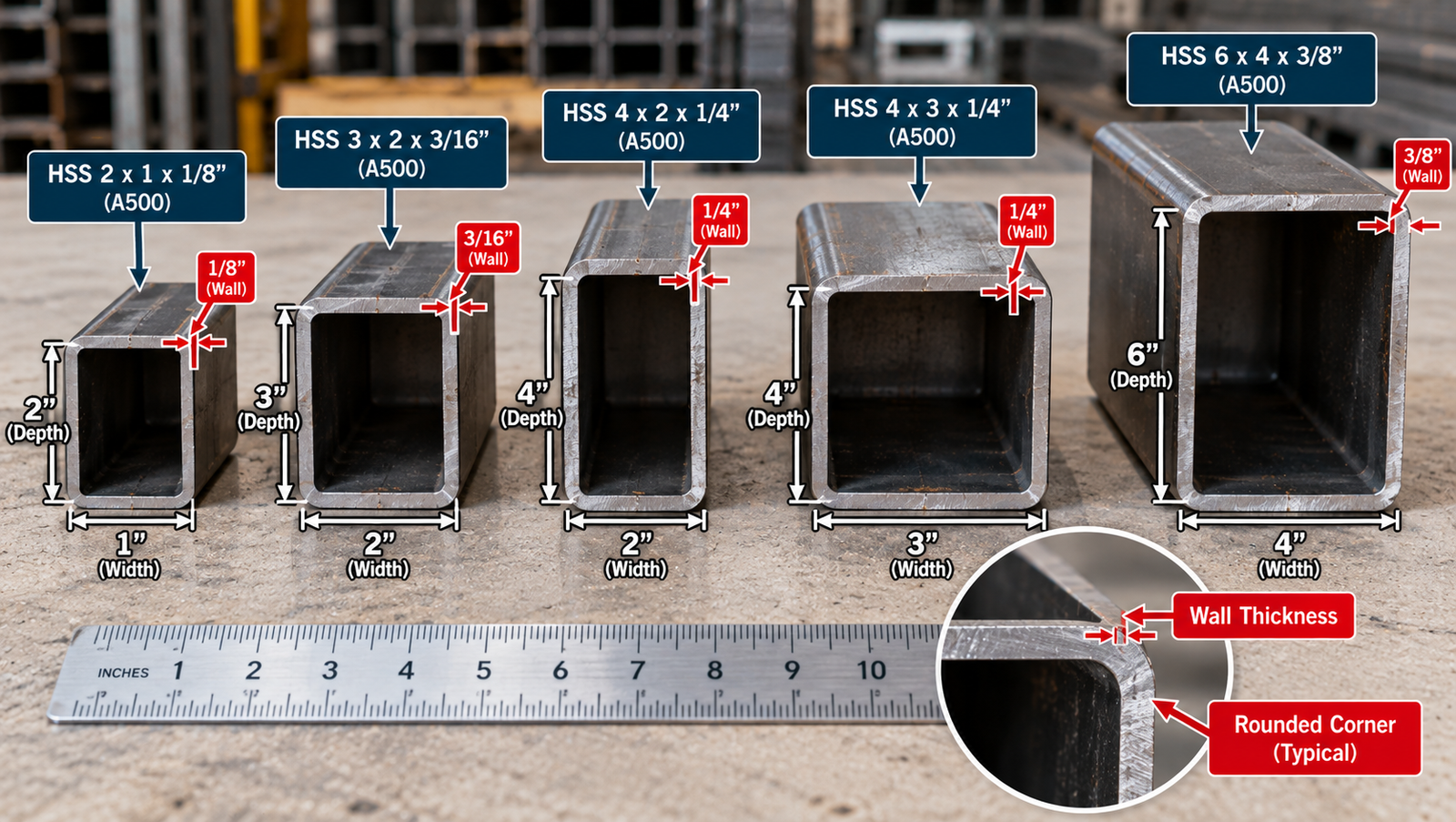
What Is Rectangular Steel Tubing?
The generic product, then the structural subset this chart covers.
Rectangular steel tubing is a hollow steel section with a rectangular cross-section, sold under many specifications for structural, mechanical and architectural uses. This page narrows to rectangular hollow structural sections (HSS) used in U.S. structural construction, because that is where published dimensions and section properties are standardized. For other shapes, see the square steel tube sizes and the HSS size chart.
Rectangular Tube vs. Rectangular HSS
Not every rectangular tube is structural HSS.
AISC defines HSS as manufactured hollow structural sections, typically round, square or rectangular. In the U.S., structural HSS commonly conforms to ASTM A500 or ASTM A1085. Mechanical rectangular tubing may instead be made under standards such as ASTM A513 and can differ in tolerances, materials, wall thicknesses, corner geometry and intended application.
Editorial Rule Used on This Page
The main chart is based on ASTM A500 rectangular HSS. Mechanical rectangular tubing is discussed separately and its dimensions are not mixed into the structural chart. STI’s capability tool likewise lists A513 mechanical tubing separately from A500 and A1085 HSS.
How to Read HSS Sizes
Depth, width and nominal wall, in that order.
AISC writes a rectangular HSS as HSS depth × width × nominal wall thickness. For example, HSS6×4×1/4 has a nominal 6 in. outside depth, 4 in. outside width and 1/4 in. nominal wall.
| Field | Value | Meaning |
|---|---|---|
| HSS | Hollow structural section | Product family |
| 6 | 6 in. | Nominal outside depth (H) |
| 4 | 4 in. | Nominal outside width (B) |
| 1/4 | 0.250 in. | Nominal wall thickness |
Depth is conventionally the larger dimension, and the section is stronger when loaded across that depth. See the strong-axis section for what changes when you turn the tube.
Are Rectangular Tube Dimensions Inside or Outside?
Outside, for structural HSS.
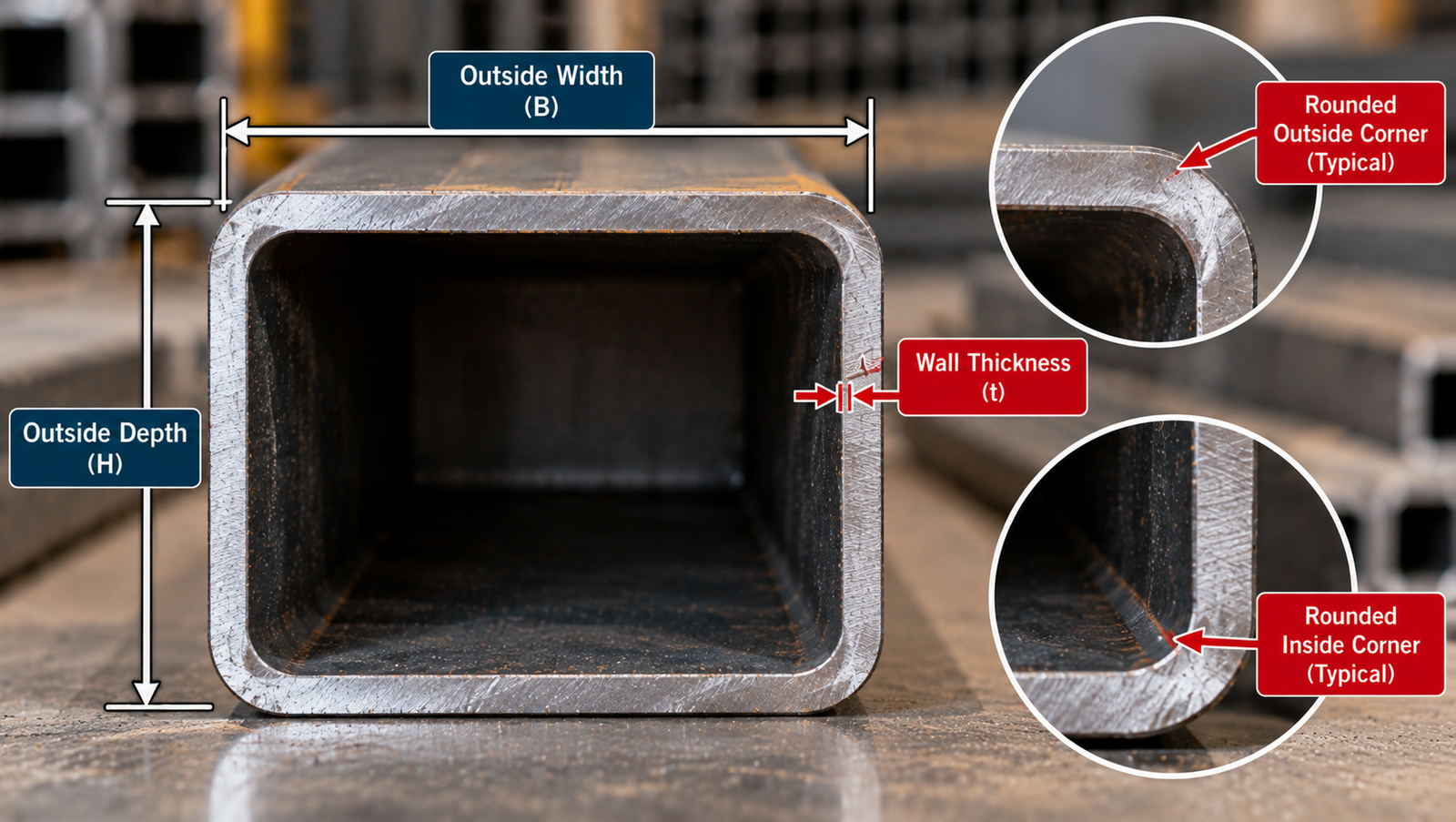
The depth and width in an HSS designation are overall outside dimensions. The inside opening is smaller by the wall thickness on each side, and it has rounded corners, so it is not a perfect rectangle. A 4×2×1/4 tube does not have a 4 in. by 2 in. opening.
Rectangular Steel Tube Wall Thickness Chart
Nominal fractions, their decimals and the A500 design wall.
| Nominal Wall | Decimal (in.) | A500 Design Wall t (in.) |
|---|---|---|
| 1/8 | 0.125 in. | 0.116 in. |
| 3/16 | 0.1875 in. | 0.174 in. |
| 1/4 | 0.2500 in. | 0.233 in. |
| 5/16 | 0.3125 in. | 0.291 in. |
| 3/8 | 0.3750 in. | 0.349 in. |
| 1/2 | 0.5000 in. | 0.465 in. |
| 5/8 | 0.6250 in. | 0.581 in. |
Nominal Is Not Design
Do not assume a catalog decimal such as 0.188 or 0.134 means the same thing as an A500 design wall. Always distinguish nominal wall from AISC design wall. Some STI and producer tables list decimal nominal walls such as 0.134 and 0.165 instead of fractions. Do not call a wall “gauge” unless the producer designates the product that way; for gauge-to-thickness conversion see the sheet metal gauge chart, and for plate see the steel plate thickness chart.
Nominal vs. Design Wall Thickness
The 0.93 factor, explained.
- tnom: nominal wall thickness (in.)
- tdes: design wall thickness used in AISC section properties (in.)
ASTM A500 permits a wall-thickness tolerance of about 10 percent, so AISC 360 requires calculations involving thickness to use 0.93 times the nominal wall. This is a design treatment, not a statement that the tube wall is physically 93 percent as thick.
HSS3×2×0.134 Design Wall
HSS3×2×0.165 Design Wall
ASTM A500 Rectangular HSS
The common U.S. structural specification.
ASTM A500/A500M covers cold-formed welded and seamless carbon steel structural tubing in rounds and shapes for welded, riveted or bolted construction of bridges and buildings and for general structural purposes. A500 covers tubes up to a maximum perimeter of 88 in. and a maximum nominal wall of 1 in. STI notes that domestic producers supply rectangular HSS up to 34 in.
Grade C and Material Strength
Grade C is the predominant A500 grade, with a minimum yield strength of 50 ksi and a tensile strength of 62 ksi for all HSS shapes. Most domestic HSS is dual-graded B and C, and STI recommends specifying Grade C. Material strength is not member capacity: do not convert 50 ksi directly into a load rating.
The 0.93 Design Wall
Because of the allowed wall thickness tolerance of about 10 percent, AISC 360 requires the 0.93 factor on nominal wall in design. That is why A500 design properties in the chart use the design wall column.
ASTM A1085 Rectangular HSS
A tighter-tolerance welded alternative.
ASTM A1085 covers cold-formed welded carbon steel HSS. It adds testing requirements, tighter tolerances and property ranges. The minimum wall tolerance is only -5 percent of nominal and the minimum mass tolerance is -3.5 percent, so AISC allows section properties to use the full nominal wall. A1085 requires a minimum yield strength of 50 ksi (maximum 70 ksi) and a Charpy V-notch test of 25 ft-lb at 40°F.
Availability
STI states that A500 is the preferred choice for nearly all applications. A1085 is less readily available: it is currently produced on demand and is not generally stocked. Check the STI Capability Tool before specifying it.
ASTM A500 vs. A1085
Same product family, different design treatment.
| Property | ASTM A500 | ASTM A1085 |
|---|---|---|
| Structural HSS | Yes | Yes |
| Cold formed | Yes | Yes |
| Welded | Yes | Yes |
| Seamless permitted | Yes | No (welded HSS) |
| Typical availability | Broad; most common U.S. choice | Limited; produced on demand |
| AISC design wall | 0.93 tnom | tnom |
| Maximum nominal wall | 1.000 in. | 1.000 in. |
| Maximum perimeter | 88 in. | 88 in. |
| Minimum yield (typical grade) | 50 ksi (Grade C) | 50 ksi (70 ksi maximum) |
| Charpy V-notch (CVN) | Not required by the standard | 25 ft-lb at 40°F required |
| Size | Weight (lb/ft) | A500 Area (in²) | A1085 Area (in²) | A1085 Larger By |
|---|---|---|---|---|
| HSS6×4×3/16 | 11.97 | 3.28 | 3.53 | 7.5% |
| HSS6×4×1/4 | 15.62 | 4.30 | 4.59 | 6.6% |
| HSS6×4×3/8 | 22.37 | 6.18 | 6.58 | 6.4% |
| HSS6×4×1/2 | 28.43 | 7.88 | 8.36 | 6.1% |
The A1085 area equals the nominal-wall area, which is why an A1085 HSS6×4×1/4 shows 4.59 in² while an A500 HSS6×4×1/4 shows 4.30 in². Do not mix the two tables unless a specification column identifies each row.
Structural HSS vs. Mechanical Rectangular Tube
Look-alikes with different standards.
| Feature | Structural rectangular HSS | Mechanical rectangular tube |
|---|---|---|
| Typical standard | ASTM A500 / A1085 | ASTM A513, depending on product |
| Primary intent | Structural members | Mechanical and fabricated products |
| AISC shape properties | Yes, for recognized HSS | Do not assume |
| Typical designation | HSS5×3×1/4 | OD × OD × wall or product designation |
| Structural design | AISC 360 where applicable | Needs an appropriate material and property basis |
| Availability | Structural producer and service-center system | Mechanical tubing suppliers |
Do not use A500 properties for an unidentified mechanical tube. Pipe schedules do not apply to rectangular HSS; for round pipe terminology see the steel pipe size chart.
Common Rectangular Steel Tube Sizes
Searchable size families, limited to what AISC and STI data support.
| Size Family (in.) | Outside Dimensions (mm) | Nominal Walls Listed (in.) | Weight Range (lb/ft) |
|---|---|---|---|
| 2×1 | 51 × 25.4 mm | 1/8, 3/16 | 2.20 to 3.04 |
| 3×2 | 76 × 50.8 mm | 1/8, 3/16, 1/4, 5/16 | 3.90 to 8.45 |
| 4×2 | 102 × 50.8 mm | 1/8, 3/16, 1/4, 5/16, 3/8 | 4.75 to 12.17 |
| 4×3 | 102 × 76.2 mm | 1/8, 3/16, 1/4, 5/16, 3/8 | 5.61 to 14.72 |
| 5×3 | 127 × 76.2 mm | 1/8, 3/16, 1/4, 5/16, 3/8, 1/2 | 6.46 to 21.63 |
| 6×2 | 152 × 50.8 mm | 1/8, 3/16, 1/4, 5/16, 3/8 | 6.46 to 17.27 |
| 6×3 | 152 × 76.2 mm | 1/8, 3/16, 1/4, 5/16, 3/8, 1/2 | 7.31 to 25.03 |
| 6×4 | 152 × 101.6 mm | 1/8, 3/16, 1/4, 5/16, 3/8, 1/2 | 8.16 to 28.43 |
| 8×4 | 203 × 101.6 mm | 1/8, 3/16, 1/4, 5/16, 3/8, 1/2, 5/8 | 9.86 to 42.30 |
These nine families (2×1, 3×2, 4×2, 4×3, 5×3, 6×2, 6×3, 6×4 and 8×4) cover the most searched sizes. Larger rectangular HSS goes up to 34 in. from domestic producers, but a size appearing in a table does not mean every wall is available for it. The full numbers for each family are in the size chart above, so there are no separate pages per size.
Rectangular Tube Weight per Foot Chart
Published weights by size and nominal wall, in lb/ft.
| Size | 1/8 in. | 3/16 in. | 1/4 in. | 5/16 in. | 3/8 in. | 1/2 in. | 5/8 in. |
|---|---|---|---|---|---|---|---|
| HSS2×1 | 2.20 | 3.04 | – | – | – | – | – |
| HSS3×2 | 3.90 | 5.59 | 7.11 | 8.45 | – | – | – |
| HSS4×2 | 4.75 | 6.87 | 8.81 | 10.58 | 12.17 | – | – |
| HSS4×3 | 5.61 | 8.15 | 10.51 | 12.70 | 14.72 | – | – |
| HSS5×3 | 6.46 | 9.42 | 12.21 | 14.83 | 17.27 | 21.63 | – |
| HSS6×2 | 6.46 | 9.42 | 12.21 | 14.83 | 17.27 | – | – |
| HSS6×3 | 7.31 | 10.70 | 13.91 | 16.96 | 19.82 | 25.03 | – |
| HSS6×4 | 8.16 | 11.97 | 15.62 | 19.08 | 22.37 | 28.43 | – |
| HSS8×4 | 9.86 | 14.53 | 19.02 | 23.34 | 27.48 | 35.24 | 42.30 |
Weights depend on the outside perimeter and the nominal wall, which is why HSS6×2 and HSS5×3 weigh the same at the same wall. These are published values, not calculated from idealized sharp-corner geometry. For project totals, use the steel weight calculator or the metal weight calculator, and see the structural steel weight chart for other steel shapes.
How to Calculate Rectangular Tube Weight
A simplified estimate, and why published weight wins.
- Steel density 490 lb/ft³ ≈ 0.2836 lb/in³
- W = A × 12 × 0.2836 ≈ 3.403 A
Idealized 4×2×1/4 Tube
Total Weight for Any Length
- w: published weight per foot (lb/ft)
- L: length in feet
HSS3×2×0.134, 20 ft and 24 ft
Rectangular Tube Cross-Sectional Area
Sharp-corner model, clearly labeled.
- B: outside width; H: outside depth; t: wall thickness (inches)
Idealized 4×2×1/4
The area in the chart for an HSS4×2×1/4 is smaller (2.44 in² using the A500 design wall) because the real section has rounded corners and AISC uses the design wall. Published AISC/STI values account for actual HSS geometry.
Rectangular Tube Inside Dimensions
Approximate only: the corners are rounded.
Idealized 4×2×1/4
Rectangular HSS Corner Radius
Rounded corners are part of the section.
ASTM A500 rectangular HSS is not a sharp-corner box. STI reports that the maximum corner radius for rectangular and square A500 HSS is 3t. Different effective radii are used for different calculations: STI describes 1.5t in slenderness calculations and 2.25t for the workable flat. Do not calculate published HSS properties as though the section were four sharp-corner plates.
Rectangular Tube Moment of Inertia and Section Properties Chart
Published-method properties first, idealized formula second.
| HSS Size | t (in.) | A | Ix | Sx | rx | Iy | Sy | ry |
|---|---|---|---|---|---|---|---|---|
| HSS2×1×1/8 | 0.116 | 0.608 | 0.280 | 0.280 | 0.679 | 0.092 | 0.184 | 0.389 |
| HSS2×1×3/16 | 0.174 | 0.845 | 0.349 | 0.349 | 0.643 | 0.112 | 0.223 | 0.364 |
| HSS3×2×1/8 | 0.116 | 1.07 | 1.30 | 0.866 | 1.10 | 0.692 | 0.692 | 0.804 |
| HSS3×2×3/16 | 0.174 | 1.54 | 1.76 | 1.18 | 1.07 | 0.931 | 0.931 | 0.777 |
| HSS3×2×1/4 | 0.233 | 1.97 | 2.12 | 1.42 | 1.04 | 1.11 | 1.11 | 0.750 |
| HSS3×2×5/16 | 0.291 | 2.35 | 2.38 | 1.58 | 1.00 | 1.23 | 1.23 | 0.724 |
| HSS3×2×0.134* | 0.125 | 1.15 | 1.38 | 0.920 | 1.10 | 0.733 | 0.733 | 0.800 |
| HSS3×2×0.165* | 0.153 | 1.38 | 1.61 | 1.07 | 1.08 | 0.852 | 0.852 | 0.787 |
| HSS4×2×1/8 | 0.116 | 1.30 | 2.65 | 1.32 | 1.43 | 0.898 | 0.898 | 0.830 |
| HSS4×2×3/16 | 0.174 | 1.89 | 3.66 | 1.83 | 1.39 | 1.22 | 1.22 | 0.804 |
| HSS4×2×1/4 | 0.233 | 2.44 | 4.49 | 2.25 | 1.36 | 1.48 | 1.48 | 0.778 |
| HSS4×2×5/16 | 0.291 | 2.94 | 5.12 | 2.56 | 1.32 | 1.66 | 1.66 | 0.752 |
| HSS4×2×3/8 | 0.349 | 3.39 | 5.59 | 2.80 | 1.28 | 1.79 | 1.79 | 0.727 |
| HSS4×3×1/8 | 0.116 | 1.54 | 3.52 | 1.76 | 1.51 | 2.27 | 1.51 | 1.21 |
| HSS4×3×3/16 | 0.174 | 2.24 | 4.93 | 2.47 | 1.49 | 3.16 | 2.10 | 1.19 |
| HSS4×3×1/4 | 0.233 | 2.91 | 6.15 | 3.07 | 1.45 | 3.91 | 2.61 | 1.16 |
| HSS4×3×5/16 | 0.291 | 3.52 | 7.13 | 3.57 | 1.42 | 4.52 | 3.01 | 1.13 |
| HSS4×3×3/8 | 0.349 | 4.09 | 7.92 | 3.96 | 1.39 | 5.00 | 3.33 | 1.11 |
| HSS5×3×1/8 | 0.116 | 1.77 | 6.03 | 2.41 | 1.85 | 2.75 | 1.83 | 1.25 |
| HSS5×3×3/16 | 0.174 | 2.58 | 8.53 | 3.41 | 1.82 | 3.85 | 2.57 | 1.22 |
| HSS5×3×1/4 | 0.233 | 3.37 | 10.7 | 4.29 | 1.78 | 4.81 | 3.20 | 1.19 |
| HSS5×3×5/16 | 0.291 | 4.10 | 12.6 | 5.03 | 1.75 | 5.59 | 3.73 | 1.17 |
| HSS5×3×3/8 | 0.349 | 4.78 | 14.1 | 5.65 | 1.72 | 6.23 | 4.16 | 1.14 |
| HSS5×3×1/2 | 0.465 | 6.02 | 16.4 | 6.56 | 1.65 | 7.14 | 4.76 | 1.09 |
| HSS6×2×1/8 | 0.116 | 1.77 | 7.42 | 2.47 | 2.05 | 1.31 | 1.31 | 0.861 |
| HSS6×2×3/16 | 0.174 | 2.58 | 10.5 | 3.49 | 2.01 | 1.80 | 1.80 | 0.835 |
| HSS6×2×1/4 | 0.233 | 3.37 | 13.1 | 4.37 | 1.97 | 2.21 | 2.21 | 0.809 |
| HSS6×2×5/16 | 0.291 | 4.10 | 15.3 | 5.11 | 1.93 | 2.52 | 2.52 | 0.784 |
| HSS6×2×3/8 | 0.349 | 4.78 | 17.1 | 5.71 | 1.89 | 2.75 | 2.75 | 0.759 |
| HSS6×3×1/8 | 0.116 | 2.00 | 9.43 | 3.14 | 2.17 | 3.23 | 2.15 | 1.27 |
| HSS6×3×3/16 | 0.174 | 2.93 | 13.4 | 4.47 | 2.14 | 4.55 | 3.03 | 1.25 |
| HSS6×3×1/4 | 0.233 | 3.84 | 17.0 | 5.66 | 2.10 | 5.70 | 3.80 | 1.22 |
| HSS6×3×5/16 | 0.291 | 4.68 | 20.1 | 6.69 | 2.07 | 6.66 | 4.44 | 1.19 |
| HSS6×3×3/8 | 0.349 | 5.48 | 22.7 | 7.57 | 2.04 | 7.47 | 4.98 | 1.17 |
| HSS6×3×1/2 | 0.465 | 6.95 | 26.8 | 8.94 | 1.96 | 8.65 | 5.77 | 1.12 |
| HSS6×4×1/8 | 0.116 | 2.23 | 11.4 | 3.81 | 2.26 | 6.15 | 3.08 | 1.66 |
| HSS6×4×3/16 | 0.174 | 3.28 | 16.4 | 5.46 | 2.23 | 8.76 | 4.38 | 1.63 |
| HSS6×4×1/4 | 0.233 | 4.30 | 20.9 | 6.96 | 2.20 | 11.1 | 5.56 | 1.61 |
| HSS6×4×5/16 | 0.291 | 5.26 | 24.8 | 8.27 | 2.17 | 13.1 | 6.57 | 1.58 |
| HSS6×4×3/8 | 0.349 | 6.18 | 28.3 | 9.43 | 2.14 | 14.9 | 7.46 | 1.55 |
| HSS6×4×1/2 | 0.465 | 7.88 | 33.9 | 11.3 | 2.08 | 17.7 | 8.87 | 1.50 |
| HSS8×4×1/8 | 0.116 | 2.70 | 22.9 | 5.73 | 2.92 | 7.90 | 3.95 | 1.71 |
| HSS8×4×3/16 | 0.174 | 3.98 | 33.1 | 8.27 | 2.88 | 11.3 | 5.65 | 1.69 |
| HSS8×4×1/4 | 0.233 | 5.24 | 42.5 | 10.6 | 2.85 | 14.4 | 7.21 | 1.66 |
| HSS8×4×5/16 | 0.291 | 6.43 | 51.0 | 12.8 | 2.82 | 17.2 | 8.58 | 1.63 |
| HSS8×4×3/8 | 0.349 | 7.58 | 58.7 | 14.7 | 2.78 | 19.6 | 9.79 | 1.61 |
| HSS8×4×1/2 | 0.465 | 9.74 | 71.7 | 17.9 | 2.71 | 23.6 | 11.8 | 1.56 |
| HSS8×4×5/8 | 0.581 | 11.7 | 81.9 | 20.5 | 2.64 | 26.6 | 13.3 | 1.51 |
Values are for ASTM A500 with the 0.93 design wall; rows marked * are STI decimal-wall products. Properties were calculated with the AISC/STI rounded-corner method and reproduce the published STI HSS3×2×0.134 row (Ix = 1.38, Sx = 0.920, rx = 1.10, Iy = 0.733, Sy = 0.733, ry = 0.800). Ix is greater than Iy when the longer dimension acts as the depth.
Idealized Formulas
- b = B – 2t; h = H – 2t
- Idealized sharp-corner geometry, not for structural design
Idealized 4×2×1/4 Inertia
Rectangular Tube Section Modulus
Elastic bending resistance per unit of material strength.
Larger section modulus generally gives greater elastic bending resistance for the same material strength. For the STI HSS3×2×0.134 row, Sx = 1.38 / 1.5 = 0.920 in³ and Sy = 0.733 / 1.0 = 0.733 in³. S alone is not a beam load-capacity chart.
Rectangular Tube Radius of Gyration
A shape property used for slenderness and buckling.
For HSS3×2×0.134, rx = √(1.38 / 1.15) ≈ 1.10 in. and ry = √(0.733 / 1.15) ≈ 0.80 in. Radius of gyration relates to column slenderness and buckling; it is not the physical corner radius. This page is not an HSS column design calculator.
Strong Axis vs. Weak Axis
Orientation changes bending stiffness.
For a rectangular HSS with H greater than B, the X-X axis associated with the larger depth usually has Ix greater than Iy. For the STI HSS3×2×0.134 example, Ix = 1.38 in⁴ and Iy = 0.733 in⁴, a ratio of 1.38 / 0.733 ≈ 1.88.
Stiffness Ratio Is Not a Load Ratio
An inertia ratio of 1.88 does not mean the tube carries 1.88 times the load in one orientation. Capacity also depends on span, bracing, local slenderness, shear and the controlling limit state.
How Size and Wall Thickness Affect Properties
Depth, width, wall and orientation each matter differently.
- Wall thickness: a thicker wall generally raises area, weight, I, S and the material available for connections, but not linearly in every property.
- Depth: the H³ term in the idealized inertia equation means depth has an outsized effect on stiffness in the direction it acts.
- Width: adds stiffness about the weak axis and changes the flat widths available for connections.
- Orientation: turning the tube swaps which of Ix and Iy resists bending.
Compare HSS6×4×1/4 and HSS6×4×3/8 in the chart: weight rises 43 percent (15.62 to 22.37 lb/ft) while Ix rises about 36 percent (20.9 to 28.3 in⁴). This is not a beam-size recommendation.
Rectangular HSS Size Availability
A table entry is not stock.
Do not assume every combination of width, depth and wall is routinely stocked. STI’s HSS availability tools distinguish regularly produced, produced on demand and not produced, and cover domestic producers representing most of the U.S. HSS market. Mill ranges vary by producer and facility, and service-center stock is a separate question. Use the STI Capability Tool, not a static table, to confirm what is currently available.
Common vs. Special Order
A500 is the broadly available structural choice. A1085 is currently produced on demand. A listed size, even one in AISC’s database, does not guarantee local stock.
Rectangular Steel Tube Lengths
Cross-sectional size is not piece length.
Mill and service-center stock lengths vary by producer and product, so no universal standard length is published here. Confirm available lengths with the supplier, then use the published weight per foot to find total weight: total weight = weight per foot times length. A 3×2 section has the same cross-section whether it is cut to 8 ft or 24 ft.
Rectangular HSS for Beams and Columns
Properties that matter, and what this page does not decide.
Beams
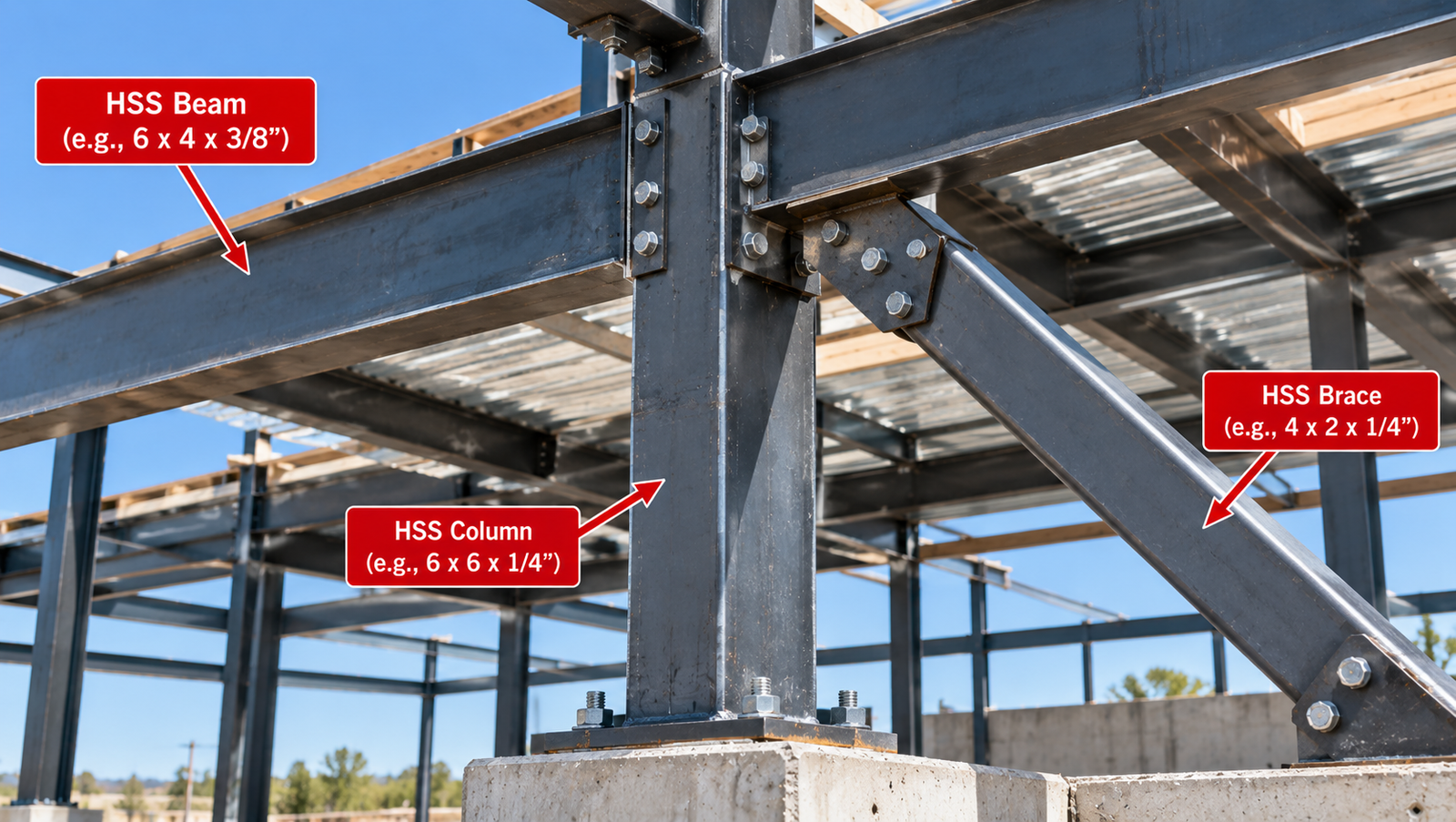
For bending members the relevant properties are Ix, Sx and the plastic modulus Zx, along with orientation. Do not choose a beam size from span alone; use the steel beam size chart for other shapes and the beam load calculator or beam deflection calculator for load and deflection checks.
Columns
For compression members the relevant properties are area, rx, ry, effective length and slenderness, with buckling governed by AISC 360. STI’s HSS selection tools perform compression checks to AISC 360 rather than relying on size alone.
Connections
An HSS is a closed section, so connections face access limits, wall-thickness limits, local yielding and effective weld length. STI publishes dedicated HSS connection resources; connection design is outside this chart. See also structural steel shapes for open-section alternatives.
How Much Weight Can Rectangular Steel Tube Hold?
There is no universal answer, and this page does not give one.
No Size-Only Load Rating Exists
There is no universal “4×2×1/4 tube holds X pounds.” Capacity depends on span or effective length, support conditions, load pattern, axis orientation, material specification, wall thickness, local slenderness, lateral stability, flexure, shear, compression, connection details and deflection criteria.
Yield strength (50 ksi for Grade C) is a material property, not a member load capacity. For structural use, have a licensed design professional check the member to AISC 360, or use a design tool that does. The beam load calculator is a starting aid only.
Common Rectangular Tube Sizing Mistakes
Quick checks before you order or specify.
Treating HSS dimensions as inside
They are outside dimensions.
Omitting wall thickness
Depth and width alone do not identify a section.
Calling 4×2 a full spec
Wall and specification are required.
Reversing depth and width
Depth is the larger dimension.
Confusing nominal and design wall
They differ by 7 percent for A500.
Using nominal wall for A500 properties
AISC uses 0.93 t(nom).
Applying 0.93 to A1085
A1085 uses nominal wall.
Mixing A500 and A1085 tables
Label each row’s specification.
Mixing structural and A513 tube
Do not assign A500 properties to A513.
Treating square and rectangular alike
Their properties differ.
Treating tube as sharp-corner
Real corners are rounded.
Ignoring corner radii
They change area and inertia.
Using B – 2t as exact inside
It is an approximation.
Using theoretical weight
Published weight is preferred.
Confusing lb/ft with total weight
Multiply by length.
Confusing area with section modulus
Different quantities.
Confusing I with S
S = I / c.
Confusing Ix and Iy
X-X belongs to the depth.
Rotating tube unaware
Strong and weak axes swap.
Assuming bigger is stronger
Wall, span and bracing matter.
Assuming thicker wall solves everything
Buckling and connections can still govern.
Using yield as capacity
Capacity needs a member check.
Publishing ‘holds X lb’ by size
No such universal value.
Assuming every size is stocked
Check availability.
Assuming every wall exists
Not every wall is made for every size.
Ignoring ASTM grade
Grade sets strength.
Ignoring corrosion and exposure
Coatings and exposure matter.
Ignoring connection capacity
Connections often govern.
Ignoring deflection
Serviceability can control.
Ignoring local slenderness
Thin walls can buckle locally.
Using an HSS table for pipe
Pipe uses NPS and schedule.
Using pipe schedule terms for HSS
Schedules do not apply.
Steel Rectangular Tube FAQs
Thirty common questions, answered with AISC, STI and ASTM information.
What sizes does rectangular steel tubing come in?
What does HSS4x2x1/4 mean?
Are rectangular tube dimensions inside or outside?
What is the wall thickness of rectangular steel tubing?
What is design wall thickness?
Why is A500 design wall 0.93 of nominal?
Does A1085 use 0.93 wall thickness?
What is ASTM A500?
What is ASTM A500 Grade C?
What is ASTM A1085?
Is rectangular tubing the same as HSS?
Is mechanical tubing the same as structural HSS?
What is the difference between rectangular and square HSS?
How much does 2×1 rectangular tube weigh?
How much does 3×2 rectangular tube weigh?
How much does 4×2 rectangular tube weigh?
How much does 6×4 rectangular tube weigh?
How do you calculate tube weight?
How do you calculate rectangular tube area?
How do you calculate inside dimensions?
How do you calculate moment of inertia?
What is section modulus?
What is radius of gyration?
Which way is rectangular tube stronger?
Does wall thickness increase strength?
How much weight can rectangular steel tubing hold?
Can rectangular HSS be used as a beam?
Can rectangular HSS be used as a column?
What is the corner radius of HSS?
Are all HSS sizes readily available?
Standards and References Used
| Reference | What It Covers | Used For |
|---|---|---|
| AISC Hollow Structural Sections | HSS definition, designation format, A500 and A1085 | Terminology and designation |
| STI ASTM A500 | Grade C strengths, 0.93 design wall, corner radius, availability | A500 data |
| STI ASTM A1085 | A1085 tolerances, CVN and availability | A1085 comparison |
| STI A500 dimensions and section properties | Published A500 dimensions and properties | HSS3x2x0.134 row and property checks |
| ASTM A500/A500M-23 | Cold-formed welded and seamless carbon steel structural tubing | A500 scope |
| ASTM A1085/A1085M-22 | Cold-formed welded carbon steel HSS | A1085 scope |
Section properties on this page follow the AISC/STI design-wall method. For final design, use the current AISC Steel Construction Manual or the STI brochure. Local codes, project specifications and the engineer of record govern structural use.
📥 Download Rectangular Tube Chart PDF
Use your browser’s print function to save this page as a PDF for jobsite binders, estimating folders and shop reference.