Nail Size Chart 2026 – Penny Sizes, Length & Diameter
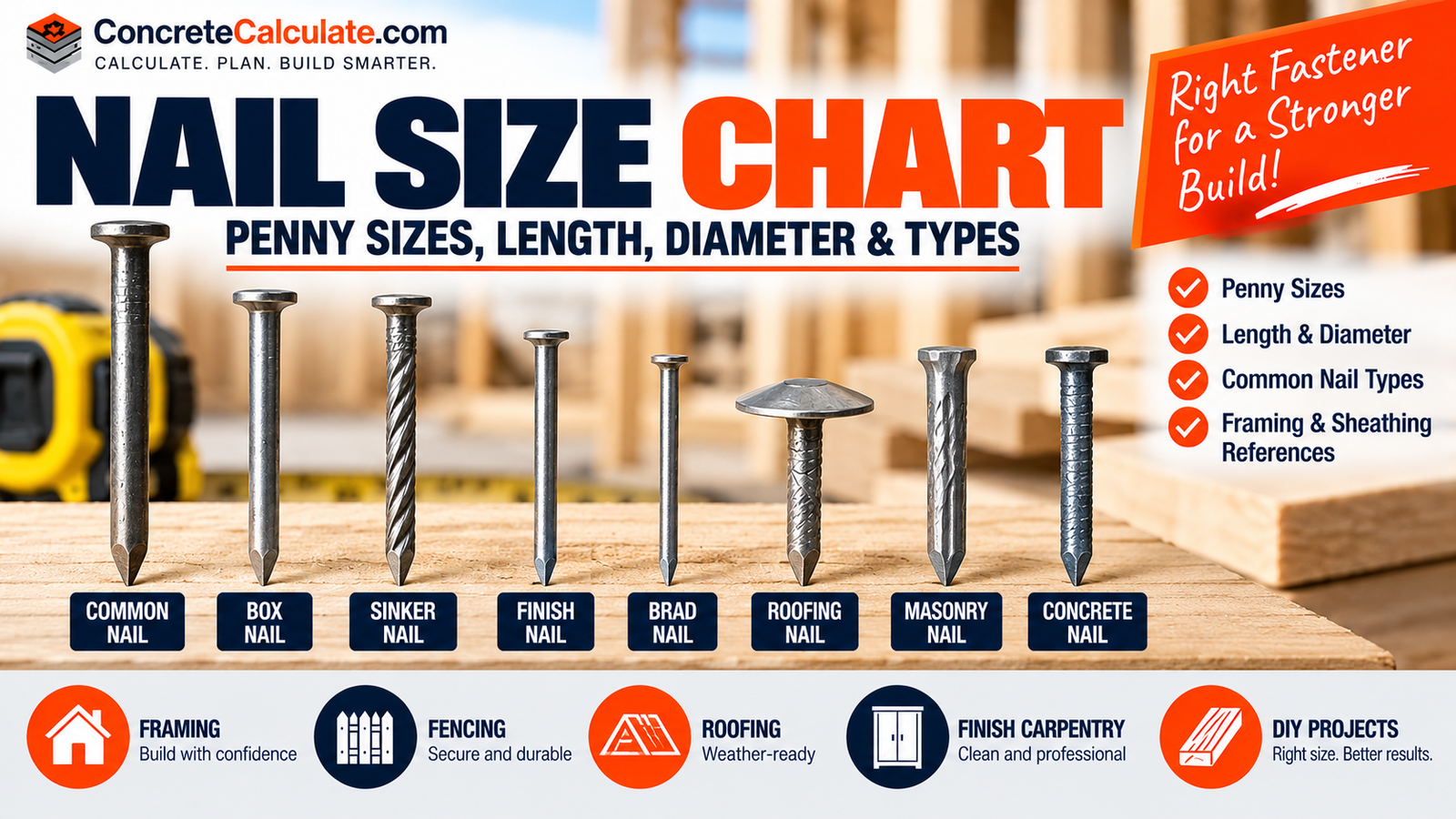
Nail Size Chart
Penny Sizes, Length & Diameter
Penny size, length, and actual shank diameter for common, box, sinker, finish, brad, roofing, and framing nails, with the exact dimensions used in the current IRC fastener schedule.
 Reviewed by Muhammad Ramzan Babar, PhD Researcher (Plasma Physics) & Calculator Developer, View Profile
Penny size does not completely define a nail
The current IRC fastener schedule shows this directly: an 8d common nail is 2-1/2 in by 0.131 in, while an 8d box nail is 2-1/2 in by 0.113 in. A 16d common nail is 3-1/2 in by 0.162 in, while a 16d box nail is 3-1/2 in by 0.135 in. For structural work, specify actual length and shank diameter, and identify the nail type, not just the penny size.
Nail Size Chart, Quick Reference
Penny size, length, and common nail diameter for the sizes used most often in U.S. construction.
Common Nail Penny Size Chart
| Penny Size | Length (in) | Length (mm) | Common Diameter (in) | Typical Context |
|---|---|---|---|---|
| 6d | 2 | 50.8 | 0.113 | Light framing, toe nailing |
| 7d | 2-1/4 | 57.1 | 0.113 | Face nailing, blocking |
| 8d | 2-1/2 | 63.5 | 0.131 | General framing, sheathing |
| 10d | 3 | 76.2 | 0.148 | Framing, structural connections |
| 12d | 3-1/4 | 82.5 | 0.148 | Framing, blocking |
| 16d | 3-1/2 | 88.9 | 0.162 | Structural framing, studs, plates |
| 20d | 4 | 101.6 | 0.192 | Built-up girders, heavy framing |
These length/diameter combinations directly match the current IRC fastener schedule for common nails. For larger traditional sizes: 30d is 4-1/2 in, 40d is 5 in, 50d is 5-1/2 in, and 60d is 6 in, but published shank-diameter values for these larger, non-code sizes can vary by manufacturer, so structural selection should use specified diameter plus length plus nail type, not penny size alone.
Common vs Box Nail Quick Comparison
| Penny Size | Length (in) | Common Diameter (in) | Box Diameter (in) |
|---|---|---|---|
| 6d | 2 | 0.113 | ~0.099 |
| 8d | 2-1/2 | 0.131 | 0.113 |
| 10d | 3 | 0.148 | 0.128 |
| 16d | 3-1/2 | 0.162 | 0.135 |
| 20d | 4 | 0.192 | 0.148 |
Critical Note
A “10d nail” does not uniquely define shank diameter. Specify common, box, sinker, ring-shank, or another nail type when strength or code compliance matters.
What Is Nail Size?
Nail size is not one number.
Nail size is defined by several independent dimensions: length, shank diameter, head diameter, shank type, point style, and material or coating. A structural connection can depend heavily on diameter and penetration, not just length, which is why a single “size” label is insufficient for code-critical work.
What Does the “d” Mean in Nail Sizes?
A brief history behind the penny system.
The “d” is traditionally called penny, a designation that originated in England when nails were sold by price per hundred. The modern practical meaning is more important: the penny designation is primarily a traditional length designation, and it does not reliably tell you the nail’s exact diameter across different nail types.
Nail Penny Size vs Length
One of the main search intents for this chart.
| Penny | Length (in) | Length (mm) |
|---|---|---|
| 2d | 1 | 25.4 |
| 3d | 1-1/4 | 31.8 |
| 4d | 1-1/2 | 38.1 |
| 5d | 1-3/4 | 44.4 |
| 6d | 2 | 50.8 |
| 7d | 2-1/4 | 57.1 |
| 8d | 2-1/2 | 63.5 |
| 10d | 3 | 76.2 |
| 12d | 3-1/4 | 82.5 |
| 16d | 3-1/2 | 88.9 |
| 20d | 4 | 101.6 |
| 30d | 4-1/2 | 114.3 |
| 40d | 5 | 127.0 |
| 50d | 5-1/2 | 139.7 |
| 60d | 6 | 152.4 |
From 2d to 16d, penny size increases by roughly one to two per 1/4 inch of added length. From 20d and larger, penny size increases by 10 per 1/2 inch of added length.
Nail Diameter vs Penny Size
Nail diameter is type-dependent, not fixed by penny size alone.
| Designation | Length | Diameter |
|---|---|---|
| 8d Common | 2-1/2 in | 0.131 in |
| 8d Box | 2-1/2 in | 0.113 in |
The same 8d label does not imply the same lateral, shear, or withdrawal properties. The 2024 IRC recognizes these as different fasteners in its framing schedule, often specifying different quantities depending on which one is used.
Nail Gauge vs Shank Diameter
Gauge is a supporting descriptor, not the primary structural sizing variable.
Gauge numbers are often used to describe nail wire diameter, but gauge-to-diameter conventions are not always presented consistently across nail product families. This chart prioritizes actual shank diameter in inches and millimeters, using gauge only as a supporting descriptor, since gauge alone can be ambiguous between manufacturers and nail types.
| Gauge | Approx. Diameter (in) | Typical Nail Context |
|---|---|---|
| 18 ga | ~0.0475 | Brad nails |
| 16 ga | ~0.0625 | Finish nails, staples |
| 15 ga | ~0.072 | Finish nails |
| 11 to 11.5 ga | ~0.12 to 0.113 | 6d common range |
| 8 ga | ~0.162 | 16d common range |
Common Nail Size Chart
A flagship chart, focused on the sizes that dominate structural framing references.
| Penny | Length (in) | Shank Diameter (in) | Typical Use |
|---|---|---|---|
| 6d | 2 | 0.113 | Toe nailing, light framing |
| 8d | 2-1/2 | 0.131 | General framing, sheathing |
| 10d | 3 | 0.148 | Framing, structural connections |
| 12d | 3-1/4 | 0.148 | Framing, blocking |
| 16d | 3-1/2 | 0.162 | Structural framing, studs, plates |
| 20d | 4 | 0.192 | Built-up girders, heavy framing |
Box Nail Size Chart
Box nails generally use thinner shanks than common nails of the same penny length.
| Penny | Length (in) | Box Diameter (in) | Comparison to Common |
|---|---|---|---|
| 6d | 2 | ~0.099 | Thinner |
| 8d | 2-1/2 | 0.113 | Thinner (common: 0.131) |
| 10d | 3 | 0.128 | Thinner (common: 0.148) |
| 16d | 3-1/2 | 0.135 | Thinner (common: 0.162) |
This dimension reduction can lower splitting risk when nailing near the end of a board, but it also changes connection capacity, so box nails are not automatic one-for-one substitutes for common nails in structural connections.
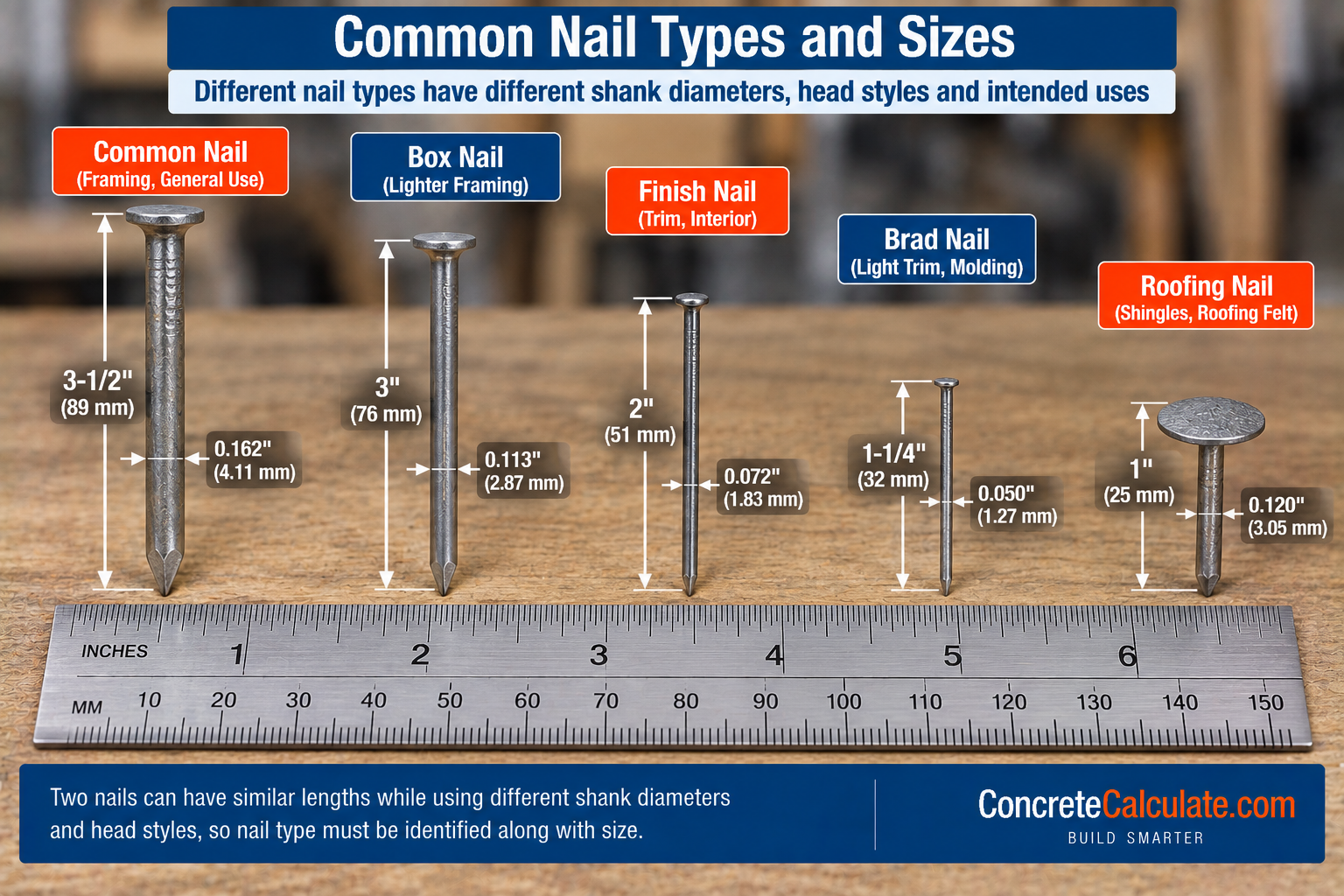
Common Nail vs Box Nail
Never substitute one for the other in a code-specified connection unless allowed.
| Feature | Common Nail | Box Nail |
|---|---|---|
| Same penny length available? | Often | Often |
| Shank | Thicker | Thinner |
| Splitting risk | Higher | Lower |
| Structural equivalence | Not automatic | Not automatic |
Important
The IRC frequently specifies different quantities of box and common nails for exactly this reason, since a thinner box nail must sometimes be used in greater numbers to achieve equivalent connection capacity.
Sinker Nail Size Chart
A common nail type used in pneumatic framing, with important dimensional caveats.
Sinker nails typically feature a thinner shank than common nails of the same penny designation, a coated shank for driving ease, and a smaller or textured head depending on the product. A “16d sinker” is not automatically dimensionally identical to a “16d common” nail. Use manufacturer product data for exact dimensions rather than assuming one universal sinker diameter table.
Framing Nail Size Chart
Prescriptive nail options for common framing connections per the current IRC.
| Framing Connection | Typical IRC Nail Options | Spacing / Nailing |
|---|---|---|
| Joist to sill, top plate, or girder | 4-8d box (2-1/2 x 0.113); or 3-8d common (2-1/2 x 0.131); or 3-10d box (3 x 0.128) | Toe nail |
| Stud to stud, not at braced wall panels | 16d common (3-1/2 x 0.162); or 10d box (3 x 0.128) | 24 in. o.c. face nail |
| Built-up header (2x with 1/2-in spacer) | 16d common (3-1/2 x 0.162); or 16d box (3-1/2 x 0.135) | 16 in. or 12 in. o.c. each edge |
| Top plate to top plate | 16d common (3-1/2 x 0.162); or 10d box (3 x 0.128) | 16 in. or 12 in. o.c. face nail |
| Bottom plate to joist, rim joist, or blocking | 16d common (3-1/2 x 0.162); or 16d box (3-1/2 x 0.135) | 16 in. or 12 in. o.c. face nail |
The 2024 IRC fastener schedule gives a detailed framing fastening table using exact nail length and diameter, not merely a generic “framing nail” description. See the Joist Span Chart and Lumber Span Chart for related framing sizing references.
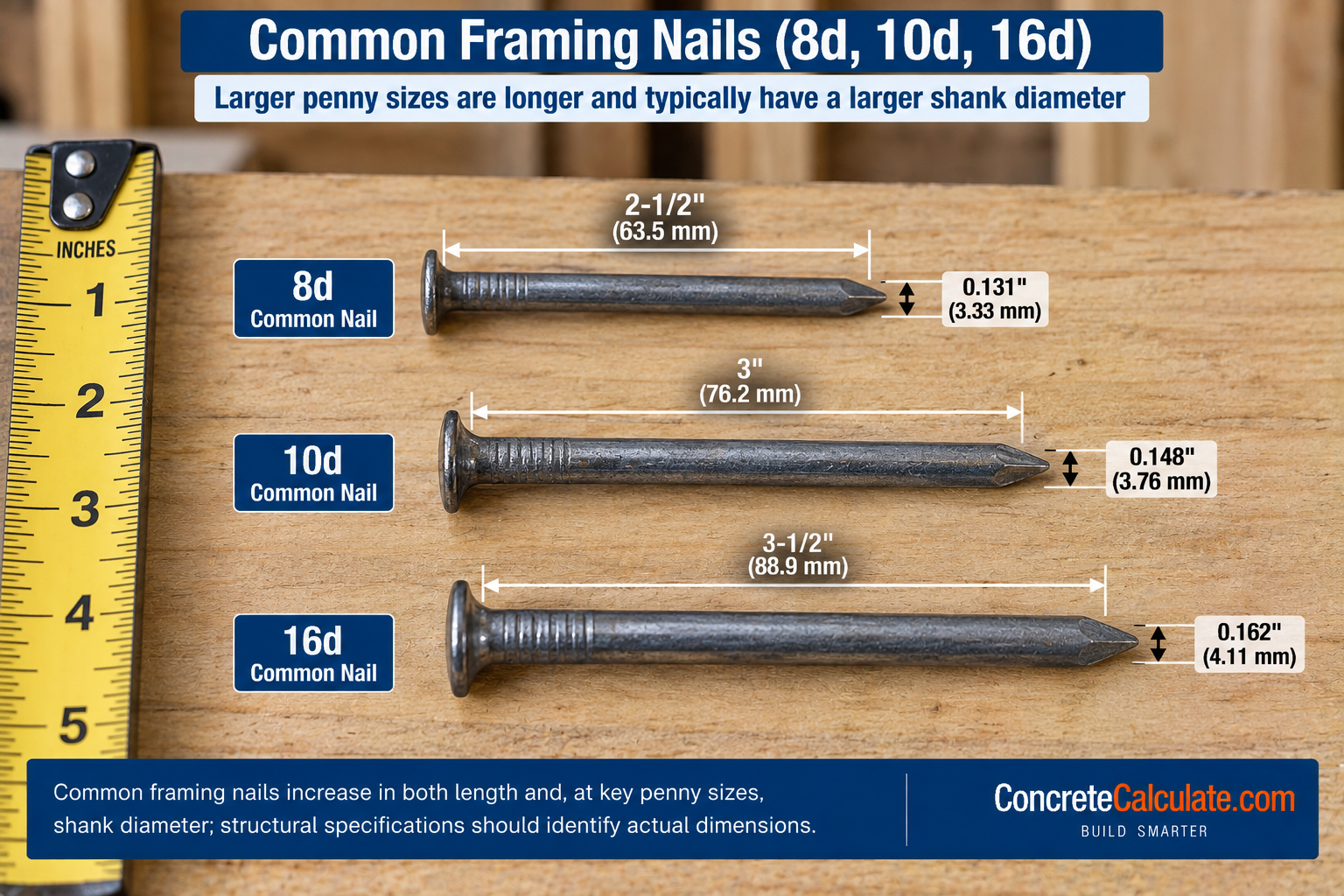
8d, 10d, 16d, and 20d Nail Dimensions and Uses
The most frequently referenced structural nail sizes.
| Designation | Length | Diameter | Common Applications |
|---|---|---|---|
| 8d Common | 2-1/2 in | 0.131 in | Framing, blocking, sheathing, rim joist connections |
| 8d Box | 2-1/2 in | 0.113 in | Sheathing, lighter framing |
| 10d Common | 3 in | 0.148 in | Framing, structural connections |
| 10d Box | 3 in | 0.128 in | Framing, blocking |
| 16d Common | 3-1/2 in | 0.162 in | Face-nailing framing, built-up members, heavier lumber |
| 16d Box | 3-1/2 in | 0.135 in | Framing, blocking, plate connections |
| 20d Common | 4 in | 0.192 in | Built-up girders and beams |
Large Penny Nails and Spikes
30d and larger sizes, used less commonly in modern residential construction.
| Penny | Length (in) |
|---|---|
| 30d | 4-1/2 |
| 40d | 5 |
| 50d | 5-1/2 |
| 60d | 6 |
For these larger traditional nails and spikes, verify the specific product’s actual diameter rather than relying on penny designation alone, since published shank-diameter values can vary between manufacturers for these non-code, less standardized sizes.
Sheathing Nail Size Chart
A very strong section, since sheathing nailing depends heavily on panel thickness and application.
| Panel Thickness | Nail | Edge Spacing (in) | Field Spacing (in) |
|---|---|---|---|
| 3/8 – 1/2 in (subfloor, wall) | 6d common (2 x 0.113) | 6 | 12 |
| 3/8 – 1/2 in (roof) | 8d common (2-1/2 x 0.131) or RSRS-01 ring-shank (2-3/8 x 0.113) | 6 | 12 |
| 19/32 – 1 in | 8d common (2-1/2 x 0.131) or RSRS-01 (roof) | 6 | 12 |
| 1-1/8 – 1-1/4 in | 10d common (3 x 0.148) or 8d deformed (2-1/2 x 0.131) | 6 | 12 |
Do not oversimplify into “all plywood uses 8d nails”; the correct nail depends on panel thickness and whether the application is subfloor, wall, or roof sheathing.
Roof Sheathing Nail Sizes
A focused subsection on roof-specific fastening requirements.
Roof sheathing fastener requirements depend on panel thickness and span rating, framing spacing, wind conditions, edge versus field location, and local code adoption. The 2024 IRC uses 8d common (2-1/2 x 0.131 in) nails in several roof sheathing conditions, or RSRS-01 ring-shank nails as an alternative, and requires closer nail spacing near ridges, eaves, and gable end walls where the ultimate design wind speed exceeds 130 mph.
Subfloor Nail Size Chart
Nailing requirements for combination subfloor underlayment panels.
| Subfloor Thickness | Nail Type | Edge (in) | Field (in) |
|---|---|---|---|
| 3/4 in and less | 6d deformed (2 x 0.120) or 8d common (2-1/2 x 0.131) | 6 | 12 |
| 7/8 – 1 in | 8d common (2-1/2 x 0.131) or 8d deformed (2-1/2 x 0.120) | 6 | 12 |
| 1-1/8 – 1-1/4 in | 10d common (3 x 0.148) or 8d deformed (2-1/2 x 0.120) | 6 | 12 |
Roofing Nail Size Chart
Do not mix asphalt roofing nails with ordinary framing nails.
Roofing nails are identified by length, shank diameter, head diameter, and shank type (smooth or ring shank), along with galvanized or stainless coatings for corrosion resistance. For certain sheathing and wall-covering applications, the 2024 IRC specifies galvanized roofing nails such as 1-1/2 in by 0.120 in with a 7/16-in head diameter, and 1-3/4 in by similar diameter for thicker cellulosic fiberboard sheathing.
Important
For actual roof coverings such as asphalt shingles, manufacturer installation instructions and the roofing-specific code section control fastener selection, not this general reference chart alone.
Wood Shingle and Shake Nail Sizes
A useful standards-backed example of why penny size and nail type must be specified together.
| Application | Nail |
|---|---|
| 16/18-in wood shingles | 3d box, 1-1/4 x 0.076 in |
| 24-in wood shingles | 4d box, 1-1/2 x 0.076 in |
| 18/24-in shakes (some applications) | 6d box, 2 x 0.099 in |
Finish Nail Size Chart
Finish nails are generally identified by gauge and length, not penny size.
| Finish Nail Gauge | Common Length Range | Typical Use |
|---|---|---|
| 15 gauge | 1 to 2-1/2 in | Baseboard, casing, heavier trim |
| 16 gauge | 3/4 to 2-1/2 in | Trim, door and window casing |
Brad and Pin Nail Size Chart
Light-duty fasteners for trim, molding, and cabinetry.
| Type | Gauge | Length Range | Typical Use |
|---|---|---|---|
| Brad | 18 gauge | 5/8 to 2 in | Light trim, molding, cabinetry |
| Pin | 23 gauge | 1/2 to 1-1/4 in | Glue-assisted trim, delicate finish work |
Important
Pin nails are not structural substitutes for framing nails; their thin gauge and near-headless design provide minimal holding power without glue assistance.
Framing vs Roofing vs Finish vs Brad Nails
A comparison to help identify which chart or nail family applies to a given task.
| Nail Family | Main Size System | Typical Diameter | Head | Primary Use |
|---|---|---|---|---|
| Common/framing | Penny + actual diameter | Larger | Full head | Framing |
| Roofing | Length/diameter/head | Stout | Wide | Roofing |
| Finish | Gauge + length | Smaller | Small | Trim |
| Brad | Gauge + length | Thin | Tiny | Light trim |
| Pin | Gauge + length | Very thin | Headless/nearly | Delicate finish |
Smooth, Ring-Shank, and Spiral Nail Sizes
Shank profile affects withdrawal resistance, independent of penny size.
Smooth shank is common in traditional framing, with dimensions that may match standard common or box nail patterns depending on the specific product. Ring-shank nails are important for sheathing, subfloor, siding, and roofing applications requiring higher withdrawal resistance. The 2024 IRC specifically references RSRS-01 roof sheathing ring-shank nails meeting ASTM F1667, and permits ring-shank fasteners in certain exterior wall-covering applications with specified minimum diameters. Twisted or spiral shank nails are used for specialty applications, with dimensions that are typically manufacturer-specific.
Nail Head Diameter and Head Types
What distinguishes this chart from a generic nail-length reference.
Head diameter affects pull-through resistance, sheathing attachment performance, roofing and siding holding behavior, and appearance. The IRC often specifies not only shank dimensions but head dimensions as well; for example, certain galvanized roofing nails used in wall sheathing applications are defined with a 7/16-in head diameter, while some structural sheathing conditions reference specific head sizes for adequate pull-through resistance.
Nail Length and Penetration
A selection principle without a single universal rule.
A nail must be long enough to pass through the attached material and achieve the required embedment into the supporting member. There is no single universal rule such as “2.5 times material thickness” for every assembly; penetration requirements vary by assembly, code section, and product. For example, 2024 IRC wood shake and shingle roofing requires fasteners to penetrate sheathing by at least 3/4 in, or pass fully through thinner sheathing.
Galvanized Nail Sizes and Coatings
Coating changes corrosion protection, not the penny designation.
Galvanizing and other coatings improve corrosion resistance without changing the underlying nail size designation. Common options include hot-dip galvanized, electrogalvanized (where applicable), and other mechanically coated products, with coating compatibility depending on the specific application. For exterior wall coverings, the 2024 IRC requires aluminum, galvanized, stainless, rust-preventative-coated, or other approved corrosion-resistant fasteners depending on the application, and requires nails and staples to comply with ASTM F1667.
Stainless Steel Nails
Important for coastal exposure, treated wood, and certain shake or shingle applications.
The 2024 IRC requires Type 316 stainless fasteners in some saltwater coastal shake and shingle applications and for certain treated wood products. Stainless nails should not be assumed to have automatically identical structural properties to carbon steel nails of the same geometry; strength characteristics can differ by alloy and manufacturing process.
Nails for Pressure-Treated Wood
An essential construction and safety consideration.
The IRC requires corrosion-resistant fasteners for preservative-treated wood, such as hot-dip galvanized, stainless, silicon bronze, or copper nails, subject to applicable conditions and exceptions. In permanent wood foundations, the 2024 IRC imposes more specific stainless or galvanized requirements depending on the below-grade or above-grade location.
Main Point
Correct nail size is not enough; the coating and material must also be compatible with the specific lumber treatment chemical and exposure condition.
ASTM F1667/F1667M Nail Standard
The main standards section for driven fasteners.
ASTM F1667/F1667M is the current active driven-fastener standard, covering nails, cut nails, spikes, staples, and other driven fasteners, along with material requirements, physical properties, coatings, finishes, and dimensional requirements. ASTM F1667 defines driven-fastener products; it does not tell you which specific nail connection to use in every building assembly. That selection comes from the applicable building code or engineered design specification.
✓ Verified Against ASTM F1667/F1667M-21a2024 IRC Nail Fastening Schedule
The main code and application section for this chart.
IRC Table R602.3(1) specifies nail type, quantity, length, diameter, and spacing by connection location, covering framing, roof, floor, sheathing, blocking, rim joists, built-up members, and more. For code-prescriptive framing, use the exact fastener dimensions and quantities given in the adopted code, not a generic “8d” or “16d” description alone, since local jurisdictions may adopt different code editions or amendments.
✓ Verified Against 2024 IRC Table R602.3(1)Hand-Driven vs Pneumatic Framing Nails
Very useful for modern builders using nail guns.
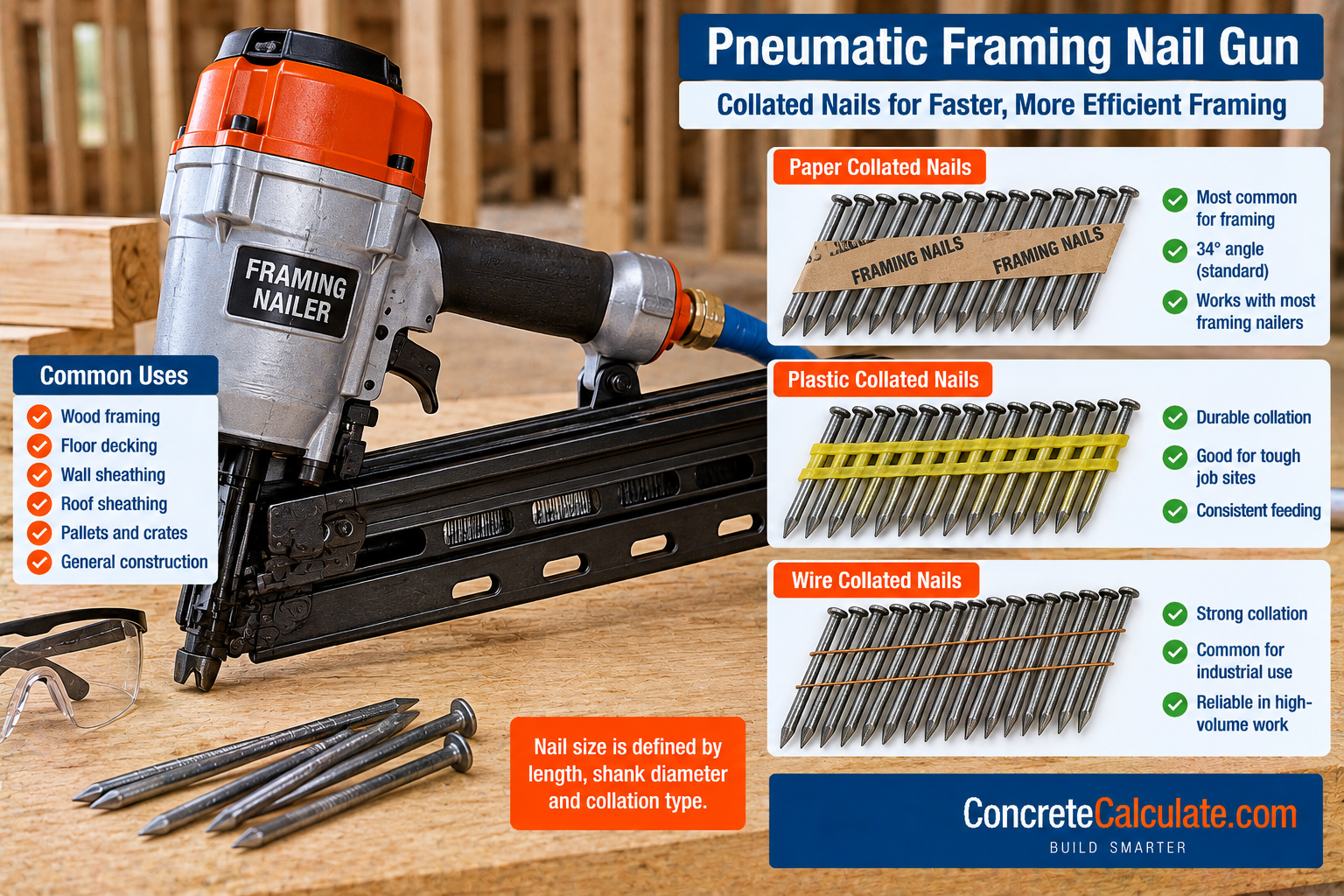
Pneumatic framing nails are often sold by length, shank diameter, collation angle, head style, and shank type, rather than by penny size alone. A gun nail labeled 3-1/4 in is not automatically equivalent to a code-specified 16d common nail at 3-1/2 x 0.162 in. Likewise, a 3-in by 0.131-in gun nail can be a recognized option in some IRC connections, but not necessarily every connection where a 10d or 16d nail appears; the 2024 IRC explicitly lists specific 3-in by 0.131-in nails as alternatives in selected assemblies, not as a universal substitute.
Nail Gun Angle and Collation
A tool-compatibility factor separate from structural nail size.
Common collation systems include paper tape, plastic strip, and wire-weld, with common magazine angles varying by tool and manufacturer. Collation angle affects nail-gun compatibility, not the structural nail size by itself. ASTM F1667 includes collated driven fasteners within its scope but does not make collation material or orientation a general dimensional equivalence guarantee for every tool.
How to Choose the Right Nail Size
The page’s main decision framework.
Nail Selection Workflow
How to Read a Nail Package or Specification
What to look for on labeling or a cut sheet.
Most loose nail packaging displays both penny size and actual length in inches. Collated nails for pneumatic tools often display length and shank diameter directly, sometimes without a penny size at all. Look for nail type (common, box, sinker, ring-shank), material and coating, and any applicable standard reference such as ASTM F1667 or a specific IRC-recognized designation such as RSRS-01.
Common Nail Size Mistakes
Assuming penny size uniquely defines diameter
Shank diameter depends on nail type, not penny size alone.
Assuming all 8d nails are identical
8d common and 8d box nails differ substantially in shank diameter.
Assuming all 16d nails are identical
16d common (0.162 in) and 16d box (0.135 in) are not the same fastener.
Treating box nails as one-for-one substitutes for common nails
The IRC often specifies different quantities for each because of the diameter difference.
Treating sinkers as identical to common nails
Sinkers typically have thinner shanks than common nails of the same penny size.
Using length only for structural selection
Shank diameter and nail type matter as much as length for connection capacity.
Ignoring actual shank diameter
This is the dimension most often overlooked in casual nail selection.
Ignoring head diameter
Head size affects pull-through resistance in sheathing and roofing applications.
Confusing gauge with penny size
These are two different sizing systems used for different nail families.
Assuming higher penny number always means proportionally thicker nail
Diameter increases are not perfectly proportional to penny number across all types.
Using finish nails for structural framing
Finish nails lack the diameter and head size needed for structural connections.
Using brads where full-head nails are required
Brads are light-duty fasteners, not structural substitutes.
Assuming a framing-gun nail is automatically “16d”
Gun nails are identified by actual dimensions, not always by penny size.
Ignoring collation and tool compatibility
Nail gun and collation system compatibility is separate from structural sizing.
Using non-corrosion-resistant nails outdoors
Uncoated steel nails can corrode quickly in exterior applications.
Using incompatible fasteners with pressure-treated lumber
Treatment chemicals can accelerate corrosion of incompatible fastener materials.
Ignoring coastal stainless requirements
Some coastal shake and shingle applications require Type 316 stainless fasteners.
Overdriving sheathing or roofing nails
Overdriving can reduce pull-through resistance and structural performance.
Ignoring required penetration
A nail that is too short will not achieve adequate embedment in the supporting member.
Ignoring nail spacing
Spacing requirements are as important as nail size for sheathing and framing performance.
Ignoring local code amendments
Adopted code editions and local amendments can differ from the base IRC schedule.
Relying on old generic nail charts instead of current specified dimensions
Always confirm against the current adopted code or product specification.
Nail Size Chart Limitations
Read Before Using for Structural or Code-Compliance Decisions
Penny size is a traditional designation. Nail diameter varies by nail type. Common, box, sinker, roofing, finish, brad, and pin nails are not dimensionally interchangeable. Structural connections depend on actual length and diameter, not penny size alone. Nail head dimensions can matter for pull-through resistance. Quantity and spacing can be as important as size. Coating and material selection depends on exposure and treated wood chemistry. Manufacturer product dimensions can differ from generic reference values, particularly for sinkers and larger traditional sizes. Pneumatic nail compatibility depends on tool and collation system. Code fastening schedules vary with assembly type and jurisdiction. This page is a reference, not a substitute for engineered connection design or the specific adopted building code requirements for your project.
Frequently Asked Questions
Download Nail Size Chart PDF
Save or print this reference including the penny size tables, common vs box nail comparisons, IRC framing and sheathing nail schedules, and the nail selection workflow.