Pipe Size Chart 2026 – NPS, Schedule & Material Guide
Pipe Size Chart
NPS, Schedule & Material Guide
Complete pipe reference for contractors and engineers — NPS/DN sizing, Schedule 40 vs 80, OD/ID explained, and material selection guidance.
 Reviewed by Muhammad Ramzan Babar, PhD Researcher (Plasma Physics) & Calculator Developer — View Profile
What This Page Helps You Decide
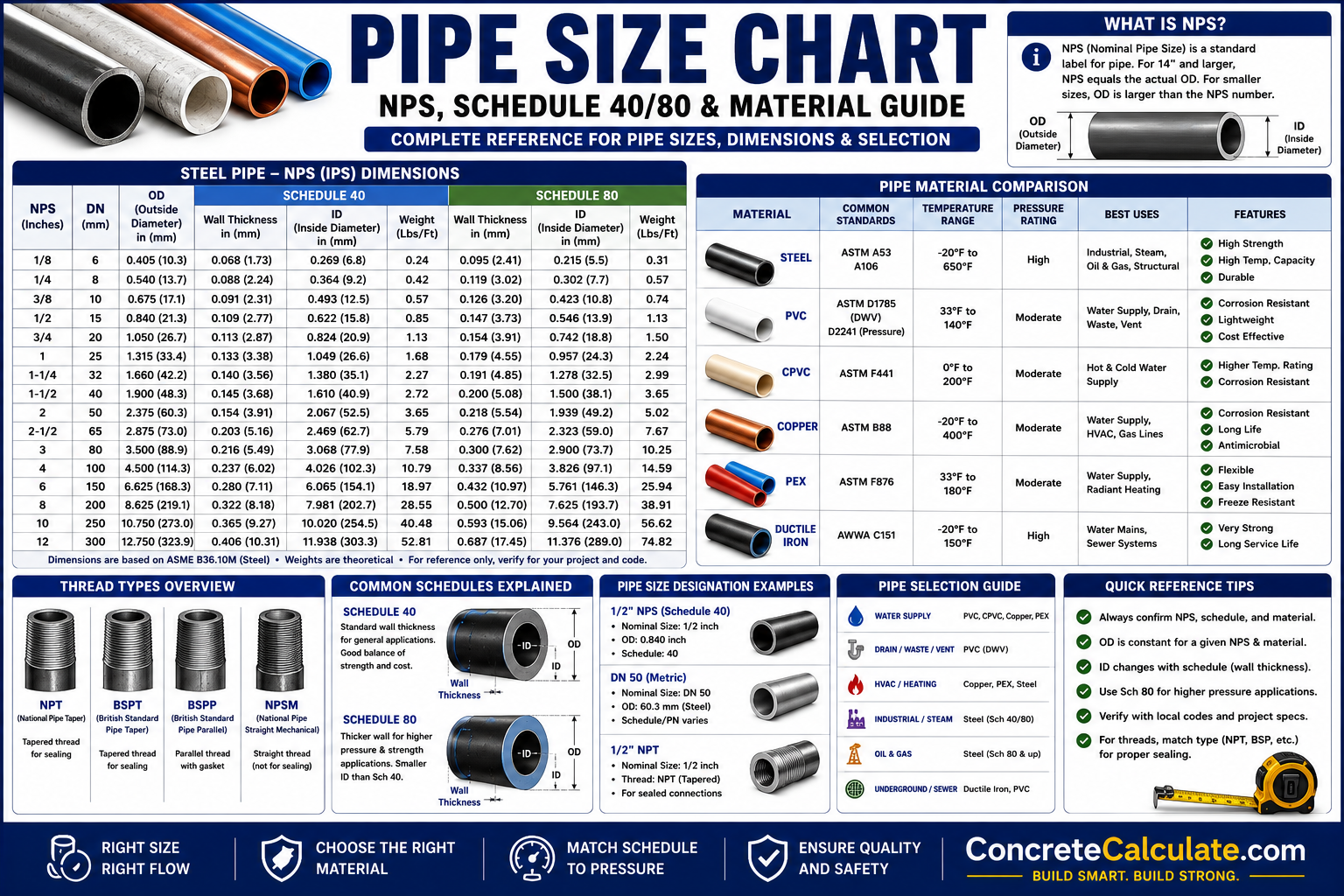
Rather than reproducing every ASME/ASTM dimension table, this page focuses on understanding: why “1-inch pipe” doesn’t measure 1 inch, when to use Schedule 40 vs 80, which material fits your project, and how to convert between NPS and DN. Use the Table of Contents to jump straight to what you need.
⭐ Master Pipe Size Chart
Complete overview of pipe sizing systems, materials, and how nominal size relates to actual dimensions.
How to Read This Chart
Pipe size is defined by three independent factors: nominal size (NPS/DN label), outside diameter (fixed per size), and schedule/wall thickness (which changes the inside diameter). Get any one confused with another and you’ll order the wrong pipe. For structural pipe columns, verify capacity with our Load Bearing Calculator.
| Material Category | Common NPS Range | Sizing System | Typical Applications |
|---|---|---|---|
| Carbon/Stainless Steel | 1/8″–24″+ | NPS with Schedule (10/40/80/160) | Structural, process piping, gas, water |
| PVC/CPVC | 1/2″–12″ | NPS with Schedule 40/80, or SDR | Plumbing, drainage, irrigation |
| Copper | 1/4″–8″ | Nominal size (Type K/L/M) | Water supply, refrigeration |
| PEX | 3/8″–2″ | Nominal/CTS sizing | Residential water supply, radiant heat |
| HDPE | 1/2″–63″+ | DIPS or IPS, by SDR | Municipal water, gas distribution, irrigation |
| Ductile Iron | 3″–64″+ | Nominal diameter, pressure class | Municipal water mains, sewer force mains |
⭐ Standard Pipe Size Chart (NPS)
Common nominal pipe sizes with fixed outside diameter (per ASME B36.10M) and typical use.
| NPS | Outside Diameter (OD) | Common Applications |
|---|---|---|
| 1/8″ | 0.405″ | Instrument lines, small fittings |
| 1/4″ | 0.540″ | Small gauge and pneumatic lines |
| 3/8″ | 0.675″ | Small plumbing and pneumatic fittings |
| 1/2″ | 0.840″ | Residential branch water lines, gas lines |
| 3/4″ | 1.050″ | Residential main water lines |
| 1″ | 1.315″ | Water mains, compressed air, irrigation |
| 1¼” | 1.660″ | Larger residential/light commercial supply |
| 1½” | 1.900″ | Commercial plumbing, drainage |
| 2″ | 2.375″ | Commercial water/drain lines, irrigation mains |
| 2½” | 2.875″ | Fire protection, larger commercial systems |
| 3″ | 3.500″ | Fire sprinkler mains, larger drainage |
| 4″ | 4.500″ | Sewer lines, structural columns, fire mains |
| 5″ | 5.563″ | Larger sewer and process piping |
| 6″ | 6.625″ | Municipal water mains, structural columns |
| 8″ | 8.625″ | Municipal water/sewer mains |
| 10″ | 10.750″ | Municipal infrastructure, large industrial |
| 12″ | 12.750″ | Municipal infrastructure, large industrial |
| 16″ | 16.000″ | Large municipal and industrial mains |
| 20″ | 20.000″ | Large-diameter transmission piping |
| 24″ | 24.000″ | Major transmission mains |
Notice the Pattern
For NPS 14″ and larger, the outside diameter equals the nominal size exactly. Below 14″, the OD is always larger than the nominal number — a “12-inch” pipe is actually 12.75″ OD, not 12″.
⭐ Pipe Dimensions Chart
Understanding the three core measurements that define any pipe cross-section.
| Dimension | What It Means |
|---|---|
| Outside Diameter (OD) | The measurement across the pipe’s exterior surface; fixed for a given NPS regardless of schedule |
| Inside Diameter (ID) | The open interior bore through which fluid or gas flows; shrinks as wall thickness increases |
| Wall Thickness | The material thickness between OD and ID, determined by the schedule number |
| Cross-Section | The full circular profile showing OD, ID, and wall thickness together — the basis for pressure and flow calculations |
⭐ Pipe Size by Material
Common sizes and applications across the primary piping material categories.
| Material | Common Sizes | Typical Applications |
|---|---|---|
| Carbon Steel | 1/2″–24″+ | Structural, process piping, gas transmission |
| Stainless Steel | 1/2″–12″ | Food/beverage, chemical, corrosive-resistant service |
| PVC | 1/2″–12″ | Drainage, irrigation, cold water supply |
| CPVC | 1/2″–2″ | Hot and cold water supply |
| Copper | 1/4″–4″ | Water supply, refrigeration lines |
| PEX | 3/8″–2″ | Residential water supply, radiant heating |
| HDPE | 1/2″–63″+ | Municipal water, gas distribution, irrigation |
| Ductile Iron | 3″–64″+ | Municipal water mains, sewer force mains |
| Cast Iron | 2″–15″ | Legacy drainage and sewer systems |
| Galvanized Steel | 1/2″–6″ | Legacy water supply, some outdoor structural use |
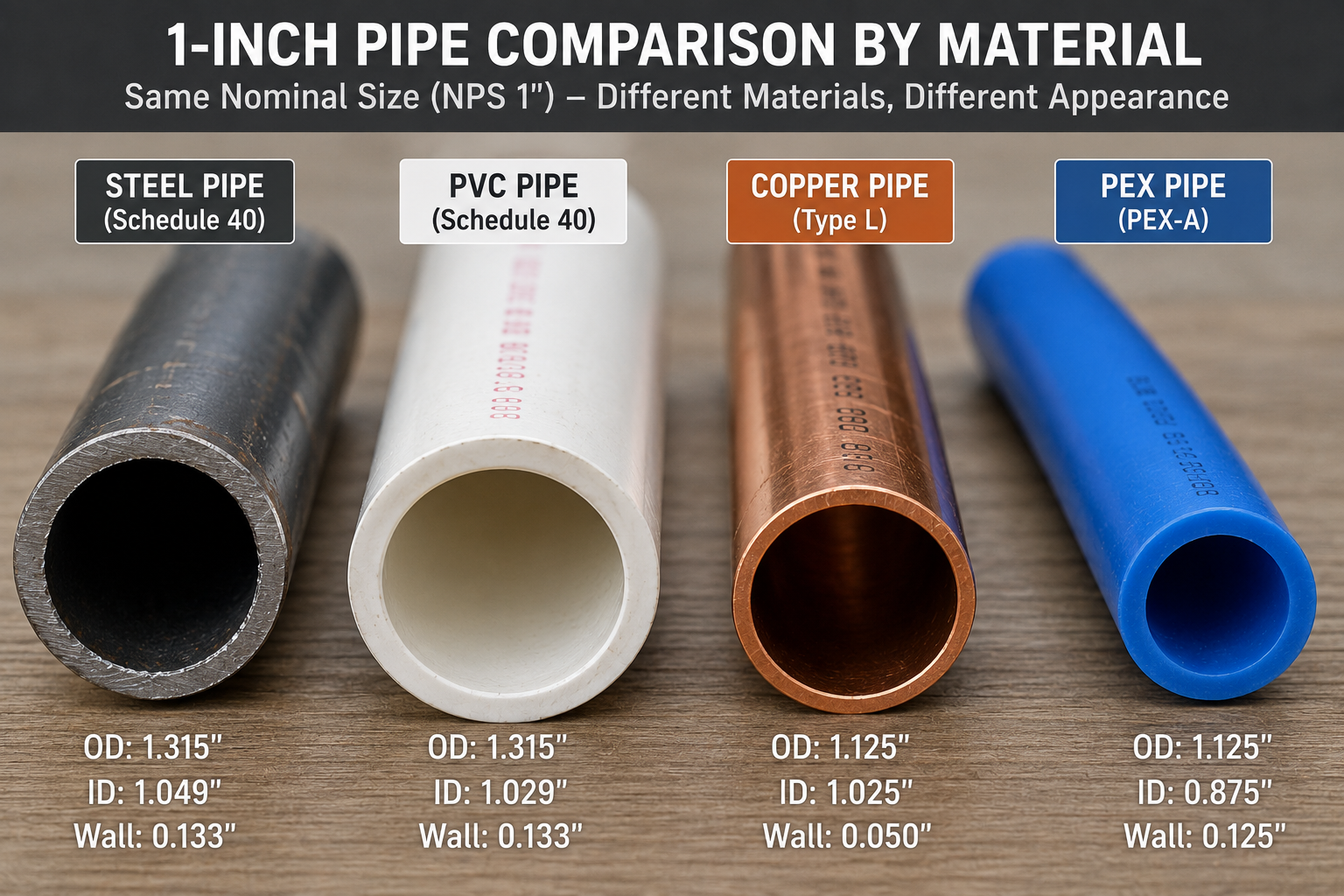
⭐ Schedule 40 Pipe Size Chart
The most common general-purpose wall thickness standard, used across steel and PVC pipe.
| NPS | OD | Wall Thickness | ID |
|---|---|---|---|
| 1/2″ | 0.840″ | 0.109″ | 0.622″ |
| 3/4″ | 1.050″ | 0.113″ | 0.824″ |
| 1″ | 1.315″ | 0.133″ | 1.049″ |
| 1½” | 1.900″ | 0.145″ | 1.610″ |
| 2″ | 2.375″ | 0.154″ | 2.067″ |
| 3″ | 3.500″ | 0.216″ | 3.068″ |
| 4″ | 4.500″ | 0.237″ | 4.026″ |
| 6″ | 6.625″ | 0.280″ | 6.065″ |
Schedule 40 is the default choice for most residential and light commercial plumbing, drainage, and general-purpose piping where extreme pressure isn’t a factor.
⭐ Schedule 80 Pipe Size Chart
A thicker-wall standard for higher pressure and more demanding industrial service.
| NPS | Wall Thickness | Relative Pressure Capability | Relative Weight |
|---|---|---|---|
| 1/2″ | 0.147″ | Higher than Sch 40 | ~28% heavier than Sch 40 |
| 1″ | 0.179″ | Higher than Sch 40 | ~29% heavier than Sch 40 |
| 2″ | 0.218″ | Higher than Sch 40 | ~31% heavier than Sch 40 |
| 4″ | 0.337″ | Higher than Sch 40 | ~38% heavier than Sch 40 |
Schedule 80 is common in industrial process piping, compressed air/gas systems, and chemical service where higher pressure or added wall margin against corrosion is needed.
⭐ Schedule 40 vs Schedule 80 Pipe Comparison
One of the highest-value comparisons for anyone specifying pipe — the practical trade-offs side by side.
| Factor | Schedule 40 | Schedule 80 |
|---|---|---|
| Wall Thickness | Thinner | Thicker (same OD) |
| Internal Diameter | Larger (more flow area) | Smaller (reduced flow area) |
| Weight | Lighter | Heavier (25–40% more, size-dependent) |
| Pressure Rating | Moderate | Higher |
| Cost | Lower | Higher |
| Typical Uses | Residential/commercial plumbing, drainage, general service | Industrial process lines, compressed gas, high-pressure or corrosive service |
The Key Insight
Both schedules share the exact same outside diameter at a given NPS — the only difference is where the wall thickness “eats into” the ID. This is why Schedule 80 fittings and Schedule 40 fittings of the same NPS use identical outer connections but different bore sizes.
⭐ Pipe Size by Construction Application
Matching common construction and plumbing projects to typical pipe material and size.
| Project | Recommended Pipe Material | Typical Size |
|---|---|---|
| Residential Water Supply | Copper, PEX, or CPVC | 1/2″–1″ |
| Sewer Lines | PVC or cast/ductile iron | 3″–6″ |
| Drainage | PVC | 1½”–4″ |
| Irrigation | PVC or HDPE | 3/4″–2″ |
| Fire Sprinklers | Steel (Schedule 40) or CPVC | 1″–4″ |
| HVAC | Copper or steel | 3/4″–4″ |
| Natural Gas | Steel or approved PE gas pipe | 1/2″–2″ |
| Compressed Air | Steel (Schedule 80) or aluminum | 1/2″–2″ |
| Industrial Process Piping | Steel or stainless (per chemical compatibility) | Varies widely |
Always confirm exact material and sizing requirements against local plumbing, gas, and fire codes — these are general planning references, not code substitutes.
Steel Pipe Size Chart
Steel pipe serves both fluid-carrying and structural roles.
| Use Category | Typical Sizes | Notes |
|---|---|---|
| Process/Fluid Piping | 1/2″–24″+ | Sized by NPS and schedule per service pressure |
| Structural Pipe Columns | 4″–12″ | Selected for load capacity, not flow — see our Steel I-Beam Chart for beam alternatives |
| Fire Protection Mains | 1″–8″ | Typically Schedule 40, sized per sprinkler system design |
PVC Pipe Size Chart
Common PVC pipe sizes across plumbing, drainage, and irrigation — with a key caveat about conduit.
| Use | Typical Sizes | Notes |
|---|---|---|
| Plumbing (Schedule 40/80) | 1/2″–4″ | Shares OD with steel pipe of same NPS |
| Drainage (DWV) | 1½”–4″ | Thinner wall than pressure-rated Schedule 40 |
| Irrigation | 1/2″–3″ | Often SDR-rated rather than Schedule-rated |
| Electrical Conduit | 1/2″–4″ | Different sizing standard — conduit trade size does not always match plumbing pipe OD |
Conduit Sizing Is Different
PVC electrical conduit trade sizes follow NEC/UL sizing conventions, not the same OD standard as pressure-rated plumbing pipe — never assume a conduit fitting will match a plumbing pipe of the same “size” label.
Copper Pipe Size Chart
Copper tube sizing (CTS) uses nominal sizes that differ from the actual outside diameter.
| Nominal Size | Actual OD | Type K (thickest) | Type L (standard) | Type M (thinnest) |
|---|---|---|---|---|
| 3/8″ | 0.500″ | 0.049″ wall | 0.035″ wall | 0.025″ wall |
| 1/2″ | 0.625″ | 0.049″ wall | 0.040″ wall | 0.028″ wall |
| 3/4″ | 0.875″ | 0.065″ wall | 0.045″ wall | 0.032″ wall |
| 1″ | 1.125″ | 0.065″ wall | 0.050″ wall | 0.035″ wall |
Type K has the thickest wall (underground/high-pressure use), Type L is the standard for most residential and commercial plumbing, and Type M has the thinnest wall (limited to low-pressure interior use, restricted in some jurisdictions).
PEX Pipe Size Chart
Cross-linked polyethylene tubing, sized on the same nominal system as copper (CTS).
| PEX Type | Manufacturing Process | Common Sizes | Typical Use |
|---|---|---|---|
| PEX-A | Peroxide (Engel) method, most flexible | 3/8″–2″ | Residential supply, radiant heat, tight bends |
| PEX-B | Silane method, most common/economical | 3/8″–2″ | General residential and commercial supply |
| PEX-C | Electron beam method | 3/8″–1″ | Similar residential applications, less common |
HDPE Pipe Size Chart
High-density polyethylene pipe used for municipal, gas, and industrial systems requiring flexibility and corrosion resistance.
| Application | Typical Size Range | Key Advantage |
|---|---|---|
| Municipal Water | 4″–48″+ | Corrosion-proof, flexible for ground movement |
| Gas Distribution | 1/2″–12″ | Approved for underground gas service in most jurisdictions |
| Irrigation | 1/2″–8″ | Lightweight, easy to fuse and bury |
| Industrial Systems | 2″–63″+ | Chemical resistance and long service life |
Ductile Iron Pipe Size Chart
The standard for large-diameter municipal water and sewer infrastructure.
| Common Diameters | Municipal Applications | Pressure Classes |
|---|---|---|
| 3″–12″ | Distribution water mains | Class 150–350 (varies by manufacturer standard) |
| 14″–36″ | Transmission mains, large distribution | Class 150–300 |
| 42″+ | Major transmission infrastructure | Per project-specific engineering design |
Pipe Size by Pressure Rating
How material, schedule, diameter, and temperature interact to determine allowable pressure.
| Pressure Category | General Character | Key Factors |
|---|---|---|
| Low Pressure | Gravity drainage, low-pressure irrigation | Wall thickness matters less; material and joint type matter more |
| Medium Pressure | Residential water supply, standard HVAC | Schedule 40 or Type L copper typically sufficient |
| High Pressure | Industrial process, compressed gas, fire mains | Schedule 80+ or Type K, plus temperature derating checks |
Higher temperature service generally derates a pipe’s allowable pressure for a given material and schedule — always check the manufacturer’s pressure-temperature rating table for the exact service condition.
⭐ Pipe Wall Thickness Chart
How schedule number changes wall thickness while OD stays constant.
| Schedule | Relative Wall Thickness | Typical Applications |
|---|---|---|
| Schedule 10 | Thin | Low-pressure service, stainless sanitary lines |
| Schedule 40 (Standard) | Medium | General-purpose plumbing and process piping |
| Schedule 80 (Extra Strong) | Thick | Higher pressure, industrial, corrosive service |
| Schedule 160 | Very thick | High-pressure industrial applications |
As schedule number increases, wall thickness increases while OD stays fixed for that NPS — this means the ID shrinks and the pipe gets heavier, but fittings and threading at the same NPS remain compatible across schedules.
⭐ Pipe Weight Chart
One of the most searched pipe-related topics — approximate weight per foot and per meter by material.
| Pipe (2″ NPS, Sch 40 equivalent) | Weight per Foot | Weight per Meter |
|---|---|---|
| Steel | ~3.65 lb/ft | ~5.44 kg/m |
| Stainless Steel | ~3.65 lb/ft | ~5.44 kg/m |
| PVC (Schedule 40) | ~0.72 lb/ft | ~1.07 kg/m |
| Copper (Type L) | ~1.36 lb/ft | ~2.03 kg/m |
Weight comparisons at the same nominal size highlight why steel piping systems need more robust hanger and support spacing than PVC or copper of the same diameter.
Pipe Size by Flow Application
General guidance by use case rather than detailed hydraulic design.
| Application | General Guidance |
|---|---|
| Residential Water Supply | 3/4″–1″ main, 1/2″ branch lines are typical starting points |
| Drainage | Sized by fixture unit count per local plumbing code, not by supply logic |
| Stormwater | Sized by roof/site area and local rainfall intensity per code |
| Irrigation | Sized by zone flow rate (GPM) and acceptable pressure loss |
| Compressed Air | Sized by total CFM demand and acceptable pressure drop over distance |
| Fire Protection | Sized by hydraulic calculation per NFPA 13 or local fire code — never estimate |
⭐ NPS vs DN Pipe Size Chart
An excellent keyword opportunity — the two dominant pipe sizing systems side by side.
| NPS (inches) | DN (mm) | Actual OD |
|---|---|---|
| 1/2″ | DN15 | 21.3 mm (0.840″) |
| 3/4″ | DN20 | 26.7 mm (1.050″) |
| 1″ | DN25 | 33.4 mm (1.315″) |
| 1½” | DN40 | 48.3 mm (1.900″) |
| 2″ | DN50 | 60.3 mm (2.375″) |
| 4″ | DN100 | 114.3 mm (4.500″) |
| 6″ | DN150 | 168.3 mm (6.625″) |
| 8″ | DN200 | 219.1 mm (8.625″) |
Not a Direct Conversion
DN is not simply NPS multiplied by 25 for every size — that rule works reasonably well above NPS 4″, but smaller sizes (like DN15 for 1/2″) don’t follow it exactly. Always reference a proper NPS/DN table rather than a quick formula for critical work.
Pipe OD vs ID Comparison
Resolving one of the biggest points of confusion in pipe sizing.
Why Pipe Size Is “Nominal”
Historic iron pipe sizing referred loosely to the internal bore, but as manufacturing standardized, the outside diameter became the fixed reference point for a given NPS — the nominal number is now essentially a label, not a direct measurement of either OD or ID. OD stays constant across all schedules at a given NPS; ID is what actually changes as wall thickness (schedule) increases, since material is added or removed from the inside of a fixed-OD tube.
⭐ Pipe Material Comparison
Comparing the major piping materials across the factors that actually drive selection.
| Material | Strength | Corrosion Resistance | Temperature Limit | Typical Applications | Relative Cost |
|---|---|---|---|---|---|
| Steel | High | Low (needs coating) | High | Structural, process, gas | Moderate |
| Stainless Steel | High | Excellent | High | Food, chemical, corrosive service | High |
| PVC | Moderate | Excellent | Low-moderate (~140°F max) | Drainage, irrigation, cold water | Low |
| CPVC | Moderate | Excellent | Moderate-high (~200°F) | Hot and cold water supply | Low-moderate |
| Copper | Moderate-high | Very good | High | Water supply, refrigeration | Moderate-high |
| PEX | Moderate | Excellent | Moderate-high (~200°F) | Residential water supply | Low-moderate |
| HDPE | Moderate | Excellent | Moderate | Municipal, gas, irrigation | Moderate |
⭐ Pipe Selection Guide
Quick decision reference matching project type to recommended pipe with reasoning.
| Project | Recommended Pipe | Why |
|---|---|---|
| House Plumbing | PEX or copper, 1/2″–3/4″ | Reliable, code-accepted, widely serviceable |
| Irrigation | PVC or HDPE, 3/4″–2″ | Corrosion-proof and cost-effective for buried lines |
| Sewer Line | PVC, 3″–4″ | Corrosion resistant, smooth bore, code standard |
| Fire Sprinkler | Steel Schedule 40, sized per NFPA 13 | Required listing and hydraulic design for life safety |
| Natural Gas | Steel or approved PE gas pipe | Code-mandated material for gas service |
| Industrial Plant | Steel or stainless, per chemical compatibility | Handles higher pressure/temperature and process chemicals |
| Structural Columns | Steel pipe or tube, sized structurally not by flow | Selected for load capacity — see our Steel I-Beam Chart |
| Drainage System | PVC, sized per fixture unit count | Standard, code-accepted material for gravity drainage |
⭐ Visual Pipe Size Guide
Original engineering diagrams explaining pipe cross-sections, schedule comparison, and measurement technique.
Pipe Joint Types
Common methods for connecting pipe sections, each suited to different materials and applications.
| Joint Type | Common Materials | Notes |
|---|---|---|
| Threaded | Steel, brass, some PVC | Uses NPT or BSP threads — see our Thread Size Chart |
| Welded | Steel, stainless steel | Permanent, high-strength, common in process piping |
| Flanged | Steel, ductile iron | Bolted flange connection, easy to disassemble for maintenance |
| Grooved | Steel, ductile iron | Mechanical coupling over grooved pipe ends, fast installation |
| Solvent Weld | PVC, CPVC | Chemical bond forms a permanent, leak-tight joint |
| Compression | Copper, PEX | Mechanical fitting compresses onto the pipe, no heat required |
| Push-Fit | PEX, copper, CPVC | Tool-free connection using an internal O-ring seal |
Common Pipe Selection Mistakes
Avoiding these errors prevents leaks, code violations, and premature system failure.
Confusing Nominal Size with Actual Diameter
A “1-inch” pipe rarely measures exactly 1 inch anywhere on its cross-section — always check OD/ID against a proper chart.
Selecting the Wrong Schedule
Using Schedule 40 where pressure or corrosion margin demands Schedule 80 can lead to premature failure under service conditions.
Ignoring Pressure and Temperature Requirements
A pipe rated for cold water may not be safe for hot water or compressed gas service at the same pressure.
Mixing Incompatible Pipe Materials
Direct-connecting dissimilar metals (like copper and galvanized steel) without proper isolation can cause galvanic corrosion.
Using Plumbing Pipe for Structural Applications
Standard plumbing-grade pipe is not rated for structural loads — structural pipe columns require specific material and wall thickness verification.
Overlooking Corrosion and Chemical Compatibility
Selecting a material without checking compatibility with the fluid, soil, or atmosphere can lead to rapid, hidden degradation.
Assuming All 1-Inch Pipes Have the Same Internal Diameter
A 1″ Schedule 40 pipe, 1″ Schedule 80 pipe, and 1″ copper Type M tube all have different actual internal diameters despite the same nominal label.
Contractor Worked Examples
Real-world pipe selection scenarios for common project types.
Residential Water Supply
Compressed Air Installation
Frequently Asked Questions
📄 Download Pipe Size Chart PDF
Get a printable engineering reference including standard NPS tables, OD/ID comparison, Schedule 40 and 80 tables, pipe material comparison, pipe selection guide, pipe measurement diagrams, joint type illustrations, and field-ready contractor reference.