Rebar Bend Diameter Chart: ACI Sizes & Bending Pins
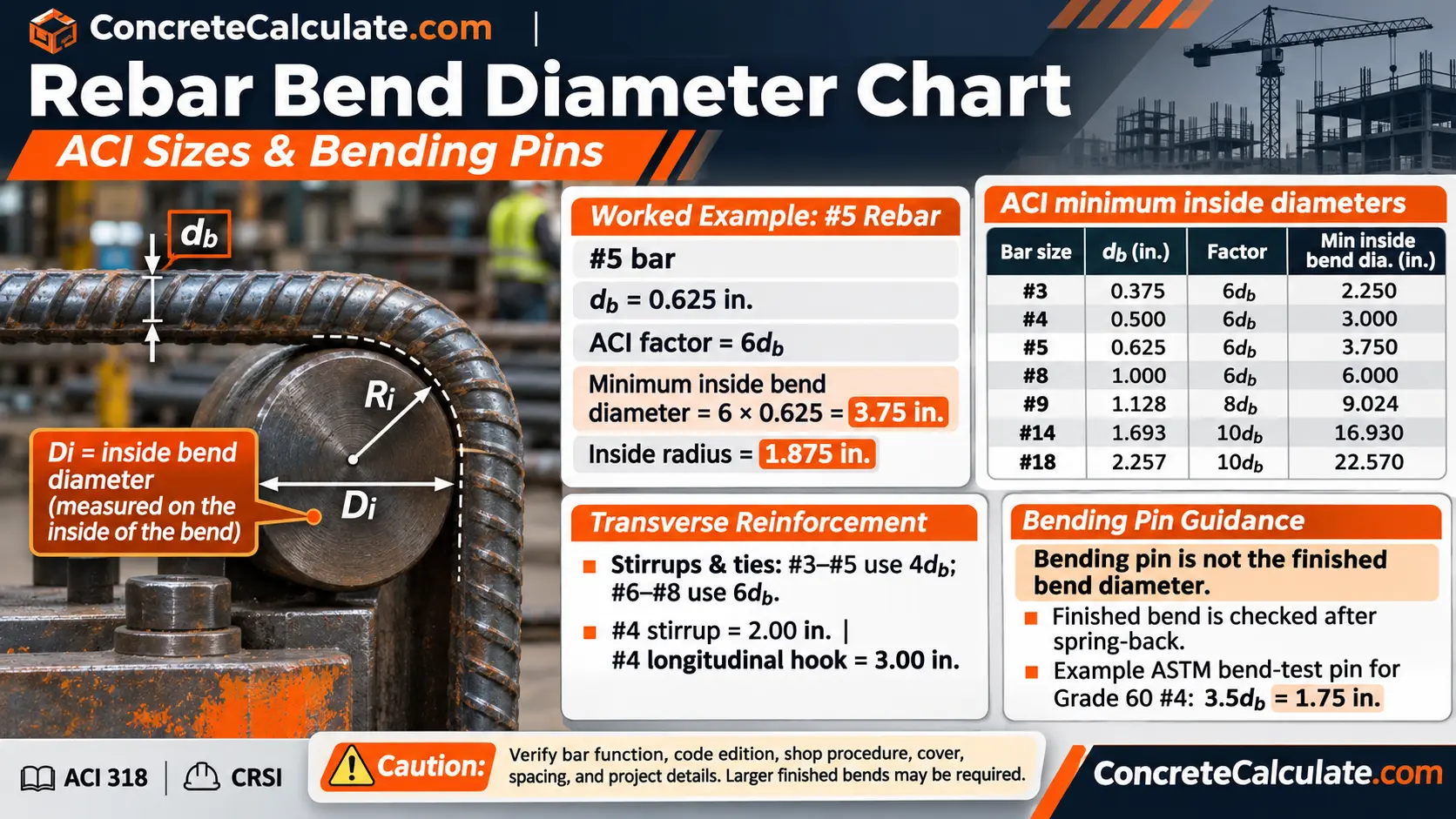
Minimum inside bend diameters for #3 through #18 bars, stirrup and tie rules, bending-pin guidance, and finished-bend inspection.
 Reviewed by Muhammad Ramzan Babar, PhD Researcher (Plasma Physics) & Calculator Developer. View Profile
⭐ Rebar Bend Diameter Chart
A rebar bend diameter chart lists the minimum inside bend diameter by bar size: ACI sets 6db for #3 through #8, 8db for #9 through #11, and 10db for #14 and #18 standard longitudinal hooks, so a #5 bar needs at least 3.75 in. Stirrups and ties follow separate, smaller rules for #3 through #5.
ACI Minimum Inside Diameters, #3 to #18
| U.S. bar size | Nominal db (in.) | ACI bend factor | Minimum inside bend diameter (in.) | Calculated equivalent (mm) |
|---|---|---|---|---|
| #3 | 0.375 | 6db | 2.250 | 57.2 |
| #4 | 0.500 | 6db | 3.000 | 76.2 |
| #5 | 0.625 | 6db | 3.750 | 95.3 |
| #6 | 0.750 | 6db | 4.500 | 114.3 |
| #7 | 0.875 | 6db | 5.250 | 133.4 |
| #8 | 1.000 | 6db | 6.000 | 152.4 |
| #9 | 1.128 | 8db | 9.024 | 229.2 |
| #10 | 1.270 | 8db | 10.160 | 258.1 |
| #11 | 1.410 | 8db | 11.280 | 286.5 |
| #14 | 1.693 | 10db | 16.930 | 430.0 |
| #18 | 2.257 | 10db | 22.570 | 573.3 |
Source: bar diameters from ASTM U.S. rebar standards (ASTM A615/A615M-26); bend factors for standard longitudinal hooks from ACI CODE-318-25 Section 25.3.1 (confirmed in the CRSI hook sheet and state DOT tables). Inch values are calculated as 6db, 8db, or 10db; mm values are conversions at 25.4 mm/in., rounded to 0.1 mm.
✓ Checked against ANSI/CRSI IPG5.1-2026, CRSI hook sheet, and WSDOT and WisDOT published tables, November 2026Code minimums, not shop pin sizes
The chart shows minimum inside bend diameters for standard longitudinal hooks. Fabrication may use larger diameters. Stirrups, ties, hoops, seismic reinforcement, special products, and project details can follow different rules. These are calculated code-minimum dimensions, not necessarily the finished bend or the shop pin size.
Metric values are conversions
ASTM inch-pound and SI systems are standardized independently, so the mm column is a unit conversion of U.S. data, not an independent ACI 318M or A615M lookup.
#20 bars
Do not extend 10db to #20 bars. ASTM A615 includes #20, but notes that design codes may not recognize it and that it can need special approval and detailing. ACI standard-hook groups in the table end at #18.
How to Read the Chart
- Find the bar size, then read the factor k and the minimum inside diameter in inches.
- Confirm the reinforcement function: stirrups and ties use a different table.
- The value is an inside diameter, so half of it is the inside radius (see the Rebar Bend Radius Chart).
For nominal bar diameters, see the Rebar Size Chart and Rebar Diameter Chart.
What Is Rebar Bend Diameter?
Rebar bend diameter is the inside diameter of a bent bar, such as 3.75 in. for a #5 standard hook, and it differs from the bar diameter, the bending-pin diameter, and the bend radius.
- Nominal bar diameter (db): the ASTM nominal diameter, such as 0.625 in. for #5.
- Inside bend diameter: measured on the inside surface of the bend.
- Finished bend diameter: the inside diameter measured after bending, including spring-back (ANSI/CRSI IPG5.1-2026, Section 3.1).
- Bending-pin diameter: the tooling size. CRSI states the finished bend diameter is not the pin diameter.
Key point
ACI sets the required minimum inside bend diameter. The fabricated bar must satisfy the governing drawings and fabrication standard, not just match a theoretical pin size.
⭐ Minimum Inside Bend Diameter Requirements
ACI 318 sets minimum inside bend diameters of 6db for #3 through #8, 8db for #9 through #11, and 10db for #14 and #18 longitudinal standard hooks, with smaller values for #3 through #5 stirrups and ties.
| Bar size | Longitudinal standard hook (Table 25.3.1) | Stirrups, ties, hoops (Table 25.3.2) |
|---|---|---|
| #3 through #5 | 6db | 4db |
| #6 through #8 | 6db | 6db |
| #9 through #11 | 8db | Not covered by Table 25.3.2 |
| #14 and #18 | 10db | Not covered by Table 25.3.2 |
Sources: ACI CODE-318-25 Sections 25.3.1 and 25.3.2 as reproduced in the CRSI hook details sheet, the WisDOT Bridge Manual (Chapter 9), and WSDOT Standard Specifications M 41-10, Division 9 (stirrup and tie table covers #3 through #8). Do not extend these factors to unlisted sizes or special details without checking the code.
✓ Checked against ANSI/CRSI IPG5.1-2026, CRSI hook sheet, and WSDOT and WisDOT published tables, November 20266db, 8db, and 10db
The factor steps up with bar size because larger bars need a gentler bend to avoid breakage and concrete crushing inside the bend. ACI 318-25 is the latest ACI code, but the edition legally applicable to a project is the one adopted by the jurisdiction and named in the project specifications.
Rebar Bend Diameter by Bar Size
Minimum bend diameter grows with bar size, and it jumps about 50% at #9 (6.000 in. at #8 to 9.024 in. at #9) because the factor changes from 6db to 8db.
| Size change | From (in.) | To (in.) | Increase (in.) | Increase (%) |
|---|---|---|---|---|
| #5 to #6 | 3.750 | 4.500 | 0.750 | +20.0 |
| #8 to #9 | 6.000 | 9.024 | 3.024 | +50.4 |
| #11 to #14 | 11.280 | 16.930 | 5.650 | +50.1 |
Calculated from the main chart values.
✓ Calculated from verified bar diameters, arithmetic checked, November 2026#3 to #5
2.250, 3.000, and 3.750 in. for longitudinal hooks; 1.50, 2.00, and 2.50 in. for stirrups and ties.
#6 to #8
4.500, 5.250, and 6.000 in. for both longitudinal hooks and transverse bars.
#9 to #11
9.024, 10.160, and 11.280 in. at 8db.
#14 and #18
16.930 and 22.570 in. at 10db. Do not continue 6db for larger bars.
⭐ Longitudinal vs. Stirrup Bend Diameter
A #4 longitudinal hook needs a 3.00 in. minimum inside diameter (6db) while a #4 stirrup or tie needs 2.00 in. (4db), so bar size alone does not set the bend diameter.
| Bar size | Nominal diameter (in.) | Longitudinal hook minimum (in.) | Stirrup / tie minimum (in.) | Difference (in.) |
|---|---|---|---|---|
| #3 | 0.375 | 2.25 | 1.50 | 0.75 |
| #4 | 0.500 | 3.00 | 2.00 | 1.00 |
| #5 | 0.625 | 3.75 | 2.50 | 1.25 |
| #6 | 0.750 | 4.50 | 4.50 | 0.00 |
| #7 | 0.875 | 5.25 | 5.25 | 0.00 |
| #8 | 1.000 | 6.00 | 6.00 | 0.00 |
Source: ACI CODE-318-25 Tables 25.3.1 and 25.3.2; the stirrup and tie values 1.5, 2, 2.5, 4.5, 5.25, and 6 in. also appear in WSDOT Standard Specifications M 41-10, Division 9 (stirrups and ties, #3 to #8). Dimensions calculated from bar diameters.
✓ Checked against ANSI/CRSI IPG5.1-2026, CRSI hook sheet, and WSDOT and WisDOT published tables, November 2026For #3 to #5: main bars use 6db and stirrups use 4db. For #6 to #8 both use 6db, but that does not make hook tails, closure, anchorage, or seismic requirements identical.
Why #4 Stirrup and #4 Longitudinal Diameters Differ
ACI sets separate tables for each function. Identify the reinforcement function first, then read the matching row.
⭐ Rebar Bending Pin and Mandrel Size
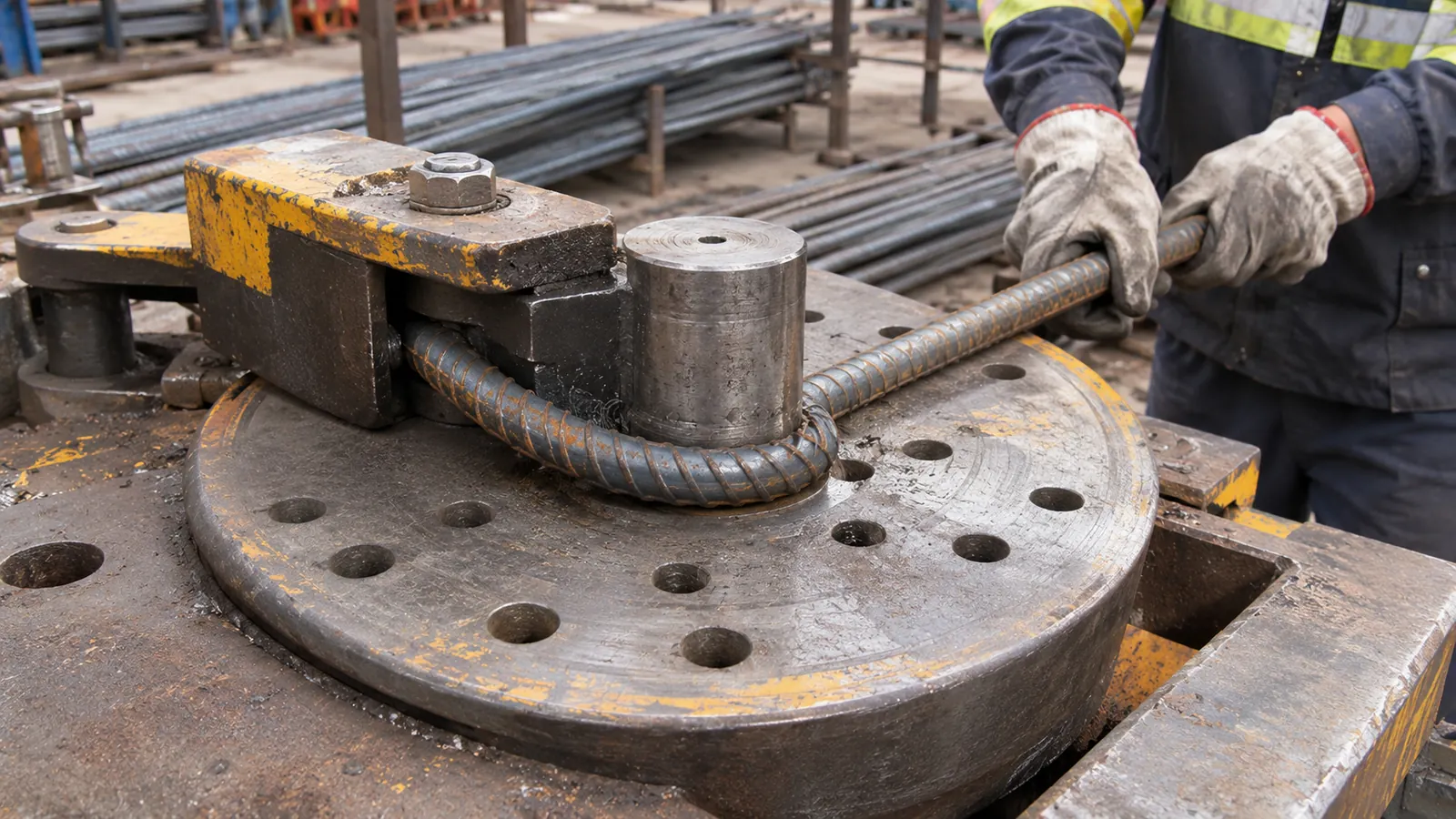
CRSI requires bending pins at least as large as the ASTM bend-test pin, and requires the finished bend, measured after spring-back, to be at least the ACI minimum, so pin size and finished diameter are related but distinct.
| Bar size | Nominal db (in.) | ASTM test pin, Grades 40 and 60 (3.5db) | ASTM test pin, Grades 80 and 100 (5db) | ACI stirrup/tie minimum finished diameter (4db) |
|---|---|---|---|---|
| #3 | 0.375 | 1.312 | 1.875 | 1.50 |
| #4 | 0.500 | 1.750 | 2.500 | 2.00 |
| #5 | 0.625 | 2.188 | 3.125 | 2.50 |
Source: ASTM A615 bend-test pin diameters as reported for A615/A615M-20 in the PCI ASPIRE article on CRSI stirrup and tie bend diameters; confirm in ASTM A615/A615M-26. ACI value from Table 25.3.2. A bend-test pin is a material qualification size, not a finished bend requirement.
✓ Pin sizes checked against the PCI ASPIRE summary of ASTM A615-20; confirm in A615-26, November 2026- ANSI/CRSI IPG5.1-2026 Section 9.1 requires pins equal to or larger than the pin diameter specified for qualification to the applicable ASTM standard, so bending does not damage the bar.
- Section 8.2 requires the finished bend diameter to meet the ACI 318 minimum (Sections 25.3.1 and 25.3.2).
- Because of spring-back, the finished diameter can differ from the pin size. No spring-back allowance is published here, since none was verified.
⭐ ACI Minimum vs. Finished Fabrication Diameter
The finished bend diameter must be equal to or larger than the ACI minimum, so a shop or drawing may use a larger value such as CRSI’s historical 2.00 in. for #3 stirrups against ACI’s 1.50 in.
| Term | Meaning | Where determined | Key caution |
|---|---|---|---|
| Code minimum inside diameter | Smallest permitted inside bend for the detail | ACI 318 as adopted | Not necessarily the shop’s chosen value |
| Specified bend diameter | Diameter on project or shop drawings | Engineer or detailer, approved documents | May exceed the code minimum |
| Bending pin or mandrel diameter | Tooling used to form the bar | Fabrication procedure | Not the final diameter |
| Finished inside bend diameter | Measured inside diameter of the fabricated bend | Approved measurement method | Includes spring-back |
| Fabrication tolerance | Permitted dimensional deviation | CRSI IPG5.1-2026 and project specs | Do not invent values |
| Hook extension | Straight leg after the bend | ACI hook geometry | Not the bend diameter |
| Development length | Length needed for anchorage | ACI development provisions | Not set by bend diameter alone |
Sources: ANSI/CRSI IPG5.1-2026 Sections 3, 8, 9, 12, and 14; ACI CODE-318-25.
✓ Terms checked against ANSI/CRSI IPG5.1-2026 text, November 2026| Bar size | ACI 318 minimum (in.) | CRSI Manual 29th ed. Table 7-2 (in.) | Difference (in.) |
|---|---|---|---|
| #3 | 1.50 | 2.00 | 0.50 |
| #4 | 2.00 | 2.50 | 0.50 |
| #5 | 2.50 | 3.25 | 0.75 |
Source: PCI ASPIRE article on CRSI stirrup and tie bend diameters reporting CRSI Manual of Standard Practice 29th edition (2018) Table 7-2 values of 2, 2½, and 3¼ in. versus 4db in ACI 318-19. CRSI does not prohibit 4db bends but treats them as a special-order item that must be noted in documents. The values for ANSI/CRSI IPG5.1-2026 Table 7-3 were not readable in the text version and must be checked directly.
✓ Checked against the PCI ASPIRE article, November 2026; confirm in the current CRSI documentsState DOT tables, such as WSDOT’s 1½, 2, and 2½ in. for #3, #4, and #5 stirrups and ties, show agencies using the ACI values directly. They corroborate the numbers but do not apply to every project.
⭐ How to Measure Rebar Inside Bend Diameter
Rebar inside bend diameter is measured on the inside of the finished bend, while leg dimensions are measured out-to-out of the bar at the CRSI measuring points.
| Item | What to do or know |
|---|---|
| Inside bend diameter | Measure on the inside surface of the finished bend, not the pin and not the outside width |
| Leg dimensions | Reported and measured out-to-out of bar (A and G legs on 135° and 180° hooks are the stated exceptions) |
| Measuring points | Use the points in ANSI/CRSI IPG5.1-2026 Figures 1 to 3 for fabrication and inspection |
| Ribs | Deformations affect where a tool contacts the bar, so use the approved method |
| Disc or template | A disc sized to the ACI minimum should fit inside the bend (CRSI Manual of Standard Practice) |
| Bend shape | Not required to be a perfect circle if the finished diameter meets the minimum |
Sources: ANSI/CRSI IPG5.1-2026 Sections 10, 11, and 13 and CRSI Manual of Standard Practice (29th edition) guidance on inspection discs. Figures are illustrative in the standard.
✓ Checked against ANSI/CRSI IPG5.1-2026 text, November 2026An ordinary tape on the outside of a bend is not an approved method for certifying the inside diameter.
⭐ CRSI Rebar Fabrication Tolerances
ANSI/CRSI IPG5.1-2026 covers finished bend diameter, bending pins, measuring points, and fabrication tolerances for uncoated and coated bars, with numeric tolerances given in its Section 12 tables.
| Section | Topic | What it says (summary) |
|---|---|---|
| 3 | Definitions | Finished bend diameter includes spring-back; typical vs. special fabrication |
| 8 | Finished bend diameter | Equal to or larger than the ACI 318 minimum; not the pin diameter |
| 9 | Bending pins | Pins at least the ASTM qualification pin diameter |
| 10 | Dimensions | Out-to-out of bar, with stated exceptions for A and G legs |
| 11 | Measuring points | Used for both fabrication and inspection (Figures 1 to 3) |
| 12 | Fabrication tolerances | Tables 12-1a and 12-1b (standard pin bending), 12-2a and 12-2b (stirrup/tie), spirals; single plane |
| 13 | Bend curvature | Out-of-roundness allowed if finished diameter meets the ACI minimum |
| 14 | Inspection | Finished bent bars only; diameter and leg dimensions checked |
Source: ANSI/CRSI IPG5.1-2026, a 22-page ANSI standard. The numeric tolerance values are in its Section 12 tables and are not reproduced here. Read the standard or the governing project specification before applying any tolerance.
✓ Sections checked against the published IPG5.1-2026 text, November 2026- Typical fabrication follows Section 12 tolerances; special fabrication means tolerances tighter than Section 12.
- The standard applies to uncoated bars and, where specified, to listed coated products. ASTM A767 galvanized bars have their own finished bend diameters (Table 8-2).
- Final field tolerance for assembled spirals and other units is a separate question from bar fabrication.
Inside Bend Diameter vs. Bend Radius
Inside bend diameter is twice the inside bend radius, so a #4 longitudinal bend with a 3.00 in. inside diameter has a 1.50 in. inside radius, a 1.75 in. centerline radius, and a 4.00 in. outside diameter.
| Measurement | Formula | Meaning |
|---|---|---|
| Minimum inside bend diameter | Di = k × db | ACI-controlled minimum for the category |
| Inside radius | Ri = Di ÷ 2 | Half the inside diameter |
| Centerline radius | Rc = (Di + db) ÷ 2 | Idealized bar centerline radius |
| Centerline diameter | Dc = Di + db | Diameter through the bar centerline |
| Outside radius | Ro = (Di + 2db) ÷ 2 | Idealized outside radius |
| Outside diameter | Do = Di + 2db | Idealized full outside diameter |
Idealized circular geometry. These quantities are related but not interchangeable on bar bending schedules.
✓ Calculated from verified bar diameters, arithmetic checked, November 2026| Bar size | Nominal diameter (in.) | Minimum inside diameter (in.) | Theoretical outside diameter (in.) |
|---|---|---|---|
| #3 | 0.375 | 2.250 | 3.000 |
| #4 | 0.500 | 3.000 | 4.000 |
| #5 | 0.625 | 3.750 | 5.000 |
| #6 | 0.750 | 4.500 | 6.000 |
| #7 | 0.875 | 5.250 | 7.000 |
| #8 | 1.000 | 6.000 | 8.000 |
| #9 | 1.128 | 9.024 | 11.280 |
| #10 | 1.270 | 10.160 | 12.700 |
| #11 | 1.410 | 11.280 | 14.100 |
Calculated theoretical geometry, not ACI-published outside dimensions. Deformed bars have ribs, and fabricated bends have tolerances, so an outside measurement cannot certify the minimum inside bend diameter. Use IPG5.1-2026 for measuring points.
✓ Calculated from verified bar diameters, arithmetic checked, November 2026For radius tables and conversions, see the Rebar Bend Radius Chart.
Rebar Bend Diameter vs. Hook Length
Bend diameter sets the curve of a hook, while hook length (the straight extension) and development length are separate requirements, so a correct 3.00 in. #4 bend does not by itself satisfy anchorage.
| Quantity | What it is | Set by |
|---|---|---|
| Inside bend diameter | Diameter of the bend itself, e.g. 3.00 in. for #4 | ACI 25.3.1 or 25.3.2 |
| Hook extension | Straight leg after the bend | ACI hook geometry |
| Development length | Length of embedment needed for the bar to develop stress | ACI development provisions (including 25.4.3 for hooked bars) |
Sources: ACI CODE-318-25. A hook extension is not hooked-bar development length.
Hook extensions and full hook dimensions are on the Rebar Hook Length Chart; anchorage is on the Rebar Development Length Chart.
90° and 180° Standard Hooks
For a given bar size, 90° and 180° longitudinal standard hooks use the same minimum inside bend diameter, but the 90° hook extends 12db while the 180° hook extends the greater of 4db or 2.5 in.
| Bar size | Minimum inside diameter (in.) | 90° extension 12db (in.) | 180° extension, greater of 4db or 2.5 in. (in.) |
|---|---|---|---|
| #4 | 3.000 | 6.00 | 2.50 |
| #5 | 3.750 | 7.50 | 2.50 |
| #8 | 6.000 | 12.00 | 4.00 |
Extension rules from ACI CODE-318-25 Section 25.3.1 (12db for 90°; the greater of 4db and 2.5 in. for 180°), as shown in the CRSI hook details sheet. Values calculated for illustration; full dimensions are on the Rebar Hook Length Chart.
✓ Extension rules checked against the CRSI standard hook sheet, November 2026Keep hook geometry and fabrication dimensions on the Rebar Hook Length Chart.
Stirrup, Tie and 135° Hook Bends
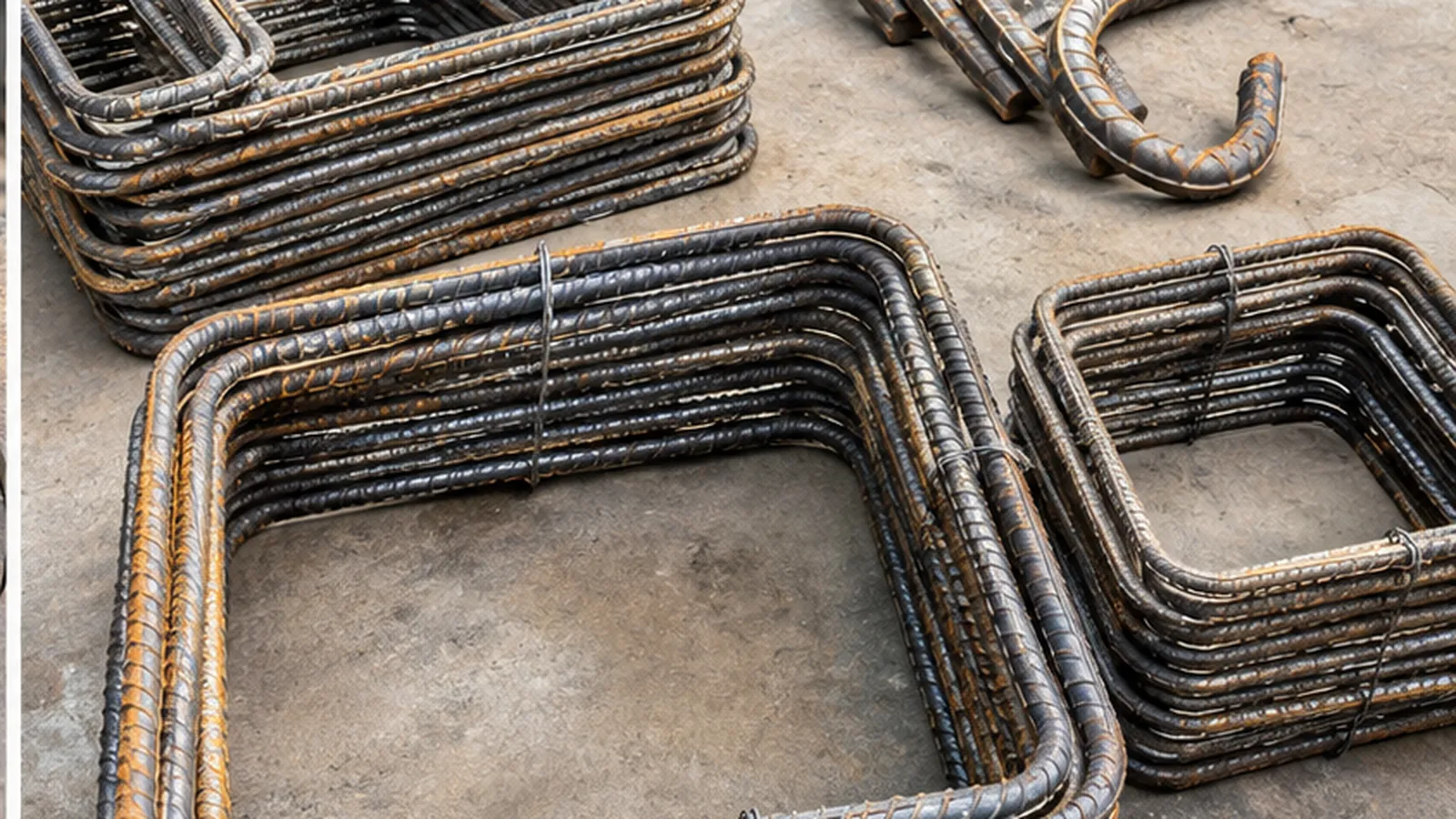
Ordinary stirrup, tie, and hoop hooks use a 4db inside bend diameter for #3 through #5 and 6db for #6 through #8, while extensions, closure, and confinement are separate requirements.
| Bar size | Minimum inside diameter | Applies to |
|---|---|---|
| #3 through #5 | 4db | 90° and 135° stirrup, tie, and hoop hooks |
| #6 through #8 | 6db | 90° and 135° stirrup, tie, and hoop hooks |
Source: ACI CODE-318-25 Section 25.3.2, confirmed in the CRSI hook sheet and state DOT tables. Closed stirrups, rectangular ties, column hoops, and crossties each have their own closure and anchorage details.
✓ Checked against ANSI/CRSI IPG5.1-2026, CRSI hook sheet, and WSDOT and WisDOT published tables, November 2026- A 135° hook angle alone does not establish seismic compliance.
- ACI defines a seismic hook as a bend of at least 135° (90° allowed for circular hoops) with an extension of at least 6db, not less than 3 in., that engages longitudinal reinforcement.
⭐ Seismic Reinforcement Bend Requirements
Meeting the minimum inside bend diameter is only the first of three seismic hook checks; hook angle, extension, and the full confinement detail must also comply with the applicable seismic provisions.
| Question | What it checks | Passing it proves |
|---|---|---|
| 1. Does the bend meet the minimum inside diameter? | Bend diameter vs. 4db or 6db | Only the bend diameter |
| 2. Does the hook meet its angle and extension? | Hook angle, extension, engagement | Only hook geometry |
| 3. Does the full detail meet seismic provisions? | Confinement, bar sizes, hook engagement, structural system | Compliance with the seismic provisions |
Source: ACI CODE-318-25 Section 25.3.4 and applicable seismic chapters. Do not use a universal “135° hook equals seismic safe” rule.
Rebar Grade and Material Requirements
Rebar grade does not reduce the ACI minimum bend diameter, because ASTM bend tests, bending suitability, and structural bend detailing are separate issues.
| Standard | Steel type | Grades listed in IPG5.1-2026 |
|---|---|---|
| ASTM A615/A615M-26 | Carbon steel | 40 (where permitted), 60, 80, 100 |
| ASTM A706/A706M-26a | Low-alloy steel | 60, 80, 100 |
| ASTM A955 | Stainless steel | 60, 75, 80 |
| ASTM A996 | Rail and axle steel | Rail 50, 60; axle 40, 60 |
| ASTM A1035 | Low-carbon chromium steel | 100, 120 |
Source: ANSI/CRSI IPG5.1-2026 Section 1.1.1; ASTM editions per ASTM A615/A615M-26 and ASTM A706/A706M-26a. ASTM A706 low-alloy bars are intended where weldability matters.
✓ Grades checked against IPG5.1-2026 scope text, November 2026Check grade and availability against the Rebar Grade Chart; ASTM A615 includes #20 bars, but design codes may not recognize them.
Cold Bending and Field Rebending
Reinforcing bars are normally cold bent in the shop to the specified diameter, and heating, rebending, or straightening installed bars needs engineer approval and an evaluated procedure.
- Shop bending is done cold on the approved pin and procedure, and CRSI inspection applies to finished bent bars only.
- Do not heat a bar with a torch to make a bend easier.
- Do not rebend installed bars or straighten damaged reinforcement without engineer-of-record approval and an evaluated procedure.
- Look for cracks, kinks, or excessive deformation; repeated bending and straightening can damage the bar.
Approval required
Misfabricated or damaged bars should be referred for review, not corrected in the field by improvised methods. State specifications such as WSDOT’s also address cold bending and tolerances; the contract documents control.
Coated and Stainless Rebar Bending
Epoxy-coated, galvanized, and stainless bars follow additional CRSI and ASTM product requirements, and ASTM A767 galvanized bars have different finished bend diameters for some sizes.
| Bar type | Fabrication reference | Note |
|---|---|---|
| Uncoated carbon steel (A615, A706) | IPG5.1-2026 Tables 7-1, 7-3, 8-1 | Standard finished bend diameters |
| Epoxy-coated | IPG5.1-2026 plus CRSI CG2.1 | Same ACI minimums; protect the coating during bending |
| Galvanized (ASTM A767) | IPG5.1-2026 Tables 7-2, 7-4, 8-2 | Some finished diameters differ from uncoated bars |
| Stainless (A955) | IPG5.1-2026 plus CRSI IPG4.1 | Follow product-specific instructions |
Source: ANSI/CRSI IPG5.1-2026 Sections 1.2, 1.3, 7, and 8. Material standards and project specifications control; do not assume all coatings use the same pin diameter or can be rebent.
✓ Checked against IPG5.1-2026 text, November 2026Bend Diameter, Concrete Cover and Congestion
A larger finished bend takes more room in a congested member, but reducing the bend diameter below the ACI minimum is never an acceptable fix for insufficient cover or crowding.
- Check concrete cover, bar spacing, clear distance between bars, member dimensions, hook orientation, stirrup dimensions, and adjacent layers.
- If a required bend does not fit, the engineer may need to revise the detail.
Do not tighten the bend
Cover and spacing problems are solved by revising the detail, not by bending below the code minimum.
See the Concrete Cover Chart and Rebar Spacing Chart; splices are on the Rebar Lap Splice Chart.
Bend Diameter in Bar Bending Schedules
Bar bending schedules report dimensions out-to-out of the bar, so the inside bend diameter must be specified or taken from the ACI minimum rather than read from a centerline length.
| Field | Purpose |
|---|---|
| Bar mark | Identifies the bar |
| Bar size and grade | Selects the bend diameter and material |
| Shape designation | Names the bend shape |
| Overall and leg dimensions | Reported out-to-out of bar |
| Bend angle | Defines each bend |
| Inside bend diameter | Specified or ACI minimum value |
| Quantity and notes | Count and fabrication notes |
Source: ANSI/CRSI IPG5.1-2026 Section 10.2 (placing drawings, bar lists, and bills of material report out-to-out dimensions). Do not assume every dimension is measured along the centerline.
✓ Checked against IPG5.1-2026 Section 10, November 2026For cut-length quantities, see the Rebar Length Chart and Rebar Weight Chart.
Rebar Bend Diameter Formulas and Worked Examples
Minimum inside bend diameter equals k × db, with k = 6, 8, or 10 for longitudinal hooks and 4 or 6 for ordinary stirrups, so a #5 bar needs 3.75 in. and a #9 bar needs 9.024 in.
Use the factors in Section 3 for k. Do not extend them to unlisted sizes or specialized details without verification.
Minimum inside bend diameter of a #5 longitudinal hook
This is the code minimum for the stated category. A shop may select a larger finished diameter under its approved fabrication procedure.
Minimum inside bend diameter of a #9 longitudinal hook
The factor changes between #8 and #9. Do not keep using 6db for larger bars.
Inside radius of a #6 longitudinal hook
The radius is derived geometry; ACI specifies the 4.50 in. inside diameter.
Centerline radius and idealized arc of a #5 90° bend
This is an idealized centerline arc, not a cutting length. Cut length depends on the approved shape, straight segments, and detailing conventions.
Same #4 bar, two reinforcement functions
Bar size alone does not set the minimum bend diameter. Identify the reinforcement function first.
⭐ How to Inspect Finished Rebar Bends
To inspect a finished rebar bend, confirm the bar designation and bend angle, check the required inside diameter, measure at the approved points, and compare with drawings and tolerances before accepting or referring the bar.
| Check | Requirement | Source |
|---|---|---|
| Bar is finished | Inspect finished bent bars only | IPG5.1-2026, 14.1 |
| Bend diameter | Finished diameter equal to or larger than the required minimum | IPG5.1-2026, 14.2 and 8 |
| Leg dimensions | Within the drawings, Section 12 tolerances, and ACI 117 | IPG5.1-2026, 14.3 |
| Bend shape | Out-of-roundness allowed if diameter is not below the minimum | IPG5.1-2026, 13.1 |
| Condition | No cracks, kinks, or excessive deformation | Good practice; project specs |
Source: ANSI/CRSI IPG5.1-2026. Measure at the approved measuring points; verify any exact technique in the standard.
✓ Checked against IPG5.1-2026 Section 14, November 2026⭐ Common Rebar Bend Diameter Mistakes
The most common rebar bend diameter mistakes are confusing diameter with radius, using the wrong factor for the bar function, and treating the bending pin as the finished bend.
Measuring and reading
- Confusing bend diameter with bend radius
- Measuring the outside instead of the inside bend
- Using theoretical outside dimensions as fabrication tolerances
- Using an ordinary field tape in place of an approved method
- Treating the centerline arc length as the cut length
Bar size and function
- Using 6db for every bar size
- Using 4db for every stirrup and tie
- Applying longitudinal values to #4 stirrups
- Applying small-stirrup values to #6 through #8 transverse bars
- Extrapolating ACI rules to #20 bars
Pins and fabrication
- Choosing a pin from the bar number alone
- Assuming the pin diameter equals the finished diameter
- Ignoring spring-back and measurement tolerance
- Treating the ACI minimum as the only acceptable diameter
- Ignoring a larger diameter on the drawings
- Treating a rounded shop value as smaller than the code minimum without checking
Hooks and seismic
- Confusing 90° and 180° extensions
- Treating a 135° bend as automatically seismic compliant
- Confusing hook extension with development length
- Applying standard-hook rules to special bends without checking
Code, material, and field
- Ignoring the adopted code edition or the approved bar schedule
- Treating an ASTM bend test as an ACI hook detail
- Ignoring grade or product limits
- Rebending or heating bars without approval
- Damaging epoxy or galvanizing during bending
- Ignoring cover and congestion
- Ignoring cracks, kinks, or excessive deformation
Rebar Bend Diameter FAQs
These are the most common questions about rebar bend diameter, answered with ACI and CRSI values.
What is the minimum rebar bend diameter?
It depends on bar size and function. For standard longitudinal hooks ACI sets 6db for #3 through #8, 8db for #9 through #11, and 10db for #14 and #18, measured on the inside of the bend. Stirrups and ties use 4db for #3 through #5 and 6db for #6 through #8.
What is inside bend diameter?
Inside bend diameter is the diameter of the bend measured on the inside surface of the bar, equal to twice the inside radius. CRSI defines the finished bend diameter as the inside diameter measured after bending, including spring-back, and states it is not the pin diameter.
How is rebar bend diameter measured?
Measure the inside of the finished bend, after spring-back, using the approved shop or inspection method, such as a template or disc sized to the ACI minimum. Leg dimensions are measured out-to-out of bar at the CRSI measuring points. An outside tape reading alone cannot certify the inside diameter.
What is the difference between bend diameter and bend radius?
Bend diameter is the full inside diameter, and the inside radius is half of it. A #4 longitudinal bend has a 3.00 in. inside diameter and a 1.50 in. inside radius. Centerline and outside radii are larger. They are not interchangeable on schedules.
What is the minimum bend diameter for #3 rebar?
A #3 longitudinal standard hook needs at least 2.250 in. (6 × 0.375 in.), about 57.2 mm. A #3 stirrup or tie hook needs at least 1.50 in. (4db). Which applies depends on the reinforcement function, so confirm it on the drawings first.
What is the minimum bend diameter for #4 rebar?
A #4 longitudinal hook needs a minimum inside bend diameter of 3.00 in. (6 × 0.500 in.), about 76.2 mm. A #4 stirrup or tie hook needs 2.00 in. (4db). The difference of 1.00 in. comes from separate ACI tables for each function.
What is the minimum bend diameter for #5 rebar?
A #5 longitudinal hook needs at least 3.75 in. (6 × 0.625 in.), about 95.3 mm, and a #5 stirrup or tie hook needs at least 2.50 in. (4db). A shop or drawing may use a larger finished diameter, but not a smaller one.
What is the minimum bend diameter for #6 rebar?
A #6 bar needs at least 4.50 in. (6 × 0.750 in.), about 114.3 mm, for both longitudinal standard hooks and ordinary stirrup, tie, and hoop hooks. The inside radius is 2.25 in. Extensions and other hook details can still differ between the two uses.
What is the minimum bend diameter for #8 rebar?
A #8 bar needs at least 6.000 in. (6 × 1.000 in.), about 152.4 mm, for both longitudinal hooks and ordinary transverse hooks. It is the largest bar in the 6db group, and #9 jumps to 9.024 in. because the factor changes to 8db.
What is the minimum bend diameter for #9 rebar?
A #9 longitudinal standard hook needs at least 9.024 in. (8 × 1.128 in.), about 229.2 mm. The factor increases from 6db to 8db at #9, which is about 50% more than the 6.000 in. required at #8. The #9 rule applies to longitudinal hooks only, because Table 25.3.2 does not cover #9 transverse bars.
Why does #9 rebar use an 8db bend?
Larger bars are stiffer and have more ribs and stored stress, so a gentler bend reduces the risk of breakage and of crushing the concrete inside the bend. ACI therefore steps the factor from 6db to 8db for #9 through #11 and to 10db for #14 and #18.
What is the minimum bend diameter for #11 rebar?
A #11 longitudinal hook needs at least 11.280 in. (8 × 1.410 in.), about 286.5 mm. #14 and #18 use 10db, which gives 16.930 and 22.570 in. Do not carry 10db to #20 bars, which ACI’s ordinary standard-hook groups do not cover.
What is the difference between 4db, 6db, 8db and 10db?
They are ACI factors that multiply the nominal bar diameter. 4db applies to #3 through #5 stirrups and ties, 6db to #3 through #8 longitudinal hooks and #6 through #8 transverse bars, 8db to #9 through #11, and 10db to #14 and #18 longitudinal hooks.
What bending pin is needed for #4 rebar?
The pin must be at least the ASTM bend-test pin size (reported as 3.5db, 1.75 in., for Grade 60 #4) and must produce a finished diameter that meets or exceeds the ACI minimum after spring-back. The shop selects the pin by its approved procedure, so there is no single universal pin.
Does a bending pin have to equal the specified inside bend diameter?
No. CRSI states the finished bend diameter is measured after the bar is bent, including spring-back, and is not the pin diameter. The pin must meet the ASTM pin requirement, and the finished bend must equal or exceed the ACI minimum.
Are stirrup bend diameters different from main-bar bends?
Yes for #3 through #5. Stirrups and ties use 4db and main longitudinal hooks use 6db, so a #4 stirrup is 2.00 in. while a #4 main-bar hook is 3.00 in. For #6 through #8 both ordinary cases use 6db, with different hook details.
What is the inside bend diameter for a #4 stirrup?
The ACI minimum is 2.00 in. (4 × 0.500 in.), about 50.8 mm, and WSDOT’s table lists the same 2 in. A shop may fabricate a larger value, and CRSI has published larger recommended shop diameters for #3 through #5 stirrups, so check the drawings and fabrication standard.
Can the finished bend diameter be larger than the ACI minimum?
Yes. CRSI requires the finished bend diameter to be equal to or larger than the ACI minimum, and drawings may specify a larger value. Larger bends are acceptable from a code-minimum standpoint, but they can affect cover, spacing, and fit in congested members.
Does CRSI specify bending tolerances?
Yes. ANSI/CRSI IPG5.1-2026 Section 12 gives standard fabrication tolerances for standard pin bending, stirrups and ties, and spirals, and treats tighter tolerances as special fabrication. The numeric values are in its tables, so read the standard or project specification before applying one.
How do you inspect a finished rebar bend?
Inspect only the finished bent bar. Confirm the designation and bend angle, check that the finished inside diameter is at least the required minimum, measure legs at the approved points, compare with drawings and tolerances, and record acceptance or refer the bar for review.
Do 90° and 180° hooks use the same minimum bend diameter?
For standard longitudinal hooks of the same bar size, yes. A #5 90° or 180° hook needs at least 3.75 in. The straight extensions differ: 12db for the 90° hook and the greater of 4db or 2.5 in. for the 180° hook.
Is a 135° bend always a seismic hook?
No. A seismic hook needs a bend of at least 135° (90° for circular hoops) plus an extension of at least 6db, not less than 3 in., that engages the longitudinal bar. Meeting the bend diameter does not prove the whole detail meets seismic provisions.
Can reinforcing bars be rebent after fabrication?
Not casually. Rebending or straightening installed or finished bars can crack or damage them and needs engineer-of-record approval and an evaluated procedure. Do not heat bars to ease a bend. Misfabricated or damaged bars should be referred for review, not corrected in the field by improvised methods.
Does higher-grade rebar require different bending procedures?
Higher grades can need larger ASTM bend-test pins (for example 5db instead of 3.5db for #3 through #5 Grades 80 and 100 in A615-20), and grade does not reduce the ACI minimum. Follow the material standard, fabrication standard, and project specifications for the exact grade.
Can epoxy-coated rebar be bent?
Yes, as fabricated product, but coatings need care. Epoxy-coated bars fall under CRSI IPG5.1-2026 together with its CG2.1 fabrication facility standard, and damage to the coating must be avoided. Do not assume coated bars can be rebent in the field.
What standard governs rebar bend diameters?
ACI CODE-318-25 (Sections 25.3.1 and 25.3.2) sets the minimum inside bend diameters, ANSI/CRSI IPG5.1-2026 governs fabrication, measuring points, and tolerances, and ASTM A615 or A706 govern the bar material. The code edition adopted by the jurisdiction and the project specifications control.
Does ASTM A615 specify the same requirements as ACI 318?
No. ASTM A615 sets product properties and bend-test pin sizes for material qualification, while ACI 318 sets the minimum inside bend diameters for structural hooks. An ASTM bend test is not the same requirement as the finished bend of a hook used in structural concrete.
Can #20 rebar use a 10db minimum bend?
Not automatically. ASTM A615 includes #20 bars but notes that design codes may not recognize them and that special approval and detailing may be required. ACI’s ordinary standard-hook groups end at #18, so ASTM product recognition does not create a standard #20 hook, and any #20 bend needs engineering approval.
Using the Rebar Bend Diameter Chart
This rebar bend diameter chart gives ACI minimum inside bend diameters for #3 through #18 bars, with fabrication and inspection context.
Identify the reinforcement function, read the ACI minimum inside diameter, and confirm the finished bend after spring-back against the drawings, the adopted code edition, and ANSI/CRSI IPG5.1-2026. Pins, grade, coatings, cover, and seismic detailing each have separate requirements. For radius geometry use the Rebar Bend Radius Chart, for extensions the Rebar Hook Length Chart, and for anchorage the Rebar Development Length Chart.
📄 Download Rebar Bend Diameter Chart PDF
Use your browser print function to save this page as a print-ready PDF for shop and inspection folders. Buttons and image placeholders are hidden when printing.
- #3 to #18 bend diameter chart
- Main bar vs. stirrup table
- Pin vs. finished bend terms
- Inspection criteria
- Formulas and worked examples