How Much Is a 1 Yard Truck of Concrete in California? 2026 Price Guide
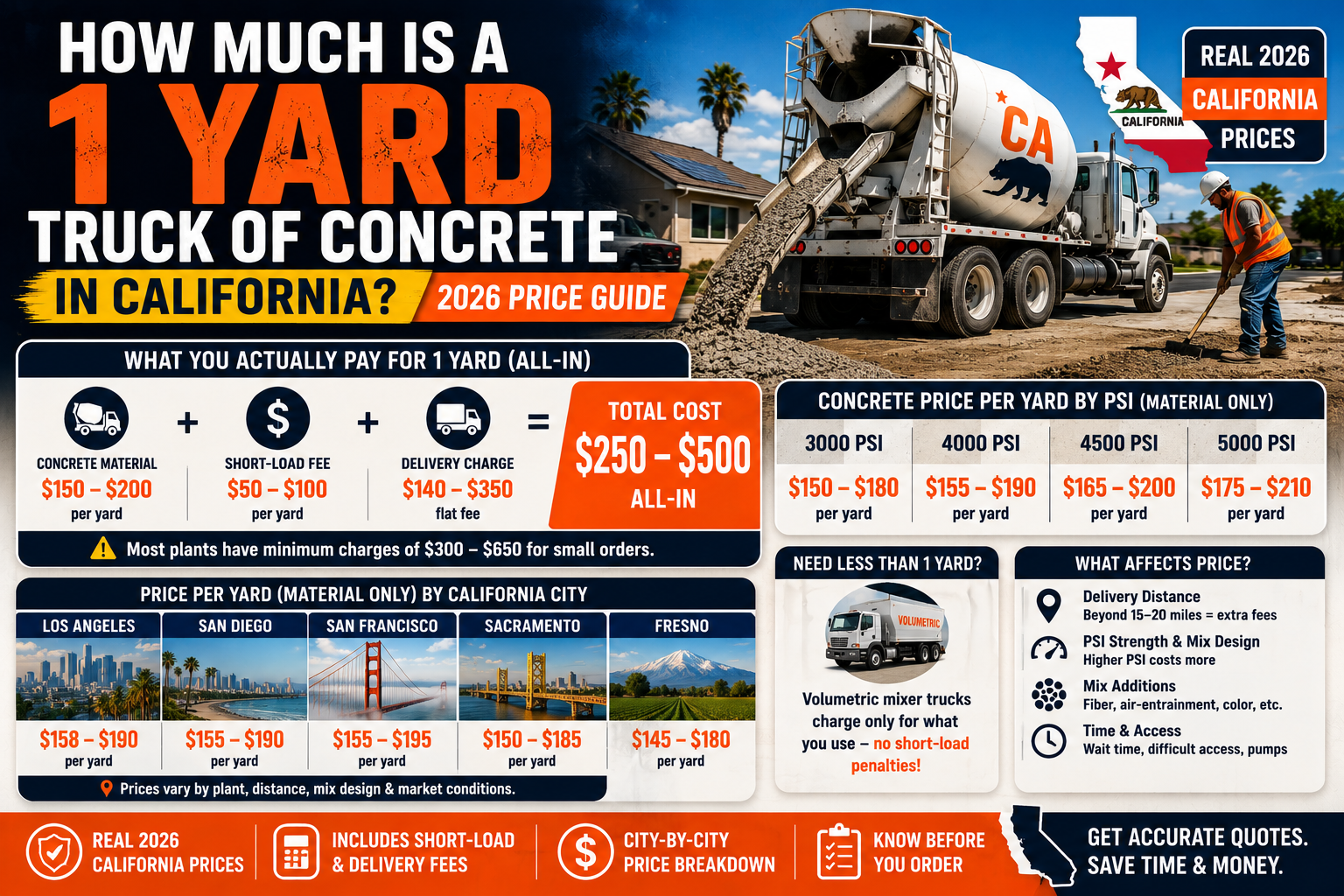
Ordering 1 yard of concrete in California in 2026 costs $250 to $500 all-in for most markets once you factor in the per-yard base price, a short-load fee, and the delivery charge. The concrete material itself runs $150 to $200 per cubic yard across California – but ordering just 1 yard is one of the most expensive ways to buy concrete per effective yard because of the fees that apply to small orders. This guide explains exactly what you will pay, why, and when a 1-yard order actually makes sense.
What a 1-Yard Concrete Order in California Actually Costs
Searching for “1 yard of concrete in California” tells you someone needs a small amount of concrete – likely for a post hole repair, a small step, a patch, or a compact project. The reality is that ordering exactly 1 cubic yard from a California ready-mix plant is one of the most expensive purchasing decisions per effective yard you can make. Here is why, and what it actually costs.
A ready-mix truck carries 8 to 11 cubic yards of concrete. When you order just 1 yard, the plant sends that same truck, uses the same driver, burns the same fuel, and runs the same batching operation – for one-tenth of a full load. To compensate, plants charge a short-load fee on top of the per-yard base price. In California, these fees are steep by national standards because operating costs – fuel, wages, insurance, and CalOSHA compliance – are higher than anywhere else in the USA.
| Order Size | Base Cost (4000 PSI) | Short-Load Fee | Delivery Fee | All-In Total | Effective $/Yard |
|---|---|---|---|---|---|
| 1 cubic yard | $170 | $100 | $140 to $200 | $410 to $470 | $410 to $470 |
| 2 cubic yards | $340 | $150 | $140 to $200 | $630 to $690 | $315 to $345 |
| 3 cubic yards | $510 | $180 | $140 to $200 | $830 to $890 | $277 to $297 |
| 5 cubic yards | $850 | $150 | $140 to $200 | $1,140 to $1,200 | $228 to $240 |
| 8 cubic yards | $1,360 | $50 | Included | $1,410 to $1,460 | $176 to $183 |
| 10 cubic yards (full load) | $1,700 | $0 | Included | $1,700 to $1,800 | $170 to $180 |
The table above illustrates the most important number: the effective price per yard. A 1-yard order in California costs $410 to $470 per effective yard – two to three times the per-yard price of a full 10-yard load at $170 to $180. This is not a scam; it is the real cost structure of concrete delivery. Understanding it helps you decide whether to order more volume, use bags, or combine orders with a neighbor.
Several Northern and Southern California ready-mix plants do not simply charge a short-load fee on a 1-yard order. They set a hard minimum charge. Verified 2026 pricing from Townsend Concrete in Vacaville shows a minimum charge of $162 for 1 yard at the plant gate – before delivery. For extended zones, their minimum charge jumps to $648 for 4 yards of product, meaning a 1-yard order is not available for delivery to those locations at all. Always call the plant and ask about both their short-load policy and their minimum delivery requirements for your zip code.
Base Price Per Yard by PSI: California 2026
The concrete material price before any fees is set by PSI strength. Here are the 2026 base per-yard prices from actual California ready-mix plants for each common mix strength.
| PSI / Mix Strength | Sack Count | CA Base Price/Yard (2026) | Best Used For |
|---|---|---|---|
| 3000 PSI | 5 Sack | $155 to $175 | Patios, walkways, mild-climate slabs |
| 3500 PSI | 5.5 Sack | $160 to $180 | General residential slabs, driveways in mild CA climates |
| 4000 PSI | 6 Sack | $165 to $190 | Driveways, garage floors, most residential work (recommended spec) |
| 4500 PSI | 6.5 Sack | $170 to $195 | Foundation slabs, structural pads |
| 5000 PSI | 7 Sack | $175 to $200 | Heavy loads, structural elements |
| 6000 PSI | 8 Sack | $185 to $210 | Commercial structural concrete |
| 7000 PSI | 9 Sack | $195 to $220 | High-performance structural |
| 8000 PSI | 10 Sack | $200 to $230 | Specialty structural and industrial |
For most California residential projects – driveways, patios, garage floors, and pool decks – 4000 PSI (6-sack mix) is the right specification. California’s climate variation from mountain freeze-thaw in the north to the desert heat of the Inland Empire means 4000 PSI provides the best all-around durability. The cost premium over 3000 PSI is only $10 to $15 per yard – less than $150 extra on a full truckload. Confirm the right spec for your application using the concrete PSI guide.
Every California ready-mix supplier starts the quote with your yardage. Use the concrete calculator to get your precise volume before you call. If your project is close to 5 or 7 yards – the typical short-load thresholds at most California plants – a small amount of additional concrete work (a walkway extension, an apron, or a small pad) can push you past the threshold and eliminate a substantial fee.
Short-Load Fees in California: What Every Plant Charges
Short-load fees are the biggest reason a 1-yard order costs so much more per effective yard than a full load. California plants are among the highest in the nation for short-load charges because of the state’s high operating costs. Here is how the fee structure works at California plants in 2026.
| Plant / Region | Short-Load Threshold | Short-Load Fee | Minimum Charge |
|---|---|---|---|
| Northern California (Vacaville area) | Under 3 yards (local zone) | Charged as minimum order | 1 yd = $162 (plant gate) |
| Northern California (extended zones) | Under 5 to 6 yards | Minimum charge applies | $486 to $810 minimum |
| Los Angeles Metro | Under 7 yards | $50 to $75/yard | Varies by plant |
| San Diego | Under 6 to 7 yards | $50 to $80/yard | $300 to $600 minimum |
| Bay Area / San Francisco | Under 7 yards | $60 to $100/yard | $350 to $700 minimum |
| Sacramento Area | Under 5 yards | $40 to $70/yard | $200 to $500 minimum |
| Fresno / Central Valley | Under 5 yards | $40 to $65/yard | $200 to $450 minimum |
| Inland Empire (Riverside, SB) | Under 6 yards | $45 to $70/yard | $270 to $500 minimum |
The important takeaway here is that short-load thresholds in California are significantly higher than in most other states. In Texas or Ohio, short-load fees typically kick in below 3 to 4 yards. In California, many plants penalise orders under 6 to 7 yards. This means the short-load fee affects a much wider range of California residential projects than it does elsewhere in the country.
Delivery Charges by Zone: California Plants
California ready-mix plants use zone-based delivery pricing. The closer your job site is to the plant, the lower the delivery fee – or the larger the free delivery zone. Here is how real California plant delivery pricing structures work in 2026, based on verified live price lists.
| Distance Zone | Delivery Fee | Short-Load Threshold in Zone |
|---|---|---|
| Plant gate / self-haul pickup | $0 | Varies by plant (1 yd min at some) |
| Zone 1 (0 to 10 miles) | $120 to $160/load | 3 yards at most CA plants |
| Zone 2 (10 to 20 miles) | $140 to $200/load | 5 yards |
| Zone 3 (20 to 30 miles) | $160 to $260/load | 5 yards |
| Zone 4 (30 to 40 miles) | $180 to $300/load | 5 to 6 yards |
| Zone 5 (40 to 60 miles) | $300 to $350/load | 6 yards |
| Weekend delivery (any zone) | +$50 (Sat) / +$100 (Sun) | Same as weekday threshold |
The delivery zone structure in California directly explains why concrete in remote foothill communities and rural Central Valley towns costs more than in the metro areas – even though labour wages are lower. The extra distance charge often more than offsets the lower regional wage rates, keeping per-yard costs elevated throughout the state.
Concrete Price Per Yard by California City
Here are the 2026 all-in per-yard prices for a standard 4000 PSI order in major California markets. These figures reflect a moderately sized order of 5 to 7 yards – enough to avoid the most severe short-load fees – delivered within 15 miles of the plant.
| City / Market | 4000 PSI Base/Yard | All-In Per Yard (5-7 yds) | Full 10-Yard Load Total |
|---|---|---|---|
| Los Angeles | $165 to $190 | $195 to $225 | $1,950 to $2,250 |
| San Francisco / Bay Area | $168 to $200 | $200 to $235 | $2,000 to $2,350 |
| San Diego | $162 to $192 | $190 to $220 | $1,900 to $2,200 |
| Sacramento | $158 to $185 | $185 to $215 | $1,850 to $2,150 |
| San Jose | $168 to $198 | $198 to $230 | $1,980 to $2,300 |
| Fresno | $150 to $178 | $175 to $205 | $1,750 to $2,050 |
| Bakersfield | $148 to $175 | $172 to $200 | $1,720 to $2,000 |
| Riverside / Inland Empire | $158 to $185 | $185 to $215 | $1,850 to $2,150 |
| Long Beach / Orange County | $165 to $192 | $195 to $225 | $1,950 to $2,250 |
| Stockton / Modesto | $152 to $180 | $178 to $208 | $1,780 to $2,080 |
| Santa Barbara | $165 to $195 | $195 to $228 | $1,950 to $2,280 |
| Vacaville / Solano County | $160 to $186 | $185 to $215 | $1,850 to $2,150 |
Use the California concrete cost calculator for a precise estimate based on your specific city, project dimensions, and finish type. For project-specific full budgets, use the driveway cost calculator, patio cost calculator, or garage floor cost calculator.
Real Invoice Examples: 1, 3, 5, and 10-Yard California Orders
The following examples use Northern California market rates based on verified 2026 plant pricing to show exactly what each order size costs and what the effective price per yard works out to.
📋 Example 1: 1-Yard Order – Los Angeles Area
Project: Small post repair and step patch
Concrete material (1 yd x $175/yd, 4000 PSI): $175
Short-load fee (1 yd x $75/yd): $75
Delivery fee (Zone 2, LA area): $180
Total invoice: $430
Effective cost per yard: $430 per yard
Note: 80 lb bags for 1 yard of concrete cost $315 to $450 in materials – comparable but requires all mixing labour.
📋 Example 2: 3-Yard Order – Sacramento Area
Project: Small patio extension, 10×10 ft at 4 inches
Concrete material (3 yds x $165/yd, 4000 PSI): $495
Short-load fee (3 yds x $55/yd): $165
Delivery fee (Zone 1, within 10 miles): $130
Total invoice: $790
Effective cost per yard: $263 per yard
📋 Example 3: 5-Yard Order – San Diego Area
Project: 12×15 driveway apron at 5 inches thick
Concrete material (5 yds x $170/yd, 4000 PSI): $850
Short-load fee (5 yds x $40/yd – borderline): $200
Delivery fee (Zone 2): $155
Total invoice: $1,205
Effective cost per yard: $241 per yard
📋 Example 4: 10-Yard Full Load – Fresno Area
Project: Two-car driveway, 18×22 ft at 5 inches thick
Concrete material (10 yds x $162/yd, 4000 PSI): $1,620
Short-load fee (full load – waived): $0
Delivery fee (included in full-load pricing): $0
Total invoice: $1,620
Effective cost per yard: $162 per yard
Savings vs. same volume in 1-yd orders: $2,680 difference in effective rate – the 10-yard buyer pays less than 40% of what the 1-yard buyer pays per effective yard.
Know Your Yards Before You Call Any California Plant
Get your precise cubic yard figure and check whether your order triggers a short-load fee.
Use the Ready-Mix Truck CalculatorHow Many Yards California Projects Actually Need
Most California homeowners searching for “1 yard of concrete” are thinking about a small project. Here is whether those projects actually need 1 yard – or more – and how that affects their cost.
| Project | Dimensions | Thickness | Cubic Yards | Short-Load Fee? |
|---|---|---|---|---|
| Fence post holes (6 holes) | 12 in dia x 36 in deep | N/A | ~0.4 yds | Major – use bags |
| Mailbox base | 1x1x2 ft | N/A | ~0.07 yds | Major – use bags |
| Step repair patch | Varies | 2 to 4 in | 0.1 to 0.3 yds | Major – use bags |
| Small shed pad (6×8 ft, 4 in) | 6×8 ft | 4 in | ~0.6 yds | Yes – consider bags |
| Stepping stone path | 2×20 ft | 3 in | ~0.5 yds | Yes – consider bags |
| 10×10 patio (4 in) | 10×10 ft | 4 in | ~1.2 yds | Yes – significant |
| Sidewalk section (4×20 ft, 4 in) | 4×20 ft | 4 in | ~1.0 yd | Yes – significant |
| 12×12 patio (4 in) | 12×12 ft | 4 in | ~2.0 yds | Yes – moderate |
| Single-car driveway (10×20 ft, 5 in) | 10×20 ft | 5 in | ~3.1 yds | Yes – moderate |
| Two-car driveway (18×20 ft, 5 in) | 18×20 ft | 5 in | ~5.6 yds | Borderline |
| 20×20 patio (4 in) | 20×20 ft | 4 in | ~5.5 yds | Borderline |
| Standard pool deck (600 sq ft, 4 in) | 600 sq ft | 4 in | ~7.4 yds | No (most CA plants) |
The key insight from this table: almost every project a homeowner would associate with “needing about 1 yard” is actually well under 1 yard – and those tiny jobs are better handled with bags. Projects that are genuinely 1 to 2 yards are better served by adding scope to push past the short-load threshold. Use the concrete calculator to confirm your exact yardage and then decide whether adding a walkway, apron, or small adjacent pad makes economic sense.
Bags vs Ready-Mix for Small California Jobs
For small California jobs, the short-load fee math sometimes tips in favour of mixing bags. Here is an honest comparison for 2026 California prices.
| Volume Needed | Bags Cost (80 lb bags @ $8) | Ready-Mix All-In (CA) | Better Option |
|---|---|---|---|
| 0.5 cubic yards | ~$180 in bags | $370 to $440 | Bags |
| 1 cubic yard | ~$360 in bags | $410 to $470 | Bags (similar cost, no mixing wait) |
| 2 cubic yards | ~$720 in bags | $630 to $690 | Ready-mix |
| 3 cubic yards | ~$1,080 in bags | $790 to $890 | Ready-mix (clear winner) |
| 5+ cubic yards | $1,800+ in bags | $1,050 to $1,200 | Ready-mix (always) |
One 80 lb bag of concrete mix fills approximately 0.022 cubic yards. To fill 1 full cubic yard you need approximately 45 bags at 80 lbs each – that is 1.8 tons of bagged material to load, carry, mix, and place. The labour involved in that process makes ready-mix economically justified at 2 yards even if the material cost is similar. For anything over 2 yards, there is no practical case for bags in California. Use the concrete bags calculator to see the exact bag count and material cost for your project.
If your project genuinely requires about 1 cubic yard of concrete, consider these three options before calling a plant: (1) Use 80 lb bags from a California home improvement store for $7 to $10 each – the material cost is similar and you avoid the delivery logistics. (2) Add adjacent work to push your order to at least 5 yards and eliminate most of the short-load fee. (3) Call a volumetric mixer service – they charge only for what you use with no short-load penalty, though the per-yard rate ($190 to $240 in California) is slightly higher than full-load ready-mix.
Installed Concrete Cost Per Square Foot in California
The concrete material delivery is only one part of the total project cost. Here is what fully installed concrete costs per square foot in California in 2026, including all labour, base prep, forming, reinforcement, and finishing. These are among the highest installed prices in the USA due to California’s elevated labour rates.
| Project Type | Thickness | Installed Cost Per Sq Ft (CA) | Installed Cost Per m2 (CA) |
|---|---|---|---|
| Plain broom-finish patio | 4 in | $9 to $15 | $97 to $161 |
| Exposed aggregate patio | 4 in | $11 to $17 | $118 to $183 |
| Stamped concrete patio | 4 in | $16 to $26 | $172 to $280 |
| Plain driveway | 5 to 6 in | $10 to $16 | $108 to $172 |
| Coloured driveway | 5 to 6 in | $12 to $18 | $129 to $194 |
| Garage floor (smooth) | 4 to 5 in | $10 to $15 | $108 to $161 |
| Pool deck (plain) | 4 in | $10 to $16 | $108 to $172 |
| Foundation slab | 6 to 8 in | $12 to $18 | $129 to $194 |
| Walkway / sidewalk | 4 in | $8 to $13 | $86 to $140 |
California installed concrete prices are 25 to 50% higher than the national average in most categories. The primary driver is labour rates – a skilled concrete finisher in Los Angeles or the Bay Area earns $55 to $80 per hour versus $25 to $45 per hour in mid-range US markets like Ohio or Texas. Use the California concrete cost calculator for a precise estimate on your specific project size and finish type.
How to Get the Best Price on Concrete in California
California concrete is expensive by national standards, but there are several effective ways to reduce what you pay without compromising the quality of the work.
- Call at least three plants in your area. California has a competitive ready-mix market in most urban regions. A $10 to $15 per yard difference between two plants in the same city is common. On a 10-yard pour, calling three plants before committing can save $100 to $200 on material alone.
- Push your order over the short-load threshold. If your project comes in at 4 or 5 yards, look for additional concrete work – a walkway, a step landing, a small raised pad, or an extended apron – that can push you past 6 or 7 yards. At California short-load rates of $50 to $100 per yard, eliminating the fee on a 4-yard order saves $200 to $400.
- Pour Monday through Friday, during business hours. Saturday delivery adds $50 per load. Sunday delivery adds $100. That savings alone can cover a significant portion of your short-load fee on small orders.
- Order from the nearest plant to your job site. California zone delivery fees are real – a plant 30 miles away charges $100 to $150 more in delivery than a plant 10 miles away. The concrete is identical; only the drive time differs.
- Consider a volumetric mixer for orders under 3 yards. Several California operators offer volumetric mixing trucks that charge only for exact volume used with no short-load fee. The per-yard rate is $190 to $240 in California – higher than full-load ready-mix but often lower than the short-load-penalised small order from a drum truck plant.
- Get your cubic yardage right before calling. Use the concrete calculator, add 10% waste, and present your number to every plant you call. Suppliers who know you have done your homework are less likely to pad the estimate.
California Concrete Cost Calculators
- California Concrete Cost Calculator – state-specific project pricing
- Concrete Calculator – cubic yards for any shape
- Ready-Mix Truck Calculator – truckloads and short-load check
- Concrete Driveway Cost Calculator – CA driveway full budget
- Concrete Patio Cost Calculator – CA patio full budget
- Garage Floor Cost Calculator – CA garage slab pricing
- Concrete Bags Calculator – bags vs. ready-mix comparison
- Concrete Cost Estimator – complete project budget
- Concrete Pour Cost Calculator – pour-specific cost breakdown
- Concrete Labor Cost Calculator – California labour budget check
Key Takeaways
- Ordering 1 yard of concrete in California costs $250 to $500 all-in in 2026 once you add the short-load fee and delivery charge to the $150 to $200 base per-yard price.
- The effective price per yard on a 1-yard California order is $410 to $470 – two to three times the $162 to $180 per yard cost of a full 10-yard load.
- California short-load fees apply to orders under 5 to 7 yards in most markets – far higher thresholds than the national norm of 3 to 4 yards.
- For orders genuinely under 1 yard (post holes, patches, small repairs), mixing 80 lb bags is the right choice in California – the cost is similar but no truck or delivery logistics are needed.
- For orders between 1 and 2 yards, adding adjacent project work to push over the short-load threshold typically saves $200 to $500 in fees.
- California ready-mix base prices range from $150 to $200 per yard depending on PSI, city, and plant. Fresno and Bakersfield are on the lower end; Los Angeles, San Francisco, and San Jose are at the high end.
- Saturday delivery adds $50 per load; Sunday adds $100. Scheduling Monday through Friday saves real money on any California pour.