How to Protect Fresh Concrete From Heavy Rain: Stage Guide
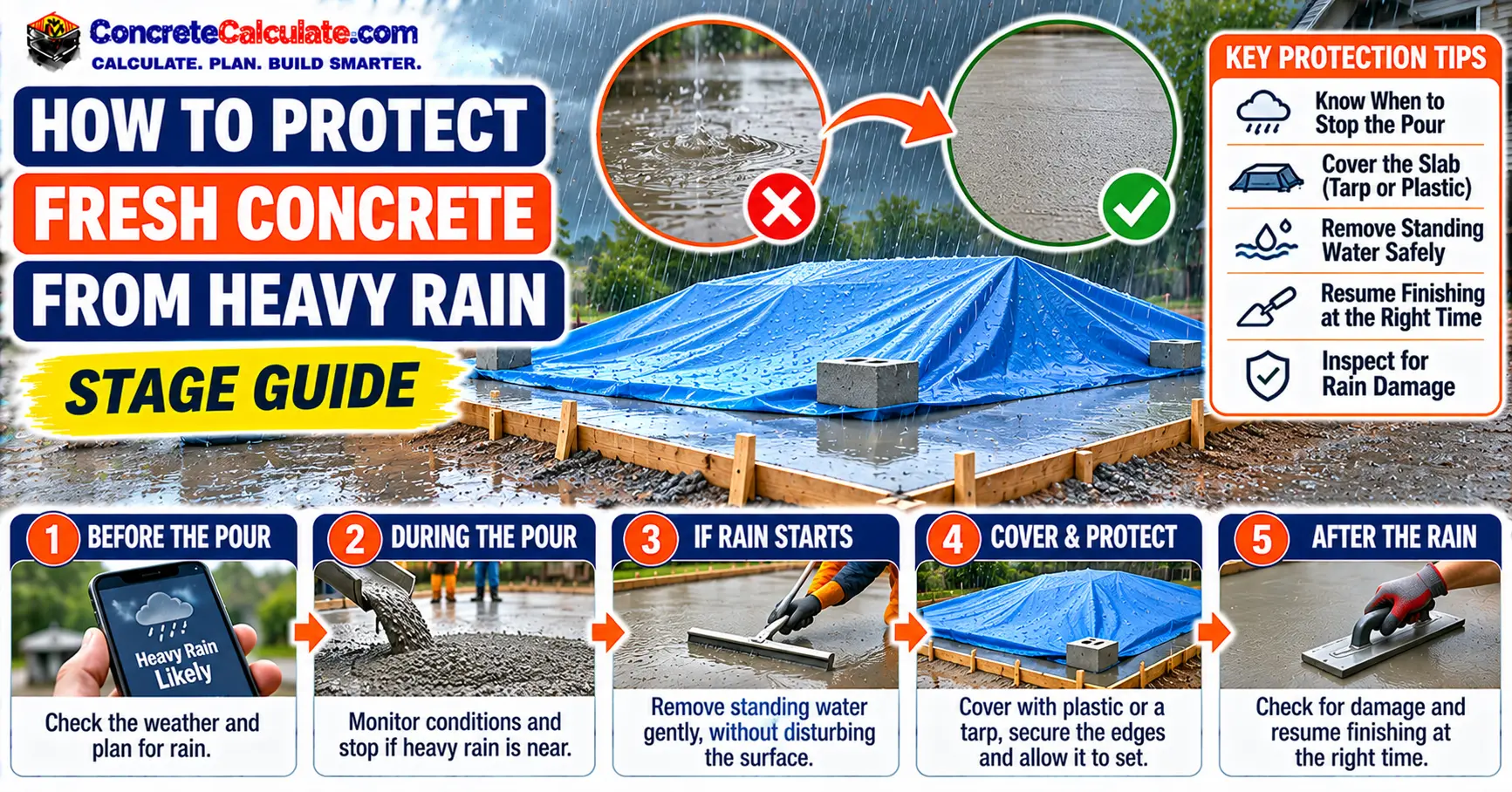
A stage-by-stage guide to preparing for rain, responding during the pour, removing rainwater safely, and checking the slab for damage afterward.
To protect fresh concrete from heavy rain, match your response to the stage. During placement, stop or limit the pour so rainwater is not mixed in. After floating, remove surface water and do not finish. During finishing, never work rainwater in. Once the concrete has hardened, rain is much less harmful.
- Check the hourly forecast and keep covers, tools and bulkhead material on site.
- Redirect roof and ground runoff away from the slab.
- If heavy rain starts during placement, stop or limit the pour and protect the concrete.
- After floating, wait out the storm and remove standing water gently.
- Resume finishing only when the water sheen is gone and the surface has stiffened.
- Inspect the slab afterward and do not re-finish hardened rain marks.
A. Understand what rain does
- Can Heavy Rain Ruin Fresh Concrete?
- Why Is Rain Dangerous to Fresh Concrete?
- Rainwater vs. Bleed Water: Why the Same Rule Applies
- The Four Stages of Rain Risk
B. Prepare before the pour
- Check the Weather Before Ordering Concrete
- When Should You Postpone the Concrete Pour?
- Build a Fresh-Concrete Rain Protection Kit
- How Much Plastic Sheeting Do You Need?
- Keep Roof and Ground Runoff Away From the Pour
C. Rain during placement
- Rain Starts While Concrete Is Being Poured: What Should You Do?
- Should You Keep Screeding Concrete in Heavy Rain?
- How to Stop a Pour With an Emergency Bulkhead
- How to Protect Sloped Concrete During Heavy Rain
D. After placement and floating
- What If Rain Starts During the Waiting/Bleed Period?
- Should You Cover Concrete During the Waiting Period?
- How to Remove Rainwater From Fresh Concrete
- Can You Use a Leaf Blower on Fresh Concrete?
- When Can Finishing Resume After Rain?
E. Rain during final finishing
- What If Rain Starts While You Are Troweling or Brooming?
- Never Trowel or Broom Rainwater Into the Concrete
- Should You Add Dry Cement to Absorb Rainwater?
F. Rain after finishing and curing
- What If Heavy Rain Starts Immediately After Finishing?
- Is Rain Good for Concrete After It Sets?
- How Long Should Fresh Concrete Be Protected From Rain?
G. Inspect after the storm
Can Heavy Rain Ruin Fresh Concrete?
Yes, heavy rain can ruin fresh concrete, but how much damage it does depends on timing, intensity, duration and what the crew does while rainwater is on the slab.
ACI describes a rain event in terms of those storm properties and stresses timing above all. Rain mixed into plastic concrete during placement is a very different problem from rain that falls after the slab is floated (ACI, Concrete Placements Exposed to Rain).
This guide protects fresh concrete from heavy rain stage by stage. For a shorter overview, see our page on pouring concrete in the rain.
Why Is Rain Dangerous to Fresh Concrete?
Rain harms fresh concrete by adding water where it does not belong or by washing away the surface. Several separate mechanisms are at work.
- Water mixed into the plastic concrete during placement
- Cement paste washed from the surface by intense rain or flowing runoff
- A weakened surface layer when finishing continues through standing water
- Pockmarks and marring from raindrops or from covers
- Erosion on slopes, steps and ramps
- Disrupted or delayed finishing
Each mechanism has its own fix, which is why the response must match what is actually happening on the slab.
Rainwater vs. Bleed Water: Why the Same Rule Applies
Rainwater on a placed slab behaves much like bleed water, the water that rises to the surface of fresh concrete. Both sit on top of plastic concrete, and neither should be worked into it.
ACI makes this comparison directly, noting that rainwater standing on already placed and floated concrete is not automatically harmful if it is removed before final finishing.
NRMCA gives the matching rule for bleed water: wait until bleeding has stopped and the water sheen is gone (NRMCA CIP 14).
So the rule is the same in both cases. Remove free water first, then finish.
The Four Stages of Rain Risk
Rain risk changes at four stages: placement, waiting, final finishing and curing. This is the framework ACI uses, and it is the backbone of this guide (ACI University).
| Stage | Typical concrete condition | Main rain risk | Recommended response |
|---|---|---|---|
| Placement | Highly plastic | Rain mixed into the concrete | Stop or limit placement, protect, use a bulkhead if needed |
| Waiting | Placed and floated | Paste washout and surface water | Avoid finishing and remove water later |
| Final finishing | Stiffening | Water worked into the surface | Remove water and do not finish through it |
| Curing | Hardened or stiff | Heavy rain may mark or erode the surface if early | Protect if intense. Later rain may aid curing |
The correct response to rain depends on the stage of the concrete placement, not simply how many minutes have passed.
Check the Weather Before Ordering Concrete
Check the hourly forecast and radar before you schedule the truck. The timing of the rain matters more than the daily rain total.
- Hourly forecast for the placement and finishing window
- Radar movement and storm speed
- Thunderstorm probability
- Expected rainfall intensity
- Likely storm duration
Forecasts are uncertain, so keep protection supplies on site even when the odds of rain look low.
When Should You Postpone the Concrete Pour?
Postpone when you cannot protect the placement quickly if the weather turns. There is no single rainfall percentage that works for every job.
- Heavy rain is highly likely during placement or finishing.
- The site cannot be covered quickly.
- Drainage cannot handle the runoff.
- The placement is too large to protect.
- The finish is highly sensitive to appearance.
FHWA’s field reference manual suggests that when rain is forecast, it may be prudent to adjust the schedule or choose smaller pours that are easier to cover (FHWA Field Reference Manual). Use the Concrete Pour Duration Calculator to see how long your placement will really take.
Build a Fresh-Concrete Rain Protection Kit
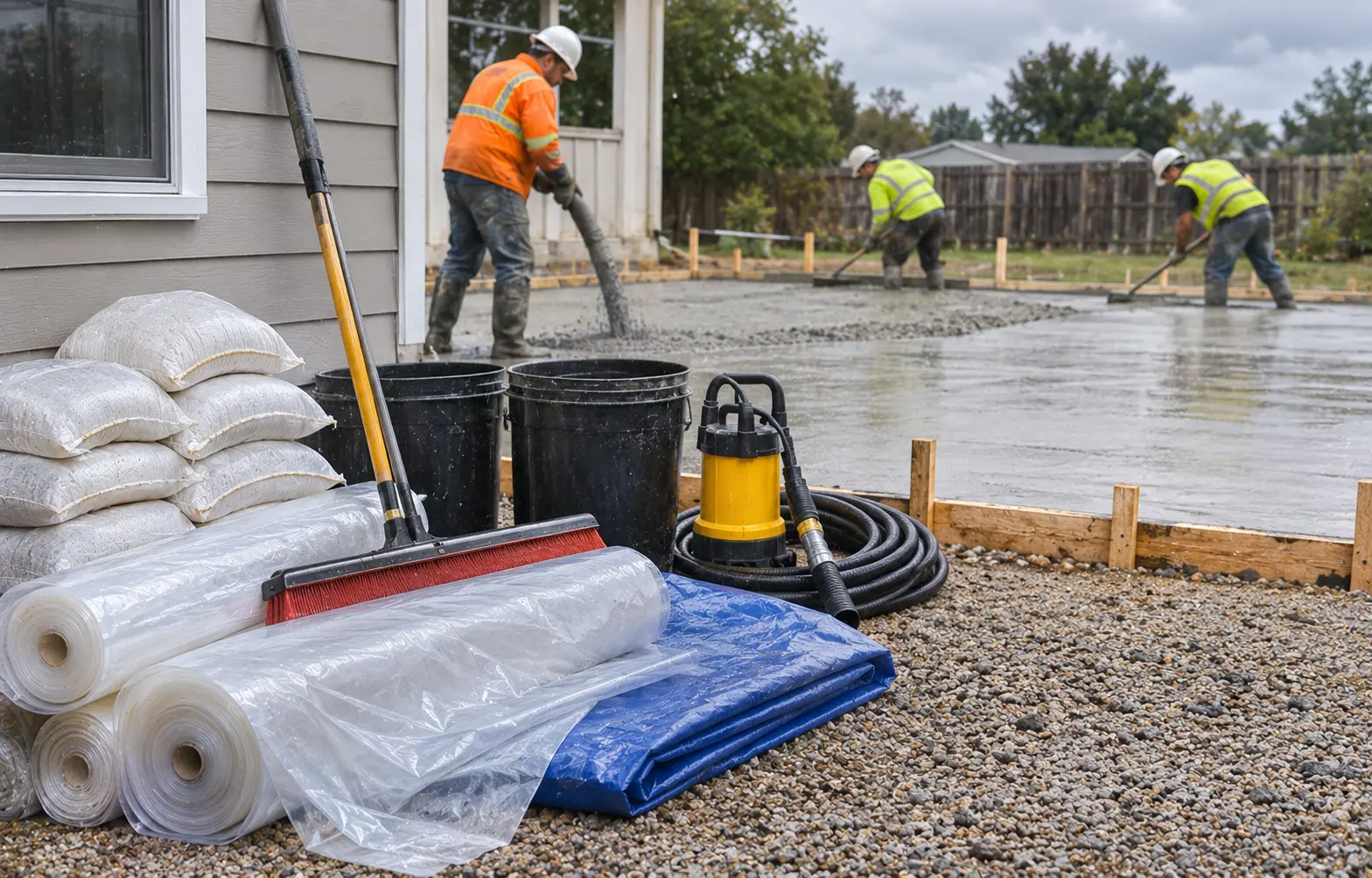
A rain kit is the set of tools and materials you keep ready before the truck arrives. Table 2 lists what to include and why.
| Item | Purpose |
|---|---|
| Polyethylene sheets | Emergency surface protection |
| Sandbags or weights | Secure the covering |
| Squeegee | Move standing water |
| Smooth foam board | Remove surface water gently |
| Pump | Remove collected water |
| Hose | Drag or move surface water where appropriate |
| Leaf blower | Assist water removal and drying |
| Bulkhead material | Stop the placement cleanly |
| Flashlights | Work safely if a storm arrives late |
| Weather and radar access | Track approaching rain |
| Extra labor | Cover and remove water quickly |
Public agencies treat this as a basic requirement. FHWA’s guide specification for full-depth repairs calls for covering materials such as burlap or cotton mats, curing paper or plastic sheeting to be on hand at all times (FHWA Full-Depth Repairs).
How Much Plastic Sheeting Do You Need?
You need more sheeting than the slab area, because the cover has to overlap, extend past the edges and be anchored. Use a planning method instead of a fixed waste factor.
Do not apply one universal overlap dimension unless your project specification gives one. Overlap, perimeter extension and anchoring all add to the total.
Example (planning assumption only)
A 12 ft × 20 ft slab has a surface area of 240 ft². If you want the cover to extend 1 ft past every edge, the covered area is (12 + 2) × (20 + 2) = 14 × 22 = 308 ft².
That is the minimum before overlaps are added. Check the width of the sheeting you buy and plan the seams.
Keep Roof and Ground Runoff Away From the Pour
Rain falling on the slab is only part of the problem. Runoff from roofs, uphill ground and excavations can reach the fresh concrete as flowing water.
- Redirect downspouts away from the slab.
- Divert uphill runoff around the placement.
- Keep excavation water out of the forms.
- Watch for flow along form edges.
ACI notes that intense rain or flowing water can remove surface paste, so a concentrated stream of runoff is more damaging than ordinary rainfall (ACI). Plan the diversion before the pour, not during the storm.
A wet-weather plan should control both direct rainfall and runoff before the concrete truck arrives.
Rain Starts While Concrete Is Being Poured: What Should You Do?
If heavy rain starts during placement, stop or limit the pour so rainwater is not mixed into the concrete. Placement is the stage when rainwater can become intermixed with the body of the slab.
- Stop or limit continued placement if the rain is becoming damaging.
- Prevent water from being mixed into the concrete.
- Set a clean stopping point, such as a bulkhead, where it is practical.
- Protect the exposed concrete.
- Evaluate the affected sections afterward.
FHWA’s guide specification takes the same approach. When rain appears imminent, paving stops and everyone starts covering the unhardened concrete (FHWA).
Should You Keep Screeding Concrete in Heavy Rain?
Generally no, not if screeding mixes significant rainwater into the fresh concrete. Normal operations should pause when water is being worked into the body of the slab.
The concern is workers walking, consolidating and striking off through standing rainwater. The existence of rain above the slab is not the problem by itself.
How to Stop a Pour With an Emergency Bulkhead
An emergency bulkhead is a temporary end form that holds back the fresh concrete so you can stop cleanly. It gives you a defined edge instead of a ragged, unprotected one.
- Build a stable termination that retains the concrete.
- Coordinate its location with joint and reinforcement requirements.
- Do not invent dowel details on your own.
For structural slabs, the contractor, the engineer and the project specifications control. Your pour-stop plan should be part of the wet-weather plan, not an improvisation.
How to Protect Sloped Concrete During Heavy Rain
Sloped concrete needs protection sooner because flowing water can wash paste off it. Driveways, steps, ramps and sloped patios are all at higher risk.
- Expect greater washout risk than on a flat slab.
- Consider a cover, which can be especially useful.
- Keep flowing water from crossing the slab.
- Secure the covering against wind.
ACI notes that covering sloped surfaces can help prevent paste loss during intense rain (ACI).
What If Rain Starts During the Waiting/Bleed Period?
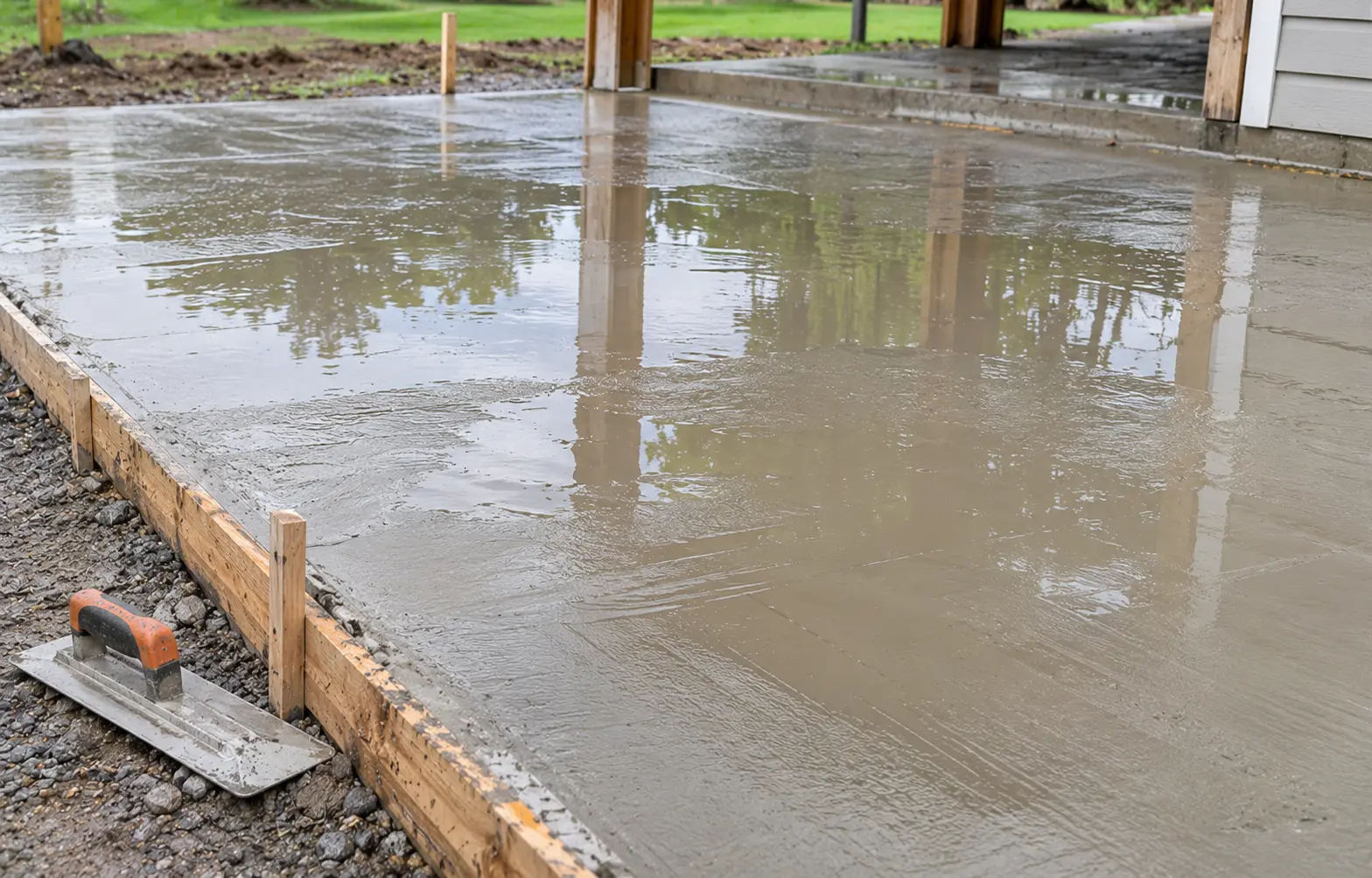
If rain starts after the slab is placed and floated, do not finish it. This waiting stage is more favorable than rain during placement or final finishing because the floated concrete is relatively impermeable.
- Do not finish while rain is falling.
- Control runoff around the slab.
- Protect against severe washout.
- Wait for the storm to pass.
- Remove surface water before resuming finishing.
Should You Cover Concrete During the Waiting Period?
Sometimes. Covering is worth considering in intense rain, on slopes and wherever paste washout is a risk, but it is not always the best option.
Direct plastic contact has drawbacks. According to the ACI article, covers can mar a soft surface, seams can leak, projecting steel or plumbing can puncture a sheet, and very plastic concrete can be damaged by workers walking on it to place the sheets (ACI).
Removing a sheet can also dump collected water back on the slab. Where practical, hold the covering clear of a soft surface and lift it so water runs off the edge.
How to Remove Rainwater From Fresh Concrete
Remove standing rainwater as soon as it is safe to, without stripping sound surface paste. The goal is speed with a gentle touch.
The ACI article lists squeegees, smooth polystyrene foam boards, hoses dragged across the surface and leaf blowers as field methods. Its authors report that a foam board often works best because it covers more area and is gentler on the paste (ACI).
| Method | Advantage | Main caution |
|---|---|---|
| Squeegee | Simple, local control | Can disturb very soft paste |
| Foam board | Broad, gentle contact | Needs controlled handling |
| Hose dragged over the surface | Covers a large area | Must not gouge the surface |
| Leaf blower | Noncontact air movement | Avoid excessive force |
| Pump at a collection point | Removes redirected water | Keep suction off the fresh surface |
Can You Use a Leaf Blower on Fresh Concrete?
Yes, as a helper, not a main tool. A blower moves water and air-dries the surface without touching it, which helps when humid air slows evaporation after rain.
Do not blast the concrete hard enough to erode paste. Use the blower to move water and speed drying, not to reshape the surface.
When Can Finishing Resume After Rain?
Finishing can resume only when standing water is gone, bleeding has ended, no water sheen remains and the surface has stiffened appropriately. The clock alone does not tell you.
- Standing rainwater has been removed.
- Bleeding has ended.
- No water sheen remains.
- The surface has stiffened enough to finish.
NRMCA warns that finishing through free surface water can lead to dusting, scaling, crazing, delamination and blisters (NRMCA CIP 14). ACI also says finishing should begin after bleeding stops and the surface has stiffened, and must finish before final set (ACI technical FAQ).
What If Rain Starts While You Are Troweling or Brooming?
Rain during final finishing is difficult because the surface is stiffening while you are still working it. Stop and protect the surface rather than working rainwater in.
The ACI article notes that light rain may sometimes be removed between passes, but working water into the surface creates a weaker surface layer (ACI). See how to create a broom finish on concrete for the correct timing.
Never Trowel or Broom Rainwater Into the Concrete
Never trowel or broom rainwater into the surface. Doing so raises the local water-cement ratio, weakens the paste and invites wear and durability problems.
- Do not add water.
- Do not add dry cement.
- Do not add cement powder.
NRMCA is explicit that you should never sprinkle water or cement on the surface to make finishing easier (NRMCA CIP 14). Weak spots from this mistake often show up later as concrete dusting or concrete scaling.
Rainwater should be removed before final finishing rather than incorporated into the surface.
Should You Add Dry Cement to Absorb Rainwater?
No. Sprinkling dry cement on a wet surface makes a weak, uneven layer, and NRMCA prohibits sprinkling cement on the surface during finishing.
ACI describes one narrow emergency use of dry cement and sand: as a perimeter dam outside the slab to hold back water. It specifically warns against adding dry cement to the fresh concrete itself.
| Mistake | Why it is harmful |
|---|---|
| Keep pouring through heavy rain | Water can mix into the concrete |
| Trowel through standing water | Creates weaker surface paste |
| Broom through rainwater | Works water into the surface |
| Sprinkle dry cement | Creates a weak, nonuniform layer |
| Add more water | Raises the local water-cement ratio |
| Walk on a very soft slab to spread plastic | Can deform or mar the surface |
| Dump water from plastic back onto the slab | Restarts the surface-water problem |
| Re-finish hardened rain marks | Can worsen surface quality |
What If Heavy Rain Starts Immediately After Finishing?
The answer depends on how stiff the surface already is. Heavy rain right after finishing can still pockmark, erode or mark a soft surface.
- Raindrop pockmarks
- Paste erosion
- Marks from covers
Keep plastic available for intense storms, but protect the finish from direct sheet contact where practical. If a sheet must go on, prevent water from collecting on top and spilling back.
Is Rain Good for Concrete After It Sets?
Once concrete has hardened enough, rain can help rather than hurt, because moisture supports curing. That holds only if the rainfall is not intense enough to wash away the surface.
The ACI article makes this point about the curing stage, so rain after final set is not the same problem as rain during placement (ACI).
Still, do not assume all post-finish rain is harmless, and begin curing as soon as finishing is done, as the concrete curing and drying time guide explains.
How Long Should Fresh Concrete Be Protected From Rain?
Protect it until placement and finishing are complete and the surface is stiff enough to resist erosion. There is no single hour count that fits every job.
- Placement is complete.
- Finishing is complete.
- The surface has reached enough stiffness, or final set, to resist erosion.
Temperature, mix, admixtures, wind and humidity all change the timing. The Concrete Curing Temperature Chart and Concrete Curing Time Chart give general context.
How to Tell Whether Rain Damaged the Concrete
Check the slab after it has hardened enough to inspect without disturbing it. Look for signs that paste was washed or water was worked in.
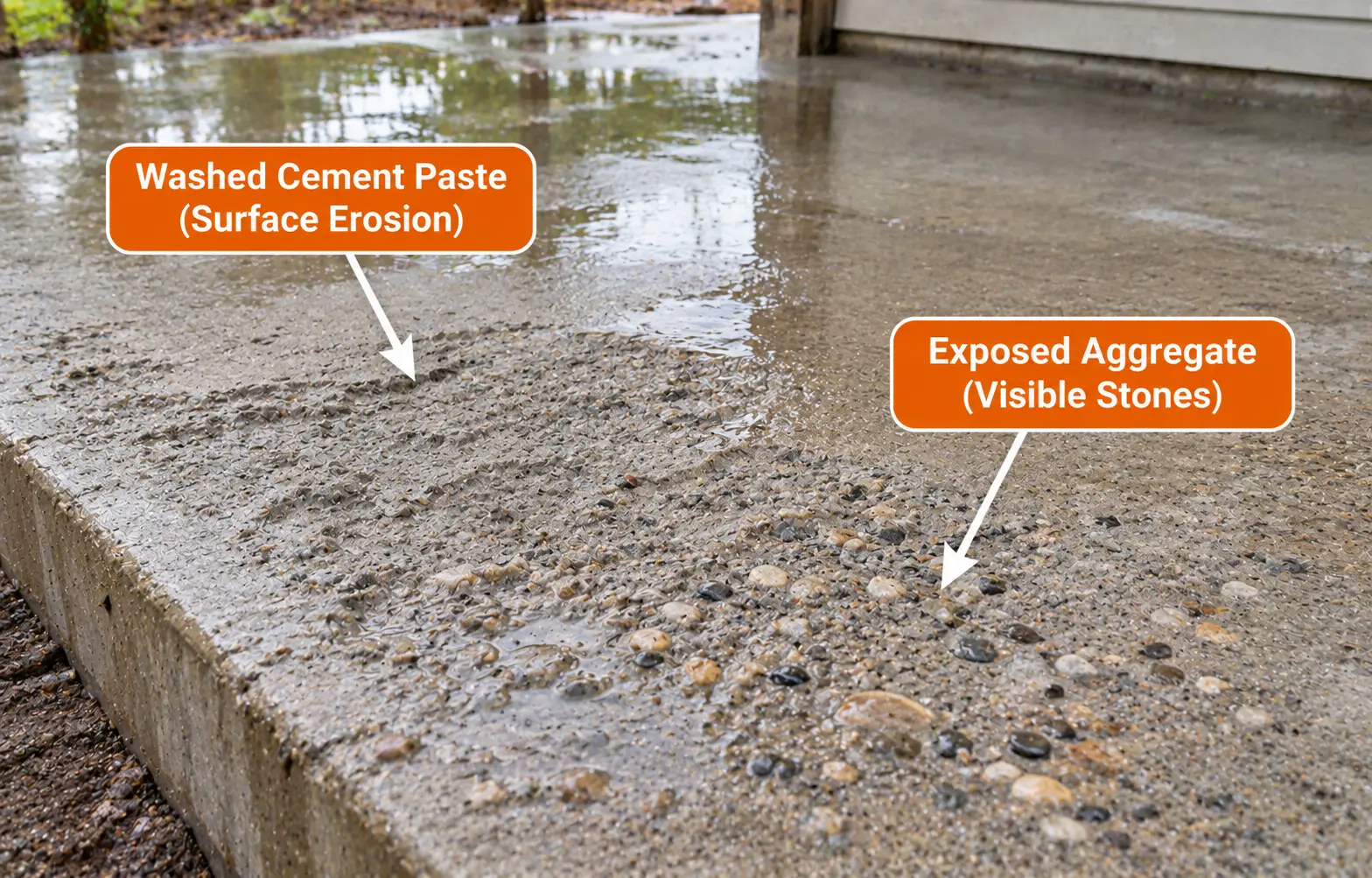
- Washed paste and exposed aggregate
- Pockmarks
- A rough or sandy surface
- Discoloration
- Shallow erosion
- An obviously soft surface
- Deeper disturbance where rain mixed into plastic concrete
| Symptom | Possible meaning | Severity |
|---|---|---|
| Light raindrop marks | Surface marring | Often cosmetic |
| Plastic-sheet marks | Cover contact | Usually shallow |
| Sandy surface | Surface paste disturbed or washed | Evaluate |
| Exposed aggregate | Paste washout | More significant |
| Soft surface | High local water-cement ratio or poor finish | Concerning |
| Deep rut or distortion | Concrete disturbed during placement | Serious |
| Broad weak layer | Water worked into the surface | Repair likely |
| Full-depth disturbance | Water mixed in while placing | Professional evaluation |
Cosmetic Rain Marks vs. Serious Rain Damage
Many rain defects are shallow and cosmetic, while others point to a weak surface or deeper problem. The difference is how far the water got into the concrete.
- Potentially cosmetic: light pockmarks, mild cover marks and appearance variation.
- More concerning: paste washout, a soft or weak surface, deep erosion, large areas finished through rainwater, or rain mixed in during placement.
The ACI article notes that surface-only rain defects are often shallow and repairable, while full-depth effects from substantial water mixed into the slab can be more serious (ACI).
Can Rain-Damaged Concrete Be Repaired?
Often yes, depending on how deep the damage goes. Repair options range from doing nothing to replacement, and the right one depends on a proper evaluation.
- No repair if the appearance is acceptable
- Surface grinding
- Resurfacing
- A hardener or densifier in selected cases
- Localized repair
- Removal and replacement for severe full-depth damage
Do not simply re-finish hardened concrete. FHWA warns that unprotected rained-on pavement should not be re-finished, and says texture may be restored by sawcut grooving (FHWA Field Reference Manual).
For shallow surface problems, see the Concrete Resurfacing Guide and how to fix pitted concrete floors. If you see hollow or flaking areas, check concrete delamination.
Run through Table 6 before the truck arrives, so nothing is missing when the weather turns.
| Check | Ready? |
|---|---|
| Forecast reviewed | ☐ |
| Rain timing and intensity considered | ☐ |
| Plastic covers on site | ☐ |
| Covers can be deployed safely | ☐ |
| Squeegee and foam board ready | ☐ |
| Pumps and drainage path ready | ☐ |
| Bulkhead plan and material ready | ☐ |
| Downspouts and site runoff redirected | ☐ |
| Enough crew available | ☐ |
| Finishing tools protected | ☐ |
| Curing materials available | ☐ |
| Post-rain inspection plan understood | ☐ |
Fresh Concrete and Rain FAQs
Can concrete be poured if rain is forecast?
Sometimes, but plan for it. Check the hourly forecast, keep plastic sheeting, water-removal tools and bulkhead material on site, and have enough crew to protect the slab quickly. If heavy rain is likely during placement or finishing, or the pour is too large to cover, postponing is the safer choice.
Will heavy rain ruin fresh concrete?
Not necessarily. The damage depends on when the rain falls and how intense it is. Rain mixed into plastic concrete during placement is the most serious. Rain on a floated slab is manageable if the water is removed before finishing, and intense rain can still wash paste from the surface.
Should I cover fresh concrete with plastic?
Cover it when rain is imminent or intense, and on sloped surfaces, since sheeting helps prevent paste loss. Be careful, because plastic can mar a soft surface, seams can leak and removal can dump water back on the slab. Hold the sheet clear of soft concrete where practical.
What if it rains one hour after pouring?
It depends on the condition of the concrete, not the hour count. If the slab is placed and floated but still bleeding, avoid finishing, protect against washout and remove standing water later. If rain is falling during placement or is very intense, stop and cover the work.
Can rainwater be troweled into concrete?
No. Troweling or brooming rainwater into the surface raises the local water-cement ratio and creates a weak layer that can dust, scale or wear quickly. Remove the standing water first, wait until the sheen is gone and the surface has stiffened, then finish.
Can I add cement powder after rain?
No. NRMCA says never to sprinkle cement or water on the surface to help finishing, because it creates a weak, uneven layer. Dry cement and sand are used only outside the slab, for example as a temporary perimeter dam to hold back water.
How do I remove standing water?
Use gentle tools that move water without stripping sound paste, such as a squeegee, a smooth foam board, a hose dragged across the surface or a leaf blower to assist drying. Pump any water you collect away from the slab. Avoid heavy pressure that scrapes the surface.
When can finishing resume?
Finishing can resume when the standing rainwater is gone, bleeding has ended, no water sheen remains and the surface has stiffened enough to finish. Judge it by how the concrete behaves, not by a clock, and complete finishing before final set.
Is rain helpful during curing?
It can be. Once the concrete has hardened enough, rain adds moisture that supports curing, as long as it is not intense enough to wash away the surface. Rain while the surface is still soft is a different matter, so protect it if a heavy storm arrives early.
How do I know if rain damaged my slab?
Look for washed paste, exposed aggregate, pockmarks, a sandy or soft surface, discoloration or erosion. Light marks are often cosmetic, while a weak surface, deep disturbance or rain mixed in during placement deserves a professional evaluation. Compare the affected area with sound concrete nearby before deciding.
Conclusion
To protect fresh concrete from heavy rain, match your response to the stage. Prevent rainwater from mixing in during placement, remove surface water before finishing, never work rainwater into the surface, and inspect the slab after the storm.
Plan your pour timing and truck deliveries before you commit to a rainy-weather window.
Open the Concrete Pour Duration Calculator