Steel Pipe Weight Chart 2026 – lb/ft & kg/m by Schedule
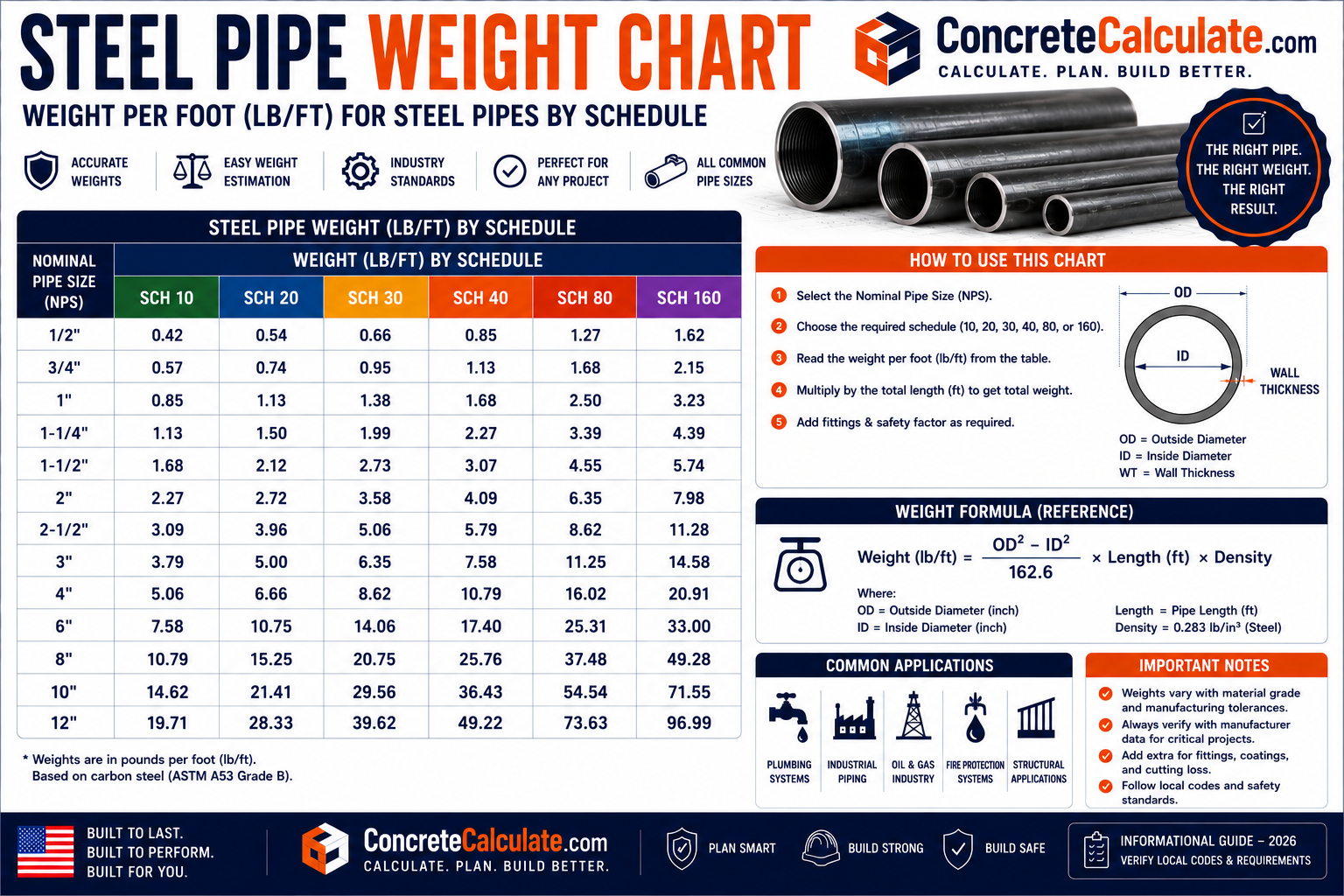
Steel Pipe Weight Chart
lb/ft & kg/m by Schedule
Plain end weight for welded and seamless wrought steel pipe, with the exact formula, worked examples, and water filled weight calculations.
 Reviewed by Muhammad Ramzan Babar, PhD Researcher & Calculator Developer · View Profile
All values in this chart represent plain end, bare carbon steel pipe weight per ASME B36.10, before coating, threading, flanges, fittings, or contents. Actual installed or shipped weight will be higher; see the sections on coating, water filled weight, and theoretical versus actual weight below.
⭐⭐⭐ Steel Pipe Weight Chart: Quick Reference
Plain end weight per ASME B36.10 for common Schedule 40 steel pipe sizes.
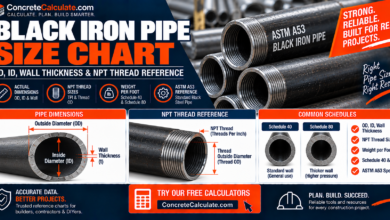
| NPS | DN | OD | Schedule | Wall Thickness | Weight lb/ft | Weight kg/m |
|---|---|---|---|---|---|---|
| 1/8″ | 6 | 0.405″ | 40 | 0.068″ | 0.24 | 0.36 |
| 1/4″ | 8 | 0.540″ | 40 | 0.088″ | 0.42 | 0.63 |
| 3/8″ | 10 | 0.675″ | 40 | 0.091″ | 0.57 | 0.84 |
| 1/2″ | 15 | 0.840″ | 40 | 0.109″ | 0.85 | 1.27 |
| 3/4″ | 20 | 1.050″ | 40 | 0.113″ | 1.13 | 1.68 |
| 1″ | 25 | 1.315″ | 40 | 0.133″ | 1.68 | 2.50 |
| 1-1/4″ | 32 | 1.660″ | 40 | 0.140″ | 2.27 | 3.38 |
| 1-1/2″ | 40 | 1.900″ | 40 | 0.145″ | 2.72 | 4.04 |
| 2″ | 50 | 2.375″ | 40 | 0.154″ | 3.65 | 5.44 |
| 3″ | 80 | 3.500″ | 40 | 0.216″ | 7.58 | 11.27 |
| 4″ | 100 | 4.500″ | 40 | 0.237″ | 10.79 | 16.06 |
| 6″ | 150 | 6.625″ | 40 | 0.280″ | 18.97 | 28.24 |
| 8″ | 200 | 8.625″ | 40 | 0.322″ | 28.55 | 42.49 |
| 10″ | 250 | 10.750″ | 40 | 0.365″ | 40.48 | 60.25 |
| 12″ | 300 | 12.750″ | 40 | 0.406″ | 53.53 | 79.65 |
ASME B36.10 provides dimensions and plain end weights/masses for welded and seamless wrought carbon and alloy steel pipe. Values shown are calculated using the standard formula and verified against multiple independently published B36.10 based references.
⭐ What Is Steel Pipe Weight?
Steel pipe weight is the mass of the bare pipe material per unit length.
Weight vs mass
Weight is commonly expressed in lb/ft in U.S. construction practice, while mass is commonly expressed in kg/m in metric practice. Both describe the same physical quantity using different unit conventions.
Why weight varies
Pipe weight depends on outside diameter, wall thickness (which is set by schedule), steel density, and the length of pipe being weighed.
Key variables
NPS, OD, wall thickness, schedule, and material density are the core inputs; end condition (plain end vs threaded and coupled) also affects actual supplied weight.
Answering “how much does it weigh”
Weight cannot be answered from NPS alone; both the schedule and the actual OD/wall combination must be known.
⭐⭐⭐ Steel Pipe Weight Formula
The theoretical relationship behind every value in this chart.
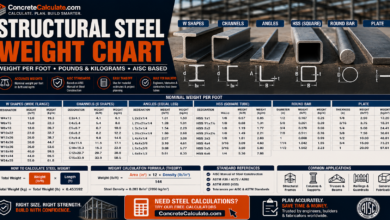
W (lb/ft) = 10.6802 × t × (OD − t), where t is wall thickness in inches and OD is outside diameter in inches. This constant is derived from carbon steel density (approximately 0.2836 lb per cubic inch) combined with the geometric conversion from square inches to a per foot basis.
| Variable | Meaning | Unit |
|---|---|---|
| OD | Outside diameter | Inches |
| t | Wall thickness | Inches |
| 10.6802 | Constant combining steel density and unit conversion | lb/ft per in² |
This formula gives a close approximation consistent with ASME B36.10 tabulated values, but always use the actual standard table or manufacturer data for final engineering, procurement, or shipping decisions.
⭐⭐⭐ Steel Pipe Weight Calculation Example
Demonstrating that the formula and the standard tabulated value agree closely.
2 Inch Schedule 40 Steel Pipe
Identify the nominal pipe size.
Look up the standard actual outside diameter for that NPS.
Identify the wall thickness for the specific schedule.
Use the annular ring area between OD and ID.
Multiply by the applicable material density.
Express the result in the desired unit convention.
⭐⭐⭐ Schedule 40 Steel Pipe Weight Chart
The most commonly referenced steel pipe weight series.
| NPS | OD (in) | Wall (in) | Weight (lb/ft) | Weight (kg/m) |
|---|---|---|---|---|
| 1/2″ | 0.840 | 0.109 | 0.85 | 1.27 |
| 3/4″ | 1.050 | 0.113 | 1.13 | 1.68 |
| 1″ | 1.315 | 0.133 | 1.68 | 2.50 |
| 1-1/4″ | 1.660 | 0.140 | 2.27 | 3.38 |
| 1-1/2″ | 1.900 | 0.145 | 2.72 | 4.04 |
| 2″ | 2.375 | 0.154 | 3.65 | 5.44 |
| 3″ | 3.500 | 0.216 | 7.58 | 11.27 |
| 4″ | 4.500 | 0.237 | 10.79 | 16.06 |
| 6″ | 6.625 | 0.280 | 18.97 | 28.24 |
| 8″ | 8.625 | 0.322 | 28.55 | 42.49 |
| 10″ | 10.750 | 0.365 | 40.48 | 60.25 |
| 12″ | 12.750 | 0.406 | 53.53 | 79.65 |
⭐⭐⭐ Schedule 80 Steel Pipe Weight Chart
Always heavier than Schedule 40 at the same NPS due to thicker walls.
| NPS | OD (in) | Wall (in) | Weight (lb/ft) | Weight (kg/m) |
|---|---|---|---|---|
| 1/2″ | 0.840 | 0.147 | 1.09 | 1.62 |
| 3/4″ | 1.050 | 0.154 | 1.47 | 2.19 |
| 1″ | 1.315 | 0.179 | 2.17 | 3.23 |
| 1-1/4″ | 1.660 | 0.191 | 3.00 | 4.46 |
| 1-1/2″ | 1.900 | 0.200 | 3.63 | 5.40 |
| 2″ | 2.375 | 0.218 | 5.02 | 7.47 |
| 3″ | 3.500 | 0.300 | 10.25 | 15.26 |
| 4″ | 4.500 | 0.337 | 14.98 | 22.30 |
| 6″ | 6.625 | 0.432 | 28.57 | 42.52 |
| 8″ | 8.625 | 0.500 | 43.39 | 64.57 |
| 10″ | 10.750 | 0.593 | 64.33 | 95.73 |
| 12″ | 12.750 | 0.687 | 88.51 | 131.72 |
⭐⭐⭐ Schedule 160 Steel Pipe Weight Chart
The heaviest common schedule series for standard pressure piping.
| NPS | OD (in) | Wall (in) | Weight (lb/ft) | Weight (kg/m) |
|---|---|---|---|---|
| 1/2″ | 0.840 | 0.187 | 1.31 | 1.95 |
| 1″ | 1.315 | 0.250 | 2.85 | 4.24 |
| 2″ | 2.375 | 0.344 | 7.46 | 11.10 |
| 4″ | 4.500 | 0.531 | 22.51 | 33.50 |
| 6″ | 6.625 | 0.719 | 45.35 | 67.48 |
| 8″ | 8.625 | 0.906 | 74.71 | 111.19 |
⭐⭐⭐ STD, XS & XXS Steel Pipe Weight
These are alternative wall designations within ASME B36.10, not additional schedule numbers.
STD (Standard Weight)
Matches Schedule 40 wall thickness and weight for NPS 1/8 through 10. At NPS 12 and larger, STD diverges from Schedule 40, generally becoming relatively thinner at a given size as Schedule 40 continues increasing.
XS (Extra Strong)
Matches Schedule 80 wall thickness and weight for NPS 1/8 through 8. At NPS 10 and larger, XS diverges from Schedule 80 and uses its own fixed wall thickness and corresponding weight.
XXS (Double Extra Strong)
The heaviest wall designation, available only across a limited range of NPS sizes, not the full range offered by Schedule 40/80/160.
| NPS | OD (in) | STD Weight (lb/ft) | XS Weight (lb/ft) | XXS Weight (lb/ft) |
|---|---|---|---|---|
| 1/2″ | 0.840 | 0.85 | 1.09 | 1.71 |
| 2″ | 2.375 | 3.65 | 5.02 | 9.03 |
| 4″ | 4.500 | 10.79 | 14.98 | 27.54 |
| 6″ | 6.625 | 18.97 | 28.57 | 53.16 |
⭐⭐⭐ Schedule 40 vs Schedule 80 Weight Comparison
The practical implications of choosing a heavier schedule.
| NPS | Sch 40 (lb/ft) | Sch 80 (lb/ft) | Weight Increase |
|---|---|---|---|
| 2″ | 3.65 | 5.02 | +37% |
| 3″ | 7.58 | 10.25 | +35% |
| 4″ | 10.79 | 14.98 | +39% |
| 6″ | 18.97 | 28.57 | +51% |
| 8″ | 28.55 | 43.39 | +52% |
Heavier schedule pipe requires stronger lifting equipment, closer support spacing consideration, higher shipping costs, and greater handling effort. A 6 inch Schedule 80 run can weigh over 50 percent more than the same length of Schedule 40, which materially affects crane capacity and support design assumptions.
⭐⭐⭐ Steel Pipe Weight by NPS
Quick individual reference for commonly searched sizes.
1/2 inch steel pipe
OD 0.840 in. Sch 40: 0.85 lb/ft (1.27 kg/m). Sch 80: 1.09 lb/ft (1.62 kg/m).
1 inch steel pipe
OD 1.315 in. Sch 40: 1.68 lb/ft (2.50 kg/m). Sch 80: 2.17 lb/ft (3.23 kg/m).
2 inch steel pipe ⭐⭐⭐
OD 2.375 in. Sch 40: 3.65 lb/ft (5.44 kg/m). Sch 80: 5.02 lb/ft (7.47 kg/m). Sch 160: 7.46 lb/ft (11.10 kg/m).
3 inch steel pipe ⭐⭐⭐
OD 3.500 in. Sch 40: 7.58 lb/ft (11.27 kg/m). Sch 80: 10.25 lb/ft (15.26 kg/m).
4 inch steel pipe ⭐⭐⭐
OD 4.500 in. Sch 40: 10.79 lb/ft (16.06 kg/m). Sch 80: 14.98 lb/ft (22.30 kg/m). Sch 160: 22.51 lb/ft (33.50 kg/m).
6 inch steel pipe ⭐⭐⭐
OD 6.625 in. Sch 40: 18.97 lb/ft (28.24 kg/m). Sch 80: 28.57 lb/ft (42.52 kg/m).
8 inch steel pipe ⭐⭐⭐
OD 8.625 in. Sch 40: 28.55 lb/ft (42.49 kg/m). Sch 80: 43.39 lb/ft (64.57 kg/m).
12 inch steel pipe ⭐⭐⭐
OD 12.750 in. Sch 40: 53.53 lb/ft (79.65 kg/m). Sch 80: 88.51 lb/ft (131.72 kg/m).
⭐⭐⭐ Steel Pipe Weight Unit Conversion
Essential conversions for switching between imperial and metric weight units.
| Conversion | Formula | Example |
|---|---|---|
| lb/ft to kg/m | kg/m = lb/ft x 1.48816 | 3.65 lb/ft = 5.43 kg/m |
| kg/m to lb/ft | lb/ft = kg/m ÷ 1.48816 | 5.44 kg/m = 3.66 lb/ft |
| lb/ft to lb/in | lb/in = lb/ft ÷ 12 | 3.65 lb/ft = 0.304 lb/in |
| lb/ft to total weight | Total lb = lb/ft x length (ft) | 3.65 lb/ft x 20 ft = 73.0 lb |
Equipment for Your Project
Affiliate disclosure: As an Amazon Associate, ConcreteCalculate earns from qualifying purchases. We may also earn a commission from other affiliate links at no additional cost to you.
⭐⭐⭐ Steel Pipe Weight and Material Density
Theoretical weight calculations depend directly on the assumed material density, which varies by steel type.
| Material | Density (lb/in³) | Density (g/cm³) | Common Standard |
|---|---|---|---|
| Carbon steel | 0.2836 | 7.85 | ASTM A53 / A106, ASME B36.10 |
| Stainless steel 304 | 0.2890 | 7.99 | ASTM A312 TP304, ASME B36.19 |
| Stainless steel 316 | 0.2900 | 8.02 | ASTM A312 TP316, ASME B36.19 |
Stainless steel is slightly denser than carbon steel, meaning a stainless pipe of identical dimensions weighs slightly more. Keep stainless steel pipe weight calculations separate from the carbon steel table above; consult ASME B36.19 and the applicable stainless material density for accurate stainless steel pipe weight, rather than mixing it into the primary carbon steel table.
Carbon steel pipe weight
The primary material covered by this chart, using 0.2836 lb/in³ density and ASME B36.10 dimensional data.
Stainless steel pipe weight
Uses a slightly higher density (approximately 0.289 to 0.290 lb/in³ depending on grade) and ASME B36.19 dimensional tables, which can differ from B36.10 at certain sizes and schedules.
⭐⭐⭐ Steel Pipe Weight With Water
Total filled pipe weight is significantly higher than empty pipe weight and matters for supports and hydrotest planning.
Total filled weight equals empty pipe weight plus water weight, where water weight per unit length equals (π/4) times ID squared times water density (approximately 62.4 lb/ft³ or 1000 kg/m³). Contents, insulation, coating, lining, flanges, and water can substantially increase actual system weight beyond the bare plain end pipe weight.
| NPS (Sch 40) | Empty Weight (lb/ft) | Water Weight (lb/ft) | Total Filled Weight (lb/ft) |
|---|---|---|---|
| 2″ | 3.65 | 0.99 | 4.64 |
| 4″ | 10.79 | 3.61 | 14.40 |
| 6″ | 18.97 | 8.10 | 27.07 |
| 8″ | 28.55 | 13.94 | 42.49 |
⭐⭐⭐ Theoretical vs Actual Steel Pipe Weight
Three related but distinct weight concepts that should never be confused.
| Concept | Basis |
|---|---|
| Theoretical weight | Calculated directly from OD, wall thickness, and assumed material density using the geometric formula |
| Standard tabulated weight | Published in the governing dimensional standard, such as ASME B36.10, reflecting the standard’s own rounding and reference basis |
| Actual weight | The real measured weight of a specific manufactured pipe, which can vary due to manufacturing tolerance, actual material density, end preparation, and coating |
For final engineering design, shipping calculations, or crane lift planning, use the specific manufacturer’s actual weight data rather than relying solely on theoretical or generic tabulated values.
⭐⭐ Coating, Fittings, Insulation & Lining
None of these are included in the base plain end weight table.
Galvanized pipe weight
Zinc coating adds mass beyond bare steel weight; the exact addition depends on coating thickness and the specific galvanizing process, so no single universal percentage applies to every product.
Paint and epoxy coating
Adds a comparatively small amount of weight versus bare steel, but should still be accounted for in precise weight calculations for coated pipe systems.
Internal lining
Cement mortar lining, epoxy lining, or other internal linings add weight and also reduce effective internal diameter and flow area.
Insulation and cladding
Insulation and its protective cladding add substantial weight to a piping system beyond the bare pipe, particularly relevant for hot or cold service line support design.
Fittings, flanges, and valves
Elbows, tees, flanges, couplings, and valves are not represented in the straight pipe weight table and require separate weight data from their specific manufacturer or applicable dimensional standard.
Plain end vs threaded and coupled
Threading removes some material at the pipe end, while couplings add material; actual supplied weight for threaded and coupled (T&C) pipe differs from the plain end weight shown in the base B36.10 table.
⭐⭐⭐ Weight per Length & Bundle Weight
Weight per foot must be multiplied by actual purchased length for real quantities.
| NPS 4″ Sch 40 (10.79 lb/ft) | Length | Total Weight |
|---|---|---|
| Single length | 1 ft | 10.79 lb |
| Single length | 10 ft | 107.9 lb |
| Single length | 20 ft | 215.8 lb |
| Single length | 21 ft | 226.6 lb |
| Single length | 40 ft | 431.6 lb |
Actual commercial pipe lengths vary by manufacturer and product (commonly cited around 20 or 21 feet random length, but not universal); always confirm actual purchased length rather than assuming a fixed standard.
Bundle weight
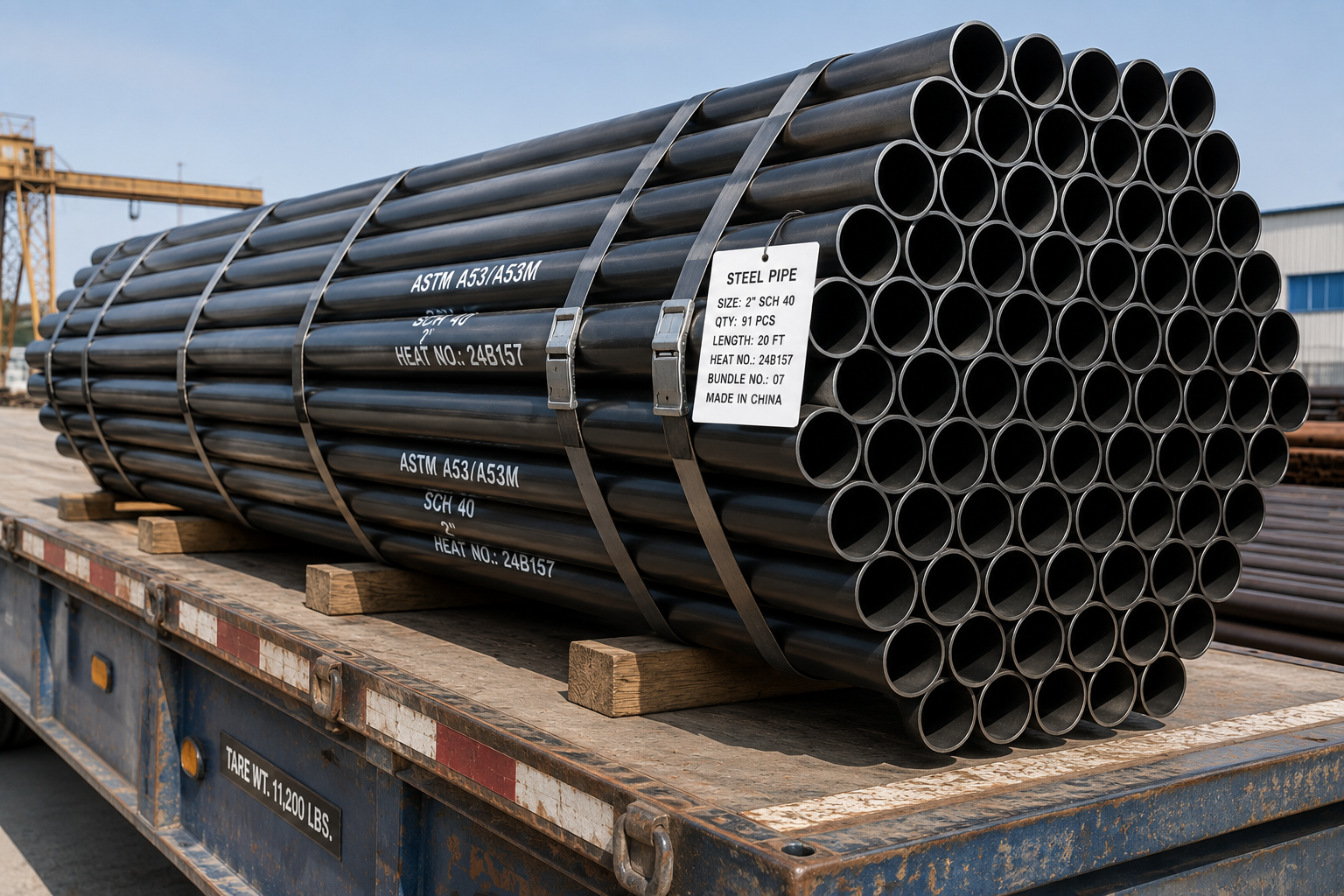
Total bundle weight equals number of pipes multiplied by weight per pipe (weight per foot times length), important for crane capacity and transport planning.
Shipping considerations
Bare pipe weight, packaging, bundling material, and any coating together determine actual shipping weight, which can meaningfully exceed the plain end theoretical weight.
⭐⭐⭐ Supports, Lifting & Hydrostatic Testing
Pipe weight is a critical but not sole input into support design and lifting safety.
Pipe supports
Support load calculations must consider empty pipe weight, operating contents, insulation, hydrotest water, and any attached valves or fittings together, not bare pipe weight alone.
Hydrostatic testing ⭐⭐⭐
Water filled hydrotest weight can be significantly greater than empty pipe weight, since water adds substantial mass; this hydrotest condition can govern support loads even when it is not the normal operating condition.
Lifting
Lifting calculations require actual pipe weight, length, attached fittings, slings, coating, and any contents; this chart provides a starting weight reference only and does not itself constitute a lifting safety determination.
Support spacing
Support spacing depends on pipe size, material, contents, temperature, applicable code, support type, and deflection criteria together; pipe weight alone does not determine correct spacing.
⭐⭐⭐ Steel Pipe Weight for Structural Applications
Structural round hollow sections may follow different standards than process piping schedules.
Structural round HSS products can follow different dimensional and weight standards than ASME B36.10 process pipe. Confirm the applicable structural specification before using a generic process-pipe schedule chart for structural design or weight calculations.
Construction applications ⭐⭐⭐
Steel pipe weight matters for pipe supports, concrete pump systems, temporary piping, water lines, structural applications, equipment specification, and material handling on construction sites.
Weight vs steel vs copper vs PVC
Steel pipe is meaningfully heavier per foot than PVC pipe of comparable size, and copper tube uses an entirely different sizing convention; see the PVC Pipe Size Chart and Copper Pipe Size Chart for those material-specific dimensions before comparing weight across materials.
⭐⭐⭐ Steel Pipe Weight Visual Guide
Original diagrams explaining the weight formula, schedule comparison, and empty vs filled weight.
⭐⭐⭐ Steel Pipe Weight Worked Examples
These examples demonstrate the calculation and conversion process.
1. 2 Inch Schedule 40
2. 4 Inch Schedule 40
3. 6 Inch Schedule 80
4. Calculate 20 Foot Pipe Weight
5. Convert lb/ft to kg/m
6. Calculate Water Filled Pipe Weight
⭐⭐⭐ Common Steel Pipe Weight Mistakes
Most weight calculation errors trace back to one of these misunderstandings.
❌ Confusing NPS with actual OD
Nominal pipe size and actual outside diameter differ for NPS 12 and smaller.
❌ Assuming Schedule 40 has one weight for every size
Weight increases substantially with NPS, from 0.24 lb/ft to over 50 lb/ft.
❌ Confusing lb/ft with total pipe weight
Weight per foot must be multiplied by actual length for total weight.
❌ Confusing kg/m with kg per pipe
Same issue in metric units; multiply by actual length in meters.
❌ Ignoring wall thickness
OD alone cannot determine weight; wall thickness (schedule) is equally essential.
❌ Ignoring pipe length
Weight per unit length is not the same as the weight of an actual purchased piece.
❌ Treating theoretical weight as exact shipping weight
Manufacturing tolerance and coating change actual shipped weight.
❌ Ignoring coating
Galvanizing, paint, and lining all add weight beyond bare steel.
❌ Ignoring fittings
Elbows, tees, flanges, and valves are not included in straight pipe weight.
❌ Ignoring contents
Water filled weight can be substantially higher than empty pipe weight.
❌ Using carbon steel density for stainless steel
Stainless steel has a slightly higher density than carbon steel.
❌ Confusing STD, XS, and XXS
These match specific schedules only within limited size ranges, then diverge.
Frequently Asked Questions
📄 Download Steel Pipe Weight Chart PDF
This PDF is a genuine field reference. Use the print button to create a print-ready or downloadable version.
Cite or Embed This Chart
Copy the page-wide citation to reference the complete Steel Pipe Weight Chart.