
Concrete Driveway Drainage: How to Fix Standing Water and Runoff
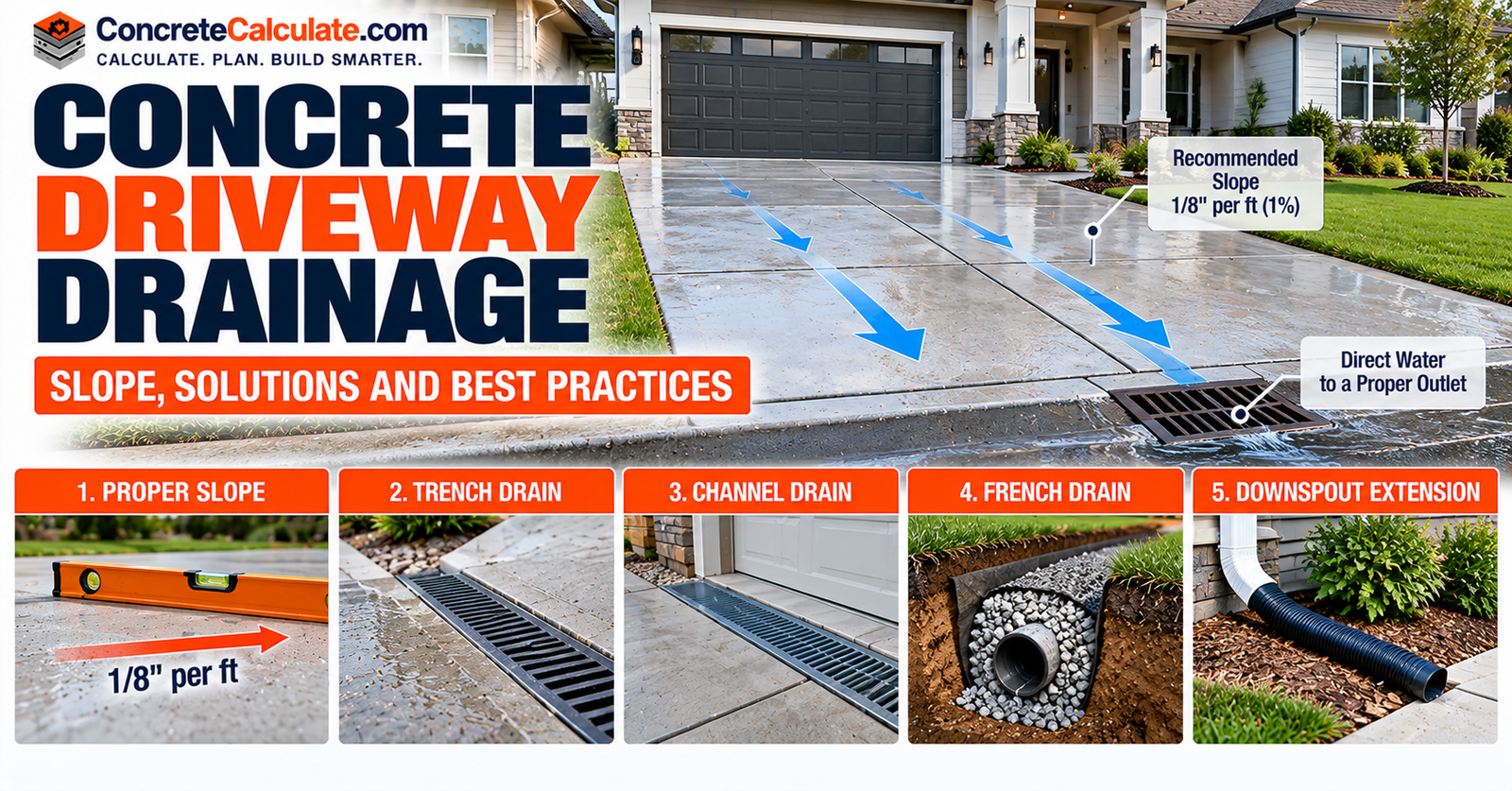
Where driveway runoff should go, why water pools on concrete, and how to choose between regrading, channel drains and other drainage solutions.
Quick Answer
An effective driveway drainage system moves rainfall and other runoff away from the garage, foundation and vulnerable driveway edges to an appropriate collection or discharge point. Getting there usually involves one or more of three approaches: correcting the surface grade, intercepting runoff with a suitable drain, or managing water at the driveway’s edges.
There’s no single universal slope or drain that fits every driveway. The right fix depends on where the water is coming from, where it currently collects, and whether a working outlet actually exists downstream.
| Problem | Likely Direction to Investigate |
|---|---|
| Water pools in one spot | Local depression, settlement or a blocked drain |
| Water runs toward the garage | Overall grade or extra runoff entering the driveway |
| Water washes out soil at the edges | Concentrated runoff without adequate edge drainage |
In This Guide
- 1. Concrete Driveway Drainage: Quick Answer
- 2. How Does Concrete Driveway Drainage Work?
- 3. Why Is Water Pooling on My Concrete Driveway?
- 4. Where Is the Driveway Water Coming From?
- 5. What Happens When Driveway Drainage Is Poor?
- 6. What Is the Appropriate Slope for a Concrete Driveway?
- 7. Longitudinal Slope vs. Cross Slope vs. Crown
- 8. How to Calculate Driveway Slope and Elevation Drop
- 9. How to Measure an Existing Driveway’s Slope
- 10. How to Identify Low Spots and Incorrect Drainage Direction
- 11. Driveway Slope Near a Garage and House Foundation
- 12. Can a Driveway Be Too Steep for Proper Drainage?
- 13. Concrete Driveway Drainage Solutions Compared
- 14. How to Fix Standing Water in a Concrete Driveway
- 15. When Does a Driveway Need a Channel or Trench Drain?
- 16. How to Plan and Install a Driveway Channel Drain
- 17. Channel Drain vs. Catch Basin vs. French Drain
- 18. How to Drain Water Away From Driveway Edges
- 19. Rain Gardens, Swales and Other Runoff-Management Options
- 20. Where Should Driveway Drainage Water Discharge?
- 21. Drainage for a Driveway That Slopes Toward the Garage
- 22. Drainage for Flat Driveways and Driveways With Low Spots
- 23. Drainage for Long, Steep and Curved Driveways
- 24. Roof Downspouts and Neighboring Runoff: Protecting the Driveway
- 25. How Much Does Concrete Driveway Drainage Cost?
- 26. How to Maintain a Driveway Drainage System
- 27. Common Driveway Drainage Mistakes and How to Avoid Them
- 28. Concrete Driveway Drainage FAQs
1. Concrete Driveway Drainage: Quick Answer
An effective driveway drainage system moves rainfall and other incoming runoff away from the garage, foundation and vulnerable edges toward an appropriate collection or discharge point. Getting water to move is only half the job. It also needs somewhere legitimate to go once it leaves the driveway surface.
Three principal solutions cover most residential situations: correcting the surface grade so water flows in the right direction, intercepting runoff with a suitable drain where grading alone isn’t enough, and managing water at the driveway’s edges with swales or stabilized shoulders. No single slope or drain type fits every driveway, so the right combination depends on your specific diagnosis.
2. How Does Concrete Driveway Drainage Work?
Water traveling across a driveway follows a complete path: it starts as rainfall or incoming runoff, moves across the surface following the longitudinal slope (lengthwise) and cross slope (side to side), reaches a collection point, and finally leaves through a discharge route. Each link in that chain has to work for the whole system to function.
A low point with no functioning outlet becomes exactly where water collects and sits, even if every other part of the driveway is properly graded. Throughout this guide, picture a simple residential driveway running from the street to a garage as the reference example for how these pieces fit together.
| Driveway Area | Rainfall Depth | Approximate Rainfall Volume |
|---|---|---|
| 400 ft² | 1 in | 249 gallons |
| 600 ft² | 1 in | 374 gallons |
| 800 ft² | 1 in | 499 gallons |
| 1,000 ft² | 1 in | 623 gallons |
Calculated using gallons = area (ft²) x rainfall (in) x 0.6233. These are illustrative gross rainfall volumes before losses or contributions from other surfaces. A real drainage system must be sized for the relevant design storm, rainfall intensity, contributing catchment area, runoff characteristics and local requirements, not simply the total gallons shown here.
3. Why Is Water Pooling on My Concrete Driveway?
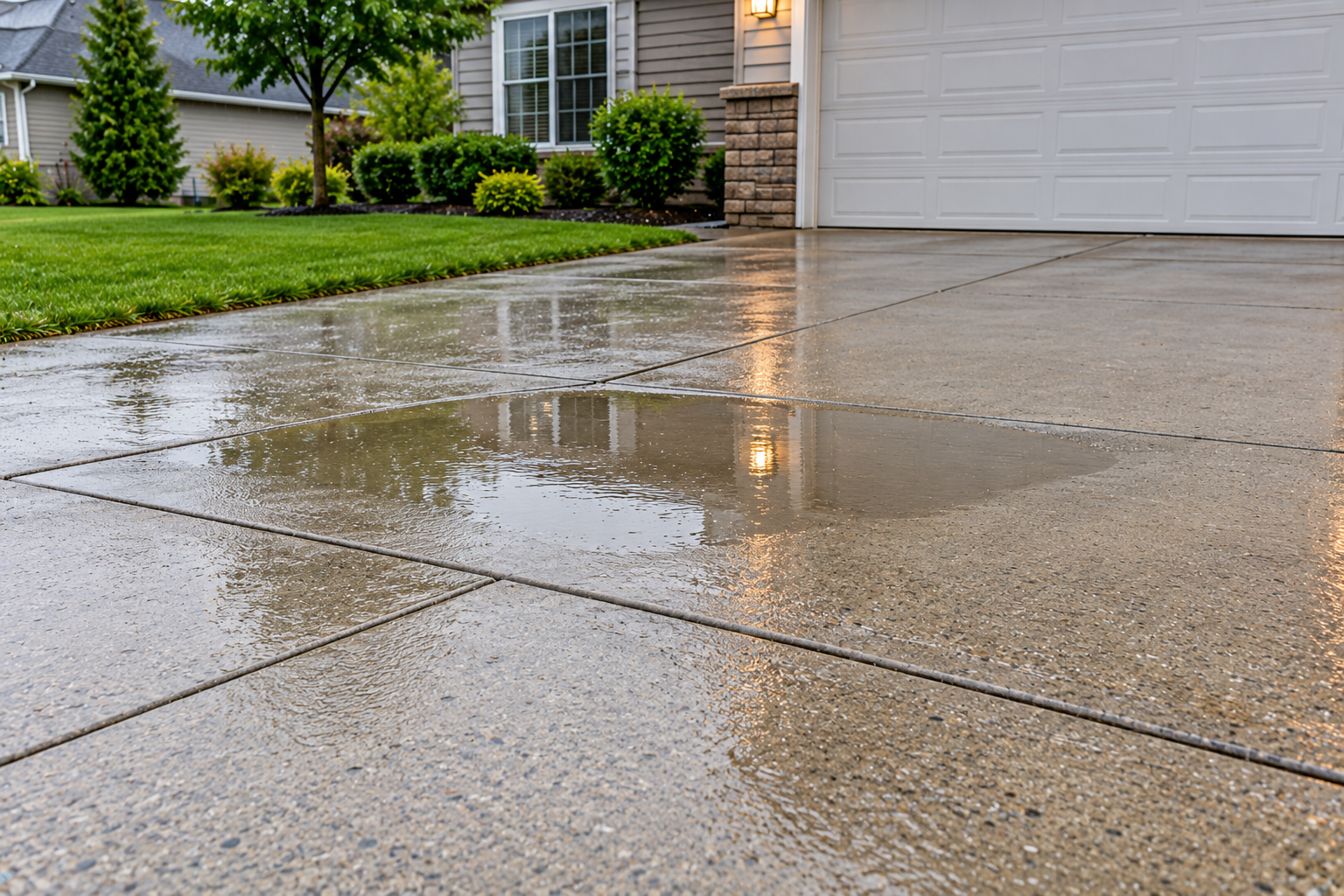
Ponding has several possible explanations, and the right fix depends heavily on which one applies to your driveway.
| What the Homeowner Observes | Possible Cause | What to Check First | Possible Solution |
|---|---|---|---|
| Water pools in one small area | Local surface depression | Surrounding elevations and concrete condition | Suitable localized repair or panel replacement |
| Water flows toward the garage | Overall grade or incoming runoff | Driveway profile, threshold and contributing area | Regrading or appropriately designed interception |
| Water pools beside a raised border | Blocked cross-drainage | Edge elevations and landscaping | Restore an appropriate drainage path |
| Water collects over an existing grate | Blocked inlet or inadequate system capacity | Grate, pipe and outlet | Cleaning or drainage-system assessment |
| Soil washes away beside the driveway | Concentrated runoff or unsuitable edge protection | Discharge pattern and soil condition | Swale, stabilized edge or appropriate drainage |
| Water reappears around concrete joints | Surface runoff or possible underlying drainage problem | Joint condition, grades and drainage history | Identify the water source before repair |
Timing matters too. Water that lingers long after rain has stopped points toward a drainage or outlet problem, while flooding only during intense storms suggests the system may be adequate for light rain but undersized for the contributing area during heavy events.
4. Where Is the Driveway Water Coming From?
Water reaching a driveway doesn’t always originate on the driveway itself. Rainfall falling directly on the slab is one source, but roof downspouts, uphill landscaping, neighboring hard surfaces and street runoff can all contribute additional water the driveway’s own grading was never designed to handle.
Observing water movement during a safe, light rainfall event, or running a controlled hose test along suspected entry points, helps identify where water actually enters versus where it merely ends up. Identifying every contributing source matters before selecting a drainage solution, since a fix sized only for direct rainfall will underperform if roof or uphill runoff is also reaching the driveway.
5. What Happens When Driveway Drainage Is Poor?
Poor drainage can lead to garage flooding, water entering near the foundation, erosion along the driveway’s edges, deterioration of the supporting soil beneath the slab, persistent standing water, winter ice buildup and damage to adjacent landscaping.
Ponding by itself does not automatically prove that a concrete slab has structural damage. Persistent moisture and edge erosion, however, can contribute to problems worth investigating, particularly if they continue for multiple seasons without improvement.
6. What Is the Appropriate Slope for a Concrete Driveway?
Longitudinal slope and cross slope serve different purposes on the same driveway. Longitudinal slope moves water along the driveway’s length, while cross slope moves it sideways off to one or both edges.
The applicable grade for a given driveway depends on the garage elevation, the street connection, where the water is meant to discharge, vehicle clearance needs, and any building or accessibility requirements that apply to that specific site. The 2024 International Residential Code requires ground immediately adjacent to a foundation, and applicable impervious surfaces within 10 feet of it, to slope away at a minimum of about 2 percent.
This foundation-specific provision shouldn’t be extended automatically to the entire driveway, and it doesn’t mean every driveway must have exactly a 2 percent slope end to end. Always confirm the code actually adopted in your jurisdiction.
7. Longitudinal Slope vs. Cross Slope vs. Crown
Three basic surface geometries cover most residential driveway drainage patterns.
| Pattern | How It Works | Where It’s Useful | Risk to Watch For |
|---|---|---|---|
| Longitudinal slope | Water moves along the driveway’s length toward one end | Straight driveways with a clear low-end outlet | Directing flow toward a garage if the low end is at that side |
| Cross slope | Water sheds sideways to one edge | Driveways with a receiving swale or drain on one side | Sending water toward a house or neighboring property |
| Crown | Water splits toward both edges from a center high point | Wider driveways needing drainage on both sides | Requires functioning collection on both edges, not just one |
8. How to Calculate Driveway Slope and Elevation Drop
Slope and Drop Formulas
Slope (%) = (Vertical change / Horizontal run) x 100
Drop (in) = Run (ft) x 12 x (Slope (%) / 100)
Worked Example: 20-ft Run at 2% Grade
Drop = 20 x 12 x (2 / 100) = 240 x 0.02 = 4.8 inches of elevation difference across the 20-foot run.
This tells you how much lower one end of the measured run needs to be than the other to achieve a 2 percent grade, which is the starting point for checking whether your existing driveway meets its intended slope.
Calculate Your Driveway Grade
Use the Elevation Grade Calculator to work out slope and elevation differences for your specific driveway measurements.
Open the Elevation Grade Calculator9. How to Measure an Existing Driveway’s Slope
A long straightedge and level, a string-line system, or a suitable laser level can all measure existing driveway slope with reasonable accuracy. Record readings at the garage, the driveway’s midpoint, the street connection, and both edges rather than just one line down the center.
A measurement taken only along the centerline can miss a depression running through one wheel path or a low spot near a raised border, since these often sit off-center from where a single string line would pass.
10. How to Identify Low Spots and Incorrect Drainage Direction
Map where water actually accumulates after rain, then compare those locations against the elevations you’d expect from the intended grade. A localized depression is a different problem than a driveway whose overall profile sends water the wrong direction entirely.
A small surface repair fixes an isolated depression but won’t solve flooding that’s actually caused by the driveway’s larger drainage layout, so it’s worth confirming which situation you’re dealing with before choosing a repair scope.
11. Driveway Slope Near a Garage and House Foundation
Garage thresholds, adjacent walls, doorway clearances and exterior runoff routing all deserve careful attention where a driveway meets a house. The 2024 IRC’s foundation-drainage provision is a useful reference point here, though unusually constrained sites may need an approved drainage alternative or an engineered solution instead of the standard general approach.
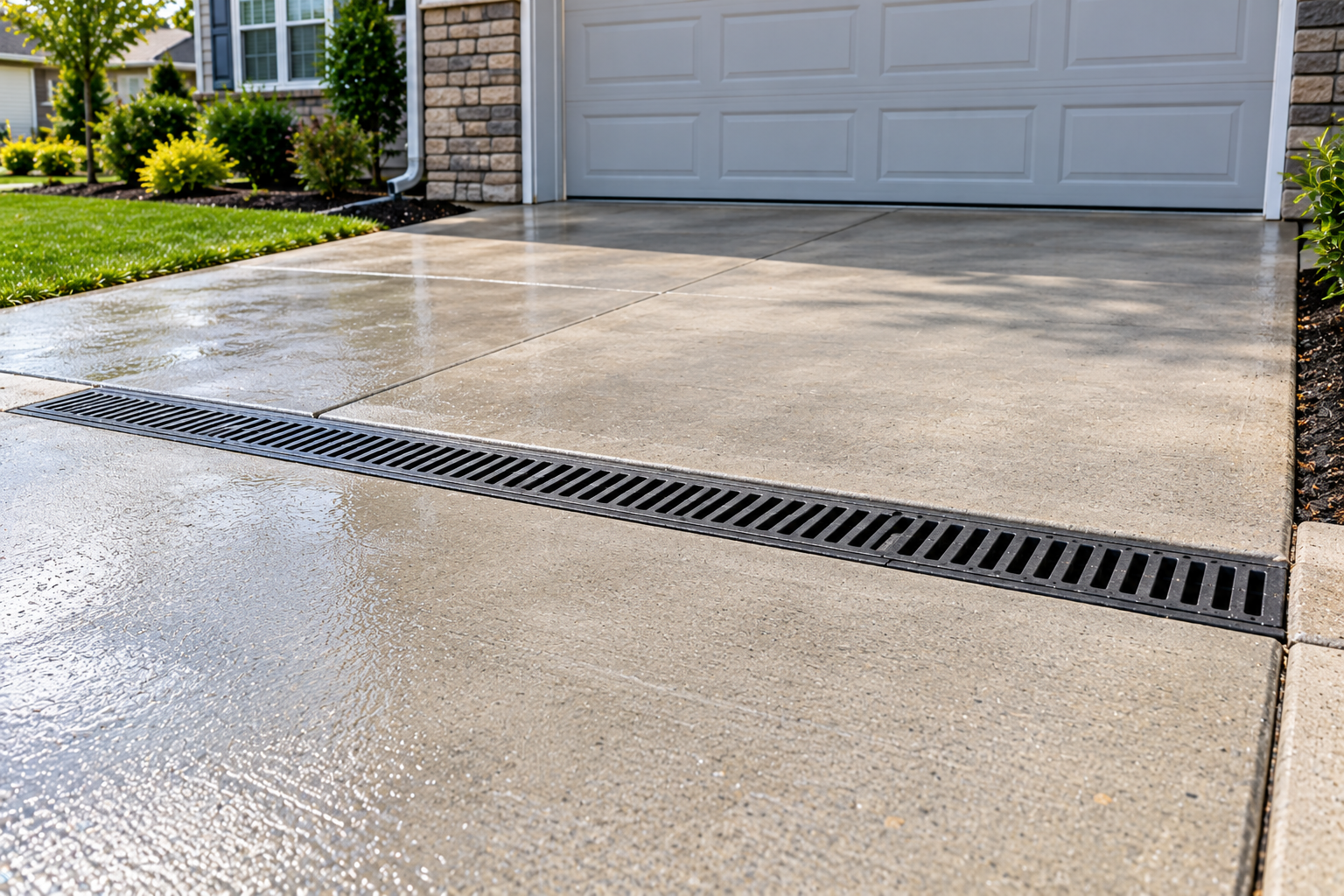
A channel drain can intercept surface water arriving at a garage threshold, but it does not automatically correct an unsuitable foundation-drainage system on its own. If water is entering near the foundation itself rather than just pooling on the driveway surface, that’s a separate issue worth investigating directly.
12. Can a Driveway Be Too Steep for Proper Drainage?
An overall driveway that’s too steep, an abrupt transition at the garage or street, and poorly directed runoff are three separate problems that sometimes get lumped together. Excessive slope can create vehicle-clearance issues, reduced traction, accelerated erosion and winter-access difficulty, independent of whether the drainage itself works.
Check local requirements for transition geometry and driveway permits before finalizing a steep driveway design. Where a driveway also functions as an accessible route or accessible parking area, separate accessibility requirements apply.
Accessible Parking Has Its Own Slope Limit
Accessible parking spaces and their adjacent access aisles must not exceed a slope of 1:48, approximately 2.08 percent, in any direction, under the ADA Standards for Accessible Design. Ordinary residential driveway slope guidance should not be applied to a required accessible parking space, since the accessibility slope limit is stricter and measured differently than typical drainage grading.
13. Concrete Driveway Drainage Solutions Compared
The correct solution depends entirely on the diagnosed drainage problem, not on which fix happens to be most familiar.
| Drainage Problem | Potential Solution | Main Advantage | Important Limitation |
|---|---|---|---|
| Local depression in sound concrete | Compatible surface repair | Addresses an isolated low spot | Must preserve traffic suitability and drainage |
| Settled or deteriorated concrete panel | Appropriate repair or reconstruction | Corrects underlying geometry | Soil support and movement must be investigated |
| Runoff moving toward garage | Channel drain or grade redesign | Can intercept concentrated surface runoff | Requires suitable capacity and a working outlet |
| Runoff accumulating at one low point | Catch basin | Collects water at a defined location | Ineffective if poorly positioned or blocked |
| Water flowing along driveway edge | Swale or suitable edge drainage | Intercepts and conveys runoff | Needs adequate grade and erosion protection |
| Suitable onsite infiltration location | Rain garden or engineered infiltration practice | Can slow and absorb runoff | Requires appropriate soils, siting and overflow |
| Water trapped beneath or beside the driveway | Properly designed subsurface drainage | Can address certain subsurface-water conditions | Does not automatically fix surface grading |
14. How to Fix Standing Water in a Concrete Driveway
Start from your findings in sections 3 through 10 rather than jumping straight to a repair. Distinguish a small surface depression in otherwise sound concrete from a settled section, a blocked drainage component, or an entire driveway graded incorrectly from the start.
Resurfacing over a depression requires checking the resulting finished elevation against the garage threshold, confirming the surrounding slab is sound enough to bond to, and verifying that a drainage route still exists once the repair is complete. Skipping any of these checks risks trading one drainage problem for another.
15. When Does a Driveway Need a Channel or Trench Drain?
A linear drain becomes useful where a driveway descends toward a garage, or wherever a defined low line needs to intercept runoff before it reaches a vulnerable area. The key distinction is between collecting water at the surface and actually having enough downstream capacity to carry that water away.
Grate loading appropriate for the expected traffic, channel capacity matched to the contributing drainage area, correct installation elevation, and access for future cleaning all factor into whether a channel drain will actually perform as intended.
16. How to Plan and Install a Driveway Channel Drain
Select the Collection Location
Identify the actual drainage low point on the driveway and determine what elevation the drain can be installed at while still intercepting the water before it reaches the vulnerable area.
Confirm the Outlet
Check the complete discharge route, its elevation, its capacity and whether you have permission for that discharge, before cutting into any existing concrete.
Choose a Vehicle-Rated System
Select a channel and grate rated for the expected traffic, following the manufacturer’s specific installation requirements for that product.
Install, Connect and Test
Excavate appropriately, prepare the supporting concrete around the channel, maintain the finished drainage geometry through the installation, and check that the outlet is actually functioning once the work is complete.
A residential installation tutorial demonstrates one situation well, but its specific trench depth, pipe diameter or grate specification shouldn’t be copied as a universal requirement for every driveway.
17. Channel Drain vs. Catch Basin vs. French Drain
These three systems get confused often, but they handle different drainage jobs. A channel drain intercepts runoff along a line, typically across a driveway or walkway. A catch basin collects water at one localized surface inlet point instead of along a continuous run.
A properly designed subsurface drainage system, sometimes called a French drain, intercepts groundwater or infiltrated water moving beneath the surface. A conventional French drain is not automatically the right solution for concentrated surface runoff on an impervious driveway, since it’s designed for a different kind of water movement entirely.
18. How to Drain Water Away From Driveway Edges
Appropriate cross slope, open edges without obstruction, curbs, gutters, stabilized shoulders and vegetated swales all help move water safely away from the sides of a driveway. Landscaping borders, accumulated soil, or driveway edging installed without considering drainage can accidentally trap water right on the concrete surface.
Protecting the adjacent soil against erosion and maintaining a functioning downstream flow path both matter once water actually leaves the driveway, not just while it’s still on the concrete.
19. Rain Gardens, Swales and Other Runoff-Management Options
Rain gardens, vegetated swales and properly designed infiltration systems are landscaped features the EPA identifies as stormwater practices that can slow, filter or infiltrate runoff. Suitability depends heavily on the specific site rather than being a universal fit.
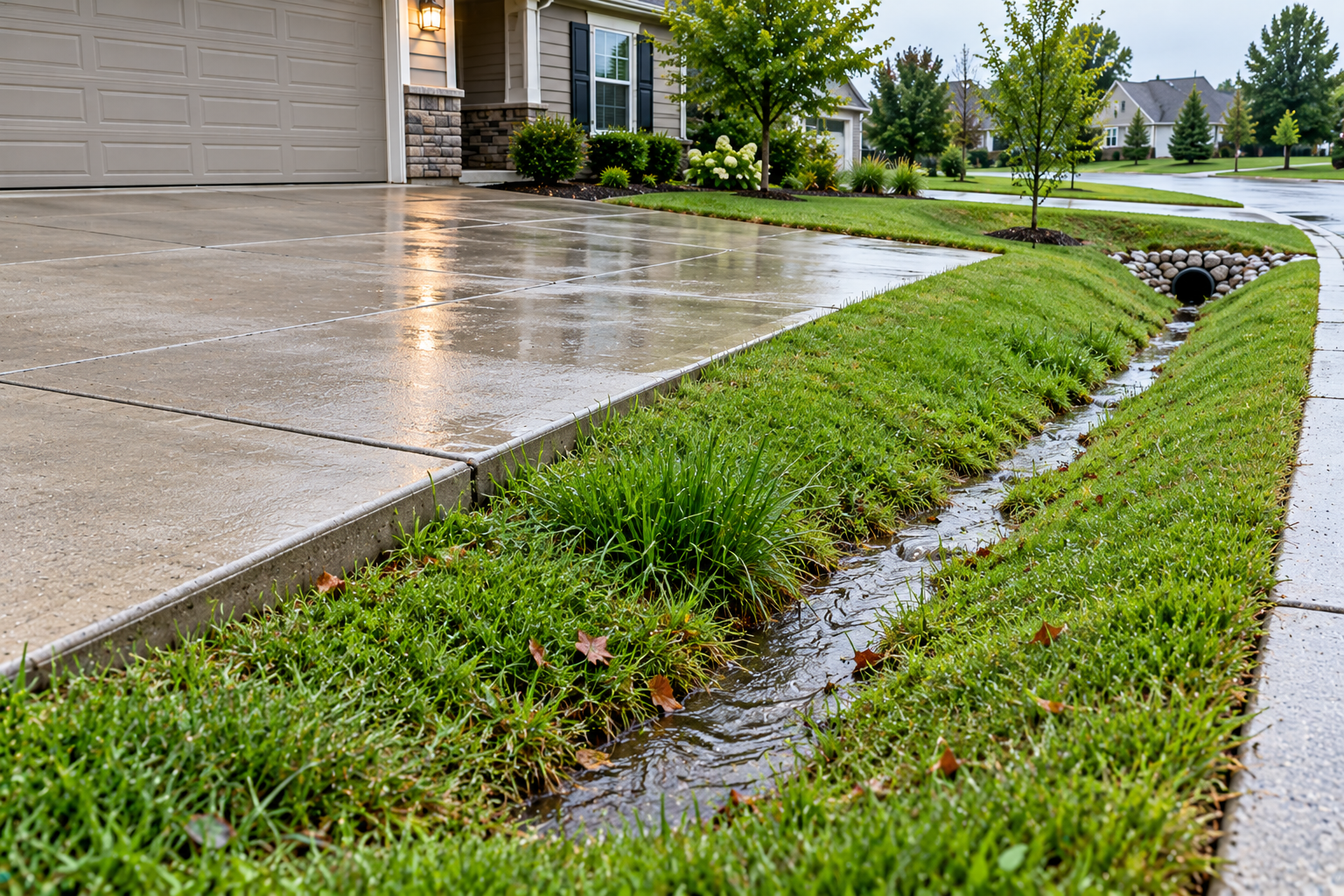
Soil infiltration rate, groundwater depth, proximity to foundations, overflow routing during larger storms, winter freeze conditions and local stormwater rules all factor into whether one of these features will work well on a given property.
20. Where Should Driveway Drainage Water Discharge?
Every drainage solution needs a lawful and functional outlet, whether that’s approved stormwater infrastructure, an appropriate onsite feature, or another locally permitted discharge arrangement. Water should never simply be redirected toward a neighboring basement, across a sidewalk, or into the street without confirming that’s actually allowed.
Outlet elevation, downstream capacity, erosion protection at the discharge point, potential backflow during heavy storms, and access for future maintenance all deserve consideration before finalizing where the water will actually go.
21. Drainage for a Driveway That Slopes Toward the Garage
Here’s a realistic diagnostic example: a driveway descending toward a garage door, where water naturally wants to collect right at the threshold.
An appropriately positioned cross-driveway channel drain can intercept runoff before it reaches the garage, but how much water actually reaches that drain depends on the surrounding grades and any additional catchment feeding the driveway. The drain needs to be sized for the actual contributing drainage area and a reasonable design rainfall, not merely the driveway’s own width.
22. Drainage for Flat Driveways and Driveways With Low Spots
Repairing one isolated depression, reconstructing a settled panel, and redesigning a larger area that simply lacks an effective drainage grade are three different scopes of work requiring different investigations. Confusing them leads to spending money on a fix that doesn’t address the actual problem.
Thin overlays can be unsuitable over deteriorating concrete or in locations with insufficient vertical clearance near a garage door or the street connection, so check both the substrate condition and available clearance before committing to a resurfacing approach.
23. Drainage for Long, Steep and Curved Driveways
Long runoff paths, steep grades, bends in the driveway, and additional uphill catchment areas all concentrate more water by the time it reaches the lower end of the driveway. Intercepting runoff before it travels the entire length, using edge drainage along the way, and protecting vulnerable outlets from concentrated flow all help manage this concentration.
FHWA’s driveway guidance discusses crowning, roadside ditching and culverts as ways to prevent driveways from diverting inappropriate runoff onto adjoining roadways. That highway-specific geometry shouldn’t be applied wholesale to residential driveways, but the underlying principle of managing concentrated flow before it becomes a problem applies broadly.
24. Roof Downspouts and Neighboring Runoff: Protecting the Driveway
Investigate whether runoff entering from outside the driveway itself, roof downspouts discharging directly onto the concrete, or water flowing in from a neighboring property, is overwhelming a system that would otherwise be adequate. Appropriate downspout extensions, separate stormwater collection for roof water, additional grading, and lawful interception of uphill runoff are all worth considering.
Whatever solution you choose, make sure it doesn’t simply create a new drainage problem somewhere else on the property.
25. How Much Does Concrete Driveway Drainage Cost?
Cost varies widely by the scope of work involved, from simply clearing an existing drain up through partial driveway replacement.
| Proposed Work | Main Cost Components | Budgeting Method |
|---|---|---|
| Clear an existing drain | Cleaning, equipment and possible inspection | Local service quote |
| Repair one low spot | Preparation, material and labor | Repair area x verified local rate |
| Install a channel drain | Channel, grate, cutting, excavation, installation, pipe and outlet | Installed linear footage plus itemized downstream work |
| Regrade surrounding landscaping | Excavation, fill, grading and erosion control | Local earthwork estimate |
| Add a swale or rain garden | Earthwork, engineered soil where needed, plants and overflow | Site-specific landscape or drainage quote |
| Replace a driveway section | Demolition, removal, supporting base, concrete and finishing | Local contractor estimate |
This Old House’s published guidance, sourced from Angi, cites an illustrative channel-drain installation range of roughly 30 to 100 dollars per linear foot. That figure is dated and specific to channel drains alone, and excavation, concrete cutting, grates, drainage piping, outlet work and local labor rates can all materially change an actual quote for your project.
Practical Estimate Worksheet
List your project scope, then gather a local quote for each cost component: material, cutting or excavation labor, installation labor, piping and outlet work, and any required landscaping restoration. Compare multiple contractor quotes referencing the same scope for an accurate comparison, rather than relying on a single national price range.
26. How to Maintain a Driveway Drainage System
Clear debris from grates regularly, inspect outlets to confirm they’re still flowing freely, remove accumulated soil that’s built up beside the driveway, check for new erosion, inspect joints for damage, and test the system before an expected heavy rain where practical.
Winter maintenance deserves extra attention where freezing temperatures, snow accumulation and blocked outlets can all interfere with drainage function. A blockage that keeps recurring in the same spot, despite regular cleaning, usually signals a larger design problem rather than simple debris accumulation.
27. Common Driveway Drainage Mistakes and How to Avoid Them
| Mistake | What Can Go Wrong | Better Approach |
|---|---|---|
| Installing a channel drain without an outlet plan | Water backs up or collects in the channel | Establish the entire discharge route first |
| Assuming 2% is mandatory everywhere | Conflicts with street transitions, accessibility or site design | Determine requirements for each part of the project |
| Directing runoff onto another property | Flooding, erosion or possible local-rule violations | Confirm a permitted drainage destination |
| Using an unsuitable drain grate | Damage under vehicle loading | Select for actual traffic and installation |
| Installing a drain at the wrong elevation | Water bypasses the inlet | Survey the collection line and finished surface |
| Resurfacing without checking underlying movement | Water returns or the repair fails | Investigate settlement and substrate condition |
| Ignoring roof runoff | The proposed system handles less water than reaches the driveway | Include all contributing drainage areas |
| Omitting maintenance access | Future cleaning becomes difficult | Include accessible grates, outlets and cleanouts as appropriate |
Pre-Construction Checklist for Contractor Quotes
Ask each contractor to identify the water source, confirm the outlet location and capacity, specify the grate and material selection, and explain how the finished grade will be verified before work begins.
28. Concrete Driveway Drainage FAQs
What slope should a driveway have?
It depends on the specific site, but common residential grades generally fall in a range that avoids ponding while remaining comfortable for vehicles. There’s no single slope that fits every driveway, as explained in section 6.
How do I fix standing water on my driveway?
First diagnose whether it’s a local depression, an overall grading issue, or a blocked drain, then choose the matching solution described in sections 13 and 14.
Is a channel drain suitable for every driveway?
No. Channel drains work well for intercepting concentrated runoff at a defined low point, but they need a working outlet and appropriate capacity, covered in section 15.
Is a French drain suitable for a driveway?
Not typically for surface runoff on an impervious driveway. French drains address subsurface water movement, a different problem than water flowing across a concrete surface, as explained in section 17.
How do I stop water from flowing into my garage?
Identify whether the water originates from the driveway’s own grade, roof runoff, or elsewhere, then consider a channel drain, regrading or downspout correction, as covered in sections 11 and 21.
How much does driveway drainage cost?
It varies widely by scope, from a simple drain cleaning to a full channel-drain installation or driveway reconstruction, detailed in section 25.
Can a sloped driveway still flood?
Yes, if the contributing drainage area exceeds what the slope and any drainage system were designed to handle, or if the outlet is blocked, as discussed in section 2.
Can I redirect driveway water toward the street?
Only if it’s a permitted discharge destination under your local rules. Confirm this before finalizing any drainage plan, as covered in section 20.
Will resurfacing fix my driveway’s drainage problem?
Only if the underlying cause is a sound but poorly shaped surface. Resurfacing over settled or unsound concrete without addressing the cause tends to fail, as explained in section 14.
When should I hire a professional for driveway drainage design?
When multiple runoff sources are involved, when a discharge destination isn’t obvious, or when previous DIY fixes haven’t resolved recurring flooding.
References
- 2024 International Residential Code, Section R401.3, Drainage. Used for foundation drainage, appropriate destinations and the applicable 2 percent slope provision for nearby impervious surfaces. Verify the code adopted locally.
- Federal Highway Administration, Access Management: Driveways. Used for driveway runoff direction, crowning, roadside drainage and appropriate treatment of driveway connections to public roads.
- Federal Highway Administration, Drainage of Highway Pavements. Used for the technical relationship among pavement slope, runoff, drainage structures and receiving channels. Its highway-design dimensions are not universal residential requirements.
- U.S. Environmental Protection Agency, Types of Green Infrastructure. Used for rain gardens, bioretention, swales and infiltration alternatives, including the need for site-specific suitability.
- U.S. Access Board, ADA Accessibility Standards. Used when discussing accessible parking areas and required pedestrian routes associated with a driveway. Relevant parking spaces and access aisles have a maximum slope of 1:48 in all directions under the applicable provisions.
Plan Your Driveway Grade
Check your slope and elevation measurements before deciding on a drainage solution, so your fix matches the actual problem.
Use the Elevation Grade Calculator