Joist Span Chart 2026 – Spans, Spacing & Sizing Guide
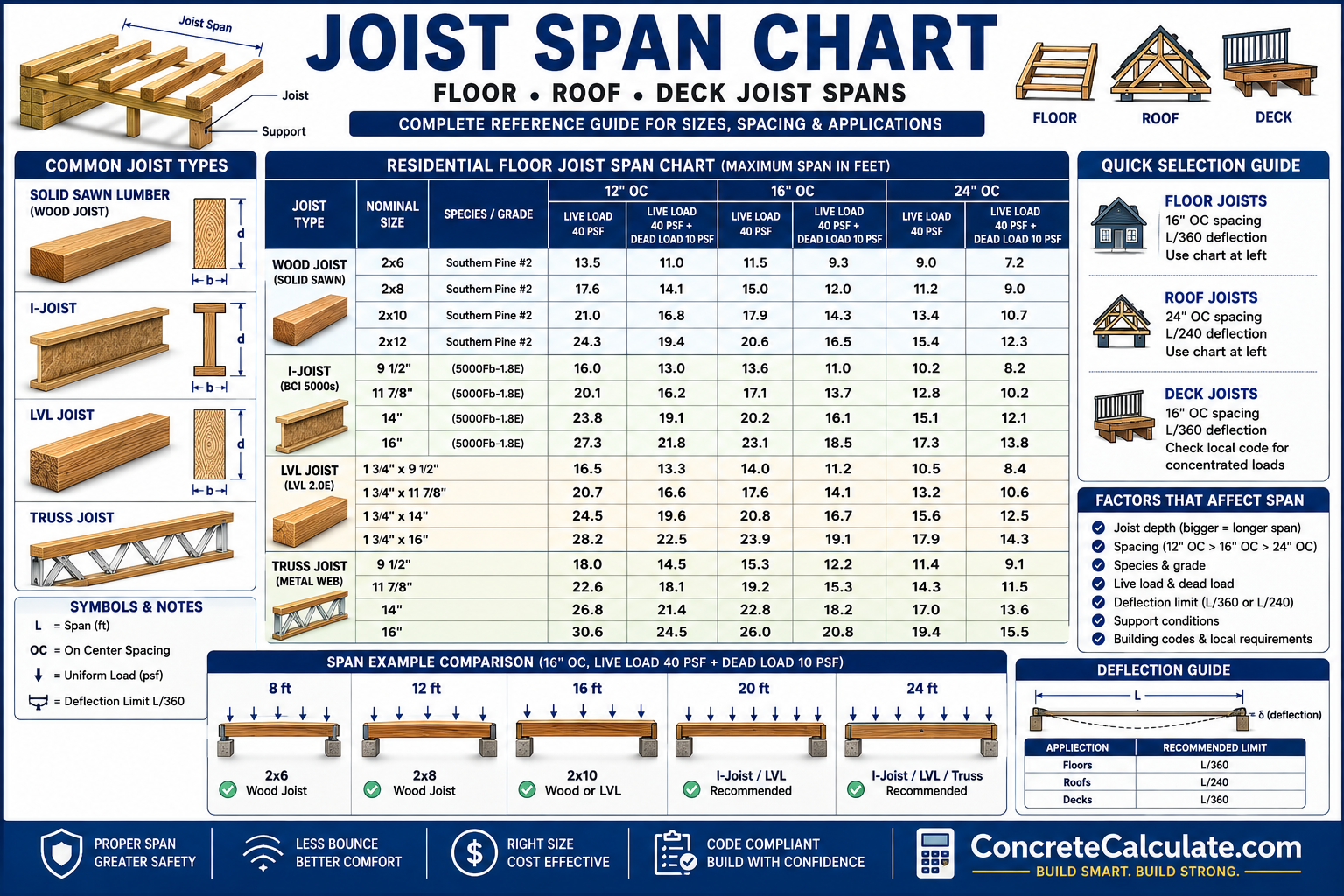
Joist Span Chart
Spans, Spacing & Sizing Guide
Complete joist reference for contractors and builders — wood, I-joist, LVL, and truss spans by spacing, species, grade, and application.
 Reviewed by Muhammad Ramzan Babar, PhD Researcher (Plasma Physics) & Calculator Developer — View Profile
Important: Planning Reference Only
All spans on this page are general planning references illustrating typical ranges. Actual joist selection depends on species, grade, spacing, live and dead loads, deflection limits, and applicable building codes — always verify with local code tables or a licensed professional before construction.
⭐ Master Joist Span Chart
Complete overview of joist types, typical span ranges, spacing, and application guidance for residential and light commercial framing.
How to Read This Chart
Joist span depends on the combination of material, depth, spacing, species/grade, and applied load — no single factor determines span alone. Once you’ve narrowed down a joist size, verify capacity with our Beam Size Calculator and Slab Load Calculator.
| Joist Type | Typical Depth Range | Typical Span Range | Common Uses |
|---|---|---|---|
| Solid Sawn Lumber | 2×6 to 2×12 | 8–18 ft | Residential floors, decks, ceilings |
| LVL Joists | 9¼” to 16″ | 12–24 ft | Floors requiring longer spans |
| I-Joists | 9½” to 16″+ | 14–26 ft | Residential and light commercial floors |
| Open-Web Floor Trusses | 12″ to 24″+ | 16–36 ft | Long spans, mechanical chases |
| Steel Joists | 8″ to 30″+ | 20–60 ft | Commercial and industrial floors/roofs |
| Reinforced Concrete Joists | 6″ to 12″ wide, 8″ to 20″ deep | 10–24 ft | Commercial floors, fire-rated construction |
⭐ Joist Span Guide by Material
Comparing joist types and typical spans across the primary framing material categories.
| Joist Type | Typical Span Range | Common Applications |
|---|---|---|
| Solid Sawn Lumber | 8–18 ft | Standard residential floor and ceiling framing |
| LVL Joists | 12–24 ft | Floors needing longer spans than dimensional lumber |
| I-Joists | 14–26 ft | Modern residential floor systems, flat and level performance |
| Open-Web Floor Trusses | 16–36 ft | Long spans with room for ductwork and plumbing |
| Steel Joists | 20–60 ft | Commercial and industrial floor/roof systems |
| Reinforced Concrete Joists | 10–24 ft | Fire-rated commercial floors and parking structures |
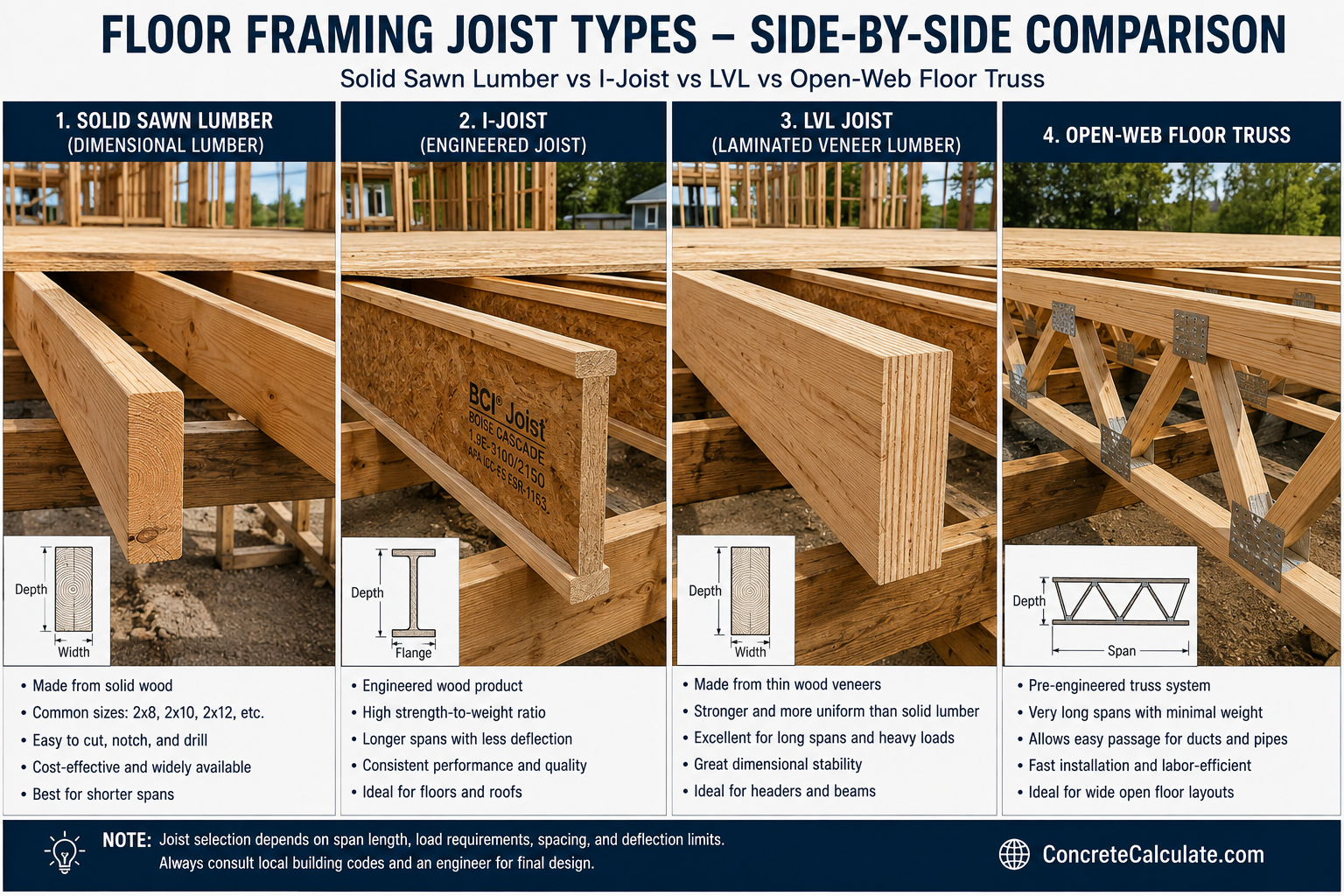
⭐ Joist Span by Construction Application
Matching joist type and span expectations to common project categories.
| Project | Typical Joist Type | Typical Span Range |
|---|---|---|
| Residential Floors | Solid lumber, I-joist | 10–18 ft |
| Second Floors | I-joist, LVL | 12–20 ft |
| Basements | Solid lumber, I-joist | 10–16 ft |
| Garages | Solid lumber, LVL | 10–16 ft |
| Decks | Pressure-treated solid lumber | 8–16 ft |
| Roofs | Rafters, trusses | 10–24 ft |
| Attics | Solid lumber, engineered joists | 10–18 ft |
| Commercial Buildings | Steel joists, concrete joists | 20–40 ft |
| Mezzanines | Steel joists, LVL | 16–30 ft |
Wood Joist Span Guide
General discussion of common dimensional lumber sizes and the factors that determine actual allowable span.
| Nominal Size | General Span Character | Common Use |
|---|---|---|
| 2×6 | Shortest typical spans | Small floor areas, ceiling joists |
| 2×8 | Moderate spans | Decks, smaller rooms |
| 2×10 | Common residential floor span range | Standard floor joists |
| 2×12 | Longest solid lumber spans | Larger rooms, heavier loads |
What Actually Determines Span
The exact allowable span for any given lumber size depends on wood species, lumber grade, on-center spacing, and the applicable live and dead loads for the specific room use — official prescriptive span tables in your local building code should always be the final reference rather than generic charts.
⭐ Engineered I-Joist Span Guide
I-joists combine an engineered wood web with solid flanges to achieve longer, flatter, more consistent spans than solid lumber.
| Common Depth | Typical Residential Use | Notes |
|---|---|---|
| 9½” | Moderate spans, common in many homes | Good balance of depth and weight |
| 11⅞” | General floors, longer spans | More stiffness and span capacity |
| 14″ | Large spans and higher loads | Heavier and taller; requires sufficient headroom |
| 16″+ | Extended commercial/residential spans | Used where maximum span capacity is needed |
| Advantages | Limitations |
|---|---|
| Longer spans than equivalent-depth solid lumber | Cannot be notched or drilled outside manufacturer zones |
| Straighter, more dimensionally stable | Requires engineered hangers and blocking panels |
| Lighter weight per span capacity | Vulnerable to moisture damage if not protected on site |
| Reduced squeaks and deflection | Higher material cost than solid sawn lumber |
I-joists span farther than solid lumber because the engineered web and flange combination optimizes material where bending stress is highest, improving strength-to-weight ratio and controlling deflection more predictably.
LVL Floor Joist Guide
Laminated Veneer Lumber joists offer high strength and consistency for demanding floor spans.
| Common Sizes | Typical Uses | Benefits |
|---|---|---|
| 9¼” to 16″ depth | Residential and commercial floor joists | Consistent strength, minimal warping |
| 1¾” to 3½” width | Single or multi-ply floor systems | High load capacity in narrow profile |
LVL joists generally achieve longer spans than solid lumber of the same depth due to their engineered, defect-free composition, though exact spans should be confirmed against manufacturer literature.
Open-Web Floor Truss Span Guide
Comparing wood floor trusses and steel joists for long-span and mechanical-integration applications.
| Factor | Wood Floor Trusses | Steel Joists |
|---|---|---|
| Typical Span | 16–36 ft | 20–60 ft |
| Mechanical Openings | Open web allows ducts, plumbing, wiring to pass through | Open web joists allow similar routing in commercial buildings |
| Weight | Lighter than steel for equivalent span | Heavier, but higher load capacity |
| Common Applications | Residential and light commercial floors | Commercial and industrial floors/roofs |
⭐ Joist Spacing Chart
Common on-center spacing options and how each affects floor performance and cost.
| Spacing | Floor Stiffness | Material Cost | Span Capability |
|---|---|---|---|
| 12″ O.C. | Highest stiffness | Highest (more joists) | Longest allowable span |
| 16″ O.C. | Good, most common standard | Moderate | Standard span range |
| 19.2″ O.C. | Slightly reduced stiffness | Lower | Slightly reduced span |
| 24″ O.C. | Lowest stiffness, more deflection-prone | Lowest (fewer joists) | Shortest allowable span |
Spacing Trade-Offs
Tighter spacing (12″ O.C.) increases stiffness and allowable span but uses more material, while wider spacing (24″ O.C.) reduces material cost but shortens allowable span and can increase deflection and floor bounce if not properly sized.
Joist Span by Floor Load
Different room uses carry different design loads, which directly affect required joist span capacity.
| Room Type | General Load Character |
|---|---|
| Bedrooms | Lighter residential live load category |
| Living Rooms | Standard residential live load category |
| Kitchens | Standard to slightly higher due to fixtures/appliances |
| Storage Areas | Higher live load category |
| Garages | Higher load category, often includes vehicle loads |
Required joist spans depend on design loads specified by applicable building codes for each occupancy type — always confirm exact live and dead load values with local code before finalizing a design. Verify with our Slab Load Calculator.
Roof Joist Span Guide
Roof framing spans are influenced heavily by regional snow and wind loads, plus roofing material weight.
| Roof Type | Key Span Factors |
|---|---|
| Flat Roofs | Sized for full snow/live load plus drainage considerations |
| Pitched Roofs | Rafter length affected by pitch angle and snow load |
| Cathedral Ceilings | Deeper rafters or engineered members needed for insulation space and span |
| Shed Roofs | Single-slope framing, span depends on pitch and load path |
Snow loads, wind loads, and roofing material weight (asphalt shingle vs tile vs metal) all combine to determine the actual design load a roof joist or rafter must carry.
Deck Joist Span Guide
Common deck joist span references measured from face of support to face of support.
| Joist Size | 12″ O.C. (planning reference) | 16″ O.C. (planning reference) |
|---|---|---|
| 2×6 | ~9 ft 11 in | ~9 ft |
| 2×8 | ~13 ft 1 in | ~11 ft 10 in |
| 2×10 | ~16 ft 2 in | ~14 ft |
| 2×12 | ~18 ft | ~16 ft 6 in |
Species and Grade Vary
These figures reflect common Southern Pine #2 planning values; SPF, Hem-Fir, and Douglas Fir spans differ. Deck joist spacing must also match decking board compatibility — always confirm with local code before building.
| Deck Type | Common Joist Approach |
|---|---|
| Residential Decks | Pressure-treated 2×8–2×10, 16″ O.C. |
| Elevated Decks | 2×10–2×12, tighter spacing for added stiffness |
| Covered Decks | Sized larger for roof dead load, often 2×12 |
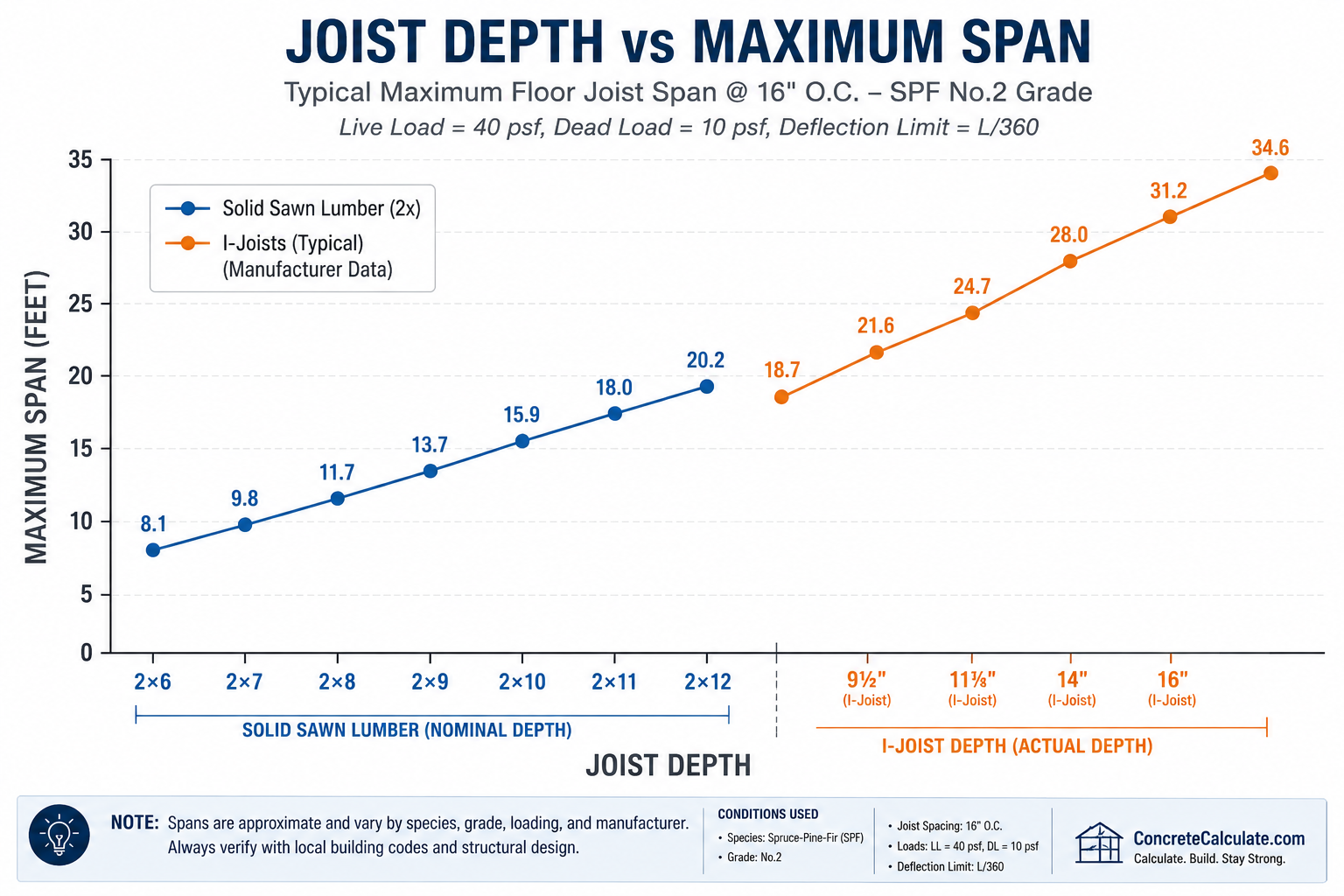
⭐ Joist Span vs Joist Depth
Illustrating the general relationship between joist depth and structural performance.
| Depth Trend | Effect on Span | Effect on Deflection | Effect on Load Capacity |
|---|---|---|---|
| Shallower Joists | Shorter possible span | More deflection under load | Lower load capacity |
| Deeper Joists | Longer possible span | Reduced deflection | Increased load capacity |
Joist Span vs Spacing
How changing on-center spacing shifts span capability, structural performance, and material use.
| Spacing Change | Span Capability | Structural Performance | Material Quantity |
|---|---|---|---|
| Tighter (12″ O.C.) | Increases | Stiffer floor, less deflection | More joists required |
| Wider (24″ O.C.) | Decreases | More prone to deflection/bounce | Fewer joists required |
Joist Span vs Deflection
Deflection limits often govern joist selection even when a joist has sufficient raw bending strength.
| Deflection Limit | Meaning | Common Use |
|---|---|---|
| L/240 | Span divided by 240; more flexible allowance | Roof joists, less sensitive finishes |
| L/360 | Span divided by 360; standard residential floor limit | Typical floor joists under live load |
| L/480 | Span divided by 480; stricter, stiffer floor | Floors with brittle finishes like tile or plaster |
Why Deflection Often Wins
A joist might be strong enough to resist breaking under a given load, yet still bend more than a chosen deflection ratio allows — since excessive bending cracks finishes and creates a bouncy feel, deflection frequently becomes the limiting factor over pure strength.
Joist Span by Wood Species
Different framing lumber species carry different strength and stiffness properties, directly affecting allowable span.
| Species Group | General Strength Character |
|---|---|
| SPF (Spruce-Pine-Fir) | Widely available, moderate strength |
| Douglas Fir-Larch | Higher strength and stiffness, common West Coast species |
| Southern Pine | High strength, dense, common in Southeastern US |
| Hem-Fir | Moderate strength, common West Coast species |
Southern Pine and Douglas Fir-Larch generally allow longer spans than SPF or Hem-Fir at the same size and grade, due to higher inherent bending strength and stiffness.
Joist Span by Grade
Lumber grade reflects the presence of knots, grain slope, and other defects that affect strength.
| Grade | General Performance |
|---|---|
| No.2 | Common structural baseline grade for framing lumber |
| No.1 | Fewer defects, slightly higher allowable span/load |
| Select Structural | Highest grade, fewest defects, longest allowable spans |
⭐ Floor Joists vs Ceiling Joists
Though visually similar, floor and ceiling joists serve very different structural roles.
| Factor | Floor Joists | Ceiling Joists |
|---|---|---|
| Purpose | Support floor live loads and finishes | Support ceiling finish and light attic storage |
| Loads | Higher live loads (occupants, furniture) | Lower loads, mainly dead load plus light storage |
| Typical Sizes | 2×10, 2×12, I-joists common | 2×6, 2×8 common |
| Span Characteristics | Sized for stiffness and deflection under live load | Often shorter spans, less deflection-critical |
Floor Joists vs Roof Rafters
Understanding the distinct roles of floor joists, ceiling joists, rafters, and trusses in a framed structure.
| Member | Location | Primary Function |
|---|---|---|
| Floor Joists | Horizontal, between floor levels | Carry floor live and dead loads |
| Ceiling Joists | Horizontal, below roof/attic | Support ceiling finish, tie rafters together |
| Rafters | Sloped, following roof pitch | Support roof sheathing and roofing loads |
| Roof Trusses | Sloped/combined assembly | Combine rafter and ceiling joist function in one engineered unit |
⭐ Joist Selection Guide
Quick decision reference matching project type to recommended joist type and spacing with reasoning.
| Project | Recommended Joist Type | Typical Spacing | Why |
|---|---|---|---|
| Bedroom | Solid lumber or I-joist | 16″ O.C. | Standard residential live load, cost-effective |
| Living Room | I-joist or LVL | 16″ O.C. | Often longer spans, benefits from stiffness |
| Basement | Solid lumber or I-joist | 16″ O.C. | Standard floor load, moisture-tolerant framing preferred |
| Garage | Solid lumber or LVL | 16″ O.C. | Higher point and vehicle loads need robust framing |
| Deck | Pressure-treated solid lumber | 16″ O.C. | Moisture resistance and cost-effectiveness outdoors |
| Roof | Rafters or trusses | 16″–24″ O.C. | Depends on snow/wind load and roofing material |
| Commercial Floor | Steel joists or concrete joists | Engineer-specified | Higher occupancy loads and fire code requirements |
For general project planning, see our How to Calculate Concrete guide and Beam Size Chart.
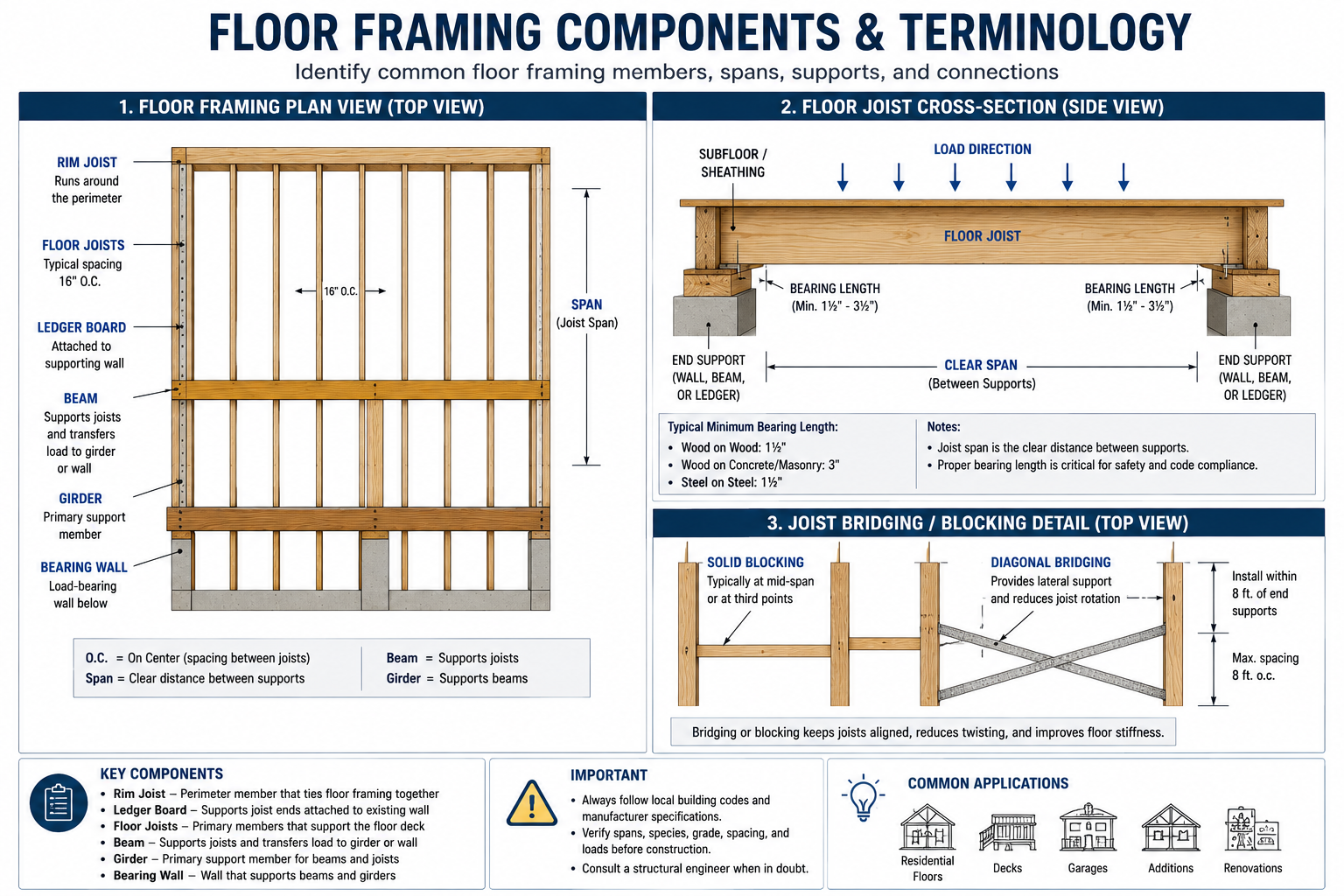
⭐ Visual Joist Span Guide
Engineering diagrams showing labeled floor framing components and terminology.
Joist Installation Best Practices
Correct installation practices are essential to achieving the design span and load capacity of any joist system.
Proper Bearing
Ensure full, level bearing at each support to evenly distribute load and avoid point-loading the joist end.
Blocking
Install solid blocking between joists at supports and mid-span to prevent rotation and improve load transfer.
Bridging
Cross bridging or engineered bridging panels help distribute concentrated loads across adjacent joists.
Hangers
Use manufacturer-specified joist hangers for proper load transfer at ledger boards and beams.
Fasteners
Follow manufacturer nailing or screw schedules for hangers, blocking, and sheathing attachment.
End Support
Provide adequate end bearing length per material type — typically 1.5 inches on wood/steel, more on masonry.
Rim Joists
Install rim (band) joists around the floor perimeter to distribute loads and provide lateral stability to joist ends.
Common Joist Design Mistakes
Avoiding these errors prevents bouncy floors, structural failures, and costly rework.
Overspanning Joists
Pushing a joist size beyond its rated span for the given spacing and load leads to excessive deflection or failure.
Ignoring Deflection Limits
Focusing only on strength while ignoring L/360 or L/480 limits can result in bouncy floors and cracked finishes.
Using Incorrect Spacing
Installing joists at wider spacing than the design assumed reduces actual capacity below the intended safety margin.
Improper Bearing Length
Insufficient bearing at joist ends can crush the support material or cause the joist to slip off its seat.
Cutting or Drilling Beyond Manufacturer Recommendations
Notching or drilling engineered joists outside approved zones can seriously compromise structural capacity.
Mixing Lumber Grades
Combining different species or grades within the same framing run without accounting for the weakest member risks under-capacity spans.
Overloading Storage Areas
Using standard residential floor joists for heavy storage without upgrading size or spacing can exceed design load limits.
Assuming One Span Table Applies to Every Project
Span tables vary by species, grade, load, and code jurisdiction — a chart from one region or product line should not be applied universally.
Contractor Worked Examples
Real-world joist selection scenarios for common project types. Pair these with our Beam Size Calculator and How to Calculate Concrete guide.
Bedroom Floor
Small Commercial Floor
Frequently Asked Questions
📄 Download Joist Span Chart PDF
Get a print-ready engineering reference including joist type comparison tables, spacing guide, material comparison, floor framing diagrams, joist selection guide, installation checklist, and field-ready contractor reference.