PVC Pipe Pressure Rating Chart: Schedule 40 & 80
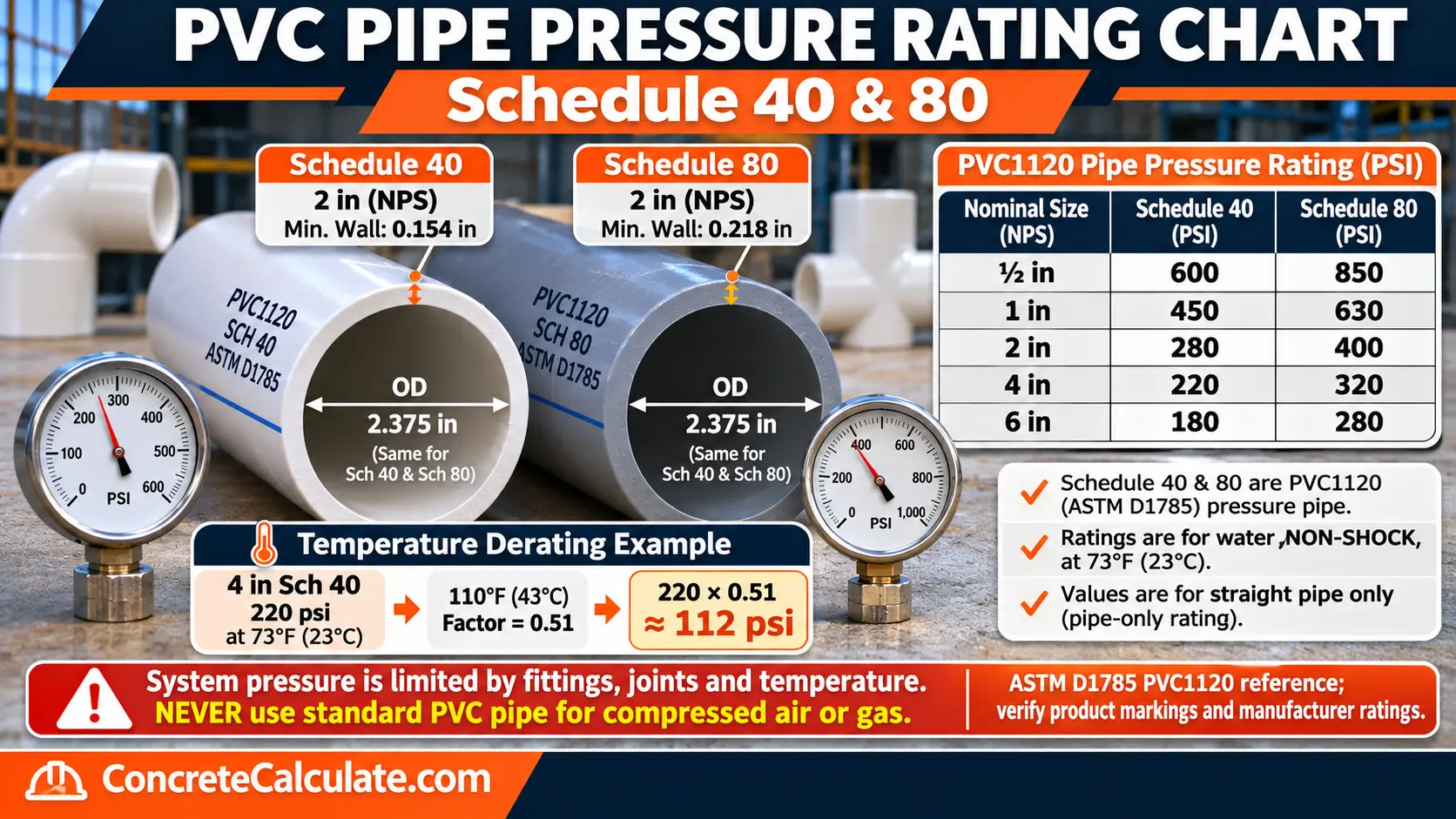
Pipe-only working pressure ratings for PVC Schedule 40 and 80, with SDR and AWWA C900 pressure classes, temperature derating, and fitting ratings.
 Reviewed by Muhammad Ramzan Babar, PhD Researcher (Plasma Physics) & Calculator Developer. View Profile
⭐ PVC Pipe Pressure Rating Chart
A PVC pipe pressure rating chart lists maximum working pressure by size: Schedule 40 PVC1120 pipe is rated 600 psi at 1/2 in. and 220 psi at 4 in., while Schedule 80 is rated 850 psi and 320 psi, for water at 73°F. These are pipe-only ratings; fittings, temperature, and joints can lower system pressure.
Schedule 40 PSI and Schedule 80 PSI
| Nominal PVC pipe size (in.) | Schedule 40 pipe rating (psi) | Schedule 80 pipe rating (psi) |
|---|---|---|
| 1/2 | 600 | 850 |
| 3/4 | 480 | 690 |
| 1 | 450 | 630 |
| 1¼ | 370 | 520 |
| 1½ | 330 | 470 |
| 2 | 280 | 400 |
| 2½ | 300 | 420 |
| 3 | 260 | 370 |
| 4 | 220 | 320 |
| 5 | 190 | 290 |
| 6 | 180 | 280 |
| 8 | 160 | 250 |
| 10 | 140 | 230 |
| 12 | 130 | 230 |
Source: Charlotte Pipe Plastics Product Knowledge Guide (IPS Schedule pipe table), cross-checked with the Westlake Schedule 40 specification and Westlake Schedule 80 specification. Basis: manufacturer-listed PVC1120 (ASTM D1784 cell class 12454, Type I, Grade I) pressure pipe, compatible water, non-shock service, 73°F (23°C).
✓ Checked against Charlotte Pipe and Westlake published PVC1120 ratings, November 2026Pipe-only ratings
These are pipe-only working pressure ratings for the stated PVC1120 reference condition at 73°F. Do not apply them automatically to fittings, threaded pipe, flanges, valves, DWV piping, compressed-gas systems, other PVC compound grades, or elevated-temperature service. Verify the product marking and the manufacturer’s technical documentation.
Reference Temperature and Material
Every value above assumes PVC1120, water, non-shock service, and 73°F. The 2½ in. Schedule 40 rating (300 psi) is higher than the 2 in. rating (280 psi); that comes from the standardized dimensions and is kept as published. For wall thickness and diameters, see the PVC Pipe Size Chart and Pipe Wall Thickness Chart.
Seeing lower PSI numbers elsewhere?
Some references quote the working pressure of the complete system, not the pipe. Westlake notes that molded Schedule 40 and 80 fittings are commonly taken at 60% of the same-size pipe rating, and threaded joints at 50% of plain-end pipe. See Section 16. For a cross-material view, use the Pipe Pressure Rating Chart.
What Does PVC Pipe Pressure Rating Mean?
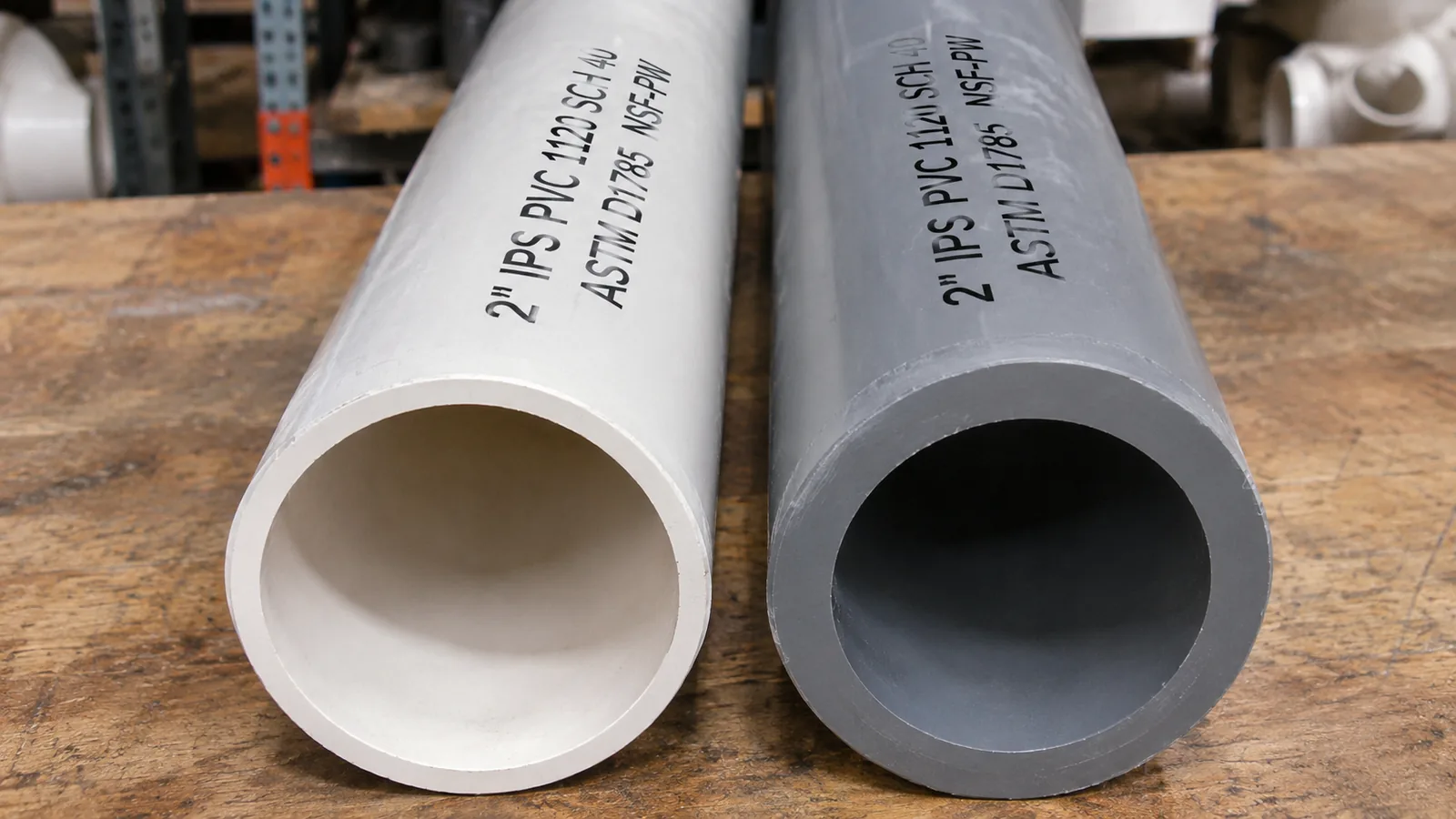
A PVC pipe pressure rating is the maximum continuous working pressure published for a specific pipe product, usually water at 73°F in non-shock service, such as 280 psi for 2 in. Schedule 40 PVC1120.
- Maximum working pressure: the continuous internal water pressure the manufacturer or standard lists for that size and product.
- Non-shock service: steady pressure without recurring surges or water hammer.
- Pressure class: the rating system used by a standard such as ASTM D2241 (PR) or AWWA C900 (PC), each with its own rules.
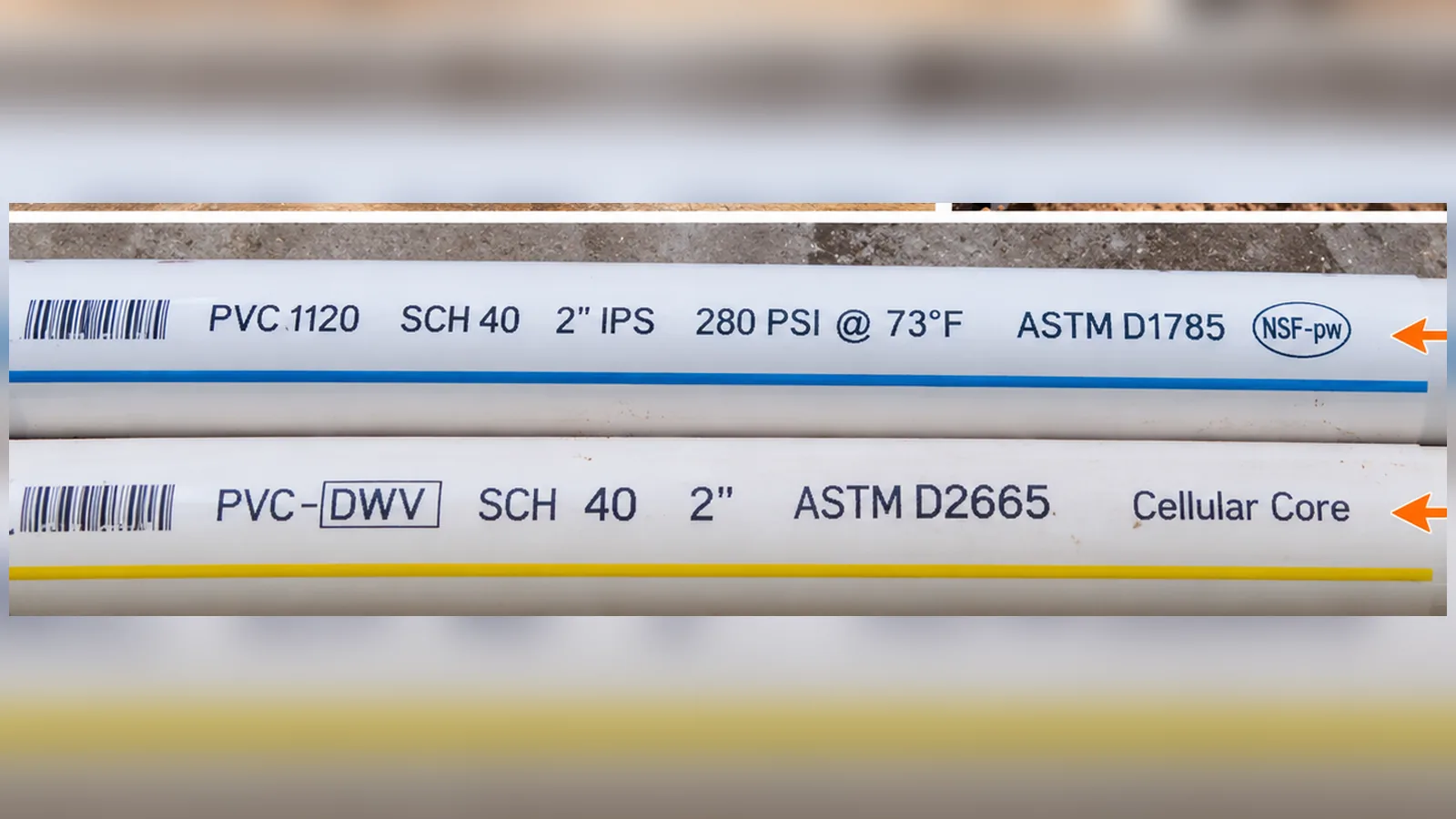
- Product certification: the printed marking identifies the standard and material, which is what ties a pressure number to a real pipe.
Key point
A rating belongs to a product, a size, a temperature, and a fluid. Without those four details, a PSI number is incomplete.
How to Read a PVC Pressure Rating Chart
To read a PVC pressure rating chart, match the product standard, PVC compound, nominal size, schedule or DR, and temperature, then confirm the pipe marking, before taking the psi value.
- Identify the product standard: ASTM D1785 (Schedule 40, 80, 120), ASTM D2241 (SDR), or AWWA C900 (DR and pressure class).
- Identify the PVC compound: the main chart uses PVC1120 (Type I, Grade I).
- Find the nominal size: nominal IPS size, not the measured diameter.
- Find the schedule or DR: Schedule values change with size; SDR and DR values do not.
- Confirm service temperature: the chart value is for 73°F; use Section 14 above that.
- Check the actual pipe marking and manufacturer documentation.
⭐ Schedule 40 PVC Pressure Rating Chart
Schedule 40 PVC1120 pressure pipe is rated from 600 psi at 1/2 in. down to 130 psi at 12 in. for water at 73°F, and the ratings fall as the size increases.
| Nominal size (in.) | Outside diameter (in.) | Minimum wall (in.) | Max working pressure at 73°F (psi) |
|---|---|---|---|
| 1/2 | 0.840 | 0.109 | 600 |
| 3/4 | 1.050 | 0.113 | 480 |
| 1 | 1.315 | 0.133 | 450 |
| 1¼ | 1.660 | 0.140 | 370 |
| 1½ | 1.900 | 0.145 | 330 |
| 2 | 2.375 | 0.154 | 280 |
| 2½ | 2.875 | 0.203 | 300 |
| 3 | 3.500 | 0.216 | 260 |
| 4 | 4.500 | 0.237 | 220 |
| 5 | 5.563 | 0.258 | 190 |
| 6 | 6.625 | 0.280 | 180 |
| 8 | 8.625 | 0.322 | 160 |
Source: Charlotte Pipe Plastics Product Knowledge Guide, Schedule 40 product data (OD, minimum wall, max work PSI at 73°F). PVC1120, water, non-shock. 10 in. and 12 in. dimensions are listed in the PVC Pipe Size Chart.
✓ Checked against Charlotte Pipe and Westlake published PVC1120 ratings, November 2026Larger Sizes
Schedule 40 ratings continue at 140 psi for 10 in. and 130 psi for 12 in. Dimensions for those sizes are in the Schedule 40 Pipe Chart.
Pressure Applications vs. DWV
Only solid-wall pipe marked to ASTM D1785 is pressure pipe. DWV pipe and cellular-core pipe are not pressure rated (see Section 22).
⭐ Schedule 80 PVC Pressure Rating Chart
Schedule 80 PVC1120 pipe has a thicker wall than Schedule 40 and is rated from 850 psi at 1/2 in. to 230 psi at 12 in. for water at 73°F.
| Nominal size (in.) | Outside diameter (in.) | Minimum wall (in.) | Max working pressure at 73°F (psi) |
|---|---|---|---|
| 1/2 | 0.840 | 0.147 | 850 |
| 3/4 | 1.050 | 0.154 | 690 |
| 1 | 1.315 | 0.179 | 630 |
| 1½ | 1.900 | 0.200 | 470 |
| 2 | 2.375 | 0.218 | 400 |
| 3 | 3.500 | 0.300 | 370 |
| 4 | 4.500 | 0.337 | 320 |
| 6 | 6.625 | 0.432 | 280 |
| 8 | 8.625 | 0.500 | 250 |
| 12 | 12.750 | 0.687 | 230 |
Source: pipe ratings from Charlotte Pipe Plastics Product Knowledge Guide and the Westlake Schedule 80 specification; wall dimensions as published in Charlotte Pipe Schedule 80 data. Other sizes (1¼, 2½, 5, 10 in.) are rated in the main chart; see the Schedule 80 Pipe Chart for their dimensions.
✓ Ratings checked against Charlotte Pipe and Westlake; walls from Charlotte Schedule 80 data, November 2026Connection Restrictions
Schedule 80 is the PVC schedule manufacturers allow to be threaded, but a threaded joint is rated at 50% of the plain-end pipe (Westlake). Details are in Section 17.
⭐ Schedule 40 vs. Schedule 80 PVC Pressure
At the same nominal size and PVC1120 material, Schedule 80 pipe is rated higher than Schedule 40, for example 400 psi versus 280 psi at 2 in.
| Nominal size (in.) | Schedule 40 (psi) | Schedule 80 (psi) | Difference (psi) | Increase vs. Schedule 40 |
|---|---|---|---|---|
| 1/2 | 600 | 850 | 250 | +41.7% |
| 3/4 | 480 | 690 | 210 | +43.8% |
| 1 | 450 | 630 | 180 | +40.0% |
| 1¼ | 370 | 520 | 150 | +40.5% |
| 1½ | 330 | 470 | 140 | +42.4% |
| 2 | 280 | 400 | 120 | +42.9% |
| 2½ | 300 | 420 | 120 | +40.0% |
| 3 | 260 | 370 | 110 | +42.3% |
| 4 | 220 | 320 | 100 | +45.5% |
| 5 | 190 | 290 | 100 | +52.6% |
| 6 | 180 | 280 | 100 | +55.6% |
| 8 | 160 | 250 | 90 | +56.2% |
| 10 | 140 | 230 | 90 | +64.3% |
| 12 | 130 | 230 | 100 | +76.9% |
Difference and percentage calculated from the published pipe ratings in Section 1.
✓ Calculated from published ratings, arithmetic checked, November 20262 in. Schedule 40 vs. Schedule 80
This compares published pipe-only ratings. It does not mean an assembled Schedule 80 plumbing system is rated 42.9% higher, because fittings and joints have their own ratings.
Flow-Area Tradeoff
Both schedules share the same outside diameter, so the thicker Schedule 80 wall reduces the opening. For 2 in. pipe, the opening based on minimum wall is about 2.067 in. (Schedule 40) versus 1.939 in. (Schedule 80), roughly 12% less flow area. See the Pipe Inside Diameter Chart and Pipe Flow Rate Chart.
Why PVC Pipe Pressure Changes With Diameter
PVC pipe pressure rating falls with diameter because a schedule wall does not grow as fast as the outside diameter, so the wall-to-OD ratio gets thinner, for example DR 15.4 at 2 in. Schedule 40 and DR 19.0 at 4 in.
| Nominal size (in.) | Schedule 40 DR | Schedule 40 (psi) | Schedule 80 DR | Schedule 80 (psi) |
|---|---|---|---|---|
| 1/2 | 7.7 | 600 | 5.7 | 850 |
| 3/4 | 9.3 | 480 | 6.8 | 690 |
| 1 | 9.9 | 450 | 7.3 | 630 |
| 1½ | 13.1 | 330 | 9.5 | 470 |
| 2 | 15.4 | 280 | 10.9 | 400 |
| 2½ | 14.2 | 300 | not listed here | 420 |
| 3 | 16.2 | 260 | 11.7 | 370 |
| 4 | 19.0 | 220 | 13.4 | 320 |
| 6 | 23.7 | 180 | 15.3 | 280 |
| 8 | 26.8 | 160 | 17.2 | 250 |
DR calculated from published outside diameter and minimum wall. 2½ in. Schedule 80 wall is not shown here; see the Schedule 80 Pipe Chart.
✓ Calculated from published ratings, arithmetic checked, November 2026- Pressure rating follows the OD-to-wall ratio, not the schedule name.
- The progression is not perfectly smooth: 2½ in. Schedule 40 (DR 14.2) has a relatively thicker wall than 2 in. (DR 15.4), so it is rated 300 psi versus 280 psi. Do not smooth this into an invented trend.
PVC Wall Thickness and Pressure Rating
For a given PVC material, pressure rating rises with minimum wall thickness and falls with outside diameter, following PR = 2·HDS·t ÷ (OD – t), which gives about 277 psi for 2 in. Schedule 40 at HDS 2,000 psi.
| Pipe | OD (in.) | Min wall (in.) | DR | Calculated PR (psi) | Published rating (psi) |
|---|---|---|---|---|---|
| 1/2 in. Sch 40 | 0.840 | 0.109 | 7.7 | 596.4 | 600 |
| 1 in. Sch 40 | 1.315 | 0.133 | 9.9 | 450.1 | 450 |
| 2 in. Sch 40 | 2.375 | 0.154 | 15.4 | 277.4 | 280 |
| 2½ in. Sch 40 | 2.875 | 0.203 | 14.2 | 303.9 | 300 |
| 3 in. Sch 40 | 3.500 | 0.216 | 16.2 | 263.1 | 260 |
| 4 in. Sch 40 | 4.500 | 0.237 | 19.0 | 222.4 | 220 |
| 6 in. Sch 40 | 6.625 | 0.280 | 23.7 | 176.5 | 180 |
| 8 in. Sch 40 | 8.625 | 0.322 | 26.8 | 155.1 | 160 |
| 1/2 in. Sch 80 | 0.840 | 0.147 | 5.7 | 848.5 | 850 |
| 1 in. Sch 80 | 1.315 | 0.179 | 7.3 | 630.3 | 630 |
| 2 in. Sch 80 | 2.375 | 0.218 | 10.9 | 404.3 | 400 |
| 4 in. Sch 80 | 4.500 | 0.337 | 13.4 | 323.8 | 320 |
| 6 in. Sch 80 | 6.625 | 0.432 | 15.3 | 279.0 | 280 |
| 8 in. Sch 80 | 8.625 | 0.500 | 17.2 | 246.2 | 250 |
Calculated with PR = 2·HDS·t ÷ (OD – t), HDS = 2,000 psi. Use the published value in practice; calculated values are illustrative.
✓ Calculated from published ratings, arithmetic checked, November 2026Dimension ratio from OD and wall
This is a dimensional illustration. It does not prove an arbitrary pipe with these dimensions qualifies as AWWA C900 DR 18.
Pressure from OD and wall: 2 in. Schedule 40
The small gap reflects tabulation and rounding. Use the published 280 psi for the chart, not the reconstructed value.
Manufacturer tolerances apply to both diameter and wall. Cross-material wall data is in the Pipe Wall Thickness Chart; outside diameters are in the Pipe Outside Diameter Chart.
PVC1120, Material Grades and Hydrostatic Design Stress
PVC1120 (ASTM D1784 cell class 12454, Type I, Grade I) carries a hydrostatic design stress of 2,000 psi at 73°F for water, which is the basis of the Schedule 40 and 80 chart.
| PVC designation | HDS at 73°F (psi) | SDR 21 pressure rating (psi) |
|---|---|---|
| PVC1120, PVC1220, PVC2120 | 2,000 | 200 |
| PVC2116 | 1,600 | 160 |
| PVC2112 | 1,250 | 125 |
| PVC2110 | 1,000 | 100 |
Source: ASTM D2241-25a pressure-rating relationships (table of PR by SDR and material, text as published in earlier ASTM D2241 editions) and ASTM D1784 material classes. Confirm in the current edition.
✓ Checked against ASTM D2241 material table (earlier edition text) and Westlake D2241 sheet, November 2026- Hydrostatic design basis (HDB): the long-term strength rating of the compound, 4,000 psi for PVC1120 water service (Westlake C900 bulletin).
- Hydrostatic design stress (HDS): HDB multiplied by a design factor, which gives 2,000 psi.
- Rating vs. test pressure: test pressures are higher than the working rating. See Section 18.
ASTM D1785 Pressure Pipe Requirements
ASTM D1785-26 is the U.S. specification for PVC Schedule 40, 80, and 120 pressure pipe, covering material class, dimensions, sustained-pressure and burst tests, and marking.
| Requirement area | What it covers |
|---|---|
| Scope | PVC Schedule 40, 80, and 120 pressure pipe for compatible liquids |
| Material | PVC compounds and hydrostatic design stress classes |
| Dimensions | Outside diameter, minimum wall, tolerances |
| Sustained pressure | Long-duration pressure test of the pipe |
| Burst pressure | Short-duration test, not a working pressure |
| Marking | Manufacturer, size, schedule, material, standard |
| Hazard warning | Compressed air and gas are hazardous in PVC pipe |
Source: ASTM D1785-26 (ASTM lists D1785-26 as the active edition).
Schedule 120 is outside this chart. The standard does not make Schedule alone a universal PSI: the compound, size, and temperature set the value.
⭐ PVC SDR Pressure Rating Chart
For ASTM D2241 PVC pipe with a 2,000 psi design stress, SDR 21 is rated 200 psi at 73°F, and every nominal diameter in the same SDR has the same rating.
| SDR | Published rating (psi) | Calculated 2·HDS ÷ (SDR – 1) (psi) | Listed in Charlotte guide? |
|---|---|---|---|
| SDR 13.5 | 315 | 320 | Yes |
| SDR 17 | 250 | 250 | Not in that guide |
| SDR 21 | 200 | 200 | Yes |
| SDR 26 | 160 | 160 | Yes |
| SDR 32.5 | 125 | 127 | Not in that guide |
| SDR 41 | 100 | 100 | Not in that guide |
Source: ASTM D2241-25a SDR pressure-rating table (checked in earlier edition text), with the Westlake ASTM D2241 specification sheet. Charlotte Pipe lists SDR 13.5 (PR315), SDR 21 (PR200), and SDR 26 (PR160) in its Charlotte Pipe Plastics Product Knowledge Guide. Calculated column is illustrative.
✓ Checked against ASTM D2241 table text, Westlake D2241 sheet, and Charlotte Pipe, November 2026SDR 13.5, 17, 21, 26 and 32.5
The rating depends on the wall-to-OD ratio, so an SDR 21 pipe is 200 psi at 2 in. and at 6 in. SDR 13.5 calculates to 320 psi but the published rating is 315 psi; SDR 32.5 calculates to 127 psi and is published as 125 psi.
Qualification
These ratings apply to the stated material design-stress class and water at 73°F. They do not describe every PVC resin or application. Verify against current ASTM D2241-25a.
⭐ AWWA C900 PVC Pressure Classes
AWWA C900 PVC waterworks pipe uses pressure classes of 305 psi (DR 14), 235 psi (DR 18), and 165 psi (DR 25), calculated with a 4,000 psi HDB and a safety factor of 2.0.
| Dimension ratio | Current pressure class (psi) | Calculated 2·HDB ÷ ((DR – 1)·SF) (psi) | Max working + occasional surge, 1.6 × PC (psi) | Pre-2007 class, 4 to 12 in. (psi) |
|---|---|---|---|---|
| DR 14 | 305 | 308 | 488 | 200 |
| DR 18 | 235 | 235 | 376 | 150 |
| DR 25 | 165 | 167 | 264 | 100 |
Source: AWWA C900-22 (current edition); values checked in the Westlake AWWA C900 pressure class bulletin, which gives HDB = 4,000 psi and safety factor 2.0, and in the Uni-Bell C900 guide. Surge limit from AWWA C900-16 text. Confirm in C900-22.
✓ Checked against Westlake C900 bulletin and PVC Pipe Association C900 guidance (C900-16 basis), November 2026- C900 is a waterworks standard, not another name for ASTM D1785 Schedule 40/80.
- Pressure class is the working-pressure capacity at 73°F. Occasional surge is evaluated separately: working pressure plus occasional surge should not exceed 1.6 times the pressure class.
- Recurring surge is analyzed with the cyclic method in the standard. See Section 19.
PVC Schedule vs. SDR vs. C900
Schedule pipe, SDR pipe, and C900 pipe use different rating systems, so a pressure class from one cannot be carried to another without checking its standard and material.
| Feature | ASTM D1785 Schedule 40/80 | ASTM D2241 SDR | AWWA C900 DR |
|---|---|---|---|
| Rating basis | Size, schedule, material | DR and material design stress | DR with pressure class method |
| Same rating across sizes? | No | Yes, within an SDR | Yes, within a DR |
| Example | 2 in. Sch 80: 400 psi | SDR 21: 200 psi | DR 18: 235 psi |
| Typical use | Plumbing, irrigation, industrial | Water pressure pipe | Water transmission and distribution |
| Surge treatment | Non-shock rating only | Check separately | Defined recurring and occasional surge |
Examples use values shown in Sections 1, 11, and 12. Typical-use row is a general summary; confirm with each standard.
⭐ PVC Temperature Derating Chart
PVC pressure rating drops as water temperature rises: Westlake multiplies the 73°F rating by 0.62 at 100°F, 0.51 at 110°F, and 0.22 at 140°F.
| Sustained water temperature | Derating factor | Share of 73°F rating | 4 in. Sch 40 (psi) | 2 in. Sch 80 (psi) |
|---|---|---|---|---|
| 73°F (reference) | 1.00 | 100% | 220 | 400 |
| 80°F | 0.88 | 88% | 194 | 352 |
| 90°F | 0.75 | 75% | 165 | 300 |
| 100°F | 0.62 | 62% | 136 | 248 |
| 110°F | 0.51 | 51% | 112 | 204 |
| 120°F | 0.40 | 40% | 88 | 160 |
| 130°F | 0.31 | 31% | 68 | 124 |
| 140°F | 0.22 | 22% | 48 | 88 |
Source: Westlake Schedule 40 specification and Westlake Schedule 80 specification (same factor table). Charlotte Pipe 140°F values are consistent with the 0.22 factor. Some manufacturers print 0.50 at 110°F and 0.30 at 130°F; this page uses one series, Westlake’s, throughout. Example columns are calculated and rounded to 1 psi.
✓ Checked against Charlotte Pipe and Westlake published PVC1120 ratings, November 2026140°F is not a hot-water approval
Manufacturers list 140°F as an upper limit for PVC pressure piping, with a severe pressure reduction. That does not make PVC suitable for domestic hot water, steam, boilers, or high-temperature processes. Use CPVC or another approved system where conditions require it. See the CPVC Pipe Size Chart.
How to Calculate Temperature-Adjusted Pressure
Multiply the 73°F pipe rating by the source’s temperature factor: a 4 in. Schedule 40 pipe rated 220 psi at 73°F is about 112 psi at 110°F using the 0.51 factor.
4 in. Schedule 40 at 110°F
Westlake prints the same worked example (112 psi). A source using 0.50 would give 110 psi, which is why one factor series must be kept throughout.
2 in. Schedule 80 at 100°F
Check fittings and components separately. The system can have a lower permitted pressure.
Fittings use the same temperature factors as pipe, and conventional threaded connections are not recommended above 110°F (Westlake).
⭐ PVC Pipe vs. Fitting Pressure Ratings
A PVC system is limited by its weakest rated component: for 2 in. Schedule 80 at 73°F, Charlotte lists pipe at 400 psi, socket fittings at 240 psi, threaded fittings at 200 psi, and flanges at 150 psi.
| Nominal size (in.) | Sch 80 pipe (psi) | Sch 80 socket fitting (psi) | Sch 80 threaded fitting (psi) | Flange (psi) |
|---|---|---|---|---|
| 1/2 | 850 | 510 | 425 | 150 |
| 3/4 | 690 | 414 | 345 | 150 |
| 1 | 630 | 378 | 315 | 150 |
| 1½ | 470 | 282 | 235 | 150 |
| 2 | 400 | 240 | 200 | 150 |
| 3 | 370 | 222 | 185 | 150 |
| 4 | 320 | 192 | 160 | 150 |
| 6 | 280 | 168 | 140 | 150 |
Source: Charlotte Pipe Schedule 80 pressure-rating table (Charlotte Pipe Plastics Product Knowledge Guide; Plastics Technical Manual). Flange rating of 150 psi at 73°F is stated by Charlotte Pipe and Westlake for molded PVC flanges. These are manufacturer-specific component ratings, not universal ASTM D2467 values.
✓ Checked against Charlotte Pipe technical manual (1/2 and 3/4 in. read directly; other sizes follow the same published 60% and 50% pattern), November 2026Which component limits a 2 in. Schedule 80 system?
The system cannot simply be called 400 psi because the straight pipe is. This minimum check is necessary but not sufficient: joints, temperature, surge, and installation can lower the allowable pressure further.
| Nominal size (in.) | Sch 40 pipe (psi) | Sch 40 socket fitting (psi) | Sch 40 threaded fitting (psi) | Unions (psi) |
|---|---|---|---|---|
| 1/2 | 600 | 360 | 300 | 150 |
| 3/4 | 480 | 288 | 240 | 150 |
| 1 | 450 | 270 | 225 | 150 |
| 1½ | 330 | 198 | 165 | 150 |
| 2 | 280 | 168 | 140 | 150 |
| 3 | 260 | 156 | 130 | not listed |
| 4 | 220 | 132 | 110 | not listed |
| 6 | 180 | 108 | 90 | not listed |
| 8 | 160 | 96 | 80 | not listed |
Source: Charlotte Pipe Plastics Product Knowledge Guide, Schedule 40 pressure ratings table (pipe, socket fittings, threaded fittings, unions). Manufacturer-specific. Westlake notes ASTM D2466 sets no working pressure rating for fittings.
✓ Checked against Charlotte Pipe and Westlake published PVC1120 ratings, November 2026- Do not assume another manufacturer’s fittings have the same ratings.
- Unions, flanges, and valves can have lower individual ratings than the pipe.
- A fitting body rating does not validate the installed joint.
- Fittings are derated for temperature with the same factors as pipe.
For fitting geometry, use the manufacturer catalog; the weakest applicable component governs.
⭐ Threaded, Solvent-Welded and Flanged PVC Connections
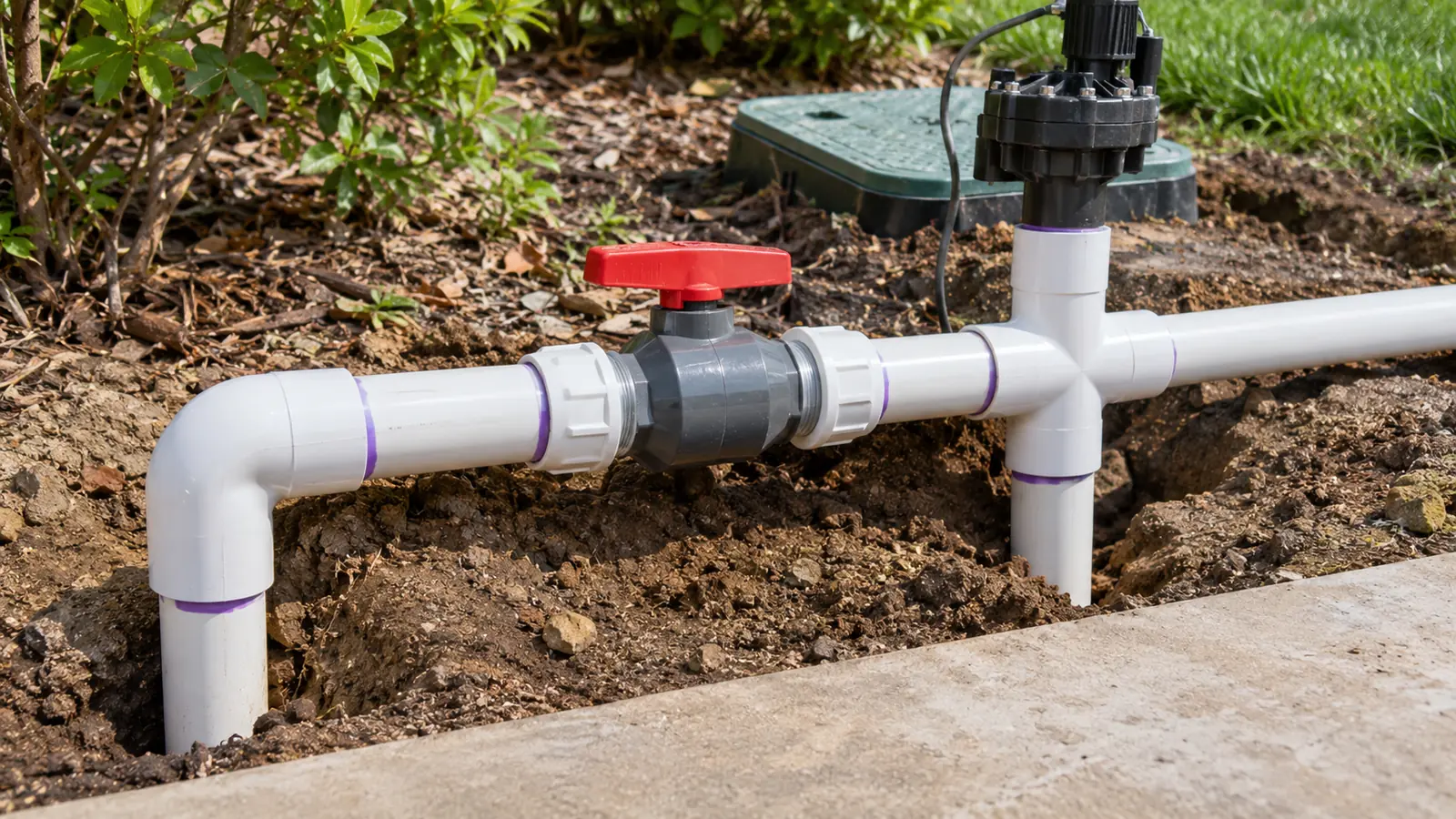
A threaded PVC joint is rated at 50% of the plain-end pipe, so a threaded 2 in. Schedule 80 system at 73°F is limited to about 200 psi, not 400 psi.
| Connection | Pressure basis | Notes |
|---|---|---|
| Solvent-welded socket | Fitting rated at about 60% of same-size pipe (Westlake rule of thumb; Charlotte lists 60%) | Primer and cement matching the pipe; cure before pressure testing |
| Threaded | 50% of plain-end pipe rating (Westlake) | Thread Schedule 80 or heavier only; not above 110°F |
| Flanged | 150 psi at 73°F for molded PVC flanges (Charlotte, Westlake) | Class 150 bolt pattern; follow flange installation guidance |
| Unions | Manufacturer-specific (Schedule 40 sizes up to 2 in.: 150 psi at 73°F, Charlotte) | Often lower than pipe; verify per product |
Sources: Westlake Schedule 40 specification, Westlake Schedule 80 specification, Charlotte Pipe Plastics Product Knowledge Guide.
✓ Checked against Westlake and Charlotte Pipe published notes, November 20262 in. Schedule 80 threaded at 100°F
Solvent-welded joints are preferred near maximum temperature. Schedule 40 pipe should not be threaded because the wall is too thin.
Threading removes wall and creates stress concentration, so use the manufacturer’s instructions. Joint preparation basics: cut square, deburr and bevel, clean, dry-fit, apply primer and cement, then let the joint cure before pressure testing. Use water, not air.
PVC Working Pressure vs. Burst and Test Pressure
PVC working pressure is a continuous service rating, while sustained-pressure, burst, and field test pressures are different quantities and must not be used interchangeably.
| Term | What it means | Use as operating pressure? |
|---|---|---|
| Working pressure rating | Published continuous water-service reference at stated conditions | Yes, within its conditions |
| Sustained-pressure test | Long-duration test in ASTM D1785 product requirements | No |
| Burst pressure | Short-duration performance criterion | No |
| Field hydrostatic test | Set by the system standard, manufacturer procedure, and project | No: a test, not a rating |
Source: ASTM D1785-26 treats these as distinct requirements.
Never test with air
Charlotte Pipe and Westlake warn that compressed air or gas in PVC pipe can fail explosively. Do not use a psi value from this chart for compressed-air distribution or pneumatic testing.
PVC Pressure Surges and Water Hammer
A pressure class is not a surge allowance: under AWWA C900, working pressure plus occasional surge should not exceed 1.6 times the pressure class, so a 235 psi DR 18 pipe is limited to 376 psi combined.
| Term | Definition (summary) | How it is handled |
|---|---|---|
| Pressure class | Working-pressure capacity at 73°F | From the DR and 4,000 psi HDB with safety factor 2.0 |
| Recurring surge | Frequent surges inherent to operation, such as pump starts and valve closure | Analyzed with the standard’s cyclic method |
| Occasional surge | Emergency or malfunction surges | Working + occasional surge not above 1.6 × pressure class |
Sources: Westlake AWWA C900 pressure class bulletin; Uni-Bell C900 primer; AWWA C900-16 text. Confirm in C900-22.
✓ Checked against Uni-Bell primer and AWWA C900-16 preview text, November 2026Pump starts and stops, valve closure, and system design all create transients. Schedule 40 and 80 ratings are stated for non-shock service, so surge needs separate engineering analysis.
PVC Static Water Head and Pressure
Static water pressure is about 0.433 psi per foot of elevation, so 100 ft of vertical water column creates about 43.3 psi before dynamic effects.
| Elevation difference (ft) | Static pressure (psi) |
|---|---|
| 25 | 10.8 |
| 50 | 21.6 |
| 100 | 43.3 |
| 200 | 86.6 |
| 300 | 129.9 |
| 400 | 173.2 |
Calculated with P (psi) = 0.433 × head (ft); head (ft) = 2.31 × P (psi), for water of conventional density.
✓ Calculated from published ratings, arithmetic checked, November 2026Static pressure from a 100 ft elevation difference
This is static pressure only. Pump discharge pressure, friction losses, water hammer, valves, and temperature must be added separately in design.
PVC Pressure Pipe for Irrigation and Water Supply
PVC pressure pipe is used for irrigation mains, sprinkler systems, and outdoor water distribution, with the design pressure checked against pipe, fittings, valves, temperature, and surge.
- Charlotte Pipe lists Schedule 40 pressure pipe for potable water supplied up to a building, irrigation and sprinkler systems, and HVAC condensate drains.
- Charlotte offers SDR 13.5 (315 psi), SDR 21 (200 psi), and SDR 26 (160 psi) pipe, whose ratings follow the SDR, not the size (see Section 11).
- Use pressure-rated fittings with straight angular turns; do not use DWV sanitary-turn fittings.
- Painting or covering is needed where pipe is permanently exposed to sunlight (UV).
- Support spacing is covered in the Pipe Support Spacing Chart; HDPE is an alternative pressure-pipe material in the HDPE Pipe Size Chart.
PVC Pressure Pipe vs. DWV, Conduit and CPVC
Only solid-wall PVC marked to a pressure standard such as ASTM D1785 is pressure pipe; DWV pipe, cellular-core pipe, and electrical conduit are not rated for pressure.
| Product | Pressure use | Key point |
|---|---|---|
| Solid-wall PVC pressure pipe (ASTM D1785) | Yes, per rating | Check marking and size |
| PVC Schedule 40 DWV fittings and system | No: 0 psi working pressure | Charlotte: DWV is not a pressure system; recommended test is 10 ft of head (4.3 psi) |
| Cellular-core PVC (ASTM F891) | Never for pressure | Lighter, drainage only |
| Dual-marked solid-wall pipe with DWV fittings | Not pressure rated | The fittings control |
| PVC electrical conduit | No: not pressure pipe | Different product and purpose |
| CPVC | Separate ratings | Use for hot and cold water; see CPVC chart |
Source: Charlotte Pipe Plastics Product Knowledge Guide. The conduit row is a general distinction; confirm with the product standard. A visible “Schedule 40” marking alone does not establish pressure suitability.
✓ Checked against Charlotte Pipe and Westlake published PVC1120 ratings, November 2026For PVC versus CPVC dimensions and links, see the CPVC Pipe Size Chart.
PVC Pressure Rating Formulas and Worked Examples
PVC pressure rating follows PR = 2·HDS ÷ (DR – 1), so an SDR 21 pipe with a 2,000 psi design stress is rated 200 psi at 73°F.
| Formula | Equation | Where used |
|---|---|---|
| Pressure from HDS and DR | PR = 2·HDS ÷ (DR – 1) | This section |
| Dimension ratio | DR = OD ÷ t | Section 8 |
| Pressure from OD and wall | PR = 2·HDS·t ÷ (OD – t) | Section 8 |
| Temperature adjustment | PR_T = PR_73 × f_T | Section 15 |
| Limiting component | P_system ≤ min(components) | Section 16 |
| Static head | P = 0.433·h | Section 20 |
Formulas are illustrative; published manufacturer and standard ratings control.
Pressure rating from HDS and DR: SDR 21
This matches the published SDR 21 rating for 2,000 psi HDS material. It does not replace product certification, temperature derating, surge analysis, or component-rating checks.
Unit conversion: psi to bar
Do not confuse a pressure class in psi with a nominal bar class from a different standard.
⭐ How to Choose PVC Pipe for the Required Pressure
To choose PVC pipe for a required pressure, compare peak working pressure, surge, and temperature against the derated rating of every component, not only the pipe.
- Service: confirm the fluid is compatible water service.
- Peak pressure and surge: include recurring and occasional events.
- Temperature: apply the factor from Section 14.
- Material and size: pick Schedule, SDR, or C900 product.
- Fittings, valves, and joints: use their own ratings.
- Approvals and local requirements: verify markings, listings, and codes.
| Component | Sch 40 at 73°F (psi) | Sch 40 at 100°F (psi) | Sch 80 at 73°F (psi) | Sch 80 at 100°F (psi) |
|---|---|---|---|---|
| Pipe | 280 | 174 | 400 | 248 |
| Socket fitting (60%) | 168 | 104 | 240 | 149 |
| Threaded fitting (50%) | 140 | 87 | 200 | 124 |
| Flange (150 psi) | 150 | 93 | 150 | 93 |
Illustrative arithmetic: published component ratings multiplied by the 0.62 factor (fittings use the same factors as pipe per Westlake). Flange derating should be confirmed with the manufacturer. Not a design approval.
✓ Calculated from published ratings, arithmetic checked, November 2026For 150 psi at 100°F, only the plain pipe clears the target in this example. Schedule 80 socket fittings come to 148.8 psi, just under 150, and the flange comes to 93 psi. A different joint type, size, or product would change the result.
ASTM, AWWA and Manufacturer Verification
Verify PVC pressure values against the current ASTM D1785, ASTM D2241, or AWWA C900 edition and the manufacturer’s documentation for the exact product marked on the pipe.
| Source | Use |
|---|---|
| ASTM D1785-26 | Schedule 40/80/120 pressure pipe: material, dimensions, tests, marking |
| ASTM D2241-25a | SDR pressure-rated PVC pipe |
| AWWA C900-22 | C900 waterworks pipe: DR and pressure class |
| PVC Pipe Association (Uni-Bell) | PVC pipe design, surge, and temperature guidance |
| Charlotte Pipe Plastics Product Knowledge Guide | Pipe and component ratings, SDR product list |
| Westlake Schedule 40 specification and Westlake Schedule 80 specification | Pipe ratings, temperature factors, fitting rules of thumb |
| Westlake AWWA C900 pressure class bulletin | C900 pressure class method |
Several edition-specific tables were checked in earlier published editions or secondary summaries. Confirm values in the current standard before specifying.
- Fitting standards ASTM D2466 (Schedule 40), D2467 (Schedule 80 socket), and D2464 (Schedule 80 threaded) do not set one universal working PSI for every manufacturer.
- Chemical resistance must be checked for fluids other than water, and severe service can require substantial pressure reductions (Westlake).
- Local plumbing and utility requirements can be stricter.
⭐ Common PVC Pressure Rating Mistakes
The most common PVC pressure mistakes are using a pipe-only rating for the whole system, ignoring temperature and surge, and treating schedule alone as a universal psi.
Rating basis
- Treating Schedule 40 or 80 as a universal PSI
- Using a PVC1120 chart for a different compound
- Applying ratings across ASTM D1785, D2241, and AWWA C900
- Smoothing the 2½ in. Schedule 40 rating into a trend
System rating
- Calling a system 400 psi because the pipe is 400 psi
- Ignoring fittings, unions, flanges, and valves
- Assuming another manufacturer’s fittings match
- Threading Schedule 40 pipe or ignoring the 50% threaded rating
Temperature and service
- Ignoring the 73°F reference temperature
- Mixing derating factors from different sources
- Reading the 140°F limit as hot-water approval
- Skipping chemical compatibility for fluids other than water
Pressure terms and safety
- Confusing burst or test pressure with working pressure
- Ignoring surge and water hammer
- Treating static head as full operating pressure
- Using DWV Schedule 40 or conduit for pressure
- Using compressed air in PVC pipe or air testing
PVC Pipe Pressure Rating FAQs
These are the most common questions about PVC pipe pressure ratings, answered with PVC1120 reference values at 73°F.
How much pressure can Schedule 40 PVC handle?
It depends on size. Schedule 40 PVC1120 pipe is rated 600 psi at 1/2 in., 280 psi at 2 in., 220 psi at 4 in., and 130 psi at 12 in. for water at 73°F, non-shock. Those are pipe-only values, and fittings, joints, and temperature can lower the system limit.
How much pressure can Schedule 80 PVC handle?
Schedule 80 PVC1120 pipe is rated 850 psi at 1/2 in., 400 psi at 2 in., 320 psi at 4 in., and 230 psi at 12 in. at 73°F for water. The rating still falls with size, and fittings, threaded joints, and flanges are rated lower than the straight pipe.
What is the PSI rating of 2-inch PVC pipe?
Two-inch PVC1120 pipe is rated 280 psi in Schedule 40 and 400 psi in Schedule 80 at 73°F for water. Its outside diameter is 2.375 in. for both. An SDR 21 pipe is 200 psi at any size, so always confirm the product marking before relying on a number.
What is the pressure rating of 4-inch Schedule 40 PVC?
Four-inch Schedule 40 PVC1120 pipe is rated 220 psi at 73°F for water in non-shock service. At 110°F the Westlake factor of 0.51 reduces that to about 112 psi. A 4 in. Schedule 80 pipe is rated 320 psi under the same reference conditions.
Is Schedule 80 PVC rated higher than Schedule 40?
Yes, for the same size and material. Schedule 80 has a thicker wall, so a 2 in. pipe goes from 280 psi to 400 psi, about 43% higher. That comparison is for pipe only; a Schedule 80 system can be limited by lower-rated fittings, flanges, or threaded joints.
Why does PVC pressure rating change with pipe size?
Schedule walls do not grow as fast as the outside diameter, so larger pipe has a thinner wall relative to its diameter and a lower rating. SDR pipe keeps a constant ratio, which is why every diameter in an SDR 21 series has the same 200 psi rating.
Does PVC pressure rating decrease at higher temperatures?
Yes. Manufacturers multiply the 73°F rating by a factor that falls as temperature rises: 0.88 at 80°F, 0.62 at 100°F, 0.40 at 120°F, and 0.22 at 140°F in the Westlake series. A 280 psi pipe is therefore about 174 psi at 100°F.
Can PVC fittings have lower ratings than the pipe?
Yes. Standards for molded fittings do not set working pressures, and manufacturers publish their own. For 2 in. Schedule 80 at 73°F, Charlotte lists pipe at 400 psi, socket fittings at 240 psi, threaded fittings at 200 psi, and flanges at 150 psi. The lowest component governs.
What is the pressure rating of PVC SDR 21?
PVC SDR 21 pipe made from 2,000 psi design stress material is rated 200 psi for water at 73°F under ASTM D2241, and the same rating applies at every nominal diameter in that SDR. SDR 26 is rated 160 psi, and SDR 13.5 is rated 315 psi.
What is the difference between PVC Schedule 40 and PVC SDR 21?
Schedule 40 has a wall set by nominal size, so its rating changes from size to size, while SDR 21 has a wall set at one-twenty-first of the outside diameter and a constant 200 psi rating. They are different standards and are not interchangeable by diameter alone.
Is PVC DWV pipe suitable for pressure applications?
No. Charlotte Pipe lists PVC DWV systems at zero working pressure, with a recommended test of 10 ft of head, about 4.3 psi. Cellular-core pipe is never for pressure, and dual-marked solid-wall pipe used with DWV fittings does not make a pressure-rated system.
Can ordinary PVC water pipe be used for compressed air?
No. ASTM D1785 and manufacturers warn that compressed air and gas in PVC pipe can fail explosively because of stored energy. A psi rating for water does not apply to gas, and air or gas pressure testing should not be used.
What is PVC1120?
PVC1120 is the common name for Type I, Grade I rigid PVC, ASTM D1784 cell class 12454. It carries a hydrostatic design stress of 2,000 psi at 73°F for water, which is the basis of the Schedule 40 and 80 ratings in this chart.
What is the PSI rating of 1/2 inch PVC pipe?
Half-inch PVC1120 pipe is rated 600 psi in Schedule 40 and 850 psi in Schedule 80 at 73°F for water. Its outside diameter is 0.840 in. Small sizes have the highest ratings because their walls are thick relative to their diameter.
What is the pressure rating of 6-inch Schedule 40 PVC?
Six-inch Schedule 40 PVC1120 pipe is rated 180 psi at 73°F for water, and 6 in. Schedule 80 is rated 280 psi. Six-inch pipe has a 6.625 in. outside diameter. Socket fittings of the same size are commonly taken at about 60% of the pipe rating.
How much pressure can 1-inch Schedule 80 PVC take?
One-inch Schedule 80 PVC1120 pipe is rated 630 psi at 73°F for water. With a threaded joint the rating drops to 50%, about 315 psi, and at 100°F the 0.62 factor reduces it further. Always check the lowest-rated component in the line.
How does 100°F affect PVC pipe pressure?
At 100°F, PVC pipe keeps 62% of its 73°F rating in the Westlake series. A 2 in. Schedule 40 pipe falls from 280 psi to about 174 psi, and 2 in. Schedule 80 from 400 psi to about 248 psi. Fittings must be derated as well.
Is burst pressure the same as working pressure?
No. Burst pressure is a short-duration test result, and sustained-pressure tests are product qualification checks. Working pressure is the continuous service rating and is much lower than either. Do not use a burst or test value as an operating pressure, and never test PVC with air.
Is AWWA C900 the same as Schedule 40 PVC?
No. AWWA C900 is a waterworks standard with dimension ratios and pressure classes, such as 235 psi for DR 18, and its own surge rules. Schedule 40 is an ASTM D1785 product rated by size. Pressure values cannot be transferred between them.
Can you thread Schedule 40 PVC pipe?
Manufacturers do not recommend it, because the wall is too thin. Only Schedule 80 or heavier is threaded, and a threaded joint is rated at 50% of the plain-end rating. Use solvent-welded joints or threaded adapters instead, and check the threaded connection rating.
How many feet of water head equal 100 psi?
One hundred psi equals about 231 ft of water head, using 2.31 ft per psi. Conversely, 100 ft of elevation creates about 43.3 psi at the lower point. This is static pressure only and does not include pump pressure, friction loss, or surge.
Can PVC be used for hot water?
Standard PVC pressure pipe is not intended for domestic hot water. Its rating drops to 0.22 of the 73°F value at 140°F, the upper manufacturer limit. CPVC systems are made for hot and cold water. Check the product standard and local plumbing code.
Using the PVC Pipe Pressure Rating Chart
This PVC pipe pressure rating chart gives pipe-only ratings for PVC1120 at 73°F, with temperature, fitting, SDR, and C900 context.
Start from the product marking, take the pipe rating for that size and schedule, apply the temperature factor, and then compare against the lowest-rated fitting, joint, flange, or valve. Surge, chemical service, and local requirements can lower the allowable pressure further. For dimensions, see the PVC Pipe Size Chart and Pipe Schedule Chart; for other materials, use the Pipe Pressure Rating Chart.
📄 Download PVC Pipe Pressure Rating Chart PDF
Use your browser print function to save this page as a print-ready PDF for submittal binders and field reference. Buttons and image placeholders are hidden when printing.
- Schedule 40 and 80 pressure chart
- SDR and C900 pressure classes
- Temperature derating table
- Pipe vs. fitting ratings
- Formulas and worked examples