
How to Estimate a Concrete Job: Complete Contractor Guide

A practical method for turning plans or site measurements into a complete concrete bid, covering materials, labor, equipment, subcontractors, overhead, risk and profit.
To estimate a concrete job, define the scope, take off quantities, price materials with current quotes, estimate labor and equipment from crew production rates, add subcontractors, then layer on project overhead, company overhead, risk and profit. Concrete volume is only one line item in the final bid.
- Review plans or site measurements and write a clear scope.
- List assumptions, then break the work into cost items.
- Take off concrete, steel, forms, base and accessories.
- Price materials with current supplier quotes.
- Estimate labor and equipment from production rates and loaded costs.
- Add subcontractors, overhead, risk and profit as separate layers.
- Check the estimate independently, then compare it with actual job cost.
A. Understand the estimating process
- What Is a Concrete Job Estimate?
- Concrete Takeoff vs. Cost Estimate vs. Bid
- What Costs Should Be Included in a Concrete Estimate?
- Build an Estimate Using a Work Breakdown Structure
B. Review scope before the math
- Step 1: Review Plans, Specifications or Site Measurements
- Step 2: Write a Clear Scope of Work
- Step 3: Identify Assumptions Before Pricing
- Step 4: Break the Work Into Cost Items
C. Complete the quantity takeoff
- Calculate Concrete Volume
- Add the Concrete Ordering Allowance Separately
- Calculate Reinforcing Steel or Mesh
- Calculate Formwork
- Calculate Base and Subgrade Materials
- Include Joints, Vapor Barrier, Dowels and Accessories
D. Price materials
- Get Current Ready-Mix Pricing
- Price Reinforcement, Forms and Consumables
- Include Material Delivery and Hauling Costs
E. Estimate labor
- Build the Concrete Crew
- Estimate Labor Using Production Rates
- Use Loaded Labor Cost, Not Just Hourly Wage
- Adjust Productivity for Job Conditions
F. Equipment and subcontractors
G. Overhead, risk and profit
- Direct Cost vs. Overhead
- How to Add Project Risk and Contingency
- How to Add Profit Without Confusing It With Markup
H. Build the final bid
What Is a Concrete Job Estimate?
A concrete job estimate is a structured calculation of every resource needed to finish a defined concrete scope. It covers quantities, production, direct cost, indirect cost, risk and profit.
Concrete volume is only one line item. A slab bid that multiplies cubic yards by a ready-mix price has left out the forms, base, steel, labor, equipment, overhead and everything else that makes the job possible.
FHWA’s major-project guidance describes a construction estimate as the cost of physically building the work, based on current costs for labor, materials, equipment, mobilization, bonds and profit (FHWA cost estimating guidance). That is a useful checklist for any concrete bid.
Concrete Takeoff vs. Cost Estimate vs. Bid
A takeoff, a cost estimate and a bid are three different steps. Confusing them is a common reason jobs are underpriced.
- Quantity takeoff: measures quantities from the plans or the site.
- Cost estimate: assigns costs to those quantities and to the production activities needed.
- Bid: the contractor’s commercial offer for a defined scope.
- Selling price: the customer-facing amount after overhead, risk and profit.
The hierarchy runs from takeoff to cost estimate to bid price. Build the quantities first with the concrete material takeoff guide, then price them here.
USACE requires quantities to come from a documented source tied to scope and design, traceable enough for an independent quality review (USACE ER 1110-2-1302). A contractor can adopt the same habit.
What Costs Should Be Included in a Concrete Estimate?
A complete estimate includes materials, labor, equipment, subcontractors, project overhead, company overhead, permits and fees, risk and profit. Table 1 breaks each category into typical items.
| Cost category | Typical items |
|---|---|
| Concrete | Ready-mix, admixtures, fibers |
| Reinforcement | Rebar, mesh, chairs |
| Subbase | Gravel, fill, geotextile |
| Forms | Lumber or forms, stakes, bracing |
| Labor | Forms, prep, placement, finish |
| Equipment | Excavation, compaction, finishing |
| Subcontractors | Pumping, testing, cutting |
| Hauling | Demolition debris, spoil, aggregate |
| Project overhead | Supervision, mobilization |
| Company overhead | Office, administration, insurance |
| Risk | Defined uncertainties |
| Profit | Contractor return |
A profitable concrete bid includes far more than ready-mix concrete and labor.
Build an Estimate Using a Work Breakdown Structure
A work breakdown structure (WBS) divides the job into activities you can quantify and price one by one. It keeps you from pricing the job as a single lump.
- Mobilization
- Demolition
- Excavation
- Base preparation
- Forms
- Reinforcement
- Concrete
- Placement and finishing
- Joints
- Curing and sealing
- Cleanup
USACE requires its estimates to follow a work breakdown structure that also supports sequencing and schedule. The same structure helps a small contractor see which activity is driving the cost.
A concrete estimate should flow from measurable scope to direct cost, overhead, risk and profit, and actual job results should feed future estimates.
Step 1: Review Plans, Specifications or Site Measurements
Start from the best documents you have. For plan jobs, review the structural drawings, details, concrete notes, reinforcement plans and finish schedule.
For residential and site-measured jobs, record field dimensions, elevations, access routes, demolition needs, drainage and existing utilities. FHWA advises field reviews before preparing an estimate, and the same applies to a driveway or patio.

Step 2: Write a Clear Scope of Work
A written scope states what is included and what is excluded. A low estimate caused by missing scope is usually worse than a slightly high unit cost.
- Excavation and haul-off
- Base and subgrade preparation
- Rebar or mesh
- Pumping
- Sealer
- Permits
- Landscaping restoration
Mark each item as included or excluded. Anything that is not written down becomes an argument later.
Step 3: Identify Assumptions Before Pricing
Assumptions are the conditions your price depends on. State them before you price, so a change in conditions justifies a change in price.
- Normal soil conditions
- Unrestricted truck and equipment access
- Standard working hours
- No contaminated soil
- One mobilization
- No unexpected reinforcement
- Normal weather
FHWA stresses that estimates should be built from a clearly identified scope, with assumptions documented so the estimate can be checked and verified (FHWA).
Step 4: Break the Work Into Cost Items
Break the job into cost items inside your estimate, even if the customer sees one price. A single internal line such as “concrete driveway” hides the numbers you need to review.
Separate demolition, excavation, base, forms, steel, concrete, labor, equipment, finishing and cleanup. USACE also asks that unit prices, lump sums and allowances carry a stated basis.
Use a worksheet like Table 2, and record each line as scope item, quantity, unit, production assumption, unit cost and total.
| Item | Quantity | Unit | Unit cost | Labor hrs | Equipment | Extended cost |
|---|---|---|---|---|---|---|
| Demolition | ft² | |||||
| Excavation | yd³ | |||||
| Base | ton | |||||
| Forms | LF | |||||
| Rebar | lb | |||||
| Concrete | yd³ | |||||
| Finishing | ft² | |||||
| Saw cuts | LF | |||||
| Sealer | ft² | |||||
| Cleanup | LS |
Calculate Concrete Volume
Convert length, width and thickness to cubic feet, then divide by 27 to get cubic yards. Use inches for thickness only after dividing by 12.
For irregular shapes, break the plan into rectangles, triangles and circles and add them. Check results with the Concrete Cubic Yard Calculator, the Concrete Slab Calculator or the Concrete Footing Calculator, and see the Concrete Volume Conversion Chart.
Add the Concrete Ordering Allowance Separately
Add the ordering allowance as its own line after the net quantity. NRMCA says to order 4% to 10% more than an estimate calculated from plan dimensions, to cover job contingencies (NRMCA CIP 31).
- Accurate forms and subgrade can justify a lower allowance.
- Irregular excavation points toward a higher allowance.
- On small jobs, a shortage can be a proportionally large problem.
Do not call this a flat 10% waste factor. It is an ordering allowance, and it is separate from your project contingency and your profit.
Calculate Reinforcing Steel or Mesh
Reinforcement is priced by weight or area, never by concrete volume. Take the bar size, spacing, count and lengths from the plans, then add laps and bends only as shown in the design.
- Rebar count, bar size and spacing
- Cut lengths and laps from the design
- Chairs and supports
- Welded wire reinforcement where specified
Keep steel cost separate from concrete cost. The Rebar Calculator and the Rebar Size Chart help with weights and sizes.
Calculate Formwork
Formwork is measured by contact area and edge length, not by concrete volume. Measure slab edges in linear feet and wall or beam forms in square feet of contact area.
- Linear feet of slab edge forms
- Square feet of wall or beam contact area
- Stakes
- Lumber or reusable forms
- Ties and bracing where applicable
The Concrete Formwork Calculator treats slab-edge forms separately from larger forms. The sidewalk forms guide shows how forms are set to grade.
Calculate Base and Subgrade Materials
Base and subgrade material is a volume that is converted to tons using the supplier’s density. Include gravel, crushed stone, fill and geotextile if specified.
Convert cubic feet to cubic yards by dividing by 27, then ask your supplier for the density or the tons per cubic yard. The Gravel Calculator can help with the conversion.
Include Joints, Vapor Barrier, Dowels and Accessories
Small accessories add up and are easy to forget. List each one on its own line.
- Vapor retarder
- Expansion or isolation material
- Saw cutting
- Dowels and anchor bolts
- Curing compound and sealers
- Fibers and embeds
Take quantities from the plans and the specification. Do not assume any of them is included in the ready-mix price.
Get Current Ready-Mix Pricing
Use a current written quote for every real bid, not a national average. Ask the supplier for each charge that can change the delivered price.
- Base price per cubic yard
- Mix-specific premium
- Fiber or admixture charges
- Delivery charges
- Fuel or environmental fees
- Short-load fee
- Weekend or after-hours charges
- Standby time
NRMCA notes that different mixtures are commonly used for different parts of a structure, each with its own mixture designation, so price by mix (NRMCA CIP 31). Use the concrete cost per yard, ready-mix concrete prices and concrete delivery cost pages for planning context only.
Record the quote date and expiration. FHWA notes that price swings in cement, steel and fuel can make firm quotes hard to get, which pushes bids up.
Build a clearer concrete project estimate
Organize concrete quantities, material costs, labor, and job expenses in a downloadable Excel workbook. Use it to prepare a project estimate and track job costs.
One-time purchase · Digital download · Microsoft Excel workbookPrice Reinforcement, Forms and Consumables
Get current supplier prices for every consumable. These small items add up and are priced on their own.
- Rebar and mesh
- Lumber and stakes
- Form oil
- Tie wire
- Curing materials
- Joint material
- Saw blades
FHWA cautions that bid-history pricing is only reliable for similar work and similar-sized projects (FHWA). Adjust old prices for quantity, location and timing.
Include Material Delivery and Hauling Costs
Delivery and hauling are real costs even when no one asks about them. Count every load that comes in or goes out.
- Aggregate delivery
- Rebar delivery
- Dump fees
- Dumpster rental
- Spoil haul-off
- Concrete washout handling where required
Demolition and haul-off are easy to underbid. Confirm thickness, reinforcement and disposal rules before pricing.
Build the Concrete Crew
Build the crew from the roles the job needs, and do not assume one standard crew fits every project.
- Foreman
- Laborers
- Form carpenters
- Finishers
- Equipment operator
A small driveway and a large foundation need different mixes of skills and different crew sizes. Record the crew you plan to use with each estimate.
Estimate Labor Using Production Rates
Labor cost is crew-hours multiplied by the loaded crew rate. Crew-hours come from the quantity and your crew’s production rate.
FHWA describes cost-based estimating as pricing each component of work by labor, equipment and materials and then adding overhead and profit, which mirrors how a contractor prepares a bid-day estimate (FHWA-HRT-22-075).
Production rates should come from your own completed jobs. If your records show a rate of P ft² per crew-hour, a 600 ft² placement takes 600 ÷ P crew-hours.
Use Loaded Labor Cost, Not Just Hourly Wage
Loaded labor cost is the true cost of an hour of work, not the wage on a paycheck. It includes the wage plus the extra costs of employing the person.
- Wage
- Payroll taxes
- Workers’ compensation
- Insurance
- Benefits
- Overtime
Two crews with the same wages can have very different job costs because of production. The Construction Labor Cost Calculator can help you assemble a loaded rate.
Adjust Productivity for Job Conditions
Job conditions change production, so adjust your rate when conditions differ from your usual work. FHWA notes that project access, construction timing and work restrictions all affect estimate cost.
- Poor access or hand carry
- Steep grade
- Complex forms
- Congested reinforcement
- Weather
- Short placements
- Multiple mobilizations
- Night or weekend work
If access cuts your production rate by 25%, crew-hours rise by about 33%, because 1 ÷ 0.75 is 1.33. Small production changes move labor cost a lot.
NRMCA also reminds buyers that a loaded concrete truck weighs about 80,000 lb and may not be able to maneuver on loose dirt or over residential curbs (NRMCA CIP 31), which can force a pump or hand placement.
Two jobs with the same concrete quantity can have very different costs because access, complexity and production rate control labor and equipment hours.
Price Equipment Usage
Price every machine the job uses, whether you own it or rent it. Owned equipment still has ownership and operating costs.
USACE’s equipment library, for example, is built on hourly ownership and operating costs, which are not the same as rental rates (USACE ER 1110-2-1302). Use the Equipment Rental Cost Calculator for rental pricing.
| Equipment | Pricing basis | Cost items to include |
|---|---|---|
| Mini excavator | Hour or day | Rental or ownership, fuel, delivery |
| Skid steer | Hour or day | Machine and attachments |
| Plate compactor | Day | Rental or ownership |
| Concrete saw | Day or hour | Machine and blade |
| Power trowel | Day | Machine and fuel |
| Pump | Hour, yard or minimum | Mobilization and pump charge |
| Dump truck | Hour or load | Driver, fuel, disposal |
| Generator | Day | Rental and fuel |

Include Concrete Pumping and Specialty Subcontractors
Include subcontracted work as its own priced lines whenever you expect to sublet it. Get written quotes and note what each includes.
- Concrete pumping
- Excavation
- Rebar placement
- Testing
- Concrete cutting
- Polishing
- Decorative finishing
Check how pumps are billed, since many charge a minimum plus time or volume. Confirm that access for the pump is available at the site.
Direct Cost vs. Overhead
Direct costs are tied to a specific activity, while overhead supports the work. Separating them keeps your pricing honest.
- Direct costs: materials, labor, equipment and subcontractors for a specific activity.
- Project (field) overhead: supervision, temporary facilities, project vehicles and mobilization.
- Company (home-office) overhead: office, estimating software, insurance, accounting and administration.
Overhead and profit are not the same thing, and there is no universal markup. Use the Construction Overhead Calculator to work out your own rate from your actual company costs.
How to Add Project Risk and Contingency
Contingency is an allowance for identified uncertainty, not extra profit. List each risk and decide how to respond, instead of adding a blind percentage.
FHWA says costs for uncertainty can be carried as a contingency, advises against false precision, and warns that unsupported optimism, meaning a low contingency, causes problems later (FHWA). Agency ranges for very large projects are owner-level guidance, so price your own specific risks.
| Risk | Estimating response |
|---|---|
| Unknown subgrade | Allowance, exclusion or unit-price change |
| Unknown slab thickness in demolition | Field verify or qualify the estimate |
| Rain or weather | Schedule contingency |
| Difficult access | Lower production rate |
| Concrete price volatility | Current quote with an expiration date |
| Short-load risk | Include the supplier charge |
| Multiple pours | Extra mobilization |
| Night or weekend work | Premium labor and supplier charges |
| Utility conflicts | Clarify scope and exclusions |
| Owner changes | Written change-order process |
How to Add Profit Without Confusing It With Markup
Markup is a percentage of cost, while margin is a percentage of the selling price. A 20% markup does not give a 20% margin.
Example: $10,000 cost, 20% markup
Selling price = $10,000 × 1.20 = $12,000. Profit dollars = $2,000.
Margin = $2,000 ÷ $12,000 = 16.67% of the selling price.
| Cost | Markup | Selling price | Gross profit | Margin |
|---|---|---|---|---|
| $10,000 | 10% | $11,000 | $1,000 | 9.09% |
| $10,000 | 20% | $12,000 | $2,000 | 16.67% |
| $10,000 | 25% | $12,500 | $2,500 | 20.00% |
| $10,000 | 30% | $13,000 | $3,000 | 23.08% |
Do not copy a profit target from an article. Market conditions matter, and FHWA notes that contractors bid with less profit in a downturn and higher markups in a strong market. The Contractor Markup Calculator and Profit Margin Calculator help you test your own numbers.
Complete Worked Concrete Job Estimate
This example uses an illustrative 20 ft × 30 ft slab, 5 in thick. It shows the method, not real pricing, and it leaves rates for you to fill from your own quotes.
Step 1: Concrete quantity
Volume = 20 × 30 × 5 ÷ 12 = 250 ft³. Cubic yards = 250 ÷ 27 = 9.26 yd³.
With an illustrative 6% ordering allowance: 9.26 × 1.06 = 9.82 yd³. Round or order according to the supplier’s dispatch policy.
Next, take off the other quantities from the same plan. Assume, for illustration only, a base 4 in thick across the slab, with slab edge forms around the perimeter.
- Slab area: 20 × 30 = 600 ft²
- Base volume: 20 × 30 × (4 ÷ 12) = 200 ft³, or 7.41 yd³, converted to tons with the supplier’s density
- Edge forms: 2 × (20 + 30) = 100 LF
| Cost item | Quantity | Unit rate | Extended cost |
|---|---|---|---|
| Concrete | 9.82 yd³ | Local quote | Enter from quote |
| Base | 7.41 yd³, converted to tons | Local quote | Enter from quote |
| Rebar or mesh | From plans | Supplier quote | Enter from quote |
| Forms | 100 LF | Supplier cost | Enter from supplier |
| Labor | Crew-hours | Loaded crew rate | Crew-hours × rate |
| Equipment | Hours or days | Actual rate | Hours × rate |
| Pump | Lump sum | Quote | Enter from quote |
| Cleanup | Allowance | Your allowance | Enter allowance |
| Direct cost subtotal | Sum of the lines above | Add | |
| Field overhead | From your project overhead records | Add | |
| Risk allowance | From the risk checklist | Add | |
| Home-office overhead | From your company overhead rate | Add | |
| Profit | Your chosen profit target | Add | |
| Final bid price | Sum of all lines | Total | |
Pull the totals into the Concrete Project Estimator or the Contractor Bid Calculator. For a faster pour check, use the Concrete Pour Cost Calculator.
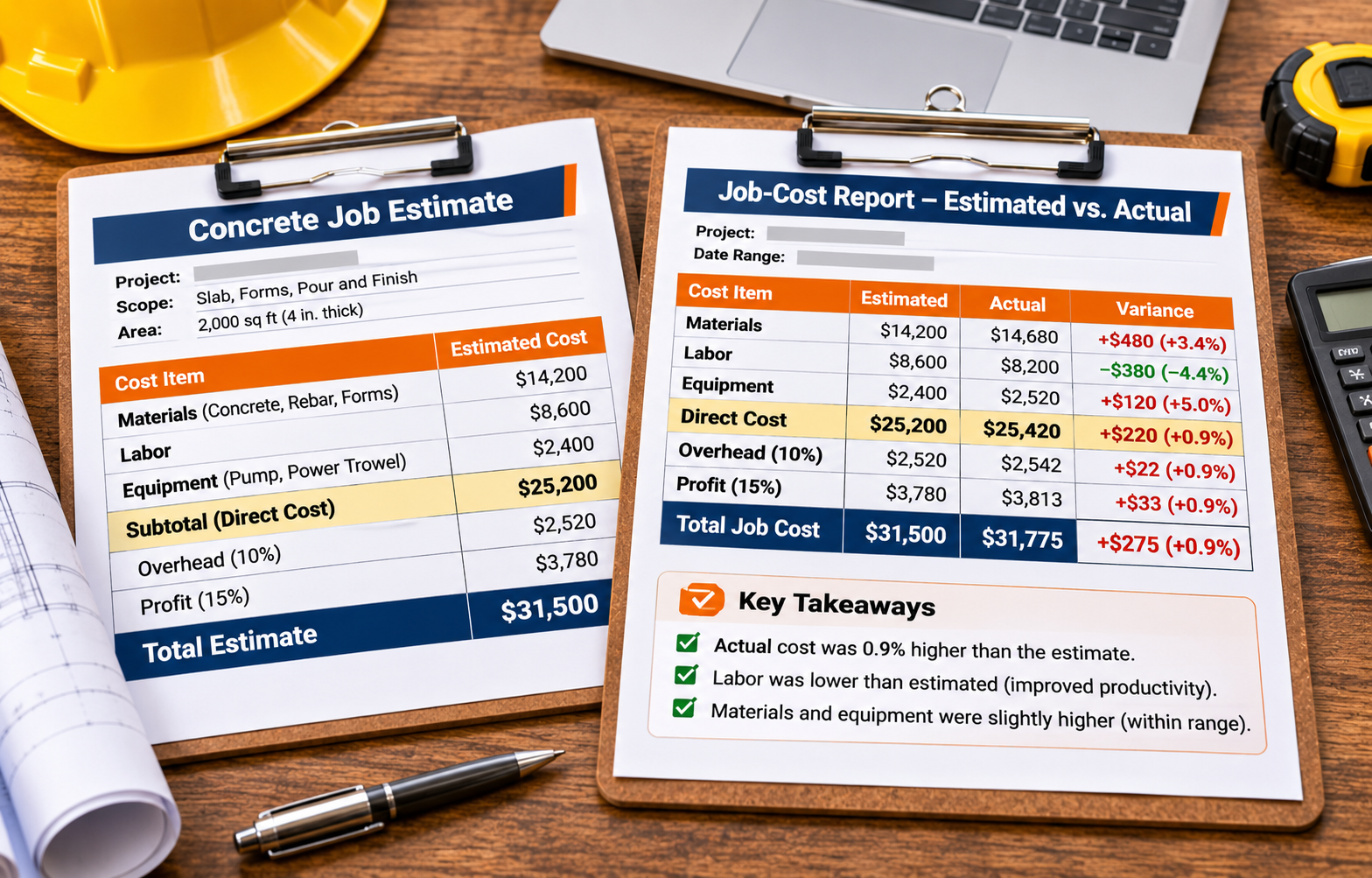
After the job, record actual hours and costs and compare them with the estimate. The Construction Job Cost Variance Calculator helps, and the result feeds your next bid.
Before the bid goes out, run the final quality check in Table 7. Have someone who did not build the estimate review it.
| Check | Complete? |
|---|---|
| Scope clearly defined | ☐ |
| Current plans and revisions used | ☐ |
| Quantities checked | ☐ |
| Concrete allowance separated | ☐ |
| Supplier quotes current | ☐ |
| Labor productivity realistic | ☐ |
| Labor burden included | ☐ |
| Equipment included | ☐ |
| Pumping included if needed | ☐ |
| Demolition and haul-off included | ☐ |
| Mobilization included | ☐ |
| Subcontractors quoted | ☐ |
| Field overhead included | ☐ |
| Company overhead accounted for | ☐ |
| Risks identified | ☐ |
| Profit included | ☐ |
| Exclusions listed | ☐ |
| Quote expiration defined | ☐ |
| Payment terms defined | ☐ |
| Final estimate independently checked | ☐ |
FHWA recommends a second, independent set of eyes on an estimate, and USACE requires reviews by people who did not develop it (FHWA). Small contractors can do the same with a partner or estimator.
Concrete Job Estimating FAQs
How do contractors estimate concrete jobs?
Contractors define the scope, take off quantities, price materials with current quotes, estimate labor and equipment from crew production rates, add subcontractors, and then add project overhead, company overhead, risk and profit. The result is a bid that covers the whole job, not just the concrete.
How much extra concrete should I include?
NRMCA says to order about 4% to 10% more than an estimate calculated from plan dimensions to cover job contingencies. The right amount depends on excavation accuracy, forms, geometry and job size. Show it as a separate ordering allowance, not as profit or contingency.
How do I estimate labor?
Divide the quantity by your crew’s production rate to get crew-hours, then multiply by the loaded crew rate. Use production rates from your own completed jobs and adjust them for access, complexity, weather and the number of mobilizations. Keep the rate tied to the activity, such as forming or finishing, so it can be reused on similar work.
How do I calculate crew productivity?
Divide the quantity a crew completed by the crew-hours it took, using real job records. Track it by activity, such as forming, placing and finishing, and note site conditions so you can adjust the rate for similar future jobs. A few completed jobs give a far better baseline than a published rule of thumb, which may not match your crew or site.
What costs should be included besides concrete?
Include reinforcement, base, forms, vapor barrier, joints, curing and sealing, labor, equipment, pumping, hauling, subcontractors, mobilization, supervision, permits, overhead, risk and profit. Leaving out these items is a common reason concrete jobs are underbid. Check each category against Table 1 before you finalize the price.
How do I estimate equipment?
Price each machine by hour, day or week, whether you own it or rent it. Include fuel, delivery, attachments, blades and operator time. Owned equipment has ownership and operating costs, so do not price it at zero because it is paid off. Add mobilization and delivery when the machine must be hauled to the site.
How much overhead should I add?
There is no universal figure. Calculate project overhead from supervision, vehicles and mobilization on the job, and company overhead from your real annual office, insurance and administrative costs divided across your work. Your own records are the best source.
What is the difference between markup and margin?
Markup is a percentage added to cost, while margin is profit as a percentage of the selling price. For example, a 20% markup on $10,000 gives a $12,000 price and $2,000 profit, which is a 16.67% margin. Always state which one you mean when you set a profit target.
How much profit should a concrete job make?
There is no single correct target. It depends on your overhead, risk, market conditions and goals. Calculate the profit you need to cover business costs and risk, then test your bid against the market instead of copying a rule of thumb.
Should contingency be included in the customer quote?
Contingency should be included in your price when it covers specific, identified risks, but it is not extra profit. Either price the risk, set an allowance with clear terms, or use exclusions and unit-price change language so the customer understands what is covered. Be transparent in the proposal about what each allowance covers.
How do I estimate demolition and haul-off?
Verify thickness, reinforcement and area on site, then price labor, equipment, hauling and disposal fees separately. If thickness or reinforcement is unknown, qualify the estimate or add a defined allowance, because demolition quantities are easy to underestimate. Include a note about disposal rules for the material.
How do I avoid underbidding?
Define the scope in writing, take off every cost item, use current quotes and your own production rates, include loaded labor, equipment, overhead, risk and profit, list exclusions, and have the estimate independently checked. Compare each finished job against its estimate.
Conclusion
To estimate a concrete job well, move from scope to takeoff to production, then add direct cost, project overhead, company overhead, risk and profit. Rely on current quotes, your own crew data and completed-job results.
Start your next bid with a clean worksheet and a quantity takeoff.
Open the Contractor Bid Calculator