Sheet Metal Gauge Chart:Thickness in Inches and Millimeters
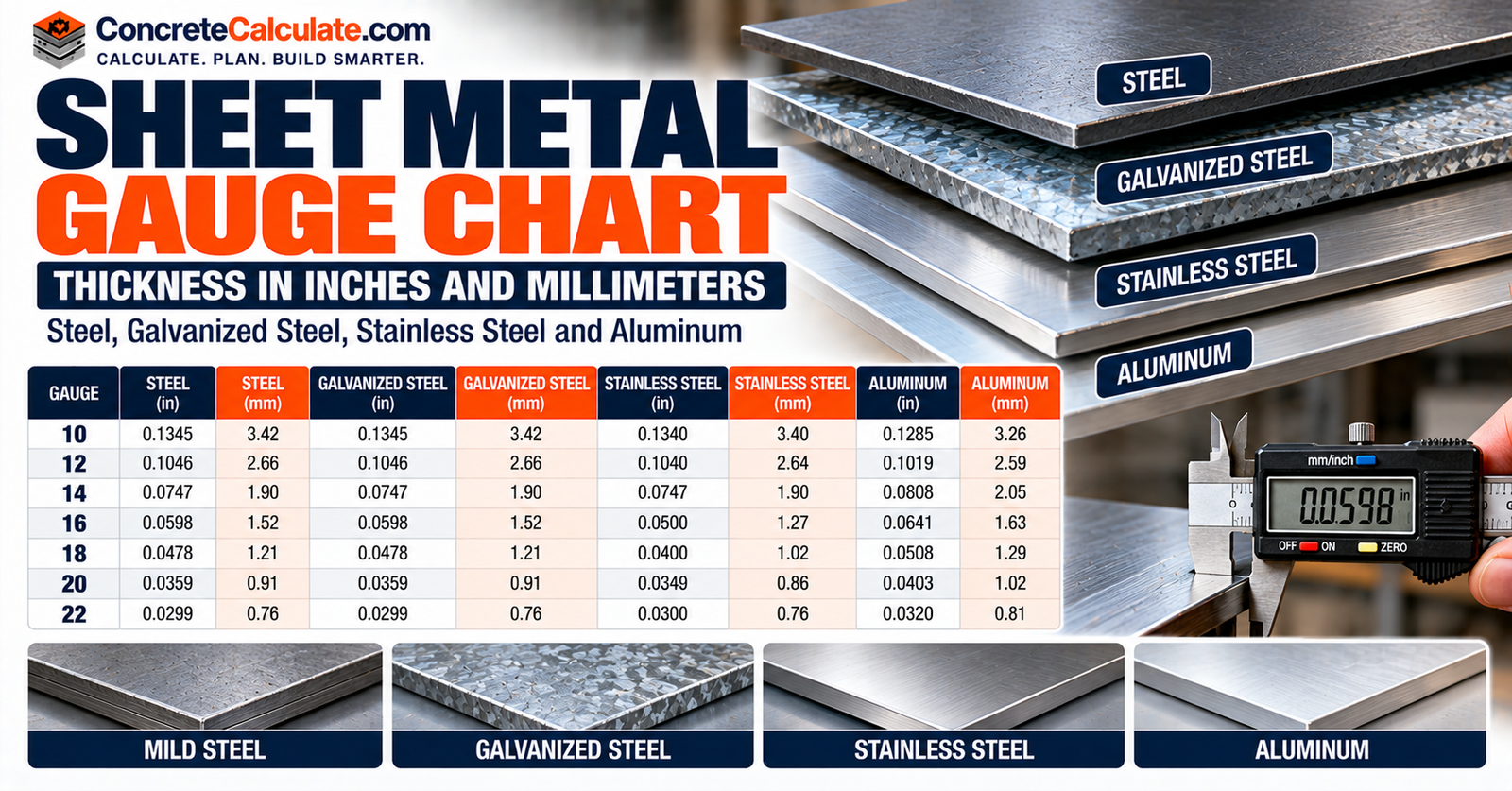
Sheet Metal Gauge Chart
Thickness in Inches and Millimeters
Convert sheet metal gauge numbers to nominal thickness for mild steel, galvanized steel, stainless steel and aluminum, with weight, tolerances, statutory-versus-commercial gauge distinctions, and material-specific conversions.
 Reviewed by Muhammad Ramzan Babar, PhD Researcher (Plasma Physics) & Calculator Developer – View Profile
Important: Gauge Depends on Material
The same gauge number represents a different thickness in mild steel, stainless steel, galvanized steel and aluminum. These are nominal conventional values, not guaranteed measured thicknesses. Always confirm the actual material specification, order thickness, and tolerance with the supplier before purchase or fabrication.
Sheet Metal Gauge Chart – Quick Reference
Start here for a compact side-by-side comparison of the four common material categories, then use the full-width material-specific charts below for complete data.
How to Read This Chart
Values below are conventional nominal gauge equivalents, not guaranteed measured thicknesses. Actual purchased material should be specified and verified by decimal or metric thickness, material grade, and applicable ASTM tolerance, not by gauge number alone.
Complete Sheet Metal Gauge-to-Thickness Chart
| Gauge | Mild Steel (in) | Stainless Steel (in) | Aluminum (in) |
|---|---|---|---|
| 10 | 0.1345 | 0.1406 | 0.1019 |
| 12 | 0.1046 | 0.1094 | 0.0808 |
| 14 | 0.0747 | 0.0781 | 0.0641 |
| 16 | 0.0598 | 0.0625 | 0.0508 |
| 18 | 0.0478 | 0.0500 | 0.0403 |
| 20 | 0.0359 | 0.0375 | 0.0320 |
| 22 | 0.0299 | 0.0313 | 0.0253 |
| 24 | 0.0239 | 0.0250 | 0.0201 |
| 26 | 0.0179 | 0.0188 | 0.0159 |
Galvanized Sheet Metal Thickness
| Gauge | Base Metal Thickness (in) | Approx. Finished Thickness, G90 (in) | Note |
|---|---|---|---|
| 16 | 0.0598 | ~0.0613-0.0629 | Coating adds approx. 0.0015-0.0031 in total across both faces for G90 |
| 20 | 0.0359 | ~0.0374-0.0390 | Actual coated thickness varies with coating designation and measurement method |
These are illustrative ranges based on common G90 coating-mass conversions, not certified dimensional values. See the dedicated galvanized section below for the coating-designation explanation.
Important Conversion Notes
- Values shown are nominal, conventional, published gauge equivalents, not exact measured thicknesses.
- Gauge systems differ by material: mild steel, stainless steel, and aluminum each commonly use their own conventional series.
- Actual purchased thickness depends on the order specification, applicable ASTM standard, and manufacturing tolerances.
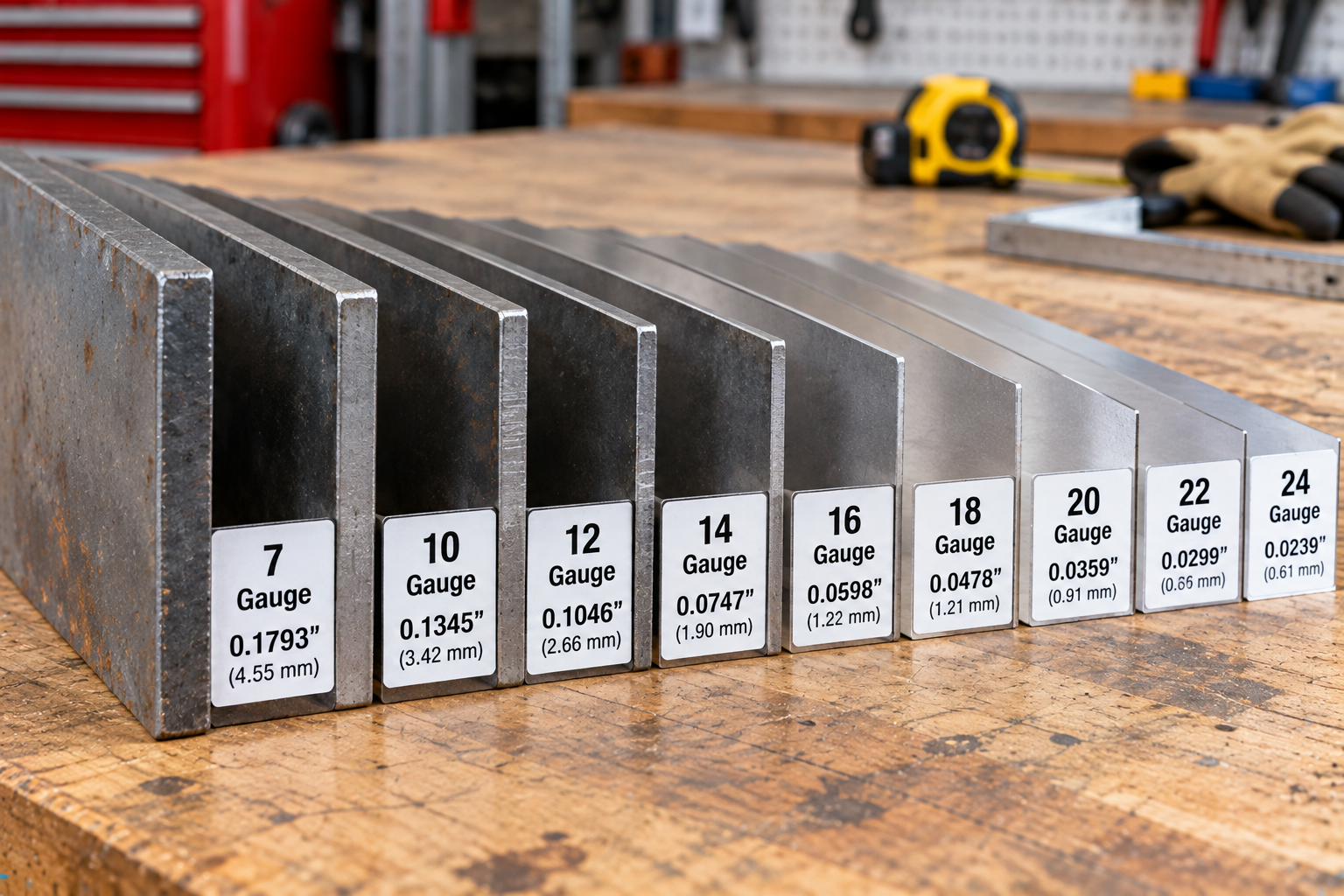
What Is Sheet Metal Gauge?
Gauge is a traditional numbering system used to identify nominal sheet metal thickness. In common sheet metal gauge systems, a larger gauge number generally indicates thinner material.
- Gauge number: The traditional designation printed on mill documentation or used in ordering.
- Nominal thickness: The conventional published thickness associated with that gauge number.
- Actual measured thickness: What a caliper or micrometer records on a specific sheet.
- Base metal thickness: The steel substrate thickness before any coating is applied.
- Coated thickness: The finished thickness of a sheet including its metallic or paint coating.
Gauge is a dimensional designation, not a direct statement of material strength, corrosion resistance, or suitability for a particular construction application.
Why Higher Gauge Numbers Mean Thinner Metal
Using the ordinary mild steel series as an illustration, 10-gauge steel (0.1345 in.) is thicker than 16-gauge steel (0.0598 in.), which is thicker than 22-gauge steel (0.0299 in.). This inverse relationship traces back to historical wire and sheet drawing processes, though not every modern gauge series follows the same mathematical progression.
Why Sheet Metal Gauge Varies by Material
A fabricator must know the material before using a gauge number, because different conventional gauge systems apply to different metals.
Manufacturers’ Standard Gauge
Commonly used for conventional carbon and galvanized sheet steel. Sixteen gauge under MSG is nominally 0.0598 inch.
Conventional Stainless Gauge
A separate published series commonly used for stainless steel. Sixteen gauge stainless is nominally 0.0625 inch.
Brown & Sharpe / Aluminum Gauge
Commonly used in many aluminum reference charts. Sixteen gauge aluminum is nominally 0.0508 inch.
| Material / System | 16-Gauge Nominal Thickness (in) | Metric (mm) |
|---|---|---|
| Mild steel (MSG) | 0.0598 | 1.519 |
| Stainless steel (conventional) | 0.0625 | 1.588 |
| Aluminum (Brown & Sharpe) | 0.0508 | 1.290 |
These values are labeled by system, not presented as an ASTM-prescribed universal gauge thickness. ASTM material specifications govern the actual ordered product.
Mild Steel Sheet Metal Gauge Chart
The complete Manufacturers’ Standard Gauge series commonly used for carbon-steel sheet.
| Gauge | Nominal Thickness (in) | Thickness (mm) | Approx. Fractional Equivalent | Theoretical Weight (lb/ft²) |
|---|---|---|---|---|
| 7 | 0.1793 | 4.554 | 3/16 in. (approx.) | 7.31 |
| 10 | 0.1345 | 3.416 | 9/64 in. (approx.) | 5.49 |
| 12 | 0.1046 | 2.657 | 7/64 in. (approx.) | 4.27 |
| 14 | 0.0747 | 1.897 | 5/64 in. (approx.) | 3.05 |
| 16 | 0.0598 | 1.519 | close to 1/16 in. | 2.44 |
| 18 | 0.0478 | 1.214 | 3/64 in. (approx.) | 1.95 |
| 20 | 0.0359 | 0.912 | close to 3/64 in. | 1.47 |
| 22 | 0.0299 | 0.760 | close to 1/32 in. | 1.22 |
| 24 | 0.0239 | 0.607 | close to 1/32 in. | 0.98 |
| 26 | 0.0179 | 0.455 | close to 1/64 in. | 0.73 |
| 30 | 0.0120 | 0.305 | close to 1/64 in. | 0.49 |
Fractional-inch equivalents are rounded approximations, not exact substitutes for the decimal gauge thickness. Weight figures use a 490 lb/ft³ steel density approximation.
Galvanized Sheet Metal Gauge Chart
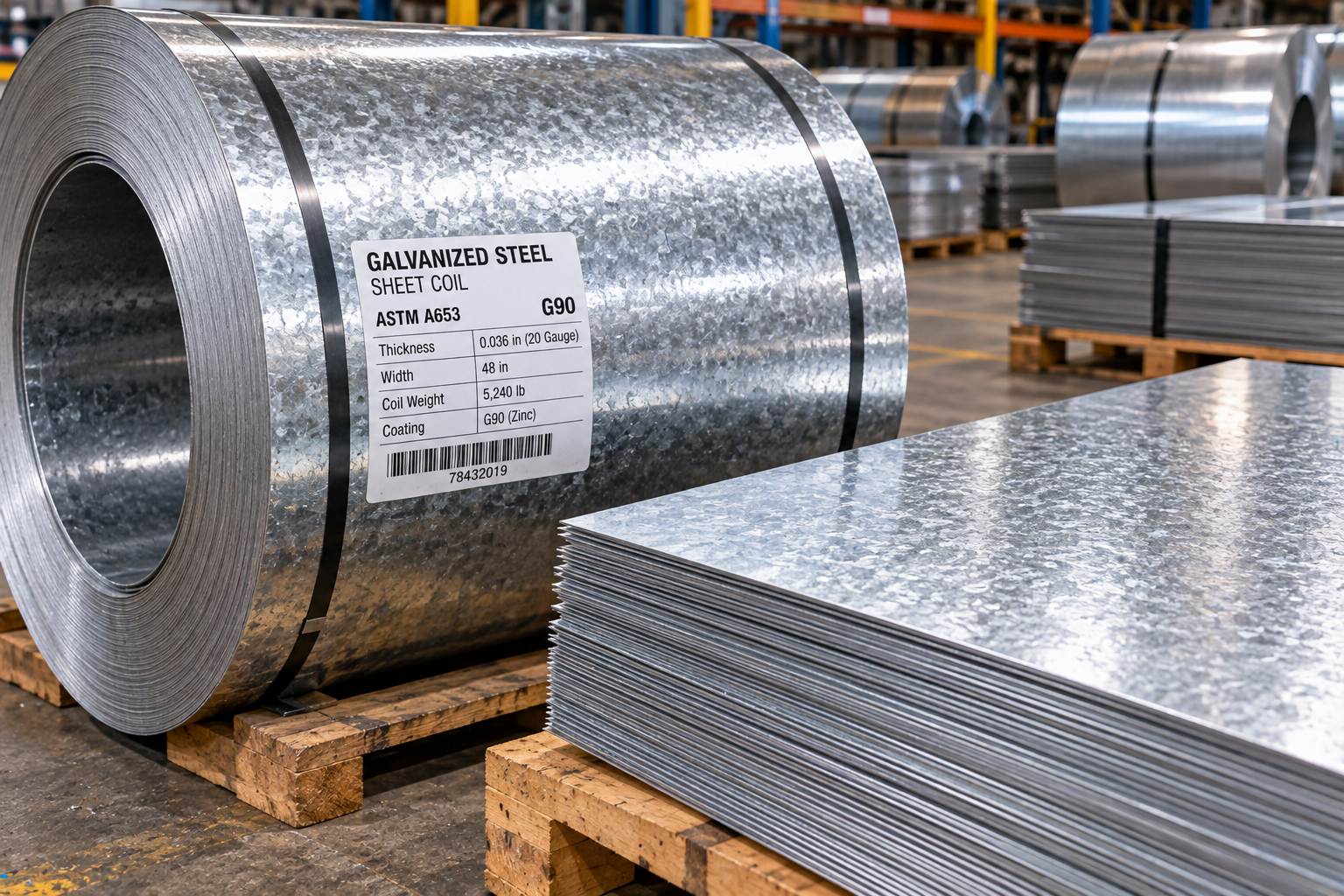
Galvanized products require particular care because base metal thickness and zinc coating contribute differently to finished thickness.
Base Metal Thickness vs. Coating Designation
ASTM A653/A653M identifies a coating designation such as G90 based on a minimum average coating weight of 0.90 oz/ft² total across both sides, measured by a specified triple-spot test. It does not mean 0.90 oz/ft² is deposited on each individual face, and it is a weight classification, not a stated coating thickness.
| Gauge | Base Metal Thickness (BMT), in | Common Coating Designation | Approx. Coating Contribution (both sides) |
|---|---|---|---|
| 16 | 0.0598 | G60 / G90 | Approx. 0.0010-0.0015 in. total, per common conversions |
| 18 | 0.0478 | G60 / G90 | Approx. 0.0010-0.0015 in. total, per common conversions |
| 20 | 0.0359 | G60 / G90 | Approx. 0.0010-0.0015 in. total, per common conversions |
| 22 | 0.0299 | G60 / G90 | Approx. 0.0010-0.0015 in. total, per common conversions |
Do not treat this as an exact result for every G30, G60, G90 or other product. If a legacy galvanized conversion table is used elsewhere, identify the convention and keep it distinct from certified product dimensions per the actual mill certification.
Stainless Steel Sheet Metal Gauge Chart
Common conventional stainless steel gauge equivalents.
| Gauge | Nominal Thickness (in) | Thickness (mm) | Approx. Fractional Equivalent |
|---|---|---|---|
| 10 | 0.1406 | 3.571 | close to 9/64 in. |
| 12 | 0.1094 | 2.779 | close to 7/64 in. |
| 14 | 0.0781 | 1.984 | close to 5/64 in. |
| 16 | 0.0625 | 1.588 | exactly 1/16 in. |
| 18 | 0.0500 | 1.270 | exactly 1/20 in. |
| 20 | 0.0375 | 0.953 | exactly 3/80 in. |
| 22 | 0.0313 | 0.795 | close to 1/32 in. |
| 24 | 0.0250 | 0.635 | exactly 1/40 in. |
| 26 | 0.0188 | 0.478 | close to 3/160 in. |
ASTM A480/A480M governs applicable general product requirements and tolerances, while the specific stainless material specification governs the ordered product. Grades such as 304, 316 and 430 are not different gauge systems; grade affects material properties, and the nominal gauge table remains a separate conversion convention. See the Structural Steel Weight Chart for structural member weight, which is distinct from sheet weight.
Aluminum Sheet Metal Gauge Chart
The conventional aluminum/Brown & Sharpe gauge series.
| Gauge | Nominal Thickness (in) | Thickness (mm) | Decimal Equivalent |
|---|---|---|---|
| 10 | 0.1019 | 2.588 | 0.1019 |
| 12 | 0.0808 | 2.052 | 0.0808 |
| 14 | 0.0641 | 1.628 | 0.0641 |
| 16 | 0.0508 | 1.290 | 0.0508 |
| 18 | 0.0403 | 1.024 | 0.0403 |
| 20 | 0.0320 | 0.813 | 0.0320 |
| 22 | 0.0253 | 0.643 | 0.0253 |
| 24 | 0.0201 | 0.511 | 0.0201 |
| 26 | 0.0159 | 0.404 | 0.0159 |
ASTM B209/B209M aluminum orders should specify the applicable alloy, temper, actual nominal thickness, and dimensional requirements rather than a gauge number alone.
Steel vs. Stainless Steel vs. Aluminum Gauge Comparison
The most commonly searched gauges, consolidated for quick comparison.
| Gauge | Mild Steel (in) | Stainless (in) | Aluminum (in) |
|---|---|---|---|
| 10 | 0.1345 | 0.1406 | 0.1019 |
| 12 | 0.1046 | 0.1094 | 0.0808 |
| 14 | 0.0747 | 0.0781 | 0.0641 |
| 16 | 0.0598 | 0.0625 | 0.0508 |
| 18 | 0.0478 | 0.0500 | 0.0403 |
| 20 | 0.0359 | 0.0375 | 0.0320 |
| 22 | 0.0299 | 0.0313 | 0.0253 |
| 24 | 0.0239 | 0.0250 | 0.0201 |
| 26 | 0.0179 | 0.0188 | 0.0159 |
Equal gauge numbers cannot be assumed to provide equivalent structural performance; each material has different yield strength, tensile strength and elastic modulus, so a matching thickness does not guarantee matching capacity.
U.S. Standard Gauge vs. Manufacturers’ Standard Gauge
These are two distinct systems and should not be substituted for each other.
Statutory Table, Not a Commercial Sheet-Steel Convention
A statutory U.S. iron-and-steel gauge table exists under 15 U.S.C. Section 206, established for its stated legal purpose, including import duties and taxes. Its values differ from the commonly published Manufacturers’ Standard Gauge used in commercial sheet-steel conversion charts.
| Gauge Number | Statutory U.S. Standard Gauge (in) | Conventional MSG Steel (in) | Difference | Intended Reference Context |
|---|---|---|---|---|
| 10 | 0.1406 | 0.1345 | 0.0061 | Statutory: legal/duty purposes; MSG: commercial sheet steel |
| 16 | 0.0625 | 0.0598 | 0.0027 | Statutory: legal/duty purposes; MSG: commercial sheet steel |
| 20 | 0.0375 | 0.0359 | 0.0016 | Statutory: legal/duty purposes; MSG: commercial sheet steel |
Establishing the intended gauge convention before ordering material is essential; specifying “16 gauge” without identifying the applicable system and material leaves room for a costly misunderstanding.
Sheet Metal Gauge Conversion: Inches and Millimeters
Use the following exact relationships to convert between inches and millimeters.
Conversion Formulas
t(mm) = 25.4 × t(in) and the reverse, t(in) = t(mm) / 25.4.
16-Gauge Mild Steel
18-Gauge Stainless Steel
Precise converted values differ from rounded metric equivalents seen in some tables; use the exact conversion for manufacturing tolerance calculations.
Decimal Thickness to Sheet Metal Gauge Chart
Use this inverse lookup when the actual material thickness is known but the commercial gauge designation is not.
Decimal Thickness to Nearest Gauge Lookup
| Measured Thickness (in) | mm | Nearest Steel Gauge | Nearest Stainless Gauge | Nearest Aluminum Gauge |
|---|---|---|---|---|
| 0.1345 | 3.416 | 10 | – | – |
| 0.0625 | 1.588 | close to 16 | 16 (exact) | – |
| 0.0598 | 1.519 | 16 (exact) | close to 16 | – |
| 0.0508 | 1.290 | – | – | 16 (exact) |
The nearest gauge is not necessarily the manufacturer’s actual ordered designation; use it only as an approximation aid.
Fractional-Inch vs. Decimal Sheet Metal Thickness
Fractional-inch values and nearby gauge numbers are often close but not identical.
| Fraction | Exact Decimal (in) | Nearby Gauge (approx.) | Label |
|---|---|---|---|
| 1/32 in. | 0.03125 | ~22-gauge steel | Approximate |
| 1/16 in. | 0.0625 | ~16-gauge steel (0.0598), exactly 16-gauge stainless | Approximate for steel, exact for stainless |
| 3/32 in. | 0.09375 | ~12-13 gauge steel | Approximate |
| 1/8 in. | 0.125 | ~11-gauge steel | Approximate |
| 3/16 in. | 0.1875 | ~7-gauge steel | Approximate |
1/16 inch is exactly 0.0625 inch, while conventional 16-gauge mild steel is nominally 0.0598 inch; they are close, not identical. A nearby gauge number should never be treated as an exact fractional-inch size.
Common Sheet Metal Gauges Explained
The highest-search-volume individual gauge questions, consolidated by common material use.
10-, 12- and 14-Gauge
These heavier gauges (0.1345, 0.1046 and 0.0747 in. in mild steel) are common in structural brackets, heavy equipment panels and fabrication requiring higher stiffness, subject to the actual design requirements.
16- and 18-Gauge
Sixteen-gauge (0.0598 in. mild steel) and 18-gauge (0.0478 in. mild steel) are common in general fabrication, enclosures, and lighter structural panels. A focused comparison: 14-gauge (0.0747 in.) is noticeably thicker than 16-gauge, which is in turn thicker than 18-gauge, useful context for fabricators choosing between adjacent gauges.
20-, 22-, 24- and 26-Gauge
These lighter gauges are common in ductwork, roofing panels, and light cladding, always subject to the applicable design, manufacturer span table, or code requirement rather than gauge number alone.
Sheet Metal Gauge vs. Actual Thickness and Tolerances
A nominal thickness does not guarantee one exact physical measurement.
- Material specification: Different ASTM specifications apply different tolerance rules.
- Hot-rolled or cold-rolled production: Production method affects achievable tolerance.
- Sheet width: Wider sheets can carry different tolerance allowances than narrower ones.
- Ordered thickness: The specific decimal thickness ordered, not just the nearest gauge.
- Product category: Structural, commercial or other quality categories can carry different tolerances.
ASTM A568/A568M contains dimensional tolerance provisions for applicable steel sheet products, while ASTM A480/A480M has separate requirements for stainless steel. There is no single generic universal tolerance, such as plus or minus 0.005 inch, that applies to every sheet and width; the applicable standard and product category govern.
Base Metal Thickness vs. Coated Thickness
This distinction is essential for galvanized roofing, cladding and light-gauge construction.
| Component | Description |
|---|---|
| Steel substrate thickness | The uncoated base metal thickness (BMT) |
| Metallic coating | Zinc or other metallic coating applied to both faces |
| Paint coating | Optional additional coating over the metallic layer |
| Finished thickness | Total measured thickness including all coatings |
A micrometer measurement across a coated sheet may not represent its base-metal thickness alone; the reading includes any metallic and paint coating. Coating mass designations such as G60 or G90 classify coating weight, not a stated coating thickness on each face.
Equipment for Your Project
Affiliate disclosure: As an Amazon Associate, ConcreteCalculate earns from qualifying purchases. We may also earn a commission from other affiliate links at no additional cost to you.
ASTM Standards for Sheet Metal Thickness
Each standard plays a different role; a traditional gauge chart is not a substitute for the applicable ASTM specification.
| Standard | Main Role |
|---|---|
| ASTM A568/A568M | General requirements and tolerances for applicable carbon and structural steel sheet |
| ASTM A1008/A1008M | Cold-rolled steel sheet products |
| ASTM A1011/A1011M | Hot-rolled steel sheet products |
| ASTM A653/A653M | Hot-dip galvanized and galvannealed steel sheet, including coating designations |
| ASTM A924/A924M | General requirements for metallic-coated steel sheet |
| ASTM A480/A480M | General stainless flat-product requirements and tolerances |
| ASTM B209/B209M | Aluminum and aluminum-alloy sheet and plate |
A material specification, a general dimensional tolerance standard, and a traditional gauge chart each play a different role; ASTM material specifications are not interchangeable with traditional gauge conversion tables. For plate-specific thickness beyond sheet gauge, see the related Steel Plate Thickness Chart.
Sheet Metal Gauge vs. Material Strength
The same thickness does not provide the same capacity for all metals.
- Yield strength: Varies significantly between low-carbon steel, structural steel, stainless steel and aluminum alloys.
- Tensile strength: Affects ultimate load capacity before failure.
- Elastic modulus: Affects stiffness and deflection under load.
- Sheet thickness, panel geometry, unsupported span and load direction all combine with material properties to determine actual capacity.
Detailed structural member design for beams, angles and tubing remains on the dedicated Structural Steel Shapes Chart, Steel Square Tube Size Chart, and HSS Size Chart, which cover structural sections rather than sheet gauge.
Sheet Metal Gauge and Weight Chart
Connect gauge thickness to practical material estimating using the theoretical weight relationship W = A x t x density, with consistent units.
| Gauge | Nominal Thickness (in) | Weight per ft² (lb) | Weight per m² (kg) | Weight of One 4×8-ft Sheet (lb) |
|---|---|---|---|---|
| 10 | 0.1345 | 5.49 | 26.80 | 175.7 |
| 14 | 0.0747 | 3.05 | 14.88 | 97.6 |
| 16 | 0.0598 | 2.44 | 11.91 | 78.1 |
| 18 | 0.0478 | 1.95 | 9.52 | 62.5 |
| 20 | 0.0359 | 1.47 | 7.15 | 46.9 |
For example, 16-gauge mild steel at 0.0598 inch is approximately 2.44 lb/ft² using a steel density of 490 lb/ft³. Coating and different alloy densities change the finished-sheet weight; these are clearly identified approximations, not certified weights. Use the Steel Weight Calculator for project-specific totals.
Standard Sheet Metal Sizes and Dimensions
Common stock dimensions include 36 x 96, 48 x 96, 48 x 120, and 60 x 120 inches, though availability varies by material, gauge and supplier.
- Sheet size: The cut length and width of a flat sheet.
- Thickness: The dimensional measurement in inches or mm.
- Gauge: The conventional numbering system corresponding to a nominal thickness.
- Coil width: The width of uncut material supplied on a coil.
- Sheet weight: Calculated from area, thickness and material density.
Estimating Sheets and Weight for a Project
Not every stock size is available in every material, gauge or finish; confirm actual availability with the supplier.
Sheet Metal Gauge for Roofing and Wall Panels
Gauge terminology is common in metal roofing, siding, wall panels and flashing, with 22-, 24-, 26- and 29-gauge steel roofing products frequently referenced, subject to actual manufacturer availability and specifications.
A gauge number alone does not establish a roof panel’s allowable span. Designers must check base-metal thickness, steel grade, roof panel profile, support spacing, wind uplift, snow loading, and the approved manufacturer span tables. See the Metal Roof Panel Span Chart for structural span capacity and the Roof Purlin Size Chart for supporting member dimensions.
Sheet Metal Gauge for HVAC Ductwork
Galvanized sheet is common in rectangular and round duct systems, but duct thickness depends on more than duct size.
Relevant design inputs include pressure class, duct dimensions, reinforcement, joint type, and applicable SMACNA requirements. There is no simplified gauge-by-duct-width chart that serves as a universal standard; consult the applicable SMACNA HVAC duct construction manual and the project’s specifications for actual selection.
Sheet Metal Gauge for Flashing, Gutters and Exterior Trim
Gauge or decimal thickness is specified for roof flashing, gutters, downspouts, fascia, coping and architectural trim, with aluminum and galvanized-steel using different thickness conventions.
Corrosion exposure, fabrication requirements, fastening, thermal expansion and manufacturer recommendations all affect the appropriate selection. There is no universal gauge recommendation for every flashing or gutter application; check the specific manufacturer’s instructions. See the Nail Size Chart for related fastener dimensions.
How Thickness Affects Cutting, Welding and Bending
Sheet thickness affects cutting, punching, drilling, welding, riveting, forming and bending processes.
| Process | What to Verify |
|---|---|
| Cutting/punching | Tooling capacity and material specification |
| Drilling | Bit selection and material hardness |
| Welding | Actual thickness for correct heat input and filler selection |
| Forming/bending | Actual material thickness, not nominal gauge, for bend allowance |
Bend Radius, Bend Allowance and Sheet Thickness
Inside bend radius, bend allowance, K-factor and flat-pattern dimensions all depend on the actual specified material thickness, not an assumed nominal gauge value. Using the true measured or ordered thickness in these calculations, rather than a rounded gauge equivalent, helps fabricators achieve accurate flat-pattern layouts.
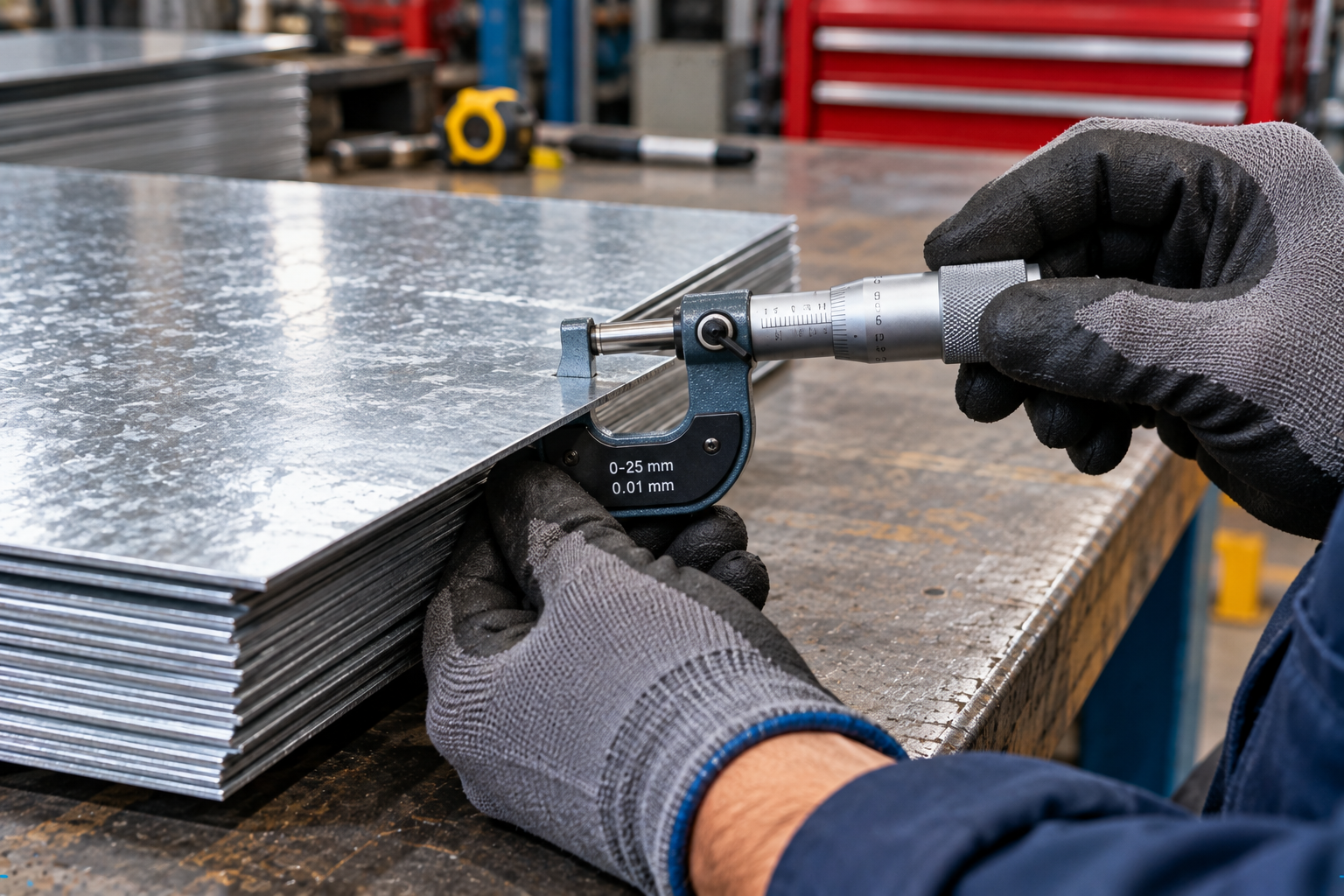
How to Measure Sheet Metal Thickness
Use a micrometer or suitable caliper for an accurate measurement.
- Measure away from cut edges and burrs, which can distort readings.
- Check several locations across the sheet.
- Confirm the material before comparing to any chart.
- Determine whether the measurement includes coating (galvanized, painted) or represents bare base metal.
- Compare the measurement with the purchase specification where available.
- Respect instrument accuracy and material tolerance ranges; do not over-interpret small variations.
An inexpensive gauge template may help identify approximate stock, but it cannot establish full compliance with a dimensional material specification.
How to Identify an Unknown Sheet Metal Gauge
- Identify the material first (steel, stainless, aluminum, galvanized).
- Measure the thickness with a micrometer or caliper.
- If coated, determine whether the measurement includes zinc, paint, or another finish.
- Consult the correct material-specific chart above.
- Compare the result with the actual order specification if available.
- Recognize that adjacent gauge values may fall within measurement or product-tolerance considerations rather than indicating a different nominal gauge.
How to Choose the Right Sheet Metal Gauge
- Identify the intended application.
- Determine the required metal and alloy.
- Establish structural, stiffness, forming or corrosion requirements.
- Identify the applicable material specification (ASTM A568, A653, A480, B209, etc.).
- Select a nominal decimal or metric thickness.
- Determine whether a gauge designation is appropriate for ordering.
- Account for coating and dimensional tolerances.
- Verify available stock sizes with the supplier.
- Calculate sheet weight and required quantity.
- Confirm the final specification with the supplier or approved design before ordering.
Common Sheet Metal Gauge Mistakes
Assuming all metals use the same gauge system
Mild steel, stainless steel and aluminum commonly use different conventional gauge series.
Using steel gauge thickness for aluminum
The same gauge number is a different nominal thickness in aluminum than in steel.
Treating statutory U.S. gauge and MSG as interchangeable
The two systems have materially different values for the same gauge number.
Assuming nominal equals exact measured thickness
Actual sheets vary within manufacturing tolerances.
Ignoring galvanizing and coating designations
Coating adds to finished thickness beyond the base metal gauge.
Confusing G90 coating mass with coating thickness
G90 is a weight classification from a triple-spot test, not a stated thickness per face.
Measuring finished coated thickness when base-metal thickness is needed
Coated measurements include zinc or paint layers.
Treating 16-gauge mild steel as exactly 1/16 inch
16-gauge mild steel is nominally 0.0598 inch, not the exact 0.0625-inch fraction.
Assuming equal gauge means equal material strength
Yield strength, tensile strength and stiffness vary significantly by material.
Using gauge number alone for structural roofing selection
Panel profile, span, and manufacturer tables govern actual roof capacity.
Confusing wire gauge with sheet metal gauge
These are separate systems; see the Wire Gauge Chart for wire-specific conversions.
Assuming every supplier stocks all gauges
Availability varies by material, gauge, and supplier.
Ignoring material-specific manufacturing tolerances
Each ASTM specification sets its own applicable tolerance rules.
Selecting bending/welding parameters without verifying actual thickness
Nominal gauge is not a substitute for the true measured or ordered thickness.
Sheet Metal Gauge Chart Limitations
This chart provides nominal conventional gauge-to-thickness conversions for common U.S. materials.
What This Chart Does Not Establish
It does not establish exact purchased thickness, manufacturing tolerance, structural capacity, product availability, or application-specific code compliance. The correct material specification, ordered thickness, coating, grade, supplier documentation, and approved structural or fabrication requirements govern where relevant.
Sheet Metal Gauge FAQs
Download Sheet Metal Gauge Chart PDF
Use your browser print function to save this reference as a PDF for shop binders, estimating folders and supplier communication.