Bolt Torque Chart 2026- SAE, Metric & Structural Bolt Guide
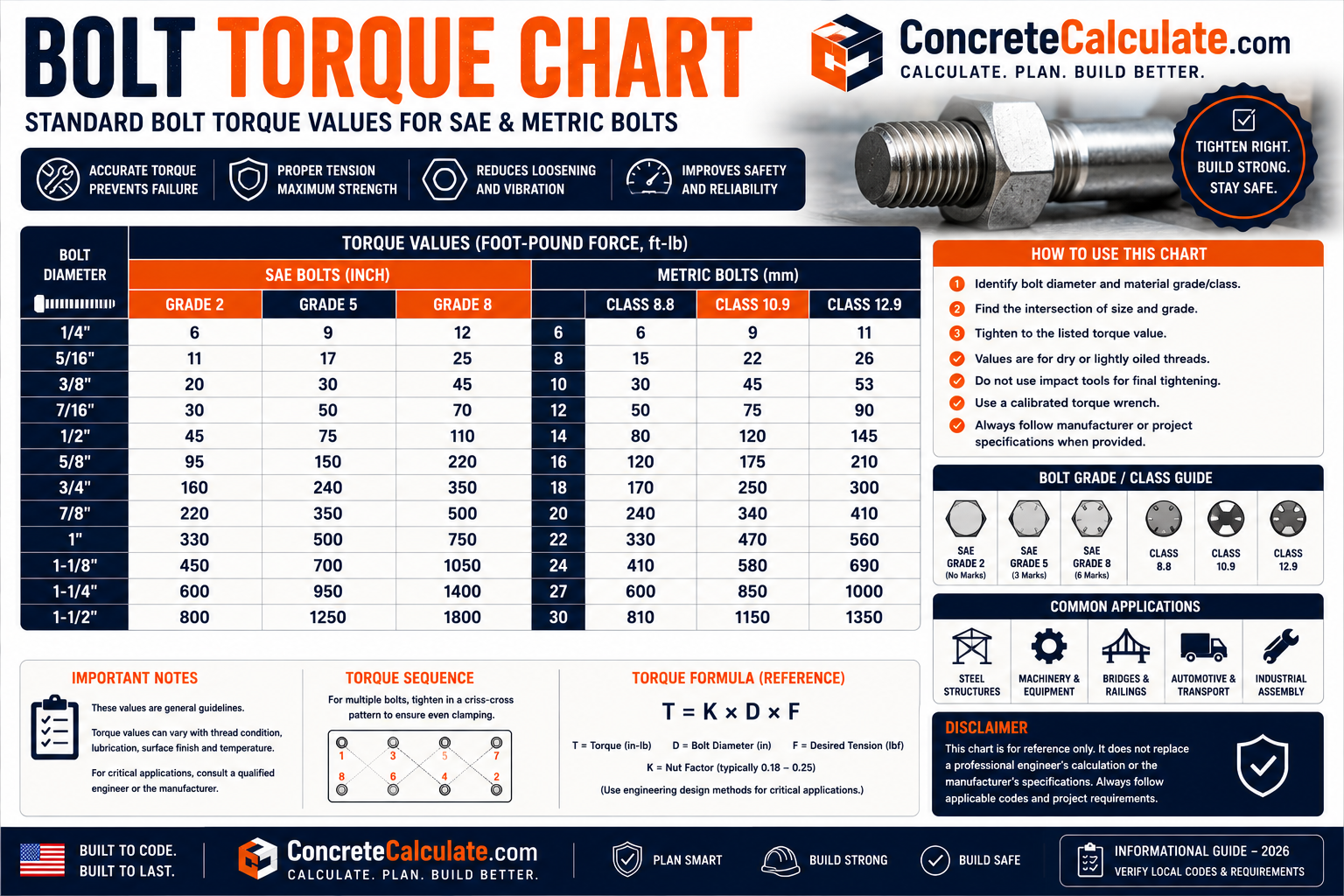
Bolt Torque Chart
SAE, Metric & Structural Bolt Guide
Torque is only an indirect way of producing bolt preload. Every value on this page states its bolt specification, thread type, grade and lubrication condition rather than a bare number.
 Reviewed by Muhammad Ramzan Babar, PhD Researcher & Calculator Developer · View Profile
General fasteners (SAE Grade 2/5/8 and metric 8.8/10.9/12.9) can use conventional torque tables when the source, condition and lubrication basis are stated. Structural high-strength bolts (A325, A490, F1852, F2280) are governed by required pretension and an approved installation method, not a generic torque number, because torque-to-tension correlation can vary by roughly 40 percent between bolt lots and conditions. Always follow vehicle, equipment or anchor manufacturer specifications when they exist; they override any generic chart.
⭐ Bolt Torque Chart: Quick Reference
Every value below assumes SAE J429 Grade 5, coarse UNC thread, slightly lubricated condition, as commonly published in general fastener torque references. Confirm your own bolt specification, coating and lubrication before applying any number.
| Bolt Size | Thread | Grade | Condition | Reference Torque |
|---|---|---|---|---|
| 1/4 in | Coarse (20 TPI) | Grade 5 | Lubricated | Approximately 6 to 8 ft-lb |
| 5/16 in | Coarse (18 TPI) | Grade 5 | Lubricated | Approximately 13 to 17 ft-lb |
| 3/8 in | Coarse (16 TPI) | Grade 5 | Lubricated | Approximately 23 to 31 ft-lb |
| 1/2 in | Coarse (13 TPI) | Grade 5 | Lubricated | Approximately 56 to 75 ft-lb |
| 5/8 in | Coarse (11 TPI) | Grade 5 | Lubricated | Approximately 112 to 150 ft-lb |
| 3/4 in | Coarse (10 TPI) | Grade 5 | Lubricated | Approximately 139 to 212 ft-lb |
| 1 in | Coarse (8 TPI) | Grade 5 | Lubricated | Approximately 323 to 430 ft-lb |
Different published references (aggregated from general fastener torque guidance including Bolt Depot style tables and Fastenal-style torque-tension charts) show a range because slight differences in target preload percentage, friction assumptions and rounding all shift the resulting number. Always confirm the specific source, bolt specification, thread condition and lubrication basis stated by whichever table you use.
⭐ What Is Bolt Torque?
Torque is the rotational force applied to a bolt or nut during tightening. It is used as an indirect way to develop a target clamping force, called preload, inside the fastener.
Fastener tightening
Turning the nut or bolt stretches the fastener slightly, creating tension that clamps the connected parts together.
Clamping force / preload
Preload is the axial tension created in the bolt shank. It is what actually holds a joint together, not the torque itself.
Thread and bearing friction
Most of the applied torque is consumed overcoming friction at the threads and at the bearing surface under the nut or bolt head, rather than converting directly into preload.
Torque as an indirect proxy
Because friction varies with lubrication, coating, surface condition and thread quality, the same torque can produce meaningfully different actual preload from one installation to another.
⭐ Bolt Torque vs Bolt Tension
This distinction is the single most important concept on this page.
| Concept | Definition | What Controls It |
|---|---|---|
| Torque | The rotational force applied to the nut or bolt during installation | Wrench setting, applied effort, or calibrated tool output |
| Tension / preload | The axial clamping force generated inside the fastener | Actual friction at threads and bearing surface, bolt stretch, and material behavior |
There is no recognized quantitative relationship between torque and pretension that holds reliably across different bolts. A variation of as much as 40 percent can exist between torque and resulting tension unless the relationship is established individually for each bolt lot, diameter and fastener condition.
⭐ SAE Bolt Torque Chart: Grade 2, Grade 5 & Grade 8
SAE J429 defines Grade 2, Grade 5 and Grade 8 inch-series fasteners. These are not automatically interchangeable with structural bolt specifications; AISC specifically warns that SAE J429 Grade 5 should not simply be substituted for ASTM F3125 Grade A325 even though strength properties are similar, because dimensional and quality/inspection requirements differ between the specifications.
| Grade | Relative Strength | Typical Use |
|---|---|---|
| Grade 2 | Lowest of the three | General hardware, low-stress applications |
| Grade 5 | Common medium/high strength | Automotive and general mechanical assembly |
| Grade 8 | Highest of the three | High-stress mechanical and structural-adjacent applications |
| Size (Coarse UNC) | Grade 2 (approx. dry, ft-lb) | Grade 5 (approx. dry, ft-lb) | Grade 8 (approx. dry, ft-lb) |
|---|---|---|---|
| 1/4-20 | 5 | 8 | 12 |
| 5/16-18 | 11 | 17 | 25 |
| 3/8-16 | 20 | 31 | 44 |
| 7/16-14 | 32 | 49 | 70 |
| 1/2-13 | 49 | 75 | 106 |
| 9/16-12 | 70 | 109 | 154 |
| 5/8-11 | 97 | 150 | 212 |
| 3/4-10 | 172 | 267 | 376 |
| 7/8-9 | — | 429 | 606 |
| 1-8 | — | 644 | 909 |
These figures are aggregated approximate reference values consistent with commonly published dry-condition SAE torque guidance for slightly lubricated to dry coarse-thread bolts. Lubricated condition values are typically 20 to 25 percent lower than dry values for the same size and grade. Always confirm the exact source, lubrication basis and thread condition before applying any table.
⭐ Metric Bolt Torque Chart: Class 8.8, 10.9 & 12.9
Metric property classes 8.8, 10.9 and 12.9 have progressively higher mechanical properties. Do not combine them into one generic metric torque table.
| Size | Pitch | Class 8.8 (approx. dry, N·m) | Class 10.9 (approx. dry, N·m) | Class 12.9 (approx. dry, N·m) |
|---|---|---|---|---|
| M6 | 1.0 | 9.8 | 14.0 | 16.8 |
| M8 | 1.25 | 24.0 | 34.3 | 41.1 |
| M10 | 1.5 | 47.5 | 67.9 | 81.6 |
| M12 | 1.75 | 83.2 | 118 | 142 |
| M14 | 2.0 | 132 | 189 | 226 |
| M16 | 2.0 | 206 | 294 | 352 |
| M20 | 2.5 | 402 | 574 | 688 |
| M24 | 3.0 | 694 | 992 | 1192 |
| M30 | 3.5 | 1381 | 1973 | 2368 |
Fastenal’s published metric torque-tension data provides different values for dry/plain and lubricated conditions at the same clamp load target. For lubricated threads, published references commonly apply roughly a 20 percent reduction from the dry/zinc-plated value at the same class and size, though the exact factor is source and coating specific.
Values shown are approximate reference figures for dry/as-received steel-on-steel condition, consistent with commonly published metric torque-tension charts. Confirm the exact class, coating and lubrication basis in your source before use.
⭐ Coarse Thread vs Fine Thread Torque
Thread pitch changes the tensile stress area and friction behavior, which in turn changes the torque needed for a comparable preload.
| Thread Type | Threads Per Inch (Example) | General Effect |
|---|---|---|
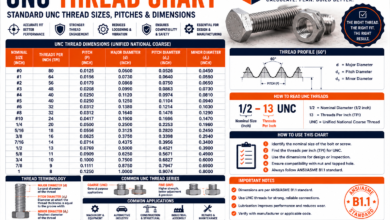
| UNC (coarse) | 1/2-13 | Larger thread pitch, generally faster assembly, common general-purpose choice |
| UNF (fine) | 1/2-20 | Smaller pitch, larger tensile stress area at the same nominal diameter, often slightly higher torque for a comparable preload |
| Metric coarse | M12 x 1.75 | Standard general-purpose metric pitch |
| Metric fine | M12 x 1.25 | Finer pitch, used in some precision or high-load applications |
Never mix coarse-thread torque values with a fine-thread bolt of the same nominal diameter; confirm thread designation before selecting a torque value.
⭐ Dry vs Lubricated Bolt Torque
Lubrication condition is one of the largest variables affecting required torque for a given preload target.
Dry / unlubricated
Higher friction generally requires more applied torque to reach the same preload compared with a lubricated equivalent. Many published general-fastener tables use dry or slightly lubricated as their baseline condition; always check which one a given source actually assumes.
Lubricated
Oil, assembly lubricant, or anti-seize reduces thread and bearing friction, generally lowering the torque needed for the same preload. Reductions in the range of roughly 20 to 25 percent versus dry values are commonly seen in published references, but the exact factor depends on the specific lubricant and coating.
Never assume a torque table’s baseline lubrication condition. Bolt Depot’s published U.S. torque table, for example, explicitly notes that its Grade 2, 5 and 8 values are for slightly lubricated bolts, not fully dry ones, so applying those values to a genuinely dry, high-friction bolt can under-torque the joint relative to the intended preload.
⭐ Stainless Steel Bolt Torque & Galling
Stainless fasteners behave differently from carbon steel and require their own torque references and installation precautions.
18-8, 304, 316 stainless
Common stainless fastener families with different corrosion resistance and mechanical properties than carbon steel grades. Use stainless-specific torque references rather than carbon-steel Grade 5/8 values.
What is galling?
Galling is a form of friction-induced surface damage where mating threads cold-weld and seize during tightening, especially common with stainless-on-stainless assemblies.
Why stainless is susceptible
Stainless steel’s work-hardening behavior and naturally higher friction coefficient make it more prone to galling than plated carbon steel, particularly without adequate lubrication.
Preventing galling
Use an appropriate anti-seize or lubricant, tighten slowly and steadily rather than rapidly, avoid over-torquing, and consider matching a stainless bolt with a dissimilar-material nut where practical.
⭐ Bolt Torque, Friction & the Torque-Tension Relationship
Friction, not nominal diameter alone, is the technical heart of the torque-tension relationship.
Thread friction
Friction between the male and female threads consumes a large share of applied torque before it ever becomes clamping force.
Bearing/nut friction
Friction under the nut face or bolt head against the washer or joint surface consumes additional torque.
Surface condition
Coating, rust, dirt and thread damage all change friction, and therefore change how much torque is needed for the same target preload.
Approximate torque-tension formula
A commonly used simplified relationship is torque approximately equals a nut factor (K) multiplied by nominal diameter (d) multiplied by desired preload (F). The nut factor K is empirical, varies by lubrication and surface finish, and is commonly cited in the rough range of about 0.12 to 0.20 for different conditions. This concept explains the relationship; it does not replace a calibrated, lot-specific test.
⭐ Bolt Torque for Structural Bolts: A325, A490, F1852, F2280
AISC identifies ASTM F3125 as the umbrella specification for structural bolt grades including A325, A490, F1852 and F2280. This category is handled differently from general fasteners on this page.
There is no recognized quantitative relationship between installation torque and installed pretension reliable enough to serve as a generic requirement. A variation of as much as 40 percent can exist between torque and tension unless the relationship is established individually for each bolt lot, diameter and fastener condition. As a result, the controlling structural specifications define required pretension and approved installation methods rather than a simple torque lookup table.
| Specification | Description |
|---|---|
| ASTM F3125 Grade A325 / A325M | Common structural bolt grade for standard steel connections |
| ASTM F3125 Grade A490 / A490M | Higher-strength structural bolt grade for heavier connections |
| ASTM F1852 | Twist-off-type tension-control bolt, strength comparable to A325 |
| ASTM F2280 | Twist-off-type tension-control bolt, strength comparable to A490 |
⭐ Structural Bolt Pretension Chart & Snug-Tight Condition
Minimum pretension, not torque, is the controlling value for structural high-strength bolts.
| Bolt Diameter (in.) | A325 Bolts, Minimum Pretension (kips) | A490 Bolts, Minimum Pretension (kips) |
|---|---|---|
| 1/2 | 12 | 15 |
| 5/8 | 19 | 24 |
| 3/4 | 28 | 35 |
| 7/8 | 39 | 49 |
| 1 | 51 | 64 |
| 1-1/8 | 56 | 80 |
| 1-1/4 | 71 | 102 |
| 1-3/8 | 85 | 121 |
| 1-1/2 | 103 | 148 |
Minimum pretension values are stated in the AISC Specification Table J3.1 and RCSC Specification Table 8.1. Values shown are illustrative and must be confirmed against the current adopted edition for any actual project.
Snug-tight condition
Snug-tight is defined in the RCSC specification as the tightness attained with a few impacts of an impact wrench or the full effort of an ironworker using an ordinary spud wrench to bring the plies into firm contact. Snug-tightened joints do not have a prescribed installed pretension requirement, since there is no specific minimum or maximum tension at snug.
Pretensioned/slip-critical condition
Connections requiring pretension have a specified minimum installed tension, generally at least 70 percent of the bolt’s specified minimum tensile strength, verified through an approved installation method rather than a generic torque value.
Equipment for Your Project
Affiliate disclosure: As an Amazon Associate, ConcreteCalculate earns from qualifying purchases. We may also earn a commission from other affiliate links at no additional cost to you.
⭐ Structural Bolt Installation Methods & Calibrated Wrench Calibration
These are the approved methods for achieving and verifying required pretension in structural bolts.
| Method | General Description |
|---|---|
| Turn-of-nut | Bring the joint to snug-tight, match-mark the nut and bolt end, then apply a prescribed additional rotation based on bolt length and diameter |
| Calibrated wrench | Use a torque wrench calibrated for the specific bolt lot, diameter and condition to reach the required pretension indirectly through torque |
| Twist-off-type tension-control bolts (F1852/F2280) | A splined end shears off at a designed torque level correlated to the required pretension for that specific bolt assembly |
| Direct-tension indicators | Washers or bolts with deformable features that indicate when the required pretension has been reached |
Prior to installing fasteners, each torque wrench must be calibrated on a daily basis for the specific assembly lot, when a lot is relubricated, when fastener surface condition changes, and when wrench components change. Use of an uncalibrated wrench for pretensioning structural bolts is prohibited due to the large number of variables affecting the torque-tension relationship.
⭐ Torque Unit Conversion Chart
Confirm units before comparing or applying any torque value.
| From | To | Multiply By | Example |
|---|---|---|---|
| ft-lb | N·m | 1.3558 | 75 ft-lb = 101.7 N·m |
| N·m | ft-lb | 0.7376 | 100 N·m = 73.8 ft-lb |
| lb-in | ft-lb | 0.0833 | 96 lb-in = 8 ft-lb |
| ft-lb | lb-in | 12 | 8 ft-lb = 96 lb-in |
| lb-in | N·m | 0.1130 | 50 lb-in = 5.65 N·m |
| N·m | kgf·m | 0.10197 | 100 N·m = 10.2 kgf·m |
⭐ Bolt Torque for Automotive, Anchors & Flange Applications
These applications each require their own specific source rather than a generic bolt-size chart.
Automotive applications
Engine components, suspension, wheels and brackets each carry specific manufacturer torque values. Vehicle manufacturer service manual specifications always take priority over a generic torque chart.
Wheel lug nut torque
Lug-nut torque is vehicle-specific and depends on wheel type, stud/nut design, wheel material and thread condition. There is no universal correct lug-nut torque for a given thread size; always use the vehicle manufacturer’s specification.
Construction bolt torque
Structural steel framing connections, machinery mounts, brackets, and anchors are different applications with different governing specifications. Separate structural bolts from ordinary general hardware.
Anchor bolt torque
Concrete anchor installation torque is product and manufacturer specific, not derived from anchor diameter alone. It depends on anchor type, concrete strength, embedment and installation method; see the Anchor Bolt Size Chart and always follow the specific anchor manufacturer’s published installation torque.
Never publish or rely on a universal lug-nut or anchor-bolt torque number. Wheel and anchor applications are both examples where a generic size-based chart can be materially wrong for the actual product installed.
⭐ Bolt Tightening Sequence & Flange Bolt Torque
Sequence matters whenever uniform clamping across multiple fasteners is required, such as on flanges, covers, and multi-bolt patterns.
Cross/star pattern
Tightening in a cross or star pattern, rather than around the circle, helps distribute clamping force more evenly and reduces gasket or flange distortion.
Multiple-pass tightening
An initial low-torque pass, one or more intermediate passes, and a final full-torque pass in the same pattern help achieve uniform, verified clamping.
Flange and gasket specific
Pipe flange bolting depends on the specific flange rating, gasket type and bolt specification; avoid using one universal flange torque table across different systems.
Verification pass
A final verification pass at full target torque, in the same sequence, confirms all fasteners reached their intended value after any settling from earlier passes.
Washers, Nut Grade, Coatings, Temperature & Retorquing
Several secondary factors influence the practical torque required for a reliable joint.
| Factor | Effect on Torque |
|---|---|
| Washer type | Flat vs hardened washers change bearing friction and stiffness at the joint interface |
| Nut grade compatibility | Bolt and nut specifications must be matched; an incompatible nut can strip or under-perform regardless of applied torque |
| Coatings (zinc, galvanizing, black oxide, proprietary) | Each coating has a different friction characteristic; do not assume all zinc-plated bolts behave identically |
| Thread condition | Clean, dirty, rusted or damaged threads all change effective friction and required torque |
| Temperature | Can influence lubricant viscosity and installation behavior; treat as a secondary consideration relative to friction and grade |
Whether retorquing is appropriate depends entirely on the application and specification. For structural high-strength bolts, follow the applicable RCSC/AISC installation and inspection requirements rather than generic retorquing advice; a simple torque check is not automatically an appropriate inspection method for pretensioned structural connections.
⭐ Bolt Torque Visual Guide
Original diagrams explaining the torque-to-preload relationship, friction components, thread types and tightening sequence.
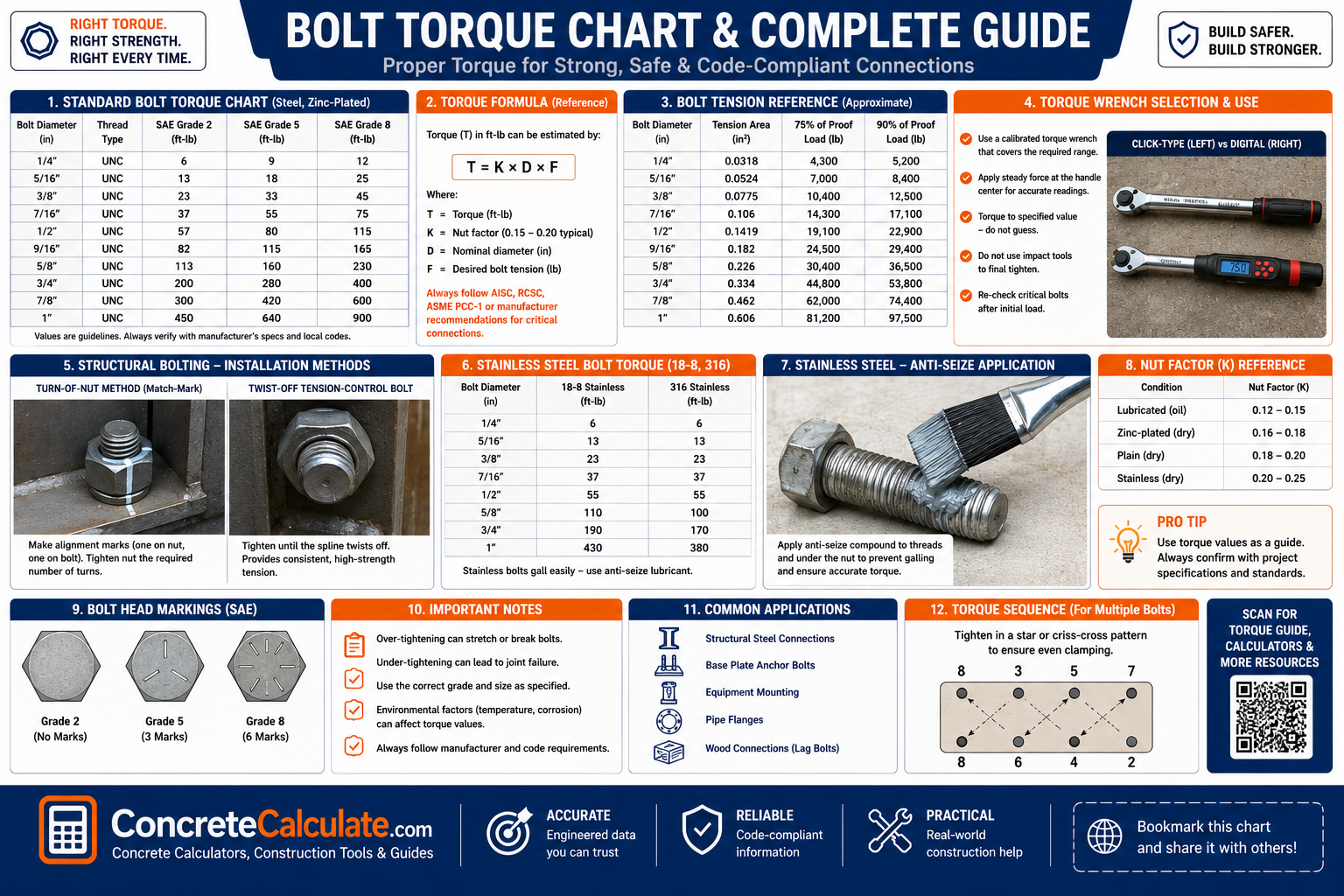
⭐ How to Read a Bolt Torque Chart
Confirm every one of these items before applying any published torque value.
Confirm the actual nominal size, not an estimated size.
Coarse, fine, metric coarse or metric fine all use different values.
Grade 2/5/8 or Class 8.8/10.9/12.9 change strength and required torque.
Confirm the nut is rated to match the bolt grade being used.
Zinc, galvanizing, black oxide or proprietary coatings change friction.
Dry, lightly lubricated or anti-seize conditions require different torque.
ft-lb, lb-in, N·m and kgf·m are not interchangeable without conversion.
Identify which manufacturer or reference published the number and its stated assumptions.
Some applications, especially structural bolting, specify pretension rather than torque.
Torque wrench, turn-of-nut, tension-control bolt or direct-tension indicator each verify differently.
Vehicle, equipment and anchor manufacturers can override generic charts.
How to Choose the Correct Bolt Torque
Follow each step in order rather than jumping straight to a number.
SAE J429, ASTM F3125, ISO 898-1 or a proprietary manufacturer specification.
Confirm the exact nominal size being installed.
Match coarse, fine, metric coarse or metric fine correctly.
Confirm markings on the bolt head match the intended specification.
Confirm compatibility with the bolt grade and thread.
Note zinc, galvanizing or other finish affecting friction.
Select the matching torque table column.
Vehicle, equipment, anchor and OEM specs take priority over generic charts.
Structural, safety-critical or fatigue-sensitive joints often specify tension directly.
Select torque wrench, turn-of-nut, tension-control bolt or direct-tension indicator as applicable.
Mandatory for torque-based pretensioning of structural bolts.
Follow the applicable specification’s inspection provisions.
⭐ Bolt Torque Worked Examples
These examples show the selection reasoning. Always verify against the actual manufacturer or specification source before installation.
1. 1/2-Inch Grade 5 Bolt
2. 3/4-Inch Grade 8 Bolt: Coarse vs Fine
3. M16 Class 8.8 Bolt
4. Lubricated vs Dry Bolt
5. Structural A325 Bolt
Common Bolt Torque Mistakes
A reliable torque selection requires matching every variable, not just bolt diameter.
❌ Using one torque value for every grade
Grade 2, 5 and 8 (or Class 8.8, 10.9 and 12.9) require different torque at the same size.
❌ Ignoring lubrication
Dry and lubricated torque values can differ by 20 percent or more for the same bolt.
❌ Ignoring thread type
Coarse and fine threads at the same nominal diameter use different values.
❌ Using automotive values for structural bolts
Vehicle torque specs are not appropriate for structural steel connections.
❌ Using structural values for ordinary hardware
A325/A490 pretension tables do not apply to general Grade 5/8 hardware.
❌ Assuming torque directly equals preload
Friction dominates the relationship; torque is only an indirect proxy for tension.
❌ Using an uncalibrated wrench for structural bolts
Uncalibrated wrench use for pretensioning structural bolts is prohibited.
❌ Mixing bolt and nut grades
Bolt and nut specifications must be compatible for the joint to perform as intended.
❌ Ignoring coating condition
Not all zinc-plated or coated bolts share the same friction coefficient.
❌ Using torque values from an unknown source
Always confirm the specification, condition and lubrication basis behind any table.
❌ Ignoring manufacturer instructions
Vehicle, anchor and equipment manufacturer specs override generic charts.
❌ Applying anti-seize without adjusting torque
Anti-seize significantly lowers friction; using the dry torque value with anti-seize can over-tighten the joint.
Frequently Asked Questions
📄 Download Bolt Torque Chart PDF
Use the print button to create a print-ready or downloadable reference. Always confirm the exact source, condition and lubrication basis, and follow manufacturer specifications for structural, automotive or anchor applications.
Cite or Embed This Chart
Copy the page-wide citation to reference the complete Bolt Torque Chart.