How to Use Concrete Bonding Adhesive: Types, Surface Prep and Application
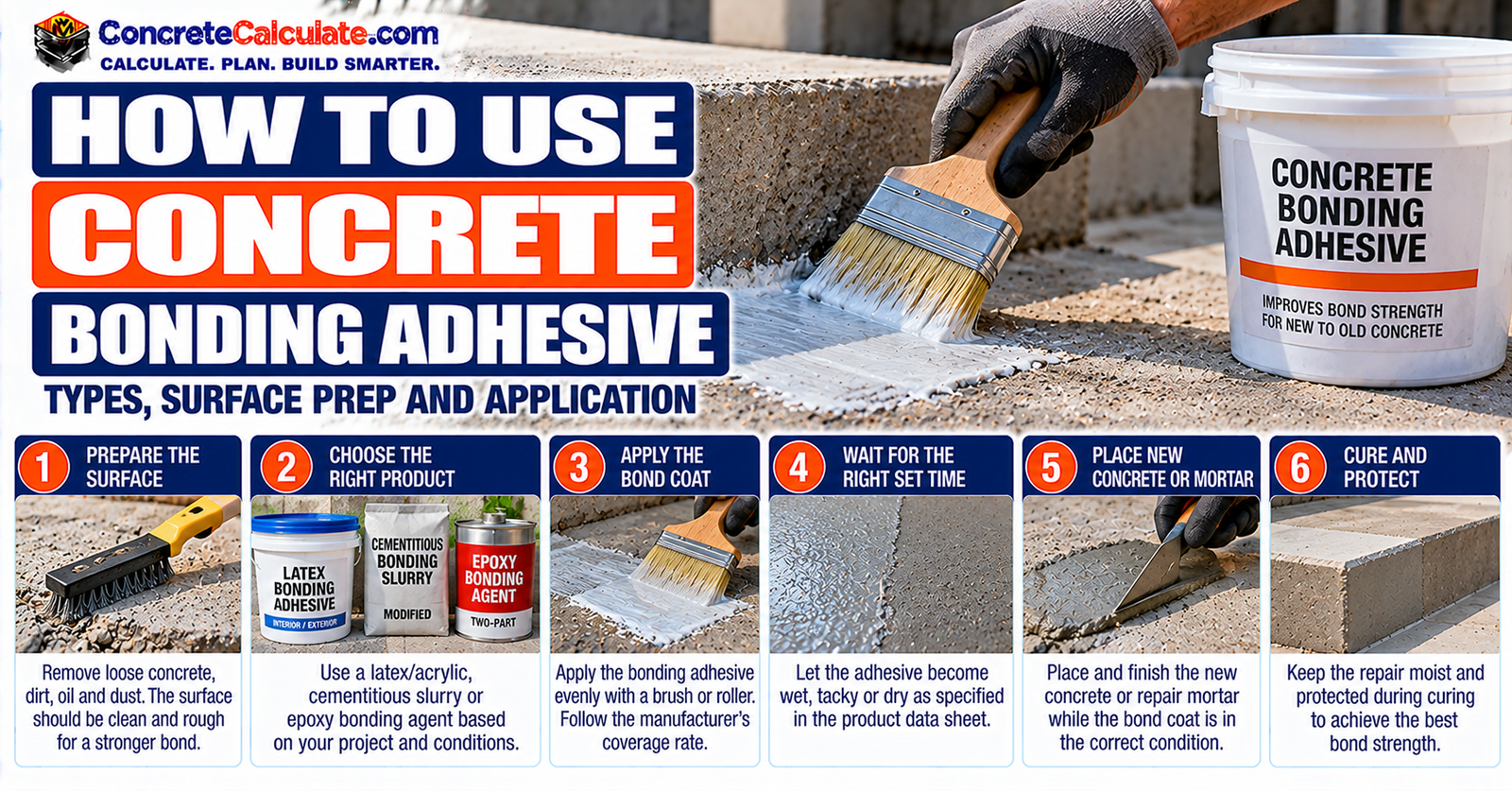
How to Use Concrete Bonding Adhesive
Learn which kind of bonding system you have, how to prepare old concrete, and whether the bond coat should be wet, tacky or dry, because the product data sheet controls the timing.
What Is Concrete Bonding Adhesive?
A concrete bonding adhesive is a product or system used to improve adhesion between hardened concrete and a new cementitious repair, topping, plaster, or concrete layer. “Concrete glue” is informal homeowner language for it.
Common families include latex or acrylic bonding agents, cementitious bonding slurries, and epoxy bonding agents. They are not applied the same way, and that difference is the main subject of this guide.
When Do You Need Concrete Bonding Adhesive?
Bonding products turn up in several kinds of work:
- Patching damaged concrete.
- Adding a topping.
- Bonding new concrete to old concrete.
- Vertical repairs.
- Plaster or stucco over concrete.
- Selected resurfacing systems.
There is an important limit. Some modern repair mortars and resurfacers are formulated to bond to properly prepared concrete without a separate bonding agent, so check the repair product’s own data sheet before buying an adhesive.
Does New Concrete Bond to Old Concrete by Itself?
Not reliably. Fresh cement paste does not form a strong repair bond to dirty, polished, contaminated, or fully hardened concrete just because both materials are concrete.
- Surface condition: clean, sound concrete bonds better.
- Mechanical interlock: a profiled surface gives the repair something to grip.
- Adhesive bond: a bonding agent adds chemical adhesion where a system calls for it.
- Moisture condition: the substrate must be at the state the product needs.
- Shrinkage: the new material shrinks as it cures and pulls at the interface.
That is why ACI PRC-548.11-24 starts with evaluating hardened concrete, removing unsound material, and preparing the surface, before it discusses adhesives.
Bonding Adhesive vs. Bonding Agent vs. Primer
Manufacturers use these words differently, so go by the function stated on the data sheet, not the product name.
- Bonding adhesive: a liquid applied to the old surface.
- Latex bonding agent: a water-based polymer bonding product.
- Acrylic fortifier: a polymer added to mortar or concrete mix.
- Epoxy bonding agent: a two-component resin system.
- Primer: a coat that conditions a surface for the next layer.
- Bonding slurry: a cement and polymer coat scrubbed into the surface.
One product can be several of these. QUIKRETE’s Concrete Bonding Adhesive data sheet, for example, describes using the same product as a paint-on adhesive, as part of a slurry coat, and as a diluted primer for a self-leveling resurfacer.
Main Types of Concrete Bonding Agents
The table compares the main systems and the timing issue that matters most for each.
| Bonding system | Typical form | Common use | Main timing issue |
|---|---|---|---|
| Liquid latex/acrylic adhesive | Ready-to-use liquid | New cementitious material to old concrete | May require dry or tacky film |
| Latex cement slurry | Polymer + cement/sand | Repairs and toppings | Often place mortar while wet |
| Epoxy bonding agent | Two-component resin | High-performance bonding | Pot life/open time critical |
| Cementitious slurry | Cement-based coat | Bonded repairs/toppings | Must remain fresh per system |
| Polymer-modified repair mortar | Polymer built into repair material | Repairs without separate adhesive in some systems | Follow repair-product TDS |
What Is a Latex or Acrylic Concrete Bonding Adhesive?
Latex or acrylic bonding adhesives are water-based polymer products, usually brushed, rolled, or sprayed onto prepared concrete. ASTM C1059/C1059M-24 is the specification for latex agents for bonding fresh to hardened concrete.
The standard covers brush, broom, or spray application and intended uses such as floors, roadways, bridge decks, ramps, and walks. It applies to latex agents only, not to every epoxy or primer.
It sets two types by bond strength. QUIKRETE’s data sheet lists slant-shear minimums of 400 psi for Type I and 1,250 psi for Type II.
What Is a Cementitious Bonding Slurry?
A cementitious bonding slurry is a cement-based coat, usually modified with a polymer, that is scrubbed into the prepared surface. The new material is placed while the slurry is still fresh, when the product says so.
Examples differ. Sika’s guide for SikaLatex R mixes 1 part cement and 2 parts sand with enough latex to make a creamy, paint-like consistency, brushes it in, and places the repair mortar immediately, before it dries. QUIKRETE’s slurry uses about 2 parts cement to 1 part adhesive. Those mixes belong to those products.
What Is an Epoxy Concrete Bonding Agent?
An epoxy bonding agent is a two-component system of resin and hardener. It is handled very differently from a latex product.
- An exact mix ratio.
- A limited pot life after mixing.
- Temperature sensitivity.
- Moisture requirements for the substrate.
- A defined open time for placing the new material.
ACI PRC-548.11-24 has a separate chapter on epoxy adhesives, covering selection, mixing, and application. ACI also publishes an epoxy bonding specification, ACI SPEC-548.13-21. Always follow the specific epoxy’s data sheet.
Latex vs. Epoxy Bonding Agent
Neither type is universally better. The table lines up the main differences.
| Attribute | Latex/acrylic | Epoxy |
|---|---|---|
| Components | Usually single liquid or polymer component | Resin + hardener |
| Application complexity | Lower | Higher |
| Pot life | Usually less critical | Critical |
| Moisture tolerance | Product-specific | Product-specific |
| Bond strength | Suitable for many repairs/toppings | Often higher-performance applications |
| Mixing ratio | Sometimes none | Exact ratio required |
| Cost | Usually lower | Usually higher |
| Main standard/reference | ASTM C1059 for latex agents | ACI SPEC 548.13 / product spec |
Different bonding systems require different interface conditions: dry, wet, or within a specific epoxy open time.
Bonding Adhesive vs. Acrylic Fortifier
A bonding adhesive coats the old surface. An acrylic fortifier replaces some or all of the mixing water in the new mortar or concrete. They are different procedures.
Sika gives separate directions for using its latex as a bonding agent and as an admixture. QUIKRETE says not to combine its Concrete Bonding Adhesive with its Concrete Acrylic Fortifier. Euclid’s FLEX-CON must be mixed with cement and not used by itself as a bonding agent.
Do You Need a Bonding Agent for Every Concrete Repair?
No. Some products need one, some prohibit a separate primer, some already contain polymer modifiers, and some rely on a cementitious slurry.
The product data sheet and the repair specification govern. If the repair mortar is designed to bond directly to prepared concrete, adding an adhesive may be unnecessary or even harmful.
Is the Existing Concrete Sound Enough to Bond To?
Sound concrete is stable, hard, and intact. It has no loose aggregate, no delamination, no friable paste, no major dusting, and no unstable spalls.
ACI places evaluation of the hardened concrete and removal of unsound material ahead of any adhesive use. Read Concrete Spalling and Concrete Delamination if you suspect the base is not sound.
What Must Be Removed Before Using Bonding Adhesive?
Anything that sits between the adhesive and sound concrete becomes the weak point. QUIKRETE requires removing dust, dirt, oil, grease, wax, unsound concrete, plaster, paint, and other foreign material.
| Surface condition | Can adhesive go over it? | Required action |
|---|---|---|
| Sound clean concrete | Usually yes | Prepare per product |
| Dust | No | Vacuum/clean |
| Oil/grease | No | Remove contamination |
| Paint | Usually no | Remove unless system specifically approves |
| Sealer | Usually no | Remove/verify compatibility |
| Loose concrete | No | Remove to sound substrate |
| Laitance | Usually no | Mechanically remove |
| Delaminated concrete | No | Remove full unsound zone |
| Standing water | Often no | Follow moisture requirement |
A strong adhesive cannot create a durable repair when it is bonded to weak or contaminated concrete.
Can Bonding Adhesive Be Applied Over Paint or Sealer?
Generally not, unless the specific system approves it. The adhesive would bond to the coating instead of the concrete, and the coating can peel away.
Incompatible chemicals and reduced adhesion are further risks. QUIKRETE, for example, says not to use its Concrete Bonding Adhesive over previously painted surfaces. Remove the coating, or get written approval from the manufacturer.
Can You Use Bonding Adhesive Over Oil-Stained Concrete?
Oil is a serious bond breaker, and it can sit in the pores below a surface that looks clean. Clean until the surface meets the product’s requirement, using the methods in How to Remove Oil Stains From Concrete.
Do not apply an adhesive to hide an oil stain. It will bond to the oil, not the slab.
How to Prepare Old Concrete for Bonding Adhesive
Preparation follows the same order for most systems:
- Inspect the concrete.
- Remove unsound concrete.
- Remove coatings and contaminants.
- Profile the surface if the product requires it.
- Remove dust.
- Bring the substrate to the required moisture condition.
This guide does not give one profile for all products, because they differ.
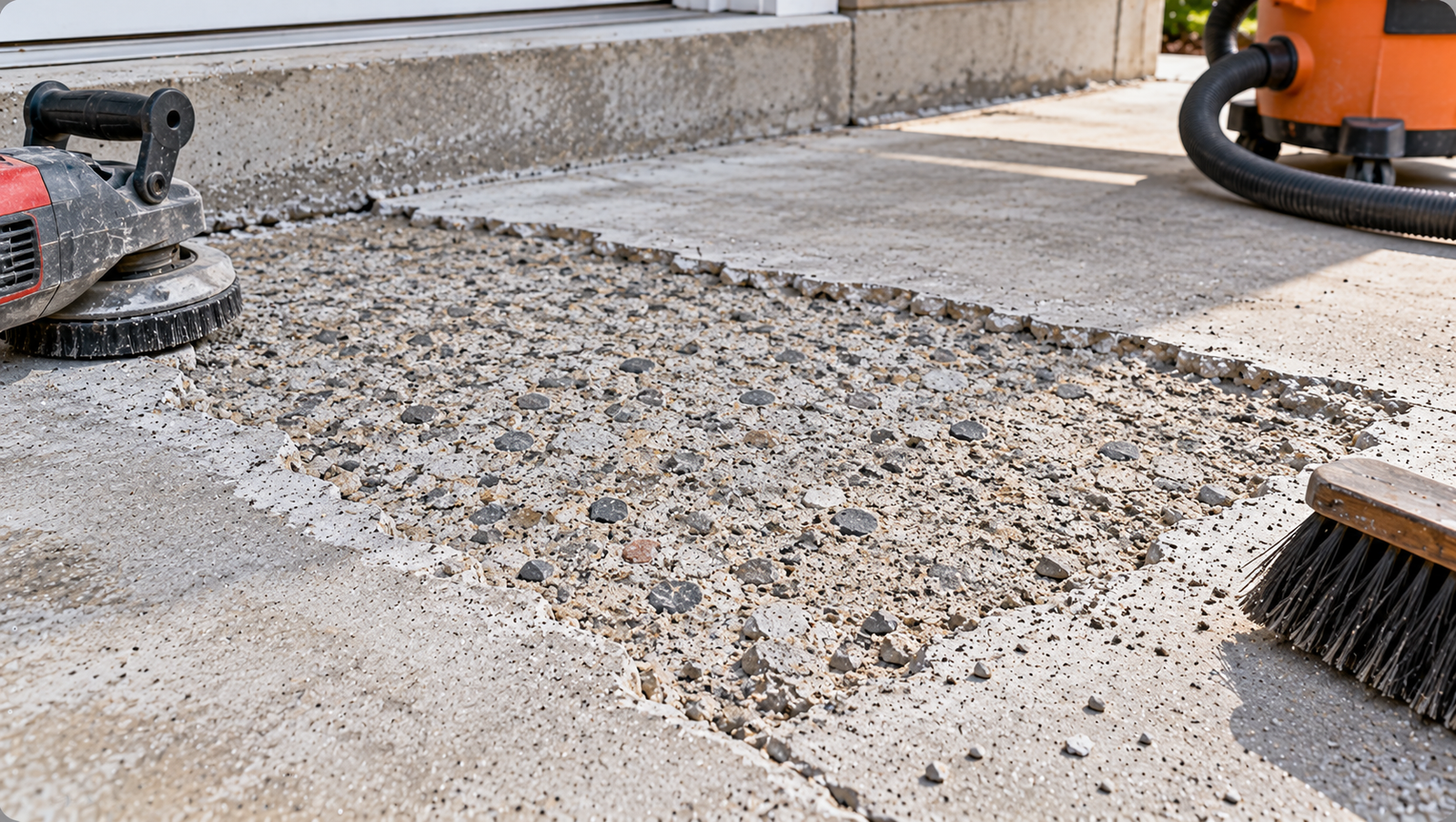
Does Old Concrete Need to Be Roughened?
It depends on the product. Some bonding products are formulated for use on clean, sound concrete without roughening. QUIKRETE says there is no need for chipping, drilling, or roughing the old surface when its adhesive is used as directed.
Others require serious mechanical preparation. Euclid’s FLEX-CON data sheet calls for scabbling, bush hammering, shot blasting, or scarifying to a minimum profile of 1/8 inch that exposes the large aggregate, and says acid etching is not acceptable.
The lesson is not “always roughen” or “never roughen.” Prepare the substrate to the requirements of the bonding system you chose.
Grinding vs. Shot Blasting vs. Chipping vs. Pressure Washing
Each method does something different. Pressure washing cleans but may not create the profile a repair system needs.
| Method | Removes contaminants? | Creates profile? | Best role |
|---|---|---|---|
| Vacuum/brush | Dust/debris | No | Final cleaning |
| Pressure wash | Dirt/some contamination | Limited | Cleaning |
| Diamond grinding | Coatings/laitance | Yes | Controlled profile |
| Shot blasting | Coatings/laitance | Yes | Larger floors |
| Scarifying | Thick weak layer | Aggressive | Heavy removal |
| Controlled chipping | Unsound local concrete | Yes locally | Patch preparation |
| Acid etching | Some surface reaction | Chemical | Only if specifically permitted; not default |
Euclid vacuums or pressure washes the concrete clean after mechanical profiling, which shows the two steps work together. Cutting and blasting concrete makes silica dust, so use dust control and respiratory protection.
Should the Old Concrete Be Dry, Damp or Saturated Surface Dry?
Product requirements differ. Dry means no visible moisture. Damp means the surface is moist but not saturated. Saturated surface dry (SSD) means the pores are full but there is no free water on the surface.
QUIKRETE says its adhesive can be applied to a dry or damp surface. Euclid’s cement bond coat calls for an SSD substrate with no standing water. These are different instructions for different products.
Bonding products may require dry, damp or saturated-surface-dry concrete; these conditions are not interchangeable.
Do not teach or follow one universal moisture condition. Read the data sheet.
How to Use Concrete Bonding Adhesive Step by Step
This sequence is general. Step 7 changes more than any other from one product to the next.
Step 1: Read the product data sheet before opening the container
Find the mode you are using, the timing, and the temperature limits.
Step 2: Confirm the substrate is sound and prepared
Check that unsound concrete, contaminants, and coatings are gone and any required profile is in place.
Step 3: Confirm temperature and moisture conditions
QUIKRETE says not to apply below 50°F. Euclid limits materials to 40°F to 90°F. Your product has its own limits.
Step 4: Mix or stir the bonding product as specified
Stir ready-to-use liquids. Mix slurries and epoxies to the stated proportions.
Step 5: Apply with the required brush, roller, broom, or spray method
Use the method the data sheet names. A stiff broom, for example, is used for some bond coats.
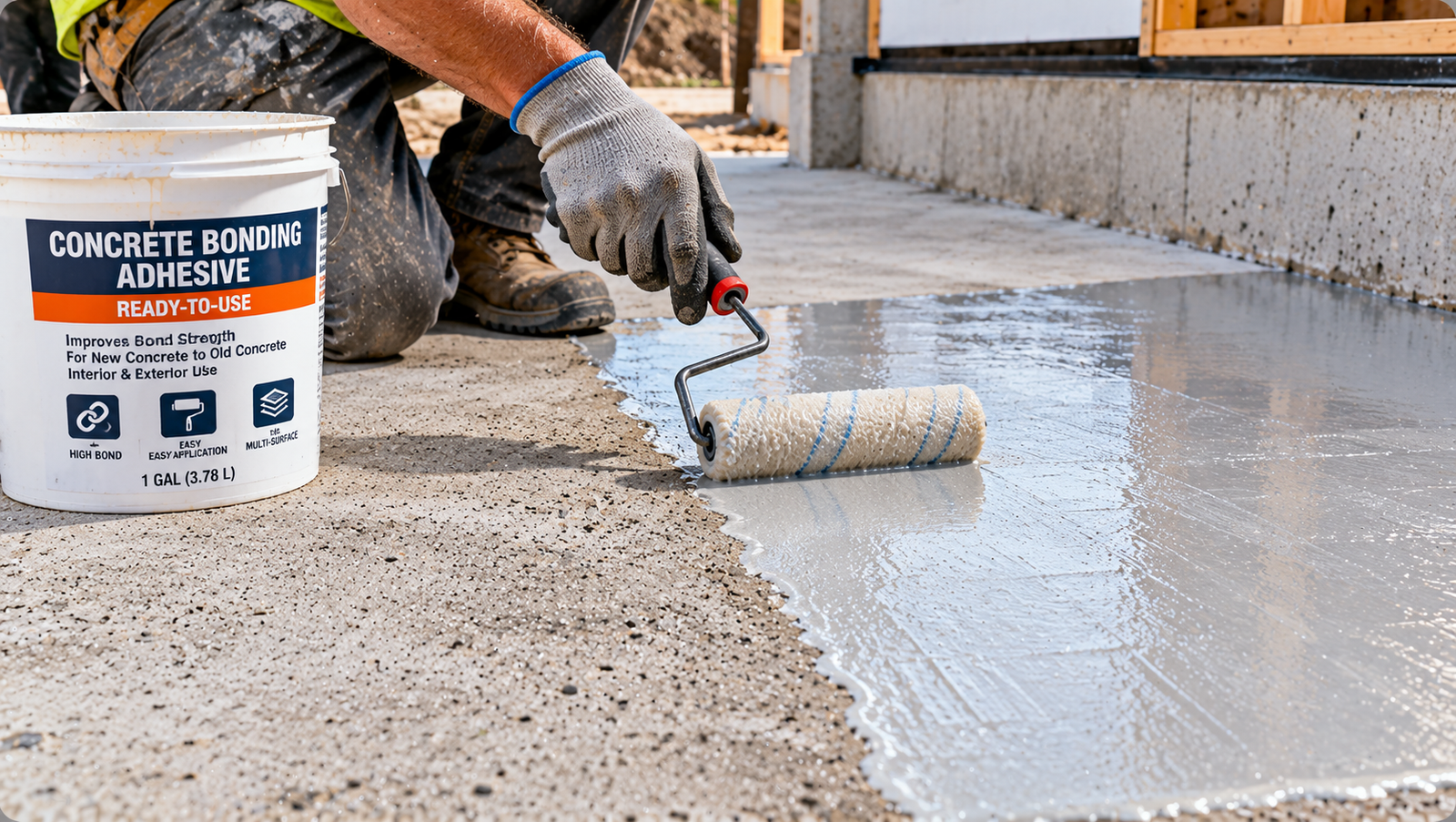
Step 6: Achieve complete coverage without puddling
Cover the whole surface and all edges, and avoid thick pools.
Step 7: Wait for the specified dry, tacky, or wet condition
Some products must dry. Others must still be wet when the new material goes on.
Step 8: Place repair mortar, topping, or fresh concrete within the permitted window
Have the material mixed and ready before you coat the surface.
Step 9: Consolidate and finish the repair
Compact the material against the interface so no voids remain, then finish.
Step 10: Cure according to the repair material instructions
Latex-modified mortars still need proper curing. Euclid, for example, calls for a moist cure for 24 hours. The Concrete Curing Time Chart gives general background on curing.
Should Concrete Bonding Adhesive Dry Before Adding New Concrete?
It depends entirely on the bonding system. There is no single rule.
- QUIKRETE tells users to place new concrete, toppings, or patches as soon as its paint-on adhesive is dry, though gypsum plasters go over a tacky coat.
- QUIKRETE’s slurry coat, Sika’s bonding grout, and Euclid’s bond coat must all be topped before they dry.
Epoxy systems follow their own open time. Wet-on-wet and dry-film systems are not interchangeable, and using the wrong one can ruin the bond.
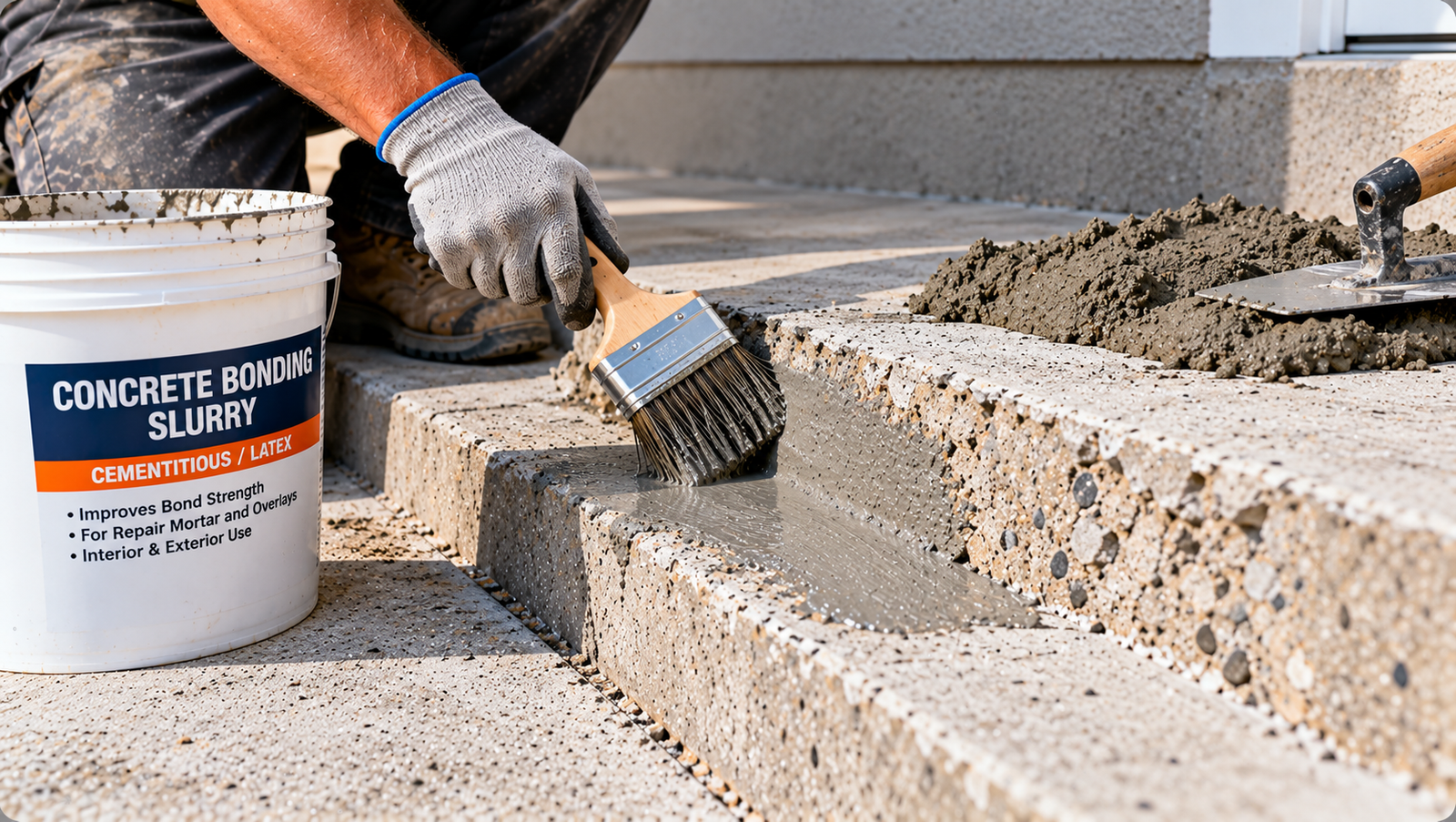
What Does “Tacky” Mean for Bonding Adhesive?
Wet, tacky, tack-free, and fully dry are different conditions. Manufacturers use them deliberately.
QUIKRETE, for example, puts gypsum and finish plaster over a tacky coat, but most cementitious toppings go on once the adhesive is dry. Use the product’s exact wording, and avoid a generic thumb test unless the manufacturer allows it.
How Thick Should Bonding Adhesive Be Applied?
Thickness is product-specific. A liquid adhesive may be specified as a paint-like film, a coverage rate, or a slurry coat.
QUIKRETE describes its paint-on use as a thickness of a coat of paint. Sika calls for a creamy paint consistency. Puddles and thick films cause trouble, so apply the stated coverage and no more.
How Long Do You Have to Place the New Concrete?
The window depends on open time, pot life, recoat window, and temperature. Epoxy systems are the most time-sensitive.
As one example, QUIKRETE says a diluted primer coat that is kept clean and dry can be topped up to 48 hours after application. That window belongs to that product and use. Do not apply a universal timeframe.
How to Use Bonding Adhesive for Patches, Overlays, Steps and Walls
The basic approach is the same, but each project has its own priorities. The table shows what to check.
| Project | Is bonding adhesive commonly relevant? | Main check |
|---|---|---|
| Small concrete patch | Sometimes | Repair mortar requirements |
| New topping over old slab | Often | Profile + bonding method |
| Resurfacing | System-specific | Resurfacer may not need separate adhesive |
| Concrete step repair | Often | Vertical/edge product compatibility |
| Wall repair | Often | Non-sag mortar and bond system |
| Stucco/plaster to concrete | Often | Product tack/dry instructions |
| Structural repair | Engineered | Specification controls |
For a full patch workflow, read How to Patch Concrete Without Removing Old Concrete. For large overlays, see the Concrete Resurfacing Guide.
Once the system is chosen, estimate quantities with the Concrete Repair Calculator, the Concrete Patch Calculator, or the Concrete Resurfacing Calculator, and budget with the Concrete Repair Cost Calculator.
Can You Use Bonding Adhesive Outdoors?
Some products are made for exterior use. QUIKRETE describes its adhesive as an exterior grade synthetic emulsion, suitable for interior or exterior applications.
Exterior work needs extra checks: freeze-thaw exposure, immersion or wet service, temperature, thickness limits, and compatibility with the repair material. Protect most bonding products from freezing, and read the wet-service limits in the data sheet.
Common Concrete Bonding Adhesive Mistakes
Most failures come from a few repeat mistakes. The table lists them with better practice.
| Mistake | Why it causes failure | Better practice |
|---|---|---|
| Adhesive over dust | Bonds to dust instead of slab | Clean thoroughly |
| Adhesive over weak concrete | Weak substrate detaches | Remove unsound material |
| Wrong wet/dry timing | Interface bond compromised | Follow product TDS |
| Let wet slurry dry | Bond coat loses intended function | Place topping in specified window |
| Cover dry-film product too early | Film not developed | Wait as instructed |
| Exceed epoxy pot life | Adhesive loses workability/performance | Mix smaller batches |
| Puddle liquid adhesive | Uneven film | Apply stated coverage |
| Assume adhesive fixes movement | Repair cracks again | Correct movement/structural cause |
Also avoid using a bonding agent the repair product does not require, and do not assume an adhesive replaces proper repair material.
Concrete Bonding Adhesive FAQs
Do I need bonding adhesive between old and new concrete?
Not always. Some repair products need one, others are designed to bond directly to prepared concrete. Check the repair product’s data sheet.
Should bonding adhesive dry first?
It depends on the system. Some paint-on adhesives must dry, while slurry and bond-coat systems must still be wet when the new material goes on.
Can I put bonding adhesive on wet concrete?
Only if the product allows it. Some work on dry or damp concrete, others call for saturated surface dry concrete with no standing water.
Do I need to roughen old concrete?
It depends. Some products say roughening is not needed, while others require mechanical profiling to a defined depth.
Can I use bonding adhesive on painted concrete?
Generally no. Remove the paint, or get approval for your specific system. Some data sheets prohibit use over painted surfaces.
Can bonding adhesive fill cracks?
No. It is a bonding coat, not a crack filler. Cracks need a repair method that suits their cause and movement.
Can it be used outdoors?
Some products are made for exterior use, but check temperature limits, freeze protection, and wet-service limits.
How long does it take to dry?
It varies by product, temperature, humidity, and the concrete. One data sheet notes a typical 2 to 3 hours for a diluted primer coat, which is not a general rule.
Is epoxy better than latex?
Not universally. Epoxy is often used for higher-performance bonding, but it needs exact mixing and has a short working window.
Can I use bonding adhesive instead of surface preparation?
No. Adhesive cannot make up for dust, oil, paint, laitance, or loose concrete.