Rebar Bend Radius Chart – Minimum Bend Diameter by Bar Size
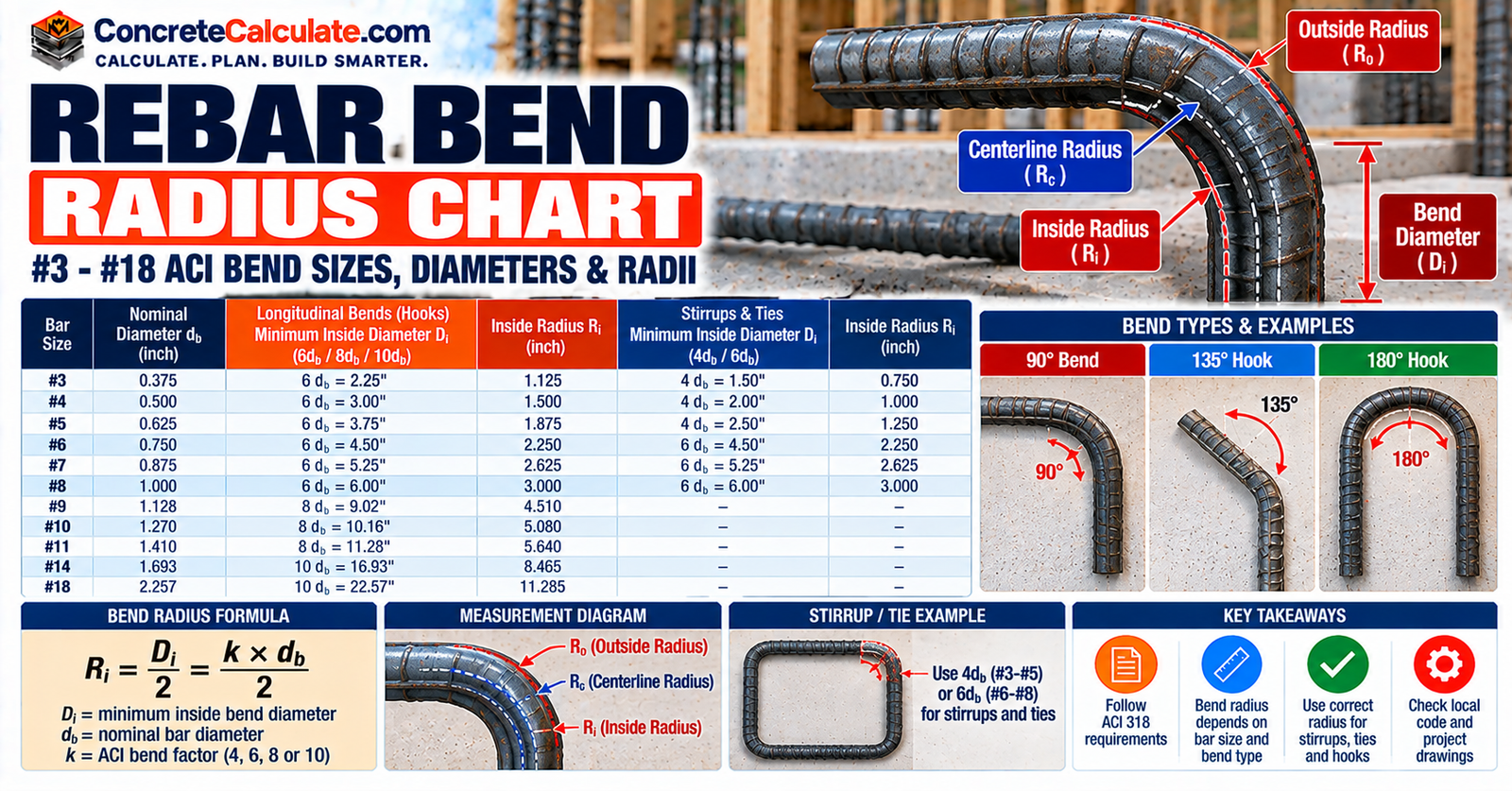
Rebar Bend Radius Chart
Minimum Bend Diameter by Bar Size
ACI specifies the minimum inside bend diameter, so this chart shows that value first and the inside radius as a derived number, for #3 through #18 bars, plus stirrups, formulas and fabrication cautions.
 Reviewed by Muhammad Ramzan Babar, PhD Researcher (Plasma Physics) & Calculator Developer, View Profile
⭐ Rebar Bend Radius Chart: ACI Minimum Inside Bend Diameter and Derived Radius
Minimum inside bend diameter for longitudinal reinforcing-bar standard hooks and bends, with the inside radius calculated as one-half of that diameter.
How to Read This Chart
Find your bar size, read the ACI multiplier (6db, 8db or 10db), then the minimum inside diameter Di. The last columns give the derived inside radius Ri = Di / 2. For #3 through #8, db equals the bar number divided by 8; for #9 and larger, use the ASTM nominal diameter listed here. See the rebar diameter chart and the rebar number chart for the bar-size basics.
| Bar Size | Nominal db | ACI Min. Inside Bend Diameter | Min. Inside Diameter Di | Derived Inside Radius Ri | Di (mm) | Ri (mm) |
|---|---|---|---|---|---|---|
| #3 | 0.375 in. | 6db | 2.250 in. | 1.125 in. | 57.2 mm | 28.6 mm |
| #4 | 0.500 in. | 6db | 3.000 in. | 1.500 in. | 76.2 mm | 38.1 mm |
| #5 | 0.625 in. | 6db | 3.750 in. | 1.875 in. | 95.3 mm | 47.6 mm |
| #6 | 0.750 in. | 6db | 4.500 in. | 2.250 in. | 114.3 mm | 57.2 mm |
| #7 | 0.875 in. | 6db | 5.250 in. | 2.625 in. | 133.4 mm | 66.7 mm |
| #8 | 1.000 in. | 6db | 6.000 in. | 3.000 in. | 152.4 mm | 76.2 mm |
| #9 | 1.128 in. | 8db | 9.024 in. | 4.512 in. | 229.2 mm | 114.6 mm |
| #10 | 1.270 in. | 8db | 10.160 in. | 5.080 in. | 258.1 mm | 129.0 mm |
| #11 | 1.410 in. | 8db | 11.280 in. | 5.640 in. | 286.5 mm | 143.3 mm |
| #14 | 1.693 in. | 10db | 16.930 in. | 8.465 in. | 430.0 mm | 215.0 mm |
| #18 | 2.257 in. | 10db | 22.570 in. | 11.285 in. | 573.3 mm | 286.6 mm |
ACI Specifies Diameter, Not Radius
ACI specifies minimum inside bend diameter. The radius values in this chart are calculated as one-half of that minimum inside diameter. They are derived geometric values, not separate ACI radius requirements. This chart is for longitudinal bars; stirrups, ties and hoops use a different table (see the stirrup and tie chart below).
Edition Note
The values follow ACI 318-19 Tables 25.3.1 and 25.3.2, which were checked against the published table text. ACI 318-25 is the newest ACI edition (published January 2025) and ICC expects it to be referenced by the 2027 IBC, so many projects still work under ACI 318-19 or earlier. Confirm the values against Section 25.3 of the edition adopted by your jurisdiction and project documents.
Bar sizes above #18 are not listed. Bend values should not be extrapolated to larger sizes without confirmed code recognition.
✓ Checked against ACI 318-19 Table 25.3.1, October 2026What Is Rebar Bend Radius?
A geometric definition, before any numbers.
Rebar bend radius describes how sharply a reinforcing bar turns. It is measured from the center of the bend’s curvature to the bar surface (inside radius) or to the middle of the bar (centerline radius). A tight bend has a small radius; a gentle bend has a large one.
ACI principally specifies the inside bend diameter, so the radius on this page is derived from it. If you also need the bar sizes themselves, the rebar size chart has the full ASTM size table.
Bend Radius vs. Bend Diameter
One is the code dimension, the other is a conversion.
- Di: minimum inside bend diameter (in.), the ACI dimension
- Ri: inside bend radius (in.), derived
Diameter is easier to verify in practice because a bending pin or inspection template has a diameter, not a radius. CRSI’s fabrication standard, ANSI/CRSI IPG5.1-2026, deals with bend diameters, measuring points and fabrication tolerances for steel reinforcing bars.
How ACI Measures Rebar Bends
Inside of the bar, every time.
- ACI measures the inside surface of the bent bar.
- It is the minimum inside diameter, not the centerline diameter.
- It is not the outside diameter either.
Section 25.3 of ACI 318 is the governing structural reference for standard hooks and minimum inside bend diameters. Measuring from the wrong surface is one of the most common errors, because the outside of a #8 bend is 2.000 in. larger in diameter than the inside (two bar thicknesses).
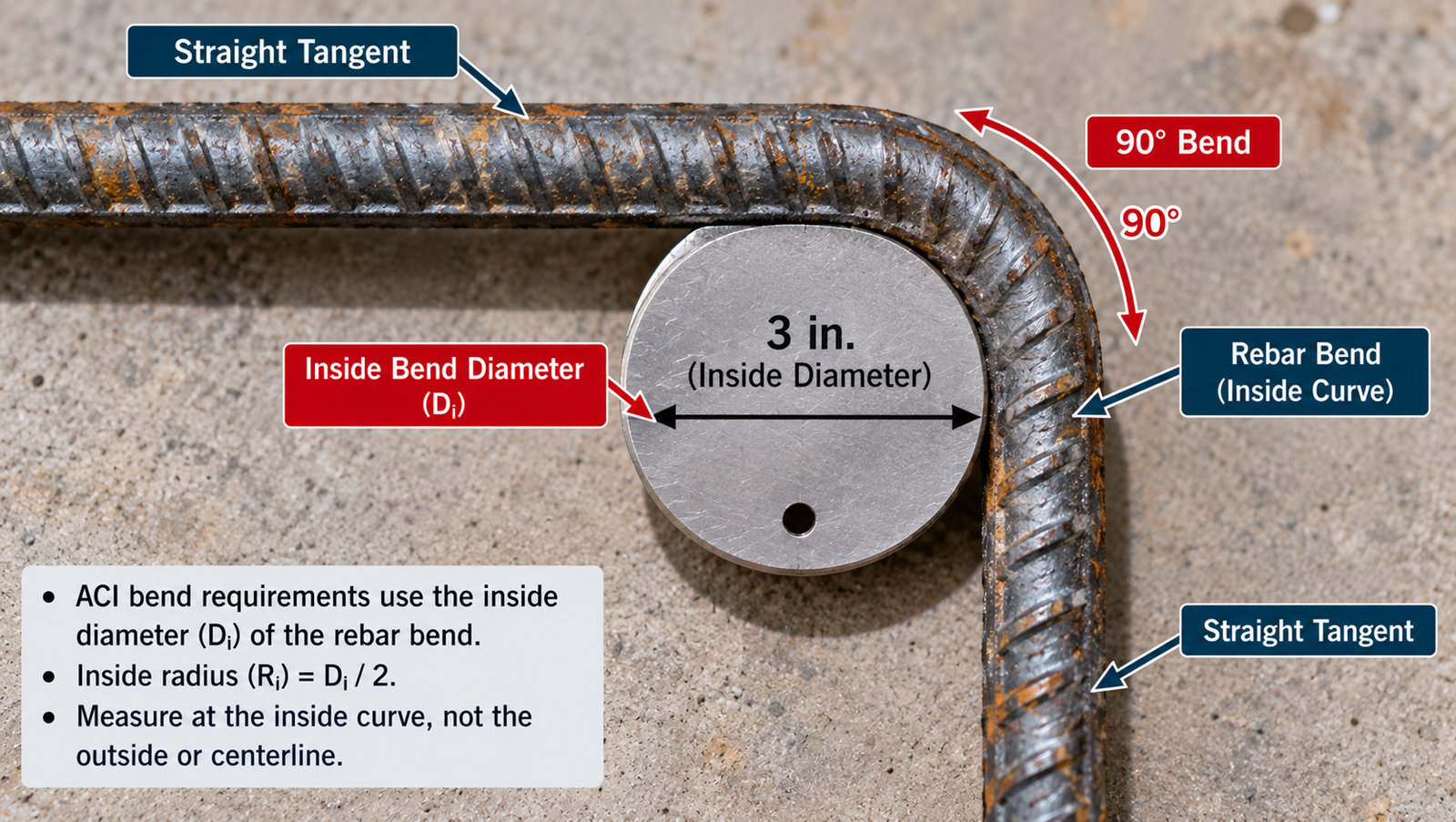
Inside vs. Centerline vs. Outside Bend Radius
Three radii for the same bend.
- Rc equals (Di + db) / 2
- All values in inches, using the longitudinal multipliers from the main chart
| Bar | db (in.) | Inside Radius Ri (in.) | Centerline Radius Rc (in.) | Outside Radius Ro (in.) |
|---|---|---|---|---|
| #3 | 0.375 | 1.125 | 1.313 | 1.500 |
| #4 | 0.500 | 1.500 | 1.750 | 2.000 |
| #5 | 0.625 | 1.875 | 2.188 | 2.500 |
| #6 | 0.750 | 2.250 | 2.625 | 3.000 |
| #7 | 0.875 | 2.625 | 3.063 | 3.500 |
| #8 | 1.000 | 3.000 | 3.500 | 4.000 |
| #9 | 1.128 | 4.512 | 5.076 | 5.640 |
| #10 | 1.270 | 5.080 | 5.715 | 6.350 |
| #11 | 1.410 | 5.640 | 6.345 | 7.050 |
| #14 | 1.693 | 8.465 | 9.312 | 10.158 |
| #18 | 2.257 | 11.285 | 12.414 | 13.542 |
Only the inside bend diameter originates directly from the cited ACI minimum. Centerline and outside radii are geometry calculated from nominal bar diameter.
Rebar Bend Diameter Multipliers
Pick the category first, then the bar size.
| Reinforcement / Bend Category | Bar Size | Min. Inside Bend Diameter |
|---|---|---|
| Longitudinal standard hook or bend | #3 through #8 | 6db |
| Longitudinal standard hook or bend | #9 through #11 | 8db |
| Longitudinal standard hook or bend | #14 and #18 | 10db |
| Stirrup, tie or hoop hook | #3 through #5 | 4db |
| Stirrup, tie or hoop hook | #6 through #8 | 6db |
Do Not Choose From Bar Size Alone
First identify whether the bar is longitudinal reinforcement or a stirrup, tie or hoop. The same #4 bar uses 6db in one role and 4db in the other. The 4db value is an ACI structural minimum; shop fabrication practice can be larger.
#3, #4 and #5 Rebar Bend Radius
Two categories, two sets of values. Label them clearly.
| Bar | db (in.) | Reinforcement Category | Di (in.) | Ri (in.) |
|---|---|---|---|---|
| #3 | 0.375 | Longitudinal (6db) | 2.250 | 1.125 |
| #3 | 0.375 | Stirrup / tie, ACI minimum (4db) | 1.500 | 0.750 |
| #4 | 0.500 | Longitudinal (6db) | 3.000 | 1.500 |
| #4 | 0.500 | Stirrup / tie, ACI minimum (4db) | 2.000 | 1.000 |
| #5 | 0.625 | Longitudinal (6db) | 3.750 | 1.875 |
| #5 | 0.625 | Stirrup / tie, ACI minimum (4db) | 2.500 | 1.250 |
A #4 longitudinal bar bends around a 3.000 in. inside diameter (1.500 in. radius). A #4 stirrup or tie can use the 4db ACI minimum of 2.000 in. (1.000 in. radius). Shop practice for #3 through #5 stirrups and ties is covered in the stirrup section below, where CRSI’s fabrication practice is compared with the ACI minimum.
#6, #7 and #8 Rebar Bend Radius
For these sizes the multiplier is 6db in both categories.
| Bar | db (in.) | Multiplier | Di (in.) | Ri (in.) |
|---|---|---|---|---|
| #6 | 0.750 | 6db | 4.500 | 2.250 |
| #7 | 0.875 | 6db | 5.250 | 2.625 |
| #8 | 1.000 | 6db | 6.000 | 3.000 |
For #6 through #8 stirrup, tie and hoop bends, the ACI multiplier is also 6db, so the longitudinal and stirrup values match. The difference at these sizes is mainly in the straight extensions, which the rebar hook length chart covers.
#9, #10 and #11 Rebar Bend Radius
Use the ASTM nominal diameter, not bar number divided by 8.
| Bar | db (in.) | Multiplier | Di (in.) | Ri (in.) |
|---|---|---|---|---|
| #9 | 1.128 | 8db | 9.024 | 4.512 |
| #10 | 1.270 | 8db | 10.160 | 5.080 |
| #11 | 1.410 | 8db | 11.280 | 5.640 |
The shortcut db = bar number / 8 fails above #8: #9 is 1.128 in. (not 1.125), #10 is 1.270 in. (not 1.250) and #11 is 1.410 in. (not 1.375). Take db from the nominal rebar diameter table, as explained on the rebar number chart.
#10 Rebar: Why the ASTM Diameter Matters
#14 and #18 Rebar Bend Radius
The largest bars use the largest multiplier.
| Bar | db (in.) | Multiplier | Di (in.) | Ri (in.) |
|---|---|---|---|---|
| #14 | 1.693 | 10db | 16.930 | 8.465 |
| #18 | 2.257 | 10db | 22.570 | 11.285 |
A #18 bar needs an inside diameter of 22.570 in. (573.3 mm), so its bends occupy a lot of space. Bars this large are normally handled through approved fabrication and detailing, not improvised bending.
Stirrup and Tie Bend Radius Chart
Stirrups, ties and hoops are separate from longitudinal end hooks.
| Bar | db (in.) | ACI Min. Multiplier | Min. Inside Diameter Di | Derived Inside Radius Ri | CRSI 29th Ed. Finished Bend (as published) |
|---|---|---|---|---|---|
| #3 | 0.375 | 4db | 1.500 in. | 0.750 in. | 2 in. |
| #4 | 0.500 | 4db | 2.000 in. | 1.000 in. | 2-1/2 in. |
| #5 | 0.625 | 4db | 2.500 in. | 1.250 in. | 3-1/4 in. |
| #6 | 0.750 | 6db | 4.500 in. | 2.250 in. | 4-1/2 in. |
| #7 | 0.875 | 6db | 5.250 in. | 2.625 in. | 5-1/4 in. |
| #8 | 1.000 | 6db | 6.000 in. | 3.000 in. | 6 in. |
ACI Minimum vs. Shop Practice
CRSI reported that its 29th Edition Manual of Standard Practice used finished bend diameters of about 5db for #3, #4 and #5 stirrups and ties (2, 2-1/2 and 3-1/4 in.), while the ACI 318-19 structural minimum for those bars is 4db. CRSI does not prohibit bending Grade 60 stirrups and ties to 4db, but calls it a special-order item that should be noted on the construction documents.
Because CRSI has since published ANSI/CRSI IPG5.1-2026, verify any shop pin or finished bend diameter against the current standard and your fabricator, and do not treat the ACI structural minimum as an automatic shop pin size.
90-Degree Rebar Bend Radius
The angle and the radius are independent quantities.
A 90-degree bend does not itself define the radius. The radius depends on the bar size, the reinforcement category and the governing detail. For a longitudinal 90-degree standard hook, the straight extension is 12db after the bend. Full extension lengths by bar size are on the rebar hook length chart, including 90-degree rebar hook dimensions.
| Hook | Category | Bar Sizes | Min. Inside Diameter | Straight Extension |
|---|---|---|---|---|
| 90° | Longitudinal | #3-#8 / #9-#11 / #14, #18 | 6db / 8db / 10db | 12db |
| 180° | Longitudinal | #3-#8 / #9-#11 / #14, #18 | 6db / 8db / 10db | Greater of 4db and 2.5 in. |
| 90° | Stirrup / tie | #3 through #5 | 4db | Greater of 6db and 3 in. |
| 90° | Stirrup / tie | #6 through #8 | 6db | 12db |
| 135° | Stirrup / tie | #3 through #5 | 4db | Greater of 6db and 3 in. |
| 135° | Stirrup / tie | #6 through #8 | 6db | Greater of 6db and 3 in. |
135-Degree Rebar Bend Radius
Mostly a stirrup, tie and hoop detail.
135-degree bends appear mainly on stirrups, ties, hoops and seismic confinement reinforcement. For ordinary stirrup and tie hooks, the ACI minimum inside diameter is 4db for #3 through #5 and 6db for #6 through #8. Do not tell yourself that “135 degrees equals 4db”: bar size and the governing detailing provision still matter, and seismic hooks have their own provisions in Section 25.3.
Extensions for 135-degree hooks, including the greater of 6db and 3 in. shown above, are covered on the rebar hook length chart.
180-Degree Rebar Bend Radius
Three separate dimensions: radius, angle and tail.
For a longitudinal 180-degree standard hook, the minimum inside bend diameter comes from the same bar-size group as the 90-degree hook (6db, 8db or 10db). What differs is the straight extension: the greater of 4db and 2.5 in. Bend radius, hook angle and tail extension are separate dimensions; the rebar hook length chart owns the tail lengths.
Equipment for Your Project
Affiliate disclosure: As an Amazon Associate, ConcreteCalculate earns from qualifying purchases. We may also earn a commission from other affiliate links at no additional cost to you.
Main-Bar vs. Stirrup Bend Radius
Same bar size, different job, different minimum.
Main bars carry tension and compression along the member; stirrups and ties confine and resist shear. ACI therefore treats their bends in separate tables. A #3 through #5 stirrup may be bent tighter (4db) than a longitudinal bar of the same size (6db), while at #6 through #8 the two use the same 6db.
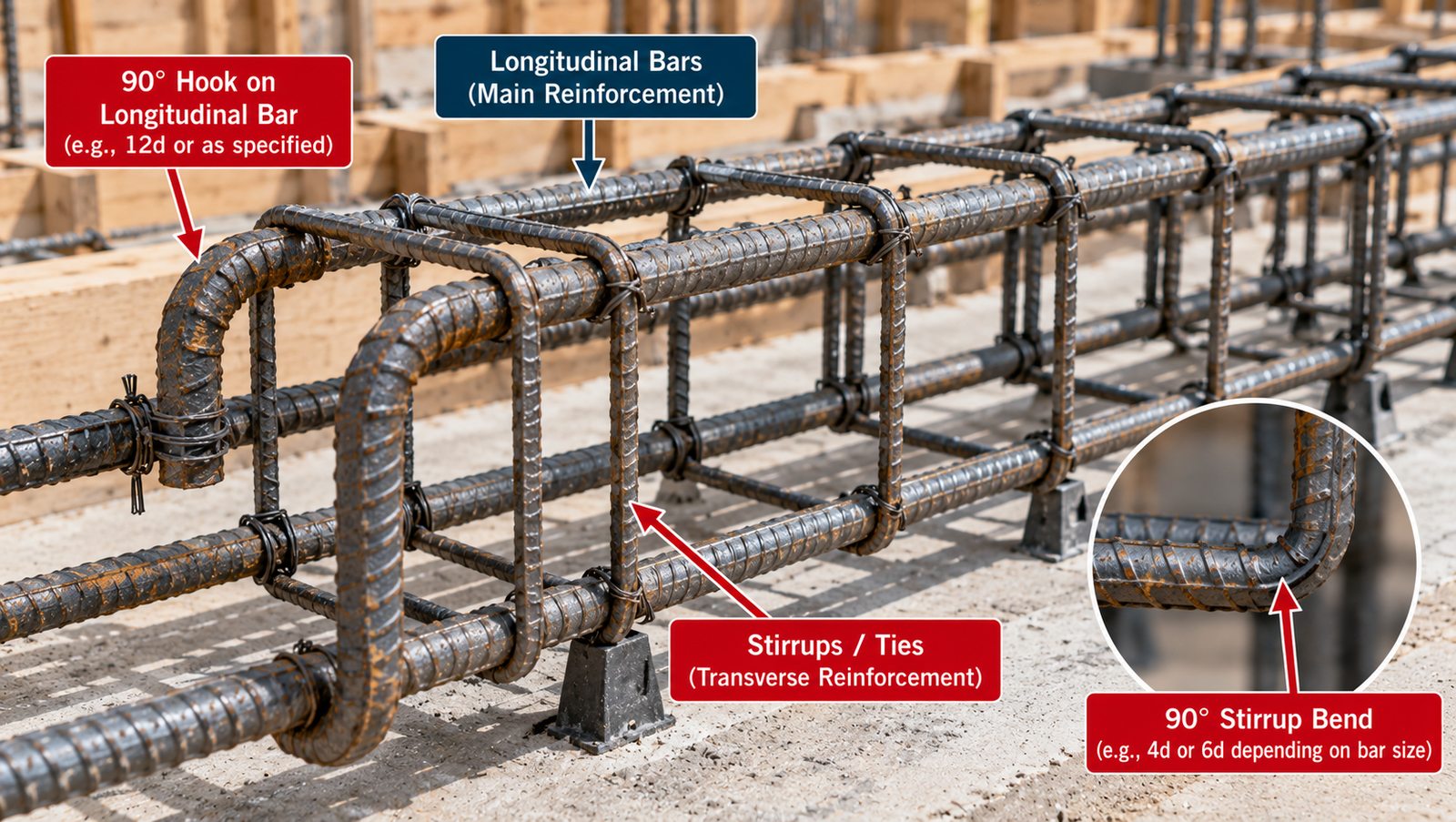
Rebar Bending Pin and Mandrel Diameter
The pin is not automatically the finished bend diameter.
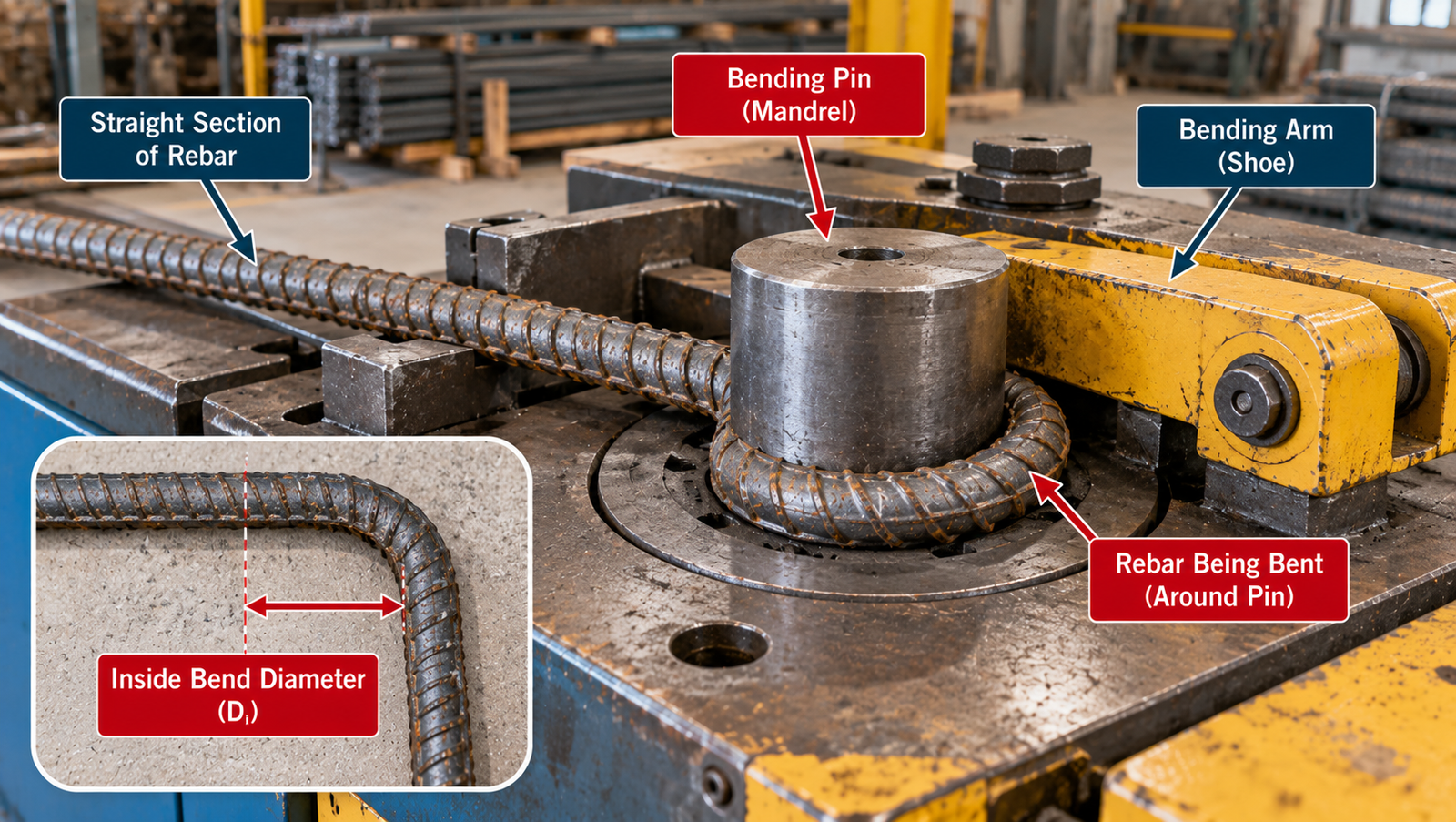
A bar is formed around a pin or mandrel on bending equipment, but the nominal pin diameter, the specified minimum finished bend diameter and the curvature you measure on the finished bar are not always the same thing. Bars also spring back slightly after bending.
CRSI recommends two checks: the inside bend diameters specified and fabricated should be equal to or larger than the applicable ACI minimum, and the pins used for fabrication should be equal to or larger than the pin diameters required by the applicable ASTM specification. ASTM bend-test pin diameters, ACI minimum bend diameters and CRSI finished bend diameters are three different values, so confirm which one a drawing or fabricator means.
How to Measure Finished Rebar Bend Diameter
A disc template tells you whether the bend meets the minimum.
CRSI describes inspecting finished bends with a disc-style template sized to match the required minimum bend diameter. The result is read this way:
- If the disc fits inside the bend, the bar was bent to at least the required diameter.
- If the disc does not fit, the bend was fabricated with a diameter smaller than the specified ACI minimum.
- If the disc fits but a small gap shows, the gap is most likely a small curvature variance. As long as the finished diameter is equal to or larger than the required minimum, the gap is not cause for rejection.
Finished bends are not perfect circles. CRSI lists causes such as pin and bar geometry, equipment wear and setup, bar type, the rib position against the pin, variance in deformation height, and permissible angular deviation. Gap limits are set in CRSI’s current standard (ANSI/CRSI IPG5.1-2026), so use that document for acceptance tolerances.
How to Calculate Rebar Bend Radius
Four formulas, worked from the nominal diameter.
Rc = Ri + db / 2 Ro = Ri + db
- k: ACI multiplier for the bar size and category (4, 6, 8 or 10)
- db: nominal bar diameter (in.), from the ASTM size table
- All results in inches; multiply by 25.4 for millimeters
#4 Rebar, Longitudinal
#8 Rebar, Longitudinal
#10 Rebar, Centerline and Outside Radius
Why Minimum Bend Radius Matters
Two broad engineering concerns, kept conceptual.
- The reinforcing steel: a bend that is too tight can damage or overstrain the bar during bending.
- The concrete inside the bend: a very tight curve concentrates bearing force on the concrete wrapped around the bar, raising the risk of local crushing.
The ACI multipliers exist to keep both effects in check. This page gives the multipliers, not stress limits; the design basis belongs to the engineer of record.
Can Rebar Be Bent Tighter Than the Minimum Radius?
Not simply because it physically fits.
Follow the adopted ACI edition, the construction documents, the bar material and grade, the fabrication standard and the licensed design professional. A tighter shop bend can require special fabrication even where a structural-code minimum permits it. CRSI documented this for small stirrups and ties: bending Grade 60 stirrups and ties to 4db is a special-order item that should be clearly noted on the construction documents.
Field Bending and Rebending Rebar
Treat embedded bars as off limits unless the engineer says otherwise.
Field Bending Requires Authorization
ACI 318 requires reinforcement to be bent cold unless the licensed design professional permits otherwise. Reinforcement partially embedded in concrete must not be field bent unless it is shown on the construction documents or permitted by the licensed design professional.
Do not heat rebar to bend or straighten it unless an approved procedure authorizes it; this page gives no heating procedure. Rebending a bar that has already been bent can affect steel ductility, bar integrity, coatings and geometry. It needs project-specific approval and the engineer’s direction under applicable CRSI and ACI guidance.
High-Strength and Coated Rebar Bend Requirements
Nominal diameter alone does not set the shop bend.
High-Strength Bars
CRSI lists commonly used reinforcing specifications including ASTM A615, A706, A955, A996 and A1035. Do not assume every grade and material can be shop-bent identically because the nominal diameter matches. ASTM A615-20 increased the bend-test pin diameter to 5db for grades above 75, and CRSI’s fabrication guidance ties finished bends to both ACI and ASTM requirements.
Epoxy-Coated Bars
Coating systems add fabrication considerations. CRSI maintains a separate standard for epoxy-coated reinforcing bar fabrication facilities (CRSI CG2.1-2026). Do not copy uncoated bend values onto coated bars without checking the project specification.
Galvanized Bars
Galvanized bars can have different finished bend requirements. The CRSI 29th Edition Table 7-4 (ASTM A767) lists #7 and #8 galvanized finished bend diameters at 8db (7.00 and 8.00 in.), larger than the 6db used for uncoated bars of those sizes. Check the current edition and project specification.
Bend Radius, Concrete Cover and Bar Spacing
The bend has to fit the member.
A larger bend consumes space. The outside radius, the minimum concrete cover, the member dimensions and adjacent bars must all fit together. A minimum bend radius never overrides required cover. You can check cover quickly with the rebar cover calculator.
Large bends can also affect clear spacing, congestion, hook placement and the geometry at beam-column joints and footing corners. See the rebar spacing requirements and the rebar spacing calculator for spacing limits.
Bend Radius vs. Hook Length
Curvature, extension and anchorage are three different things.
| Term | What It Describes | Where It Is Covered |
|---|---|---|
| Bend radius | Curvature of the bend | This page |
| Hook extension | Straight tail beyond the bend | Rebar hook length chart |
| Hook development length | Structural anchorage, calculated separately | Rebar development length chart |
| Fabricated bar length | Steel needed for the finished shape | Rebar length chart |
Keep them apart: the rebar hook length chart owns the extensions, and rebar development length is a structural anchorage quantity that is never equal to hook radius or hook extension.
Bend Radius and Fabricated Bar Length
Cut length is not the sum of the outside legs.
Because a bend has a radius, the length of steel in the bend is shorter than the sum of the outside leg dimensions. CRSI fabrication standards use defined measuring points for bent bars, and ANSI/CRSI IPG5.1-2026 covers bend diameters, measuring points and fabrication tolerances. In CRSI’s detailing practice, most dimensions are out-to-out of the bar, with a few exceptions on standard 180-degree and 135-degree hooks.
For stock lengths, cut lengths and bar schedules, use the rebar length chart. This page only explains how curvature affects the geometry.
Common Rebar Bend Radius Mistakes
Quick checks before you read a number off any chart.
Calling diameter radius
ACI gives a diameter; radius is half of it.
Dividing by two twice
Ri = Di / 2 only once.
Using centerline radius as inside radius
Rc = Ri + db / 2 is larger.
Using outside radius as inside radius
Ro = Ri + db is larger still.
Measuring from the wrong surface
ACI uses the inside of the bar.
Using bar number / 8 for #9 and larger
Use the ASTM nominal diameters.
Applying 4db to every bend
4db is limited to #3 through #5 stirrup and tie bends.
Applying 6db to every bend
Larger longitudinal bars need 8db or 10db.
Treating stirrups and main bars the same
They use different ACI tables.
Assuming 90 and 180 degrees need different radii
The angle changes the tail, not the multiplier.
Confusing hook extension with bend radius
One is straight length, the other is curvature.
Confusing development length with hook geometry
Anchorage is calculated separately.
Assuming ACI minimum equals every shop pin
Fabricators follow ASTM, CRSI and their own practice.
Ignoring bar grade
Bend-test pin sizes differ for higher grades.
Ignoring coatings
Epoxy and galvanized bars have fabrication considerations.
Ignoring fabrication tolerances
Finished bends are not perfect circles.
Ignoring concrete cover
A bend must still leave required cover.
Ignoring adjacent-bar clearance
Large bends crowd neighboring bars.
Bending embedded rebar without approval
Not permitted unless the documents or engineer allow it.
Heating rebar without an approved procedure
Heat can damage steel and concrete.
Rebending bars casually
It can affect ductility and coatings.
Treating every bend as a perfect circle
Use a template and current CRSI tolerances.
Using older code values without checking the edition
Confirm the edition your project adopts.
Extrapolating to No. 20 or larger
Do not extend values without confirmed code recognition.
Rebar Bend Radius FAQs
Thirty common questions, answered from ACI 318 provisions and CRSI guidance.
What is the minimum bend radius for rebar?
Does ACI specify bend radius or bend diameter?
How do you calculate rebar bend radius?
What is db?
What is the bend radius for #3 rebar?
What is the bend radius for #4 rebar?
What is the bend radius for #5 rebar?
What is the bend radius for #6 rebar?
What is the bend radius for #8 rebar?
What is the bend radius for #10 rebar?
What is the bend radius for #11 rebar?
What does 6db mean?
What does 8db mean?
What does 10db mean?
What is the minimum stirrup bend radius?
What is the bend radius for a 90-degree rebar bend?
What is the bend radius for a 135-degree rebar bend?
What is the bend radius for a 180-degree hook?
Is bend radius half the bend diameter?
What is centerline bend radius?
What is outside bend radius?
What bending-pin diameter should be used?
Can rebar be bent tighter than the ACI minimum?
Can you bend rebar on site?
Can rebar already embedded in concrete be bent?
Can you heat rebar before bending?
Can rebar be straightened and bent again?
Does Grade 80 rebar have different bending requirements?
Does epoxy-coated rebar require special bending?
Does galvanized rebar have different bend requirements?
Standards and References Used
| Reference | What It Covers | Used For |
|---|---|---|
| ACI CODE-318 (Section 25.3) | Standard hooks, stirrup/tie hooks and minimum inside bend diameters | Main chart, stirrup chart, multipliers |
| ANSI/CRSI IPG5.1-2026 | Bend diameters, measuring points and fabrication tolerances for steel reinforcing bars | Fabrication and measuring points |
| CRSI Industry Bulletin, June 2023 | Finished bend diameters for #3 through #5 stirrups and ties; ACI vs. ASTM vs. CRSI values | ACI minimum vs. shop practice |
| CRSI Manual of Standard Practice, 29th Ed. errata | Bend curvature, disc-template inspection, galvanized bend diameters | Inspection and coated-bar examples |
| CRSI Manual of Standard Practice (current edition) | Reinforcing-steel detailing and fabrication practice | General fabrication context |
Local adopted codes, the edition of ACI 318 in force, project specifications, the engineer of record and the fabricator can change the requirement for a given job. Older CRSI edition values are shown only as published references.
📥 Download Rebar Bend Radius Chart PDF
Use your browser’s print function to save this page as a PDF for jobsite binders, detailing folders and fabrication reference.