Galvanized Pipe Size Chart 2026 – OD, ID, Wall & Weight
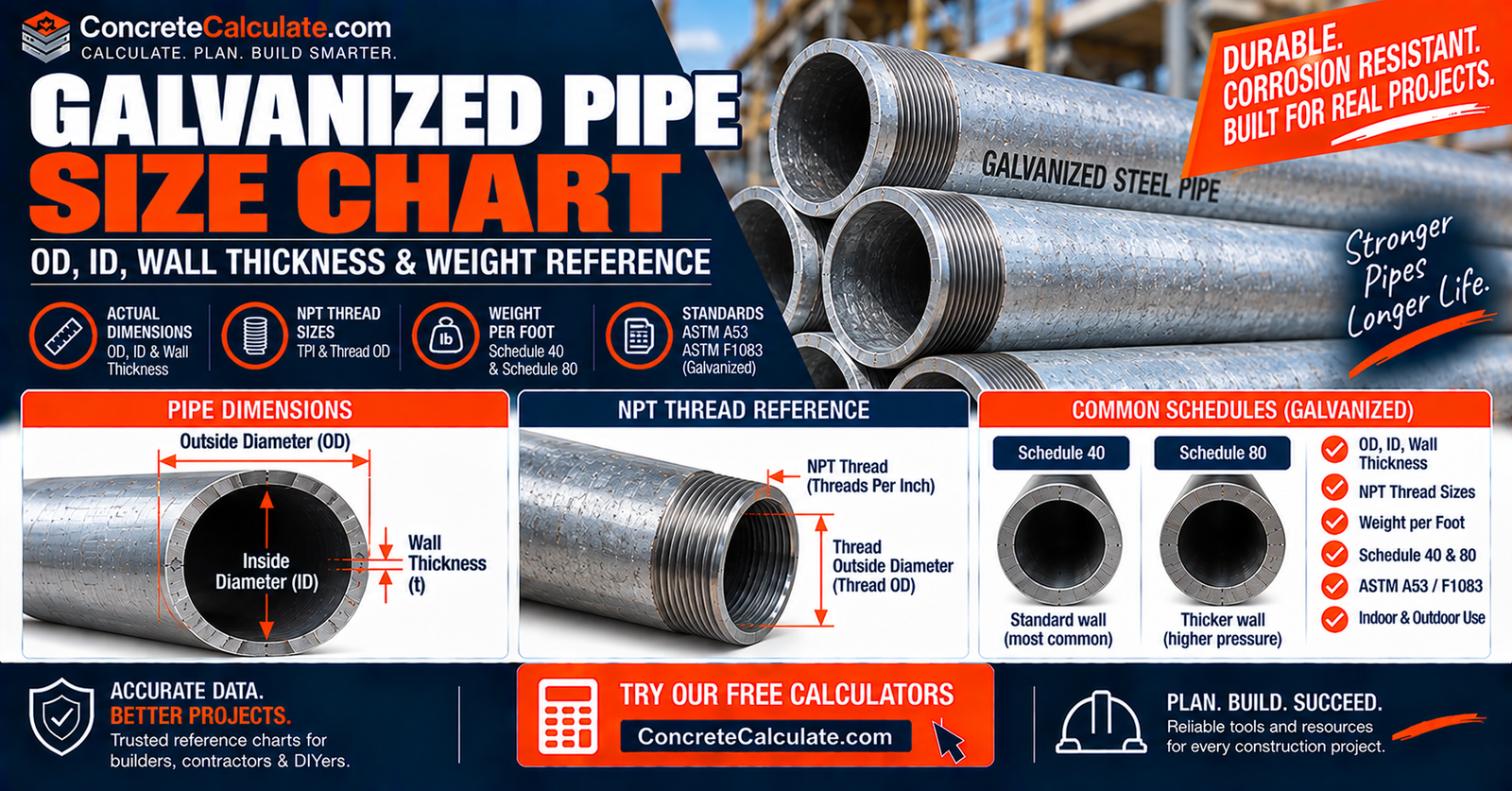
Galvanized Pipe Size Chart
OD, ID, Wall & Weight
Actual outside diameter, inside diameter, wall thickness, and weight for hot-dip galvanized steel pipe under ASTM A53 and ASTM F1083, Schedule 40 and Schedule 80.
 Reviewed by Muhammad Ramzan Babar, PhD Researcher (Plasma Physics) & Calculator Developer, View Profile
Galvanizing does not create a new nominal pipe size system
Galvanized steel pipe generally follows the same NPS/OD dimensional framework as black steel pipe; the zinc coating is a finish applied to the steel pipe. ASTM A53/A53M-24 explicitly covers both black and hot-dipped zinc-coated welded and seamless steel pipe from NPS 1/8 through NPS 26 (DN 6 through DN 650). This page is the galvanized-specific companion to the Black Iron Pipe Size Chart.
Galvanized Pipe Size Chart, Quick Reference
Nominal steel pipe dimensions for hot-dip galvanized steel pipe under ASTM A53.
Schedule 40 Galvanized Steel Pipe
| NPS (in) | OD (in) | Wall (in) | ID (in) | Approx. Weight (lb/ft) |
|---|---|---|---|---|
| 1/8 | 0.405 | 0.068 | 0.269 | 0.24 |
| 1/4 | 0.540 | 0.088 | 0.364 | 0.43 |
| 3/8 | 0.675 | 0.091 | 0.493 | 0.57 |
| 1/2 | 0.840 | 0.109 | 0.622 | 0.85 |
| 3/4 | 1.050 | 0.113 | 0.824 | 1.13 |
| 1 | 1.315 | 0.133 | 1.049 | 1.68 |
| 1-1/4 | 1.660 | 0.140 | 1.380 | 2.27 |
| 1-1/2 | 1.900 | 0.145 | 1.610 | 2.72 |
| 2 | 2.375 | 0.154 | 2.067 | 3.65 |
| 2-1/2 | 2.875 | 0.203 | 2.469 | 5.79 |
| 3 | 3.500 | 0.216 | 3.068 | 7.58 |
| 4 | 4.500 | 0.237 | 4.026 | 10.79 |
| 6 | 6.625 | 0.280 | 6.065 | 18.97 |
| 8 | 8.625 | 0.322 | 7.981 | 28.55 |
Schedule 80 Galvanized Pipe Quick Chart
| NPS (in) | OD (in) | Sch 80 Wall (in) | Sch 80 ID (in) | Approx. Weight (lb/ft) |
|---|---|---|---|---|
| 1/2 | 0.840 | 0.147 | 0.546 | 1.09 |
| 1 | 1.315 | 0.179 | 0.957 | 2.17 |
| 2 | 2.375 | 0.218 | 1.939 | 5.02 |
| 4 | 4.500 | 0.337 | 3.826 | 14.98 |
Important Scope Note
The chart values represent nominal steel pipe dimensions. The galvanized zinc coating is a surface finish; actual finished OD and weight can be slightly greater depending on coating thickness.
What Is Galvanized Pipe?
A concise definition.
Galvanized steel pipe is steel pipe coated with zinc, commonly by hot-dip galvanizing, to improve corrosion resistance. ASTM A53/A53M-24 covers both black steel pipe and hot-dipped zinc-coated steel pipe, in welded and seamless forms.
Galvanized Pipe vs Black Steel Pipe
A major distinction that shapes this entire chart.
| Feature | Galvanized Steel | Black Steel |
|---|---|---|
| Base material | Steel | Steel |
| Surface | Zinc coated | Black / uncoated finish |
| Common A53 dimensional family | Yes | Yes |
| Same NPS/OD framework | Generally yes | Yes |
| Corrosion protection | Higher | Lower |
| Finished OD exactly identical? | Coating can add slightly | Bare dimension |
Key Message
The zinc finish changes corrosion protection, not the underlying NPS sizing system. See the Black Iron Pipe Size Chart for the uncoated sibling reference.
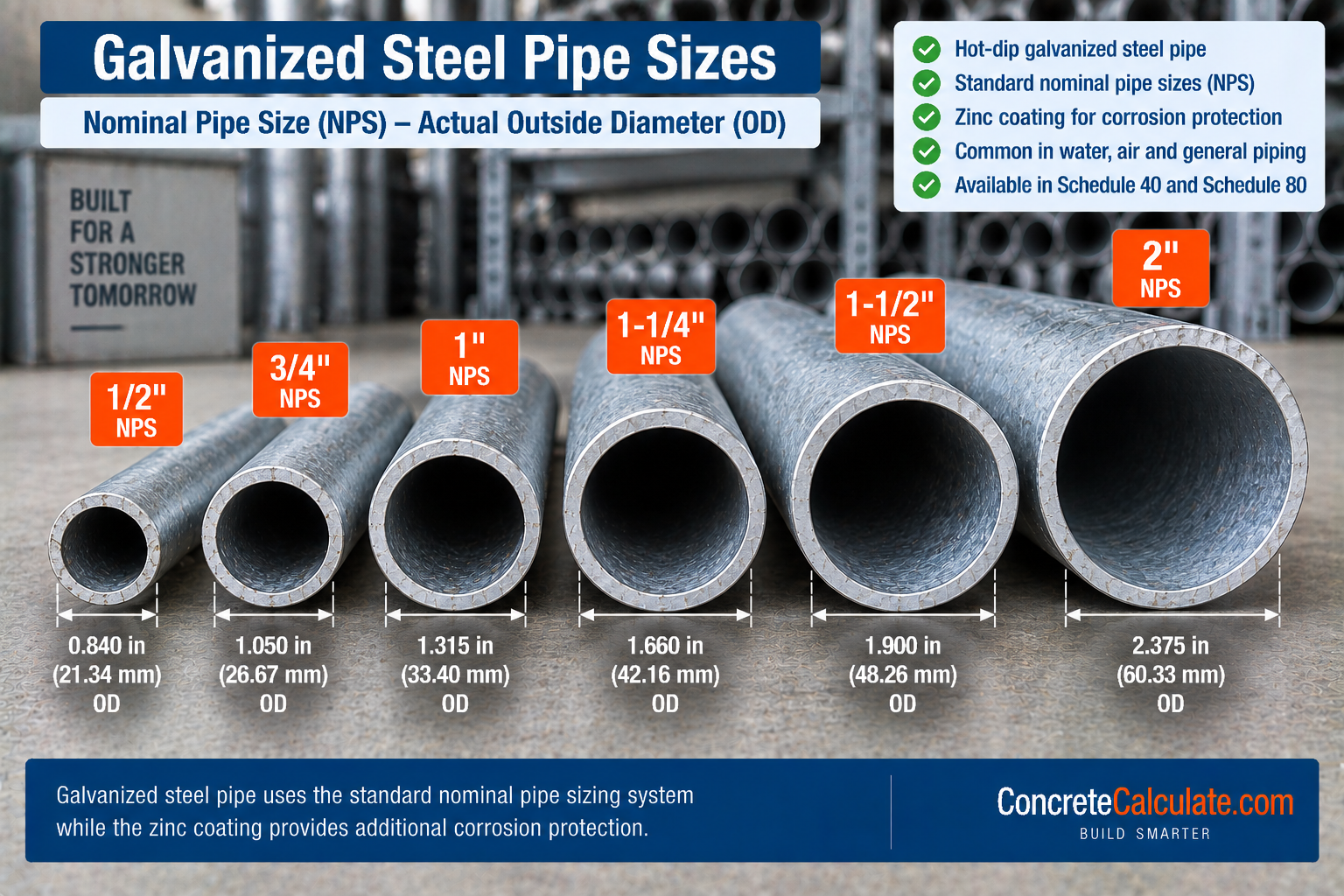
Galvanized Pipe Size vs Actual Dimensions
Four dimensions that define every pipe on this chart.
| Term | Definition |
|---|---|
| NPS | Nominal pipe size, a trade designation |
| OD | Outside diameter of the steel pipe |
| Wall Thickness | Steel wall, controlled by schedule |
| ID | Bore, based on wall thickness |
Formula
ID = OD – 2t for nominal steel geometry. Note that the zinc coating is external and, in hot-dip galvanized pipe, also present on the interior, so actual finished surfaces can differ very slightly from the bare nominal geometry.
NPS vs OD vs ID for Galvanized Pipe
How each dimension responds to schedule and coating.
| Term | Meaning | Changes With Schedule? |
|---|---|---|
| NPS | Nominal pipe size | No |
| OD | Standardized steel-pipe outside diameter | Normally no |
| Wall | Steel wall thickness | Yes |
| ID | Bore based on wall | Yes |
| Zinc coating | Surface finish | Product/specification dependent |
Key Message
Nominal pipe size does not equal measured OD or ID.
Galvanized Pipe Outside Diameter Chart
The standardized steel OD that stays fixed across schedules for a given NPS.
| NPS (in) | DN | Nominal Steel OD (in) | OD (mm) |
|---|---|---|---|
| 1/2 | DN 15 | 0.840 | 21.3 |
| 3/4 | DN 20 | 1.050 | 26.7 |
| 1 | DN 25 | 1.315 | 33.4 |
| 1-1/4 | DN 32 | 1.660 | 42.2 |
| 1-1/2 | DN 40 | 1.900 | 48.3 |
| 2 | DN 50 | 2.375 | 60.3 |
| 3 | DN 80 | 3.500 | 88.9 |
| 4 | DN 100 | 4.500 | 114.3 |
| 6 | DN 150 | 6.625 | 168.3 |
| 8 | DN 200 | 8.625 | 219.1 |
For the complete OD reference across every pipe material system, see the Pipe Outside Diameter Chart.
Galvanized Pipe Inside Diameter Chart
ID changes with wall thickness even though the standard OD stays the same for a given NPS.
| NPS (in) | Sch 40 ID (in) | Sch 80 ID (in) |
|---|---|---|
| 1/2 | 0.622 | 0.546 |
| 1 | 1.049 | 0.957 |
| 2 | 2.067 | 1.939 |
| 4 | 4.026 | 3.826 |
| 6 | 6.065 | 5.761 |
For the complete ID reference and calculation methodology, see the Pipe Inside Diameter Chart.
Schedule 40 Galvanized Pipe Size Chart
The flagship detailed section for galvanized Schedule 40 steel pipe.
| NPS (in) | DN | OD (in) | Wall (in) | ID (in) | lb/ft | kg/m |
|---|---|---|---|---|---|---|
| 1/2 | DN 15 | 0.840 | 0.109 | 0.622 | 0.85 | 1.27 |
| 3/4 | DN 20 | 1.050 | 0.113 | 0.824 | 1.13 | 1.68 |
| 1 | DN 25 | 1.315 | 0.133 | 1.049 | 1.68 | 2.50 |
| 1-1/2 | DN 40 | 1.900 | 0.145 | 1.610 | 2.72 | 4.04 |
| 2 | DN 50 | 2.375 | 0.154 | 2.067 | 3.65 | 5.44 |
| 3 | DN 80 | 3.500 | 0.216 | 3.068 | 7.58 | 11.27 |
| 4 | DN 100 | 4.500 | 0.237 | 4.026 | 10.79 | 16.06 |
| 6 | DN 150 | 6.625 | 0.280 | 6.065 | 18.97 | 28.24 |
| 8 | DN 200 | 8.625 | 0.322 | 7.981 | 28.55 | 42.49 |
Schedule 40 galvanized steel products are widely manufactured under ASTM A53, while galvanized structural and fence pipe can also be produced under ASTM F1083, which shares the same dimensional, wall, and weight table while the grade changes strength rather than size.
Schedule 80 Galvanized Pipe Size Chart
Same nominal size and OD, thicker wall, smaller ID, greater weight.
| NPS (in) | OD (in) | Wall (in) | ID (in) | Weight (lb/ft) |
|---|---|---|---|---|
| 1/2 | 0.840 | 0.147 | 0.546 | 1.09 |
| 3/4 | 1.050 | 0.154 | 0.742 | 1.47 |
| 1 | 1.315 | 0.179 | 0.957 | 2.17 |
| 2 | 2.375 | 0.218 | 1.939 | 5.02 |
| 4 | 4.500 | 0.337 | 3.826 | 14.98 |
Not every galvanized pipe product is available in Schedule 80; see the Schedule 80 Pipe Chart for full availability by size.
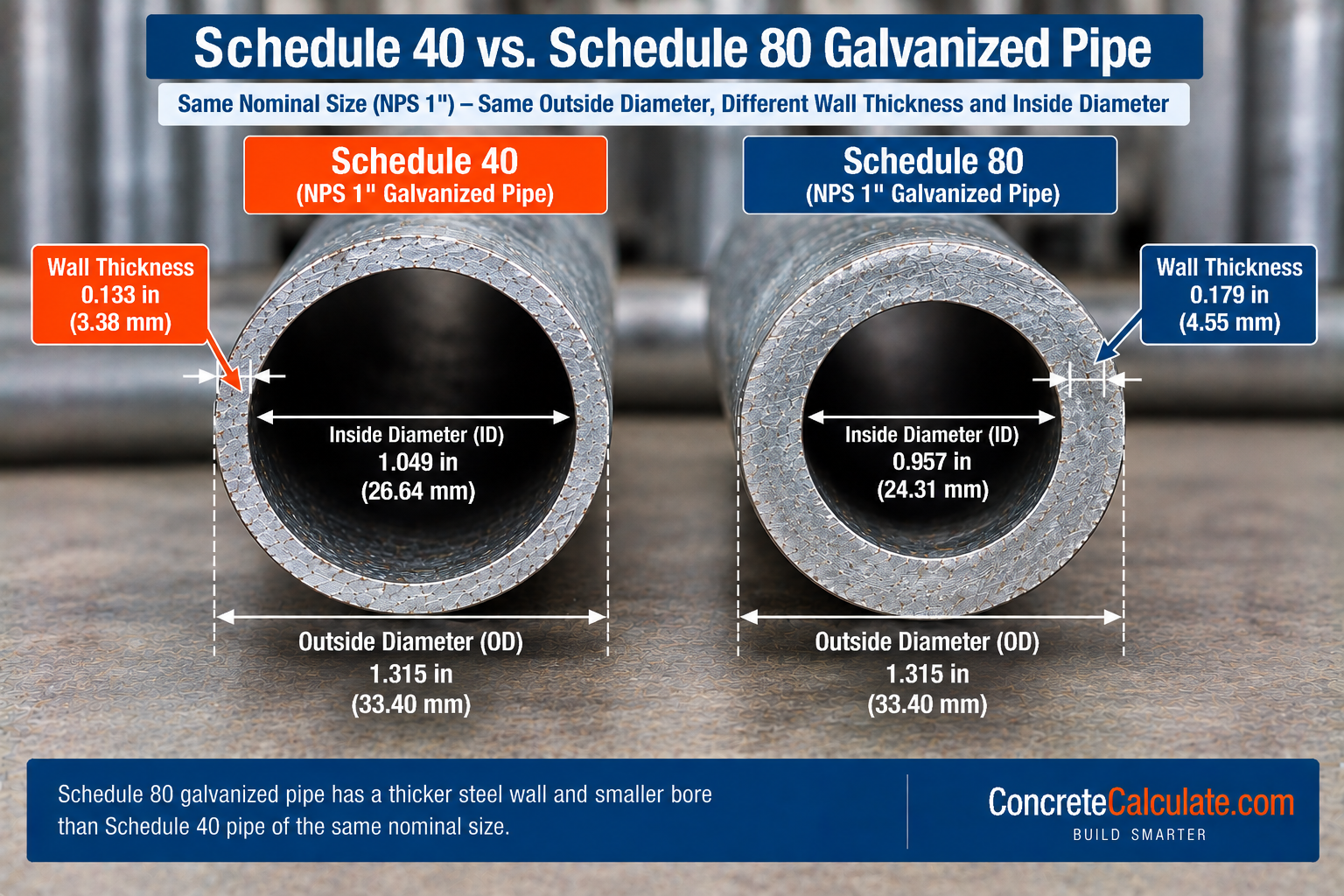
Schedule 40 vs Schedule 80 Galvanized Pipe
Schedule changes the wall and bore, not the basic NPS outside diameter family.
| NPS (in) | OD (in) | Sch 40 Wall | Sch 80 Wall | Sch 40 ID | Sch 80 ID |
|---|---|---|---|---|---|
| 1/2 | 0.840 | 0.109 | 0.147 | 0.622 | 0.546 |
| 1 | 1.315 | 0.133 | 0.179 | 1.049 | 0.957 |
| 2 | 2.375 | 0.154 | 0.218 | 2.067 | 1.939 |
| 4 | 4.500 | 0.237 | 0.337 | 4.026 | 3.826 |
Galvanized Pipe Schedule vs Wall Thickness
Schedule is fundamentally a wall-thickness designation.
ASME B36.10 includes multiple schedule families depending on NPS, with potential series including 10, 20, 30, 40, 60, 80, 100, 120, 140, and 160 where standardized. Not all schedules exist for every size or product; see the Pipe Schedule Chart for the complete availability reference.
STD, XS, and XXS Galvanized Pipe
Historical wall designations that require the same caution as with black steel pipe.
| Designation | Meaning |
|---|---|
| STD | Standard Weight |
| XS | Extra Strong |
| XXS | Double Extra Strong |
Important
Do not automatically treat STD as equal to Schedule 40 and XS as equal to Schedule 80 at every size. Keep the detailed equivalence reference on the Pipe Schedule Chart.
ASTM A53/A53M-24 Galvanized Steel Pipe
The main product-standard section for galvanized general steel pipe.
ASTM A53/A53M-24 covers black and hot-dipped galvanized steel pipe, seamless and welded, from NPS 1/8 through NPS 26 (DN 6 through DN 650), with required mechanical and testing provisions. ASTM A53 is a product specification, not merely a size chart; it establishes the material requirements that the dimensional tables on this page assume.
✓ Verified Against ASTM A53/A53M-24ASME B36.10-2022 Dimensional Standard
The framework that provides NPS, OD, and wall thickness values.
ASME B36.10 standardizes dimensions of welded and seamless wrought steel pipe, providing NPS, OD, and nominal wall thickness. ASTM A53 is the material and product/testing specification; ASME B36.10 is the dimensional system. These are two distinct layers of the same overall pipe specification.
✓ Verified Against ASME B36.10-2022Galvanizing and Zinc Coating Requirements
What differentiates this page from the Black Iron Pipe Size Chart.
Galvanized A53 pipe is zinc-coated after manufacture according to the applicable galvanizing and product requirements. Hot-dip galvanized pipe can have zinc coating on both the exterior and interior surface, for corrosion-protection purposes, with the coating mass and thickness controlled by the applicable specification. Do not assume one universal zinc thickness applies to every galvanized pipe product; coating requirements vary by specification and product.
Does Galvanizing Change Pipe Outside Diameter?
A section that deserves its own careful explanation.
Technically, the nominal standardized steel OD remains the ASME B36.10 dimension, but the applied zinc coating adds a small physical layer to the finished surface. Therefore, chart OD represents the nominal steel-pipe OD, while the actual measured galvanized outside surface may be slightly greater. This distinction matters especially for tight clamps, sleeves, and precision mechanical fit applications, though the effect should not be overstated for general use.
Does Galvanizing Change Pipe Inside Diameter?
A similar consideration on the internal side.
If zinc coats the internal surface, the finished bore can be very slightly reduced from the bare steel geometric ID. The standard dimensional chart still presents nominal pipe dimensions rather than an exact post-galvanizing bore. For precise hydraulic or fit work, use manufacturer-specific data rather than the nominal chart value alone.
Galvanized Pipe Weight Chart
Nominal bare steel weight, clearly labeled as such.
| NPS (in) | Bare Sch 40 Nominal Steel Weight (lb/ft) |
|---|---|
| 1/2 | 0.85 |
| 1 | 1.68 |
| 2 | 3.65 |
| 4 | 10.79 |
| 6 | 18.97 |
Important
These values represent nominal bare steel pipe weight. The zinc coating adds mass, and actual shipping weights depend on the specific product and manufacturer; do not invent a universal galvanized weight increment. For the complete weight reference, see the Pipe Weight Chart and Steel Pipe Weight Chart.
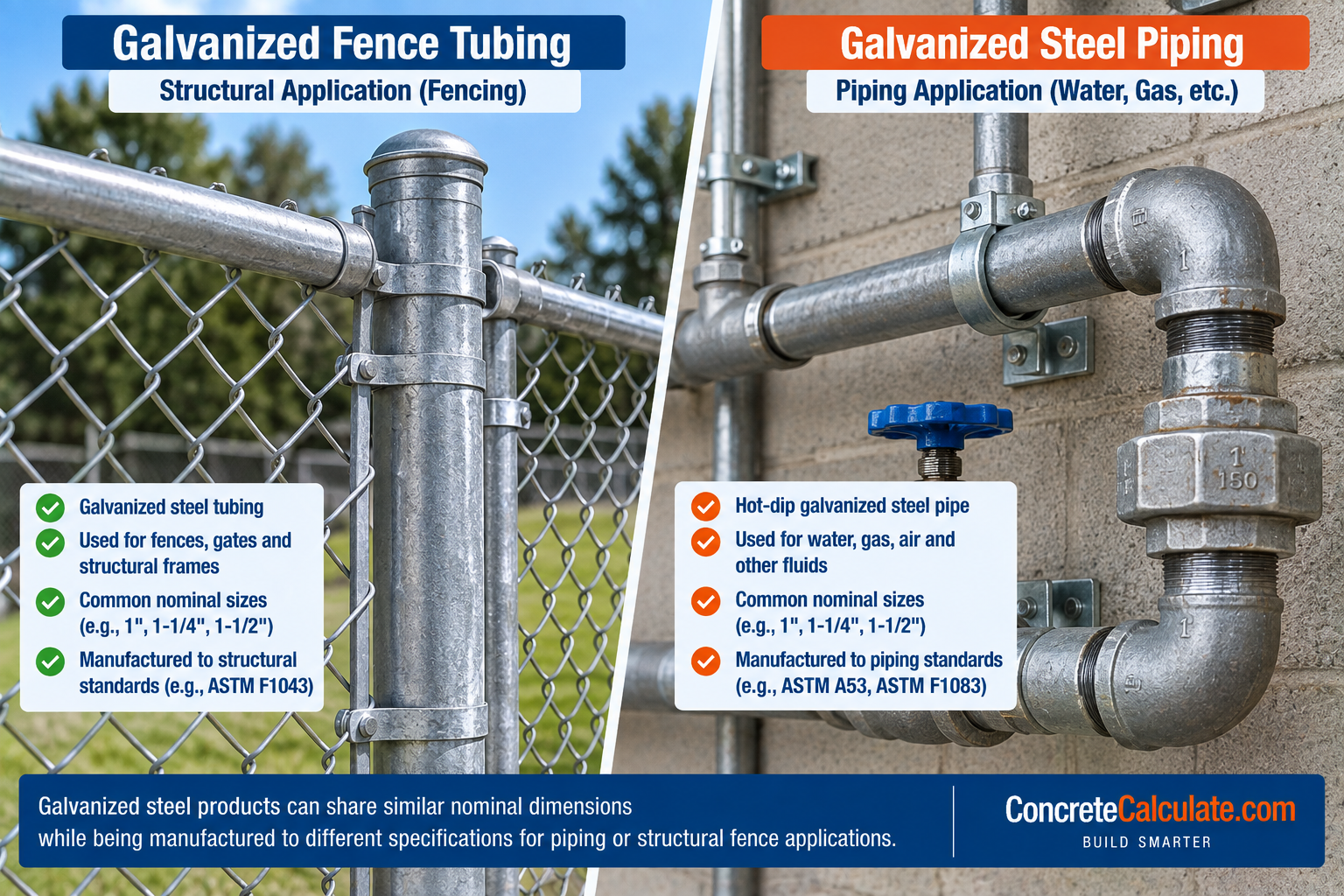
ASTM F1083 Galvanized Fence Pipe
A useful specialist section covering a completely different product category.
ASTM F1083 covers hot-dipped galvanized welded steel pipe specifically for fence structures, with sizes ranging from approximately 1.315 in to 8.625 in outside diameter. This specification explicitly states that the fence framework application requires framework fittings to fit securely on the outside of the pipe, making outside diameter the applicable controlling dimension for this specification. Regular Grade and higher-strength versions can share the same dimensions, wall thickness, and weight while differing in yield strength.
| Fence OD (in) | Decimal OD (in) | Wall (in) | Weight (lb/ft) |
|---|---|---|---|
| 1-5/8 | 1.660 | 0.140 | 2.27 |
| 1-7/8 | 1.900 | 0.145 | 2.72 |
| 2-3/8 | 2.375 | 0.154 | 3.65 |
| 2-7/8 | 2.875 | 0.203 | 5.80 |
| 3-1/2 | 3.500 | 0.216 | 7.58 |
ASTM A53 vs ASTM F1083 Galvanized Pipe
Similar dimensions do not mean identical service qualification.
| Feature | ASTM A53 | ASTM F1083 |
|---|---|---|
| Main context | General steel piping | Fence framework |
| Galvanized option | Yes | Yes |
| Schedule 40 dimensions possible | Yes | Yes |
| Controlling dimension | Wall/ID for pressure service | OD, for fitting compatibility |
| Same service qualification? | No assumption | No assumption |
This article should prevent users from selecting pipe solely because diameter and wall look identical; ASTM A53 and ASTM F1083 are separate specifications intended for different service qualifications.
Galvanized Pipe Thread Size Chart
NPT threads per inch by nominal pipe size.
| NPS (in) | Common NPT TPI | Typical Threaded Use |
|---|---|---|
| 1/2 | 14 | General plumbing and mechanical fittings |
| 3/4 | 14 | General plumbing and mechanical fittings |
| 1 | 11.5 | Mechanical piping, larger fittings |
| 1-1/2 | 11.5 | Mechanical and industrial piping |
| 2 | 11.5 | Mechanical and industrial piping |
Full thread geometry belongs to the NPT Thread Chart and Pipe Thread Chart; this table provides a useful summary specific to galvanized pipe.
NPS vs NPT on Galvanized Pipe
A strong warning that applies equally to galvanized product.
Example: 1/2-in Galvanized Threaded Pipe
Nominal size = 1/2 NPS. Actual OD ≈ 0.840 in. Thread designation = 1/2 NPT. NPT nominal thread size is not equal to actual measured outside thread diameter.
Threaded, Plain-End, and Grooved Galvanized Pipe
Common end conditions available on galvanized product.
| End Type | Common Use |
|---|---|
| Threaded | NPT-threaded joints for smaller pipe and fittings |
| Plain-end | Prepared for welding or mechanical connection |
| Grooved | Grooved mechanical coupling systems |
| Welded/beveled | Where appropriate for the service and joining method |
Do not assume all galvanized pipe is threaded; end preparation depends on the specific product and intended application.
Galvanized Pipe Fittings and Nominal Size
A useful homeowner and DIY clarification.
Fittings match nominal pipe size, not measured OD labels. A 1/2-in galvanized pipe uses a 1/2-in fitting, and a 1-in pipe uses a 1-in fitting, but the actual physical OD is larger than the nominal label in both cases.
Galvanized Pipe vs Black Iron Pipe
A substantial comparison, since both pages now exist as companion references.
Both share the same broad NPS/B36.10 dimensional family; black steel uses an uncoated finish, and galvanized steel uses a zinc-coated finish. ASTM A53/A53M-24 covers both within the same specification. See the Black Iron Pipe Size Chart for the complete black steel reference and comparison.
Galvanized Pipe vs Stainless Steel Pipe
Two corrosion-resistance strategies, entirely different material systems.
Both provide corrosion resistance, but through completely different material systems: galvanized carbon steel relies on zinc coating protection, while stainless steel relies on a corrosion-resistant alloy composition. Do not imply identical wall schedules, performance, service life, or chemistry compatibility between the two systems.
Galvanized Pipe vs PVC and Copper
Two separate material comparisons, kept concise.
OD families can overlap between galvanized steel and IPS-based PVC systems, but weight differs dramatically and joining, service, temperature, and pressure characteristics differ as well; see the PVC Pipe Size Chart for PVC-specific data. Copper uses a separate sizing system entirely: nominal 1/2 galvanized steel has an OD of 0.840 in, while nominal 1/2 plumbing copper uses a different OD convention with an actual OD of approximately 0.625 in; see the Copper Pipe Size Chart for complete copper data. Do not suggest dimensional similarity means application interchangeability in either comparison.
Galvanized Pipe for Water and Mechanical Service
A high-level overview only.
Historically, and in some applications currently, galvanized steel has been used for water distribution, outdoor piping, and industrial service. Current acceptability depends on the applicable plumbing code, water chemistry, corrosion condition, and project specification. This is not a universal recommendation for every water service application; verify against the governing code before specifying galvanized pipe for a specific water system.
Galvanized Pipe for Fencing and Outdoor Structures
One of the strongest separate search intents for galvanized pipe.
Galvanized pipe is widely used for fence framework, gates, and outdoor structural applications, commonly under ASTM F1083 as covered earlier in this chart. Do not confuse fence pipe with pressure pipe simply because schedule and diameter match; the two product categories serve different applications with different qualification requirements.
Galvanized Pipe Corrosion, Scale, and Effective Inside Diameter
Effective bore can decrease over the service life of the pipe.
Over time, internal buildup or corrosion can reduce the effective bore of galvanized pipe. Potential effects include reduced ID, increased friction, and reduced flow. There is no universal percentage loss that applies to every installation; effects vary by water chemistry, age, and service conditions. See the Pipe Inside Diameter Chart and Pipe Flow Rate Chart for related reference data, though actual hydraulic sizing for an aged system requires project-specific evaluation.
How to Measure Galvanized Pipe Size
A practical field workflow.
Field Measurement Workflow
How to Identify Schedule 40 vs Schedule 80 Galvanized Pipe
OD will normally not distinguish them.
You need wall measurement, ID, marking, or manufacturer documentation to tell schedules apart. For NPS 2, Schedule 40 has a wall of 0.154 in and Schedule 80 has a wall of 0.218 in.
Core Message
Schedule is identified from wall thickness, not outside diameter alone.
Common Galvanized Pipe Size Mistakes
Assuming nominal size equals OD
NPS 1/2 has an actual OD of 0.840 in, not 0.500 in.
Assuming nominal size equals ID
NPS 2 Schedule 40 has an ID of about 2.067 in, not 2.000 in.
Calling 1/2-in galvanized pipe 0.500-in OD
The actual measured OD is larger than the nominal number for common sizes.
Assuming galvanizing creates a different NPS system
Galvanized pipe follows the same base dimensional system as black steel pipe.
Assuming galvanized and black steel dimensions are unrelated
Both share the same ASTM A53/ASME B36.10 dimensional family.
Ignoring schedule
Schedule changes ID and weight significantly at the same NPS.
Assuming Schedule 80 has larger OD than Schedule 40
Both normally share the same OD; only wall and ID differ.
Measuring coating and treating it as a different nominal size
The zinc layer is thin and does not change the underlying NPS designation.
Using chart ID as exact finished galvanized bore
Interior zinc coating can slightly reduce the actual finished bore.
Ignoring zinc coating in precision-fit applications
Tight clamps or sleeves may need to account for the coating thickness.
Assuming all galvanized pipe is ASTM A53
Other specifications such as ASTM F1083 also produce galvanized pipe.
Confusing ASTM A53 and ASTM F1083
These serve different applications with different qualification requirements.
Using fence pipe as pressure pipe without verifying specification
Dimensional similarity does not imply equivalent service qualification.
Assuming grade or strength changes dimensions
Grade affects yield strength, not the NPS dimensional designation.
Confusing NPS and NPT
NPT describes thread geometry, separate from the pipe’s nominal size label.
Assuming 1/2 NPT measures 1/2 in OD
The pipe OD for NPS 1/2 is 0.840 in regardless of thread designation.
Assuming all galvanized pipe is threaded
Plain-end, grooved, and welded configurations are also common.
Confusing galvanized steel with stainless steel
These are different corrosion-protection strategies and material systems.
Assuming matching PVC/steel OD means interchangeable systems
Materials differ in joining, temperature, pressure, and code rules.
Ignoring corrosion or buildup in old galvanized pipe
Effective bore can be smaller than nominal chart values over time.
Using nominal weight as exact shipping weight
Actual shipping weight varies by manufacturer and coating.
Treating galvanized-pipe dimensions as a pressure-rating chart
Pressure rating is a separate property from dimensional size.
Galvanized Pipe Size Chart Limitations
Read Before Using for Procurement or System Design
Galvanized pipe is a steel pipe product with a zinc coating. NPS is nominal; OD and ID are not equal to nominal size for common small pipe sizes. Schedule changes wall thickness and ID. The zinc coating can slightly alter actual measured finished surfaces. Nominal tables do not define exact coating thickness. ASTM A53 and ASTM F1083 serve different product and application contexts. Grade and dimensions are separate properties. Thread geometry is governed separately under ASME B1.20.1. Pressure rating is not determined by size alone. Existing galvanized pipe can have reduced effective bore from corrosion or deposits. Final material selection should follow applicable plumbing, mechanical, structural, or project requirements.
Frequently Asked Questions
Download Galvanized Pipe Size Chart PDF
Save or print this reference including the Schedule 40 and Schedule 80 dimension tables, ASTM A53 and ASTM F1083 standards context, zinc coating notes, and the black iron, stainless, PVC, and copper comparisons.