Steel Channel Weight Chart: C & MC Sizes (lb/ft, kg/m)
Nominal Weights by Channel Sizelb/ft, kg/m, Length Weights and Takeoffs
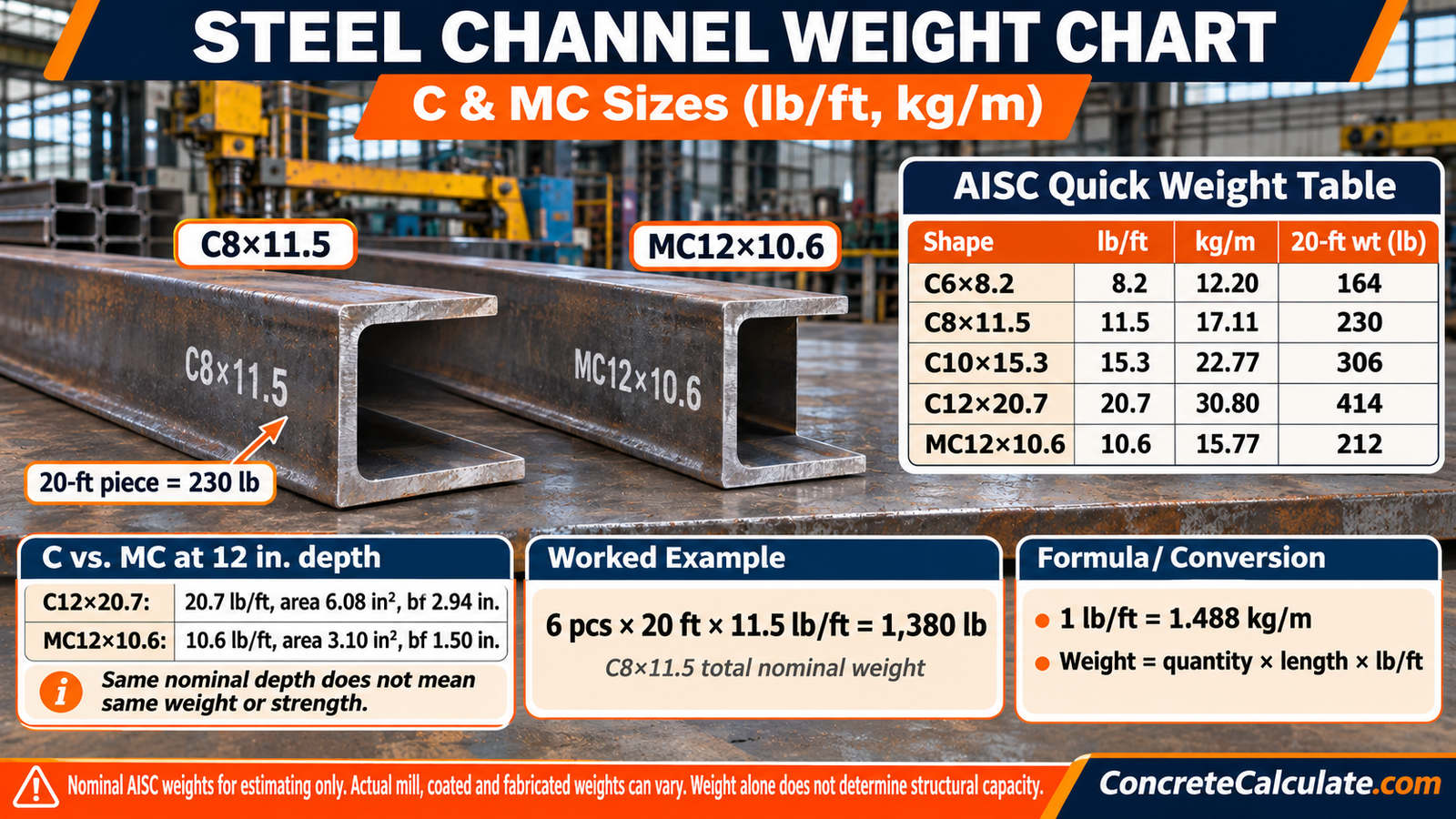
A steel channel weight chart lists the nominal weight of AISC C and MC channels in pounds per foot. C8×11.5 weighs 11.5 lb/ft (17.11 kg/m), so a 20-foot piece weighs 230 lb. Multiply lb/ft by length for piece weight, then confirm the exact shape and grade with your supplier.
 Reviewed by Muhammad Ramzan Babar, PhD Researcher (Plasma Physics) & Calculator Developer. View Profile
Steel Channel Weight Chart: Quick Reference
Nominal weight per foot for AISC C and MC channels, in lb/ft and kg/m, with 20-ft piece weights.
Standard C-Channel Weight Chart
| C-channel designation | Weight (lb/ft) | Weight (kg/m) | 20-ft piece weight (lb) |
|---|---|---|---|
| C3×4.1 | 4.1 | 6.10 | 82 |
| C4×5.4 | 5.4 | 8.04 | 108 |
| C5×6.7 | 6.7 | 9.97 | 134 |
| C6×8.2 | 8.2 | 12.20 | 164 |
| C6×10.5 | 10.5 | 15.63 | 210 |
| C7×9.8 | 9.8 | 14.58 | 196 |
| C8×11.5 | 11.5 | 17.11 | 230 |
| C8×13.75 | 13.75 | 20.46 | 275 |
| C9×13.4 | 13.4 | 19.94 | 268 |
| C9×15 | 15.0 | 22.32 | 300 |
| C10×15.3 | 15.3 | 22.77 | 306 |
| C10×20 | 20.0 | 29.76 | 400 |
| C10×25 | 25.0 | 37.20 | 500 |
| C12×20.7 | 20.7 | 30.80 | 414 |
| C12×25 | 25.0 | 37.20 | 500 |
| C12×30 | 30.0 | 44.64 | 600 |
| C15×33.9 | 33.9 | 50.45 | 678 |
| C15×40 | 40.0 | 59.53 | 800 |
| C15×50 | 50.0 | 74.41 | 1,000 |
Source basis: AISC Shapes Database v16.0 and AISC-derived channel listings. kg/m and 20-ft weights are calculated from nominal lb/ft.
- Values are nominal weights for selected AISC American Standard C-channel sections.
- The number after the cross is the nominal weight in pounds per linear foot.
- kg/m values are calculated with 1 lb/ft = 1.48816394 kg/m. The 20-ft column is lb/ft x 20 ft.
- Actual mill weight, purchased lengths and fabricated assembly weights can differ.
- This is a selected reference chart, not the complete AISC C-shape inventory. AISC lists 32 C shapes in all.
- Availability must be confirmed with the supplier. Weight alone does not establish structural adequacy.
Miscellaneous MC-Channel Weight Chart
| MC-channel designation | Weight (lb/ft) | Weight (kg/m) | 20-ft piece weight (lb) |
|---|---|---|---|
| MC6×6.5 | 6.5 | 9.67 | 130 |
| MC6×12 | 12.0 | 17.86 | 240 |
| MC8×8.5 | 8.5 | 12.65 | 170 |
| MC8×20 | 20.0 | 29.76 | 400 |
| MC10×22 | 22.0 | 32.74 | 440 |
| MC12×10.6 | 10.6 | 15.77 | 212 |
| MC12×31 | 31.0 | 46.13 | 620 |
| MC13×31.8 | 31.8 | 47.32 | 636 |
| MC18×42.7 | 42.7 | 63.54 | 854 |
Source basis: AISC Shapes Database v16.0 and AISC-derived MC listings. MC shapes can have different flange proportions and properties from C shapes, so do not infer dimensions or strength from the weight designation. This is a selected list.
How to Read the Values
lb/ft is the primary unit and kg/m the secondary one. For dimensions and section properties, use our Steel Channel Size Chart.
What it means: Depth and weight alone cannot give bending strength, deflection or torsional capacity. Those need the full section properties.
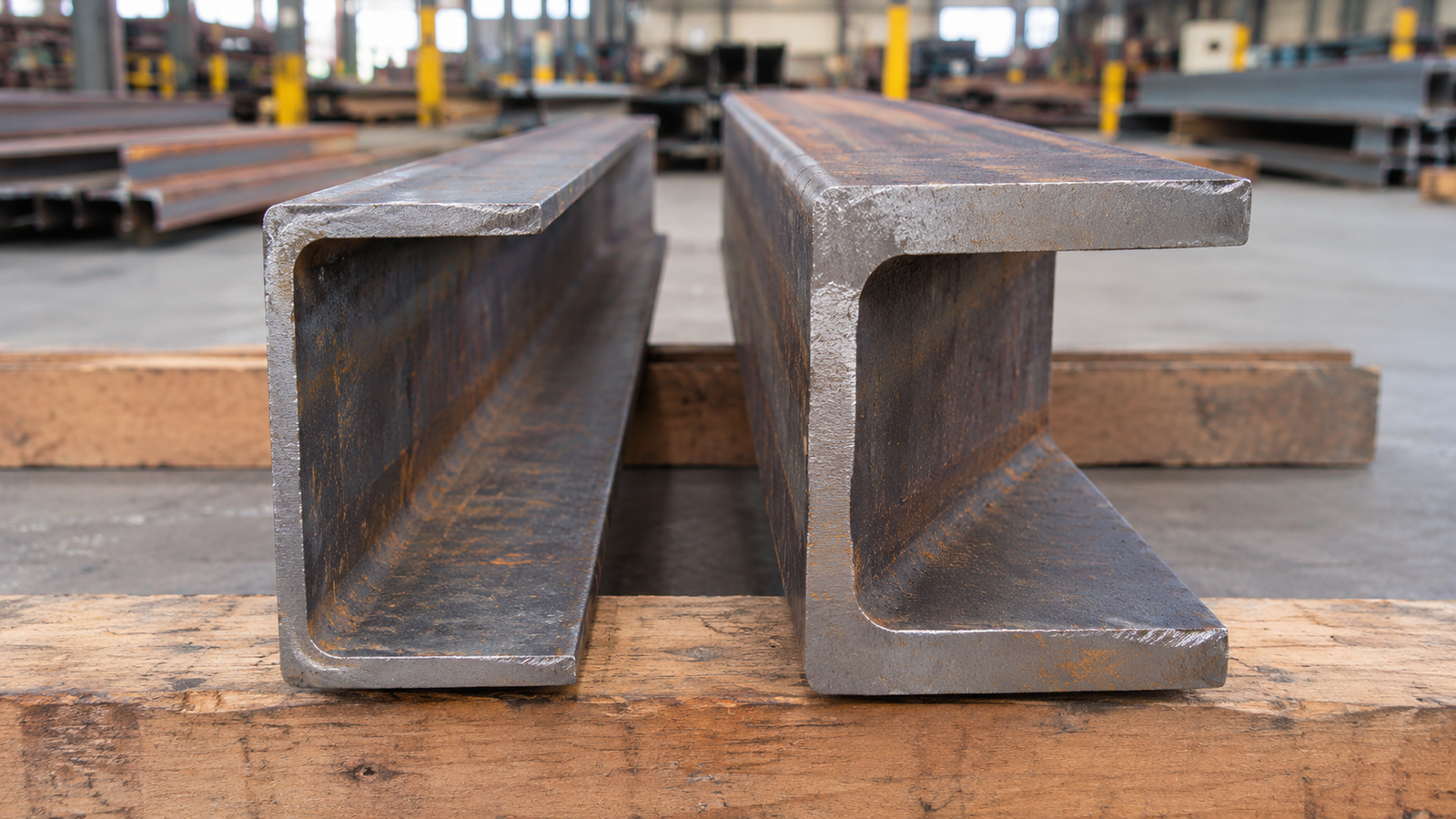
What Is a Structural Steel Channel?
A hot-rolled open C-section with a web and two flanges, listed by AISC as C and MC shapes.
A structural steel channel is a hot-rolled section with an open C-shaped cross-section, a flat web and two flanges on the same side. AISC lists C and MC channels, and each size carries its nominal weight in pounds per foot in the name.
Web and Flange Geometry
The web is the flat back of the channel and the flanges project from it. Because the section is open and the flanges sit on one side, it is not symmetric about both axes like a wide-flange beam.
Hot-Rolled Channel Sections
AISC C shapes have a tapered inner flange face, so their listed flange thickness is an average. This chart covers hot-rolled structural channels only, and cold-formed framing channels are a separate product. See the section on cold-formed C-sections below.
Common Structural and Fabrication Uses
Channels commonly serve as framing members, lintels, stair stringers, edge trim, bracing and base or support frames. For other structural shape families, use our structural steel shapes chart.
How to Read Steel Channel Designations
Decode C8×11.5 and MC12×10.6: family, nominal depth and weight per foot.
A steel channel designation such as C8×11.5 gives the shape family, the nominal depth in inches and the nominal weight in pounds per foot. AISC naming convention for structural steel products defines C and MC names this way, and uses C15X33.9 and C6X13 as C examples and MC12X10.6 and MC8X20 as MC examples.
Meaning of C8{X}11.5
C is an American Standard Channel, 8 is the nominal depth in inches and 11.5 is the nominal weight in lb/ft. The 11.5 is not a flange width or thickness.
Meaning of MC12{X}10.6
MC is a Miscellaneous Channel, 12 is the nominal depth in inches and 10.6 is the nominal weight in lb/ft. MC12×10.6 weighs less than C12×20.7 although both are 12 inches deep.
Nominal Depth and Weight per Foot
The combinations of nominal depth and weight are the ones listed in ASTM A6/A6M. Different weights at one depth are different shapes, so “8-inch channel” alone is not enough information.
Why the Full Designation Matters
Depth and weight together identify the shape. For dimensions, see our steel channel dimensions and properties.
✓ Checked against the AISC naming convention document, Section 3 (C and MC shapes).AISC Steel Channel Standards and Reference Tables
Which sources set names, weights, tolerances and design strength.
| Source | What it establishes | What it does not do |
|---|---|---|
| AISC Shapes Database v16.0 | Shape designations, nominal weights, areas and dimensions | Does not confirm what a supplier has in stock |
| AISC Steel Construction Manual, 16th Edition | Section properties and design aids for listed shapes | Does not set mill tolerances |
| ASTM A6/A6M | General requirements and permissible variations for rolled shapes | Does not choose the shape or the grade for you |
| ANSI/AISC 303-22 | Contract practice, including how nominal weight is used | Is not a section property table |
| ANSI/AISC 360-22 | Design strength, stability and load capacity | Does not give estimating weights |
Source: AISC and ASTM scope descriptions. AISC states that permissible variations for shapes are in ASTM A6/A6M Section 12 (AISC engineering FAQ on mill production and tolerances).
The AISC Shapes Database and the Steel Construction Manual set shape names, weights and properties, while ASTM A6/A6M governs mill tolerances. Supplier availability is a separate question.
AISC Steel Construction Manual, 16th Edition
The AISC Steel Construction Manual, 16th Edition carries the section properties and design aids for listed shapes.
AISC Shapes Database v16.0
AISC offers the AISC Shapes Database v16.0 as a free Excel download. The standard version holds shapes current as of the 16th Edition, and a separate historic version covers older shapes.
ASTM A6/A6M
ASTM A6/A6M covers mill requirements, including dimensional tolerances on structural shapes. Verify the current edition before you cite it. For the structural shapes chart, see our structural steel shapes chart.
Nominal Dimensions vs. Manufacturing Tolerances
Tabulated values are nominal. Mill-produced sections vary within ASTM A6/A6M limits, so a calculated weight is a planning figure.
American Standard C-Channel Weight Chart
How the C-channel weights group by size, and why depth alone is not enough.
| Nominal depth (in.) | Channel | Weight (lb/ft) | Area (in²) |
|---|---|---|---|
| 6 | C6×8.2 | 8.2 | 2.39 |
| 6 | C6×10.5 | 10.5 | 3.07 |
| 6 | C6×13 | 13.0 | 3.82 |
| 10 | C10×15.3 | 15.3 | 4.48 |
| 10 | C10×20 | 20.0 | 5.87 |
| 10 | C10×25 | 25.0 | 7.35 |
The American Standard C-channel chart runs from 4.1 lb/ft for C3×4.1 to 50 lb/ft for C15×50, and one depth can have several weights. The main chart is a selected list, not the full inventory.
Small C-Channels
C3 to C5 in the chart weigh 4.1 to 6.7 lb/ft, so a 20-foot piece weighs 82 to 134 lb.
Medium C-Channels
C6 to C9 range from 8.2 to 20 lb/ft in the chart, or 164 to 400 lb at 20 ft.
Large C-Channels
C10 to C15 range from 15.3 to 50 lb/ft, and a 20-foot C15×50 weighs 1,000 lb.
Comparing Different Weights at the Same Depth
At 6 inches, C6×13 weighs 13.0 lb/ft against 8.2 lb/ft for C6×8.2. A heavier section at the same depth has more steel area, so “6-inch steel channel” does not fix the weight.
MC-Channel Weight Chart
Miscellaneous channel weights and why they need their own lookup.
| MC-channel | Nominal depth (in.) | Weight (lb/ft) | Area (in²) |
|---|---|---|---|
| MC6×12 | 6 | 12.0 | 3.53 |
| MC8×20 | 8 | 20.0 | 5.87 |
| MC10×22 | 10 | 22.0 | 6.45 |
| MC12×10.6 | 12 | 10.6 | 3.10 |
| MC12×31 | 12 | 31.0 | 9.12 |
| MC18×42.7 | 18 | 42.7 | 12.6 |
MC channels are AISC Miscellaneous Channels, a separate shape family with its own table because MC does not automatically mean heavier. MC12×10.6 weighs 10.6 lb/ft while MC12×31 weighs 31 lb/ft at the same nominal depth.
Miscellaneous Channel Designations
MC names follow the same pattern as C names, MC depth x weight. MC shapes have proportions outside the American Standard C series.
Common MC Sizes
The main chart lists nine MC shapes from MC6×6.5 (6.5 lb/ft) to MC18×42.7 (42.7 lb/ft). It is a selected list.
MC vs. C-Channel Differences
MC12×10.6 is lighter than C12×20.7, so do not describe MC as universally wider, heavier or stronger. Compare shapes by area and section properties.
Steel Channel Weight per Foot
What lb/ft means and how to turn it into a piece weight.
Steel channel weight per foot is the nominal weight in lb/ft shown in the designation, so C8×11.5 weighs 11.5 lb for every foot of length. Multiply it by the length in feet to get piece weight.
What lb/ft Means
lb/ft is a rate, not a piece weight. AISC contract practice bases standard shape weights on the nominal weight per foot and the detailed overall length (ANSI/AISC 303-22, Section 9.2).
Calculating Weight From Length
W = w x LW is weight in lb, w is nominal weight in lb/ft and L is length in ft.
10-Foot, 20-Foot and 40-Foot Examples
What it means: The weight scales directly with length, so check that you used feet and not inches.
The full table for ten channels is in the common stock lengths section. For broader steel weights, see our Structural Steel Weight Chart.
✓ Section 9.2 method checked against the text of AISC 303 as reproduced in earlier editions. Confirm in ANSI/AISC 303-22.Steel Channel Weight per Meter
Convert lb/ft to kg/m, and keep AISC metric data apart from European channel series.
To convert steel channel weight from lb/ft to kg/m, multiply by 1.48816394, so C12×20.7 is 20.7 x 1.48816394 = 30.80 kg/m. To go back, divide kg/m by 1.48816394.
lb/ft to kg/m Conversion
w(kg/m) = 1.48816394 x w(lb/ft) w(lb/ft) = w(kg/m) / 1.48816394Reverse check: 17.11 / 1.48816394 = 11.50 lb/ft, consistent with C8×11.5.
Metric Channel Weight Examples
What it means: This matches 230 lb x 0.45359237 = 104.3 kg.
Distinguishing AISC Metric Data From European Channel Series
AISC metric designations are converted forms of the same inch-pound shapes. AISC’s naming convention gives C230X19.9 as an example, which is about C9×13.4 at 19.94 kg/m. European UPN and UPE channels are separate standardized products with their own tables, so do not mix them with AISC C and MC data.
Steel Channel Dimensions and Cross-Sectional Area
The dimensions that set channel weight, with area and weight side by side.
| Channel | Nominal depth, d (in.) | Flange width, bf (in.) | Web thickness, tw (in.) | Avg. flange thickness, tf (in.) | Area (in²) | Weight (lb/ft) |
|---|---|---|---|---|---|---|
| C3×4.1 | 3 | 1.41 | 0.170 | 0.273 | 1.20 | 4.1 |
| C4×5.4 | 4 | 1.58 | 0.184 | 0.296 | 1.58 | 5.4 |
| C5×6.7 | 5 | 1.75 | 0.190 | 0.320 | 1.97 | 6.7 |
| C6×8.2 | 6 | 1.92 | 0.200 | 0.343 | 2.39 | 8.2 |
| C8×11.5 | 8 | 2.26 | 0.220 | 0.390 | 3.37 | 11.5 |
| C10×15.3 | 10 | 2.60 | 0.240 | 0.436 | 4.48 | 15.3 |
| C12×20.7 | 12 | 2.94 | 0.282 | 0.501 | 6.08 | 20.7 |
| C15×33.9 | 15 | 3.40 | 0.400 | 0.650 | 9.96 | 33.9 |
Source basis: AISC Shapes Database v16.0 values as tabulated in published listings. C15×33.9 area is 9.96 in² in AISC-derived listings, and one site rounds it to 10. Areas are rounded. This is a limited reference for weight, not the full dimension set.
Channel weight depends on the cross-sectional area, which is set by depth, flange width and web and flange thickness. C8×11.5 has a 3.37 in² area and weighs 11.5 lb/ft. For full dimensions and section properties, use our Steel Channel Size Chart.
Overall Depth
Depth d is the overall height of the channel. The nominal depth in the name is the rounded value, and for the C shapes in the table it equals the listed depth.
Flange Width
Flange width bf is the width of one flange. It grows with depth, from 1.41 in. for C3×4.1 to 3.40 in. for C15×33.9.
Web and Flange Thickness
Web thickness tw and average flange thickness tf set how much steel sits in each part of the section. The inner flange face is tapered, so tf is an average.
Cross-Sectional Area
The area is what turns into weight. Calculating weight from the area is covered in the next section.
How to Calculate Steel Channel Weight From Section Area
The area-based check, w = 3.40278 x A, and why you should not rebuild a channel from rectangles.
Steel channel weight in lb/ft is about 3.40278 times the cross-sectional area in square inches, because structural steel is taken as 490 lb/ft³ and one foot of section is A x 12 in³. Use it as an independent check, and keep the AISC nominal weight as the primary value.
Structural Steel Unit Weight
ANSI/AISC 303 takes the unit weight of steel as 490 lb/ft³ (7,850 kg/m³). That is about 0.2836 lb/in³.
Weight per Foot From Area
w = 490 x A / 144 = 3.40278 x A (A in in², w in lb/ft)What it means: Use the tabulated 15.3 lb/ft for estimates. The small gap comes from rounded areas.
Cross-Checking an AISC Value
| Channel | Area (in²) | Weight from area (lb/ft) | Nominal weight (lb/ft) | Difference (lb/ft) |
|---|---|---|---|---|
| C3×4.1 | 1.20 | 4.08 | 4.1 | −0.02 |
| C4×5.4 | 1.58 | 5.38 | 5.4 | −0.02 |
| C5×6.7 | 1.97 | 6.70 | 6.7 | +0.00 |
| C6×8.2 | 2.39 | 8.13 | 8.2 | −0.07 |
| C8×11.5 | 3.37 | 11.47 | 11.5 | −0.03 |
| C10×15.3 | 4.48 | 15.24 | 15.3 | −0.06 |
| C12×20.7 | 6.08 | 20.69 | 20.7 | −0.01 |
| C15×33.9 | 9.96 | 33.89 | 33.9 | −0.01 |
Every difference is within 0.07 lb/ft here, which is the effect of rounded areas, not an error in the shape weight.
Why Simplified Rectangular Approximations Can Be Inaccurate
| Channel | Rectangle area (in²) | Tabulated area (in²) | Difference |
|---|---|---|---|
| C3×4.1 | 1.19 | 1.20 | −1.1% |
| C8×11.5 | 3.35 | 3.37 | −0.6% |
| C15×33.9 | 9.90 | 9.96 | −0.6% |
A web and two flange rectangles ignore the flange slope and root fillets. Using the average flange thickness, the rectangle area is about 0.6 to 1.1 percent low for these three channels, but that depends on the dimensions you use. Use the tabulated area or weight instead. For a calculator, try our steel weight calculator.
How to Calculate Steel Channel Weight From Length
Single, multiple, differing-length and mixed-section calculations.
Steel channel weight from length is nominal weight per foot times length in feet, so a 20-foot C8×11.5 weighs 11.5 x 20 = 230 lb. For several pieces, multiply by the quantity as well.
Single Channel
W = w x LMultiple Identical Channels
W_total = n x w x LWhat it means: This is the weight of the channels only, before any plates, hardware or coatings.
Different Lengths
What it means: Add all cut lengths of one section first, then multiply once by lb/ft.
Mixed Channel Sizes
W_total = sum of (q_i x L_i x w_i)q is the quantity, L the cut length in ft and w the nominal lb/ft of each section type. A worked mixed takeoff is in the quantity estimating section. For the plain calculation, our steel weight calculator also works.
Channel Weight Calculator
Pick a channel, a length and a quantity to get the nominal bare-channel weight.
Nominal weights from the charts above. Bare section only. Not a certified weight.
Steel Channel Weight for Common Stock Lengths
10, 20 and 40 ft weights for ten selected channels.
| Channel | lb/ft | 10 ft (lb) | 20 ft (lb) | 40 ft (lb) |
|---|---|---|---|---|
| C3×4.1 | 4.1 | 41 | 82 | 164 |
| C4×5.4 | 5.4 | 54 | 108 | 216 |
| C6×8.2 | 8.2 | 82 | 164 | 328 |
| C8×11.5 | 11.5 | 115 | 230 | 460 |
| C10×15.3 | 15.3 | 153 | 306 | 612 |
| C12×20.7 | 20.7 | 207 | 414 | 828 |
| C15×33.9 | 33.9 | 339 | 678 | 1,356 |
| MC6×12 | 12.0 | 120 | 240 | 480 |
| MC8×20 | 20.0 | 200 | 400 | 800 |
| MC12×10.6 | 10.6 | 106 | 212 | 424 |
A 20-foot channel weighs 20 times its lb/ft, for example 230 lb for C8×11.5 and 306 lb for C10×15.3. These are theoretical bare-section weights, and stock lengths must be confirmed with the supplier. For broader weights, see our Structural Steel Weight Chart.
10-Foot Channel Weights
C8×11.5 at 10 ft is 115 lb. Halve the 20-ft value.
20-Foot Channel Weights
20 ft is the main length in the weight charts, for example 164 lb for C6×8.2.
40-Foot Channel Weights
C15×33.9 at 40 ft is 1,356 lb, so handling needs planning.
Stock Length vs. Cut Length
Do not claim every channel is available in 20, 40 or 60 ft lengths. The AISC steel availability tool shows which producers roll which shapes, and lengths vary by supplier.
C-Channel vs. MC-Channel Weight Comparison
Equal nominal depth, very different area and weight.
| Property | C12×20.7 | MC12×10.6 |
|---|---|---|
| Nominal depth | 12 in. | 12 in. |
| Weight | 20.7 lb/ft (30.80 kg/m) | 10.6 lb/ft (15.77 kg/m) |
| Area | 6.08 in² | 3.10 in² |
| Flange width, bf | 2.94 in. | 1.50 in. |
| Web thickness, tw | 0.282 in. | 0.190 in. |
| Avg. flange thickness, tf | 0.501 in. | 0.309 in. |
Source basis: AISC Shapes Database v16.0 values as tabulated in published listings. kg/m calculated.
C12×20.7 weighs 20.7 lb/ft and MC12×10.6 weighs 10.6 lb/ft at the same 12-inch nominal depth, so the C shape is almost twice as heavy. The two are not interchangeable.
Equal-Depth Comparison
Both are 12 inches deep, but their flange widths differ by a factor of about two.
Differences in Cross-Sectional Area
The MC area (3.10 in²) is about 51 percent of the C area (6.08 in²), which accounts for the weight difference.
Weight vs. Structural Properties
Do not infer strength from weight. Compare section properties and design provisions instead.
Steel Channel Weight vs. Section Strength
Why weight alone cannot be used to pick a structural channel.
| Channel | Weight (lb/ft) | Depth (in.) | Ix, strong axis (in⁴) | Sx (in³) |
|---|---|---|---|---|
| C6×10.5 | 10.5 | 6 | 15.1 | 5.04 |
| C7×9.8 | 9.8 | 7 | 21.2 | 6.07 |
Steel channel weight is not load capacity, because C7×9.8 weighs less than C6×10.5 yet has the larger strong-axis moment of inertia (21.2 against 15.1 in⁴). Weight tells you quantity, and design uses section properties under the governing provisions.
Weight Is Not Load Capacity
Flange width, web thickness and depth change stiffness and strength, even at similar weights. Design uses ANSI/AISC 360-22 and the approved project design.
Moment of Inertia and Section Modulus
Ix drives deflection and Sx drives bending stress. For simple checks, try the beam deflection calculator and the bending stress calculator, but a calculator is not a design.
Buckling and Lateral Restraint
Bracing, unbraced length and end conditions affect capacity as much as section size does.
Channel Torsion and Eccentric Loading
A single channel is not symmetric about both axes, so its shear center is not at its centroid. Loads applied away from the shear center can twist the member. For load analysis, see the beam load calculator.
Steel Channel Weight and Material Grade
Grade sets material properties, not nominal weight.
Steel grade changes the specified mechanical properties and material requirements, but it does not change a channel’s nominal weight per foot, which is a geometric property of the shape. The shape designation does not tell you the grade delivered.
ASTM A36
A36 is a traditional grade for channels. Do not assume every channel is A36.
ASTM A572 and Other Grades
For non-wide-flange open shapes, the AISC steel availability tool defines “All Grades” as ASTM A992, A572 Gr. 50 and 55, and A529 Gr. 50 and 55. It warns that material may not comply with A36 unless A36 is specified in the order, and says to confirm with the producer.
Grade vs. Shape Designation
C8×11.5 names the shape. The order must also name the grade, for example ASTM A572 Grade 50 if the design requires it.
Material Test Reports
A material test report ties a heat to its chemistry and mechanical tests. Ask for one if the specification requires it. For older guidance, see AISC SteelWise on specifying materials, which dates from 2012.
✓ Grade availability wording checked against the AISC steel availability page.Hot-Rolled Channels vs. Cold-Formed C-Sections
Do not use AISC C-channel weights for cold-formed framing.
| Item | Hot-rolled AISC channel | Cold-formed C-stud or purlin |
|---|---|---|
| Manufacture | Rolled at a mill | Roll-formed from sheet or coil |
| Designation | AISC C or MC, depth x lb/ft | Manufacturer gauge and size labels |
| Typical weight for its depth | Heavier | Lighter |
| Weight table | AISC nominal weights | Manufacturer catalog |
| Design provisions | AISC hot-rolled steel provisions | Cold-formed steel provisions (AISI) |
Source basis: ConcreteCalculate’s C purlin size chart and general product distinctions. Check the product standard for your member.
An AISC C8×11.5 is a hot-rolled structural channel, and a cold-formed C8 stud or purlin is a different, lighter product with its own weight table. Do not apply AISC channel weights to a cold-formed framing member.
Hot-Rolled Structural Channels
These carry AISC C or MC names such as C8×11.5 and MC12×10.6.
Cold-Formed C-Studs and Purlins
Cold-formed sections are thin-walled and often lipped. See our C purlin size chart.
Manufacturer-Specific Sections
Cold-formed sections of the same nominal depth can differ in flange width, gauge and weight, so use the maker’s table.
Why Their Weight Tables Differ
The steel is thicker in a rolled channel. Channels are open sections, unlike a hollow section, so for hollow shapes see our HSS size chart.
Steel Channel Weight Tolerances and Actual Mill Weight
Nominal weight versus what a scale reads, without a universal percentage.
Nominal channel weight is a calculated value from tabulated weight per foot, and the weight on a scale can differ because mill-produced sections vary within ASTM A6/A6M limits. No single percentage tolerance applies to every channel, so this page does not publish one.
Nominal vs. Actual Weight
Contract practice under ANSI/AISC 303-22 calculates standard shape weights from nominal weight per foot and detailed length, so the invoice and the scale may not match.
ASTM A6 Dimensional Tolerances
AISC engineering FAQ on mill production and tolerances states that permissible variations for shapes are in ASTM A6/A6M Section 12. Read the current edition for the numeric limits for your size.
Material Test Reports and Supplier Records
Each heat is tested and the results recorded on a material test report. Keep it with the purchase record.
When Actual Weighing Is Necessary
Weigh when a lift plan, a certified shipping weight or a billing dispute depends on the real number.
Record which weight each figure represents (nominal, scale or certified), and use the same basis when you compare quantities.
How to Estimate Steel Channel Material Quantities
A mixed-section takeoff with stock-length and offcut allowances.
To estimate steel channel material, list each section and cut length, multiply by lb/ft and quantity, then add stock length and offcut allowances. The mixed takeoff below totals 2,040.6 lb of nominal bare-channel material.
| Item | Section | Quantity | Cut length (ft) | lb/ft | Total nominal weight (lb) |
|---|---|---|---|---|---|
| CH-01 | C6×8.2 | 4 | 12 | 8.2 | 393.6 |
| CH-02 | C8×11.5 | 6 | 15 | 11.5 | 1,035.0 |
| CH-03 | C10×15.3 | 2 | 20 | 15.3 | 612.0 |
| Total | 12 pieces | 2,040.6 |
Read the Fabrication Schedule
Take every channel item, quantity and cut length from the fabrication schedule or cut list.
Identify Section Designations
Write the full designation for each item, such as C8×11.5, not “8-inch channel”.
Calculate Cut-Length Totals
Add the cut lengths of each section, then multiply by its lb/ft. Our how to calculate steel beam weight guide covers the wider method.
Account for Stock Lengths and Offcuts
What it means: Complex cutting lists need an optimized cutting plan. Do not apply one universal waste percentage.
Prepare the Material Takeoff
Record section, grade, quantity, length and weight in one table, and keep nominal and purchased weights separate.
Steel Channel Fabricated Assembly Weight
Bare channel plus added minus removed material.
A channel weight chart gives the bare section only, so the finished assembly weight is bare channel weight plus added material minus removed material. For the illustrative example below, the assembly is about 2,167.6 lb.
Bare Channel Weight
Start from the nominal lb/ft times length, as in the takeoff above.
Connection Plates and Stiffeners
Add plates and stiffeners separately. For plate weights, use our steel plate weight calculator.
Welds and Fasteners
Weld metal, bolts and nuts add weight, and the amount depends on the detail.
Cutouts and Removed Material
Under AISC 303 practice, weight of material cut from a standard shape is generally still counted on the nominal weight of the standard shape when the remainder is not reusable, so follow the contract terms.
Final Assembly Weight
What it means: This is illustrative, not a certified lifting weight. Weld metal, coatings and other items must be accounted for as appropriate.
Steel Channel Shipping and Handling Weight
Nominal weights for planning, verified weights for lifts.
Nominal channel weights help plan handling and transport, but they are not certified lifting or shipping weights. Use measured or certified weights for rigging and transport documents.
Bundle Weight
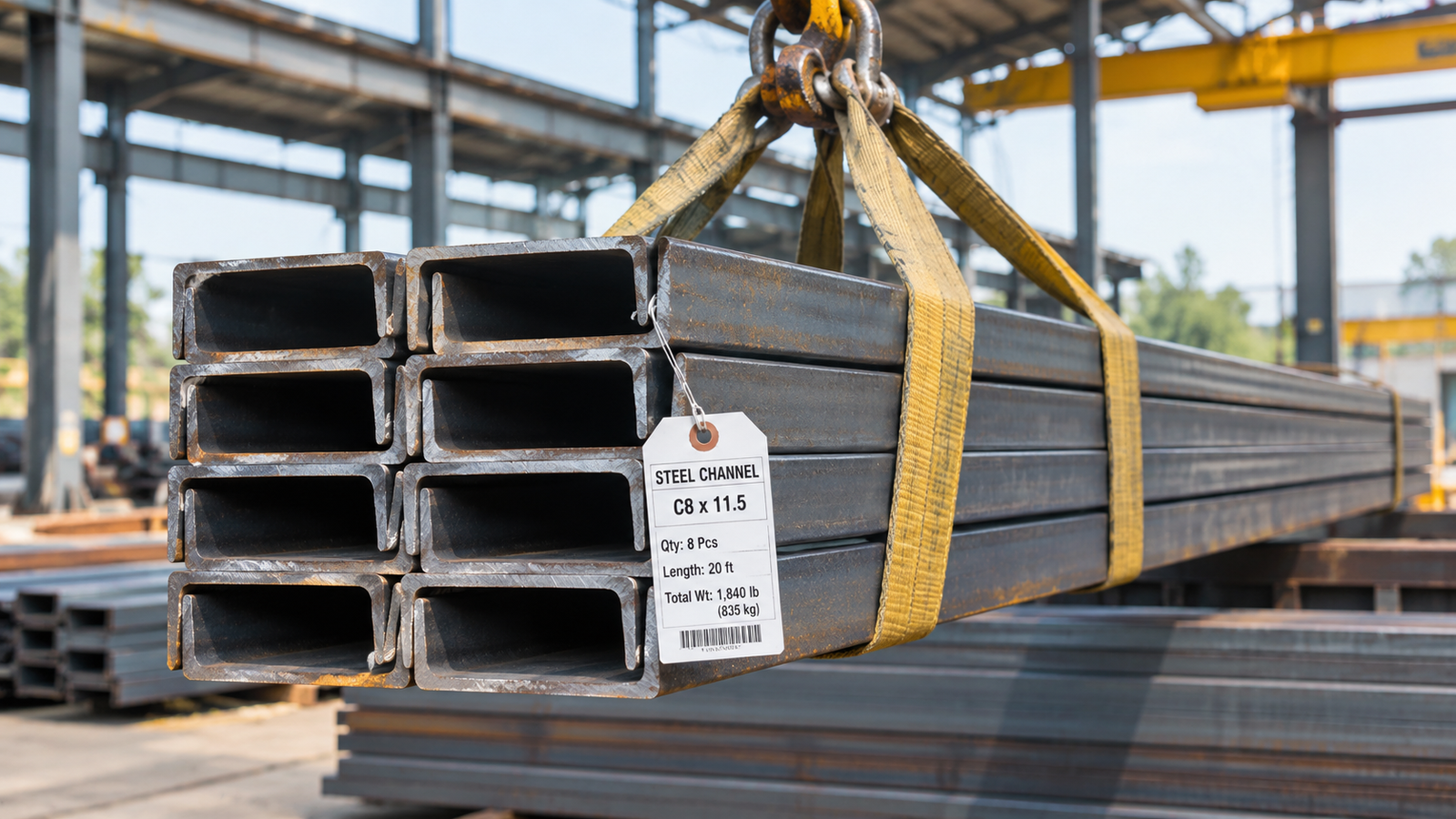
Add the nominal weights of all pieces in the bundle, then add banding and dunnage. For example, ten 20-ft C8×11.5 channels are 2,300 lb nominal.
Handling and Transport Planning
Plan trucking and handling from the heaviest piece and the full load, not from the average piece.
Nominal vs. Certified Shipping Weight
The weight on a bill of lading comes from the mill or supplier’s records, which can differ from nominal.
Lifting Plan Requirements
A lift plan needs verified weights, rigging capacity and center of gravity. Do not use a bare-channel estimate alone. The shape’s channel orientation also affects how it hangs.
Steel Channel Weight and Material Cost Estimating
Formulas with clearly hypothetical prices.
Steel channel material cost is purchased weight times the quoted price per pound, for example 2,300 lb at an assumed $0.90/lb is $2,070. That price is hypothetical, not a verified U.S. quote.
Weight-Based Material Pricing
What it means: The $0.90/lb figure is hypothetical. Real estimates need supplier quotes, freight, cutting, fabrication and taxes.
Cost per Foot vs. Cost per Pound
Cost per foot is cost per pound times lb/ft. At the same price per pound, a heavier channel costs more per foot.
Fabrication and Cutting Charges
Cutting, drilling, welding and coating are separate line items. Add them after material.
Waste and Procurement Allowances
Set allowances from the actual cutting plan, not one universal percentage.
How to Identify an Unknown Steel Channel
Measure, compare with AISC tables and know when to ask for verification.
To identify an unknown steel channel, read the drawings and material tags first, then measure overall depth, flange width and web thickness and compare them with the AISC tables. Field measurements can narrow the shape, but they may not give the grade, a historic shape series or structural suitability.
Check Drawings and Material Tags
Look for the designation, heat number and mill marks first.
Measure Overall Depth
Measure the overall depth across the web. For C8×11.5 it is 8 in.
Measure Flange Width and Web Thickness
Measure flange width and web thickness. For C8×11.5 they are about 2.26 in. and 0.220 in.
Compare With AISC Tables
Match the readings to AISC Shapes Database v16.0 values or our Steel Channel Size Chart.
When to Request Engineering Verification
Ask for verification when grade, remaining thickness or capacity matters, or when a section may be historic.
How to Specify and Order Steel Channels
A complete order description and a verification checklist.
| Required item | Example | Verification |
|---|---|---|
| Shape family | C | AISC designation |
| Full section | C8×11.5 | Drawings and schedule |
| Material grade | ASTM A572 Grade 50, if specified | Approved design and supplier |
| Quantity | 10 pieces | Material takeoff |
| Length | 20 ft each | Cut list |
| Nominal unit weight | 11.5 lb/ft | AISC table |
| Nominal channel total | 2,300 lb | Quantity calculation |
| Connections | As detailed | Fabrication drawings |
| Coating | As specified | Project requirements |
| Documentation | MTR if required | Purchase specification |
Caution: The material grade shown is an illustrative specification entry, not a claim that every C8×11.5 is supplied in that grade.
To order steel channel, give the full AISC designation, grade, quantity, length and fabrication requirements, and confirm availability. “8-inch C-channel” is not enough because one depth has several weights.
10 pieces, C8×11.5, ASTM A572 Grade 50 (if specified by the design), 20 ft each, bare, nominal weight 11.5 lb/ft, 2,300 lb total nominal, MTR required.
This is a sample format, not an approved design.
Complete AISC Shape Designation
Use the full name, for example C8×11.5.
ASTM Material Grade
Name the grade the design requires, because the shape name does not set it.
Quantity and Length
State pieces and length in feet, and say whether lengths are stock or cut.
Fabrication Requirements
List cutting, drilling, coating and tolerances.
Supplier Availability
Confirm size, grade and length with the supplier. The AISC steel availability tool shows which mills roll which shapes.
Common Steel Channel Weight Calculation Mistakes
A diagnostic list of the errors that distort channel weights.
| Error | Consequence | Correct approach |
|---|---|---|
| Using depth as weight | Incorrect quantity | Read full designation |
| Confusing C and MC | Wrong shape selected | Check AISC shape family |
| Treating lb/ft as lb/piece | Underestimated total | Multiply by length |
| Using inches as feet | Large unit error | Convert units first |
| Ignoring connections | Incomplete assembly weight | Add plates and hardware |
| Assuming exact mill weight | Procurement discrepancy | Use nominal values appropriately |
| Using cold-formed dimensions with AISC C weights | Wrong mass estimate | Use correct product standard |
| Using weight as load capacity | Unsafe design assumption | Verify structural properties and design |
The most common channel weight mistakes are unit and designation errors, such as reading C8 as a weight or multiplying by inches. Check each estimate against the list above.
Confusing Depth With Weight
In C8×11.5, 8 is the depth and 11.5 is the weight.
Using the Wrong Shape Family
C12×20.7 and MC12×10.6 are different shapes with different weights.
Incorrect Unit Conversion
Use 1 lb/ft = 1.48816394 kg/m, not 1.488 rounded twice.
Mixing Inches and Feet
20 ft is 240 in. Multiplying lb/ft by 240 gives a number twelve times too high.
Ignoring Plates and Connections
Add gussets, end plates and hardware to the channel weight.
Using Nominal Weight as Structural Capacity
Weight is for quantity. Capacity comes from section properties and design.
How to Choose the Correct Steel Channel for a Project
A practical workflow from design to procurement.
To choose a steel channel, start with the structural design, verify the section properties, confirm the grade, then estimate weight and procurement quantity and check fabrication and availability. The governing design requirements decide the shape, not weight.
- Start with the structural design. Use the design loads, spans and restraints. Quick checks are available in the beam load calculator.
- Verify section properties. Check Ix, Sx and other properties in the AISC tables, and compare with our steel beam size chart for other shapes.
- Confirm material grade. State the grade on the order.
- Estimate weight and procurement quantity. Use nominal lb/ft, lengths and quantities from this chart.
- Check fabrication and availability. Confirm the supplier has the size, grade and length. For other open shapes, see our steel angle size chart.
Start With the Structural Design
Weight is a result of the choice, not the basis for it.
Verify Section Properties
Read the AISC properties for the shape you are considering.
Confirm Material Grade
A shape name does not fix the grade.
Estimate Weight and Procurement Quantity
Use the chart, then add plates and hardware.
Check Fabrication and Availability
Ask for stock lengths and lead time before you lock the size.
Steel Channel Weight FAQs
Twenty short answers on channel designations, weights, conversions and estimating.
What does C8×11.5 mean?
C8×11.5 is an AISC American Standard Channel with a nominal depth of 8 inches and a nominal weight of 11.5 pounds per foot. The 11.5 is weight per foot, not flange width or thickness. A 20-foot piece weighs 230 lb, and you need the full section properties to judge strength.
How much does C6×8.2 weigh?
C6×8.2 weighs a nominal 8.2 lb/ft, or 12.20 kg/m. A 10-foot piece is 82 lb, a 20-foot piece is 164 lb and a 40-foot piece is 328 lb. These are bare-section theoretical weights, and actual mill weight can differ within ASTM A6/A6M limits.
What is the weight of C10×15.3?
C10×15.3 weighs a nominal 15.3 lb/ft, about 22.77 kg/m. A 20-foot piece is 306 lb. Its tabulated area is 4.48 in², which gives about 15.24 lb/ft by the area formula, and the small gap comes from rounded area values.
How much does a 20-foot C8×11.5 weigh?
A 20-foot C8×11.5 weighs a nominal 230 lb, from 11.5 lb/ft times 20 ft. In metric that is about 104.3 kg. This is the bare channel only, with no plates, hardware, coating or purchasing losses, and it is not a certified lifting weight.
What is the difference between C and MC channels?
C channels are American Standard Channels, while MC channels are Miscellaneous Channels with proportions outside the standard C series. They are separate shape families, so MC does not mean heavier. MC12×10.6 weighs 10.6 lb/ft against 20.7 lb/ft for C12×20.7 at the same 12-inch nominal depth.
What does MC12×10.6 mean?
MC12×10.6 is an AISC Miscellaneous Channel with a nominal depth of 12 inches and a nominal weight of 10.6 pounds per foot. Its area is about 3.10 in² and its flange width about 1.50 in. It is a lighter section than C12×20.7 at the same depth.
How do you calculate steel channel weight?
Multiply the nominal weight per foot by the length in feet, then by the number of pieces: W = n x w x L. For six 20-foot C8×11.5 channels, 6 x 11.5 x 20 = 1,380 lb. Add plates and hardware separately for a fabricated assembly.
How do you convert lb/ft to kg/m?
Multiply pounds per foot by 1.48816394 to get kilograms per meter. For example, C12×20.7 is 20.7 x 1.48816394 = 30.80 kg/m. To convert back, divide kg/m by 1.48816394, so 17.11 kg/m gives about 11.50 lb/ft, which matches C8×11.5.
How much does a 6-inch C-channel weigh?
It depends on the shape, because there is more than one 6-inch channel. C6×8.2 weighs 8.2 lb/ft, C6×10.5 weighs 10.5 lb/ft and C6×13 weighs 13 lb/ft. Always read the full designation before estimating weight, and do not use depth alone.
Are all 8-inch channels the same weight?
No. In the main chart, C8×11.5 weighs 11.5 lb/ft and C8×13.75 weighs 13.75 lb/ft, and AISC lists a heavier C8×18.75. MC8×8.5 and MC8×20 are 8-inch MC channels at 8.5 and 20 lb/ft. The designation, not the depth, sets the weight.
What is the density of structural steel?
ANSI/AISC 303 uses a structural steel unit weight of 490 lb/ft³, which is 7,850 kg/m³ and about 0.2836 lb/in³. It supports the area-based check w = 3.40278 x A in lb/ft. For listed shapes, still use the tabulated nominal weight as the primary value.
Does steel grade change channel weight?
No. Nominal weight per foot depends on the cross-section geometry, so C8×11.5 is 11.5 lb/ft in any grade. Grade changes specified mechanical properties and availability, so name the grade on the order, such as A572 Grade 50, if the design needs it.
How do you calculate the weight of multiple channels?
Multiply quantity, nominal weight per foot and cut length for each section, then add the results. Three lines of 4 x 12 ft C6×8.2, 6 x 15 ft C8×11.5 and 2 x 20 ft C10×15.3 give 393.6 + 1,035 + 612 = 2,040.6 lb nominal.
Are AISC channel weights exact?
They are nominal values used for estimating. AISC contract practice calculates weights from nominal weight per foot and detailed length, while mill-produced sections vary within ASTM A6/A6M limits. A scale weight or a certified shipping weight can therefore differ from the calculated figure.
What is the difference between hot-rolled and cold-formed C-channel?
Hot-rolled C channels are rolled at a mill, carry AISC C or MC names and are heavier. Cold-formed C-sections are roll-formed from sheet, often lipped, and sold under manufacturer sizes. Their weight tables and design provisions differ, so do not use AISC channel weights for a cold-formed member.
Can you determine channel load capacity from weight?
No. Weight tells you how much steel is in a section, not how it behaves under load. C7×9.8 weighs less than C6×10.5 but has the larger strong-axis Ix. Capacity depends on section properties, restraints, loading and ANSI/AISC 360 design provisions.
How do you identify an unknown channel?
Check drawings and material tags first, then measure overall depth, flange width and web thickness, and compare them with AISC tables. For C8×11.5, those are about 8 in., 2.26 in. and 0.220 in. Measurements may not reveal the grade, so ask for verification where it matters.
What is the difference between C-channel and U-channel?
The names are often used loosely. In structural steel, C-channel normally means an AISC hot-rolled C or MC shape with a nominal weight in its name. U-channel is a trade term for various sections, including cold-formed ones, so confirm the product standard and weight table before you estimate.
Does galvanizing affect finished weight?
Yes, a zinc coating adds weight to the bare section. The amount depends on the coating specification, the surface area and the process, so this page gives no percentage. Add the coating weight from the galvanizer or specification when you need a finished or shipping weight.
How do you calculate the weight of a fabricated channel assembly?
Add the nominal channel weight to the weight of added material such as plates, stiffeners, bolts, weld metal and coating, then subtract any removed material: W = channels + added − removed. For example, 2,040.6 + 120 + 15 − 8 = 2,167.6 lb. This is not a certified lifting weight.
This steel channel weight chart gives nominal lb/ft and kg/m for selected AISC C and MC channels, with length-based weights and a worked takeoff. Use the AISC nominal weight for estimating, then confirm the exact shape, grade, length and any added components with your supplier and the approved design. For dimensions and properties, see our Steel Channel Size Chart, and for other shapes use our Structural Steel Weight Chart.
Download Steel Channel Weight Chart PDF
Use your browser’s print function to save this page as a print-ready PDF for the estimating folder, shop or purchasing file. Interactive tools and image placeholders are hidden in the printed version.
Sources and References
Standards and reference tables used for this chart.
- AISC Shapes Database v16.0: C and MC designations, nominal weights, areas and dimensions. The database is a free Excel download, and values here were checked against published tables that cite it.
- AISC Steel Construction Manual, 16th Edition: section properties and shape context.
- AISC naming convention for structural steel products: formal C and MC designation meanings (Section 3).
- ANSI/AISC 303-22: structural steel unit weight of 490 lb/ft³ and nominal-weight practice (Section 9.2).
- ASTM A6/A6M, with AISC’s explanation in the AISC engineering FAQ on mill production and tolerances.
- ANSI/AISC 360-22: design strength, stability and load capacity.
- AISC steel availability tool: producers and grades for shapes.
- AISC SteelWise on specifying materials: historical 2012 guidance on specifying materials.
Weights are nominal reference values. Confirm current editions, supplier availability, grade and the approved design before purchase or fabrication.