Steel Angle Weight Chart: Equal & Unequal Angles
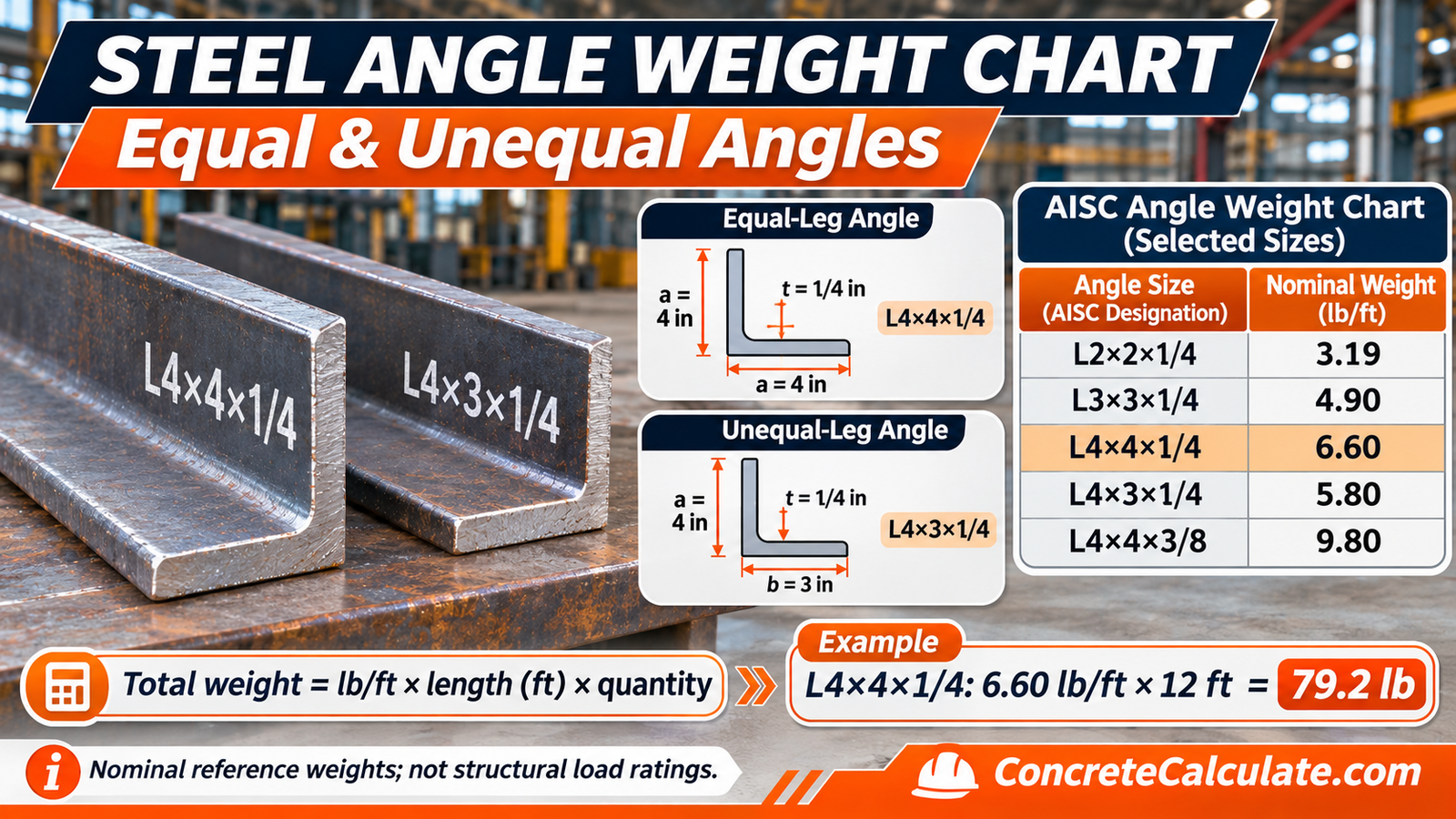
Nominal weight in lb/ft and kg/m for equal-leg and unequal-leg structural steel angles, with stock-length weights, thickness comparisons, and weight formulas.
 Reviewed by Muhammad Ramzan Babar, PhD Researcher (Plasma Physics) & Calculator Developer. View Profile
⭐ Steel Angle Weight Chart
A steel angle weight chart lists the AISC nominal weight per foot of standard L shapes, such as 6.60 lb/ft for an L4×4×1/4 and 4.90 lb/ft for an L3×3×1/4. Multiply lb/ft by length and quantity for total nominal weight, and multiply lb/ft by 1.488164 for kg/m.
Equal-Leg Angle Weights
| AISC angle size | Leg dimensions (in.) | Thickness (in.) | Nominal weight (lb/ft) | Approx. mass (kg/m) |
|---|---|---|---|---|
| L2×2×1/8 | 2 × 2 in. | 0.125 in. | 1.65 | 2.46 |
| L2×2×3/16 | 2 × 2 in. | 0.1875 in. | 2.44 | 3.63 |
| L2×2×1/4 | 2 × 2 in. | 0.250 in. | 3.19 | 4.75 |
| L2½×2½×1/4 | 2.5 × 2.5 in. | 0.250 in. | 4.10 | 6.10 |
| L2½×2½×3/8 | 2.5 × 2.5 in. | 0.375 in. | 5.90 | 8.78 |
| L3×3×3/16 | 3 × 3 in. | 0.1875 in. | 3.71 | 5.52 |
| L3×3×1/4 | 3 × 3 in. | 0.250 in. | 4.90 | 7.29 |
| L3×3×3/8 | 3 × 3 in. | 0.375 in. | 7.20 | 10.71 |
| L3×3×1/2 | 3 × 3 in. | 0.500 in. | 9.40 | 13.99 |
| L3½×3½×1/4 | 3.5 × 3.5 in. | 0.250 in. | 5.80 | 8.63 |
| L4×4×1/4 | 4 × 4 in. | 0.250 in. | 6.60 | 9.82 |
| L4×4×3/8 | 4 × 4 in. | 0.375 in. | 9.80 | 14.58 |
| L4×4×1/2 | 4 × 4 in. | 0.500 in. | 12.80 | 19.05 |
| L5×5×3/8 | 5 × 5 in. | 0.375 in. | 12.30 | 18.30 |
| L5×5×1/2 | 5 × 5 in. | 0.500 in. | 16.20 | 24.11 |
| L6×6×3/8 | 6 × 6 in. | 0.375 in. | 14.90 | 22.17 |
| L6×6×1/2 | 6 × 6 in. | 0.500 in. | 19.60 | 29.17 |
| L6×6×5/8 | 6 × 6 in. | 0.625 in. | 24.20 | 36.01 |
| L8×8×1/2 | 8 × 8 in. | 0.500 in. | 26.40 | 39.29 |
| L8×8×3/4 | 8 × 8 in. | 0.750 in. | 38.90 | 57.89 |
Source: nominal weights from the AISC Shapes Database v16.0 (consistent with the 16th Edition AISC Steel Construction Manual). kg/m is calculated as lb/ft × 1.488164 and rounded to two decimals.
✓ Checked against AISC Shapes Database v16.0 nominal weights, as published in AISC-derived shape catalogs, November 2026Nominal weights only
The weights above are nominal AISC reference weights for hot-rolled structural angles. Delivered weights can differ within product tolerances, dimensions and weight do not establish structural capacity, and a listed size is not a guarantee of supplier stock.
AISC Standard L Shapes
AISC lists both equal-leg and unequal-leg L shapes. This page owns the weights; for full leg geometry and section properties, see the Steel Angle Size Chart.
Unequal-Leg Angle Weights
Unequal-leg angles have their own table in Section 4.
lb/ft and kg/m
U.S. practice quotes pounds per foot and SI quotes kilograms per meter. Conversions are in Section 8.
How to Use the Chart
- Read the designation: two leg sizes, then thickness.
- Find that exact row and read lb/ft.
- Multiply by the detailed length in feet, then by the quantity.
How to Read Steel Angle Sizes
An AISC angle designation lists two nominal leg dimensions and then the nominal thickness, so L4×4×1/4 means two 4 in. legs, 1/4 in. thick, not 1/4 lb/ft.
| Part of the name | Example value | What it means |
|---|---|---|
| L | L | Angle (L-shaped) section |
| First number | 4 | First leg, nominal 4 in. |
| Second number | 4 | Second leg, nominal 4 in. |
| Last number | 1/4 | Nominal thickness, 1/4 in. (0.250 in.) |
| Weight | Not in the name | Look it up: 6.60 lb/ft for L4×4×1/4 |
Designation convention from the AISC Steel Construction Manual and AISC Shapes Database v16.0.
✓ Checked against AISC Shapes Database v16.0 nominal weights, as published in AISC-derived shape catalogs, November 2026Leg Dimensions
Legs are the two flat sides of the L. Equal-leg angles have matching legs and unequal-leg angles do not, for example L4×3×1/4.
Thickness
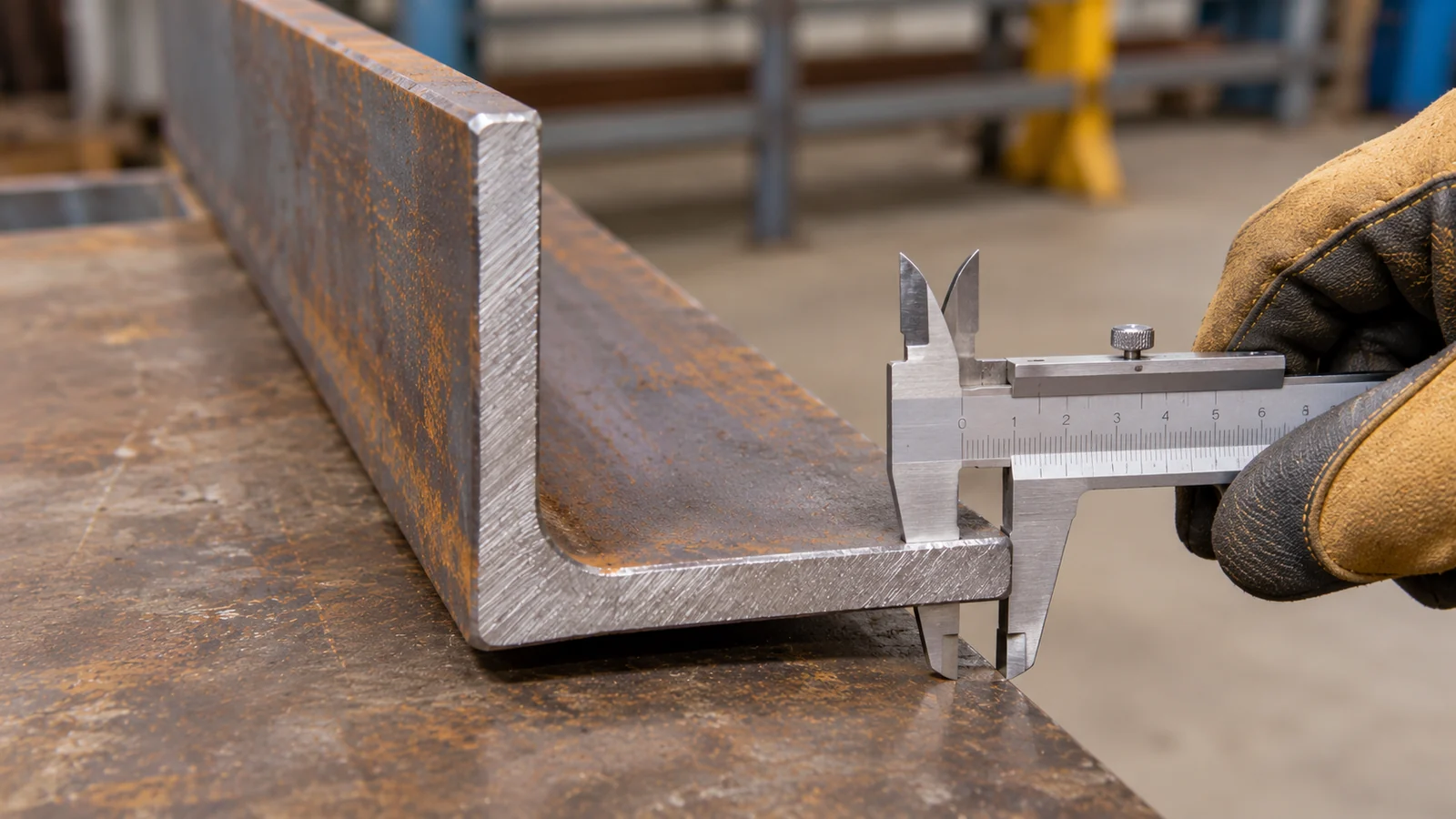
The last number is nominal thickness. Rolled thickness varies within tolerance, so it is not an exact measurement at every point. See Section 20.
AISC L Designations
Weight is never part of the angle name. For W-shapes and channels the second number is weight, but for angles you must use the table. Terminology across shapes is covered in the Structural Steel Shapes Chart.
⭐ Equal-Leg Steel Angle Weight Chart
Equal-leg angles have two identical legs, and this extended table adds the other common AISC equal-leg sizes not shown in the main chart.
Small Angles
| AISC angle size | Leg dimensions (in.) | Thickness (in.) | Nominal weight (lb/ft) | Approx. mass (kg/m) |
|---|---|---|---|---|
| L2×2×5/16 | 2 × 2 in. | 0.3125 in. | 3.92 | 5.83 |
| L2×2×3/8 | 2 × 2 in. | 0.375 in. | 4.70 | 6.99 |
| L2½×2½×3/16 | 2.5 × 2.5 in. | 0.1875 in. | 3.07 | 4.57 |
| L2½×2½×5/16 | 2.5 × 2.5 in. | 0.3125 in. | 5.00 | 7.44 |
| L2½×2½×1/2 | 2.5 × 2.5 in. | 0.500 in. | 7.70 | 11.46 |
| L3×3×5/16 | 3 × 3 in. | 0.3125 in. | 6.10 | 9.08 |
| L3×3×7/16 | 3 × 3 in. | 0.4375 in. | 8.30 | 12.35 |
Sizes not already shown in the main chart in Section 1.
✓ Checked against AISC Shapes Database v16.0 nominal weights, as published in AISC-derived shape catalogs, November 2026Medium Angles
| AISC angle size | Leg dimensions (in.) | Thickness (in.) | Nominal weight (lb/ft) | Approx. mass (kg/m) |
|---|---|---|---|---|
| L3½×3½×5/16 | 3.5 × 3.5 in. | 0.3125 in. | 7.20 | 10.71 |
| L3½×3½×3/8 | 3.5 × 3.5 in. | 0.375 in. | 8.50 | 12.65 |
| L3½×3½×7/16 | 3.5 × 3.5 in. | 0.4375 in. | 9.80 | 14.58 |
| L3½×3½×1/2 | 3.5 × 3.5 in. | 0.500 in. | 11.10 | 16.52 |
| L4×4×5/16 | 4 × 4 in. | 0.3125 in. | 8.20 | 12.20 |
| L4×4×7/16 | 4 × 4 in. | 0.4375 in. | 11.30 | 16.82 |
| L4×4×5/8 | 4 × 4 in. | 0.625 in. | 15.70 | 23.36 |
| L4×4×3/4 | 4 × 4 in. | 0.750 in. | 18.50 | 27.53 |
| L5×5×5/16 | 5 × 5 in. | 0.3125 in. | 10.30 | 15.33 |
| L5×5×7/16 | 5 × 5 in. | 0.4375 in. | 14.30 | 21.28 |
| L5×5×5/8 | 5 × 5 in. | 0.625 in. | 20.00 | 29.76 |
| L5×5×3/4 | 5 × 5 in. | 0.750 in. | 23.60 | 35.12 |
| L5×5×7/8 | 5 × 5 in. | 0.875 in. | 27.20 | 40.48 |
Large Structural Angles
| AISC angle size | Leg dimensions (in.) | Thickness (in.) | Nominal weight (lb/ft) | Approx. mass (kg/m) |
|---|---|---|---|---|
| L6×6×5/16 | 6 × 6 in. | 0.3125 in. | 12.40 | 18.45 |
| L6×6×7/16 | 6 × 6 in. | 0.4375 in. | 17.20 | 25.60 |
| L6×6×9/16 | 6 × 6 in. | 0.5625 in. | 21.90 | 32.59 |
| L6×6×3/4 | 6 × 6 in. | 0.750 in. | 28.70 | 42.71 |
| L6×6×7/8 | 6 × 6 in. | 0.875 in. | 33.10 | 49.26 |
| L6×6×1 | 6 × 6 in. | 1.000 in. | 37.40 | 55.66 |
| L8×8×9/16 | 8 × 8 in. | 0.5625 in. | 29.60 | 44.05 |
| L8×8×5/8 | 8 × 8 in. | 0.625 in. | 32.70 | 48.66 |
| L8×8×7/8 | 8 × 8 in. | 0.875 in. | 45.00 | 66.97 |
| L8×8×1 | 8 × 8 in. | 1.000 in. | 51.00 | 75.90 |
| L8×8×1-1/8 | 8 × 8 in. | 1.125 in. | 56.90 | 84.68 |
Source: nominal weights from the AISC Shapes Database v16.0. kg/m calculated as lb/ft × 1.488164. Larger sizes exist; use the full database for L10 and L12 angles.
✓ Checked against AISC Shapes Database v16.0 nominal weights, as published in AISC-derived shape catalogs, November 2026⭐ Unequal-Leg Steel Angle Weight Chart
Unequal-leg angles have two different leg lengths, such as L4×3×1/4 at 5.80 lb/ft, and need their own weight lookup.
Common Unequal-Leg Combinations
| AISC angle size | Leg dimensions (in.) | Thickness (in.) | Nominal weight (lb/ft) | Approx. mass (kg/m) |
|---|---|---|---|---|
| L2½×1½×1/4 | 2.5 × 1.5 in. | 1/4 in. | 3.19 | 4.75 |
| L3×2×3/16 | 3 × 2 in. | 3/16 in. | 3.07 | 4.57 |
| L3×2×1/4 | 3 × 2 in. | 1/4 in. | 4.10 | 6.10 |
| L3×2×3/8 | 3 × 2 in. | 3/8 in. | 5.90 | 8.78 |
| L3½×2½×1/4 | 3.5 × 2.5 in. | 1/4 in. | 4.90 | 7.29 |
| L4×3×1/4 | 4 × 3 in. | 1/4 in. | 5.80 | 8.63 |
| L4×3×5/16 | 4 × 3 in. | 5/16 in. | 7.20 | 10.71 |
| L4×3×3/8 | 4 × 3 in. | 3/8 in. | 8.50 | 12.65 |
| L4×3×1/2 | 4 × 3 in. | 1/2 in. | 11.10 | 16.52 |
| L5×3×1/4 | 5 × 3 in. | 1/4 in. | 6.60 | 9.82 |
| L5×3×3/8 | 5 × 3 in. | 3/8 in. | 9.80 | 14.58 |
| L5×3×1/2 | 5 × 3 in. | 1/2 in. | 12.80 | 19.05 |
| L6×4×5/16 | 6 × 4 in. | 5/16 in. | 10.30 | 15.33 |
| L6×4×3/8 | 6 × 4 in. | 3/8 in. | 12.30 | 18.30 |
| L6×4×1/2 | 6 × 4 in. | 1/2 in. | 16.20 | 24.11 |
| L6×4×5/8 | 6 × 4 in. | 5/8 in. | 20.00 | 29.76 |
Source: nominal weights from the AISC Shapes Database v16.0. kg/m calculated as lb/ft × 1.488164 and rounded to two decimals.
✓ Checked against AISC Shapes Database v16.0 nominal weights, as published in AISC-derived shape catalogs, November 2026Nominal Weight Comparison
Differences in leg dimensions change weight and geometry. An L4×3×1/4 (5.80 lb/ft) and an L3½×3½×1/4 (5.80 lb/ft) weigh the same but are not structurally interchangeable: leg arrangement, centroid, principal axes, and buckling behavior differ. See Steel Angle Size Chart for geometry.
Common Steel Angle Weights by Size
The most searched angle iron sizes weigh 3.19 lb/ft for 2×2×1/4, 4.90 lb/ft for 3×3×1/4, and 6.60 lb/ft for 4×4×1/4 (AISC nominal).
| AISC angle size | Nominal weight (lb/ft) | Approx. mass (kg/m) | 12 ft piece (lb) |
|---|---|---|---|
| L2×2×1/4 | 3.19 | 4.75 | 38.3 |
| L3×3×1/4 | 4.90 | 7.29 | 58.8 |
| L4×4×1/4 | 6.60 | 9.82 | 79.2 |
| L4×4×3/8 | 9.80 | 14.58 | 117.6 |
| L6×4×3/8 | 12.30 | 18.30 | 147.6 |
| L6×6×1/2 | 19.60 | 29.17 | 235.2 |
12 ft piece = lb/ft × 12 (calculated).
✓ Checked against AISC Shapes Database v16.0 nominal weights, as published in AISC-derived shape catalogs, November 20262×2×1/4
3.19 lb/ft (4.75 kg/m), so 38.28 lb for 12 ft.
3×3×1/4
4.90 lb/ft (7.29 kg/m), so 58.80 lb for 12 ft.
4×4×1/4
6.60 lb/ft (9.82 kg/m), so 79.20 lb for 12 ft.
4×4×3/8
9.80 lb/ft (14.58 kg/m), so 117.60 lb for 12 ft.
6×4×3/8
12.30 lb/ft (18.30 kg/m), so 147.60 lb for 12 ft. This is an unequal-leg angle (6 in. and 4 in. legs).
⭐ Steel Angle Weight by Thickness
Doubling a 4×4 angle from 1/4 in. to 1/2 in. thickness raises nominal weight from 6.60 to 12.80 lb/ft, about 94 percent.
| Angle size | Thickness (in.) | AISC nominal weight (lb/ft) | 20 ft nominal weight (lb) | Increase vs. 1/4 in. (%) |
|---|---|---|---|---|
| L4×4×1/4 | 0.250 in. | 6.60 | 132 | 0 (baseline) |
| L4×4×5/16 | 0.3125 in. | 8.20 | 164 | +24.2 |
| L4×4×3/8 | 0.375 in. | 9.80 | 196 | +48.5 |
| L4×4×1/2 | 0.500 in. | 12.80 | 256 | +93.9 |
| L4×4×5/8 | 0.625 in. | 15.70 | 314 | +137.9 |
| L4×4×3/4 | 0.750 in. | 18.50 | 370 | +180.3 |
20 ft weight and percentage increase are calculated from AISC nominal lb/ft.
✓ Checked against AISC Shapes Database v16.0 nominal weights, as published in AISC-derived shape catalogs, November 2026From 1/4 in. to 3/8 in. thickness the nominal weight rises by (9.8 – 6.6) ÷ 6.6 × 100 ≈ 48.5 percent. That does not mean structural capacity rises by 48.5 percent.
Thin and Heavy Thicknesses
Standard AISC angles run from 1/8 in. (L2×2×1/8 at 1.65 lb/ft) to over 1 in. in large sizes. See the extended tables in Section 3.
⭐ Steel Angle Weight by Length
Steel angle weight equals lb/ft times length, so an L4×4×1/4 weighs 66.00 lb at 10 ft and 132.00 lb at 20 ft.
| AISC size | lb/ft | 10 ft (lb) | 12 ft (lb) | 20 ft (lb) | 24 ft (lb) |
|---|---|---|---|---|---|
| L2×2×1/4 | 3.19 | 31.90 | 38.28 | 63.80 | 76.56 |
| L3×3×1/4 | 4.90 | 49.00 | 58.80 | 98.00 | 117.60 |
| L4×3×1/4 | 5.80 | 58.00 | 69.60 | 116.00 | 139.20 |
| L4×4×1/4 | 6.60 | 66.00 | 79.20 | 132.00 | 158.40 |
| L4×4×3/8 | 9.80 | 98.00 | 117.60 | 196.00 | 235.20 |
| L6×4×3/8 | 12.30 | 123.00 | 147.60 | 246.00 | 295.20 |
| L6×6×1/2 | 19.60 | 196.00 | 235.20 | 392.00 | 470.40 |
Calculated as lb/ft × length. These are estimating examples, not confirmation that a supplier stocks each section in each length. Stock lengths vary by supplier, shape, region, mill, and ordering arrangement.
✓ Calculated from AISC nominal weights, arithmetic checked, November 202610 Feet
L4×4×1/4: 6.60 × 10 = 66.00 lb.
12 Feet
L4×4×1/4: 6.60 × 12 = 79.20 lb.
20 Feet
L4×4×1/4: 6.60 × 20 = 132.00 lb.
24 Feet
L4×4×1/4: 6.60 × 24 = 158.40 lb. Distinguish calculated lengths from actual stocked bar lengths.
Steel Angle Weight in lb/ft vs. kg/m
Multiply AISC lb/ft by 1.488164 to get kg/m, so 9.8 lb/ft for an L4×4×3/8 becomes 14.58 kg/m.
| Conversion | Factor |
|---|---|
| lb/ft → kg/m | × 1.488164 |
| kg/m → lb/ft | × 0.671969 |
| lb → kg | × 0.45359237 |
| kg → lb | × 2.204623 |
| ft → m | × 0.3048 |
| in. → mm | × 25.4 |
| Short ton (US) → lb | × 2,000 |
| Metric tonne → lb | × 2,204.62 |
Mathematical unit conversions, not manufacturer data.
✓ Conversion factors checked, November 2026Convert L4×4×3/8 from lb/ft to kg/m
Under SI terminology kg/m is mass per length, while lb/ft is conventionally called weight per length in U.S. practice. Do not confuse kilograms with force units, and do not confuse kg/m with kg/ft.
⭐ How to Calculate Steel Angle Weight
Steel angle weight equals AISC lb/ft times length in feet times quantity, so six 20 ft L3×3×1/4 angles weigh 588 lb nominal.
Unit Weight × Length
W = w × L where W is nominal weight (lb), w is AISC nominal weight (lb/ft), and L is detailed member length (ft). This is the preferred method for standard rolled shapes.
Multiple Pieces
W_total = w × L × N where N is the number of identical pieces.
Weight of six 20 ft L3×3×1/4 angles
This is the nominal angle-material estimate only. It is not the weight of the complete installed assembly.
Mixed-Size Assemblies
For a project with several sizes, sum the individual results: W_project = Σ (w_i × L_i × N_i).
| AISC size | Length per piece (ft) | Quantity | lb/ft | Subtotal (lb) |
|---|---|---|---|---|
| L3×3×1/4 | 6 | 8 | 4.90 | 235.2 |
| L4×4×3/8 | 10 | 4 | 9.80 | 392.0 |
| L6×4×3/8 | 5 | 2 | 12.30 | 123.0 |
| Total | 750.2 |
Nominal weight of the angle pieces only. Excludes connection material, coatings, and fabricated assemblies.
✓ Calculated from AISC nominal weights, arithmetic checked, November 2026Use the Structural Steel Weight Chart to compare angle totals with other structural shapes. Keep all lengths in feet before multiplying by lb/ft.
Steel Angle Cross-Sectional Area Formula
The simplified L-angle area is A = t(a + b – t), which counts the corner overlap once and gives 1.4375 in² for an L3×3×1/4.
Two-Rectangle Model
The model treats the angle as two rectangular legs of length a and b, both with thickness t. Variables: a and b are outside leg dimensions (in.), t is uniform thickness (in.), A is area (in²).
Overlapping Thickness
The corner square (t × t) belongs to both rectangles, so subtract it once: that is the “- t” term.
Heel/Root Fillets
Real rolled angles have a root fillet at the inside corner and rounded toes that the model ignores.
Simplified area of an L3×3×1/4
Agreement for this size does not prove the formula reproduces every rolled profile exactly.
Approximate weight per foot of an L3×3×1/4
Use the AISC value for catalog angles. Use the approximation for teaching, sanity checks, and preliminary estimates of custom profiles.
⭐ Theoretical Weight vs. AISC Nominal Weight
For standard catalog angles, AISC nominal weight controls, and a simplified geometric estimate usually lands within about 1 percent but is not exact.
| AISC angle size | A_approx (in²) | Approx. weight (lb/ft) | AISC nominal (lb/ft) | Difference (%) |
|---|---|---|---|---|
| L2×2×1/4 | 0.9375 | 3.19 | 3.19 | +0.00 |
| L3×3×1/4 | 1.4375 | 4.89 | 4.90 | -0.17 |
| L4×4×1/4 | 1.9375 | 6.59 | 6.60 | -0.11 |
| L4×4×3/8 | 2.8594 | 9.73 | 9.80 | -0.72 |
| L4×4×1/2 | 3.7500 | 12.76 | 12.80 | -0.31 |
| L6×6×1/2 | 5.7500 | 19.57 | 19.60 | -0.17 |
| L8×8×1/2 | 7.7500 | 26.37 | 26.40 | -0.11 |
Approximate weight = 3.40278 × t(a + b – t). AISC values are the controlling numbers. Differences are small here but not guaranteed for every shape.
✓ Calculated from AISC nominal weights, arithmetic checked, November 2026Published Shape Weights vs. Simplified Estimates
AISC tabulated weights include the rolled profile and the published conventions. ANSI/AISC 303-22 Section 9.2.1 sets the unit weight of steel at 490 lb/ft³ (7,800 kg/m³), and many calculators use 7,850 kg/m³ instead.
Density assumptions differ
The 0.00785 and 0.0078 factors give slightly different kg/m. Use AISC lb/ft converted to kg/m for the chart and label any geometry-based metric estimate with the density used.
Metric Approximation
Metric approximation for an L3×3×1/4
Do not mix density assumptions inside one chart. For an AISC-based chart, convert the published lb/ft values directly to kg/m.
Worked Steel Angle Weight Examples
Three worked examples show the single-piece weight, a thickness comparison, and the gap between cut weight and purchased weight.
One angle and four angles: L4×4×1/4, 12 ft
This is a nominal material estimate. It excludes connection plates, bolts, nuts, weld metal, coatings, and other separate assemblies.
Weight difference between two thicknesses
This is only a weight difference. It does not show that one angle can replace the other structurally.
Cut length vs. purchased length
The 58.8 lb difference is offcut. Stock lengths are an assumption here, not a statement of availability. ANSI/AISC 303-22 weight rules for contracts use the overall length of the shape from which parts are cut when the remnant is not usable.
Equal-Leg vs. Unequal-Leg Angle Weight
Equal-leg and unequal-leg angles can share the same nominal lb/ft, for example 6.60 lb/ft for both L4×4×1/4 and L5×3×1/4, yet they are different shapes.
| AISC angle size | Legs (in.) | Thickness (in.) | Nominal weight (lb/ft) | Type |
|---|---|---|---|---|
| L4×4×1/4 | 4 × 4 | 1/4 | 6.60 | Equal-leg |
| L5×3×1/4 | 5 × 3 | 1/4 | 6.60 | Unequal-leg |
| L4×3×1/4 | 4 × 3 | 1/4 | 5.80 | Unequal-leg |
| L3½×3½×1/4 | 3.5 × 3.5 | 1/4 | 5.80 | Equal-leg |
Two pairs of angles share a nominal weight but not their geometry.
✓ Checked against AISC Shapes Database v16.0 nominal weights, as published in AISC-derived shape catalogs, November 2026Leg Size Effects
A longer leg adds area, and area drives weight. Matching weight is a coincidence of area, not equivalence of the shapes.
Why Weight Alone Is Not Enough for Substitution
Leg arrangement, connection geometry, centroid, principal axes, moment of inertia, and buckling behavior differ. Compare section properties in the Steel Angle Size Chart before substituting.
How Leg Size and Thickness Affect Weight
At 1/4 in. thickness each extra 1/2 in. of both legs adds roughly 0.8 to 0.9 lb/ft, while thickness at fixed legs adds more per step (see Section 6).
| AISC angle size | Legs (in.) | Nominal weight (lb/ft) | Change vs. previous size (lb/ft) |
|---|---|---|---|
| L2×2×1/4 | 2 × 2 | 3.19 | – |
| L2½×2½×1/4 | 2.5 × 2.5 | 4.10 | +0.91 |
| L3×3×1/4 | 3 × 3 | 4.90 | +0.80 |
| L3½×3½×1/4 | 3.5 × 3.5 | 5.80 | +0.90 |
| L4×4×1/4 | 4 × 4 | 6.60 | +0.80 |
Change column calculated from AISC nominal weights.
✓ Calculated from AISC nominal weights, arithmetic checked, November 2026Cross-Sectional Area
Weight rises with area. Thickness changes area quickly because it enters the area formula as t(a + b – t).
Section Properties and Selection Limits
Weight increases do not map one-to-one to stiffness or strength. Structural selection needs the full AISC section properties.
Single vs. Double-Angle Weight
A double-angle member of two identical angles weighs twice the single angle, so two L4×4×3/8 weigh 19.6 lb/ft before connection material.
| Single AISC angle | Single weight (lb/ft) | Double angle 2L (lb/ft) | 12 ft double angle (lb) |
|---|---|---|---|
| L3×3×1/4 | 4.90 | 9.80 | 117.6 |
| L4×4×3/8 | 9.80 | 19.60 | 235.2 |
| L4×4×1/2 | 12.80 | 25.60 | 307.2 |
Double-angle nominal weight is 2 × single angle weight, excluding spacer plates, gussets, bolts, and welds. AISC lists 2L4×4×1/2 at 25.6 lb/ft.
✓ Calculated from AISC nominal weights, arithmetic checked, November 20262L Notation
AISC writes double angles as 2L followed by the single-angle size. Connection arrangement (long legs back to back or short legs back to back) changes properties but not the pair’s nominal weight.
Weight of a 12 ft double angle
Excludes bolts, spacer plates, gusset plates, and welds. Do not infer AISC double-angle section properties from this arithmetic sum.
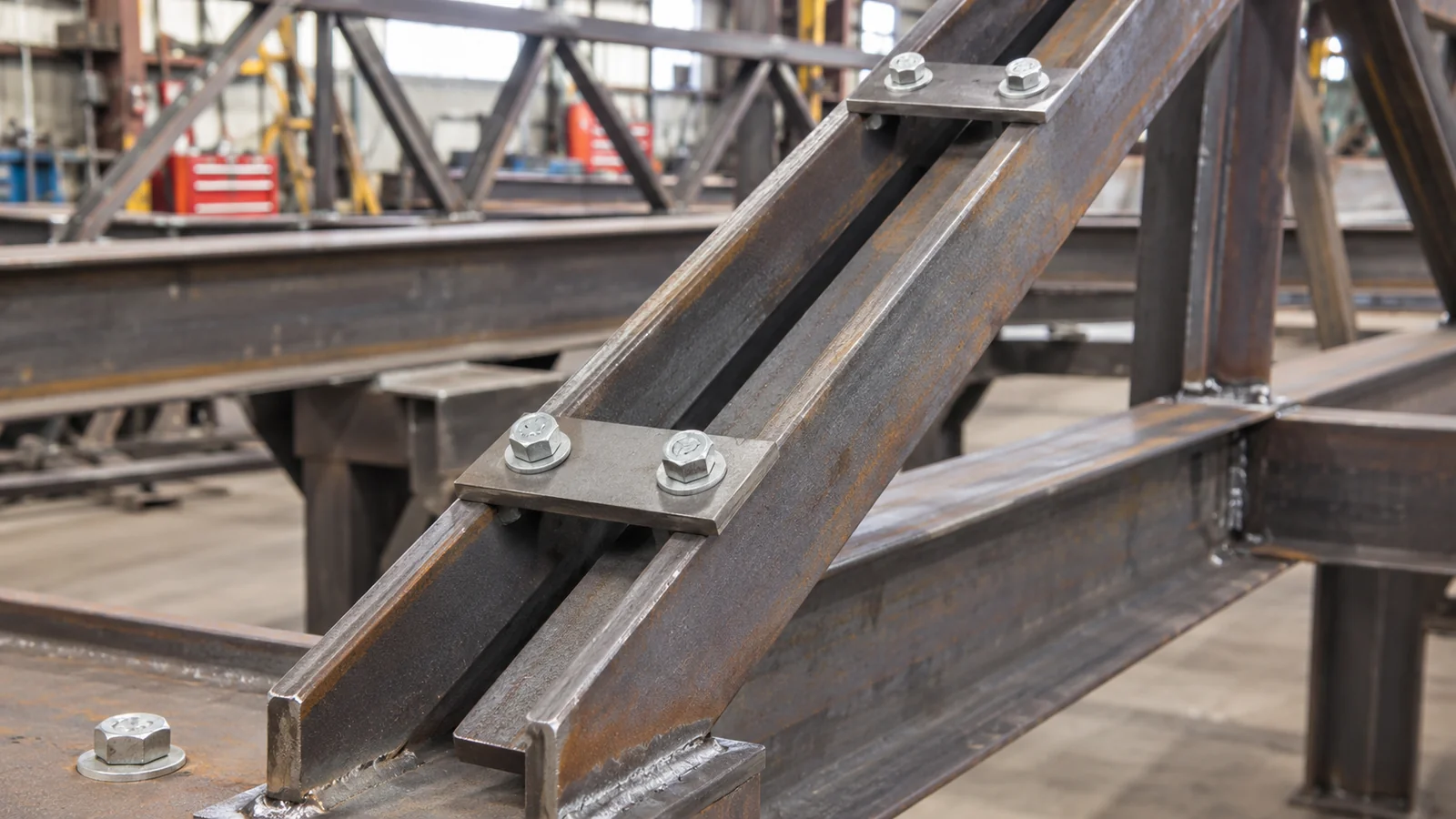
⭐ Steel Angle Weight vs. Structural Capacity
A heavier angle is not automatically stronger or an approved substitute, because capacity depends on geometry, orientation, connection, and buckling, not on lb/ft alone.
| Property | Why it matters |
|---|---|
| Leg arrangement and orientation | Which leg is vertical changes bending behavior |
| Centroid location | Sets load eccentricity and connection geometry |
| Principal axes | Angles bend and buckle about inclined principal axes |
| Moment of inertia | Controls stiffness |
| Radius of gyration | Controls buckling slenderness |
| Connection eccentricity | Single-angle connections load the member off-center |
| Buckling behavior | Compression capacity depends on length and restraint |
Properties are tabulated in the AISC Shapes Database v16.0 and used with the AISC Steel Construction Manual design provisions.
Weight is a quantity, not a design value
Two angles with nearly identical weights can have different leg dimensions, centroids, and buckling resistance. Engineering design requires the applicable AISC specification and full section properties.
Axial Force, Bending, and Connections
Axial and bending checks use section properties. Connection eccentricity can change the effective load on a single angle. Structural design is outside this chart.
Steel Angle Weight vs. Material Grade
ASTM A36 and A572 angles of the same designation have the same AISC nominal weight, because the table follows geometry and a reference steel density, not yield strength.
| Grade | Minimum yield strength | Effect on AISC nominal lb/ft |
|---|---|---|
| ASTM A36 | 36 ksi | None: weight follows the shape geometry |
| ASTM A572 Grade 50 | 50 ksi | None: weight follows the shape geometry |
ASTM A36/A36M covers carbon structural steel; other qualifying structural steels, including ASTM A572, can also be used for L shapes. Minimum yield values are standard published grade values; confirm with the supplier mill test report.
Density vs. Strength
Grade controls strength and other mechanical properties. It does not change the nominal catalog weight. Do not assume a lower-yield grade weighs more. For procurement, confirm the specified grade, since the wrong steel grade in a purchase order is a common mistake.
Hot-Rolled vs. Cold-Formed Angle Weight
The AISC angle weights apply to hot-rolled structural L shapes, not to brake-formed or cold-formed angles, which follow manufacturer dimensions.
| Feature | Hot-rolled structural angle (AISC L) | Cold-formed or brake-formed angle |
|---|---|---|
| Typical use | Structural framing, bracing, lintels, supports | Light framing, trim, brackets, formed shapes |
| Corner geometry | Rolled root fillet and rounded toes | Bent corner with a manufacturer-specific radius |
| Weight source | AISC nominal lb/ft | Manufacturer data or calculation from gauge and legs |
| Thickness | Standard rolled thicknesses | Sheet or plate gauge thickness |
| Can the AISC chart be used? | Yes for standard L shapes | No, unless the product is a listed AISC shape |
General distinctions. Confirm dimensions, tolerances, and weight with the product data for any formed angle.
Corner Geometry and Source Differences
A formed angle with the same nominal leg sizes can weigh differently because its corner radius, thickness, and tolerance rules differ. Use the product data sheet and identify the source of every weight.
Galvanized, Stainless and Aluminum Angle Weights
Stainless is about 1 to 2 percent denser than carbon steel and aluminum is about one third as dense, so the carbon-steel AISC chart should not be applied to them directly.
| Material | Typical density | Relative to carbon steel | Use the AISC carbon-steel chart? |
|---|---|---|---|
| Carbon structural steel (AISC) | 490 lb/ft³ (7,800 kg/m³ per ANSI/AISC 303-22) | Baseline | Yes, for standard L shapes |
| Stainless steel, such as 304 | about 7,930 kg/m³ (0.286 lb/in³), grade dependent | roughly 1 to 2 percent higher | No: use manufacturer weights |
| Aluminum | about 2,700 kg/m³ (0.0975 lb/in³), alloy dependent | about one third | No: use manufacturer weights |
| Galvanized steel | Carbon steel plus zinc coating | Higher by an amount that varies | Bare-steel baseline only |
Typical published engineering densities; confirm with the supplier or mill data. Do not mix density assumptions in one chart.
✓ Typical engineering densities, confirm with supplier dataGalvanized Steel Angle Weight
Zinc coating adds mass, but there is no single percentage increase. ASTM A123/A123M coating requirements vary with the steel category and thickness, and actual added weight depends on the section size, surface area, and process. Use the AISC value as the bare-steel baseline and the galvanizer or supplier data for delivered weight.
Stainless Steel and Aluminum
Different densities, material standards, and extruded or rolled profiles mean different dimensions and weights. Use the manufacturer’s published tables.
AISC and ASTM Weight Tolerances
ASTM A6/A6M sets permitted variations in dimensions and mass for rolled shapes, so a delivered angle can differ from its AISC nominal weight.
| Weight type | What it is | When to use it |
|---|---|---|
| AISC nominal weight | Published catalog value in lb/ft | Standard estimating and contract calculations |
| Calculated estimated weight | Nominal weight × length × quantity | Takeoffs and quotes |
| Actual physical weight | What the piece weighs on a scale, within tolerances | Handling and verification |
| Shipping or purchase weight | Set by the contract and supplier procedure | Freight and invoicing |
ASTM A6/A6M-26a covers permitted variations in dimensions and mass for rolled structural shapes. ANSI/AISC 303-22 Section 9.2 uses nominal shape weight and detailed length for contract weight calculations.
Nominal Thickness
Angle designations show nominal dimensions. Do not describe every nominal 1/4 in. angle as exactly 0.250 in. thick at every point.
Mill Weight vs. Theoretical Weight
A mill weight comes from actual pieces, and a theoretical weight comes from tables or geometry. Do not treat a calculated value as a certified mill weight.
Angle Steel Weight for Fabrication and Material Takeoffs
A material takeoff multiplies AISC lb/ft by detailed length and quantity, then adds connection material, coatings, scrap, and handling separately.
| Item | Included in AISC lb/ft × length? |
|---|---|
| Bare angle steel (nominal) | Yes |
| Bolts, nuts, washers | No |
| Gusset and connection plates | No |
| Weld metal | No |
| Spacer plates (double angles) | No |
| Coatings (galvanizing, paint) | No |
| Other separate members | No |
ANSI/AISC 303-22 Section 9.2.2: shape weights use nominal weight per foot and detailed overall length; parts cut from standard shapes that leave a non-usable remnant use the overall length of the shape cut; no deductions for cuts, copes, clips, drilling, punching, or weld preparation.
Material Takeoff and Cut Lists
Work from shop drawings and cut lists. Add bolts, plates, and welds from their own charts: Structural Bolt Size Chart, Bolt Hole Size Chart, Fillet Weld Size Chart, and Steel Plate Thickness Chart.
Coatings, Freight, and Handling
Coatings and handling estimates are separate from the nominal angle weight.
Estimating Shipping and Handling Weight
Nominal angle weight gives a starting material estimate, but shipping and lifting plans need verified supplier weights and the actual load configuration.
- Piece weight: lb/ft × length.
- Bundle weight: sum of pieces, plus banding and dunnage from the supplier.
- Load distribution: confirm with the carrier and rigger.
- Verification: use the supplier’s shipping weight or a scale ticket.
Not a rigging or transport check
Nominal weight alone does not validate lifting equipment, rigging, or transport capacity. Short tons (2,000 lb) and metric tonnes (about 2,204.6 lb) are different units.
Steel Angle vs. Channel and Beam Weight
Angles do not show weight in their name, unlike W-shapes and channels, so each family needs its own weight table and dimensions cannot be compared directly.
| Shape | Example | What the name tells you | Where to look up weight |
|---|---|---|---|
| Angle (L) | L4×4×1/4 | Two legs and thickness, not weight | This chart |
| Channel (C) | C6×10.5 | 6 in. depth and 10.5 lb/ft in the name | Steel Channel Size Chart |
| Wide flange (W) | W12×26 | Nominal depth and 26 lb/ft in the name | Steel Beam Size Chart or Steel I Beam Chart |
| HSS tube | HSS4×4×1/4 | Dimensions and wall, not weight | HSS Size Chart, Steel Square Tube Size Chart, Steel Rectangular Tube Size Chart |
Designation conventions from the AISC Steel Construction Manual.
For cross-family comparisons see the Structural Steel Weight Chart. For round shapes see the Steel Pipe Weight Chart.
⭐ Common Steel Angle Weight Mistakes
The most common steel angle weight mistakes are reading the designation as a weight, mixing units, forgetting quantity, and treating weight as structural capacity.
Reading the designation
- Confusing steel angle size with weight per foot
- Reading L4×4×1/4 as four pounds per foot
- Confusing nominal leg dimensions with section thickness
- Confusing equal-leg and unequal-leg angles
- Using nominal thickness as an exact physical measurement
- Confusing single-angle and double-angle sections
Weight basis and source
- Using a simple rectangular formula instead of the AISC table for standard sections
- Ignoring rolled heel fillets and corner radii
- Treating calculated theoretical weight as a certified mill weight
- Assuming every manufactured angle weighs exactly the catalog value
- Using a simplified calculator in place of the specified AISC shape
- Using historical or manufacturer-specific shape data without identifying the source
Units and conversions
- Mixing pounds per foot with kilograms per meter
- Confusing kg/m with kg/ft
- Using inches for length in a formula requiring feet
- Using millimeters in a formula intended for inches
- Confusing short tons and metric tonnes
Quantity and procurement
- Forgetting to multiply by the number of pieces
- Confusing cut length and total purchased stock length
- Ignoring scrap and offcuts in a procurement plan
- Treating stock-length examples as guaranteed market availability
- Assuming an AISC-listed shape is stocked locally
- Using the wrong steel grade in procurement
Materials and coatings
- Ignoring coating mass where relevant
- Using carbon-steel density for aluminum
- Assuming stainless steel and carbon steel have identical weight
- Assuming a galvanized angle has exactly the same weight as an uncoated angle
Structural use
- Assuming weight determines structural capacity
- Substituting shapes solely because lb/ft values match
- Ignoring angle orientation in structural calculations
- Ignoring connection eccentricity
- Ignoring buckling properties
- Assuming unequal-leg angles with the same combined leg lengths have the same structural properties
Assemblies and shipping
- Ignoring fabrication material
- Forgetting spacer plates in double-angle assemblies
- Adding fabricated connection hardware weight to the wrong quantity
- Confusing estimated shipping weight with the actual loaded shipment
- Using nominal weight alone to validate lifting equipment or transport capacity
Steel Angle Weight FAQs
These are the most common questions about steel angle weight, answered with AISC nominal values.
What is a steel angle weight chart?
A steel angle weight chart is a reference table of standard L-shaped structural angles that lists each size’s nominal weight per foot (lb/ft) and mass per meter (kg/m). This page uses AISC Shapes Database v16.0 values for equal-leg and unequal-leg angles so you can estimate total weight from size, length, and quantity.
How much does steel angle weigh per foot?
It depends on the exact AISC designation. Small angles weigh about 1.65 lb/ft (L2×2×1/8), a common 3×3×1/4 weighs 4.90 lb/ft, and an L8×8×3/4 weighs 38.90 lb/ft. Read the row for both leg sizes and the thickness rather than guessing from one dimension.
What does L4×4×1/4 mean?
It is an equal-leg angle with two nominal 4 in. legs and a nominal 1/4 in. thickness. The numbers are dimensions, not weight. The AISC nominal weight for this size is 6.60 lb/ft, about 9.82 kg/m, so a 12 ft piece weighs about 79.2 lb.
How much does a 2×2×1/4 steel angle weigh?
An AISC L2×2×1/4 angle weighs 3.19 lb/ft, about 4.75 kg/m. That works out to 31.9 lb for a 10 ft length and 63.8 lb for 20 ft. These are nominal values for the angle alone, and delivered weight can vary within product tolerances.
How much does a 3×3×1/4 steel angle weigh?
An AISC L3×3×1/4 angle weighs 4.90 lb/ft, about 7.29 kg/m. A 12 ft piece is 58.8 lb and a 20 ft piece is 98 lb. Remember that this is the bare angle only, without bolts, plates, welds, or coatings, and delivered weight can vary within rolling tolerances.
How much does a 4×4×1/4 steel angle weigh?
An AISC L4×4×1/4 angle weighs 6.60 lb/ft, about 9.82 kg/m. A 12 ft piece is 79.2 lb, and a 20 ft piece is 132 lb. This is a nominal catalog weight, so actual weight can differ slightly because of rolling tolerances.
How much does a 4×4×3/8 steel angle weigh?
An AISC L4×4×3/8 angle weighs 9.80 lb/ft, about 14.58 kg/m. A 12 ft piece weighs 117.6 lb and a 20 ft piece weighs 196 lb. It is heavier than the 1/4 in. version because the thicker legs contain more steel.
How much does a 6×6×1/2 steel angle weigh?
An AISC L6×6×1/2 angle weighs 19.60 lb/ft, about 29.17 kg/m. A 12 ft piece weighs 235.2 lb and a 20 ft piece weighs 392 lb. For handling plans, confirm the supplier’s actual shipping weight instead of relying on the nominal figure.
How much does a 20-foot steel angle weigh?
It equals the lb/ft value times 20, so it depends on the exact designation: L2×2×1/4 is 63.8 lb, L3×3×1/4 is 98 lb, and L4×4×1/4 is 132 lb. Availability in 20 ft lengths varies by supplier, shape, region, and mill, so confirm stock before ordering.
How much does a 24-foot steel angle weigh?
Multiply the lb/ft value by 24. For example, L2×2×1/4 weighs 76.56 lb, L3×3×1/4 weighs 117.6 lb, and L4×4×1/4 weighs 158.4 lb. These are calculated estimates, not confirmation that a supplier stocks that section in a 24 ft bar, so verify availability first.
How do I calculate steel angle weight?
Find the AISC nominal weight per foot for the exact size, multiply by length in feet, then multiply by the number of pieces. For six 20 ft L3×3×1/4 angles, 4.90 × 20 × 6 equals 588 lb. This covers the angle only, not plates, bolts, welds, or coatings.
What is the weight formula for an L angle?
For catalog angles use W = w × L. For a rough geometric estimate, area is A = t(a + b – t) in square inches and weight per foot is about 3.40278 × A. An L3×3×1/4 gives 4.89 lb/ft versus the AISC 4.90 lb/ft. Prefer the AISC value for standard sizes.
How do I calculate unequal-leg angle weight?
Use the same method: find the exact unequal-leg designation, such as L4×3×1/4 at 5.80 lb/ft, then multiply by length and quantity. For a geometric estimate, use t(a + b – t) with the two different leg dimensions. Never average the legs or treat it as an equal-leg size.
What is the difference between equal and unequal angles?
Equal-leg angles have two legs of the same length, such as L4×4×1/4, while unequal-leg angles have different legs, such as L4×3×1/4. Their centroids and section properties differ, so they are not interchangeable even when nominal weights match, as with L4×4×1/4 and L5×3×1/4.
Is angle iron the same as steel angle?
In everyday use, yes, but terminology varies. A structural steel angle is a standard hot-rolled L shape defined by AISC. A product sold as angle iron may be lighter, brake-formed, or made to other dimensions, so do not assume it follows AISC weights. Check the supplier’s published dimensions and weight.
Are steel angle weights listed in lb/ft or kg/m?
Both are used. U.S. construction lists weight per foot in lb/ft, and SI references list mass per meter in kg/m. AISC publishes both. Keep units consistent: use lb/ft with feet and kg/m with meters, and never mix the two systems inside one calculation.
How do I convert lb/ft to kg/m?
Multiply lb/ft by 1.488164 to get kg/m, and multiply kg/m by 0.671969 to get lb/ft. For an L4×4×3/8 at 9.8 lb/ft, the result is about 14.58 kg/m. Check that your length unit matches the weight unit before calculating a total.
Does thickness affect steel angle weight?
Yes. With legs fixed, a thicker angle has more steel area and weighs more. A 4×4 angle goes from 6.60 lb/ft at 1/4 in. to 9.80 lb/ft at 3/8 in. and 12.80 lb/ft at 1/2 in. Weight rises quickly because area depends on thickness times leg length.
Is a 4×4×3/8 angle heavier than a 4×4×1/4?
Yes. Under AISC nominal data, L4×4×3/8 weighs 9.80 lb/ft and L4×4×1/4 weighs 6.60 lb/ft, a difference of 3.20 lb/ft or about 48.5 percent. Ten 20 ft pieces would weigh 640 lb more. Heavier does not by itself make it a suitable structural substitute.
Do A36 and A572 steel angles weigh the same?
Standard nominal shape weights are geometry based, so an A36 angle and an A572 angle with the same designation share the same AISC lb/ft. The grades differ in yield strength and other mechanical properties, not in catalog weight. Confirm the specified grade separately when ordering.
Does galvanizing increase steel angle weight?
Yes, slightly, because zinc adds mass, but no single percentage fits every angle. The added weight depends on coating requirements, section thickness, surface area, and process. Treat the AISC value as the bare-steel baseline and use supplier or galvanizer data when coating mass matters.
How does stainless steel angle weight compare?
Common austenitic stainless grades are roughly 1 to 2 percent denser than carbon steel, but stainless angles are often made to manufacturer dimensions that differ from AISC shapes. Do not apply the AISC chart directly. Use the manufacturer’s published weight per foot or verified dimensions and the grade’s density.
Are aluminum angle weights the same as steel?
No. Aluminum is about one third as dense as steel, roughly 2,700 kg/m³ versus about 7,850 kg/m³, so an aluminum angle with the same dimensions weighs far less. Aluminum angles are also extruded to different dimensions, so use the manufacturer’s tables, not the AISC carbon-steel chart.
What is the difference between AISC nominal and theoretical weight?
AISC nominal weight is the published reference value for a standard shape. Theoretical weight is calculated from simplified geometry and a density, usually ignoring fillets and toe radii. They are often within about 1 percent for common angles, but the AISC value should control for standard sections.
How accurate are steel angle weight charts?
Charts show nominal weights, which suit estimating but do not certify a specific piece. Actual weight varies within ASTM A6/A6M tolerances, and coatings and fabrication add mass. ANSI/AISC 303-22 uses nominal weight and detailed length for contract weight calculations, while shipments follow the supplier’s procedures.
Does a heavier steel angle mean a stronger section?
Not automatically. A heavier angle has more steel, but strength depends on leg arrangement, thickness, orientation, connections, and buckling behavior. Two angles with equal weight can behave differently. Use AISC section properties and the governing design specification, and have an engineer approve substitutions.
How much does a double-angle section weigh?
A double angle of two identical angles weighs twice the single angle: two L4×4×3/8 weigh 19.6 lb/ft, or 235.2 lb at 12 ft. Add spacer plates, gusset plates, bolts, and welds separately. Double-angle section properties come from AISC tables and cannot be inferred from the weight sum.
Can I use steel angle weight to calculate freight?
It can help estimate material quantity, but freight planning needs verified shipping weight, bundle configuration, packaging, and actual dimensions. Nominal weight excludes coatings, banding, and added material, and tolerances apply. Confirm the loaded weight with the supplier or carrier before booking transport or selecting lifting equipment.
Using the Steel Angle Weight Chart Correctly
This steel angle weight chart gives AISC nominal lb/ft and kg/m for standard L shapes, with total weight found by length and quantity.
Use the AISC value for the exact designation, multiply by detailed length and quantity, and treat the result as a nominal material estimate. Actual weight varies within ASTM A6/A6M tolerances, assemblies add connection material and coatings, and weight never establishes structural capacity. For dimensions and section properties, go to the Steel Angle Size Chart; for cross-family comparisons, use the Structural Steel Weight Chart.
Authoritative References
Primary standards and databases behind the weights on this page.
| Source | Provision | Used for |
|---|---|---|
| AISC Shapes Database v16.0 | Shapes Database v16.0 | Equal-leg and unequal-leg nominal weights, areas, designations |
| AISC Steel Construction Manual | 16th Edition | Shape designations and section properties |
| ANSI/AISC 303-22 | Section 9.2 | 490 lb/ft³ unit weight, nominal weight and detailed length rules |
| ASTM A6/A6M-26a | General requirements | Permitted variations in dimensions and mass |
| ASTM A36/A36M | Carbon structural steel | Material context, not a source of lb/ft values |
Weights were cross-checked against AISC-derived public shape catalogs; use the official AISC database as the controlling source.
📄 Download Steel Angle Weight Chart PDF
Use your browser print function to save this page as a print-ready PDF for estimating folders and shop binders. Buttons and image placeholders are hidden when printing.
- Equal-leg and unequal-leg weight tables
- Stock-length weight table
- Thickness comparison
- Weight formulas and worked examples
- Unit conversion quick reference