Pipe Outside Diameter Chart 2026 – NPS, DN & Actual OD
Pipe Outside Diameter Chart
NPS, DN & Actual OD
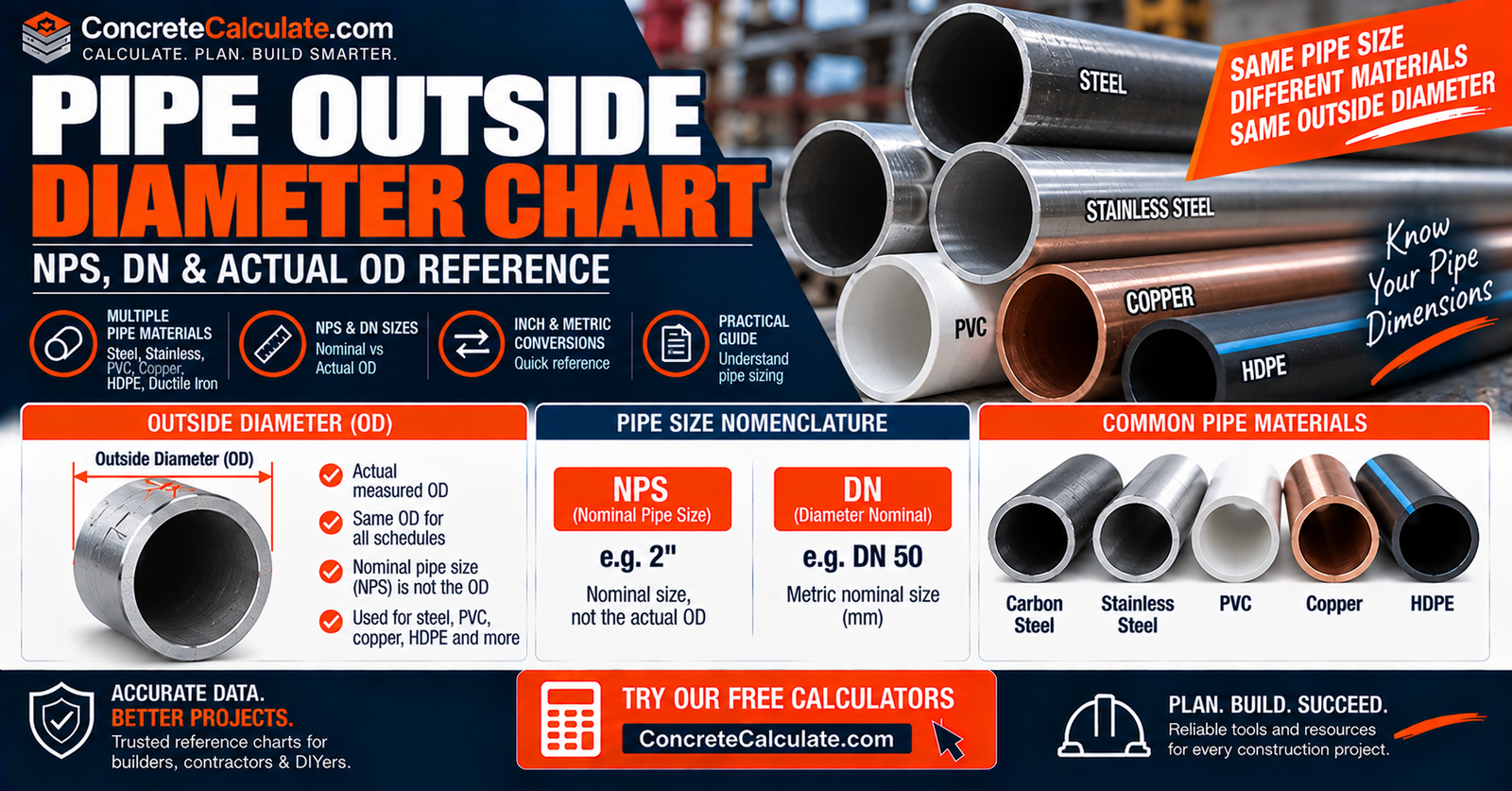
Standardized outside diameter by NPS and DN for steel, stainless, PVC, copper, HDPE, and ductile iron pipe, plus why nominal pipe size is not the measured OD.
 Reviewed by Muhammad Ramzan Babar, PhD Researcher (Plasma Physics) & Calculator Developer, View Profile
Nominal pipe size is not the measured outside diameter
NPS 2 pipe does not measure 2.000 in across the outside. Its standardized outside diameter is 2.375 in, and that OD stays the same whether the pipe is Schedule 10, Schedule 40, or Schedule 80. This chart is the companion reference to the Pipe Inside Diameter Chart: this page covers the external dimension, while inside diameter and wall thickness are covered separately.
Pipe Outside Diameter Chart, Quick Reference
Standardized actual outside diameter by NPS and DN, based on ASME B36.10-2022.
NPS Pipe Outside Diameter Chart
| NPS (in) | DN | OD (in) | OD (mm) |
|---|---|---|---|
| 1/8 | DN 6 | 0.405 | 10.3 |
| 1/4 | DN 8 | 0.540 | 13.7 |
| 3/8 | DN 10 | 0.675 | 17.1 |
| 1/2 | DN 15 | 0.840 | 21.3 |
| 3/4 | DN 20 | 1.050 | 26.7 |
| 1 | DN 25 | 1.315 | 33.4 |
| 1-1/4 | DN 32 | 1.660 | 42.2 |
| 1-1/2 | DN 40 | 1.900 | 48.3 |
| 2 | DN 50 | 2.375 | 60.3 |
| 2-1/2 | DN 65 | 2.875 | 73.0 |
| 3 | DN 80 | 3.500 | 88.9 |
| 4 | DN 100 | 4.500 | 114.3 |
| 6 | DN 150 | 6.625 | 168.3 |
| 8 | DN 200 | 8.625 | 219.1 |
| 10 | DN 250 | 10.750 | 273.1 |
| 12 | DN 300 | 12.750 | 323.9 |
| 14 | DN 350 | 14.000 | 355.6 |
| 16 | DN 400 | 16.000 | 406.4 |
| 18 | DN 450 | 18.000 | 457.0 |
| 20 | DN 500 | 20.000 | 508.0 |
| 24 | DN 600 | 24.000 | 609.6 |
These outside diameter values apply across the common schedule range (10, 40, 80, and heavier) for each NPS. For wall thickness and calculated bore by schedule, see the Pipe Inside Diameter Chart and Pipe Schedule Chart.
Important Scope Note
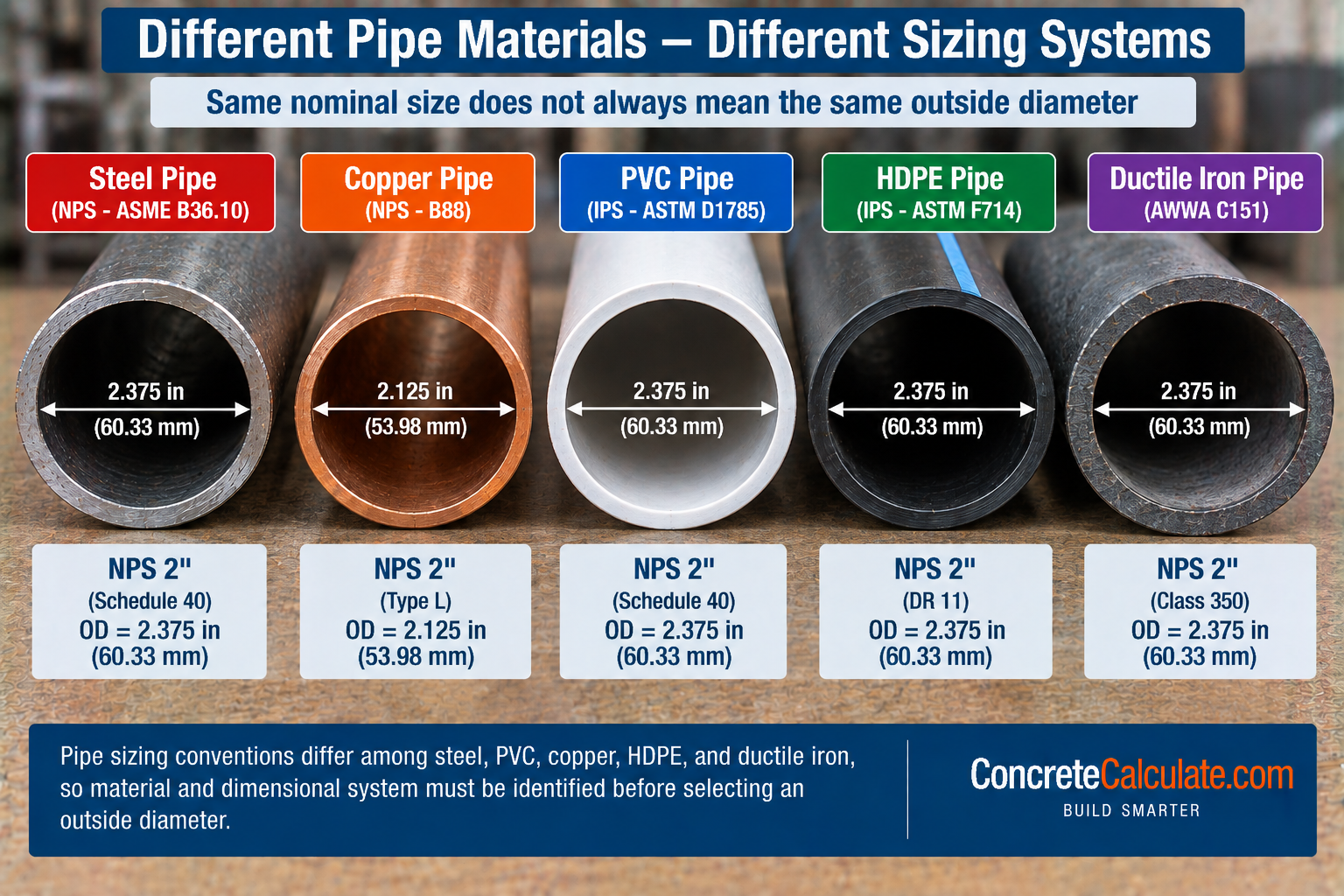
NPS is a nominal designation, not a measured outside diameter. Always identify the pipe dimensional system (steel/stainless NPS, PVC IPS, copper, HDPE IPS/DIPS, or ductile iron) before converting a nominal size into an OD.
What Is Pipe Outside Diameter?
Outside diameter is the measured diameter across the outer surface of the pipe.
OD affects fittings, clamps, hangers, pipe supports, wall and floor penetrations, sleeves, insulation sizing, grooved couplings, saddles, and flange or component fit. Unlike inside diameter, OD is largely unaffected by schedule within a given NPS dimensional system, since schedule changes are absorbed by wall thickness instead.
Nominal Pipe Size vs Actual Outside Diameter
The first major concept to understand about this chart.
Examples
NPS 2 does not have a 2.000 in OD; its actual OD is 2.375 in. NPS 4 does not have a 4.000 in OD; its actual OD is 4.500 in.
ASME B36.10-2022 states that NPS 12 and smaller have outside diameters numerically larger than their nominal size.
Why NPS Does Not Equal Actual OD
A historical sizing system, not an arbitrary mismatch.
For smaller pipe sizes, the nominal size historically related more closely to usable bore than to today’s outside diameter. As wall systems became standardized, OD remained fixed for fitting compatibility while wall thickness varied by schedule, which caused inside diameter to vary as well. The modern result is that NPS identifies a standardized pipe family, not a direct tape-measure diameter.
Pipe OD vs ID vs Wall Thickness
The three dimensions are related by a single formula.
Formula
ID = OD – 2t, or rearranged, OD = ID + 2t, where OD is outside diameter, ID is inside diameter, and t is wall thickness.
| Dimension | Changes With Schedule? | Main Function |
|---|---|---|
| NPS | No | Size designation |
| OD | Generally no | External fit |
| Wall | Yes | Strength / pressure geometry |
| ID | Yes | Flow bore |
For bore-specific calculations, see the Pipe Inside Diameter Chart.
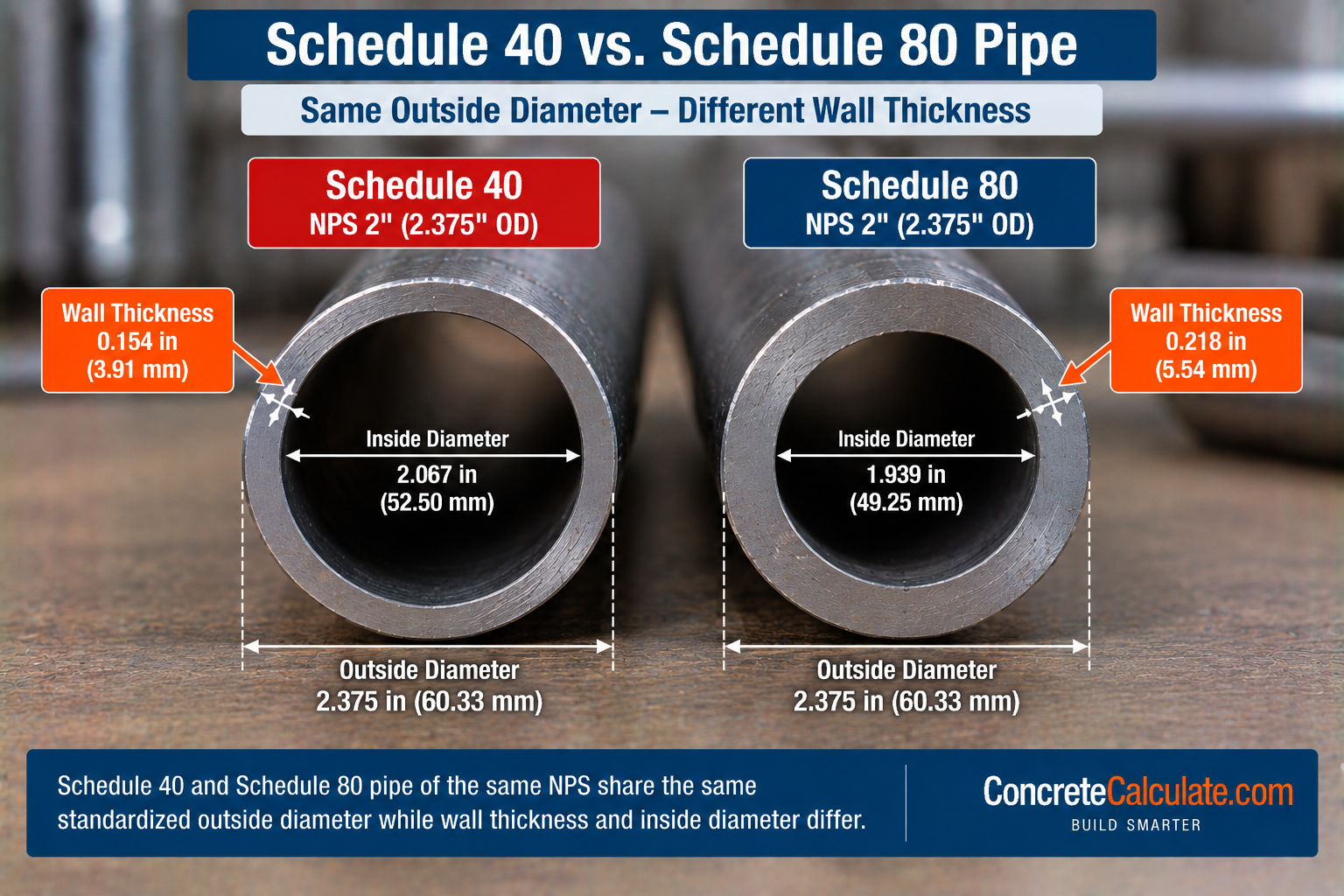
Does Pipe Schedule Change Outside Diameter?
One of the highest-priority questions this chart answers.
No. For a given NPS in the normal ASME steel-pipe system, the standardized OD stays the same while schedule changes wall thickness. For NPS 4, Schedule 40 OD equals 4.500 in and Schedule 80 OD also equals 4.500 in, but the walls and resulting inside diameters differ.
Schedule 10 vs 40 vs 80 Outside Diameter
A deliberately repetitive table: the point is that OD does not change.
| NPS (in) | Sch 10 OD (in) | Sch 40 OD (in) | Sch 80 OD (in) |
|---|---|---|---|
| 1/2 | 0.840 | 0.840 | 0.840 |
| 1 | 1.315 | 1.315 | 1.315 |
| 2 | 2.375 | 2.375 | 2.375 |
| 4 | 4.500 | 4.500 | 4.500 |
| 6 | 6.625 | 6.625 | 6.625 |
| 8 | 8.625 | 8.625 | 8.625 |
Every column matches for each NPS row. Wall thickness and bore differ between these schedules, but not the value shown here; see the Pipe Wall Thickness Chart for the wall-thickness comparison.
Steel Pipe Outside Diameter Chart
The main material-specific chart, covering the full common commercial range under ASME B36.10-2022.
| NPS (in) | DN | OD (in) | OD (mm) |
|---|---|---|---|
| 1 | DN 25 | 1.315 | 33.4 |
| 2 | DN 50 | 2.375 | 60.3 |
| 3 | DN 80 | 3.500 | 88.9 |
| 3-1/2 | DN 90 | 4.000 | 101.6 |
| 4 | DN 100 | 4.500 | 114.3 |
| 5 | DN 125 | 5.563 | 141.3 |
| 6 | DN 150 | 6.625 | 168.3 |
| 8 | DN 200 | 8.625 | 219.1 |
| 10 | DN 250 | 10.750 | 273.1 |
| 12 | DN 300 | 12.750 | 323.9 |
ASME B36.10-2022 Outside Diameter Standard
The controlling dimensional reference for U.S. steel pipe.
ASME B36.10-2022 covers welded and seamless wrought steel pipe for high or low temperature and pressure service, standardizing NPS/DN designations, outside diameters, nominal wall thicknesses, and the resulting weight relationships. ASME B36.10 is a dimensional standard; it does not by itself define every material grade or service application, since separate material specifications govern those requirements.
✓ Verified Against ASME B36.10-2022Carbon Steel Pipe OD
Material specification and dimensional standard are separate layers of a pipe specification.
Pipe manufactured to material specifications such as ASTM A53 or ASTM A106 typically uses the B36.10 dimensional sizes covered in this chart. This page focuses on outside diameter, not material grade selection; for pipe weight based on these same OD and wall dimensions, see the Steel Pipe Weight Chart.
Stainless Steel Pipe Outside Diameter Chart
ASME B36.19-2022 uses the same basic NPS/OD framework as carbon steel.
| NPS (in) | DN | OD (in) | OD (mm) |
|---|---|---|---|
| 1/2 | DN 15 | 0.840 | 21.3 |
| 1 | DN 25 | 1.315 | 33.4 |
| 2 | DN 50 | 2.375 | 60.3 |
| 4 | DN 100 | 4.500 | 114.3 |
| 6 | DN 150 | 6.625 | 168.3 |
B36.19 covers welded and seamless wrought stainless steel pipe and matches the familiar B36.10 OD family at these sizes.
ASME B36.10 vs B36.19 Outside Diameter
Carbon steel and stainless share the OD family but diverge on wall thickness.
| Feature | B36.10 | B36.19 |
|---|---|---|
| Typical material | Carbon / alloy steel | Stainless steel |
| NPS system | Yes | Yes |
| OD system | Standardized | Standardized, matches B36.10 |
| Schedule suffix | 10, 40, 80, etc. | 5S, 10S, 40S, 80S |
| Wall values identical everywhere? | – | No, some sizes differ |
ASME B36.19 notes that some 10S, 40S, and 80S stainless wall thicknesses differ from B36.10 values. Those wall differences change the inside diameter, not the fundamental OD size for a given NPS.
NPS 12 and Smaller OD Rule
The rule that explains the confusing part of this chart.
| NPS | Actual OD (in) |
|---|---|
| 1 | 1.315 |
| 2 | 2.375 |
| 4 | 4.500 |
| 6 | 6.625 |
| 8 | 8.625 |
| 10 | 10.750 |
| 12 | 12.750 |
ASME states that NPS 12 and smaller have outside diameters numerically larger than their nominal sizes.
NPS 14 and Larger Outside Diameters
The transition point where the sizing convention becomes intuitive.
In the conventional B36.10 size series, pipe beginning at NPS 14 has an OD numerically matching the NPS designation exactly.
| NPS | Actual OD (in) |
|---|---|
| 14 | 14.000 |
| 16 | 16.000 |
| 20 | 20.000 |
| 24 | 24.000 |
This makes large-pipe sizing more intuitive than the small-NPS series covered in the previous section.
NPS to DN Outside Diameter Chart
Two parallel nominal systems, each independent of the actual measured OD.
| NPS | DN | OD (in) | OD (mm) |
|---|---|---|---|
| 1/2 | DN 15 | 0.840 | 21.34 |
| 1 | DN 25 | 1.315 | 33.40 |
| 2 | DN 50 | 2.375 | 60.33 |
| 4 | DN 100 | 4.500 | 114.30 |
DN Is Nominal
DN does not mean the pipe has that exact OD in millimeters. DN 50 (NPS 2) has an actual OD of 60.3 mm, not 50 mm.
Pipe Outside Diameter in Inches and Millimeters
Direct conversion reference for common sizes.
| NPS (in) | OD (in) | OD (mm) |
|---|---|---|
| 1/2 | 0.840 | 21.3 |
| 1 | 1.315 | 33.4 |
| 2 | 2.375 | 60.3 |
| 4 | 4.500 | 114.3 |
| 6 | 6.625 | 168.3 |
Conversion: 1 in = 25.4 mm.
Pipe Outside Diameter Tolerances
Where this chart goes beyond a generic pipe-size table.
The tabulated OD is the nominal standardized value. Actual manufactured pipe carries permitted dimensional tolerances depending on the pipe specification, manufacturing process, size, material, and the applicable ASTM, API, or other product standard. Do not treat a chart OD as a guaranteed micrometer reading to unlimited precision; for precision fit applications, check the specific product specification and manufacturer tolerances directly.
Pipe OD vs Circumference
Useful for field identification when calipers cannot span the pipe.
Formula
C = πD, so D = C ÷ π, where C is circumference and D is outside diameter.
Example: Measuring Circumference
How to Measure Pipe Outside Diameter
A practical field workflow.
Field Measurement Workflow
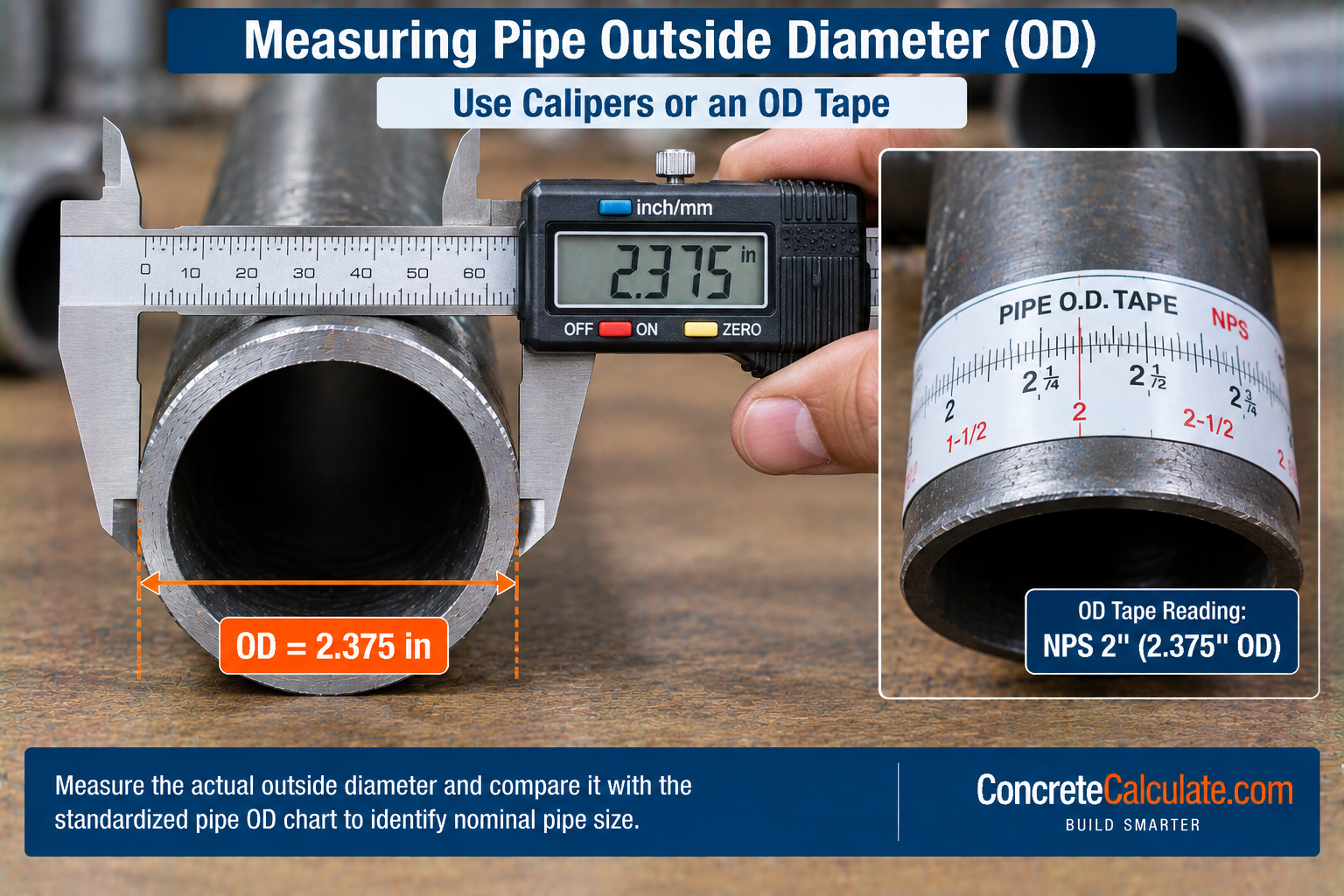
How to Identify NPS From Measured OD
A reverse lookup table for field identification.
| Measured OD, approx. (in) | Likely NPS |
|---|---|
| 0.840 | 1/2 |
| 1.050 | 3/4 |
| 1.315 | 1 |
| 1.660 | 1-1/4 |
| 1.900 | 1-1/2 |
| 2.375 | 2 |
| 2.875 | 2-1/2 |
| 3.500 | 3 |
| 4.500 | 4 |
| 6.625 | 6 |
| 8.625 | 8 |
| 10.750 | 10 |
| 12.750 | 12 |
Pipe OD vs Tube OD
An important purchasing and fitting distinction.
ASME distinguishes pipe from tube: pipe uses NPS nominal designations, while tubing is commonly designated by its actual outside diameter. As a result, 1-inch pipe has an OD of 1.315 in, while 1-inch tubing can literally have an OD of 1.000 in, depending on the tubing specification. Confirm which system applies before ordering fittings or matching components.
Pipe vs Tubing Size Identification
Key differences in how each system is designated.
| Feature | Pipe | Tube |
|---|---|---|
| Basic designation | NPS / DN | Often actual OD |
| OD equals nominal label? | Often no | Often yes |
| Wall described by | Schedule | Wall gauge / thickness |
| Typical applications | Piping systems | Structural, mechanical, instrumentation |
Tubing systems vary by product and industry, so exceptions to this general pattern exist; always confirm the governing specification for a specific tubing product.
PVC Pipe Outside Diameter Chart
A supporting material section, distinct from the full PVC Pipe Size Chart.
ASTM D1785 is the active standard for PVC Schedule 40, 80, and 120 pressure pipe, describing it as an OD-controlled pipe system. PVC manufacturer catalogs commonly publish sizes that align with the familiar IPS/NPS outside diameter family.
| Nominal Size (in) | OD (in) |
|---|---|
| 1/2 | 0.840 |
| 3/4 | 1.050 |
| 1 | 1.315 |
| 2 | 2.375 |
| 4 | 4.500 |
| 6 | 6.625 |
| 8 | 8.625 |
For complete PVC-specific dimensional data including wall thickness and pressure class, see the PVC Pipe Size Chart.
Schedule 40 vs Schedule 80 PVC Outside Diameter
The same OD principle from steel pipe, tied to the PVC standard.
For the same nominal PVC pipe size under ASTM D1785, Schedule 40 and Schedule 80 generally share the same controlled outside diameter. Schedule 80 has a thicker wall and therefore a smaller inside diameter than Schedule 40 at the same nominal size, mirroring the steel pipe relationship covered earlier on this page.
PVC vs Steel Pipe Outside Diameter
A practical cross-material comparison.
| Nominal Size (in) | PVC OD (in) | Steel OD (in) |
|---|---|---|
| 1/2 | 0.840 | 0.840 |
| 1 | 1.315 | 1.315 |
| 2 | 2.375 | 2.375 |
| 4 | 4.500 | 4.500 |
Same OD Does Not Mean Interchangeable
For IPS-based PVC and steel at common sizes, OD may be dimensionally compatible, but the materials, pressure ratings, joining systems, temperature limits, and fitting standards are not automatically interchangeable.
Copper Pipe/Tube Outside Diameter Chart
Copper uses a different naming convention entirely, separate from NPS steel pipe.
Types K, L, M, DWV, and Medical Gas copper tube are designated by standard nominal sizes, with the actual outside diameter consistently 1/8 in larger than the nominal standard size designation.
| Nominal Size (in) | Actual OD (in) |
|---|---|
| 1/2 | 5/8 (0.625) |
| 3/4 | 7/8 (0.875) |
| 1 | 1-1/8 (1.125) |
| 1-1/2 | 1-5/8 (1.625) |
| 2 | 2-1/8 (2.125) |
For complete copper-specific dimensional data by type, see the Copper Pipe Size Chart.
Type K, L, and M Copper Outside Diameter
Unlike steel schedules, copper tube types share the same OD.
For the same nominal copper water-tube size, Types K, L, and M use the same outside diameter but different wall thicknesses. This is conceptually similar to steel pipe schedules keeping OD fixed while wall thickness varies, but applied to copper’s own dimensional system.
Copper Nominal Size vs ACR Actual OD
An expert-level distinction worth knowing.
K/L/M/DWV copper is named by nominal standard size, where actual OD is 1/8 in larger than the label. ACR (air conditioning and refrigeration) tubing, by contrast, is designated by its actual outside diameter directly. This explains why a refrigeration technician and a plumber can use apparently different size terminology for physically related copper tubing products.
HDPE Pipe OD, IPS vs DIPS
A search intent that “pipe OD chart” often reaches: utility piping.
HDPE pipe can be manufactured to different OD series. IPS (Iron Pipe Size) HDPE follows the same OD family as steel pipe, while DIPS (Ductile Iron Pipe Size), sometimes called DIOD, follows the larger ductile-iron OD family.
| Nominal Size (in) | IPS OD (in) | DIPS OD (in) |
|---|---|---|
| 4 | 4.500 | 4.800 |
| 6 | 6.625 | 6.900 |
| 8 | 8.625 | 9.050 |
| 10 | 10.750 | 11.100 |
| 12 | 12.750 | 13.200 |
| 16 | 16.000 | 17.400 |
| 24 | 24.000 | 25.800 |
Key Message
“6-inch HDPE” alone is not enough information to determine OD; you need to know whether it is IPS or DIPS/DIOD before selecting fittings or fusion equipment.
Ductile Iron Pipe Outside Diameter
A separate OD family from steel NPS or IPS pipe.
| Nominal Size (in) | OD (in) |
|---|---|
| 4 | 4.80 |
| 6 | 6.90 |
| 8 | 9.05 |
| 10 | 11.10 |
| 12 | 13.20 |
| 16 | 17.40 |
| 24 | 25.80 |
Important
A nominal 6-inch ductile iron pipe does not have the same OD as NPS 6 steel or IPS pipe. Ductile iron OD (6.90 in) matches the DIPS HDPE family rather than the IPS/steel family (6.625 in).
Pipe OD and Fitting, Clamp, and Sleeve Compatibility
One of the strongest practical uses of this chart.
External fit determines compatibility with couplings, grooved fittings, compression systems, clamps, saddles, restraints, and hangers. A fitting sized for 6.625 in OD cannot automatically be assumed to fit 6.900 in OD, even if both products are casually called nominal 6-inch pipe. Always confirm actual OD, not nominal size, before ordering these components.
Coatings, Ovality, and Actual Field OD
Factors that separate a chart value from a field measurement.
External coatings such as galvanizing, epoxy, polyethylene coatings, or wraps can increase effective field OD beyond the standard bare-pipe value. For tight sleeves or couplings, verify manufacturer requirements rather than assuming a universal coating allowance. Real pipe can also have allowable ovality, meaning one caliper measurement may differ from another taken on a different axis; measure in multiple directions when precision matters for close-fit couplings or machining, and do not invent a universal ovality tolerance since the applicable product specification governs.
Common Pipe Outside Diameter Chart Mistakes
Assuming NPS equals actual OD
NPS is a nominal label, not a direct outer measurement.
Assuming 2-inch pipe measures 2.000 in outside
NPS 2 steel pipe actually measures 2.375 in OD.
Using pipe ID to select an external fitting
Fittings, clamps, and couplings fit around the OD, not the bore.
Confusing pipe with tubing
Tubing OD is often the nominal label itself; pipe OD is not.
Assuming a 1-inch tube has the same OD as NPS 1 pipe
NPS 1 pipe is 1.315 in OD; 1-inch tubing can be 1.000 in OD.
Assuming schedule changes OD
Schedule normally changes wall thickness and ID, not OD.
Thinking Schedule 80 has a larger OD than Schedule 40
They share the same OD for a given NPS; only the wall differs.
Confusing OD with wall thickness
These are separate dimensions related only through the ID formula.
Treating DN 50 as 50-mm OD
DN is nominal; DN 50 actually has a 60.3 mm OD.
Assuming steel and copper nominal sizes use the same OD
Copper OD is 1/8 in larger than its nominal label; steel is not sized this way.
Treating 1/2-inch copper as 0.500-in OD
Nominal 1/2-inch copper actually measures 0.625 in OD.
Confusing copper plumbing size with ACR actual-OD designation
ACR tubing is labeled by actual OD; K/L/M copper is labeled by nominal size.
Assuming all plastic pipe follows one OD series
PVC commonly follows IPS OD, but not every plastic pipe product does.
Ignoring IPS vs DIPS for HDPE
The same nominal HDPE size can have two different actual OD values.
Assuming ductile iron nominal size has steel-pipe OD
Ductile iron OD matches the larger DIPS family, not the IPS/steel family.
Selecting fittings from nominal label alone
Always confirm actual OD and dimensional system before ordering fittings.
Ignoring manufacturing tolerances
Actual OD can vary slightly within the applicable product tolerance.
Ignoring coating thickness
Galvanizing and other coatings can increase effective field OD.
Ignoring pipe ovality
A single caliper reading may not represent the true average OD.
Measuring over insulation
Insulation adds to the apparent diameter and will distort an OD reading.
Pipe Outside Diameter Chart Limitations
Read Before Using for Fitting Selection or Procurement
NPS is nominal, not physical OD. OD depends entirely on the dimensional system in use. ASME steel and stainless NPS sizes use standardized ODs that generally do not change with schedule. Manufacturing tolerances still apply to the tabulated values. Copper uses a separate size convention where actual OD is 1/8 in larger than the nominal label, while ACR copper is identified by actual OD directly. PVC Schedule 40/80 under ASTM D1785 is an OD-controlled system that often follows the IPS family. HDPE pipe may be IPS or DIPS, which produce different actual OD values for the same nominal size. Ductile iron pipe uses its own larger OD family, matching DIPS rather than IPS. Coatings can increase effective field OD, and ovality can affect field measurements. Always verify the material and dimensional system before selecting fittings, clamps, sleeves, or other OD-dependent accessories.
Frequently Asked Questions
Download Pipe Outside Diameter Chart PDF
Save or print this reference including the NPS/DN OD tables, the fitting-compatibility guidance, and the steel, PVC, copper, HDPE, and ductile iron comparisons for jobsite use.