Mesh Reinforcement Chart 2026 – Sizes, Spacing & Application Guide
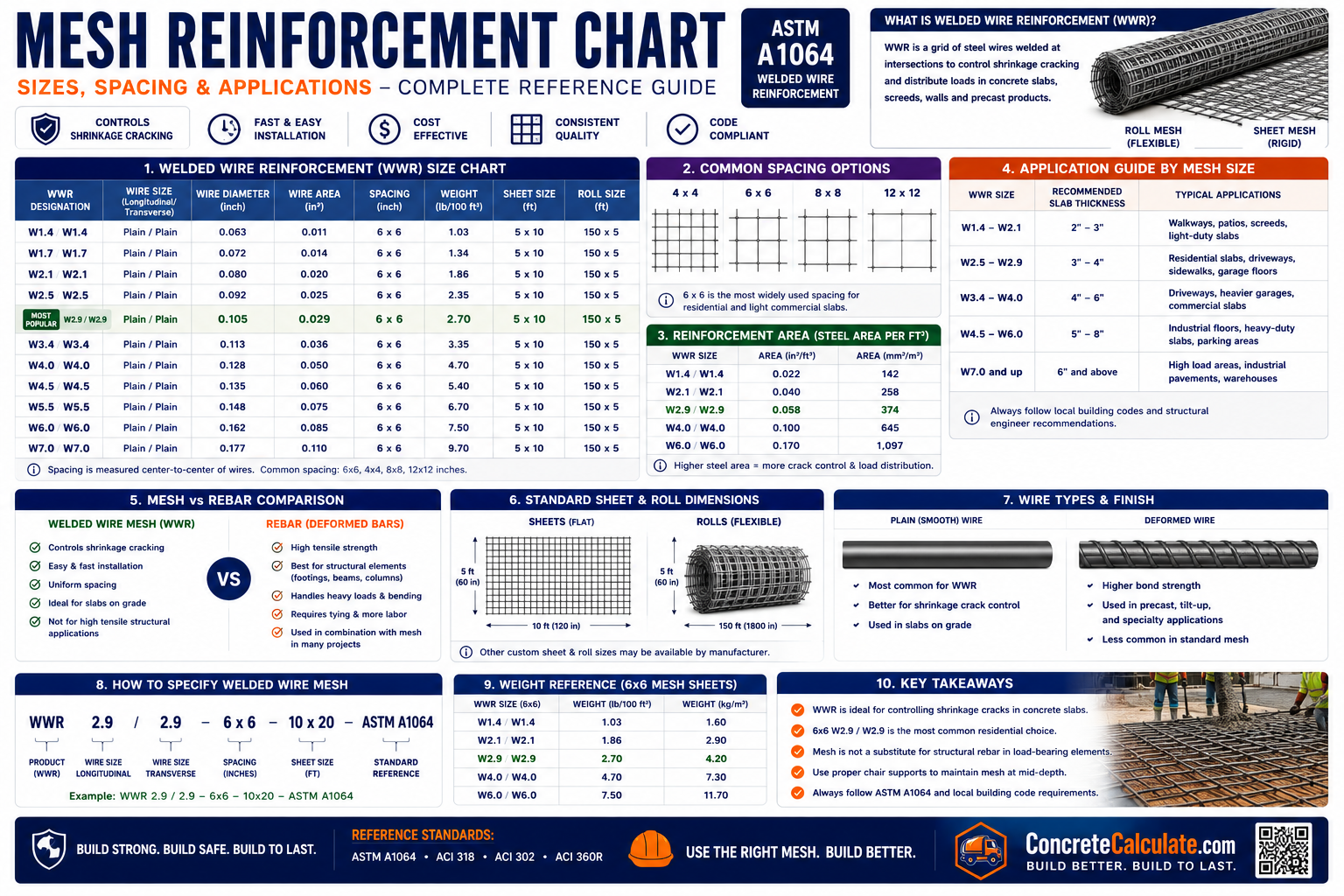
Mesh Reinforcement Chart
Sizes, Spacing & Application Guide
Complete welded wire reinforcement (WWR) reference for contractors and engineers — mesh designations, wire diameters, spacing, sheet/roll sizes, and application-specific selection.
 Reviewed by Muhammad Ramzan Babar, PhD Researcher (Plasma Physics) & Calculator Developer — View Profile
⭐ Master Mesh Reinforcement Chart
Complete overview of common welded wire reinforcement (WWR) styles used in residential and commercial concrete work.
How to Read This Chart
Mesh designations follow the format “spacing × spacing – wire size/wire size” (e.g., 6×6 W2.9/W2.9). The W number indicates wire cross-sectional area in hundredths of a square inch, per ASTM A1064.
| Mesh Designation | Wire Diameter (in) | Spacing | Steel Area (sq in/ft) | Common Use |
|---|---|---|---|---|
| 4×4 W1.4/W1.4 | 0.134 | 4″×4″ | 0.042 | Light-duty slabs |
| 4×4 W2.9/W2.9 | 0.192 | 4″×4″ | 0.087 | Sidewalks, patios |
| 6×6 W1.4/W1.4 | 0.134 | 6″×6″ | 0.028 | Light shrinkage control |
| 6×6 W2.1/W2.1 | 0.164 | 6″×6″ | 0.042 | Residential slabs |
| 6×6 W2.9/W2.9 | 0.192 | 6″×6″ | 0.058 | Driveways, garage floors |
| 6×6 W4.0/W4.0 | 0.226 | 6″×6″ | 0.080 | Heavy driveways, warehouses |
| 6×6 W5.0/W5.0 | 0.252 | 6″×6″ | 0.100 | Industrial slabs |
| 6×6 W6.0/W6.0 | 0.276 | 6″×6″ | 0.120 | Heavy industrial floors |
| 6×6 W8.0/W8.0 | 0.319 | 6″×6″ | 0.160 | Extra heavy-duty pavements |
Steel area values based on ASTM A1064/A1064M nominal wire areas.
⭐ Mesh Reinforcement Size Chart
Wire diameter, spacing, and reinforcement area for the most commonly stocked mesh styles.
| Mesh Designation | Wire Diameter | Wire Spacing | Reinforcement Area (sq in/ft) |
|---|---|---|---|
| 4×4 W1.4/W1.4 | 0.134″ | 4″ × 4″ | 0.042 |
| 4×4 W2.9/W2.9 | 0.192″ | 4″ × 4″ | 0.087 |
| 6×6 W1.4/W1.4 | 0.134″ | 6″ × 6″ | 0.028 |
| 6×6 W2.1/W2.1 | 0.164″ | 6″ × 6″ | 0.042 |
| 6×6 W2.9/W2.9 | 0.192″ | 6″ × 6″ | 0.058 |
| 6×6 W4.0/W4.0 | 0.226″ | 6″ × 6″ | 0.080 |
| 6×6 W5.0/W5.0 | 0.252″ | 6″ × 6″ | 0.100 |
| 6×6 W6.0/W6.0 | 0.276″ | 6″ × 6″ | 0.120 |
| 6×6 W8.0/W8.0 | 0.319″ | 6″ × 6″ | 0.160 |
⭐ Mesh Reinforcement by Construction Application
Recommended mesh style by project type based on typical load and crack-control requirements.
| Project | Recommended Mesh Type |
|---|---|
| Residential Slabs | 6×6 W2.1/W2.1 |
| Garage Floors | 6×6 W2.9/W2.9 |
| Sidewalks | 6×6 W1.4/W1.4 or 4×4 W1.4/W1.4 |
| Driveways | 6×6 W2.9/W2.9 |
| Patios | 6×6 W1.4/W1.4 |
| Warehouse Floors | 6×6 W4.0/W4.0 |
| Industrial Slabs | 6×6 W5.0/W5.0 or W6.0/W6.0 |
| Parking Lots | 6×6 W4.0/W4.0 |
| Concrete Pavements | 6×6 W4.0/W4.0 to W6.0/W6.0 |
| Pool Decks | 6×6 W2.9/W2.9 |
Welded Wire Reinforcement (WWR) Designation Chart
Understanding W and D number designations helps decode any mesh specification sheet.
| Designation Type | Meaning | Example |
|---|---|---|
| W Number | Plain (smooth) wire; number = area in hundredths of sq in | W2.9 = 0.029 sq in |
| D Number | Deformed wire with surface ribs for better bond | D4 = 0.040 sq in, deformed |
| Wire Diameter | Actual diameter of the wire in inches | W2.9 = 0.192″ diameter |
| Steel Area | Cross-sectional area used for structural calculations | Expressed per wire, in sq in |
Old vs New Designations
Older mesh charts referenced gauge numbers (e.g., 6×6 10/10 gauge); modern specs use W numbers per ASTM A1064, so 6×6 10/10 gauge equals roughly 6×6 W1.4/W1.4.
Mesh Reinforcement by Slab Thickness
General mesh recommendations correlated with common slab thicknesses.
| Slab Thickness | Recommended Mesh |
|---|---|
| 3″ | 6×6 W1.4/W1.4 |
| 4″ | 6×6 W2.1/W2.1 or W2.9/W2.9 |
| 5″ | 6×6 W2.9/W2.9 |
| 6″ | 6×6 W4.0/W4.0 |
| 8″ | 6×6 W5.0/W5.0 |
| 10″ | 6×6 W6.0/W6.0 |
| 12″ | 6×6 W8.0/W8.0 (or rebar with engineering review) |
For full thickness planning, see our Concrete Slab Thickness Chart.
Mesh Reinforcement by Concrete Application
Comparing whether mesh alone is suitable or should be combined with rebar for different structural elements.
| Application | Mesh Suitability | Notes |
|---|---|---|
| Sidewalks | Suitable alone | Standard shrinkage control |
| Driveways | Suitable alone | 6×6 W2.9/W2.9 typical |
| Foundations | Not sufficient alone | Requires rebar per engineering design |
| Footings | Not sufficient alone | Rebar required for structural load |
| Suspended Slabs | Not sufficient alone | Structural rebar mandatory |
| Industrial Floors | Suitable with heavier mesh | 6×6 W5.0/W5.0 or higher |
| Precast Panels | Often combined with rebar | Mesh used for surface crack control |
Learn more in our guide: Does Concrete Need Rebar?
Mesh Reinforcement Sheet Size Chart
Standard flat sheet dimensions, coverage, and approximate weight.
| Mesh Type | Width | Length | Coverage Area | Approx Weight |
|---|---|---|---|---|
| 6×6 W1.4/W1.4 | 7′ | 20′ | 140 sq ft | ~21 lb/100 sq ft |
| 6×6 W2.9/W2.9 | 7′ | 20′ | 140 sq ft | ~42 lb/100 sq ft |
| 6×6 W4.0/W4.0 | 8′ | 20′ | 160 sq ft | ~58 lb/100 sq ft |
| 4×4 W2.9/W2.9 | 7′ | 20′ | 140 sq ft | ~62 lb/100 sq ft |
Sheet dimensions and weights based on standard fabricator stock sizes.
Mesh Reinforcement Roll Size Chart
Flexible roll dimensions used for smaller jobs and irregular pour shapes.
| Mesh Type | Roll Width | Roll Length | Coverage | Typical Application |
|---|---|---|---|---|
| 6×6 W1.4/W1.4 | 5′ | 150′ | 750 sq ft | Sidewalks, patios |
| 6×6 W2.9/W2.9 | 5′-7′ | 150′ | 750-1,050 sq ft | Driveways, small slabs |
Rolls vs Sheets
Rolls are preferred for small residential jobs, curved layouts, or when working alone due to easier handling, while sheets minimize wire memory curl and are faster for large flat commercial pours.
Mesh Reinforcement by Load Capacity
Matching mesh strength to expected surface loading.
| Load Type | Recommended Mesh |
|---|---|
| Pedestrian Areas | 6×6 W1.4/W1.4 |
| Passenger Vehicles | 6×6 W2.9/W2.9 |
| Heavy Vehicles | 6×6 W4.0/W4.0 |
| Forklifts | 6×6 W5.0/W5.0 |
| Industrial Equipment | 6×6 W6.0/W6.0 to W8.0/W8.0 |
⭐ Mesh Reinforcement vs Rebar Comparison
Both control cracking and add reinforcement, but they serve different structural roles.
| Factor | Wire Mesh | Rebar |
|---|---|---|
| Strength | Lower tensile capacity | Higher tensile capacity |
| Crack Control | Excellent for shrinkage cracks | Good, but not primary purpose |
| Installation Speed | Faster, pre-fabricated grid | Slower, requires tying individual bars |
| Cost | Generally lower | Generally higher |
| Flexibility | Rolls bend; sheets are rigid | Can be bent/shaped on site |
| Best Applications | Slabs on grade, sidewalks, driveways | Foundations, footings, structural slabs |
For full breakdown, read our guide: Rebar vs Wire Mesh.
Mesh Reinforcement vs Fiber Reinforcement
Steel mesh, synthetic fibers, and steel fibers each address cracking differently.
| Type | Best For | Can Combine With Mesh? |
|---|---|---|
| Steel Mesh | Shrinkage cracking, load distribution | — |
| Synthetic Fibers | Plastic shrinkage crack reduction | Yes, commonly combined |
| Steel Fibers | Impact and structural crack resistance | Yes, in industrial floors |
Mesh Reinforcement by Crack Control
Selecting mesh based on desired crack-control performance level.
| Crack Control Need | Recommended Mesh |
|---|---|
| Light Shrinkage Control | 6×6 W1.4/W1.4 |
| Moderate Crack Control | 6×6 W2.9/W2.9 |
| Heavy-Duty Floors | 6×6 W5.0/W5.0 or higher |
Mesh Reinforcement by Concrete Strength
Mesh choice depends more on structural application than PSI alone.
| Concrete Strength | Common Mesh Pairing |
|---|---|
| 3000 PSI | 6×6 W1.4/W1.4 |
| 3500 PSI | 6×6 W2.1/W2.1 |
| 4000 PSI | 6×6 W2.9/W2.9 |
| 5000 PSI | 6×6 W4.0/W4.0 |
| 6000 PSI | 6×6 W5.0/W5.0 or heavier |
Structural Requirements First
Mesh selection is driven primarily by expected loading and crack control needs, not concrete PSI. See our Concrete PSI Guide for strength selection.
Mesh Reinforcement by Spacing
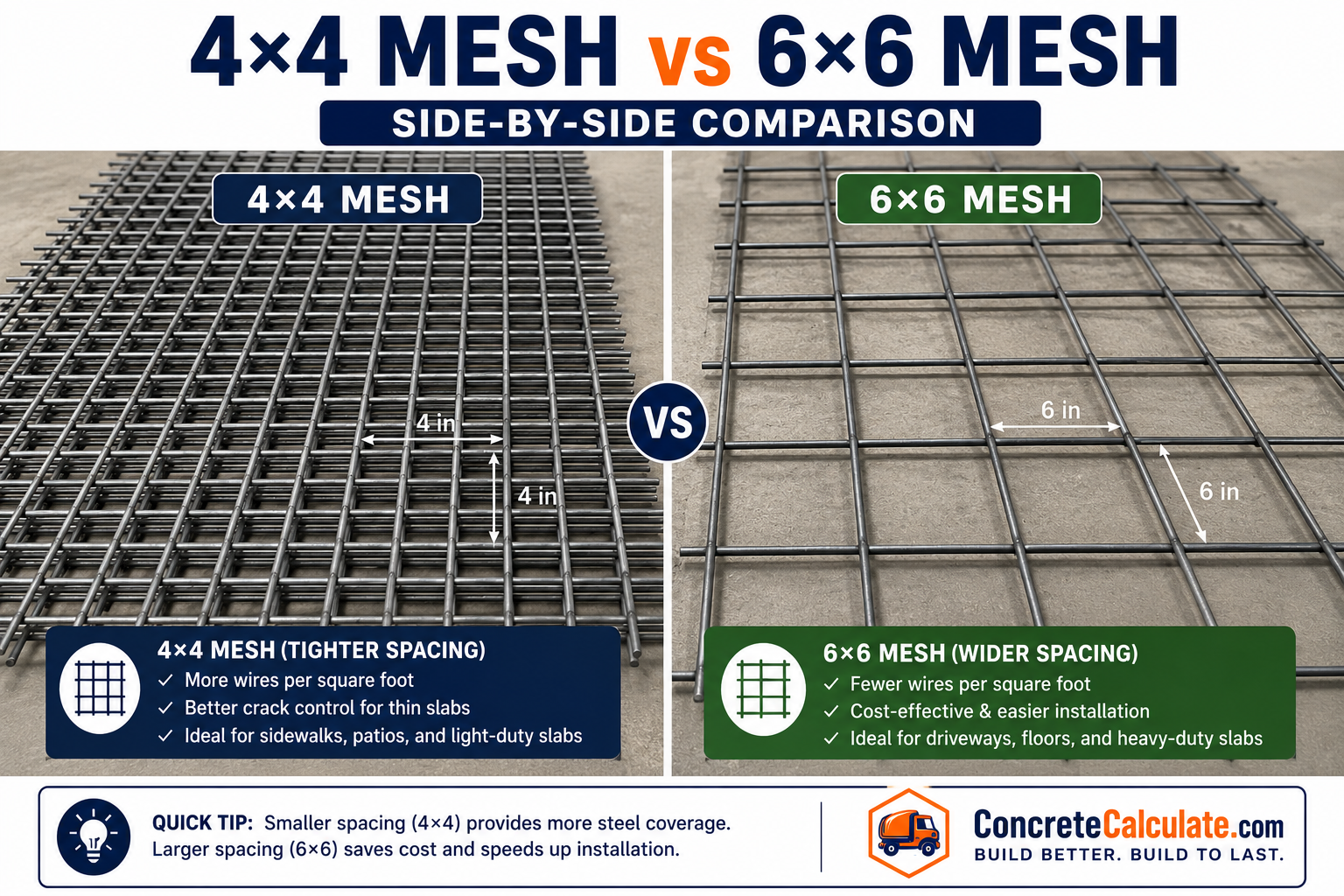
Tighter spacing improves crack distribution but increases material cost.
| Spacing | Crack Control | Typical Use |
|---|---|---|
| 4×4 Mesh | Tighter grid, finer crack distribution | High-traffic sidewalks, thin toppings |
| 6×6 Mesh | Standard, balanced performance | Most residential/commercial slabs |
| 8×8 Mesh | Wider grid, less material | Light-duty, low-traffic areas |
Mesh Reinforcement by ASTM Standard
Key standards governing wire mesh manufacturing and specification.
| Standard | Scope | Common Application |
|---|---|---|
| ASTM A1064 | Steel wire and welded wire reinforcement, plain and deformed | All standard WWR sheets and rolls |
| ASTM A497 (historical) | Superseded by A1064; deformed welded wire fabric | Legacy specifications |
| ACI 318 | Building code requirements including cover and placement | Structural design reference |
ASTM A1064/A1064M covers plain and deformed wire and welded wire reinforcement dimensional requirements.
⭐ Mesh Reinforcement Selection Guide
Quick decision reference matching project type to recommended mesh with reasoning.
| Project | Recommended Mesh | Why |
|---|---|---|
| Patio | 6×6 W1.4/W1.4 | Light foot traffic only |
| Sidewalk | 6×6 W1.4/W1.4 | Standard shrinkage crack control |
| Driveway | 6×6 W2.9/W2.9 | Handles passenger vehicle loads |
| Garage Floor | 6×6 W2.9/W2.9 | Balances cost with vehicle loading |
| Warehouse | 6×6 W4.0/W4.0 | Supports forklift and pallet loads |
| Foundation Slab | Rebar + mesh combo | Mesh alone insufficient structurally |
| Industrial Floor | 6×6 W5.0/W5.0 or heavier | Heavy equipment and repeated loading |
⭐ Visual Mesh Reinforcement Guide
Engineering diagrams showing mesh geometry, placement, and concrete cover.
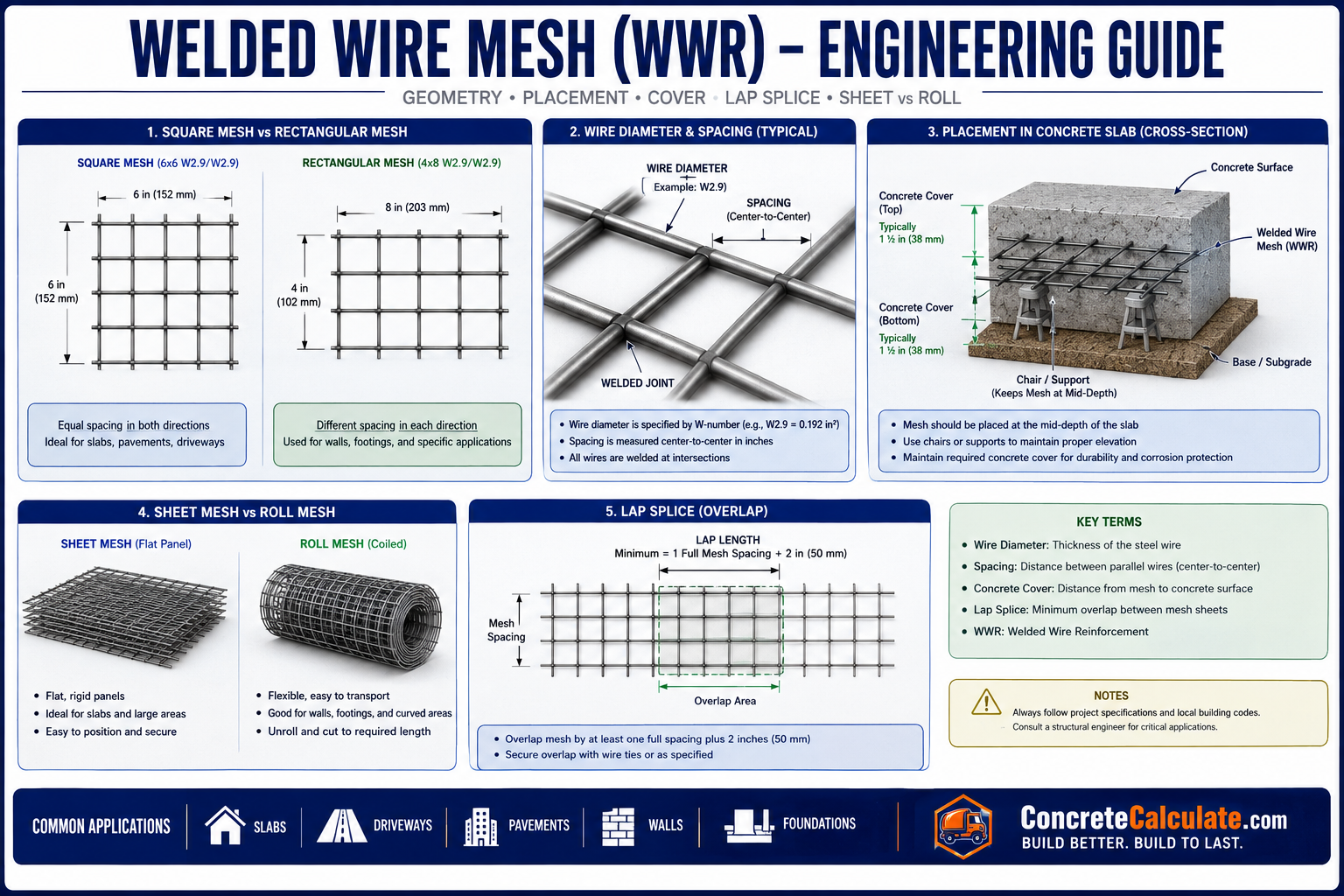
Mesh Placement & Lap Splice Guide
Proper positioning and overlap ensure mesh performs as designed.
| Requirement | Specification |
|---|---|
| Position in Slab | Mid-depth to upper third; never left on ground |
| Typical Lap Length | One full mesh spacing + 2 inches (6-12″) |
| Support Chairs | Required every 2-3 ft to maintain position during pour |
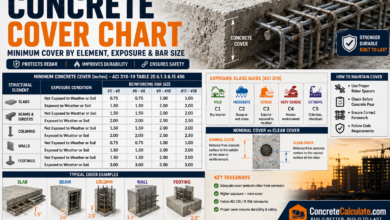
| Concrete Cover | 1.5-2 inches minimum per ACI 318 |
Related references: Concrete Cover Chart and Rebar Lap Splice Chart.
Common Mesh Reinforcement Mistakes
Avoiding these errors ensures the mesh actually performs its intended function.
Mesh Left on the Ground
Pulling mesh up mid-pour rarely achieves correct positioning; use chairs from the start.
Insufficient Lap Splice
Short overlaps create weak points where crack control fails.
Wrong Mesh Designation
Using light mesh (W1.4) under vehicle loads leads to premature cracking.
Inadequate Concrete Cover
Mesh too close to the surface corrodes and causes surface staining/spalling.
Unsupported Mesh
Without chairs, mesh sinks to the bottom, providing no crack control benefit.
Using Mesh Instead of Rebar
Structural elements like footings and foundations need rebar, not mesh alone.
Cutting Mesh Without Continuity
Improper cutting around obstacles breaks reinforcement continuity; always maintain overlap.
Contractor Worked Examples
Real-world mesh selection scenarios for common project types.
Residential Driveway (20′ × 10′)
Warehouse Floor (50′ × 100′)
Frequently Asked Questions
📄 Download Mesh Reinforcement Chart PDF
Get a print-ready contractor reference sheet for jobsite use — includes mesh designation tables, sheet and roll dimensions, reinforcement selection guide, placement and lap diagrams, ASTM reference summary, and quick field reference sheet.