
When to Worry About Cracks in Walls: Warning Signs, Causes and What to Do
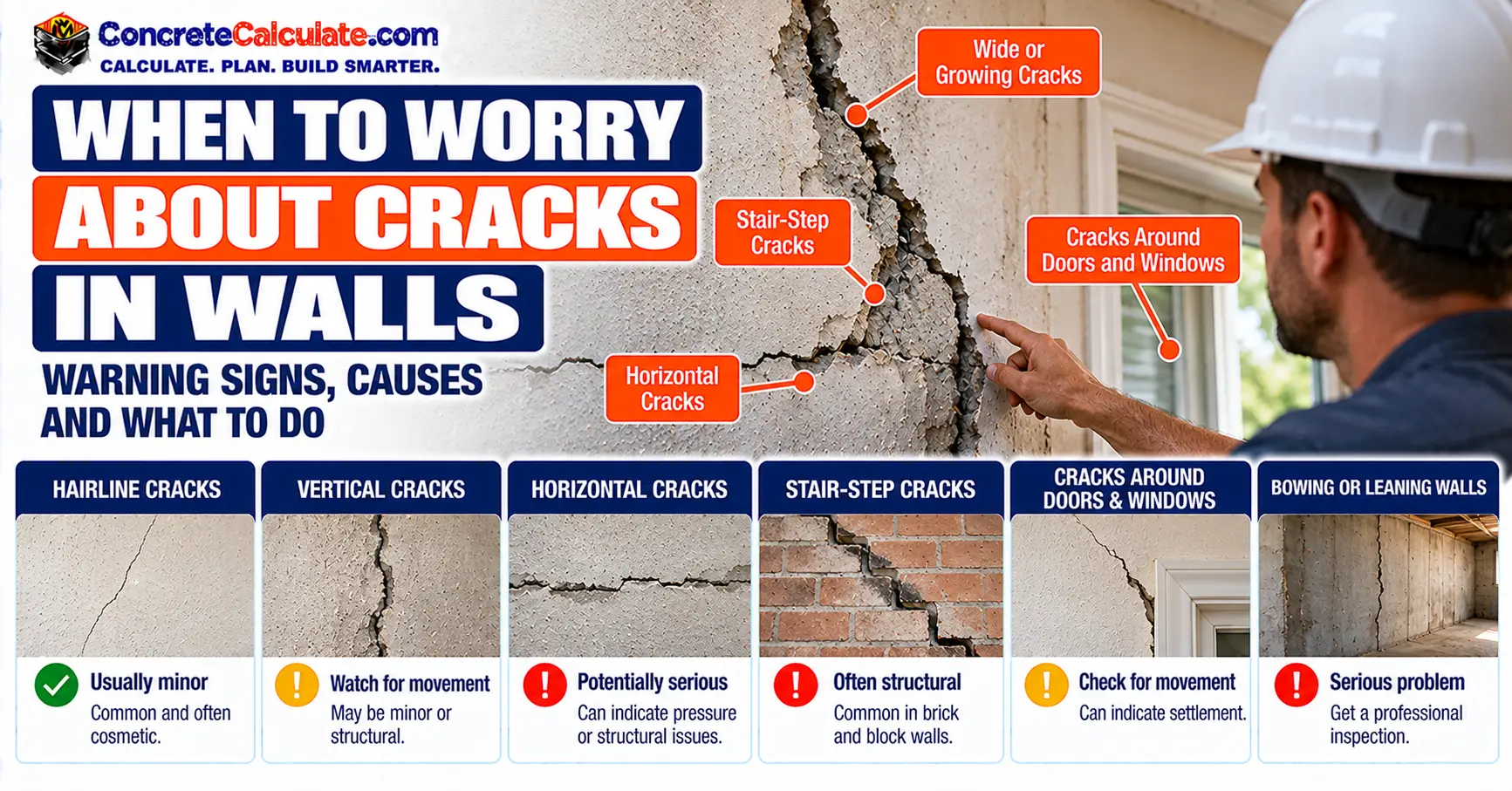
When to Worry About Cracks in Walls
Judge a wall crack by pattern, movement, displacement, wall deformation and related building symptoms, not width alone, then decide whether to monitor, repair or call a professional.
When Should You Worry About Cracks in Walls?
Worry when a crack is moving or the building is changing around it. A fine, unchanged shrinkage crack with no other symptoms is far less concerning than one that is widening, offset, or paired with a bowing wall.
These nine warning signs deserve attention:
- The crack is actively widening.
- The two sides are visibly displaced (one sticks out).
- The wall is bowing or leaning.
- Floors are sloping or doors and windows are sticking.
- A horizontal crack runs through a wall that is moving.
- Several cracks are connected.
- Water is coming in and movement is present.
- The crack appeared suddenly after a structural or ground event.
- The crack is in a beam, column, or other load path.
Width alone does not decide it. Judge pattern, movement, displacement, wall deformation, and nearby building symptoms together.
Are Cracks in Walls Normal?
Some cracking is normal. Concrete and masonry shrink as they dry, and buildings move slightly with temperature, moisture, and settling.
- Expected shrinkage: fine cracks as materials dry.
- Minor settlement: small adjustments early in a building’s life.
- Seasonal movement: cracks that open and close with temperature or moisture.
- Structural movement: ongoing or large movement that affects the building.
Do not be reassured by crack width alone. A narrow crack can still be moving, and a wider one can be old and stable.
Cosmetic vs. Structural Wall Cracks
This table screens cracks into monitor, investigate, or act. It is a screening tool and not a substitute for an engineering evaluation.
| Observation | Relative concern | Recommended response |
|---|---|---|
| Fine crack unchanged for years, no displacement | Lower | Document and monitor |
| New crack with no other symptoms | Moderate | Establish baseline and monitor |
| Crack clearly widening | Higher | Professional evaluation |
| Crack with face offset | Higher | Evaluate movement |
| Horizontal crack + wall bow | High | Structural assessment |
| Crack + sticking doors + sloping floor | High | Foundation/structural assessment |
| Crack + significant leakage | Moderate to high | Address moisture and evaluate cause |
| Crack in beam/column/load path | High | Structural professional |
| Major sudden crack or severe leaning | Potentially urgent | Prompt professional assessment |
Wall cracks become more concerning when they occur with movement, displacement or building deformation.
What Does a Serious Wall Crack Look Like?
A serious crack is usually a combination, not a single feature. Look for these together:
- A widening crack.
- Face offset, where one side sticks out.
- A crack that tapers, wider at one end.
- Wall deformation such as bowing.
- Several parallel or connected cracks.
- Cracks that occur with foundation movement.
One of these may be harmless. Several at once point toward movement.
When Should You Worry About Vertical Cracks?
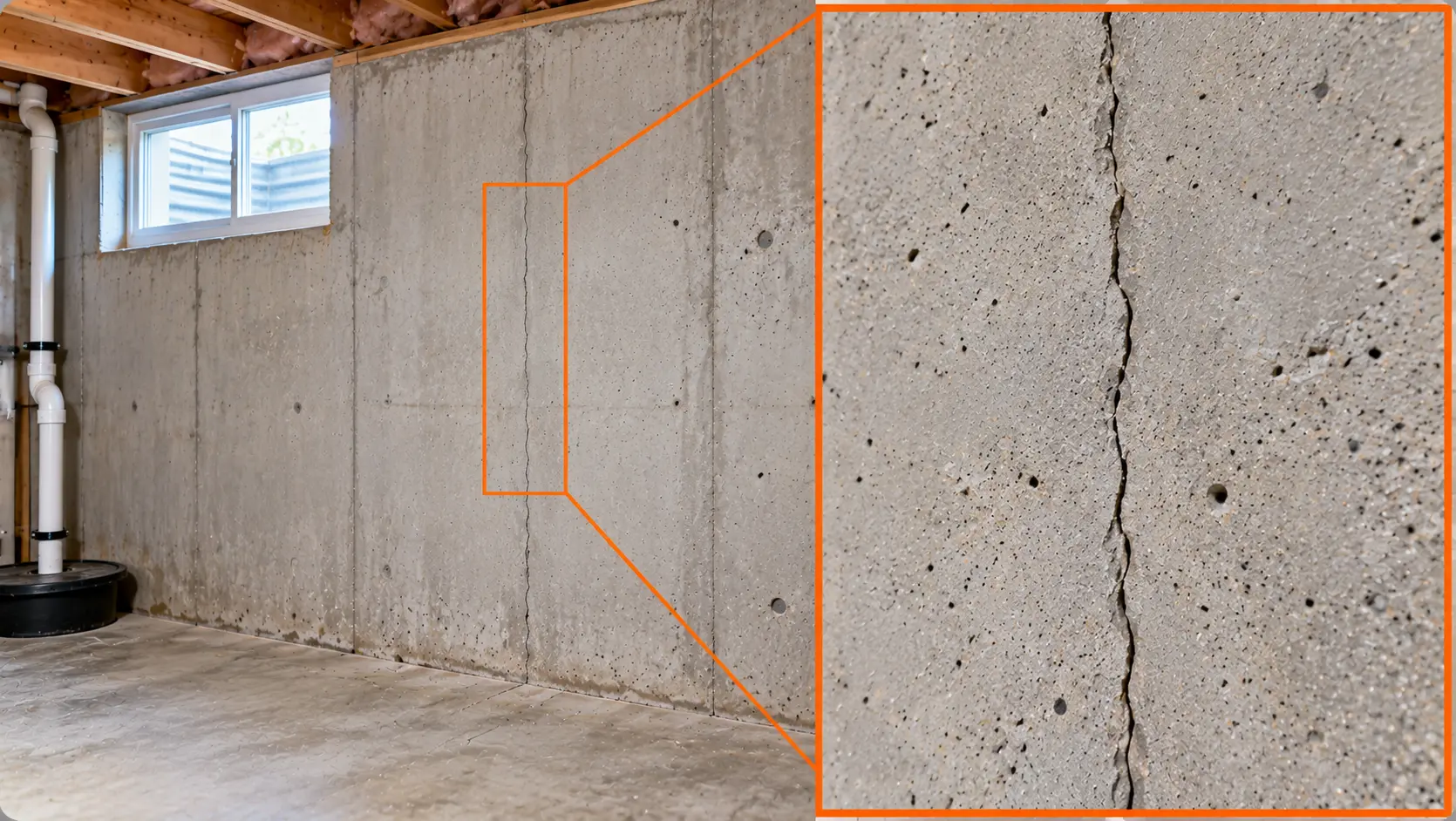
Vertical cracks often come from shrinkage or minor settlement, and many are not serious. Concrete Network notes they are often less concerning than horizontal or diagonal foundation cracks, though cause still matters.
Concern rises when a vertical crack is widening, has one side displaced, sits with foundation movement, leaks persistently, or extends into other parts of the building. Do not assume a vertical crack is always harmless.
When Should You Worry About Horizontal Cracks?
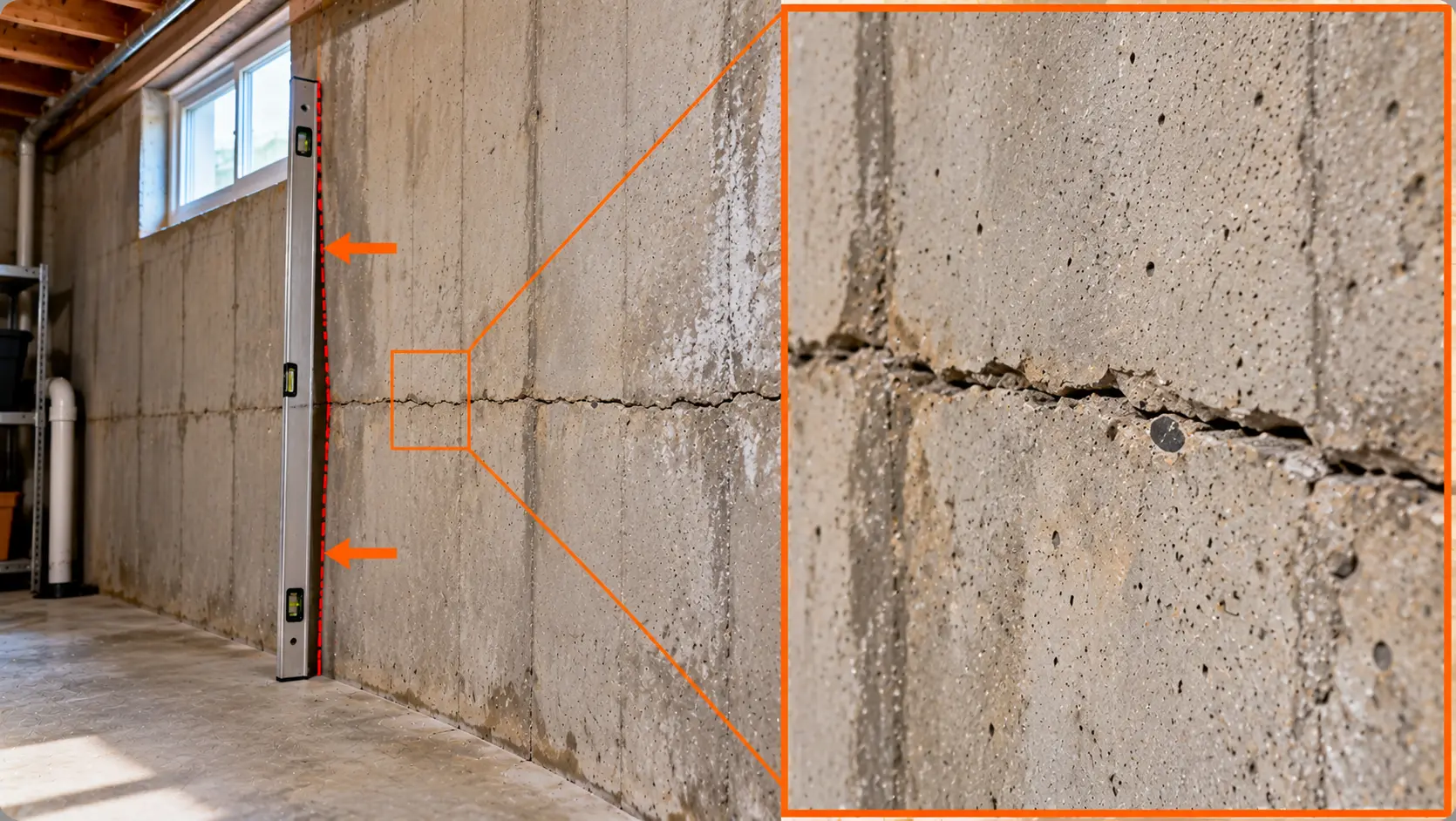
Horizontal cracks deserve extra attention, especially in basement walls. HUD’s inspection guide says sweeping or horizontal cracking in brick or concrete-block foundation walls may result from improper backfilling, vibration from heavy equipment or vehicles near the wall, or swelling or freezing and heaving of saturated soil.
That is not a diagnosis for every horizontal crack. It becomes much more concerning when the wall is also bowing inward, because HUD treats the associated bending as potentially serious.
If you see a horizontal crack with bowing, read How to Fix Structural Cracks in Walls after getting an evaluation.
When Should You Worry About Diagonal Cracks?
Diagonal cracks can come from differential settlement, shrinkage, or stress at openings. HUD notes that settlement cracking is most likely at corners and next to openings and usually follows a rough diagonal.
A crack that tapers, wider at one end, can hint at the direction of movement. It still does not prove a cause, so look for movement and other symptoms.
Stair-Step Cracks in Brick or Block Walls
Stair-step cracks follow the mortar joints of brick and concrete block walls. They can reflect differential movement or foundation settlement.
This is a masonry pattern. Do not use the term for poured-concrete walls, which crack in different ways.
Concern rises when stair-step cracks widen, spread, or come with displacement or leaning.
Cracks Around Doors and Windows
Cracks at door and window corners are common because stress concentrates there. Diagonal cracks that start at corners can be shrinkage or settlement.
- Diagonal cracks from corners.
- Sticking doors.
- Misaligned windows.
- Separation at trim.
Cracks plus functional changes matter more than plaster cracking alone. If a door that used to close now binds and a crack appears above it, take that combination seriously.
Ceiling-to-Wall and Interior Drywall Cracks
Drywall and ceiling cracks have many causes. These include framing movement, truss uplift, settlement, and temperature or humidity changes.
This guide focuses on concrete, so treat interior drywall cracks briefly. If they appear with foundation symptoms such as sloping floors or exterior cracking, look for movement. The table shows how common patterns relate to concern.
| Crack pattern | Possible explanations | What increases concern |
|---|---|---|
| Vertical | Shrinkage, settlement | Widening, offset, building movement |
| Horizontal | Shrinkage or lateral pressure | Wall bowing/leaning |
| Diagonal | Settlement, shrinkage, opening stress | Tapering + movement |
| Stair-step masonry | Differential movement | Progressive widening/displacement |
| Crack from door/window corner | Stress concentration or settlement | Sticking opening + movement |
| Multiple connected cracks | Broader movement/deterioration | Progression and distortion |
Is the Crack Getting Wider?
Change over time tells you more than one measurement. Set a baseline, then check again.
- Measure the width and write down the date.
- Photograph the crack with a ruler in the frame.
- Repeat from the same spot, using the same method.
A crack that stays the same is less worrying than one that grows. Use the table to see what width can and cannot tell you.
| Width observation | What it tells you | What it does NOT tell you |
|---|---|---|
| Hairline | Crack is visually small | Whether it is moving |
| Measurable narrow crack | Can establish baseline | Cause or structural significance |
| Wider crack | Deserves closer investigation | Automatic structural failure |
| Width increasing over time | Evidence of movement | Exact cause |
| Different width along crack | Possible movement pattern | Structural capacity |
| Crack with offset | Relative movement occurred | Full repair requirement |
For context, HUD’s NSPIRE foundation standard for assisted housing flags a foundation crack 1/4 inch or wider and 12 inches or longer as a deficiency. That is an inspection trigger, not a universal structural limit.
Does One Side of the Crack Stick Out Farther Than the Other?
Offset means the two faces of the crack are no longer flush. A crack with offset shows that one side has moved relative to the other.
That deserves more attention than a same-width crack with no offset. Check it by laying a straightedge across the crack, or by running a fingertip carefully across it and noting any step you can measure with a ruler.
Is the Wall Bowing, Bulging or Leaning?
A bowing, bulging, or leaning wall is one of the strongest warning signs. HUD illustrates horizontal cracking in bowed foundation walls under lateral pressure.
- Inward bowing in a basement wall.
- Outward leaning.
- Wall rotation.
- Bulging masonry.
Check with a long straightedge or a plumb line, and record the largest gap. Significant bowing needs professional evaluation.
Are Floors Sloping or Uneven?
Foundation movement can change floor elevations. One squeaky or uneven floor is not proof of anything.
A new or progressive floor slope that appears along with wall cracks is more significant. Roll a ball or use a level in the same spots over time to see whether things change.
Are Doors or Windows Sticking?
HUD recognizes sticking doors and windows as a possible sign accompanying settlement. They have other causes too, including humidity, paint buildup, and hardware problems.
The combination matters. A sticking door with no cracks and no floor change is probably not a foundation issue, while a sticking door with cracks and a sloping floor is a stronger signal.
Are There Gaps Between Walls, Floors or Ceilings?
Gaps can show relative movement. Look for baseboard gaps, wall-to-floor separation, trim gaps, cabinet separation, and framing movement.
Progression matters more than a single imperfection. A small gap that stays the same for years is different from one that keeps opening.
| Building symptom | Possible significance |
|---|---|
| Wall bowing | Lateral loading or structural deformation |
| Wall leaning | Movement/rotation |
| Sloping floor | Differential movement |
| Sticking doors/windows | Possible building distortion |
| Gaps at trim | Relative movement |
| Foundation settlement | Ground/support movement |
| Rust around concrete crack | Possible reinforcement corrosion |
| Spalling around crack | Concrete deterioration |
| Persistent leakage | Moisture pathway |
New Crack vs. Old Crack: Why Timing Matters
Timing changes how you read a crack. HUD offers a field test: a clean crack indicates recent movement, while a dirty or previously filled crack may be inactive.
HUD also stresses reading width against building age. A one-half-inch crack in a new building may signal rapid settlement, but in a building 50 years old it may reflect very slow movement of only about 1/100 of an inch per year.
In each case the cause and treatment may differ, so a recent or changing crack deserves more attention.
Cracks in a New House
New houses crack for ordinary reasons. Concrete shrinks as it dries, the soil beneath settles slightly, and different materials meet at transitions.
The Concrete Shrinkage Calculator gives background on shrinkage. Escalate when you see rapid widening, substantial displacement, several related symptoms, or bowing and leaning.
Cracks That Appear After Heavy Rain or Drought
Soil moisture changes can affect foundations. Swelling clay, drying shrinkage of soil, erosion, and drainage problems can all play a part.
A single storm or dry spell does not prove foundation damage. Look for a pattern of new cracks, movement, and building symptoms across seasons.
Cracks That Change With the Seasons
Some cracks open and close with the seasons. HUD notes that cyclical movements may take six months or more to measure, while daily movements can be recorded over a few days.
Recording readings through the year shows whether a crack simply breathes or keeps growing. That difference can change the diagnosis.
Basement and Foundation Wall Cracks
Basement and foundation walls face soil and water pressure. Lateral soil pressure, groundwater, settlement, frost heave, and shrinkage can all crack them.
Horizontal cracks with bowing, widening cracks, and cracks with leakage deserve evaluation. For repairs once concern is established, see How to Fix Structural Cracks in Walls.
The Foundation Wall Thickness Chart and Foundation Depth Chart give general background only.
Cracks in Load-Bearing Walls vs. Partition Walls
Location matters. A crack in a foundation wall, bearing wall, column, or beam connection deserves more careful evaluation than a finish crack in a non-load-bearing partition.
Do not try to work out load paths confidently without plans or professional help. If you are unsure which walls carry load, treat the crack as one that needs an expert opinion.
When Should You Worry About Water Coming Through a Crack?
Water through a crack is a problem even when the crack is not structurally severe. Repeated seepage can lead to damage, mold, and corrosion.
- Repeated seepage.
- Poor exterior drainage.
- Groundwater.
- Freeze-thaw damage.
- Corrosion risk.
Water leakage is a repair issue even when structural movement is not present. Find the water source before you seal the crack.
Efflorescence, Rust and Spalling Around Cracks
Deposits and staining around a crack tell a story. White efflorescence marks a moisture pathway, rust staining may point to reinforcement corrosion, and spalling means concrete has already come away.
- See Concrete Efflorescence for white deposits.
- See Concrete Spalling for material loss.
- See Concrete Delamination for hollow or separated concrete.
The Concrete Cover Chart explains why cover over steel matters. Each of these has its own guide, so this page keeps the discussion short.
How to Monitor a Wall Crack
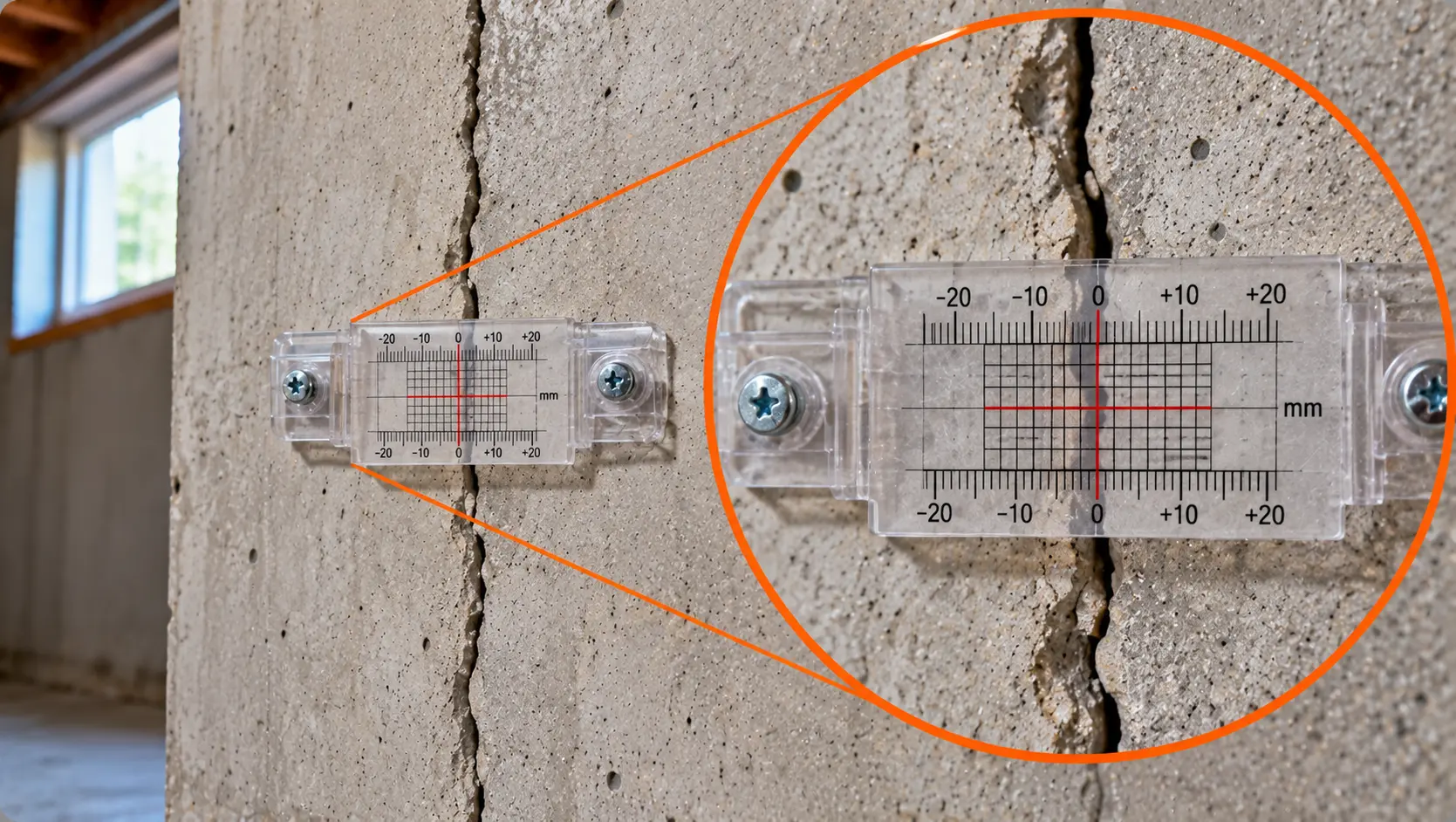
Monitoring turns a worry into data. HUD notes that a commercially available joint movement indicator, fastened over the crack with a scribe that records movement, can track change over time.
- Photograph the crack with a ruler in the frame.
- Record the date.
- Measure the width.
- Check for face offset.
- Measure wall plumbness where practical.
- Note nearby building symptoms.
- Repeat from the same reference points.
| Inspection item | Record |
|---|---|
| Date | ____ |
| Crack location | ____ |
| Orientation | Vertical / horizontal / diagonal |
| Maximum width | ____ |
| Face offset | ____ |
| Crack length | ____ |
| Wall bow/plumb measurement | ____ |
| Water leakage | Yes / No |
| Doors/windows sticking | Yes / No |
| Floor slope/change | ____ |
| New cracks nearby | Yes / No |
| Photo reference | ____ |
Repeated measurements from the same reference points reveal more than a single crack-width measurement.
When deciding whether to worry about a wall crack, movement and related building symptoms matter more than crack width alone.
When Should You Call a Structural Engineer?
Call a structural engineer when any of these apply:
- The crack is actively widening.
- There is measurable offset.
- The wall is bowing or leaning.
- There is substantial differential settlement.
- Several related structural symptoms appear.
- A structural member is cracked.
- The foundation looks undermined.
- You are unsure before a major repair or a home purchase.
HUD’s NSPIRE structural standard treats signs of serious structural failure that may threaten residents’ safety as a significant deficiency. For a home purchase, hire an independent engineer, not only a repair company that profits from the work.
| Situation | Appropriate professional |
|---|---|
| Cosmetic stable crack | Qualified repair contractor/DIY as appropriate |
| Cause uncertain | Building inspector or structural professional |
| Wall bowing/displacement | Structural engineer |
| Differential settlement | Structural engineer; geotechnical engineer if soil-related |
| Major foundation movement | Structural/foundation professional |
| Water intrusion only | Waterproofing/drainage specialist after diagnosis |
| Structural crack requiring engineered repair | Structural engineer + qualified repair contractor |
| Home-purchase concern | Independent structural engineer rather than repair sales estimate alone |
If the crack proves cosmetic, see How to Repair Cracks in Concrete Walls Before Painting. For other repairs, read How to Fix Cracked Concrete, and for a broader view of causes, Why Is My Concrete Cracking?.
Only once a crack is confirmed suitable for filling should you estimate material with the Concrete Crack Filler Calculator. Budget options include the Concrete Repair Cost Calculator and the House Leveling Cost Calculator.
What Happens During a Professional Crack Inspection?
A professional inspection is more than a glance at the crack. Depending on the case, you can expect:
- Site and building history.
- Crack mapping.
- Wall plumb checks.
- A floor-elevation survey.
- A drainage assessment.
- A foundation inspection.
- Monitoring.
- Structural calculations.
- A geotechnical investigation where needed.
USACE emphasizes evaluating the structure and relating observed distress to its underlying mechanism before choosing a repair. ACI 224.1R takes the same cause-first approach, and USACE advises that a significant isolated crack should be referred to a structural engineer.
Wall Crack FAQs
What size wall crack should I worry about?
There is no single size. Movement, offset, bowing, and related symptoms matter more than width. HUD notes a 1/2 inch crack can mean very different things in a new versus an old building.
Are hairline wall cracks normal?
Often yes. Fine shrinkage cracks are common. Check that they are not widening and that nothing else in the building is changing.
Are horizontal cracks always serious?
No, but they deserve extra attention, especially with inward bowing or soil pressure. Have them evaluated if the wall is deformed.
Are vertical foundation cracks dangerous?
Many are shrinkage or minor settlement and not dangerous. Concern rises with widening, offset, leakage, or building movement.
When is a diagonal crack structural?
When it is tapering, widening, offset, or paired with settlement signs such as sticking doors and sloping floors. Pattern alone does not decide it.
How do I know if a crack is moving?
Measure it over time from fixed reference points, use a crack gauge or joint movement indicator, and compare dated photographs.
Should I repair a crack before monitoring it?
Usually monitor first when the condition is not urgent, because repair can hide evidence of movement. Do not delay evaluation for dangerous conditions.
Can water through a crack cause structural damage?
Over time, yes, through corrosion, freeze-thaw, and soil pressure effects. Water leakage is a repair issue even without structural movement.
Do sticking doors mean foundation failure?
Not by themselves. Humidity and hardware also cause sticking. Together with cracks and sloping floors, they point to possible building movement.
Who should inspect a structural wall crack?
A structural engineer, with a geotechnical engineer added if soil is involved. For a home purchase, use an independent engineer.