
Concrete Formula Calculation: Volume Equation, Mix Ratio & Examples

Concrete Formula Calculation
Every core formula for calculating concrete volume by shape, converting units, ordering quantity, and understanding how mix proportioning actually works.
Quick Answer
The basic concrete volume formula is V = L × W × D, where L is length, W is width, and D is depth or thickness, all in the same unit. For a rectangular concrete element, convert to cubic yards with:
Cubic yards = (L × W × D) ÷ 27, when all dimensions are in feet.
Quick Example
A 10 ft × 20 ft slab at 4 inches thick.
4 ÷ 12 = 0.333 ft
10 × 20 × 0.333 = 66.6 ft³
66.6 ÷ 27 ≈ 2.47 yd³
This formula applies to rectangular concrete elements such as slabs, footings, walls, pads, and many other simple forms. Other shapes, such as circular slabs or round columns, use a different formula, covered later in this guide.
In This Guide
- Concrete Formula Calculator
- What Is the Concrete Volume Formula?
- Why Concrete Is Calculated in Cubic Yards
- How to Convert Inches to Feet for Concrete Calculations
- How to Calculate Concrete for a Slab
- How to Calculate Concrete for a Driveway
- How to Calculate Concrete for a Patio
- How to Calculate Concrete for a Footing
- How to Calculate Concrete for a Wall
- How to Calculate Concrete for a Circular Slab
- How to Calculate Concrete for a Round Column or Pier
- How to Calculate Concrete for Square or Rectangular Columns
- How to Calculate Concrete for Steps and Stairs
- How to Calculate Concrete for Triangular or Sloped Forms
- How to Calculate Concrete for Irregular Shapes
- How to Calculate Concrete for Multiple Sections
- How to Calculate Concrete in Cubic Yards
- Concrete Volume Conversion: Cubic Feet, Cubic Yards and Cubic Meters
- How to Calculate Concrete Bags
- How to Calculate Concrete Order Quantity
- How Much Concrete Overage Should You Add?
- How to Calculate Concrete Weight
- Concrete Mix Ratio: What Does 1:2:4 Mean?
- Concrete Mix Proportioning vs. Nominal Mix Ratio
- Concrete Absolute Volume Formula
- How to Calculate the Water-Cementitious Materials Ratio
- How Concrete PSI Relates to Mix Calculations
- How Slump Relates to Concrete Calculations
- Worked Example: 12 × 16 ft Concrete Patio
- Worked Example: 60-ft Continuous Footing
- Worked Example: Round Concrete Pier
- Worked Example: Irregular L-Shaped Slab
- Common Concrete Calculation Mistakes
- How to Check Your Concrete Calculation
- When a Concrete Calculation Needs Professional Review
- Concrete Formula Quick Reference
- Concrete Formula FAQs
Concrete Formula Calculator
Once you understand the formulas in this guide, apply them instantly with the Concrete Calculator or the Concrete Volume Calculator. Both show the underlying inputs, base volume, cubic feet, and cubic yard conversion, so you can see exactly how the result was reached rather than trusting a black box.
For yardage-specific planning, see the Concrete Cubic Yard Calculator, and for converting a calculated volume into bags, see the Yards to Bags Calculator.
What Is the Concrete Volume Formula?
The Basic Rectangular Volume Formula
V = L × W × D
Where V is volume, L is length, W is width, and D is depth or thickness. All three dimensions must be expressed in the same unit before multiplying.
This formula works because volume is simply the three-dimensional space a rectangular solid occupies. Multiplying length by width gives you the area of the surface, and multiplying that area by depth extends it into the third dimension, giving you the total space the concrete needs to fill.
Why Concrete Is Calculated in Cubic Yards
Ready-mix concrete in the United States is purchased and delivered by the cubic yard, so converting your calculated volume into cubic yards is the essential final step before ordering.
The Cubic Yard Conversion
1 yd³ = 27 ft³
yd³ = ft³ ÷ 27
This single conversion factor appears throughout every calculation in this guide, since every shape formula ultimately produces a result in cubic feet that then needs to be divided by 27.
How to Convert Inches to Feet for Concrete Calculations
Thickness and depth are almost always measured in inches, but the volume formula requires feet. Skipping this conversion, or doing it incorrectly, is one of the most common calculation errors.
Inches to Feet Formula
Dft = Din ÷ 12
| Thickness (in) | Decimal Feet |
|---|---|
| 2 in | 0.167 |
| 3 in | 0.250 |
| 4 in | 0.333 |
| 5 in | 0.417 |
| 6 in | 0.500 |
| 8 in | 0.667 |
| 10 in | 0.833 |
| 12 in | 1.000 |
How to Calculate Concrete for a Slab
V = L × W × T, then yd³ = V ÷ 27
Example: 12 × 16 ft Slab at 4 Inches
4 ÷ 12 = 0.333 ft
12 × 16 × 0.333 = 63.94 ft³
63.94 ÷ 27 ≈ 2.37 yd³
How to Calculate Concrete for a Driveway
Driveways are rarely a perfect rectangle in practice. Measure the total length, and check whether the width stays consistent along the whole run.
If the width varies, divide the driveway into rectangular sections, calculate each section’s volume separately, and add the results together. Don’t assume a driveway is a perfect rectangle just because it looks close to one from a distance. Use the Driveway Calculator to handle this calculation directly.
How to Calculate Concrete for a Patio
A simple rectangular patio uses the same L × W × T formula as a slab. Rounded, curved, or multi-section patios need different handling.
For a rounded patio, use the circular slab formula covered later in this guide. For an irregular patio shape, divide it into simple rectangular or circular sections and add the volumes together. See the Patio Calculator for project-specific calculations.
How to Calculate Concrete for a Footing
V = L × W × D
For multiple identical footings: Vtotal = Vone × N, where N is the number of footings.
This Calculates Volume, Not Required Dimensions
This formula tells you how much concrete a footing of a given size requires. It does not determine the footing width, depth, or thickness your project actually needs, which depends on load, soil bearing capacity, frost depth, and applicable code. See the Footing Size Chart and Concrete Footing Guide for that determination.
How to Calculate Concrete for a Wall
V = L × H × T
Convert thickness to feet before multiplying. If the wall has significant openings, such as a large doorway, subtract that opening’s volume from the total where the omission would meaningfully affect your order.
For a wall built in multiple segments of different heights or thicknesses, calculate each segment separately and add the volumes together.
Example: Foundation Wall
A wall 40 ft long, 4 ft high, 8 inches thick (0.667 ft).
40 × 4 × 0.667 = 106.7 ft³
106.7 ÷ 27 ≈ 3.95 yd³
How to Calculate Concrete for a Circular Slab
V = πr²T, where r = D ÷ 2
Example: 12-ft Diameter Circular Patio, 4 Inches Thick
r = 12 ÷ 2 = 6 ft
T = 4 ÷ 12 = 0.333 ft
V = π × 6² × 0.333 ≈ 37.7 ft³
37.7 ÷ 27 ≈ 1.40 yd³
How to Calculate Concrete for a Round Column or Pier
V = πr²h
The Most Common Mistake With Round Shapes
The formula requires the radius, not the diameter. Radius is half the diameter. Using the full diameter in place of the radius produces a volume four times too large. Always divide the diameter by two before squaring it.
How to Calculate Concrete for Square or Rectangular Columns
V = L × W × H
For multiple columns: Vtotal = Vone × N
How to Calculate Concrete for Steps and Stairs
Stairs are a composite shape, and no single simple equation, such as “tread times riser times width times number of steps,” reliably captures every real stair geometry. Three practical approaches work better:
- Method 1: calculate each individual step as its own small rectangular volume, then add them together
- Method 2: treat the overall stair profile as a series of stacked rectangular prisms and sum their volumes
- Method 3: use a dedicated stair calculator built to handle the specific geometry, including landings and side forms
The Stairs Calculator is built specifically to handle this step-by-step breakdown.
How to Calculate Concrete for Triangular or Sloped Forms
Triangle area: A = (B × H) ÷ 2
Then: V = A × L
This approach is useful for triangular slab sections, sloped forms, ramps, and tapered elements where the cross-section is a triangle extended along a length.
How to Calculate Concrete for Irregular Shapes
Break, Calculate, Add or Subtract
Break a complex shape into simpler rectangles, circles, or triangles. Calculate each piece’s volume separately, then combine them.
Total volume = Rectangle A + Rectangle B − Rectangle C (when subtracting a cutout or opening)
This is one of the most broadly useful calculation techniques in this entire guide, since almost any real-world footprint can be approximated this way.

How to Calculate Concrete for Multiple Sections
Vtotal = V1 + V2 + V3 + …
This applies to stepped foundations, irregular patios, L-shaped slabs, multiple separate footings, and disconnected pads poured as one project. Calculate every distinct section on its own, then total the results.
How to Calculate Concrete in Cubic Yards
The Complete Formula
yd³ = (L(ft) × W(ft) × D(ft)) ÷ 27
For flatwork where thickness is in inches, you can skip the separate conversion step using the shortcut yd³ = (L × W × T(in)) ÷ 324, since 12 × 27 = 324.
Concrete Volume Conversion: Cubic Feet, Cubic Yards and Cubic Meters
1 yd³ = 27 ft³
1 m³ ≈ 35.315 ft³
1 yd³ ≈ 0.7646 m³
U.S. concrete ordering is based on cubic yards. Metric conversions are useful for reference or international comparison, but keep cubic yards as your primary working unit for any U.S. ready-mix order.
How to Calculate Concrete Bags
Number of bags = Required volume ÷ Yield per bag
Use the Yield Printed on Your Specific Product
Bag yield varies by manufacturer and product line. Common categories include 40-lb, 50-lb, 60-lb, and 80-lb bags, but these are product categories, not universal yields. Always check the yield printed on the actual bag you’re buying rather than assuming a fixed cubic-foot figure applies to every product in that weight class.
| Bag Category | What to Check |
|---|---|
| 40 lb | Manufacturer’s printed yield in cubic feet |
| 50 lb | Manufacturer’s printed yield in cubic feet |
| 60 lb | Manufacturer’s printed yield in cubic feet |
| 80 lb | Manufacturer’s printed yield in cubic feet |
How to Calculate Concrete Order Quantity
Keep two numbers conceptually separate: your theoretical calculated volume, and your practical order quantity. The calculated volume comes directly from the geometric formulas in this guide.
The practical order quantity may differ from that number based on uneven excavation, form tolerances, waste and spillage during placement, pump or placement losses, and irregular geometry that’s hard to measure with complete precision. The final order should also follow your supplier’s available increments and minimum load policies, which vary by supplier and region rather than following one fixed rule.
How Much Concrete Overage Should You Add?
There Is No Universal “Always Add 10 Percent” Rule
An overage allowance may be appropriate for your project, but the right percentage depends on the accuracy of your dimensions, whether the form is irregular, excavation and subgrade conditions, whether the concrete will be pumped, project size, and site accessibility. A small, precisely formed slab may need very little overage, while a large pour with uneven excavation may reasonably need more. Decide the allowance based on your project’s actual conditions rather than applying one fixed percentage to every job.
How to Calculate Concrete Weight
Weight Formula
W = ρ × V
Where W is weight, ρ (rho) is density, and V is volume.
Density Is Not One Universal Number
Concrete density varies by type: normal-weight concrete, lightweight concrete, and heavyweight concrete all use different density values, and density also varies with the specific aggregate used. Don’t apply one density figure as a universal engineering value; use the density appropriate to your specific concrete mix. The Concrete Weight Calculator handles this calculation with adjustable density inputs.
Concrete Mix Ratio: What Does 1:2:4 Mean?
A nominal mix ratio such as 1:2:4 describes the relative proportions of cement, fine aggregate, and coarse aggregate, in that order, typically by volume in simplified educational descriptions. In this example, for every one part cement, the mix uses two parts fine aggregate and four parts coarse aggregate.
A Nominal Ratio Does Not Guarantee a Specific PSI
Nominal ratios like 1:2:4 are simplified educational descriptions of proportion, not a guarantee that the resulting concrete will reach any particular compressive strength. A 1:2:4 mix should not be presented as automatically producing 3,000 psi concrete, since actual strength depends on the water content, cementitious material quality, aggregate characteristics, air content, and other mixture variables working together, not the nominal ratio alone. For reference nominal ratios, see the Concrete Mix Ratio Chart.
Concrete Mix Proportioning vs. Nominal Mix Ratio
| Volume Calculation | Mix Proportioning |
|---|---|
| Determines quantity | Determines ingredient proportions |
| Geometry-based | Materials- and performance-based |
| Uses L × W × D | Uses absolute-volume proportioning procedure |
| Usually straightforward for homeowners | Requires engineering-level mixture design considerations |
ACI’s current concrete proportioning guide, ACI PRC-211.1-22, describes mixture proportioning as a process built around calculations based on the absolute volumes occupied by the mixture’s constituents, considering strength, workability, durability, aggregate gradation, air content, admixtures, and supplementary cementitious materials, with trial-batch adjustment refining the final proportions.
The Core Distinction This Guide Teaches
Concrete volume calculation is a mathematical quantity problem: how much space does the concrete need to fill? Concrete mix proportioning is a materials-engineering problem: what should the mixture actually contain to meet specified strength, workability, and durability requirements? These are related but genuinely different questions.
Concrete Absolute Volume Formula
Professional mix proportioning uses the absolute volume method, where the total volume of fresh concrete equals the sum of the absolute volumes of its individual ingredients.
The Conceptual Equation
Vconcrete = Vcementitious + Vwater + Vaggregate + Vair + Vadmixtures
Each ingredient’s absolute volume is calculated from its mass and specific gravity, following the relationship documented in ACI’s aggregate and mixture-proportioning guidance:
Absolute Volume Formula
V = W ÷ (SG × ρw)
Where V is absolute volume, W is the material’s mass, SG is its specific gravity, and ρw is the density of water, 62.4 lb/ft³ when working in pounds and cubic feet.
For example, 400 lb of portland cement with a specific gravity of 3.15 occupies an absolute volume of 400 ÷ (3.15 × 62.4) ≈ 2.04 ft³. Professional mix designers use this principle to solve for the missing aggregate quantity once cement, water, air, and admixture volumes are known, following the eight-step procedure described in ACI PRC-211.1-22.
This Explains the Principle, Not a Full Mix Design Tutorial
This section explains the underlying concept behind professional mixture proportioning. It is not a substitute for following ACI 211.1’s complete procedure. If you need an actual mix design, work from the full ACI guide or consult a qualified concrete materials professional.
How to Calculate the Water-Cementitious Materials Ratio
Correct Formula
w/cm = mass of water ÷ mass of cementitious materials
Example
400 lb water, 800 lb cementitious materials (cement plus any supplementary materials)
w/cm = 400 ÷ 800 = 0.50
ACI and industry sources are consistent on this point: water-cementitious materials ratio is a mass ratio, the mass of mixing water divided by the mass of cementitious material, not a volume-to-weight calculation like gallons divided by pounds. Mixing water in this calculation excludes water absorbed by the aggregate.
w/cm Is Not a Direct PSI Conversion
Lower w/cm generally supports higher strength, but there is no fixed universal table where a specific w/cm value guarantees a specific PSI. Strength depends on the complete mixture and production process, not w/cm in isolation. See the Water-Cement Ratio Chart for reference ranges, and treat any figure there as illustrative rather than a guaranteed outcome.
How Concrete PSI Relates to Mix Calculations
PSI describes specified compressive strength, verified through standardized cylinder testing at a designated age, commonly 28 days. It’s connected to, but not simply derived from, mixture proportioning, water-cementitious ratio, curing conditions, and testing procedure.
Avoid any table that claims “Mix X automatically equals PSI Y.” The actual strength a mix achieves depends on the full mixture and how it’s produced, placed, and cured, not a nominal ratio alone. For a complete discussion of PSI selection and testing, see the Concrete PSI Guide and Concrete PSI Chart.
How Slump Relates to Concrete Calculations
Slump measures the consistency of fresh concrete, meaning how workable or fluid it is, not its compressive strength. Adding water on-site to increase slump changes the water-cementitious ratio and can reduce strength and durability, moving the mix outside its designed proportions.
Water-reducing admixtures can improve workability without simply adding water, which is why professional mix adjustments favor admixtures over ad hoc water addition. See the Concrete Slump Test Procedure for how slump is actually measured and verified in the field.
Worked Example: 12 × 16 ft Concrete Patio
Given
A patio 12 ft × 16 ft, 4 inches thick.
Step 1: Convert thickness
4 ÷ 12 = 0.333 ft
Step 2: Calculate cubic feet
12 × 16 × 0.333 = 63.94 ft³
Step 3: Convert to cubic yards
63.94 ÷ 27 ≈ 2.37 yd³
Step 4: Consider overage
Apply an allowance appropriate to your site conditions, not a fixed universal percentage.
Step 5: Confirm with your supplier
Verify the final order quantity against your supplier’s ordering increments and minimum load policy before scheduling delivery.
Worked Example: 60-ft Continuous Footing
Given
A continuous footing 60 ft long, 1.5 ft wide, 0.5 ft thick.
Calculation
60 × 1.5 × 0.5 = 45 ft³
45 ÷ 27 ≈ 1.67 yd³
These example dimensions are for volume calculation only. Actual footing width, depth, and thickness must come from your project’s applicable design or code requirements, not this illustrative example.
Worked Example: Round Concrete Pier
Given
4 round piers, each 18 inches (1.5 ft diameter, 0.75 ft radius), 4 ft deep.
One pier
V = π × 0.75² × 4 ≈ 7.07 ft³
All 4 piers
7.07 × 4 ≈ 28.27 ft³
28.27 ÷ 27 ≈ 1.05 yd³
Worked Example: Irregular L-Shaped Slab
Given
An L-shaped slab divided into two rectangles: Section A at 12 ft × 10 ft, and Section B at 6 ft × 8 ft, both 4 inches thick.
Section A
12 × 10 × 0.333 = 39.96 ft³
Section B
6 × 8 × 0.333 = 15.98 ft³
Total
39.96 + 15.98 = 55.94 ft³
55.94 ÷ 27 ≈ 2.07 yd³
Common Concrete Calculation Mistakes
| Mistake | Consequence | Correction |
|---|---|---|
| Mixing inches and feet | Volume off by a factor of roughly 12 | Always convert thickness to feet first |
| Forgetting to divide by 27 | Result stays in cubic feet, not cubic yards | Always convert cubic feet to cubic yards before ordering |
| Using diameter instead of radius | Volume roughly 4 times too large | Divide diameter by 2 before squaring |
| Using the wrong shape formula | Incorrect volume for the actual geometry | Match the formula to the true shape |
| Forgetting multiple sections | Undercounts total volume | Calculate and sum every distinct section |
| Ignoring significant openings | Overstates volume for walls with large openings | Subtract opening volume when it meaningfully affects the order |
| Confusing area with volume | Square footage treated as if it were cubic footage | Always multiply by thickness to get true volume |
| Treating bag yield as universal | Wrong bag count for the actual product | Use the yield printed on your specific bag |
| Assuming a universal waste percentage | Over- or under-orders relative to actual site conditions | Base overage on your specific project conditions |
| Confusing volume calculation with structural design | Assumes the formula also determines required dimensions | Get structural dimensions from design/code, not the volume formula |
| Confusing mix ratio with guaranteed PSI | Assumes a nominal ratio equals a specific strength | Verify strength through actual testing, not the nominal ratio |
| Using mass and volume inconsistently | Errors in w/cm and mix calculations | Keep mass-based and volume-based quantities clearly separate |
How to Check Your Concrete Calculation
- Check units. Are all dimensions in compatible units before multiplying?
- Check the geometry. Does the shape you calculated actually match the real project?
- Check scale. Does the cubic-yard result make sense relative to the project’s visible size?
- Check completeness. Did you calculate every section of a multi-part project?
- Check openings. Did you account for any significant openings or cutouts?
- Check overage. Did you apply an allowance appropriate to your actual site conditions?
- Check bag yield or supplier rules. Did you verify the specific product yield or your supplier’s ordering policy?
- Check the specification. Did you confirm mix requirements against the actual project specification, not a generic online figure?
When a Concrete Calculation Needs Professional Review
Simple volume calculations are usually straightforward enough for a homeowner or contractor to handle confidently. Professional review becomes important when the calculation involves structural dimensions, footing sizing, load capacity, structural concrete design, reinforcement design, mixture design for specified performance requirements, durability or exposure requirements, unusual geometry, or large commercial pours.
ACI’s own proportioning guidance notes that it is intended for use by individuals competent to evaluate its significance and limitations, and to take responsibility for its application. That’s a reasonable standard to apply to your own work as well: know where your calculation ends and where professional design begins.
Concrete Formula Quick Reference
| Shape | Formula |
|---|---|
| Rectangular slab | L × W × T |
| Wall | L × H × T |
| Footing | L × W × D |
| Circular slab | πr²T |
| Round column | πr²H |
| Rectangular column | L × W × H |
| Triangle / sloped section | ½BH × L |
| Cubic feet to cubic yards | ÷ 27 |
Concrete Formula FAQs
What is the basic formula for calculating concrete?
V = L × W × D, where all dimensions are in the same unit, typically feet. This gives volume in cubic feet, which is then divided by 27 to get cubic yards.
How do you calculate cubic yards of concrete?
Calculate the volume in cubic feet using the appropriate shape formula, then divide by 27, since one cubic yard equals 27 cubic feet.
Why do you divide concrete volume by 27?
Because one cubic yard equals exactly 27 cubic feet, and ready-mix concrete in the U.S. is ordered and delivered by the cubic yard.
How do you calculate concrete for a slab?
Multiply length by width by thickness, with thickness converted from inches to feet, to get cubic feet, then divide by 27 for cubic yards.
How do you calculate concrete for a footing?
Use V = L × W × D for the footing’s volume. For multiple identical footings, multiply one footing’s volume by the total number of footings.
How do you calculate concrete for a wall?
Use V = L × H × T, with thickness converted to feet, then divide by 27 for cubic yards.
How do you calculate concrete for a round column?
Use V = πr²h, where r is the radius (half the diameter) and h is the height, both in feet.
How do you calculate concrete for a circular slab?
Use V = πr²T, where r is the radius and T is the thickness, both in feet, then divide by 27.
How do you calculate concrete bags?
Divide the required volume by the yield printed on the specific bag you’re using, since yield varies by manufacturer and product.
How much extra concrete should I order?
There is no universal percentage. The right overage depends on your dimensional accuracy, site conditions, form irregularity, and accessibility, so base it on your specific project rather than a fixed rule.
How do you convert inches to feet for concrete calculations?
Divide the measurement in inches by 12. For example, 4 inches divided by 12 equals 0.333 feet.
What is the concrete mix ratio formula?
A nominal mix ratio like 1:2:4 describes relative proportions of cement, fine aggregate, and coarse aggregate. It’s a simplified educational description, not a guaranteed strength specification.
Does a 1:2:4 mix equal 3,000 PSI?
Not reliably. A nominal ratio does not guarantee a specific compressive strength, since actual strength depends on water content, cementitious material, aggregate, air content, and other mixture factors together, not the ratio alone.
How do you calculate water-cement ratio?
Divide the mass of water by the mass of cementitious materials: w/cm = mass of water ÷ mass of cementitious materials. This is a mass ratio, not gallons divided by pounds.
What is the difference between concrete volume and mix design?
Volume calculation determines how much concrete fills a given geometric space. Mix design, or proportioning, determines what the concrete mixture itself should contain to meet specified strength, workability, and durability requirements. These are different problems solved with different methods.
How do you calculate concrete weight?
Multiply density by volume: W = ρ × V. Use the density appropriate to your specific concrete type, since normal-weight, lightweight, and heavyweight concrete all differ.
Can I calculate concrete for an irregular shape?
Yes. Break the shape into simpler rectangles, circles, or triangles, calculate each piece’s volume separately, and add or subtract them as needed for the actual geometry.
How do I know if my concrete calculation is correct?
Check that your units are consistent, your geometry matches the real project, the result seems reasonable for the project’s scale, you’ve included every section, and you’ve verified bag yield or supplier requirements against actual product and order data.
Apply These Formulas Instantly
Skip the manual math and get an accurate volume, yardage, and bag count for your specific project.
Use the Concrete Calculator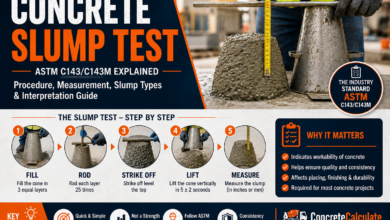




3 Comments