
Types of Cracks in Walls: Patterns, Causes and Warning Signs
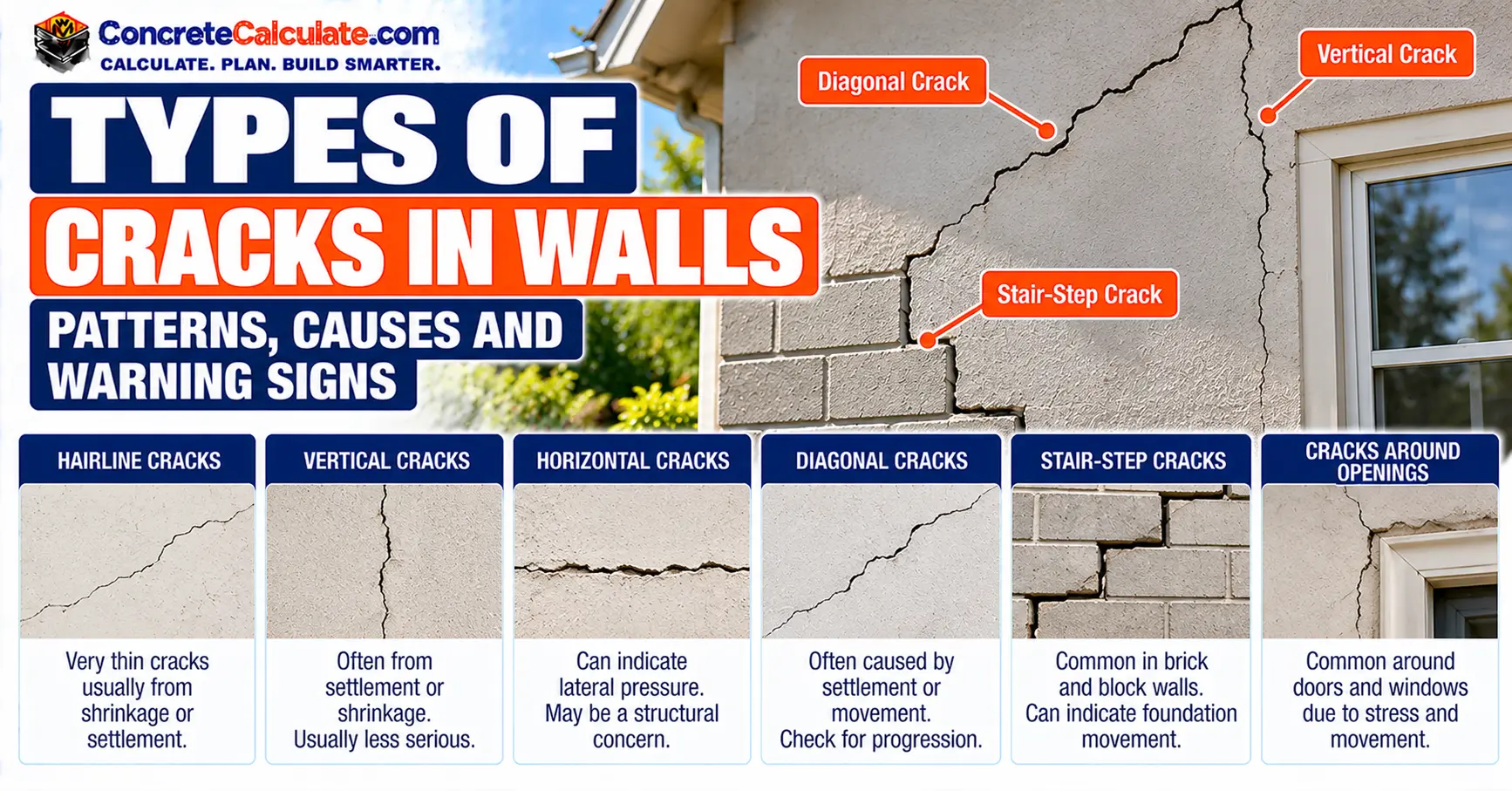
Types of Cracks in Walls
Classify a wall crack by pattern, behavior, material, location and building symptoms, then move on to the right guide for concern level, structural repair or cosmetic repair.
What Are the Main Types of Cracks in Walls?
Wall cracks fall into a handful of visible types: hairline, vertical, horizontal, diagonal, stair-step, map or crazing, cracks around doors and windows, and cracks that come with wall bowing or displacement.
Crack shape tells you where to investigate, but it does not establish the cause by itself. The table and atlas below list each type, what can cause it, and what to check next.
Common wall crack patterns and the conditions that should be checked before deciding what they mean.
| Crack type | Typical appearance | Possible causes | What to check next |
|---|---|---|---|
| Hairline | Very fine line | Shrinkage, finish movement | Growth, moisture |
| Vertical | Mostly up/down | Shrinkage, settlement, thermal movement | Offset, progression |
| Horizontal | Side-to-side | Lateral pressure, wall bending, construction effects | Wall bow |
| Diagonal | Angled | Settlement, restraint, opening stress | Taper, building distortion |
| Stair-step | Follows masonry joints | Settlement, shrinkage, masonry movement | Foundation movement |
| Map/crazing | Fine interconnected network | Surface shrinkage/finish issue or deterioration | Depth and material condition |
| Around opening | Starts at door/window corner | Stress concentration, settlement | Opening alignment |
| Crack with offset | Faces no longer flush | Differential movement | Structural evaluation |
Why Wall Crack Pattern Alone Does Not Tell You the Cause
Two cracks with the same shape can come from different causes. ACI 224.1R and USACE both stress that a crack is a symptom, and the mechanism behind it decides the repair.
- A diagonal crack in a concrete block wall can come from block shrinkage or from settlement.
- A vertical shrinkage crack can look like one from differential settlement.
- A horizontal crack from construction effects can look like one from lateral soil pressure.
HUD’s inspection guide discusses shrinkage cracking in concrete-block foundation walls alongside settlement cracking, which is why context, such as movement and the rest of the building, matters.
How to Describe a Wall Crack Correctly
Good descriptions make diagnosis easier. Record these details for any crack:
- Direction.
- Length.
- Width.
- Taper, meaning wider at one end.
- Depth or continuity, where visible.
- Displacement.
- Location on the wall.
- Moisture.
- Deformation of the adjacent wall.
Later sections use these terms. A description like “vertical, 4 feet long, tapering, with a small offset near the floor” tells a professional far more than “a big crack.”
Stable, Active and Cyclical Cracks
Behavior is one of the most useful ways to classify a crack. ACI treats whether a crack is active or dormant as an important consideration when choosing repairs.
- Stable or dormant: little or no ongoing change.
- Active: still widening, extending, or moving.
- Cyclical: opens and closes with temperature or seasons.
HUD notes that cracks may open and close seasonally and describes joint movement indicators for documenting behavior. USACE adds that a crack of unknown cause should be treated as active.
| Behavior | What it means | Typical action |
|---|---|---|
| Dormant/stable | No meaningful ongoing movement | Repair/monitor depending on function |
| Active | Continues widening, extending or moving | Diagnose cause before rigid repair |
| Cyclical | Opens/closes repeatedly | Identify seasonal/thermal mechanism |
| Progressive | Worsening over time | Professional evaluation |
| Repaired but reopening | Movement persists or repair incompatible | Reassess cause |
Structural vs. Nonstructural Wall Cracks
A screening-level split helps. Nonstructural cracks mainly affect appearance, water resistance, and durability. Structural concern rises when cracking comes with displacement, bowing, load-path problems, or foundation movement.
Do not classify by width alone. FEMA’s structural training notes that most normal concrete develops narrow, hairline cracks from shrinkage, temperature change, and predictable structural behavior, so some cracking is expected.
To decide how worried to be, read When to Worry About Cracks in Walls.
Hairline Cracks in Walls
Hairline cracks are very fine, and they are the most common. They include fine shrinkage cracks, finish-coat cracks, early concrete shrinkage, and temperature effects.
They deserve more attention when they keep growing, leak, spread over a wide area, show signs of reinforcement corrosion, or sit in a structural member.
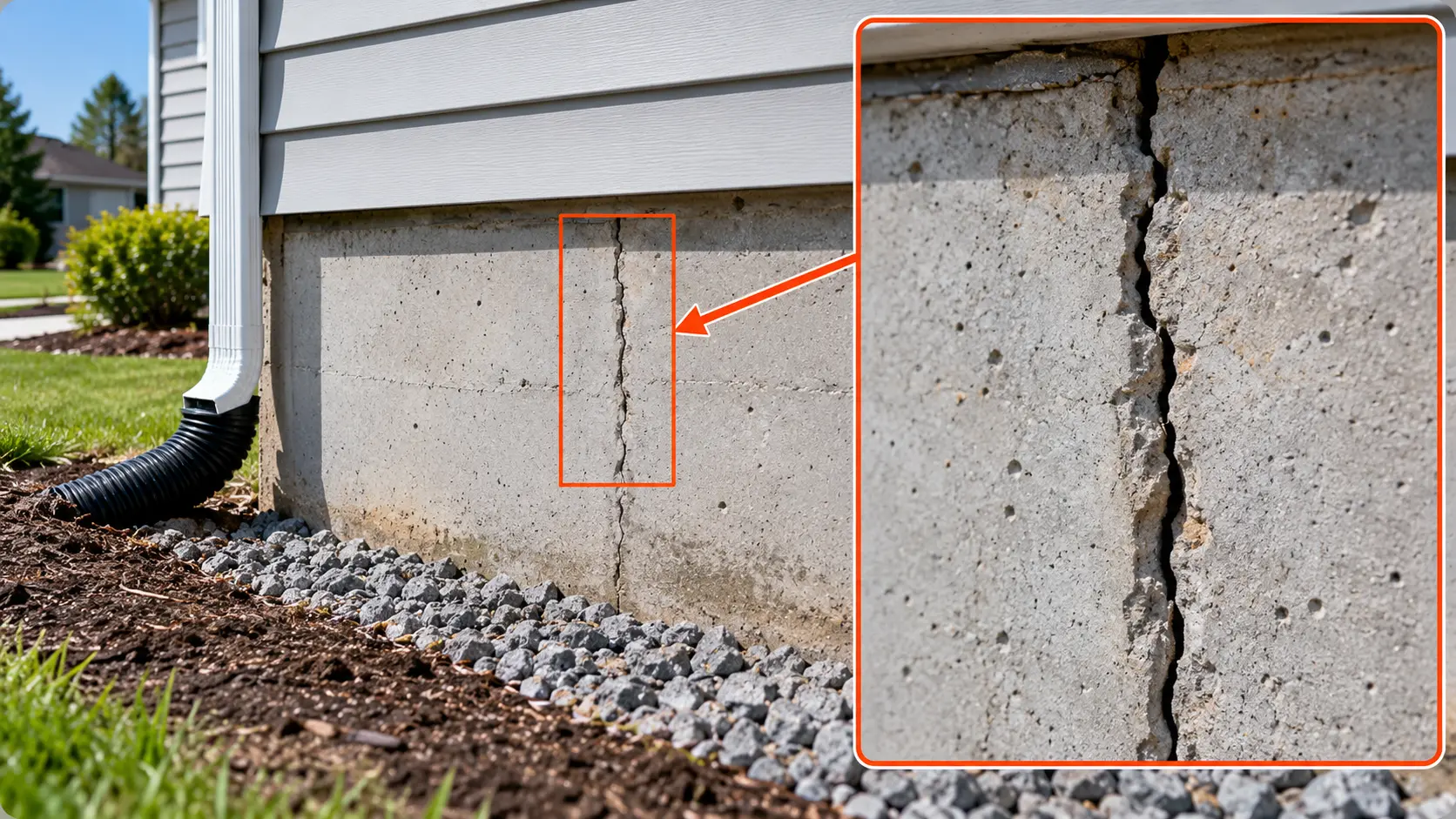
Vertical Cracks in Walls
Vertical cracks can come from drying shrinkage, thermal movement, settlement, or construction joints and details. Many vertical cracks in concrete foundation walls are relatively benign when stable.
Displacement or progressive movement changes the concern level, so check for offset and measure over time.
Horizontal Cracks in Walls
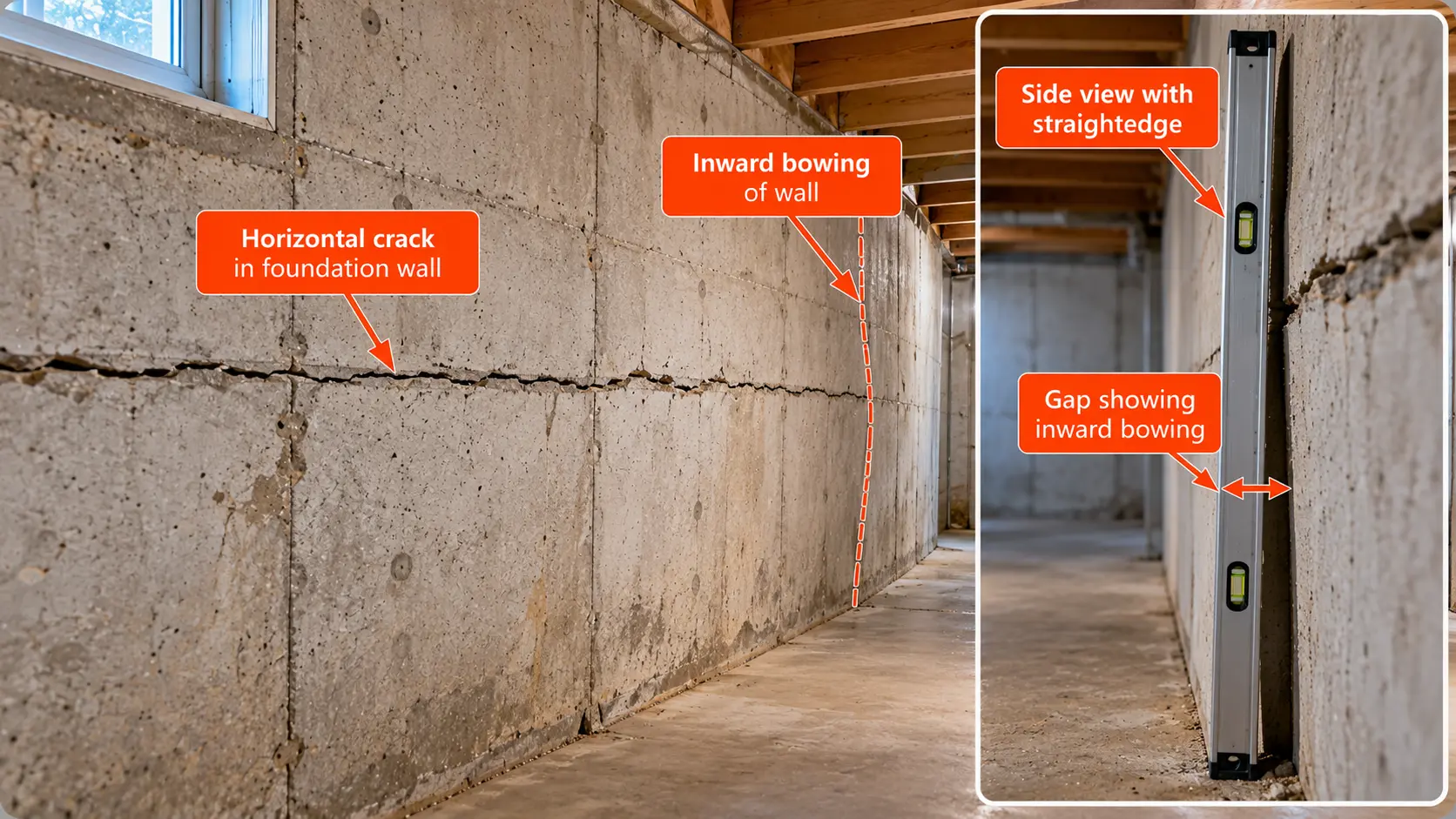
Horizontal cracks need careful attention. They can come from lateral soil pressure, wall bending, frost or heaving, backfill or construction pressure, and movement along masonry joints.
HUD describes sweeping or horizontal cracking in foundation walls from improper backfilling, vibration, or swelling or freezing of saturated soil, and treats wall bowing and leaning under lateral loading as a concern.
A horizontal crack with a measurable bow is very different from one with no deformation.
Diagonal Cracks in Walls
Diagonal cracks have several possible causes: differential settlement, stress concentration, shrinkage, openings, and load redistribution.
FEMA’s structural training says shrinkage can produce diagonal cracks at the re-entrant corners of openings such as windows and doors. HUD links settlement to diagonal patterns, so the same shape can mean different things.
The direction of taper may hint at movement, but it does not give a definitive diagnosis.
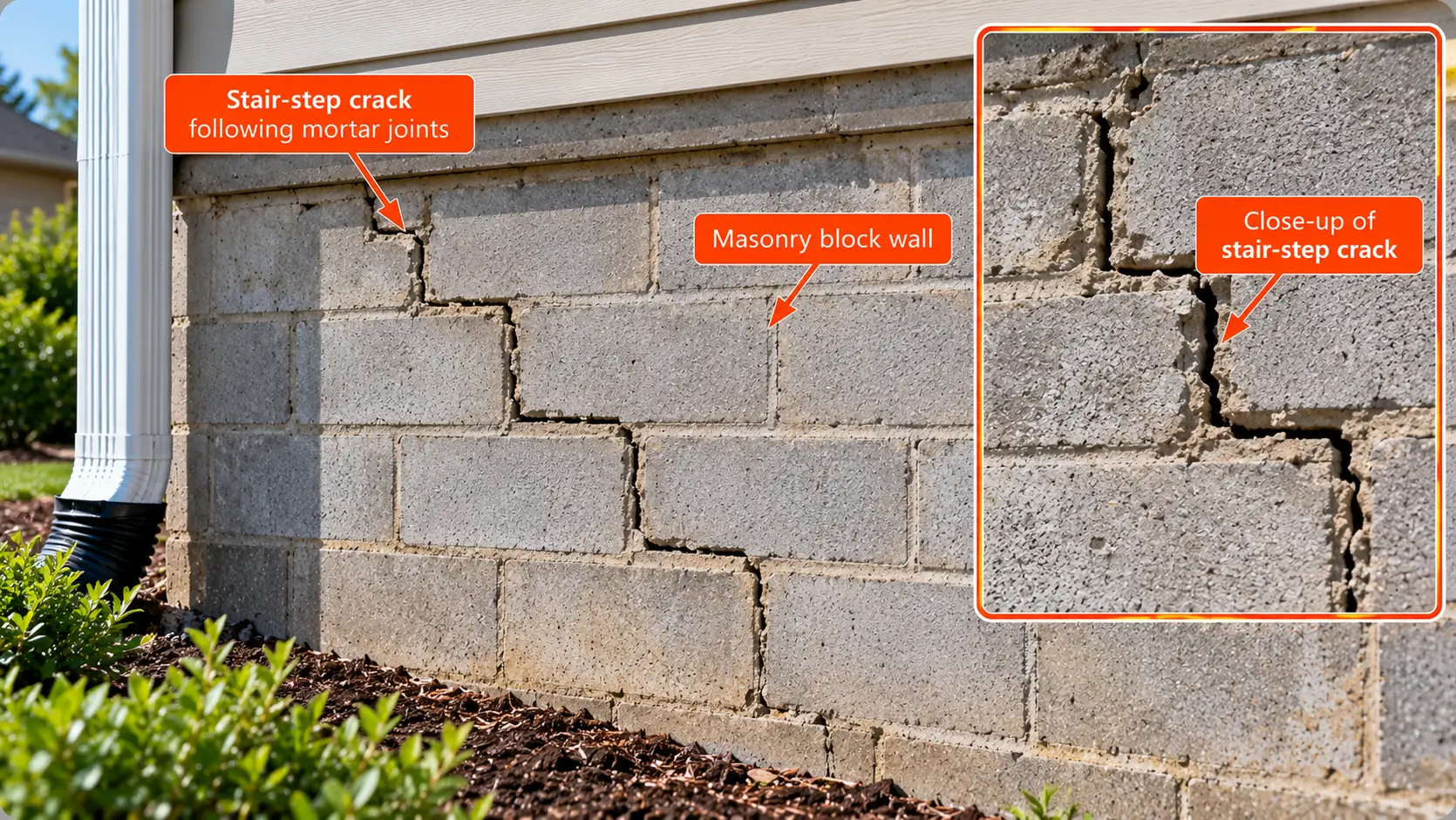
Stair-Step Cracks in Brick and Concrete Block Walls
Stair-step cracks follow the mortar joints in brick and concrete block. FEMA notes that cracks in unreinforced masonry tend to follow the weaker mortar instead of going through the units.
Causes include differential foundation movement, shrinkage, and masonry construction issues. HUD notes that block shrinkage can produce patterns resembling settlement, so context is essential.
Map Cracks and Crazing
Map cracks form a network of fine lines. NRMCA defines crazing as a network of fine random cracks caused by shrinkage of a paste-rich surface layer, and it is sometimes called shallow map or pattern cracking.
- Superficial crazing on cementitious finishes.
- Broader map cracking linked to deterioration of the material.
Do not label all map cracking as alkali-silica reaction (ASR). Crazing is usually a surface finishing issue, and it is more visible when the surface is drying after being wet.
Cracks Around Doors and Windows
Cracks at door and window corners are common because stress concentrates at those re-entrant corners. Possible causes include framing movement, settlement, lintel or header issues, and finish cracking.
A sticking door or window changes the interpretation. Cracks plus functional changes point more strongly toward movement.
Cracks at Wall-to-Ceiling or Wall-to-Floor Connections
Cracks where walls meet ceilings or floors often come from framing movement, settlement, truss movement, differential movement between materials, or foundation displacement.
Drywall cracking here is usually minor, but a gap that keeps opening or comes with sloping floors deserves a closer look.
Cracks in Poured Concrete Walls
Poured concrete walls crack from shrinkage, restraint, settlement, thermal effects, lateral pressure, and corrosion. FEMA notes that straight shrinkage cracks often occur every 5 to 20 feet in long reinforced walls, depending on reinforcement, pour joints, and curing.
For general mechanisms, read Why Is My Concrete Cracking?. For stable cosmetic cases, see the repair-before-painting guide linked in the final table.
Cracks in Concrete Block Walls
Concrete block walls crack in mortar joints, horizontally along bed joints, vertically through units, and in stair-step patterns. The Concrete Masonry & Hardscapes Association explains that concrete masonry undergoes volume changes from moisture, thermal movement, and carbonation, which is why control joints are used.
HUD discusses block shrinkage and settlement separately, but their patterns can overlap. Lateral wall pressure can also cause horizontal bed-joint cracks.
Cracks in Brick and Masonry Walls
Brick and masonry cracks include stair-step mortar-joint cracks, vertical cracks, expansion-related cracks, and lintel-related cracking.
Clay brick expands with moisture, and expansion joints are used mainly with clay masonry. Brick veneer movement and structural foundation movement are not automatically the same problem.
Cracks in Plaster and Drywall
Plaster and drywall cracks are finish cracks. Common causes include shrinkage, joint movement, framing movement, moisture, and foundation movement reflected through the finish.
They sometimes reveal building movement, but they are not themselves structural concrete defects. The table compares patterns by wall material.
| Wall material | Common patterns | Important distinction |
|---|---|---|
| Poured concrete | Vertical, diagonal, horizontal | Evaluate shrinkage vs. structural movement |
| Concrete block | Stair-step, horizontal bed joint, vertical | Block shrinkage can mimic settlement |
| Brick masonry | Stair-step, vertical, lintel-related | Veneer and structural wall may behave differently |
| Plaster | Fine random or straight cracks | May reflect substrate movement |
| Drywall | Joint/corner/door-opening cracks | Often framing/finish-related |
| Reinforced concrete | Cracks following reinforcement, flexural/shear patterns | Structural context matters |
Shrinkage Cracks
Shrinkage cracks come from drying and contraction. ACI lists shrinkage among the major causes of concrete cracking.
FEMA notes they usually appear within about 60 days of the pour as concrete dries, and reinforcing steel helps keep them small. They often develop early, show limited displacement, and are frequently stable after initial drying.
The Concrete Shrinkage Calculator gives background on shrinkage strain.
Settlement Cracks
Settlement cracks come from differential support movement, where one part of a foundation moves more than another. Contributing factors include poorly compacted fill, bearing soil movement, erosion, moisture changes, and nearby excavation.
Repairing settlement is different from filling the crack. See How to Fix Structural Cracks in Walls for stabilization methods.
Similar-looking wall cracks can have different causes, which is why movement and foundation condition matter.
Thermal and Seasonal Movement Cracks
Temperature and seasonal changes make concrete and masonry expand and contract. HUD notes that temperature-related cracks may open and close with the seasons.
FEMA adds that temperature cracks occur in roughly the same pattern as shrinkage cracks and are difficult to tell apart. Flexible repair may suit these, but the detailed procedures belong on other pages.
Lateral-Pressure Cracks
Basement and retaining walls resist soil pushing in from outside. Saturated soil, expansive soil, frost, and improper backfilling can all raise that pressure.
Horizontal cracking plus wall bowing warrants a more careful evaluation, because the wall may be bending under load.
The Foundation Wall Thickness Chart offers general background, not design values.
Reinforcement Corrosion Cracks
Corrosion cracks follow the reinforcing steel. The steel corrodes, the rust expands, and cracks form along the bar. Delamination and spalling may follow.
See Concrete Spalling and Concrete Delamination for the surface effects, and the Concrete Cover Chart for why cover matters.
Moisture and Freeze-Related Cracks
Water and freezing can crack walls in several ways: frost heave, repeated moisture movement, freeze-thaw effects, and water infiltration.
HUD illustrates bowed foundation walls, horizontal cracking, and floor movement in frost-heave conditions. White deposits along a crack point to a moisture pathway, covered in Concrete Efflorescence.
Load-, Design- and Construction-Related Cracks
Some cracks come from the design or construction itself. These include overload, insufficient support, poor detailing, openings, construction sequence, and restrained movement.
ACI includes design, detailing, and construction procedures among the factors that affect cracking. The table pairs common patterns with likely mechanisms.
| Pattern | Possible mechanism | Important caution |
|---|---|---|
| Fine vertical | Drying shrinkage | Can also be settlement-related |
| Horizontal + bowing | Lateral pressure | More significant than orientation alone |
| Diagonal from opening | Stress concentration/settlement | Check door/window alignment |
| Stair-step | Masonry movement | Shrinkage can mimic settlement |
| Crack following steel | Corrosion or settlement around reinforcement | Check rust/spalling |
| Seasonal opening/closing | Thermal movement | Document over time |
| Multiple cracks + floor slope | Foundation movement | Whole-building symptoms matter |
Crack Width, Taper and Displacement: What Each Means
Width, taper, and displacement each say something different. Width is useful for monitoring, taper may suggest the direction of relative movement, and displacement shows that surfaces have moved relative to each other.
| Feature | What it can tell you | What it cannot prove |
|---|---|---|
| Narrow width | Crack currently appears small | That it is harmless |
| Wider crack | Larger separation exists | Cause or structural capacity |
| Increasing width | Movement is occurring | Exact mechanism |
| Tapered crack | Relative movement direction may be inferred | Structural severity alone |
| Face offset | Relative displacement occurred | Exact repair method |
| Wall bow | Structural deformation | Cause without further evaluation |
There is no universal dangerous width. A narrow crack can be moving, and a wide one can be old and stable.
How Crack Location Changes the Diagnosis
Where a crack sits can be as useful as its direction. Think about these locations:
- Near foundation corners.
- At openings.
- Mid-wall.
- Near the floor line.
- Along reinforcement.
- At joints.
- Near beams and columns.
Cracks at beam and column connections deserve more careful evaluation than those in a finish layer. Combine location with pattern and behavior.
Wall cracks are best classified by combining their pattern, movement and associated building symptoms.
How to Identify and Monitor Your Wall Crack
Use this workflow to identify and track a crack, then pick the right next guide:
- Identify the wall material.
- Identify the crack pattern.
- Measure the width.
- Check for displacement.
- Photograph it with a scale.
- Inspect for moisture.
- Look for wall bowing.
- Check doors, windows, and floors.
- Monitor change over time.
- Choose the correct next guide.
HUD recommends monitoring movement and describes commercially available joint movement indicators. FEMA’s training material also describes simple marking methods, such as drawing an X across the crack, and plastic crack gauges. Its context is disaster-response training, so its collapse criteria should not be applied to ordinary home inspections.
| What the reader finds | Next guide |
|---|---|
| Stable cosmetic concrete-wall crack | How to Repair Cracks in Concrete Walls Before Painting |
| Widening/structural wall crack | How to Fix Structural Cracks in Walls |
| Unsure whether crack is serious | When to Worry About Cracks in Walls |
| General concrete cracking | Why Is My Concrete Cracking? |
| Concrete breaking away | Concrete Spalling |
| Hollow/separated concrete | Concrete Delamination |
| White deposits/moisture | Concrete Efflorescence |
| Suitable crack needing sealant quantity | Concrete Crack Filler Calculator |
Estimate filler only after the repair method is established. The calculator is meant for suitable sealing and filling applications.
Types of Wall Cracks FAQs
What are the main types of cracks in walls?
Hairline, vertical, horizontal, diagonal, stair-step, map or crazing, cracks around doors and windows, and cracks with displacement or wall bowing.
Which wall cracks are most concerning?
Those that are widening, offset, or combined with wall bowing, sloping floors, or sticking doors. Pattern alone does not decide it.
Are vertical cracks normal?
Often, yes. Many come from shrinkage and are stable. Concern rises with widening, offset, leakage, or building movement.
What causes horizontal wall cracks?
Lateral soil pressure, wall bending, frost or heaving, backfill or construction effects, and movement along masonry joints. Check for bowing.
What causes diagonal cracks?
Differential settlement, shrinkage, restraint, and stress at openings. A tapering crack may hint at movement direction but does not prove the cause.
What is a stair-step crack?
A crack that follows the mortar joints in brick or concrete block in a stepped pattern. It can come from settlement, shrinkage, or other movement.
What is the difference between active and dormant cracks?
A dormant crack shows little or no ongoing change, while an active one keeps widening, extending, or moving. Active cracks need diagnosis before rigid repair.
Can shrinkage cracks look like settlement cracks?
Yes. HUD notes that concrete-block shrinkage can mimic settlement patterns, so look at movement and the rest of the building.
What does crack displacement mean?
It means the two faces of the crack are no longer flush, which shows that one side has moved relative to the other.
When should a structural engineer inspect a wall crack?
When it is widening, displaced, associated with bowing or settlement, in a structural member, or you cannot tell the cause.