Washer Size Chart – ID, OD, Thickness & Bolt Compatibility
Washer Size Chart
ID, OD, Thickness & Bolt Compatibility
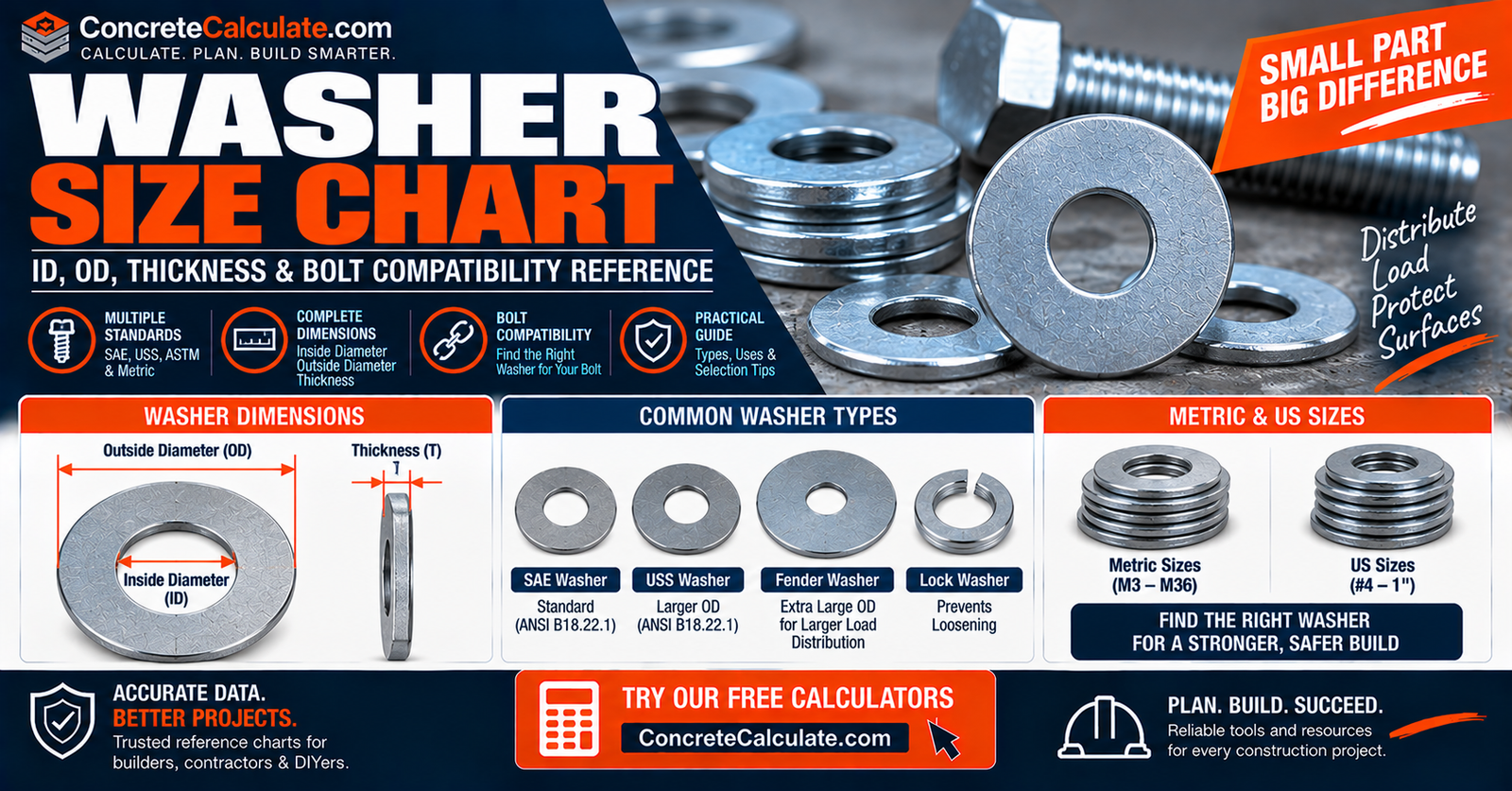
SAE, USS, ASTM F436 structural, fender, lock, and metric washer inside diameter, outside diameter, and thickness for common bolt sizes, plus style, hardness, and bolt/nut compatibility guidance under ASME B18.21.1 and ASTM F436/F436M.
 Reviewed by Muhammad Ramzan Babar, PhD Researcher (Plasma Physics) & Calculator Developer, View Profile
Washer nominal size refers to the bolt it fits, not its actual dimensions
A 3/4-in. washer is intended for a 3/4-in. bolt, but its inside diameter is larger than 3/4 in. for clearance, and its outside diameter and thickness vary significantly by pattern. A 3/4-in. SAE washer, a 3/4-in. USS washer, a 3/4-in. ASTM F436 structural washer, and a 3/4-in. fender washer all fit the same bolt but are not dimensionally interchangeable.
Washer Size Chart, Quick Reference
Washer patterns are kept separate rather than mixed into one table, since actual ID, OD, and thickness differ significantly between SAE, USS, F436, and fender washers.
Standard Inch Flat Washer Size Chart
| Nominal Bolt Size | Washer Pattern | Inside Diameter | Outside Diameter | Thickness | Typical Use |
|---|---|---|---|---|---|
| 1/2 in. | SAE | 0.531 | 1.062 | 0.083 | General purpose, compact footprint |
| 1/2 in. | USS | 0.562 | 1.375 | 0.109 | Larger bearing area |
| 1/2 in. | F436 Structural | 17/32 (0.531) | 1-1/16 (1.062) | 0.097-0.121 | High-strength structural bolting |
| 1/2 in. | Fender | 0.531 | 1.500 | 0.065 | Sheet metal, thin material, hole coverage |
| 3/4 in. | SAE | 0.812 | 1.469 | 0.083 | General purpose, compact footprint |
| 3/4 in. | USS | 0.812 | 2.000 | 0.148 | Larger bearing area |
| 3/4 in. | F436 Structural | 13/16 (0.812) | 1-15/32 (1.469) | 0.122-0.177 | High-strength structural bolting |
Washer Size vs Bolt Size
A 1/2-in. washer is intended for a 1/2-in. bolt, but its hole is larger than exactly 1/2 in. to provide clearance for assembly.
Washer Dimensions Explained
ID = inside diameter. OD = outside diameter. T = thickness. These three abbreviations are used consistently in every table on this page.
What Is a Washer?
A component placed under a bolt head, nut, or screw head to perform specific functions.
A washer distributes bearing load, protects a surface, bridges an oversized or slotted hole, provides a hardened bearing surface, accommodates geometry, or supports a locking system where specifically designed for that purpose. Not every washer prevents loosening; that function depends on the specific washer style and design.
Washer Size vs Bolt Size
One of the most important sections on this page.
Nominal washer size refers to the compatible bolt diameter. A 3/4-in. washer means it is intended for a 3/4-in. fastener. It does not mean a 3/4-in. inside diameter, a 3/4-in. outside diameter, or a 3/4-in. thickness. For ASTM F436, a nominal 3/4-in. washer uses a 13/16-in. inside diameter, not exactly 3/4 in.
Washer Dimension Anatomy
The core geometry used throughout every table on this page.
| Dimension | What It Means |
|---|---|
| ID / d1 (Inside Diameter) | The clearance hole diameter that the bolt passes through |
| OD / d2 (Outside Diameter) | The overall diameter, controlling bearing area |
| T (Thickness) | Overall washer thickness |
Additional features on some washers include a chamfer or bevel where applicable, and a defined bearing face.
Washer Inside Diameter Chart
Washer ID is a clearance dimension, not the nominal fastener size.
| Nominal Bolt Size | F436 Washer ID | Clearance Above Bolt |
|---|---|---|
| 1/2 in. | 17/32 in. | 1/32 in. |
| 5/8 in. | 11/16 in. | 1/16 in. |
| 3/4 in. | 13/16 in. | 1/16 in. |
| 1 in. | 1-1/16 in. | 1/16 in. |
Washer ID must be larger than the nominal bolt diameter so the washer slides freely onto the bolt shank, accounting for manufacturing tolerances on both parts.
Washer Outside Diameter Chart
OD controls bearing area, load distribution, edge clearance, and the ability to cover holes or slots.
| Bolt Size | SAE OD | USS OD | F436 OD | Fender Washer OD |
|---|---|---|---|---|
| 1/2 in. | 1.062 | 1.375 | 1.062 | 1.500 |
| 5/8 in. | 1.312 | 1.750 | 1.312 | 1.750 |
| 3/4 in. | 1.469 | 2.000 | 1.469 | 2.000 |
| 1 in. | 2.000 | 2.500 | 2.000 | 2.500 |
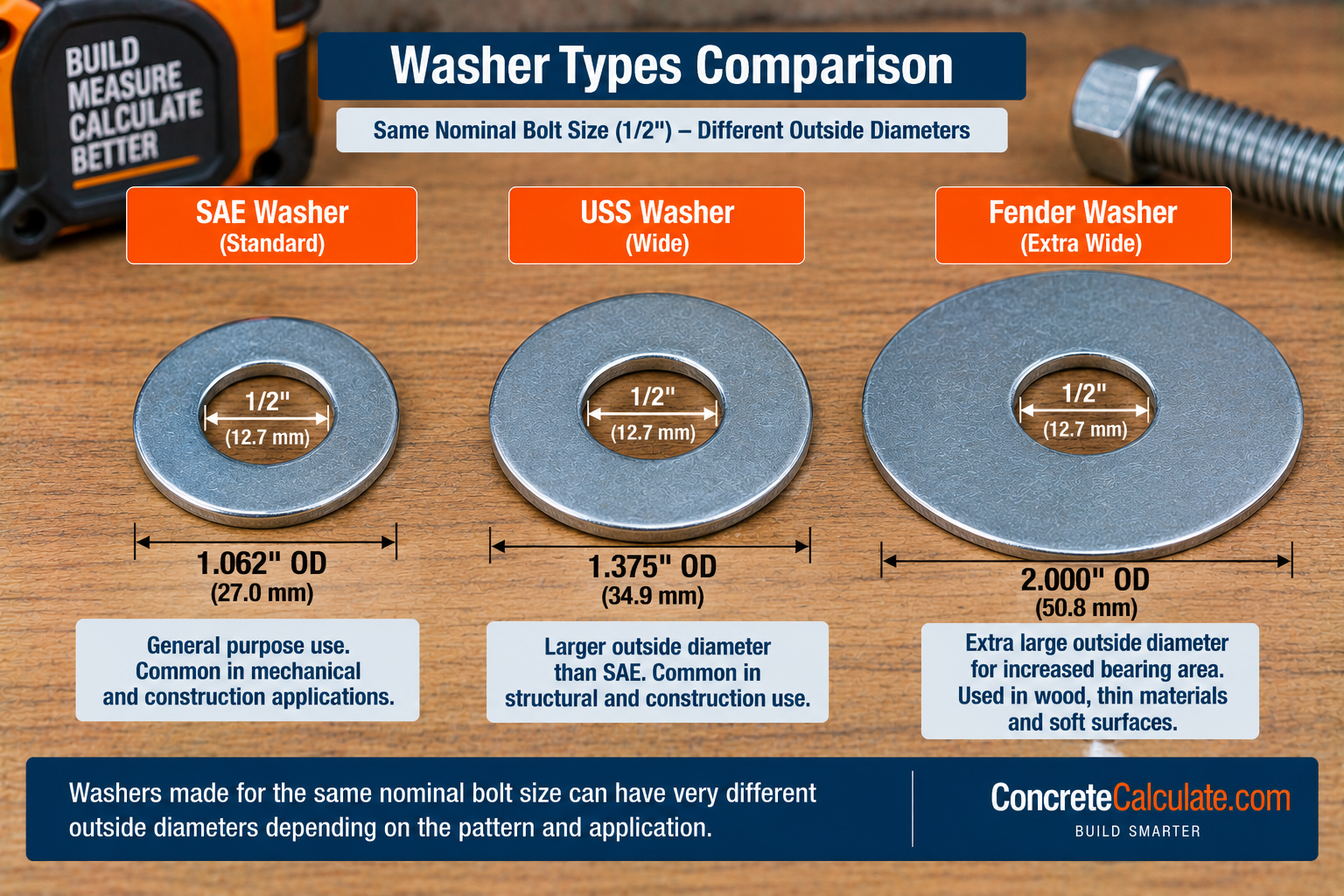
This is one of the strongest comparison tables on the page: four washers fitting the same nominal bolt can have four different outside diameters depending on pattern.
Washer Thickness Chart
Do not publish or assume one universal washer thickness.
| Bolt Size | Standard Flat Washer Thickness | F436 Standard Thickness | F436 Extra-Thick |
|---|---|---|---|
| 1/2 in. | 0.083-0.109 | 0.097-0.121 | 0.305-0.375 |
| 3/4 in. | 0.083-0.148 | 0.122-0.177 | 0.305-0.375 |
| 1 in. | 0.148-0.165 | 0.136-0.177 | 0.305-0.375 |
ASTM F436 standard-thickness washers are typically in the 0.097 to 0.177 in. range depending on size, while extra-thick F436 washers run roughly 0.305 to 0.375 in. for sizes up through 1-1/2 in.
SAE vs USS Washer Size Chart
Essential for U.S. search intent and a common point of confusion.
| Bolt Size | SAE ID | SAE OD | SAE T | USS ID | USS OD | USS T |
|---|---|---|---|---|---|---|
| 3/8 in. | 0.406 | 0.734 | 0.065 | 0.406 | 0.922 | 0.083 |
| 1/2 in. | 0.531 | 1.062 | 0.083 | 0.562 | 1.375 | 0.109 |
| 5/8 in. | 0.656 | 1.312 | 0.083 | 0.688 | 1.750 | 0.134 |
| 3/4 in. | 0.812 | 1.469 | 0.083 | 0.812 | 2.000 | 0.148 |
| 1 in. | 1.062 | 2.000 | 0.109 | 1.062 | 2.500 | 0.165 |
SAE pattern generally has a smaller OD and a more compact bearing footprint, while USS pattern generally has a larger OD and greater bearing area. SAE and USS are washer patterns, not bolt grades, and should not be confused with SAE bolt-strength grading.
SAE Washer Size Chart
The dedicated full lookup for the SAE pattern.
| Nominal Bolt Size | ID | OD | Thickness |
|---|---|---|---|
| #6 | 0.156 | 0.375 | 0.049 |
| 1/4 in. | 0.281 | 0.625 | 0.065 |
| 3/8 in. | 0.406 | 0.734 | 0.065 |
| 1/2 in. | 0.531 | 1.062 | 0.083 |
| 5/8 in. | 0.656 | 1.312 | 0.083 |
| 3/4 in. | 0.812 | 1.469 | 0.083 |
| 1 in. | 1.062 | 2.000 | 0.109 |
Values are cross-referenced against ASME B18.21.1 Type A narrow-pattern dimensional data.
USS Washer Size Chart
The dedicated full lookup for the USS pattern.
| Nominal Bolt Size | ID | OD | Thickness |
|---|---|---|---|
| 1/4 in. | 0.312 | 0.734 | 0.065 |
| 3/8 in. | 0.406 | 0.922 | 0.083 |
| 1/2 in. | 0.562 | 1.375 | 0.109 |
| 5/8 in. | 0.688 | 1.750 | 0.134 |
| 3/4 in. | 0.812 | 2.000 | 0.148 |
| 1 in. | 1.062 | 2.500 | 0.165 |
USS pattern can be useful where larger bearing area, softer material, or larger clearance holes are involved. This does not mean USS is inherently a stronger washer; it simply provides a larger bearing footprint.
SAE vs USS Washer, Which Is Larger?
A practical comparison with real numbers rather than a broad claim.
For the same nominal bolt size, USS pattern generally has a larger outside diameter than SAE pattern. For example, at 1/2 in., SAE OD is 1.062 in. while USS OD is 1.375 in. At 3/4 in., SAE OD is 1.469 in. while USS OD is 2.000 in. Actual dimensions should always come from the selected standard or product rather than assumed from a general rule.
Plain Flat Washer Size Chart
The general-purpose washer section, kept separate from structural hardened washers.
ASME B18.21.1 covers dimensional requirements for plain washers along with lock-washer families. This includes the standard flat washer, regular series, in the washer patterns and materials or finishes discussed throughout this page. Structural hardened washers are covered separately in the following sections, since ordinary plain washers do not meet ASTM F436 hardness requirements.
ASTM F436 Structural Washer Size Chart
A major dedicated section for this construction-focused audience.
| Bolt Size | ID | OD | Thickness Range | Type |
|---|---|---|---|---|
| 1/2 in. | 17/32 | 1-1/16 | 0.097-0.121 | 1 (Carbon) or 3 (Weathering) |
| 5/8 in. | 11/16 | 1-5/16 | 0.122-0.177 | 1 (Carbon) or 3 (Weathering) |
| 3/4 in. | 13/16 | 1-15/32 | 0.122-0.177 | 1 (Carbon) or 3 (Weathering) |
| 7/8 in. | 15/16 | 1-3/4 | 0.136-0.177 | 1 (Carbon) or 3 (Weathering) |
| 1 in. | 1-1/16 | 2 | 0.136-0.177 | 1 (Carbon) or 3 (Weathering) |
ASTM F436/F436M covers hardened washers for general mechanical use, structural applications, and high-strength fastener assemblies. Type 1 is carbon steel; Type 3 is weathering steel.
Standard vs Extra-Thick F436 Washers
An excellent technical differentiator for structural steel readers.
ASTM F436 includes extra-thick washer dimensions. Extra-thick washers for common 1/2 through 1-1/2-in. sizes run roughly 0.305 to 0.375 in., compared with the standard thickness range of about 0.097 to 0.177 in. Extra-thick washers may be specified for oversized holes, slotted holes, structural connections, or specific AISC/project conditions, but they are not optional substitutes for standard washers everywhere; use the exact thickness called for by the connection specification.
Circular, Beveled, and Clipped Structural Washers
ASTM F436 recognizes three main styles.
| Style | Purpose |
|---|---|
| Circular | Standard round structural washer |
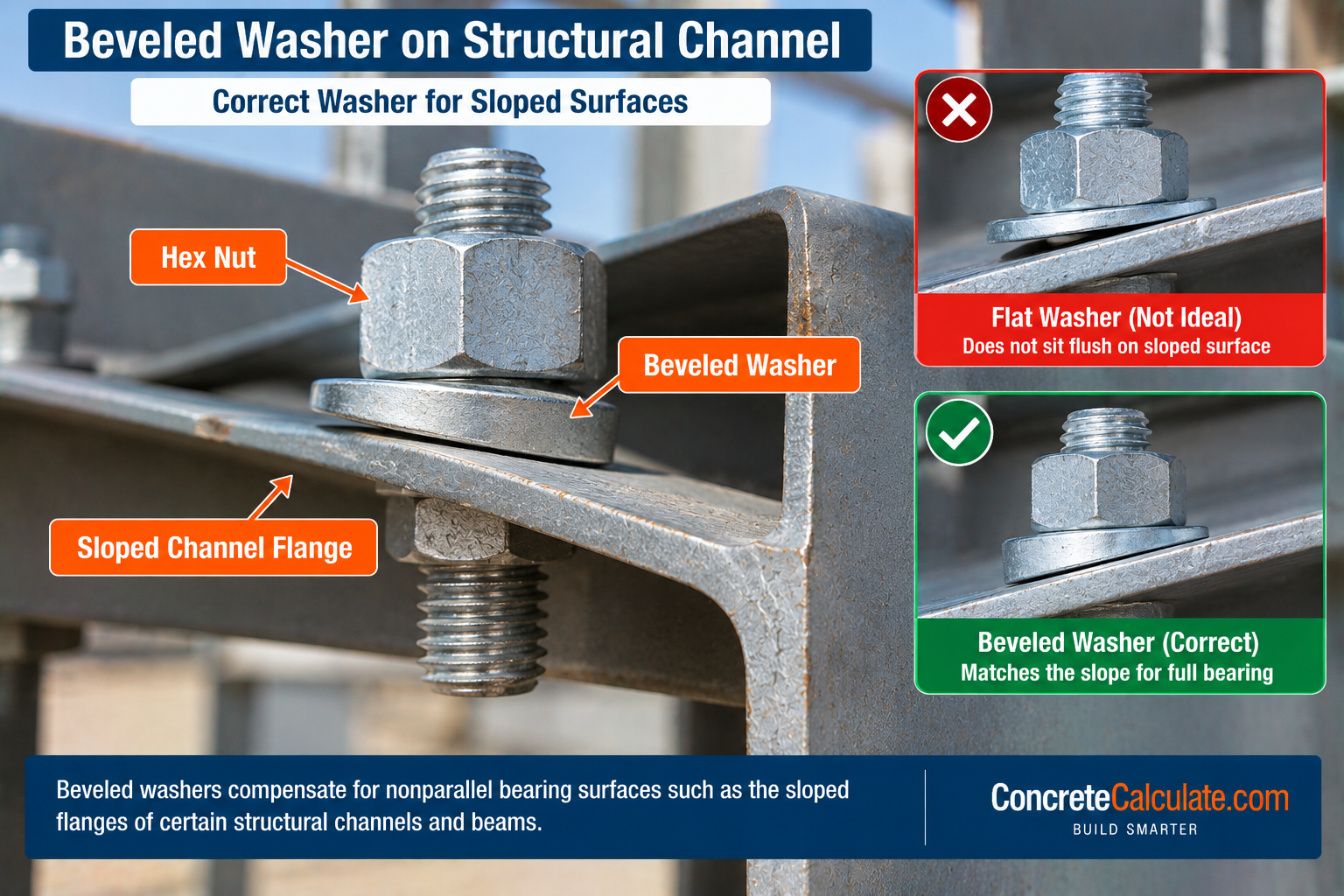
| Beveled | Used where bearing surfaces are not parallel |
| Clipped | Used when edge or space limitations exist |
Beveled Washer Size Chart
Beveled washers are geometry-correction components, not ordinary flat washers.
| Bolt Size | Square Width | Max/Min Thickness | Hole Diameter | Bevel |
|---|---|---|---|---|
| 1/2 in. | 1-3/4 | 0.313 / 0.243 | 9/16 | 1:6 |
| 3/4 in. | 2-1/4 | 0.375 / 0.305 | 13/16 | 1:6 |
| 1 in. | 2-1/4 | 0.375 / 0.305 | 1-1/16 | 1:6 |
ASTM F436 beveled washers are intended for American Standard beams and channels to compensate for surface slope or nonparallelism, using a 1:6 bevel across nominal sizes from about 1/2 through 1-1/2 in.
Clipped Washer Size Chart
Used when a full round washer will not fit due to edge or space constraints.
| Bolt Size | ID | OD | Thickness | Minimum Edge Distance |
|---|---|---|---|---|
| 1/2 in. | 17/32 | 1-1/16 | 0.097-0.121 | Per manufacturer spec |
| 3/4 in. | 13/16 | 1-15/32 | 0.122-0.177 | Per manufacturer spec |
Clipped washers are used when the full round washer will not fit or edge clearance is restricted. Minimum edge distance is product and application-specific and should be confirmed against the manufacturer’s published data for the exact clipped washer being used.
Fender Washer Size Chart
Important for homeowner and DIY search intent.
| Bolt/Screw Size | ID | OD | Thickness |
|---|---|---|---|
| #10 | 0.203 | 0.750 | 0.047 |
| 1/4 in. | 0.281 | 1.000 | 0.065 |
| 3/8 in. | 0.406 | 1.250 | 0.065 |
| 1/2 in. | 0.531 | 1.500 | 0.065 |
Fender washers have a relatively small ID with a much larger OD, providing a broad bearing surface. Applications include sheet metal, thin materials, enlarged holes, and surface protection. Fender washers are not structural equivalents to ASTM F436 hardened washers and should not be substituted for a specified structural washer.
Lock Washer Size Chart
Covers helical spring-lock and tooth-lock families under ASME B18.21.1.
| Bolt Size | Helical Spring ID | Helical Spring OD | Section Thickness |
|---|---|---|---|
| 1/2 in. | 0.518 | 0.869 | 0.125 |
| 3/4 in. | 0.775 | 1.211 | 0.188 |
Important E-E-A-T Caveat
ASME B18.21.1 itself notes that the historical term “lock washer” does not mean an indefinite, permanent locking effect. Actual loosening resistance depends on the specific joint, vibration environment, and overall assembly design.
Split and Tooth Lock Washer Types
Distinguishing the common lock-washer families.
Split, or helical spring-lock, washers use a split geometry with a defined nominal size, ID, OD, and section thickness. This page does not claim spring washers universally prevent loosening under vibration, since that depends on the specific joint and system design.
| Type | Teeth Position | Typical Contact |
|---|---|---|
| Internal tooth | Inside edge | Cleaner outside profile |
| External tooth | Outside edge | Larger tooth engagement radius |
Washer Size vs Hole Size
An important engineering distinction.
Washer ID must clear the bolt while the washer still provides enough bearing around the hole. Bolt diameter, hole diameter, washer ID, and washer OD are all related but distinct values, and washer ID should not be assumed to equal the bolt hole diameter in every standard; the exact relationship depends on the applicable specification.
Washers for Oversized and Slotted Holes
Very relevant for structural construction, and not a one-size-fits-all situation.
Potential governing issues include washer OD, washer thickness, hardness, slot orientation, and plate washer requirements. This page does not give a one-size-fits-all rule for oversized or slotted holes; use the applicable AISC, RCSC, or project requirements, and keep detailed structural connection design outside the scope of this general reference chart.
Structural Washer Hardness and Bearing Function
Why hardened washers matter beyond just their dimensions.
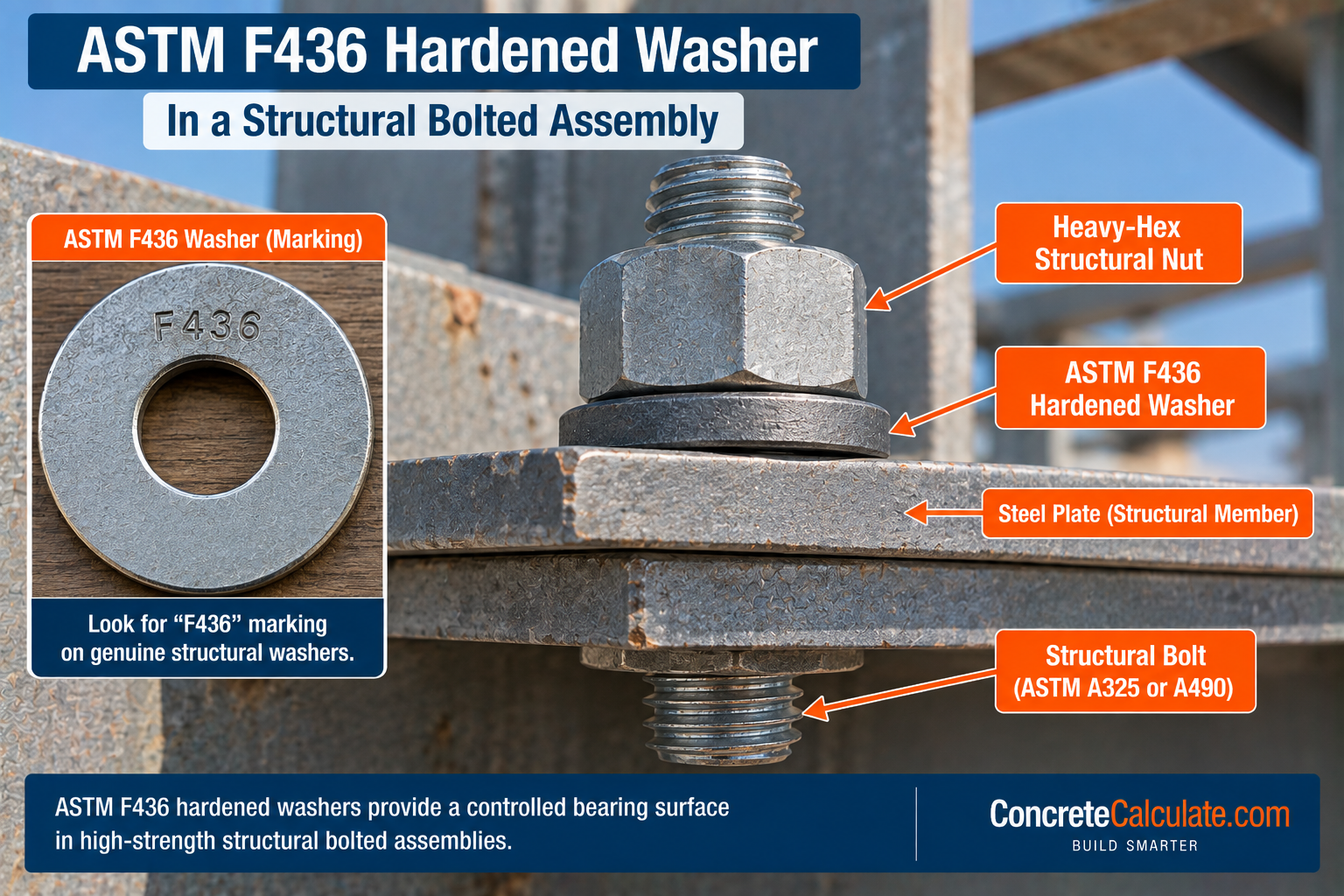
ASTM F436 controls chemical composition, Rockwell hardness, dimensions, and thickness. Hardened washers prevent local indentation under high-strength bolt and nut bearing and provide a suitable hardened bearing surface. Ordinary soft washers should not be substituted where F436 is specified.
Washer Materials and Finishes
Size alone does not define washer material or performance.
Common options include carbon steel, stainless steel, weathering steel, zinc plated, hot-dip galvanized, and plain finish. For ASTM F436, Type 1 is carbon steel and Type 3 is weathering steel.
Galvanized Washers and Structural Assemblies
Coating systems should match the rest of the assembly.
Hot-dip galvanized F436 washers exist and are commonly supplied in both plain black and hot-dip galvanized finishes for circular and beveled styles. Do not mix finishes casually in engineered structural assemblies; the washer coating should be coordinated with the bolt and nut finish specified for that connection.
Washer-to-Bolt and Nut Compatibility
Matching the hole to the bolt is only one part of washer selection.
| Factor | Why It Matters |
|---|---|
| Nominal fastener diameter | Sets the required ID clearance |
| Washer style | Determines OD, thickness, and hardness |
| Required OD | Sets bearing area and hole coverage |
| Thickness | Affects clearance and structural requirements |
| Hardness/material | Determines suitability for high-strength bolting |
| Finish | Must be compatible with mating bolt and nut coating |
| Applicable standard | Confirms the washer meets the specified requirement |
A washer sits beneath a bolt head, a nut, or sometimes both, so bearing footprint, OD, hardness, and nut type all need checking together. See the Nut Size Chart and Hex Bolt Size Chart for the mating fastener dimensions.
Metric Washer Size Chart
Use ISO data, not inch conversions.
| Metric Fastener Size | Washer ID | Washer OD | Thickness |
|---|---|---|---|
| M8 | 8.4 | 16 | 1.6 |
| M10 | 10.5 | 20 | 2.0 |
| M12 | 13.0 | 24 | 2.5 |
| M16 | 17.0 | 30 | 3.0 |
| M20 | 21.0 | 37 | 3.0 |
As of the most recent publication, ISO 7089:2000 remains the published current standard for plain washers, normal series, product grade A, though a replacement revision is under development. This chart follows that ISO dimensional data rather than a converted inch table.
ISO 7089, 7090, 7091, 7092, and 7093 Washer Series
The metric equivalent of “not all washers for the same bolt have the same OD.”
| Standard | Series |
|---|---|
| ISO 7089 | Normal series, product grade A |
| ISO 7090 | Chamfered normal series, product grade A |
| ISO 7091 | Normal series, product grade C |
| ISO 7092 | Small series |
| ISO 7093-1/-2 | Large series |
This family of standards distinguishes normal, chamfered, small, and large series, demonstrating that metric washers, just like inch washers, are not dimensionally identical simply because they fit the same nominal fastener size.
Inch vs Metric Washers
Do not simply convert an SAE/USS washer into millimeters and call it an ISO washer.
| Feature | Inch Washer | Metric Washer |
|---|---|---|
| Nominal size | Fractional inch | M size |
| Dimensional standards | ASME/ASTM | ISO |
| ID | Clearance above nominal bolt | Clearance above M size |
| OD series | SAE/USS/F436/etc. | Normal/small/large ISO series |
| Directly interchangeable? | No assumption | No assumption |
ASME B18.21.1 Plain and Lock Washer Standard
The primary U.S. dimensional standard for ordinary washers.
ASME B18.21.1 covers plain washers, helical spring-lock washers, and tooth-lock washers. The standard includes plain washers from #0 through 3 in., while inclusion in the dimensional standard does not mean every size is commercially stocked.
ASTM F436/F436M Structural Washer Standard
The current authority for structural hardened washers.
The current active reference is ASTM F436/F436M-24, which covers hardened washers for nominal fastener diameters from 1/4 through 4 in. and metric M12 through M100. This standard is central to any structural construction application requiring a hardened bearing washer.
How to Measure and Choose a Washer
Practical workflows for identification and selection.
How to Measure a Washer
How to Choose the Correct Washer
Common Mistakes and Chart Limitations
Assuming washer size equals actual ID
Nominal size refers to bolt compatibility, not the literal hole dimension.
Assuming washer size equals OD
OD varies significantly by pattern even at the same nominal size.
Matching only ID and ignoring OD
Bearing area and clearance depend on OD, not just ID fit.
Confusing SAE pattern with SAE bolt grade
SAE washer pattern and SAE bolt strength grading are unrelated systems.
Assuming USS washers are always “stronger”
USS simply has a larger bearing footprint, not inherently higher strength.
Using a fender washer in place of a hardened structural washer
Fender washers are not structural equivalents to ASTM F436 washers.
Using a soft washer where ASTM F436 is specified
Hardness requirements exist to prevent bearing indentation.
Confusing circular and beveled structural washers
Beveled washers correct nonparallel bearing surfaces; circular washers do not.
Ignoring clipped-washer edge clearance
Minimum edge distance is a real requirement, not optional.
Assuming all lock washers prevent loosening indefinitely
Locking performance depends on the specific joint and system design.
Assuming an M12 washer is simply a 1/2-in. washer in metric
Metric washers follow their own ISO dimensional standards.
Using nominal bolt size as actual washer-hole size
Washer ID always includes clearance above the nominal bolt diameter.
Treating washer dimensions as universal across patterns
SAE, USS, F436, fender, lock, and metric washers each have distinct dimensions.
Read before finalizing a washer selection
Nominal washer size refers to fastener compatibility, not actual ID, and washer ID is normally larger than bolt diameter. OD and thickness vary by washer pattern and style, and SAE, USS, F436, fender, lock, and metric washers are not dimensionally identical. Structural hardened washers have mechanical requirements beyond dimensions, and oversized or slotted structural holes may require specific washer configurations. Metric washers use ISO series rather than converted U.S. dimensions, and product availability varies by manufacturer. ASME dimensional inclusion does not mean every size is stocked. Structural washer selection should follow the applicable connection specification and construction documents.
Washer Size FAQs
Download the Washer Size Chart
Get a printable reference including SAE, USS, F436 structural, fender, lock, and metric washer tables on this page for jobsite or shop use.