Nut Size Chart – Dimensions, Wrench Size & Bolt Compatibility
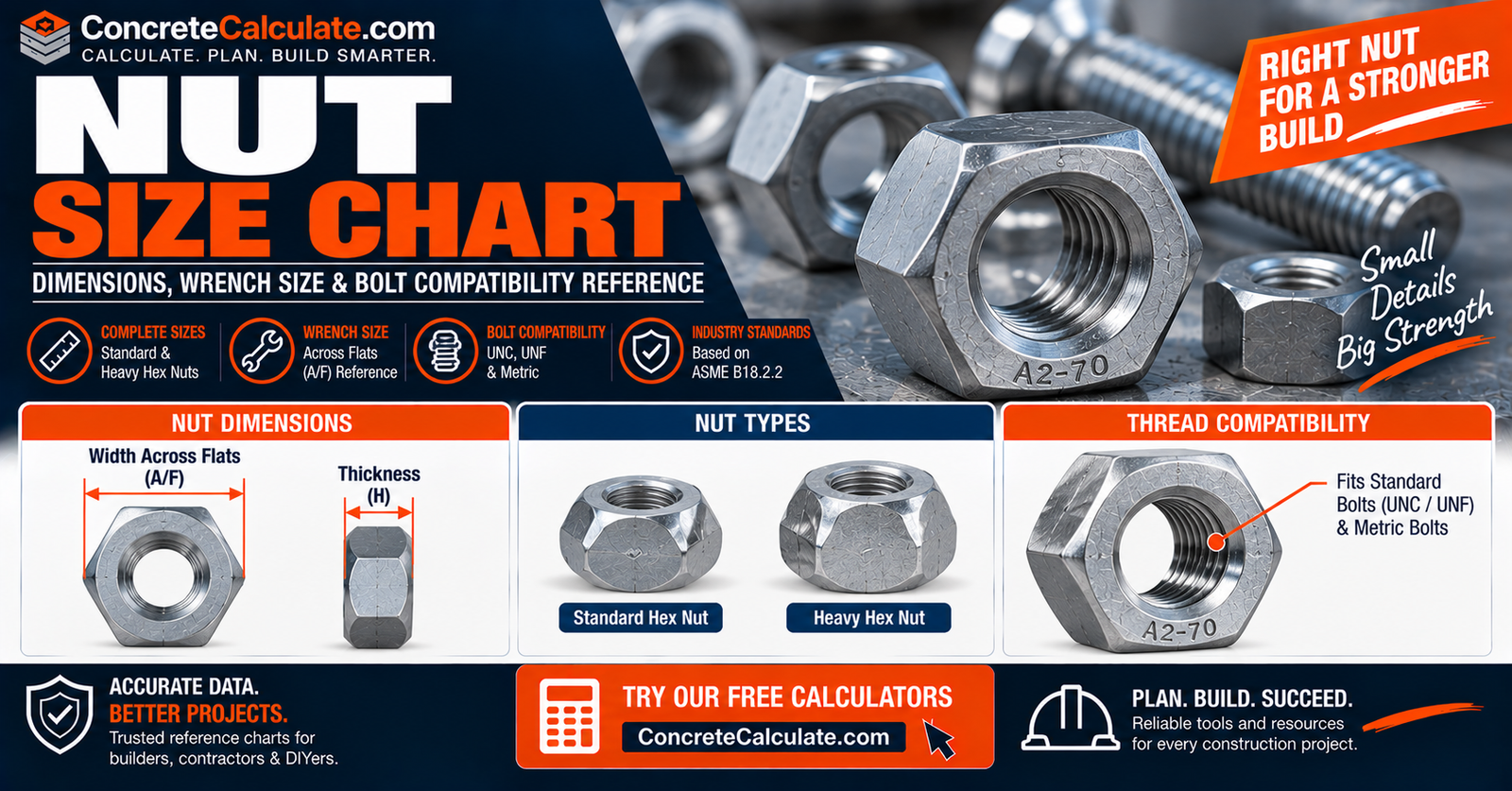
Nut Size Chart
Dimensions, Wrench Size & Bolt Compatibility
ASME B18.2.2 width across flats, width across corners, thickness, and wrench/socket size for standard and heavy hex nuts, plus UNC/UNF thread compatibility, nut styles, structural grade matching under ASTM A563/A194, and galvanized oversize tapping.
 Reviewed by Muhammad Ramzan Babar, PhD Researcher (Plasma Physics) & Calculator Developer, View Profile
Nut size, wrench size, and thread size are not the same thing
A 3/4-in. hex nut refers to the thread and bolt size it mates with, but a standard finished hex nut of that nominal size has a basic width across flats of 1-1/8 in. and therefore uses a 1-1/8-in. wrench or socket. The main chart on this page covers inch-series standard hex nuts; heavy-hex, jam, flange, lock, coupling, and metric nuts each require separate dimensional treatment covered further down this page.
Nut Size Chart, Quick Reference
Dimensions below follow ASME B18.2.2 for standard inch-series finished hex nuts.
Standard Inch Hex Nut Size Chart
| Nominal Nut/Bolt Size | UNC Thread | UNF Thread | Basic Width Across Flats | Width Across Corners (Max) | Nut Thickness | Wrench/Socket Size |
|---|---|---|---|---|---|---|
| 1/2 in. | 13 | 20 | 3/4 | 0.866 | 7/16 | 3/4 in. |
| 5/8 in. | 11 | 18 | 15/16 | 1.083 | 35/64 | 15/16 in. |
| 3/4 in. | 10 | 16 | 1-1/8 | 1.299 | 41/64 | 1-1/8 in. |
| 7/8 in. | 9 | 14 | 1-5/16 | 1.516 | 3/4 | 1-5/16 in. |
| 1 in. | 8 | 12 | 1-1/2 | 1.732 | 55/64 | 1-1/2 in. |
Standard Hex vs Heavy-Hex Quick Chart
| Bolt/Nut Size | Standard Hex Across Flats | Heavy Hex Across Flats | Difference |
|---|---|---|---|
| 1/2 in. | 3/4 in. | 7/8 in. | 1/8 in. |
| 5/8 in. | 15/16 in. | 1-1/16 in. | 1/8 in. |
| 3/4 in. | 1-1/8 in. | 1-1/4 in. | 1/8 in. |
| 7/8 in. | 1-5/16 in. | 1-7/16 in. | 1/8 in. |
| 1 in. | 1-1/2 in. | 1-5/8 in. | 1/8 in. |
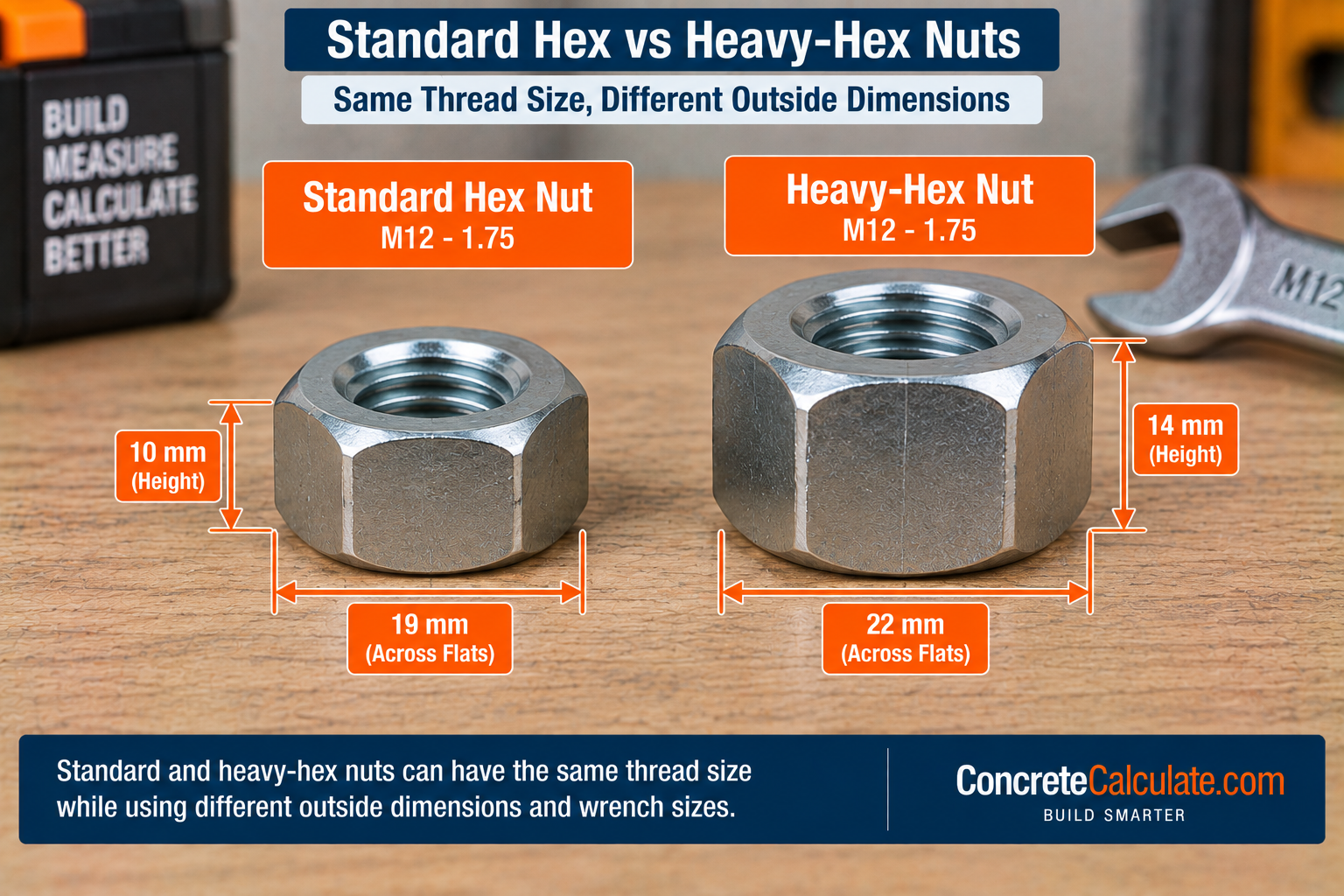
Heavy-hex nuts are 1/8 in. larger across flats than standard hex nuts of the same nominal size across this common range, and they are also thicker.
Important Scope Note
The main chart above covers inch-series standard hex nuts. Heavy-hex, jam, flange, lock, coupling, and metric nuts require the separate dimensional treatment found further down this page.
What Is a Nut?
An internally threaded fastener designed to mate with a bolt, rod, stud, or screw.
A nut is an internally threaded fastener designed to mate with a bolt, threaded rod, stud, or machine screw with matching nominal diameter, thread pitch, thread form and class, and compatible material or grade where required.
Nut Size vs Bolt Size vs Wrench Size
The most important conceptual section on this page.
| Term | What It Refers To | Example |
|---|---|---|
| Nut Size | Nominal internal thread size | 3/4-in. nut mates with a compatible 3/4-in. threaded bolt |
| Wrench/Socket Size | The nut’s width across flats | 3/4-in. finished hex nut uses a 1-1/8-in. wrench/socket |
Core rule: nut diameter does not equal wrench size. These are always two separate dimensions.
How to Read a Nut Size
Example: 1/2-13 UNC nut vs 1/2-20 UNF.
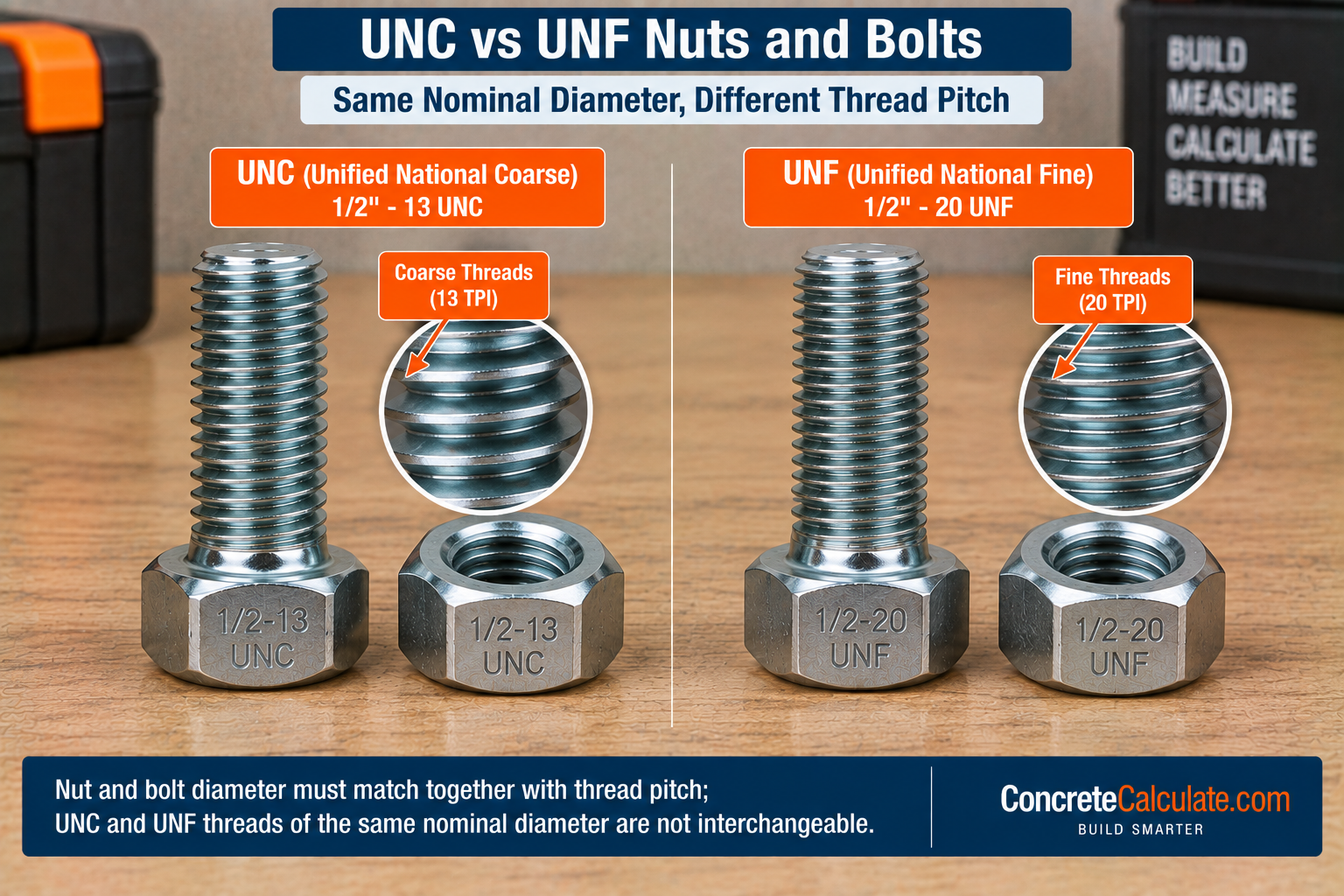
1/2-13 UNC means a nominal thread diameter of 1/2 in. with 13 threads per inch, a coarse Unified thread. 1/2-20 UNF means the same nominal diameter but 20 threads per inch, a fine Unified thread. The mating bolt must match both diameter and pitch exactly.
Nut Dimension Anatomy
The main geometry visual for this entire article.
| Dimension | What It Means |
|---|---|
| D (Nominal Thread Diameter) | The internal thread size that mates with the bolt |
| F (Width Across Flats) | Distance between two parallel flat sides, used for wrench/socket size |
| C (Width Across Corners) | Maximum diagonal head envelope |
| H (Thickness/Height) | Overall nut height |
Additional features include the bearing face, chamfer, and internal thread relief at the bearing surface.
Standard Hex Nut Size Chart
The complete ASME-based reference table for common construction sizes.
| Nominal Size | Width Across Flats | Width Across Corners (Max) | Thickness | Wrench/Socket |
|---|---|---|---|---|
| 3/8 in. | 9/16 | 0.650 | 21/64 | 9/16 in. |
| 1/2 in. | 3/4 | 0.866 | 7/16 | 3/4 in. |
| 5/8 in. | 15/16 | 1.083 | 35/64 | 15/16 in. |
| 3/4 in. | 1-1/8 | 1.299 | 41/64 | 1-1/8 in. |
| 7/8 in. | 1-5/16 | 1.516 | 3/4 | 1-5/16 in. |
| 1 in. | 1-1/2 | 1.732 | 55/64 | 1-1/2 in. |
ASME B18.2.2-2022 is the governing dimensional source for these values. A 1-in. finished hex nut has a 1-1/2-in. basic width across flats and a basic thickness of 55/64 in.
Nut Wrench and Socket Size Chart
One of the page’s flagship tables.
| Nut Thread Size | Standard Hex Wrench Size | Heavy Hex Wrench Size |
|---|---|---|
| 1/2 in. | 3/4 in. | 7/8 in. |
| 5/8 in. | 15/16 in. | 1-1/16 in. |
| 3/4 in. | 1-1/8 in. | 1-1/4 in. |
| 7/8 in. | 1-5/16 in. | 1-7/16 in. |
| 1 in. | 1-1/2 in. | 1-5/8 in. |
This table connects directly to the Socket Size Chart and the Hex Bolt Size Chart. The socket matches the width across flats, not the nominal thread diameter.
Width Across Flats vs Across Corners
Two different head-envelope measurements used for different purposes.
| Measurement | Used For |
|---|---|
| Across Flats | Wrench size, socket size |
| Across Corners | Clearance, recess design, adjacent hardware spacing |
This distinction is particularly useful in CAD, connection detailing, and tight recesses where the full diagonal envelope of the nut matters more than the flat-to-flat wrenching dimension.
Nut Thickness Chart
Affects thread engagement, assembly height, and clearance.
| Nominal Size | Standard Hex Thickness | Heavy Hex Thickness | Jam Nut Thickness |
|---|---|---|---|
| 1/2 in. | 7/16 | 1/2 | 5/16 |
| 5/8 in. | 35/64 | 39/64 | 3/8 |
| 3/4 in. | 41/64 | 47/64 | 27/64 |
| 1 in. | 55/64 | 1 | 35/64 |
Do not infer strength from thickness alone; thickness affects thread engagement and proof-load behavior, but mechanical grade is a separate specification.
Standard Hex vs Heavy Hex Nuts
A major section, especially for construction and structural audiences.
| Feature | Standard Hex | Heavy Hex |
|---|---|---|
| Across flats | Smaller | Larger |
| Thickness | Lower | Greater |
| Typical use | General fastening | Structural/high-strength |
| Same wrench size? | No | Requires larger opening |
| Common ASTM use | A563 Grade A, etc. | A563 C/D/DH, A194, etc. |
Heavy-hex nuts are wider across flats, wider across corners, and slightly thicker than standard finished hex nuts at the same nominal diameter.
Heavy Hex Nut Size Chart
Do not use standard-hex wrench sizes for heavy-hex nuts.
| Nominal Size | Across Flats | Across Corners (Max) | Thickness | Wrench Size |
|---|---|---|---|---|
| 1/2 in. | 7/8 | 1.010 | 1/2 | 7/8 in. |
| 5/8 in. | 1-1/16 | 1.227 | 39/64 | 1-1/16 in. |
| 3/4 in. | 1-1/4 | 1.443 | 47/64 | 1-1/4 in. |
| 7/8 in. | 1-7/16 | 1.660 | 55/64 | 1-7/16 in. |
| 1 in. | 1-5/8 | 1.876 | 1 | 1-5/8 in. |
Larger structural sizes continue well beyond ordinary finished-hex stock ranges, extending up to 2-3/4 in. and beyond depending on grade and manufacturer.
Finished Hex vs Jam Nuts
A jam nut is not a lighter-duty substitute without checking requirements.
| Type | Description |
|---|---|
| Finished / Regular Hex Nut | Full-height general-purpose pattern |
| Jam Nut | Thinner nut for reduced assembly height, locking with a second nut, or special adjustment |
Do not assume a jam nut has the same proof-load capability as a regular nut of the same thread size, since its reduced thickness affects thread engagement.
Lock Nut, Flange Nut, and Coupling Nut Sizes
Common specialty styles beyond the standard finished hex pattern.
Lock Nuts
Common lock-nut families include prevailing-torque distorted-thread nuts, nylon insert nuts, all-metal lock nuts, and serrated flange lock nuts. A prevailing-torque locknut resists rotation through thread distortion. Locking style does not automatically change nominal thread size, but nut height and external geometry can differ from a standard finished hex nut.
Hex Flange Nuts
Flange nuts have an integral flange at the base that distributes clamping load over a wider bearing area. Relevant dimensions include thread size, across flats, nut height, flange diameter, and flange thickness. ASME B18.2.2-2022 explicitly includes hex flange nuts within its general inch-series nut scope, but flange-nut outer diameter should not be mixed into ordinary hex-nut charts.
Hex Coupling Nuts
Coupling nuts are long nuts used to connect threaded rods, studs, or anchor rods. A 1/2-in. finished-pattern coupling nut has a basic width across flats of 11/16 in. and a nominal length of about 1-3/4 in., which is considerably longer than an ordinary hex nut’s thickness. Do not confuse coupling-nut length with ordinary hex-nut thickness.
Square Nuts
ASME B18.2.2 also covers square nuts, which have a square external shape, different bearing geometry in some applications, and different wrenching behavior than hex nuts. This is a supporting note rather than a focus of this hex-nut-centered page.
UNC Nut Thread Size Chart
A compatibility-level table; full thread dimensional data lives on the dedicated UNC chart.
| Nominal Nut Size | UNC TPI | Pitch (in.) |
|---|---|---|
| 1/4-20 | 20 | 0.0500 |
| 5/16-18 | 18 | 0.0556 |
| 3/8-16 | 16 | 0.0625 |
| 7/16-14 | 14 | 0.0714 |
| 1/2-13 | 13 | 0.0769 |
| 5/8-11 | 11 | 0.0909 |
| 3/4-10 | 10 | 0.1000 |
For the complete UNC dimensional reference including tap drill sizes, see the UNC Thread Chart.
UNF Nut Thread Size Chart
Same purpose as the UNC table, for the fine thread series.
| Nominal Nut Size | UNF TPI | Pitch (in.) |
|---|---|---|
| 1/4-28 | 28 | 0.0357 |
| 5/16-24 | 24 | 0.0417 |
| 3/8-24 | 24 | 0.0417 |
| 7/16-20 | 20 | 0.0500 |
| 1/2-20 | 20 | 0.0500 |
For the complete UNF dimensional reference, see the UNF Thread Chart.
UNC vs UNF Nuts
A 1/2-in. nut is not fully specified until thread pitch is known.
| Feature | UNC Nut | UNF Nut |
|---|---|---|
| Threads per inch | Lower | Higher |
| Pitch | Coarser | Finer |
| Same nominal diameter possible? | Yes | Yes |
| Interchangeable? | No | No |
A 1/2-13 nut will not correctly mate with a 1/2-20 bolt, even though both share the same nominal 1/2-in. diameter. The thread series must match exactly.
Nut Thread Classes and Fit
Kept concise; deeper thread data lives on the dedicated thread charts.
Internal Unified thread classes such as 1B, 2B, and 3B describe allowance and tolerance grade for nut threads. This page explains fit and compatibility at a practical level, while the Thread Pitch Chart and related thread charts own the deeper thread dimensional data.
Nut-to-Bolt Compatibility
One of the page’s strongest practical sections.
A compatible nut must match nominal diameter, thread pitch, thread system, required grade or material, and coating condition where relevant. The compatibility logic is: diameter, plus pitch, plus thread system, plus grade and finish compatibility, all four together, not diameter alone.
Nut Grade vs Nut Size
A very important distinction.
Nut grade does not inherently determine external dimensions. An ASTM A563 Grade DH heavy-hex nut and an ASTM A194 Grade 2H heavy-hex nut can use the same ASME B18.2.2 heavy-hex dimensions even though their mechanical grades differ. Nut dimensions and nut mechanical grade are separate specifications. For grade and marking details, see the Bolt Grade Chart.
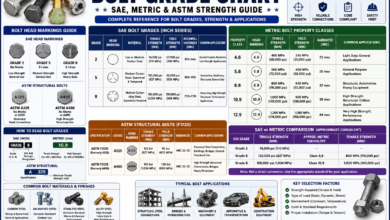
ASTM A563 Structural Nut Grades
The central specification for carbon and alloy steel structural nuts.
| Grade | Typical Pairing/Notes |
|---|---|
| A | General-purpose carbon steel nut |
| B | General-purpose carbon steel nut |
| C / C3 | Higher-strength; C3 is weathering-resistant |
| D | Higher-strength carbon steel |
| DH / DH3 | Heavy-hex structural nut; DH3 is weathering-resistant |
These grades are available in hex or heavy-hex styles depending on grade, bolt pairing, size, and finish. This page focuses on compatibility and style rather than reproducing a complete mechanical-strength table, since that data belongs on the dedicated Bolt Grade Chart.
ASTM A194 Heavy-Hex Nuts
Commonly used in higher-temperature and structural applications.
ASTM A194 nuts are commonly used in higher-temperature, high-pressure, and structural applications depending on grade, with ASTM A194 defaulting to the heavy-hex series unless otherwise specified. Grade 2H is a common example, explicitly permitted by ASTM F3125 as a substitute for ASTM A563 Grade DH on structural bolts. This page keeps focus on compatibility and style rather than becoming a full A194 mechanical-property reference.
Structural Bolt and Nut Compatibility
Connects nut selection directly to structural fastener specifications.
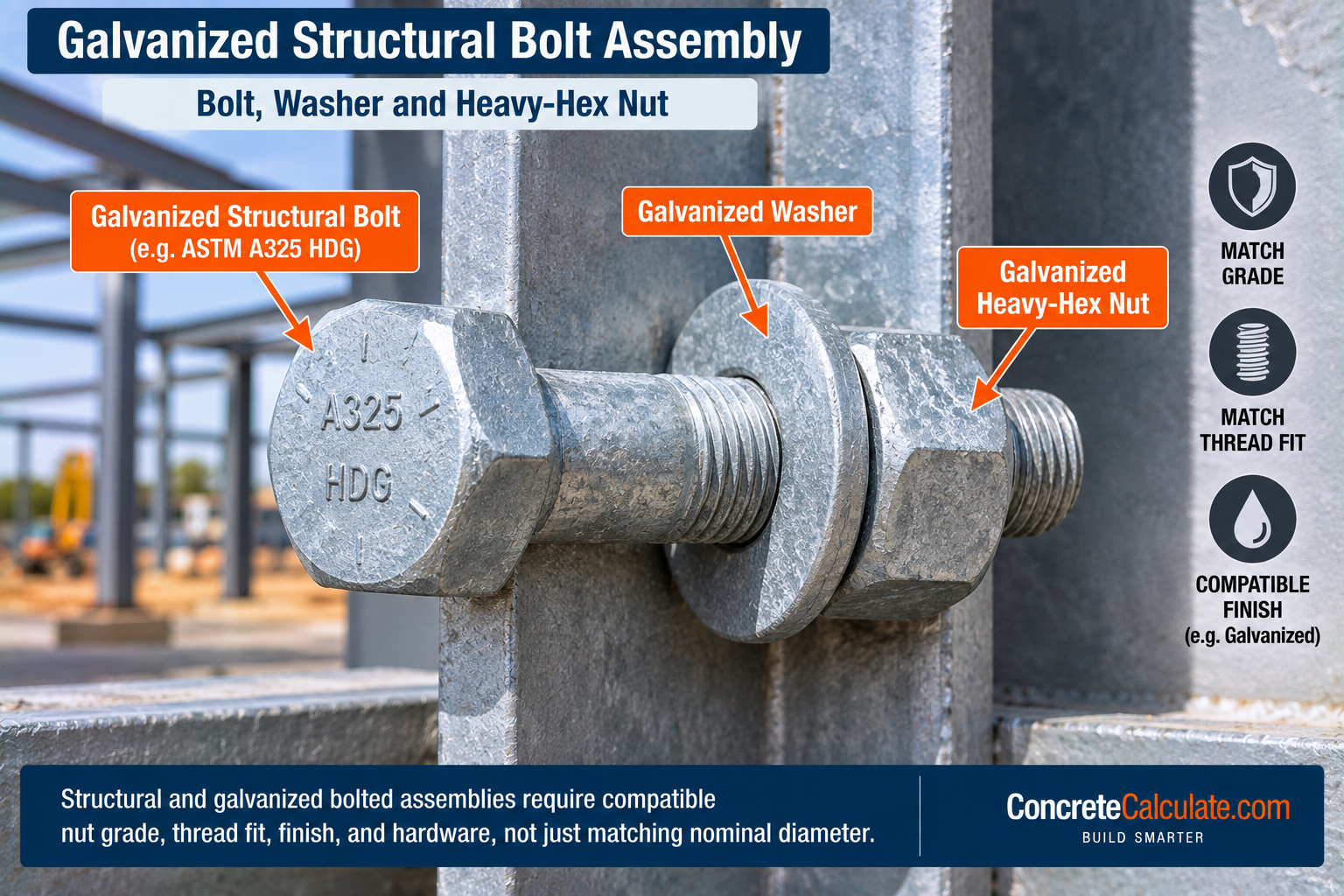
ASTM F3125 Type 1 A325 and A490 structural bolts are commonly paired with specified A563 heavy-hex grades, such as C, C3, D, or DH, depending on bolt type and plain versus galvanized finish, and ASTM A194 Grade 2H heavy-hex nuts are explicitly permitted as a substitute for A563 Grade DH on these bolts. Structural bolt-nut compatibility is not based only on matching diameter and thread; grade and coating matter and must be verified against the applicable specification.
Galvanized Nuts and Oversize Tapping
A strong specialist section, highly relevant for construction.
Hot-dip galvanizing adds coating thickness to threaded fasteners. Galvanized nuts are tapped oversize to accommodate the coating on mating galvanized bolts, with specific oversize allowances codified in ASTM A563. Do not pair a galvanized bolt with an arbitrary standard-tapped nut unless the assembly or specification permits it; using a non-oversize-tapped nut on a galvanized bolt can prevent proper thread engagement or damage the coating.
Nut Weight Chart
Useful for estimating, shipping, and inventory, but kept secondary.
| Nut Size | Finished Hex (lb/100) | Heavy Hex (lb/100) |
|---|---|---|
| 1/2 in. | 10.3 | 16.0 |
| 3/4 in. | 32.5 | 47.0 |
| 1 in. | 76.0 | 107.0 |
Manufacturer weight tables also cover finished jam, heavy-hex jam, square, and heavy square nuts. These figures help with estimating, shipping, and inventory planning rather than structural design.
Metric Hex Nut Size Chart
Metric nut dimensions are not obtained by simply converting inch nut dimensions.
| Metric Thread | Coarse Pitch (mm) | Width Across Flats (mm) | Nut Height (mm) | Wrench Size |
|---|---|---|---|---|
| M8 | 1.25 | 13 | 6.8 | 13 mm |
| M10 | 1.5 | 16 (ISO) / 17 (DIN) | 8.4 | 16 or 17 mm |
| M12 | 1.75 | 18 (ISO) / 19 (DIN) | 10.8 | 18 or 19 mm |
| M16 | 2.0 | 24 | 14.8 | 24 mm |
| M20 | 2.5 | 30 | 18.0 | 30 mm |
ISO 4032 covers hexagon regular nuts (style 1) with metric coarse-thread sizes M5 through M39, product grades A and B. As with sockets, some diameters such as M10 and M12 have a different wrench size under the older DIN 934 standard versus current ISO 4032.
Inch vs Metric Nuts
Do not recommend close-enough thread substitutions.
| Feature | Inch Nut | Metric Nut |
|---|---|---|
| Thread designation | 1/2-13, etc. | M12x1.75, etc. |
| Pitch system | TPI | mm/thread |
| Main dimensional standard | ASME B18.2.2 | ISO 4032 |
| Wrench size | Fractional inch | mm |
| Interchangeable? | No | No |
Nut Size vs Socket/Wrench Size
One of the most useful cross-page comparisons in this fastener cluster.
| Nut | Across Flats | Wrench/Socket |
|---|---|---|
| 1/2-in. standard hex nut | 3/4 in. | 3/4-in. wrench/socket |
| 1/2-in. heavy hex nut | 7/8 in. | 7/8-in. wrench/socket |
For the complete SAE and metric socket reference, including drive size and 6-point versus 12-point guidance, see the Socket Size Chart.
How to Identify an Unknown Nut
A practical workflow for field identification.
Nut Identification Workflow
For deeper thread identification support, see the Thread Identification Chart and the Thread Pitch Chart.
ASME B18.2.2 Inch Nut Dimensions
The primary dimensional authority for this entire page.
ASME B18.2.2-2022 is the current inch-series dimensional standard, covering hex nuts, heavy hex nuts, square nuts, hex jam nuts, heavy hex jam nuts, hex flange nuts, hex coupling nuts, and machine-screw nuts. ASME states that the tabulated dimensions govern, and it also notes that inclusion in the standard does not imply every listed product is commercially stocked.
ISO 4032 Metric Hex Nut Standard
The metric counterpart to ASME B18.2.2 for this page’s scope.
ISO 4032:2023 covers hexagon regular nuts (style 1) with metric coarse-thread sizes M5 through M39, in product grades A and B. Metric nut dimensions follow this separate international standard rather than being derived from inch nut dimensions.
How to Choose the Correct Nut
A complete selection workflow.
Nut Selection Workflow
Common Mistakes and Chart Limitations
Confusing nut thread size with wrench size
Wrench size is the larger, separate across-flats dimension.
Assuming a 3/4-in. nut takes a 3/4-in. wrench
A standard 3/4-in. nut uses a 1-1/8-in. wrench.
Matching diameter but not thread pitch
A 1/2-13 nut will not fit a 1/2-20 bolt.
Mixing UNC and UNF
These thread series are not interchangeable at the same nominal diameter.
Mixing metric and SAE threads
Thread forms are incompatible even when dimensions appear close.
Assuming standard and heavy-hex nuts use the same wrench
Heavy hex nuts require a larger wrench or socket.
Treating heavy hex as merely “stronger-looking” geometry
Heavy hex is a distinct dimensional standard, not just a cosmetic difference.
Assuming nut grade determines external dimensions
Different grades can share the same ASME B18.2.2 dimensions.
Using a jam nut as a full-height nut without checking requirements
Jam nuts are thinner and may not have equivalent proof-load capability.
Ignoring flange diameter on flange nuts
Flange dimensions are a separate consideration from the hex portion.
Pairing incompatible structural bolt/nut grades
Structural assemblies require specific grade pairings, not just matching size.
Ignoring galvanized oversize tapping
Standard-tapped nuts may not properly fit galvanized bolt threads.
Using nearest metric nut on an inch bolt
Even close dimensional matches are not true thread compatibility.
Assuming all 1/2-in. nuts have the same external dimensions
Style (standard, heavy hex, jam, flange) changes the actual dimensions.
Treating nut-size charts as structural connection design tables
This page identifies size and compatibility, not full connection design.
Read before finalizing a nut selection
Nominal nut size primarily describes thread compatibility. Wrench and socket size is a separate across-flats dimension, and standard and heavy-hex patterns differ in both across-flats and thickness. Nut style changes thickness and geometry, and thread pitch must match the mating fastener exactly. Grade and material are separate from size, and structural bolt and nut assemblies require grade compatibility as well as diameter matching. Hot-dip galvanizing can require oversize tapping, and metric nuts follow separate ISO standards from inch nuts. Commercial stock ranges vary by manufacturer, and ASME inclusion in a standard does not guarantee manufacturer availability. Final structural fastening should follow project specifications and applicable codes and standards.
Nut Size FAQs
Download the Nut Size Chart
Get a printable reference including standard hex, heavy hex, wrench size, and thread compatibility tables on this page for jobsite or shop use.