How to Fix Structural Cracks in Walls: Causes, Warning Signs and Repair Methods
How to Fix Structural Cracks in Walls
Learn how to recognize warning signs of structural wall cracking, understand settlement and bowing, compare repair methods, and know when an engineer is necessary.
What Is a Structural Crack in a Wall?
A structural crack is one associated with movement, overstress, foundation displacement, or another condition that affects how a wall or building carries and transfers loads. Appearance alone is not enough to classify a crack as structural.
Do not rely on filler, caulk, or paint to hide a crack when there is wall displacement, bowing, settlement, or continued movement.
The decision logic in this guide is simple: identify the movement, identify the cause, stabilize the wall or foundation if necessary, and then repair the crack.
Structural Cracks vs. Cosmetic Cracks
This table is a quick screening tool, not a diagnosis. If the answer is anything but a clear “often,” get the crack evaluated. Cosmetic cases are covered in How to Repair Cracks in Concrete Walls Before Painting.
| Observation | Possible concern | Simple cosmetic repair appropriate? |
|---|---|---|
| Fine stable shrinkage crack | Low | Often |
| Vertical crack with no displacement | May be nonstructural | Depends on cause |
| Crack widening over time | Active movement | No |
| Horizontal crack with wall bowing | Lateral loading | No |
| Diagonal crack with settlement symptoms | Foundation movement | No |
| Crack with significant face offset | Structural movement | No |
| Crack plus sticking doors/sloping floors | Foundation distress | No |
| Crack leaking but no movement | Moisture problem | Seal only after cause is assessed |
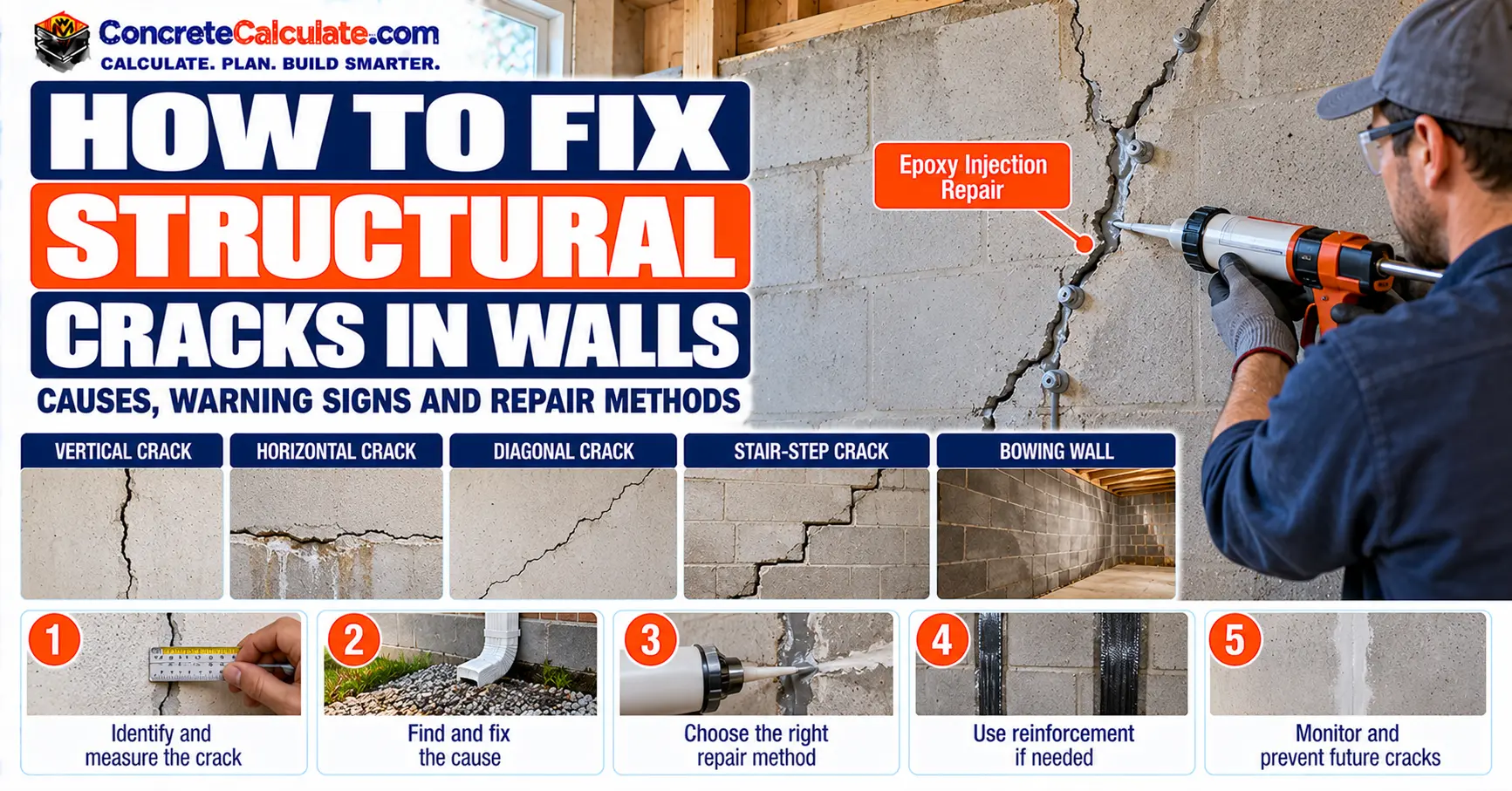
What Do Structural Wall Cracks Look Like?
These patterns can signal structural trouble. Any one of them can also have a harmless cause, so use them as prompts to look further.
- Horizontal cracks.
- Diagonal cracks.
- Stair-step cracks in masonry.
- Cracks wider at one end.
- Offset crack faces.
- Cracks that keep reopening after repair.
- Cracks combined with wall bowing.
- Cracks around doors and windows.
For a broader look at why concrete cracks, read Why Is My Concrete Cracking?.
Horizontal Cracks in Concrete or Basement Walls
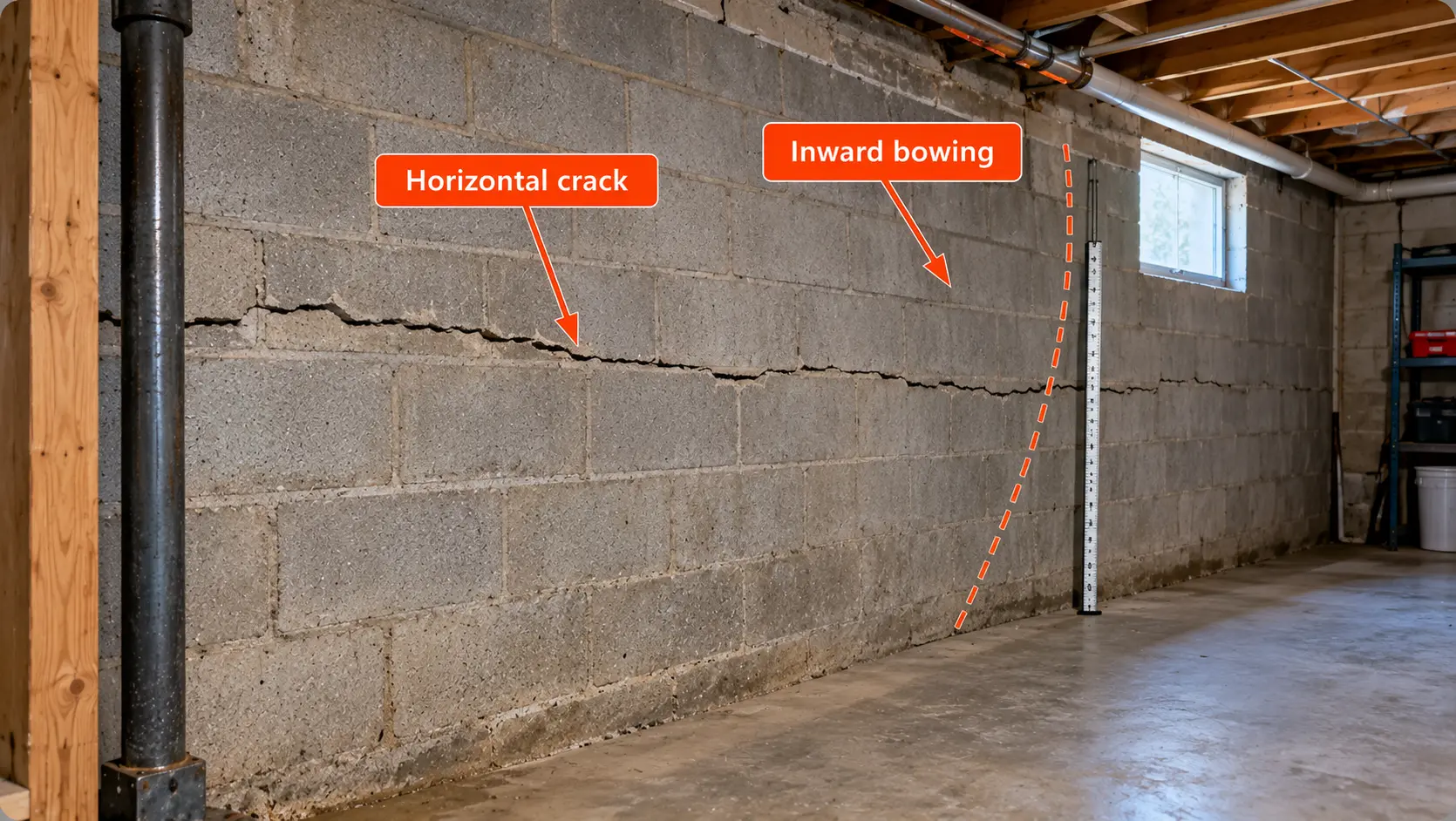
Horizontal cracking deserves particular attention where lateral soil pressure or wall bowing is present. Basement walls resist soil pushing in from the outside, and a horizontal crack can be a sign that the wall is bending.
- Inward bowing.
- Pressure from soil and water outside a basement wall.
- Cracks near mid-height.
- Cracks near reinforcement zones.
Concrete Network describes horizontal and jagged 45-degree cracks as particularly concerning. That does not make every horizontal crack automatically structural, so check for deformation and movement.
Diagonal and Stair-Step Cracks
Diagonal cracks can link to differential settlement, openings, footing movement, or masonry movement. They often start at window and door corners, where stress concentrates.
Stair-step cracking follows mortar joints, so it applies to concrete block and brick walls. Do not describe it as a poured-concrete crack pattern.
Concrete Network notes that diagonal cracks are often due to differential settlement or soil pressure, so finding where the movement is occurring matters more than the crack itself.
Vertical Cracks: When Are They Structural?
Many vertical cracks come from shrinkage or normal settlement. Concrete Network calls them the least troublesome foundation cracks, though cause still matters.
Concern rises when a vertical crack shows any of these:
- Displacement.
- Active widening.
- Multiple connected cracks.
- Leaking plus movement.
- Structural deformation.
If a vertical crack stays stable, dry, and undisplaced, it may be a candidate for a cosmetic repair after evaluation.
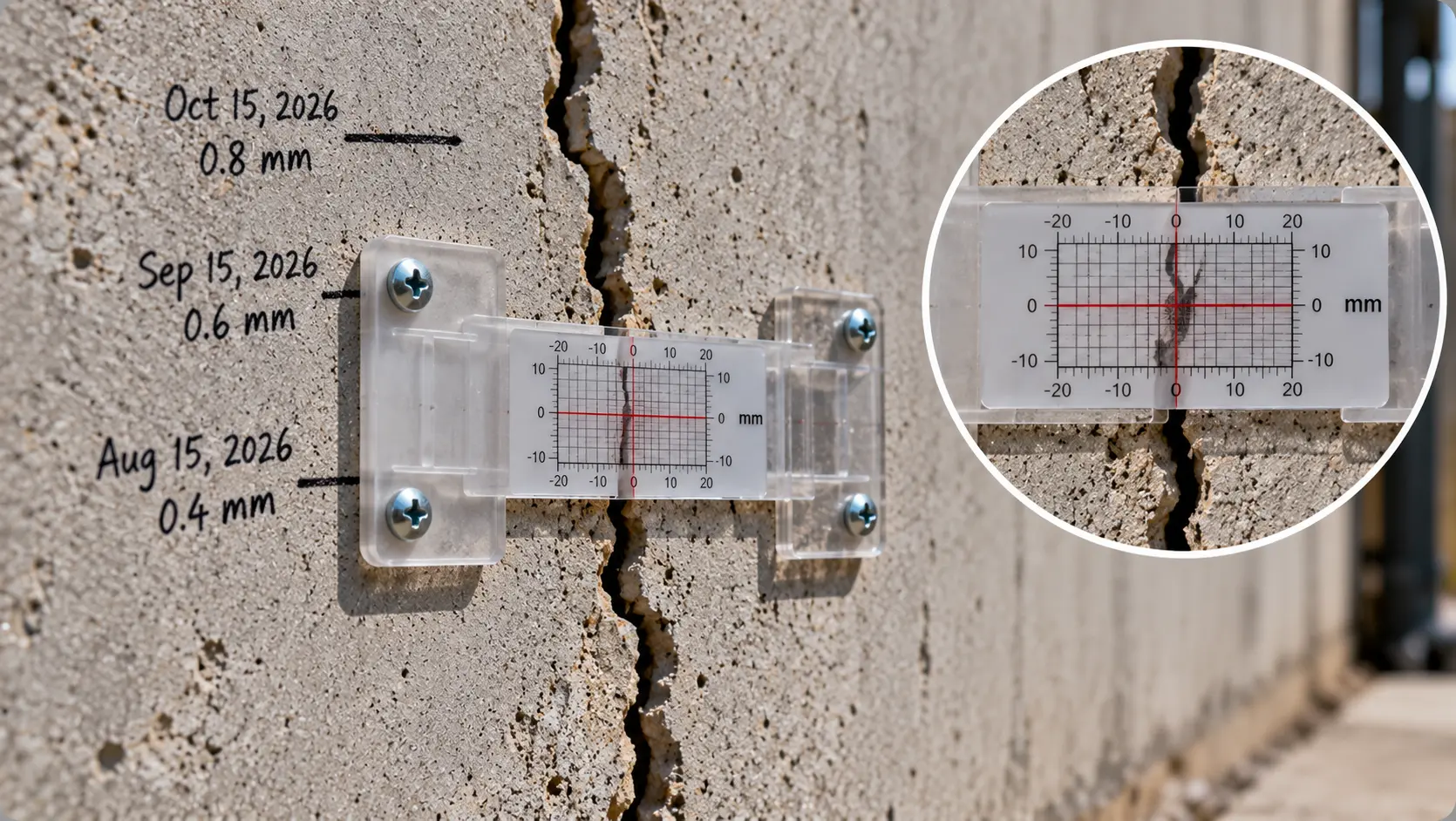
Is the Crack Getting Wider or Moving?
Movement changes the repair. A crack that is still widening cannot be treated like one that has stopped.
USACE defines an active crack as one that is currently moving, and says a crack of unknown cause should be treated as active. ACI RAP-1 adds that if a crack is subject to later movement, epoxy repair may not apply.
- Take dated photographs from the same position.
- Mark the crack ends and date them.
- Install a crack-width gauge.
- Measure periodically and record the results.
Is the Wall Bowing, Bulging or Leaning?
A bowing wall is a major warning sign. Inward bowing in a basement wall usually points to lateral earth pressure, and rotation or displacement against the floor or ceiling makes it worse.
- Inward basement-wall bowing.
- Lateral earth pressure from soil and water.
- Wall rotation.
- Displacement relative to the floor and ceiling framing.
Filling the crack does nothing to stabilize the wall. The wall itself needs to be supported or restrained, and that is an engineered repair.
Doors, Windows and Floors: Other Signs of Foundation Movement
The building often shows signs of movement before the wall does. Concrete Network lists these common warning signs of foundation distress:
- Sticking doors.
- Misaligned windows.
- Sloping floors.
- Gaps at trim and moldings.
- Cracked drywall.
- Exterior masonry cracks.
- Wall rotation and gaps around garage doors.
A wall crack with several of these is more likely tied to foundation movement than a crack with none.
When Does a Wall Crack Require Immediate Professional Evaluation?
Some conditions call for professional evaluation right away. Do not wait for more monitoring data if you see any of these:
- A sudden large crack.
- Obvious wall displacement.
- Significant bowing.
- A wall rotating inward or outward.
- A crack at a beam or column connection.
- Exposed or buckled reinforcement.
- Active foundation settlement.
- Concrete that could fall from overhead.
- A crack that is widening quickly.
- A structural member that looks distorted.
| Warning sign | Why it matters |
|---|---|
| Wall visibly bowing or leaning | Indicates deformation |
| Significant crack displacement | Shows movement across wall |
| Rapidly widening crack | Active movement |
| Multiple connected diagonal cracks | Possible settlement/load redistribution |
| Crack near beam/column bearing | Structural load path |
| Exposed corroded steel | Loss of cover/bond potential |
| Sloping floors + wall cracks | Possible foundation movement |
| Doors/windows suddenly sticking | Building distortion |
| Major water pressure + cracking | Combined structural/moisture issue |
What Causes Structural Cracks in Walls?
Structural cracks come from several mechanisms, often working together. The table pairs each cause with the clues that point to it and what needs investigating.
| Possible cause | Common clues | What requires investigation |
|---|---|---|
| Differential settlement | Diagonal cracks, uneven floors | Foundation elevations/soil |
| Expansive soil | Wall movement after moisture cycles | Soil/drainage |
| Lateral soil pressure | Horizontal crack/bowing wall | Wall capacity/backfill |
| Hydrostatic pressure | Leakage/dampness | Exterior drainage/water pressure |
| Reinforcement corrosion | Rust staining/spalling | Steel condition |
| Overload | Cracking near high-stress region | Structural loads |
| Construction/design defect | Repeated or unusual cracking | Drawings/details |
| Thermal/restraint movement | Repeating seasonal movement | Joint/restraint conditions |
ACI 224.1R makes the same point. Cracking may come from settlement, overload, thermal movement, restraint, corrosion, and more, and the repair must fit the mechanism.
Differential Foundation Settlement
Differential settlement happens when one part of a foundation moves more than another. All foundations settle a little, and little damage results when the whole foundation settles evenly.
Serious cracking can occur when settlement is uneven. Contributing conditions include:
- Compressible fill.
- Erosion.
- Moisture changes.
- Poor bearing soil.
- Plumbing leaks under the home.
- Nearby excavation.
For background on how soil and bearing pressure relate to footings, see the Soil Bearing Capacity Calculator, the Concrete Bearing Pressure Calculator, and the Footing Size Chart. These are for learning, not for designing a repair.
Expansive Soil and Lateral Pressure
Expansive clay soils swell when wet. Concrete Network says they can increase in volume by 10 percent or more, which is enough pressure to crack foundation walls and floor slabs.
Seasonal moisture cycles add to the stress. Soil shrinks away from walls in dry weather and presses against them when wet or frozen, so repeated cycles can wear on a foundation.
Lateral pressure from soil also pushes basement walls inward. When the wall was not built to resist it, horizontal cracks and bowing follow.
Poor Drainage and Hydrostatic Pressure
Saturated soil pushes harder on a foundation wall. Poor drainage, backfill that holds water, and a high water table all raise that pressure and promote leakage.
Sealing a crack from the inside does not relieve exterior water pressure. A sealed wall under pressure can leak elsewhere or crack again until drainage is corrected.
Water often leaves white deposits as it passes through, which the concrete efflorescence guide explains.
Reinforcement Corrosion and Concrete Cracking
Reinforcement corrosion causes cracking that follows the steel. Moisture and chlorides reach the bars, they rust, and the rust expands and pushes on the surrounding concrete.
- Moisture or chloride ingress.
- Steel corrosion.
- Expansive corrosion products.
- Cracking along the bars.
- Delamination and spalling.
For the surface effects, read Concrete Delamination and Concrete Spalling. The Concrete Cover Chart explains why cover over the steel matters.
ACI guidance warns against repairing corrosion-driven cracks by injection alone, because continuing corrosion makes new cracks.
Overload, Design or Construction Problems
Less commonly, the wall itself is the problem. Examples include inadequate thickness or reinforcement, missing support, altered openings, unexpected loading, and construction defects.
These need engineering assessment. The Foundation Wall Thickness Chart and Concrete Load Bearing Calculator give general background only.
How to Measure a Structural Wall Crack
Good records show how a crack changes and help an engineer judge it. Document these items for every crack:
- Width, measured the same way each time.
- Length.
- Orientation.
- Displacement.
- Location.
- Relation to openings.
- Wall bow.
Crack width alone does not define severity. A narrow crack that is moving can matter more than a wide one that is stable.
| Item | What to document |
|---|---|
| Wall type | Poured concrete / CMU / masonry |
| Crack orientation | Vertical / horizontal / diagonal |
| Crack length | Measure |
| Maximum width | Measure consistently |
| Displacement | Yes/no + amount if measurable |
| Wall bow | Measurement |
| Moisture/leakage | Present/absent |
| Nearby doors/windows | Alignment issues |
| Floor condition | Level/sloping |
| Exterior drainage | Good/poor/unknown |
| Date first observed | Record |
| Change over time | Photos/gauge readings |
How to Measure Wall Bowing or Displacement
Bowing and displacement can be checked in simple ways, but the numbers need professional interpretation. Common conceptual methods include:
- A plumb line hung against the wall.
- A laser level.
- A long straightedge held on the wall.
- Survey measurements.
Record readings at several heights and compare them over time. If movement is significant, a professional survey and evaluation are the right next step.
How Engineers Evaluate Structural Cracks
A structural evaluation is more than looking at a photograph. Depending on the situation, an engineer may use:
- Visual inspection.
- Crack monitoring.
- A foundation or floor elevation survey.
- Reinforcement locating.
- Sounding.
- Cores.
- Structural calculations.
- A soil or geotechnical investigation.
USACE notes that any significant isolated crack should be referred to a structural engineer. A geotechnical investigation may be recommended when the suspected cause lies in the soil.
Should You Repair the Crack Before Monitoring It?
Premature cosmetic repair can erase useful evidence. Filling a crack hides how much it has moved, so document and monitor first when the condition is not urgent.
Do not delay for monitoring when conditions look dangerous, such as significant bowing, rapid widening, or concrete that could fall. Those call for immediate evaluation.
Once an engineer confirms a crack is stable and nonstructural, you can estimate cosmetic filler with the Concrete Crack Filler Calculator. Use it only for suitable sealing and filling applications.
Structural Wall Crack Repair Methods Compared
Each method does a different job, and few of them stop movement by themselves. This table is the main repair-selection guide for the section.
| Method | Main purpose | Suitable for | Does it stop movement? |
|---|---|---|---|
| Epoxy injection | Restore crack continuity | Selected stable structural cracks | No, not by itself |
| Polyurethane injection | Water sealing | Leaking cracks | No |
| Crack stitching | Reinforce across crack | Selected structural cracks | Helps transfer forces; design-dependent |
| Carbon-fiber straps | Reinforce/stabilize wall | Selected bowed/cracked walls | Can restrain movement when properly designed |
| Steel bracing | Structural wall support | Bowed/loaded walls | Yes, depending on design |
| Wall anchors/tiebacks | Resist lateral pressure | Bowed basement walls | Yes, when engineered |
| Underpinning/piers | Stabilize settling foundation | Settlement-related cracks | Addresses foundation movement |
| Replacement/reconstruction | Restore severely damaged wall | Major structural damage | Yes if underlying cause corrected |
Sealing a crack, bonding it, stitching it, stabilizing the wall, stabilizing the foundation, and correcting soil or water pressure are six different jobs. Match the method to the job.
Epoxy Injection for Structural Cracks
Epoxy injection bonds a crack so it can carry load again. ACI RAP-1 covers it as a structural repair for selected cracks, with attention to preparation, materials, injection, and quality control.
- Selected dormant or stable cracks.
- Cracks where restoring continuity is desirable.
- Dry cracks, or cracks that are prepared appropriately.
Injection has limits. It does not correct settlement, it does not stabilize a wall, and it is not appropriate where movement continues unless the cause is resolved first. ACI notes that cracks as narrow as 0.002 inch can be bonded by epoxy.
Cracks that are damp need a moisture-tolerant epoxy, and cracks caused by corroding steel should not be repaired this way. Leave this work to a qualified contractor.
Polyurethane Injection: What Is It For?
Polyurethane injection is mainly used to stop water. It is flexible and can seal a leaking crack that moves a little.
Polyurethane can stop leakage, but that does not make it a structural repair. It does not bond a crack back together or add strength.
Concrete Network lists epoxy or polyurethane as common injection materials for foundation cracks, and notes that diagonal cracks tied to settlement also need the settlement addressed.
Crack Stitching and Carbon-Fiber Staples
Crack stitching places reinforcement across a crack. Carbon-fiber staples are one form, and they help redistribute tensile forces and supplement a crack repair where an engineer calls for it.
Concrete Network says cracks repaired only by injected material can suffer creep and fatigue under continuing foundation movement, and that cross-stitching with staples reduces that risk.
Do not copy DIY staple spacing or groove dimensions from the internet. The design depends on the wall and the loads.
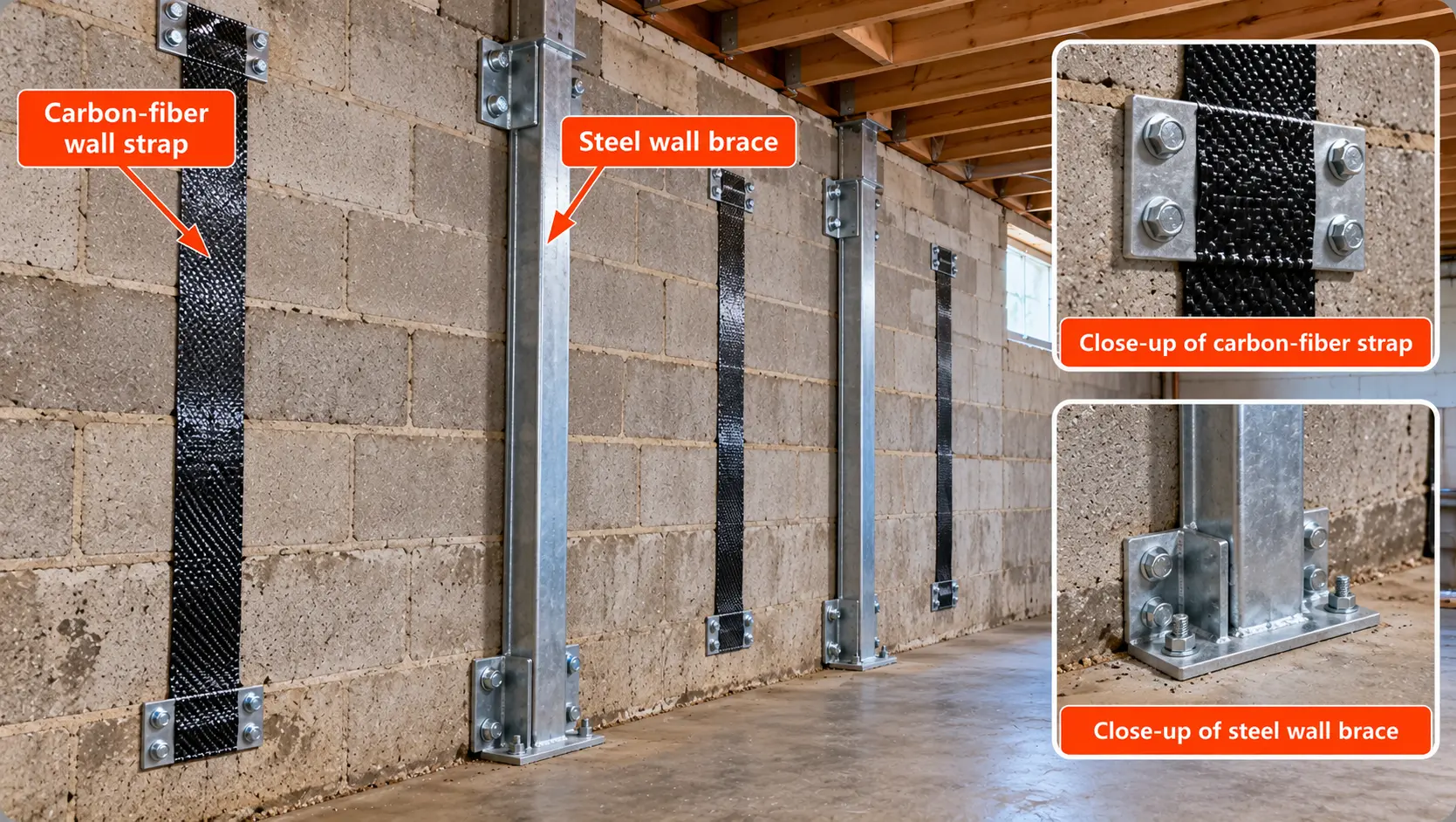
Carbon-Fiber Straps for Bowed Basement Walls
Carbon-fiber straps are bonded vertically to the inside face of a bowed wall. They can add tensile strength and resist further inward movement without excavation.
- They suit relatively stable wall conditions.
- They counter continued lateral soil pressure.
- Substrate preparation matters.
- Wall geometry and displacement determine suitability.
Concrete Network stresses that the strap system must be tied into the footing and the framing above, not just applied at the point of greatest bow. Otherwise stress can shift to another part of the wall.
Straps do not remove the soil pressure outside the wall. They resist it, so drainage and grading still matter.
Wall Anchors, Helical Tiebacks and Steel Bracing
Some bowed walls need more than straps. Contractor-designed systems include:
- Wall anchors or tiebacks, which resist lateral pressure.
- Steel beams or bracing, which provide structural support.
- Helical ties, which can relieve pressure and stabilize walls with moderate to severe movement.
These are contractor and engineer-designed systems, not general DIY crack repairs. Which one fits depends on the wall, the amount of bowing, and the soil.
Bowed basement-wall repair requires stabilization of the wall, not simply filling the visible crack.
Foundation Piers and Underpinning for Settlement Cracks
If settlement caused the crack, the real repair is stabilizing the foundation. Concrete Network describes piering as steel posts and hydraulic jacks that lift and stabilize foundations over unstable soil.
Push piers, helical piers, and underpinning all aim to carry the footing load on deeper, firmer ground. Their number, spacing, and depth come from an engineered design, not a general rule.
Concrete Network advises hiring licensed contractors, getting at least three proposals, and checking that the repair method has code evaluation. It calls foundation work definitely not a do-it-yourself project.
| Root cause | Crack repair alone enough? | Primary strategy |
|---|---|---|
| Dormant structural crack, no movement | Sometimes | Epoxy/stitching as designed |
| Active settlement | No | Foundation stabilization |
| Bowed basement wall | No | Wall stabilization |
| Water intrusion | No | Drainage/waterproofing + sealing |
| Corrosion | No | Remove damage + steel repair |
| Overload | No | Structural strengthening/load correction |
| Construction defect | Usually no | Engineer-designed repair |
| Cosmetic shrinkage | Often | Nonstructural repair |
Crack injection can repair the crack itself, but settlement must be stabilized if settlement caused the cracking.
Structural Wall Crack FAQs
How do I know if a wall crack is structural?
Look for movement, displacement, bowing, and signs elsewhere in the building such as sticking doors and sloping floors. Crack direction alone does not decide it, so get an evaluation when in doubt.
Are horizontal cracks serious?
They can be, especially with inward bowing from soil pressure. Concrete Network calls them particularly concerning, but they still need to be evaluated rather than assumed.
Can structural cracks be filled with epoxy?
Selected stable structural cracks can be bonded with epoxy injection by a qualified contractor. It does not stop ongoing movement or correct the cause.
Does epoxy injection stop foundation movement?
No. It repairs the crack, not the settlement or soil pressure behind it.
Can carbon fiber fix a bowed basement wall?
Carbon-fiber straps can stabilize some bowed walls when designed and installed correctly. Suitability depends on the wall, the bow, and the soil.
What does underpinning do?
It transfers a footing’s load to deeper, more stable soil, using methods such as piers. It addresses the foundation movement that caused the cracking.
Can structural cracks reopen?
Yes, if the cause of movement is not corrected, or if the repair method does not suit the crack.
Should I monitor a crack before repair?
Yes when the condition is not urgent. Monitoring shows whether the crack is moving. Do not delay evaluation when conditions look dangerous.
How much does structural crack repair cost?
It varies widely. Concrete Network says sealing one or two cracks may cost a few hundred dollars, while extensive structural remediation can run into the thousands. Consumer guides report per-crack, per-strap, and per-pier figures that differ a lot, so get several estimates.
When should I call a structural engineer?
Call one for bowing, displacement, widening cracks, settlement symptoms, cracks in structural walls, or when you cannot tell the cause.
To budget a repair after scope is set, try the Concrete Repair Calculator and the Concrete Repair Cost Calculator. Structural work needs a professional estimate.