Concrete Curing Temperature Chart – Cold, Hot & Strength Effects
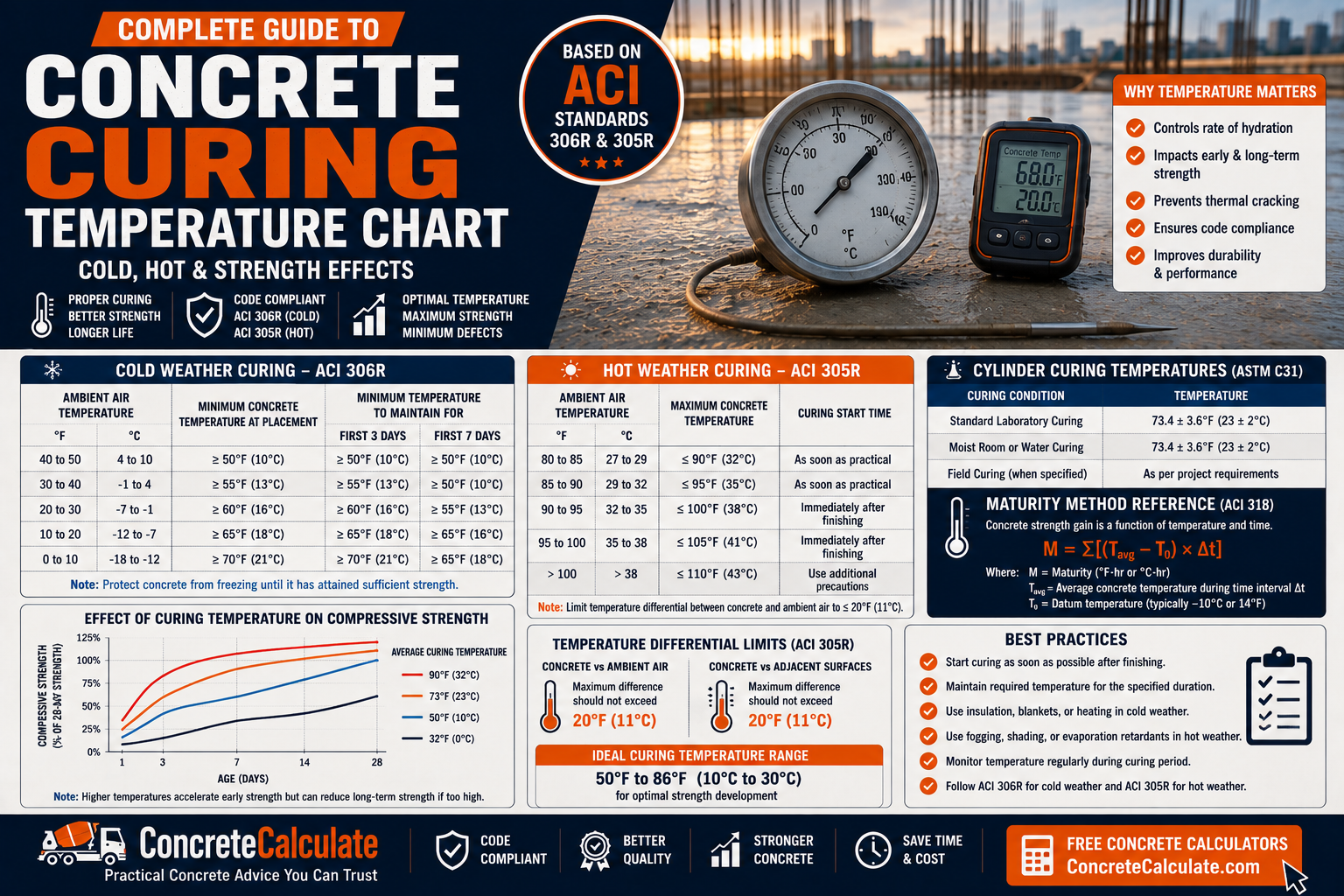
Concrete Curing Temperature Chart
Cold, Hot & Strength Effects
The complete curing temperature reference: cold weather minimums, hot weather guidance, cylinder curing conditions, strength effects, and the maturity method, in Fahrenheit and Celsius.
 Reviewed by Muhammad Ramzan Babar, PhD Researcher (Plasma Physics) & Calculator Developer, View Profile
There is no single universal curing temperature
Curing temperature has several distinct meanings: concrete temperature, air temperature, surface temperature, and test cylinder curing temperature are not interchangeable. ACI notes that higher curing temperatures accelerate early hydration but can reduce later-age strength, so no single number can be labeled universally best.
Concrete Curing Temperature Chart, Quick Reference
This table describes general conditions and considerations, not a single ideal target. The correct approach depends on concrete mixture, section size, exposure, and whether you are discussing in-place concrete or test specimens.
| Concrete Temperature (°F) | °C | General Condition | Expected Effect on Hydration | Main Curing Consideration |
|---|---|---|---|---|
| Below 32 | Below 0 | Below-freezing | Hydration effectively stops; freezing risk | Protect from ice damage before adequate strength is gained |
| 32 to 40 | 0 to 4 | Near-freezing | Extremely slow hydration | ACI 306R minimum concrete temperatures and protection required |
| 40 to 55 | 4 to 13 | Cool curing | Significantly retarded hydration | Extended curing duration, monitor strength gain |
| 55 to 70 | 13 to 21 | Moderate curing | Balanced hydration rate | Common reference range for many placements |
| 70 to 80 | 21 to 27 | Warm curing | Accelerated early hydration | Monitor moisture retention and evaporation |
| Above 80 | Above 27 | Hot curing | Rapid early hydration, potential later-strength tradeoff | ACI 305R hot weather protocols, evaporation control |
No temperature in this table is universally best
ACI states that higher curing temperatures accelerate early hydration and strength gain but can produce lower strength at later ages compared with moderate temperatures. Always evaluate temperature together with time, moisture, mixture, and exposure condition.
Planning your next concrete project?
Plan concrete materials and project costs with our downloadable Excel estimator pack. For estimating only; follow applicable technical standards for design and installation.
One-time purchase · Digital downloadWhat Is Concrete Curing Temperature?
Curing temperature refers to the temperature maintained in and around fresh concrete during the period when cement hydration develops strength, and it is not the same as ambient air temperature.
Concrete temperature exists on a spectrum from the internal core of a placement to its exposed surface, and it can differ substantially from the surrounding air temperature, especially in thick sections. Curing temperature matters differently at early ages, when it primarily affects hydration rate and setting, than at later ages, when temperature history affects the ultimate strength and microstructure that develops.
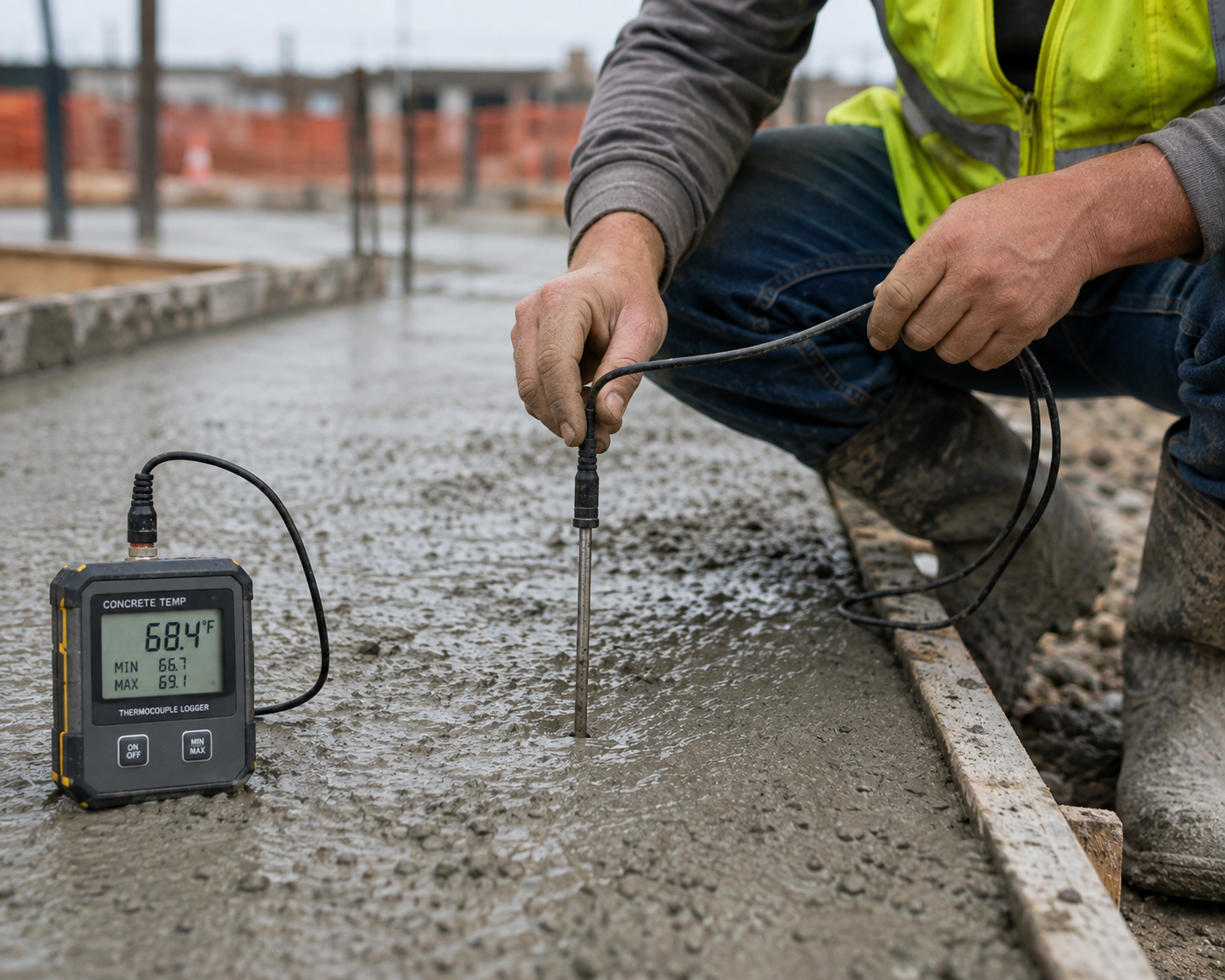
Why Temperature Matters During Concrete Curing
Temperature influences hydration rate, setting time, moisture retention, durability, and the risk of thermal cracking, making it one of several interacting curing variables rather than the only one.
| Factor | Temperature’s Role |
|---|---|
| Cement hydration | Reaction rate is temperature dependent |
| Strength development | Affects both early rate and later-age potential |
| Setting | Higher temperature accelerates setting time |
| Moisture retention | Higher temperature increases evaporation and moisture loss |
| Thermal cracking | Temperature differentials create restrained thermal stress |
Temperature is only one part of proper curing. Moisture retention, curing duration, and the specific concrete mixture all interact with temperature to determine actual outcomes, which is why this chart addresses temperature as one dimension alongside the Concrete Curing Time Chart‘s duration guidance.
Concrete Temperature vs Air Temperature vs Surface Temperature
These three temperatures can differ substantially, especially in thick sections, mass concrete, and extreme weather, so an air temperature reading should never be assumed to represent concrete temperature.
| Term | Definition |
|---|---|
| Concrete temperature | Temperature within the concrete mass at a given location |
| Air temperature | Ambient environmental temperature surrounding the placement |
| Surface temperature | Temperature at or near the exposed concrete surface |
| Internal/core temperature | Temperature within the interior of a concrete section, often elevated by heat of hydration |
Concrete Curing Temperature Chart in °F and °C
Verified conversions for the temperature values referenced throughout this chart, rounded to standard engineering precision.
| °F | °C | General Curing Condition | Main Concern |
|---|---|---|---|
| 0 | -17.8 | Severe cold | Freezing damage, hydration effectively stopped |
| 32 | 0 | Freezing point | Fresh concrete freezing risk |
| 40 | 4.4 | ACI cold weather threshold | Hydration greatly retarded below this point |
| 50 | 10.0 | Cool | Slower strength development |
| 55 | 12.8 | Cool to moderate | ACI 306R minimum for thin sections |
| 60 | 15.6 | Moderate | Lower bound of ASTM C31 initial curing range |
| 68 | 20.0 | Moderate | Lower bound for higher-strength specimen curing |
| 73.5 | 23.1 | Standard laboratory curing | NRMCA standard cylinder curing target |
| 80 | 26.7 | Warm | Upper bound of ASTM C31 initial curing range |
| 90 | 32.2 | Hot | Accelerated hydration, evaporation risk |
| 100 | 37.8 | Very hot | ACI 305R hot weather protocols strongly recommended |
Recommended Concrete Curing Temperature Range
The answer to “what temperature should concrete be cured at” depends entirely on which context is being discussed.
| Context | Governing Reference | Typical Range |
|---|---|---|
| Standard-cured test specimens | ASTM C31, NRMCA guidance | 60 to 80°F initial; 73.5 ± 3.5°F laboratory |
| High-strength specimens (6000 psi+) | ASTM C31 | 68 to 78°F initial curing |
| Cold-weather in-place concrete | ACI 306R-16 | 40 to 55°F minimum, varies by section size |
| Hot-weather in-place concrete | ACI 305R-20 | Project-specific; managed, not a fixed target |
Concrete Curing Temperature Around 70°F
Moderate temperatures near 70 to 73.5°F are commonly used as a laboratory reference for strength testing, not as a mandatory field target for every structure.
Laboratory reference, not a structural requirement
NRMCA summarizes standard specimen curing at 73.5 ± 3.5°F after the initial curing period, following ASTM C31 practice. This standardized condition exists so test results can be compared consistently across projects; it does not mean every concrete structure must be maintained at 70 to 73°F.
Concrete Curing Temperature Below 50°F
Hydration slows substantially below 50°F, requiring longer curing durations and closer temperature monitoring to reach required strength.
| Consideration | Effect |
|---|---|
| Hydration rate | Significantly slower than moderate temperature curing |
| Strength development | Extended time needed to reach target strength |
| Protection | Cold-weather protection measures often warranted |
| Monitoring | Temperature tracking becomes more important for schedule planning |
ACI notes that hydration is greatly retarded below approximately 40°F (5°C), making the 40 to 50°F range a transition zone where protection and monitoring become increasingly important rather than optional.
Concrete Curing Temperature Below Freezing
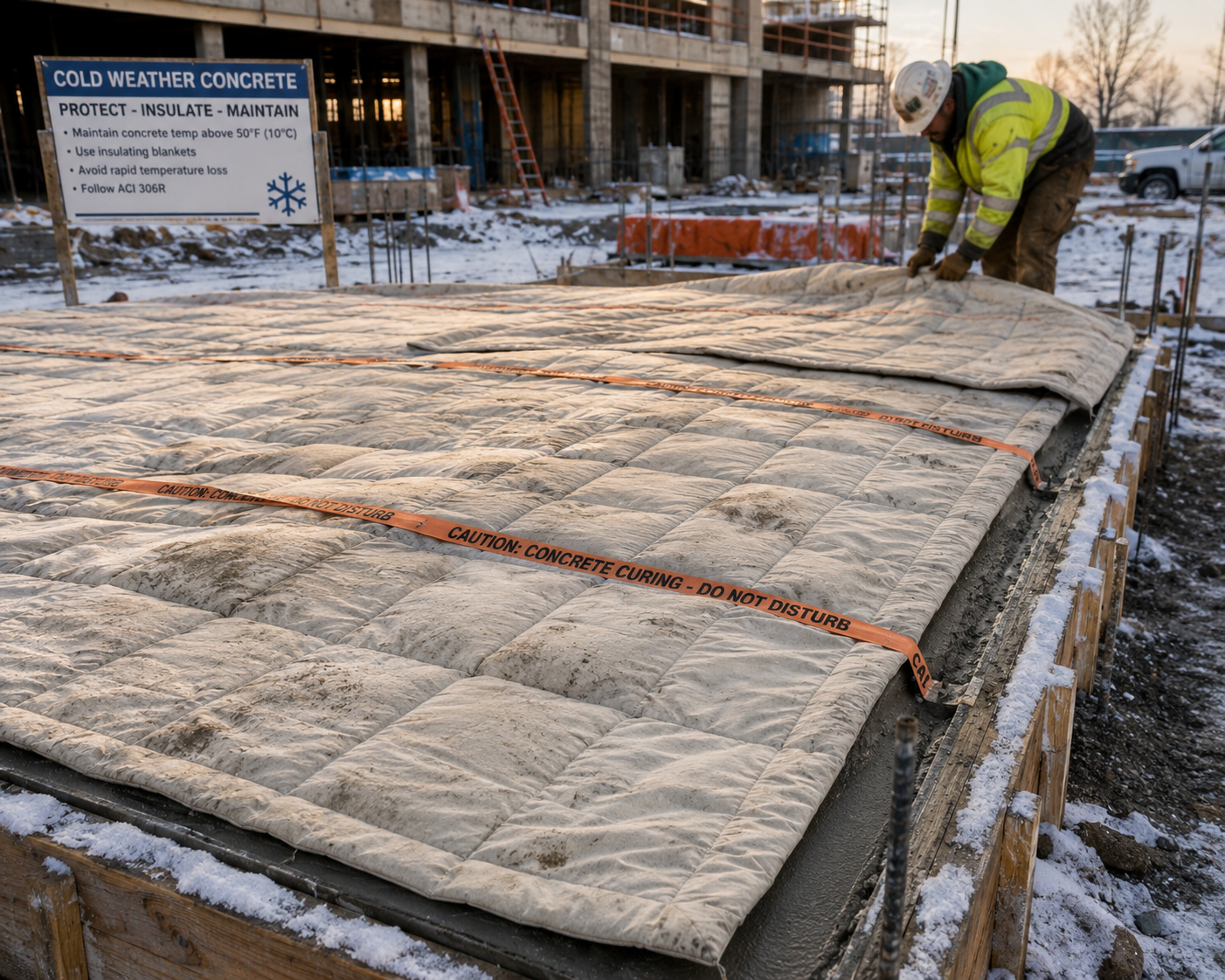
Proper cold-weather concreting controls and protects concrete temperature; it is not simply a rule against pouring when the air temperature forecast is low.
Freezing risk depends on concrete temperature, not air temperature alone
Fresh concrete that freezes before developing sufficient strength can suffer permanent internal damage from ice crystal formation. ACI PRC-306-16 focuses specifically on preventing early-age freezing, maintaining adequate strength development, and limiting rapid temperature changes, rather than treating a single air temperature threshold as an automatic pour/no-pour rule.
Protection methods including insulation, heated enclosures, and heated materials allow placement to continue in cold conditions, provided concrete temperature is actively controlled and monitored rather than assumed from the weather forecast.
Concrete Curing Temperature Above 80°F
Higher temperatures accelerate hydration and moisture loss simultaneously, raising plastic shrinkage and workability concerns.
| Consideration | Effect |
|---|---|
| Hydration rate | Accelerated compared to moderate temperatures |
| Moisture loss | Increased evaporation from the exposed surface |
| Plastic shrinkage risk | Elevated, especially with wind and low humidity |
| Slump/workability | Can decline faster than at moderate temperatures |
ACI’s hot-weather guidance identifies high ambient temperature, high concrete temperature, low relative humidity, and high wind speed together, not any single factor alone, as the environmental conditions that can impair concrete quality and construction operations.
Concrete Curing Temperature Above 90°F
Very high temperatures intensify the same concerns present above 80°F, without representing an automatic universal rejection threshold.
| Consideration | Effect |
|---|---|
| Setting time | Accelerated, reducing available finishing time |
| Evaporation | Substantially increased, especially with wind |
| Thermal gradients | Larger differentials possible in thicker sections |
| Later-age strength | May be reduced in some circumstances compared to moderate-temperature curing |
Effect of Curing Temperature on Concrete Strength
Temperature affects the rate and ultimate outcome of strength development differently at different ages, according to ACI’s own technical guidance.
| Temperature Range | Early Strength | Later-Age Strength |
|---|---|---|
| Lower (below moderate) | Slower early development | Not necessarily reduced; often comparable or favorable |
| Moderate (near 68 to 73°F) | Balanced development | Commonly used strength testing reference |
| Higher (above roughly 40°F increase) | Faster early development | Can be lower than moderate-temperature cured concrete |
ACI’s direct technical position
ACI states that tests of specimens sealed against moisture loss show higher early strengths but lower strengths at later ages as temperature is increased above about 40°F (5°C). ACI also notes that for job control specimens cured near 68°F, lower temperatures at casting and for a few hours afterward can give higher strengths at one to three months.
For strength reference values by age and mix, see the Concrete Strength Gain Chart and Concrete PSI Chart.
Early Strength vs Later-Age Strength and Temperature
Faster early strength gain does not necessarily translate into higher ultimate strength, because temperature affects the microstructure that forms during hydration.
ACI explains that the rapid stiffening in the first few hours and the rapid rate of early strength development under higher temperatures can be detrimental to later strength development. This occurs because rapid early hydration can produce a denser shell around cement particles that limits later hydration, affecting the microstructure and long-term strength potential differently than more gradual, moderate-temperature hydration.
Concrete Curing Temperature and Hydration
Cement hydration is a chemical reaction whose rate depends directly on temperature, but the reaction also requires adequate moisture to proceed.
Higher temperatures speed the hydration reaction, generating heat and developing strength faster, while lower temperatures slow the reaction correspondingly. Temperature cannot be considered independently of moisture availability, since hydration requires water to continue, and heat generation from hydration itself can raise internal concrete temperature above the surrounding air, particularly in larger sections.
Concrete Curing Temperature and Moisture
Temperature and moisture together define the effective curing environment; neither factor alone determines curing quality.
| Method | Function |
|---|---|
| Wet coverings | Maintain a damp surface condition |
| Water curing/spraying | Actively replenish surface moisture |
| Curing compounds | Form a membrane to reduce moisture loss |
| Plastic sheeting | Traps moisture without active replenishment |
FHWA guidance emphasizes that conventional curing should begin promptly after finishing, since wet coverings and water spraying can maintain a damp condition that hydration requires, particularly important at higher temperatures where evaporation accelerates moisture loss.
Concrete Curing Temperature and Humidity
Air temperature alone does not determine curing conditions; relative humidity strongly influences evaporation and surface drying.
Low relative humidity increases the rate of surface moisture evaporation at a given temperature, raising plastic shrinkage risk during hot-weather placements. ACI 305R specifically notes that plastic shrinkage cracking is seldom a problem in hot and humid climates where relative humidity rarely falls below about 80 percent, illustrating why humidity must be evaluated alongside temperature rather than in isolation.
Concrete Curing Temperature and Wind
Wind speed increases surface moisture evaporation, compounding the effects of high temperature and low humidity.
High wind speed is one of the four combined environmental conditions ACI 305R identifies as capable of impairing concrete quality, alongside high ambient temperature, high concrete temperature, and low relative humidity. Evaporation control measures, such as windbreaks or immediate curing after finishing, become more important as wind speed increases.
Concrete Curing Temperature in Cold Weather
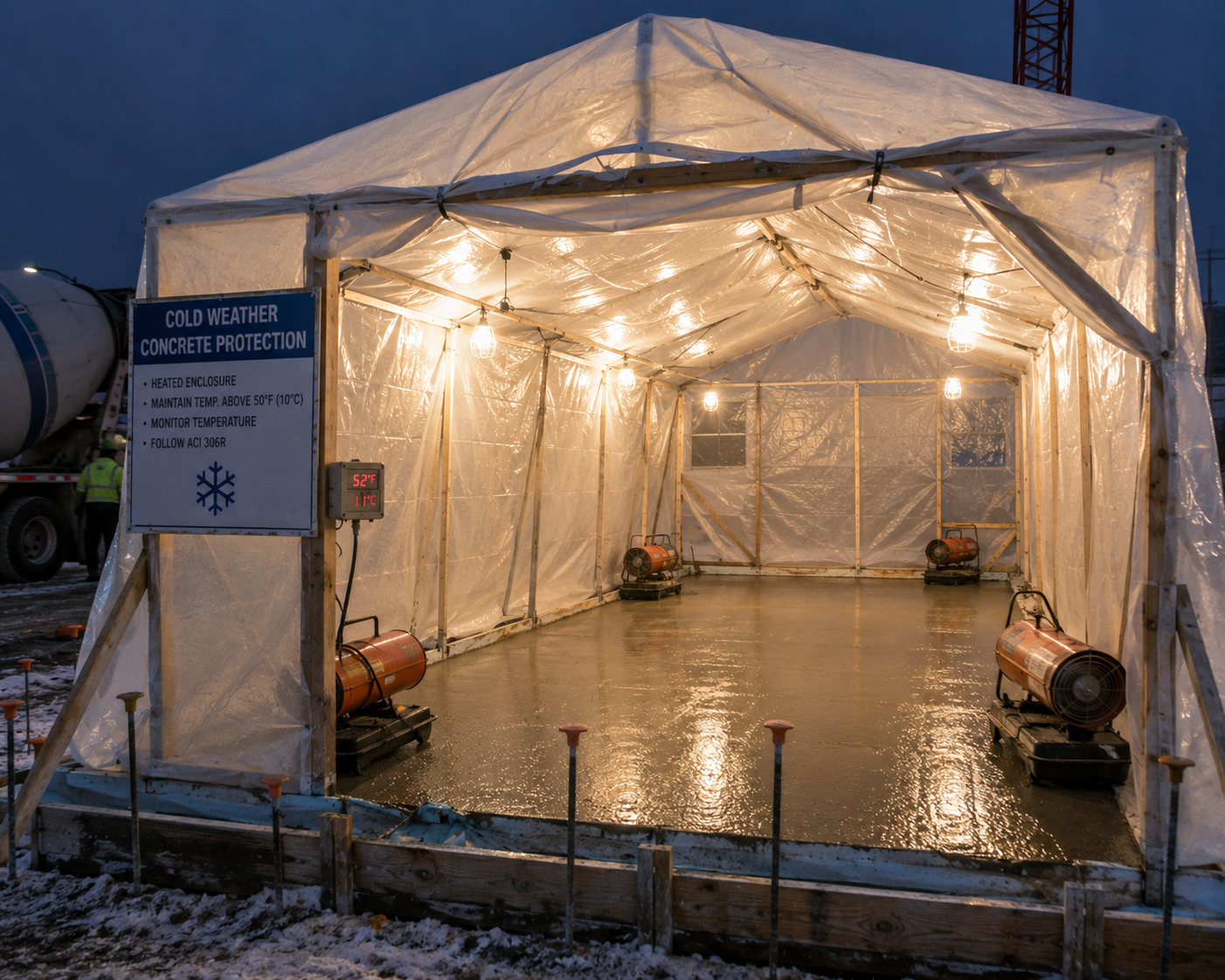
ACI PRC-306-16 defines cold weather and provides specific concrete temperature requirements based on section size, not just air temperature.
ACI 306R’s cold weather definition
ACI 306R defines cold weather as a period when the air temperature has fallen or is expected to fall below 40°F for more than three consecutive days. During this period, concrete temperature must be actively placed and maintained above specific minimums, and protected long enough to prevent early-age freezing and achieve required strength.
Cold-Weather Concrete Temperature Chart
ACI 306R-16 Table 5.1 sets minimum concrete temperatures based on both air temperature and section size, since thinner sections lose heat faster than thicker ones.
| Section Size (Min. Dimension) | Min. Concrete Temp. as Placed/Maintained | Min. Concrete Temp. as Mixed, Air Above 30°F | Min. Concrete Temp. as Mixed, Air 0 to 30°F | Min. Concrete Temp. as Mixed, Air Below 0°F |
|---|---|---|---|---|
| Less than 12 in. | 55°F (13°C) | 60°F (16°C) | 65°F (18°C) | 70°F (21°C) |
| 12 to 36 in. | 50°F (10°C) | 55°F (13°C) | 60°F (16°C) | 65°F (18°C) |
| 36 to 72 in. | 45°F (7°C) | 50°F (10°C) | 55°F (13°C) | 60°F (16°C) |
| Greater than 72 in. | 40°F (5°C) | 45°F (7°C) | 50°F (10°C) | 55°F (13°C) |
Source: ACI 306R-16, Table 5.1, Recommended Concrete Temperatures. This is why a single “minimum curing temperature” figure would be misleading; the requirement genuinely depends on both section thickness and ambient air temperature at the time of mixing.
Concrete Curing Temperature in Hot Weather
ACI 305R-20 addresses hot weather as a combination of environmental conditions, not a single temperature threshold.
| Condition | Contributing Factor |
|---|---|
| High ambient temperature | Accelerates hydration and evaporation |
| High concrete temperature | Accelerates setting and reduces workable time |
| Low relative humidity | Increases evaporation rate |
| High wind speed | Further accelerates surface moisture loss |
ACI 305R-20 defines hot weather as one or a combination of these conditions tending to impair the quality of freshly mixed or hardened concrete by accelerating moisture loss and cement hydration, or otherwise causing detrimental results.
Equipment for Your Project
Affiliate disclosure: As an Amazon Associate, ConcreteCalculate earns from qualifying purchases. We may also earn a commission from other affiliate links at no additional cost to you.
Hot-Weather Concrete Temperature Management
Managing concrete temperature in hot weather involves controlling ingredient temperatures and delivery time, not just curing after placement.
| Method | Purpose |
|---|---|
| Cooling mixing water | Reduces fresh concrete temperature at batching |
| Ice as mixing water | Provides additional cooling where appropriate for the mixture |
| Shading aggregates | Prevents aggregate stockpiles from absorbing solar heat |
| Reducing delivery time | Limits temperature rise and slump loss before placement |
| Immediate curing after finishing | Minimizes the window for rapid moisture loss |
Maximum Concrete Temperature During Placement
There is no single universal maximum placement temperature; ACI 305R-20 treats fresh concrete temperature as one part of overall hot-weather planning.
Project specifications frequently set specific fresh concrete temperature limits depending on the application, mixture, and mass concrete considerations, since larger placements generate more heat of hydration and require closer temperature control to manage thermal gradients. Rather than a fixed number, ACI 305R-20 frames concrete temperature as placed alongside length of haul, site handling facilities, and early curing techniques as interconnected hot-weather planning factors.
Concrete Temperature During the First 24 Hours
The first 24 hours is a critical period for freezing protection, but ACI cautions that this window alone may not ensure satisfactory strength development.
24-hour protection is not automatically sufficient
ACI’s cold-weather guidance specifically notes that protecting concrete from freezing for the first 24 hours alone may not ensure satisfactory strength development. Continued temperature maintenance beyond this initial period is often necessary, particularly in colder conditions or with slower-strength-gain mixtures.
Concrete Temperature During the First 48 Hours
The 48-hour period aligns with the initial curing timeframe used for standard test specimens and remains an important window for field monitoring.
ASTM C31 initial curing for standard test specimens covers up to 48 hours in a controlled temperature environment. For in-place concrete, cold-weather protection typically continues based on strength development and section size rather than defaulting to exactly 24 or 48 hours as universal milestones.
Concrete Curing Temperature for Test Cylinders
Test cylinder curing temperature is governed by ASTM C31 and is a controlled laboratory or field condition, separate from the temperature the actual structure experiences.
| Curing Phase | Temperature Requirement |
|---|---|
| Initial curing (general) | 60 to 80°F (16 to 27°C), up to 48 hours |
| Initial curing (6000 psi or greater) | 68 to 78°F (20 to 26°C) |
| Laboratory (standard) curing | 73.5 ± 3.5°F (23.1 ± 1.9°C) |
NRMCA guidance clarifies that these temperature ranges refer to the temperature of the medium surrounding the specimens, which may be air, water, or damp sand, and do not refer to the concrete’s own internal temperature.
Standard-Cured vs Field-Cured Concrete Specimens
Standard curing evaluates concrete for acceptance under controlled conditions; field curing estimates the actual in-place condition of the structure.
| Aspect | Standard Curing | Field Curing |
|---|---|---|
| Conditions | Controlled laboratory temperature and moisture | Conditions representative of the actual structure |
| Purpose | Acceptance and quality control testing | Evaluate in-place/field strength conditions |
| Protection | Standardized temperature/moisture per ASTM C31 | Similar protection to the structure itself |
Concrete Curing Temperature and Maturity
A single temperature reading is insufficient to estimate strength, since strength development depends on the full temperature history over time, not one snapshot.
The maturity method, standardized in ASTM C1074, uses the Nurse-Saul temperature-time factor, calculated as the sum of (concrete temperature minus a datum temperature) multiplied by the time interval, summed over the curing period. FHWA describes this function and emphasizes that the maturity relationship depends on the specific concrete mixture and its actual temperature history, not a generic assumption.
- M(t) = temperature-time factor (maturity index), °C-hours
- Ta = average concrete temperature during the time interval
- T0 = datum temperature (commonly 0°C for Type I cement without admixtures, per ASTM C1074)
- Δt = time interval
Maturity Method vs Fixed Curing Temperature
A fixed temperature reading does not equal maturity, because maturity accounts for the full time and temperature history specific to the mixture in use.
Two placements that both measure 60°F at a single point in time can have very different maturity values if one has been curing for 6 hours and the other for 60 hours, or if their temperature histories varied differently over that time. This is why the maturity method, once calibrated to the specific mixture’s strength-maturity relationship per ASTM C1074, provides substantially more information than any single fixed temperature target.
Concrete Curing Temperature Monitoring
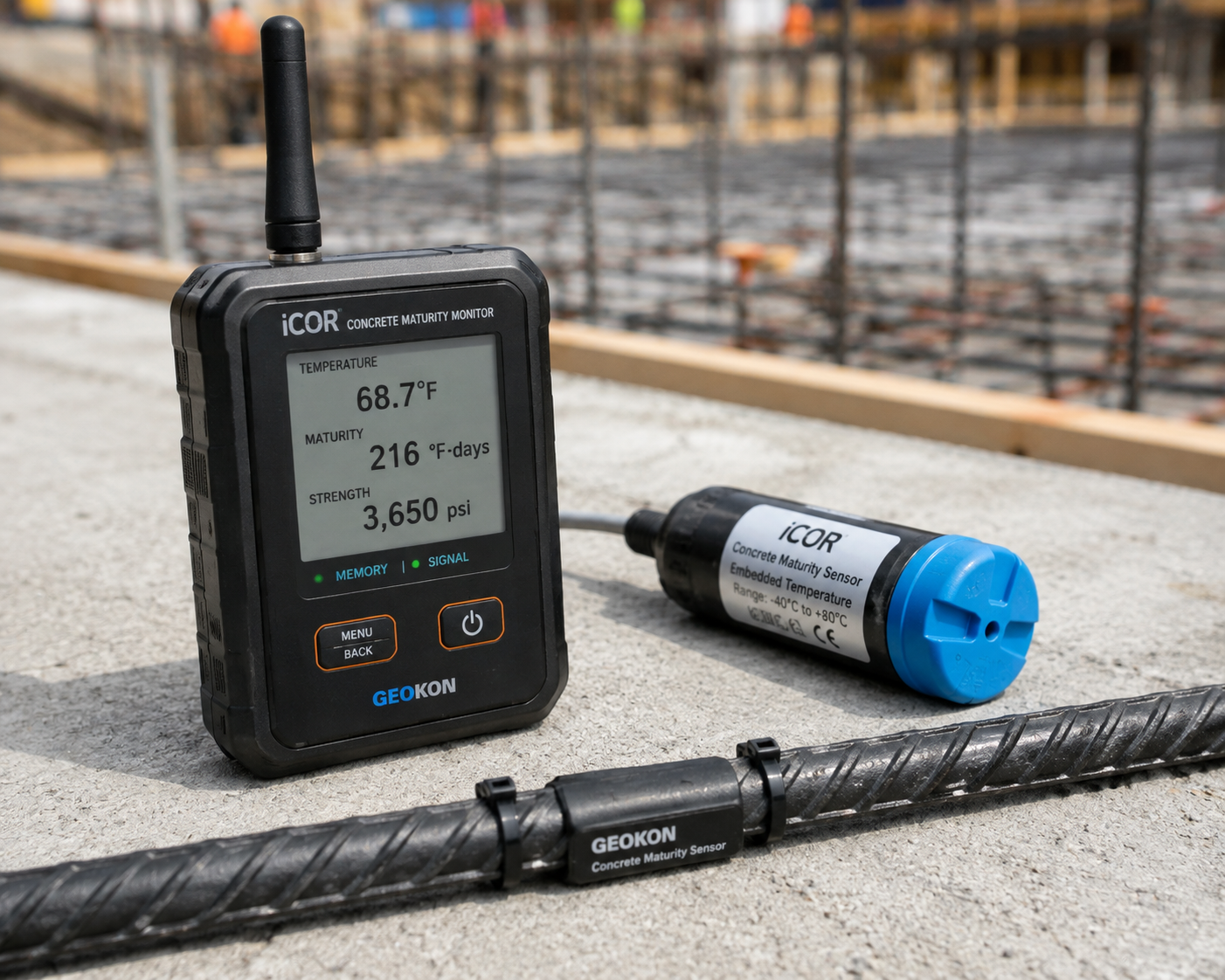
Monitoring methods range from simple thermometers to embedded sensors with continuous data logging, depending on the application’s precision needs.
| Method | Application |
|---|---|
| Thermometers | Simple spot checks of surface or ambient temperature |
| Embedded sensors | Continuous internal/core temperature tracking |
| Data loggers | Automated recording over time for maturity calculations |
| Min/max recording | Required for ASTM C31 initial curing verification |
ASTM C31 practice specifically requires recording the minimum and maximum temperature during initial curing of standard test specimens, which is a documentation requirement, not an optional best practice.
Concrete Temperature Difference and Thermal Cracking
Large temperature differentials between the internal core and exposed surface of a concrete section can generate restrained thermal stress and cracking risk.
As the concrete core, heated by hydration, cools while the surface has already cooled to ambient conditions, the resulting differential contraction can exceed the concrete’s tensile capacity if restrained, leading to thermal cracking. This risk is especially relevant for mass concrete, thick slabs, foundations, and large walls, where core-to-surface temperature differences can be substantial.
Mass Concrete Curing Temperature
Mass concrete temperature control is a distinct discipline from ordinary slab curing, focused on managing heat of hydration and internal-to-surface temperature differentials.
Large concrete placements generate substantial heat of hydration that can raise core temperatures well above ambient conditions, while the surface cools more quickly through exposure. Managing this differential, often through insulation to slow surface cooling rather than accelerate it, and through continuous temperature monitoring, is central to mass concrete curing and should not be confused with ordinary slab-on-grade curing practices.
How to Maintain Concrete Temperature During Curing
Practical methods differ substantially between cold-weather and hot-weather conditions.
| Condition | Method | Purpose |
|---|---|---|
| Cold weather | Insulation blankets | Retain heat of hydration at the surface |
| Cold weather | Heated enclosures | Maintain ambient temperature around the placement |
| Cold weather | Heated materials | Raise as-mixed concrete temperature |
| Hot weather | Evaporative cooling/wet coverings | Offset accelerated moisture loss |
| Hot weather | Shading | Reduce solar heat gain on fresh concrete |
| Hot weather | Curing compounds | Form a moisture-retaining membrane quickly after finishing |
Concrete Curing Temperature Problems and Troubleshooting
Use this table to identify likely causes before deciding on remediation.
| Problem | Likely Temperature Issue | Potential Effect | What to Check |
|---|---|---|---|
| Concrete froze early | Inadequate cold-weather protection | Permanent strength/durability loss | Placement temperature log, protection duration |
| Strength gain is slow | Sustained low temperature | Extended time to reach required strength | Temperature history, maturity calculation if available |
| Surface dried rapidly | High temperature, low humidity, or wind | Plastic shrinkage cracking | Curing start time, evaporation conditions |
| Concrete set too quickly | High concrete/ambient temperature | Reduced finishing window | As-placed temperature, admixture use |
| Large temperature differential | Mass concrete heat buildup vs surface cooling | Thermal cracking risk | Core vs surface temperature monitoring |
| Early cracking | Thermal or plastic shrinkage stress | Reduced durability, aesthetic issues | Temperature differential, curing timing, restraint conditions |
Concrete Curing Temperature Worked Examples
These examples cover reading and interpreting temperature values correctly, not structural design calculations.
Convert °F to °C
Interpret a Cold-Weather Curing Condition
Compare Standard-Cured and Field-Cured Temperatures
Calculate a Core to Surface Temperature Difference
Concrete Curing Temperature Standards and References
Five standards and guides govern most curing temperature decisions in U.S. construction.
| Standard/Guide | Scope |
|---|---|
| ACI PRC-308-26 | Curing of Concrete Guide; current 2026 edition covering external curing practices, procedures, and monitoring methods for structures, pavements, and mass concrete |
| ACI PRC-306-16 | Guide to Cold Weather Concreting; minimum concrete temperatures by section size, protection duration, and freezing prevention |
| ACI 305R-20 | Guide to Hot Weather Concreting; combined environmental conditions, evaporation control, and production/placement guidance |
| ASTM C31/C31M | Making and Curing Concrete Test Specimens in the Field; initial and laboratory curing temperature requirements |
| ASTM C1074 | Estimating Concrete Strength by the Maturity Method; temperature-time factor and equivalent age calculation procedures |
ACI PRC-308-26 supersedes the earlier ACI 308-16 curing guide and was published in 2026, so newer references to curing practice should identify this current edition rather than assuming the older guide remains current.
Concrete Curing Temperature Chart Limitations
This chart is a reference and educational tool. It does not replace project-specific curing plans, mixture design evaluation, or engineering judgment.
Temperature alone does not define proper curing
Moisture, duration, and mixture all interact with temperature.
Concrete mixture affects temperature response
Different cements and admixtures respond differently to the same temperature.
Section size affects temperature history
Thin and thick sections behave very differently under the same ambient conditions.
Ambient temperature is not concrete temperature
Always measure concrete temperature directly rather than assuming from air temperature.
Test cylinder curing is not structural curing
Standard curing evaluates acceptance; it does not represent the structure’s actual condition.
Project specifications may impose different requirements
Always confirm project-specific temperature requirements before relying on general guidance.
Maturity may be more informative than a single reading
Consider the maturity method for a more complete strength estimate where feasible.
Frequently Asked Questions
Download Concrete Curing Temperature Chart PDF
Use your browser’s print function to save a curated, print-ready reference sheet: the quick-reference chart, all supporting tables including the cold-weather and cylinder curing charts, key formulas, worked examples, and diagrams, without navigation, FAQs, or explanatory prose. This avoids broken file links and stays automatically current.