Sinking Concrete Repair: Why It Happens and How to Fix It
A practical, contractor-neutral guide to diagnosing sunken concrete, choosing between mudjacking, polyurethane foam, and replacement, and understanding what actually drives the cost.
Quick Answer
Most sinking concrete can be repaired when the slab itself is still structurally sound and the real problem is settlement or loss of support underneath it, not the concrete itself falling apart. The two most common repair methods are mudjacking (also called slabjacking) and polyurethane foam injection, both of which lift the existing slab back toward its original position by filling the void or space beneath it. When a slab is severely cracked, broken into pieces, or sitting on soil conditions that cannot reasonably be corrected, removal and replacement is usually the better path.
The two questions that matter most before choosing a repair are simple: is the slab sound, and why did it sink in the first place? Answering the second question correctly is what keeps a repair from failing again in a year or two.
In This Guide
- Sinking Concrete Repair Cost Calculator
- What Is Sinking or Sunken Concrete?
- Why Does Concrete Sink?
- Signs Your Concrete Is Sinking
- How to Tell How Serious the Settlement Is
- Can Sinking Concrete Be Repaired?
- When Concrete Leveling Is a Good Option
- When Concrete Replacement Is Better
- How Mudjacking or Slabjacking Repairs Sinking Concrete
- How Polyurethane Foam Injection Repairs Sinking Concrete
- Mudjacking vs. Polyurethane Foam
- Concrete Leveling vs. Full Replacement
- How to Fix the Cause of Sinking Concrete
- Can You Fix Sinking Concrete Yourself?
- How Much Does Sinking Concrete Repair Cost?
- Sinking Concrete Repair Cost by Method
- Factors That Affect Repair Cost
- Sinking Concrete Repair Examples
- How Long Does Sinking Concrete Repair Last?
- Will Sinking Concrete Sink Again?
- How to Prevent Concrete From Sinking Again
- Sinking Concrete vs. Foundation Settlement
- Common Sinking Concrete Repair Mistakes
- How to Choose a Concrete Leveling Contractor
- Sinking Concrete Repair FAQs
Sinking Concrete Repair Cost Calculator
Before diving into causes and repair methods, the fastest way to get a realistic number for your own project is to run it through the Mudjacking Cost Calculator. It is built specifically around this problem, and it estimates cost based on the details that actually move the price.
To get a useful estimate, you will generally need:
- Slab type (driveway, sidewalk, patio, garage floor, steps)
- Settled area in square feet
- Settlement depth, or how far the slab has dropped
- Estimated rate for the repair method you are considering
- Regional adjustment to reflect local labor and material pricing
Get a Fast Repair Estimate
Enter your slab size, settlement depth, and repair method to see an estimated cost range for your project.
Use the Mudjacking Cost CalculatorWhat Is Sinking or Sunken Concrete?
Sinking concrete, also called sunken concrete or slab settlement, describes a slab that has dropped below its original, level position. This happens on driveways, sidewalks, patios, garage floors, and steps. The term concrete leveling refers to the general category of repair techniques used to raise a sunken slab back toward its original elevation without removing it.
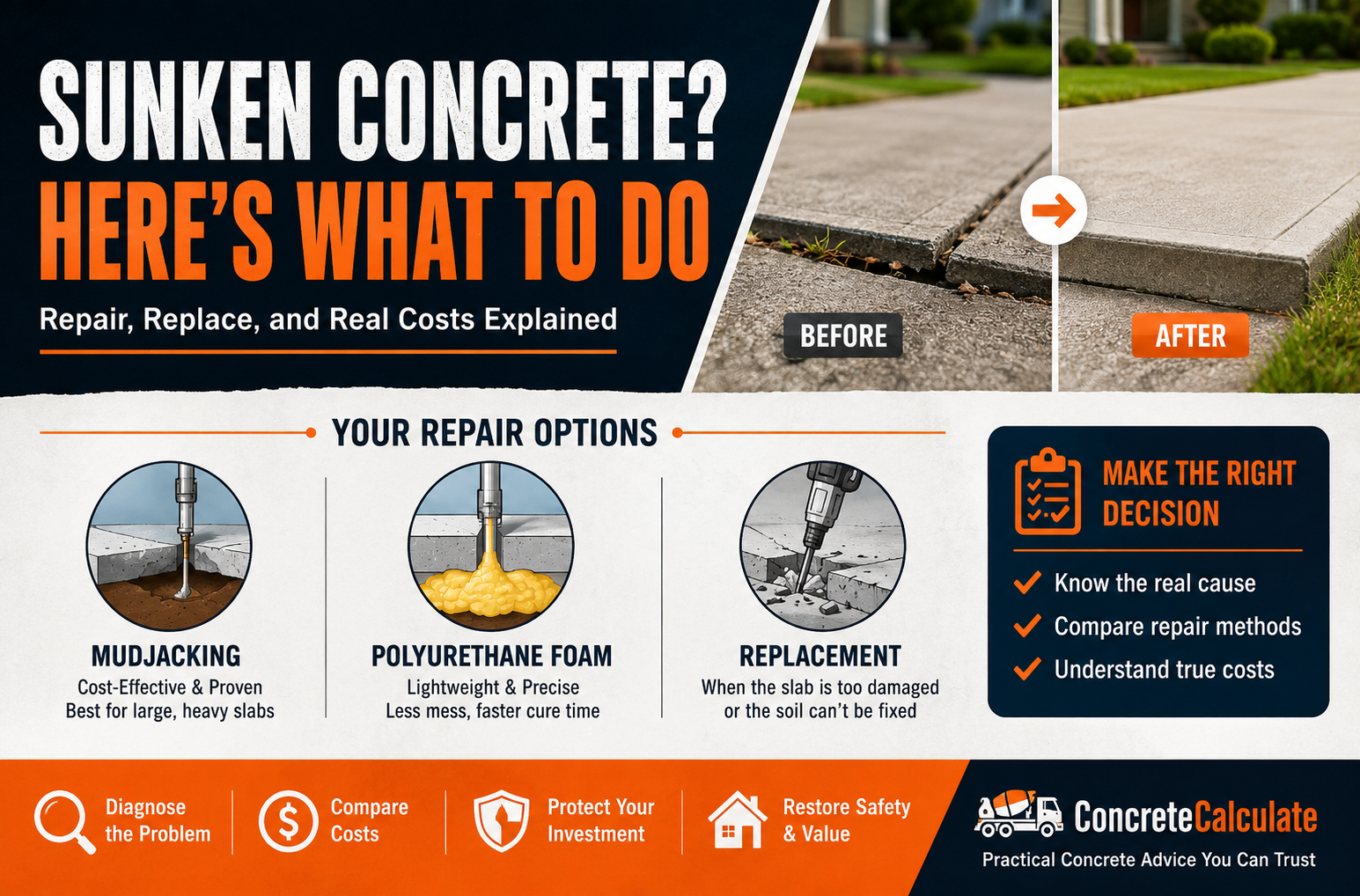
The two most common leveling methods go by specific names. Slabjacking (often called mudjacking when a cement-based grout is used) involves pumping material through drilled holes to fill the space beneath a slab and lift it. Polyurethane foam injection uses an expanding polymer instead of a cement-based slurry, but the underlying goal is the same: restore support and elevation without pouring new concrete.
The Core Concept to Understand
A sinking slab is almost always a support problem, not a concrete problem. The concrete itself is frequently still sound. What has changed is the material underneath it, which may have settled, consolidated, eroded, become saturated, shrunk, or lost enough support to create a void. That distinction is the single most useful thing to understand before choosing a repair method.
Why Does Concrete Sink?
Concrete slabs are only as stable as what lies beneath them. The American Concrete Institute (ACI) points to improper soil compaction, soil shrinkage or drying, and erosion of the sub-base as recurring causes of slab settlement, and the Federal Highway Administration (FHWA) similarly identifies soil consolidation and erosion or washout as conditions that slabjacking is designed to address. Rather than treating every possible trigger as its own category, it helps to group the causes into five broader groups.
Poor or inadequate compaction
When a slab is poured over fill soil that was not properly compacted during construction, that soil tends to settle further under the weight of the slab and normal use over time. This is one of the most common root causes of new-construction settlement, particularly in driveways and additions built on disturbed or recently placed fill.
Water erosion and drainage problems
Water is one of the most persistent causes of slab settlement because it can physically move soil and fine material out from underneath a slab. Common contributors include leaking plumbing lines, poor site grading that channels water toward the slab, downspouts that discharge next to the foundation or driveway, gutter overflow, general surface runoff, and drainage systems that no longer function correctly. Multiple current sources on concrete leveling and repair identify drainage-related erosion as one of the most frequent causes homeowners encounter.
Soil shrinkage or expansion
Certain soil types, particularly clay-rich soils, change volume as their moisture content changes. They can shrink during dry periods and swell when saturated. This behavior varies significantly by region and soil type, so it should not be treated as a universal explanation. It is a meaningful factor in some parts of the country and a minor one in others.
Voids and loss of support
A void, meaning an open or loosely filled space, can form beneath a slab as a direct result of erosion, ongoing settlement, nearby utility excavation, or a combination of these. Once a void exists, the slab above it is essentially unsupported at that location and will eventually flex or drop under load.
Construction and site conditions
Some settlement problems trace back to how the site was prepared before the concrete was ever poured. Examples include a poorly prepared subgrade, inadequate compaction during construction, the use of unsuitable fill material, organic material left in the subgrade that later decomposes, or soil that was disturbed and never properly restored.
Smaller, situational factors such as tree roots absorbing moisture from nearby soil, burrowing animals, or repeated freeze-thaw cycles can also contribute to settlement, but they typically act through one of the five categories above rather than as an independent cause.
Settlement is closely related to, but distinct from, surface cracking. If your slab is cracking as well as sinking, Why Is My Concrete Cracking? covers the causes of cracking specifically.
Illustrative diagram. Not every sunken slab has a large open cavity beneath it; loss of support can also occur as gradual soil consolidation without a distinct void.
Signs Your Concrete Is Sinking
Settlement is often visible before it becomes a serious problem. Watch for:
- A visible slope or dip across part of a slab that used to be flat
- Uneven panels where one section sits noticeably lower than the one next to it
- Gaps or separation where a slab meets a step, garage floor, porch, or foundation
- Cracks that appear along the edges of the settled section
- Water pooling on the surface instead of draining away
- A trip edge where the height difference between panels creates a lip
- Rocking or shifting slabs that move slightly underfoot or under a vehicle
How to Tell How Serious the Settlement Is
Before calling a contractor, a homeowner can gather useful information simply by inspecting the slab carefully. This does not require special tools, and it helps you describe the problem accurately when you do get quotes.
- Elevation difference: How far has the slab dropped compared with the surrounding concrete or a nearby reference point?
- Crack condition: Are cracks hairline and stable, or wide, spreading, and accompanied by crumbling edges?
- Affected area: Is the settlement confined to one small section, or does it span a large portion of the slab?
- Drainage: Does water pool on or near the settled area after rain?
- Water movement: Is there any visible sign of water running beneath or along the edge of the slab?
- Active vs. stable: Has the settlement stayed the same over the past several months, or does it appear to be getting worse?
- Isolated vs. widespread: Is only one slab affected, or are multiple adjacent slabs, steps, or structures showing similar movement?
Why This Matters
There is no universal rule stating that a specific number of inches of settlement automatically means replacement rather than repair. The right decision depends on the slab’s overall condition, whether the settlement is still active, and whether the underlying cause can reasonably be corrected. This is a case-by-case judgment, ideally made by a qualified concrete repair professional after an in-person inspection.
Can Sinking Concrete Be Repaired?
Yes, in many cases sinking concrete can be repaired rather than replaced, but not every slab is a good candidate for lifting. The decision comes down to two questions: is the slab itself still structurally sound, and can the underlying cause of settlement be reasonably addressed? ACI specifically notes that slab removal and replacement should be evaluated based on the extent of cracking, visible distress, and the amount of future movement expected, rather than treated as an automatic decision either way.
| Condition | Concrete Leveling | Replacement | Professional Evaluation |
|---|---|---|---|
| Slab mostly intact, minor surface wear | Usually suitable | Not usually needed | Recommended before major lifting |
| Localized settlement in one area | Usually suitable | Not usually needed | Helpful to confirm void extent |
| Wide, spreading, or structural cracking | Often not suitable | Often the better option | Strongly recommended |
| Broken or separated slab sections | Not suitable | Recommended | Strongly recommended |
| Settlement appears to be ongoing/active | Possible after cause is fixed | Possible if soil cannot be stabilized | Required to identify the cause |
| Unstable soil that cannot reasonably be corrected | Not suitable | Usually necessary | Required, may include geotechnical input |
When Concrete Leveling Is a Good Option
Concrete leveling tends to be a strong option when several conditions line up together:
- The slab is relatively sound, with no severe cracking or crumbling
- The settlement is localized rather than affecting the entire slab uniformly in a way that suggests deeper structural issues
- The main problem is loss of support or elevation, not the concrete material itself failing
- The underlying condition, such as a drainage issue or a void, can be identified and reasonably addressed
- The homeowner wants to preserve the existing concrete, including its finish, color, and any decorative work, rather than pour new material
When Concrete Replacement Is Better
Replacement becomes the more sensible choice when the slab itself, not just its position, is the problem:
- The slab is severely cracked, with wide or spreading cracks rather than stable hairline cracks
- Sections of concrete are crumbling, spalling, or breaking apart
- The slab has broken into separate pieces that no longer move as a single unit
- Deterioration is extensive enough that lifting would not produce an acceptable result
- Ground movement is major and ongoing in a way that cannot reasonably be stabilized
- The slab’s geometry has been distorted to the point that lifting cannot restore an acceptable, safe surface
As noted earlier, ACI frames this decision around the extent of cracking, visible distress, and anticipated future movement rather than a single fixed threshold. If replacement is ultimately the right path, How to Pour a Concrete Driveway and the Concrete Driveway Cost Guide are useful next steps.
How Mudjacking or Slabjacking Repairs Sinking Concrete
Mudjacking, also called slabjacking, is one of the oldest and most widely used concrete leveling methods. ACI’s slabjacking bulletin describes cementitious, noncementitious, and asphaltic materials as options for injection, with cementitious grout mixtures being the most common in residential and light commercial work. The general process looks like this:
- Locate the settled area and determine the extent of the void or loss of support beneath it.
- Drill access holes through the slab in a pattern suited to the settlement. ACI notes cementitious grout holes are typically drilled roughly every 5 to 10 feet, with closer spacing near edges, joints, or badly cracked areas.
- Inject the cementitious or grout material through the drilled holes under controlled pressure.
- Fill the void beneath the slab as the material spreads and consolidates the loose soil or empty space.
- Gradually lift the slab in small, controlled increments rather than a single motion, which helps avoid inducing new cracks.
- Check elevation continuously against the surrounding slabs or a reference point during lifting.
- Stop at the target position once the slab reaches an acceptable, level position.
- Patch the injection holes with a matching concrete or mortar patch.
ACI’s bulletin specifically emphasizes gradual, controlled lifting to reduce the risk of new stress cracks, and it identifies typical hole diameters of about 1½ to 2½ inches for cementitious grout injection.
How Polyurethane Foam Injection Repairs Sinking Concrete
Polyurethane foam injection, sometimes called polyjacking, follows a similar overall logic to mudjacking but uses an expanding polymer instead of a cement-based slurry. The process generally includes:
- Drill small injection holes through the slab. ACI’s bulletin identifies typical polymer foam grout hole diameters of about ½ to ¾ inch, noticeably smaller than cementitious grout holes.
- Inject the two-part polymer components, which begin reacting once combined.
- The foam expands within seconds to minutes, filling the available space beneath the slab.
- Voids are filled as the expanding foam pushes into the loose or open space under the concrete.
- The slab is lifted and leveled as the expanding foam generates enough pressure to raise the concrete back toward its target elevation.
- Holes are sealed with a small patch once the desired lift and position are achieved.
Because the foam expands rapidly, this method is generally associated with a shorter return-to-service time than cementitious grouting. Manufacturer-specific performance claims about strength, expansion ratios, or exact cure times vary by product and are outside the scope of this guide; ask any contractor you are evaluating to provide documentation for the specific material they plan to use.
Mudjacking vs. Polyurethane Foam
This comparison is one of the most important decisions in the entire repair process, and it deserves a neutral look rather than a declaration that one method is universally better. Contractor marketing pages that specialize in foam injection often emphasize its lightweight material and smaller injection holes, and those are genuine advantages in the right situation. But mudjacking remains a proven, cost-effective option for many slabs, and FHWA recognizes both traditional cementitious grouting and proprietary expanding foams as legitimate slabjacking approaches.
| Factor | Mudjacking | Polyurethane Foam | Replacement |
|---|---|---|---|
| Initial cost | Usually lower | Usually higher | Highest overall |
| Injection holes | Larger, about 1.5–2.5 in. | Smaller, about 0.5–0.75 in. | None (existing slab removed) |
| Material injected | Cementitious/grout slurry | Expanding polymer foam | New concrete |
| Relative weight added beneath slab | Higher | Lower | New slab, not applicable |
| Typical speed of the repair | Relatively fast | Very fast | Much slower (demolition, cure time) |
| Existing slab retained | Yes | Yes | No, slab is removed |
| Best suited for | Stable, accessible slabs where lower cost matters | Precise lifting, lightweight fill, tight access | Severely damaged or unsalvageable slabs |
How to Actually Choose Between Them
The right choice depends on slab condition, soil conditions, the size of the void beneath the slab, site accessibility, how much lift is needed, drainage conditions, your budget, and the specific method a qualified local contractor recommends after inspecting the site. No single factor should decide the outcome on its own.
Concrete Leveling vs. Full Concrete Replacement
Once you have compared mudjacking and polyurethane foam, the next decision is whether leveling makes sense at all compared with starting over.
| Factor | Concrete Leveling | Full Replacement |
|---|---|---|
| Initial cost | Generally lower | Generally higher |
| Demolition required | No | Yes, existing slab removed |
| Construction waste | Minimal | Significant (old concrete disposal) |
| Project timeline | Typically hours to a day | Typically several days including cure time |
| Existing slab condition required | Must be structurally sound | Not a factor, slab is removed |
| Appearance | Matches existing finish, patched holes visible on close inspection | Fully new, uniform surface |
| Underlying soil problem | Must be identified and addressed separately | Can be corrected during subgrade prep |
Neither option should be assumed to last longer than the other in every case. Longevity depends far more on whether the underlying soil and drainage problem was corrected than on which repair method was chosen. For sizing and budgeting a full replacement, see the Concrete Slab Cost Guide and How Thick Should a Concrete Driveway Be? if the replacement involves a driveway.
How to Fix the Cause of Sinking Concrete
This is arguably the most important section in this entire guide. Lifting a slab restores its elevation, but it does not automatically fix whatever caused it to sink in the first place. ACI explicitly warns that if soil settlement continues after a repair, repeated slabjacking may be necessary. In other words, treating the symptom without treating the cause is a common way to end up paying for the same repair twice.
Drainage
Check gutters and downspouts to confirm they are directing water away from the slab rather than dumping it next to the foundation or driveway edge. Confirm the site grading slopes away from the structure. Address any surface runoff that consistently pools near the settled area.
Plumbing
If settlement is isolated to an area near a water line, sewer line, or irrigation pipe, a suspected underground leak should be investigated before or alongside any lifting work. Lifting a slab over an active leak treats the surface, not the source.
Soil
Determine, as best you can, whether the settlement is still actively progressing or whether it has stabilized. A contractor or geotechnical professional can help assess this more precisely than a visual inspection alone.
Voids
Identify the unsupported area beneath the slab as clearly as possible before lifting begins, since the extent of the void affects both the repair method and the amount of material needed.
Key Principle
Lifting a slab without addressing an active source of settlement, such as an ongoing leak, unresolved drainage problem, or continuing soil movement, can lead to renewed sinking. Correcting the cause, not just the elevation, is what makes a repair durable.
Can You Fix Sinking Concrete Yourself?
Some parts of this problem are reasonable for a homeowner to handle. Others are not, and treating them as a DIY project can make the underlying problem worse or create a false sense that it has been resolved.
| Task | DIY-Suitable | Generally Professional |
|---|---|---|
| Redirecting downspouts away from the slab | Yes | — |
| Correcting a simple grading or drainage problem | Yes | — |
| Sealing minor surface cracks after settlement has stabilized | Yes | — |
| Monitoring settlement over time (photos, measurements) | Yes | — |
| Slabjacking or mudjacking | — | Yes |
| Polyurethane foam injection | — | Yes |
| Significant slab lifting | — | Yes |
| Extensive void filling | — | Yes |
| Suspected utility or plumbing leaks | — | Yes |
| Major settlement or structural/foundation concerns | — | Yes |
Slab lifting and foam injection require specialized equipment, controlled pressure, and experience judging how much material to inject and how far to lift a slab safely. Improvised lifting, or DIY foam injection using consumer-grade kits intended for small gaps, should not be treated as a substitute for a professional slabjacking or polyurethane injection service on a load-bearing driveway or structural slab. If cracks are the main visible symptom alongside minor settlement, How to Fix Cracked Concrete covers surface-level crack repair once the settlement itself has been addressed.
How Much Does Sinking Concrete Repair Cost?
Cost is a major part of this decision, but current data varies enough across sources that a single “average repair cost” would be misleading. Ranges depend heavily on the repair method, project size, region, and site conditions.
As of late 2025 and 2026 data, HomeGuide reports mudjacking costing roughly $4 to $9 per square foot, while its broader concrete leveling guide places overall leveling costs between about $3 and $12 per square foot, or roughly $700 to $5,000 total, with a wider possible range of $2 to $25 per square foot depending on method, location, and project complexity. HomeGuide’s separate polyjacking data places polyurethane foam injection at roughly $8 to $25 per square foot. Angi’s 2026 data on mudjacking specifically reports an average project cost of about $1,229, with most mudjacking projects falling between roughly $662 and $1,866. Angi’s broader concrete leveling guide reports an average price per square foot of about $4, with a range of roughly $3 to $25 depending on method and scope.
Why the Ranges Are Wide
Mudjacking and polyurethane foam pricing depend heavily on regional labor rates, the contractor’s specific material and equipment, the size and depth of the settled area, and whether drainage or soil correction work is bundled into the price. Treat any number here as a planning range, not a quote, and get a written estimate from a local contractor for your specific project.
Sinking Concrete Repair Cost by Method
| Repair Method | Typical Cost Range | Main Advantage | Main Limitation |
|---|---|---|---|
| Mudjacking / slabjacking | Roughly $4–$9 per sq. ft. (HomeGuide); average project about $1,229, typically $662–$1,866 (Angi) | Lower initial cost; proven, long-standing method | Heavier injected material; larger injection holes |
| Polyurethane foam injection | Roughly $8–$25 per sq. ft. (HomeGuide polyjacking data) | Lightweight material; very fast cure and return to service; smaller holes | Higher cost per square foot |
| Full removal and replacement | Varies widely by slab type and region; see the Concrete Slab Cost Guide and Driveway Cost Guide for detailed figures | Fully new slab, no dependence on lifting existing concrete | Demolition, disposal, and significantly longer project timeline |
For replacement-specific figures, the Concrete Driveway Cost Guide and Concrete Slab Cost Guide break down material, labor, and total installed costs in more detail than is appropriate to repeat here.
Factors That Affect Sinking Concrete Repair Cost
| Factor | Why It Affects Cost |
|---|---|
| Settled area (square footage) | Larger areas require more material, more injection holes, and more labor time |
| Settlement depth | Deeper settlement requires more fill material to restore elevation |
| Void size | Larger voids beneath the slab require significantly more injected material |
| Injection material (cementitious vs. foam) | Polyurethane foam typically costs more per square foot than cementitious grout |
| Slab condition | Cracked or deteriorated slabs may need additional repair work beyond leveling alone |
| Site access | Tight spaces, landscaping, or obstacles increase labor time and sometimes equipment needs |
| Number of injection points | More holes mean more drilling, injection, and patching labor |
| Drainage repairs | Correcting the underlying water problem adds cost beyond the lifting itself |
| Soil stabilization | Loose, sandy, or saturated soil may need extra treatment before or during lifting |
| Crack repair | Sealing or patching accompanying cracks is often billed separately from lifting |
| Geographic location and labor rates | Labor and material costs vary meaningfully by region |
| Minimum contractor charges | Many contractors apply a minimum job fee that affects the cost of small repairs disproportionately |
HomeGuide specifically identifies project size, minimum job charges, fill material type, settlement depth, accessibility, location, and any additional surface work as the major factors driving concrete leveling cost.
Sinking Concrete Repair Examples
The following are illustrative planning scenarios, not real contractor quotes. They are meant to show how the factors above interact, not to predict your exact price.
Example 1: Small Sidewalk Section
Scenario: A 4-foot by 6-foot (24 sq. ft.) sidewalk panel has settled roughly 1 inch, with no significant cracking and easy access from the street.
Assessment: This is a strong candidate for concrete leveling. The area is small, the settlement is shallow, and the slab is otherwise sound.
Illustrative estimate: Using a per-square-foot mudjacking rate of roughly $4 to $9, a 24 sq. ft. repair could fall in a rough range of about $96 to $216 before any minimum job charge is applied. Many contractors have a minimum charge for small jobs, so the final invoice for a project this size is often closer to that minimum than to the raw per-square-foot math.
Example 2: Driveway Settlement With a Drainage Issue
Scenario: A 10-foot by 20-foot (200 sq. ft.) driveway section has settled about 2 inches near a downspout that discharges directly onto the slab.
Assessment: This slab may be a good leveling candidate, but the drainage problem should be corrected as part of the same project, not treated as optional. Downspout extension or regrading would typically be priced separately from the lifting work itself.
Illustrative estimate: At a mudjacking rate of roughly $4 to $9 per square foot, the lifting portion alone could fall in a rough range of about $800 to $1,800, before adding any cost for downspout or grading correction. A polyurethane foam approach for the same area, at roughly $8 to $25 per square foot, could fall in a rough range of about $1,600 to $5,000.
Example 3: Severely Damaged Patio Slab
Scenario: A patio slab has settled unevenly across its full area, with wide cracking, several broken sections, and visible crumbling near one edge.
Assessment: This is a case where replacement is likely the more sensible path. The slab’s condition, not just its elevation, is the limiting factor, and lifting a broken or badly deteriorated slab typically will not produce a lasting, acceptable result.
Illustrative comparison: Leveling this slab, even if technically possible, would only address elevation while leaving the cracked and crumbling concrete in place. Full replacement addresses both the surface condition and the elevation at once, at a higher upfront cost reflected in the Concrete Slab Cost Guide.
How Long Does Sinking Concrete Repair Last?
There is no single, reliable lifespan figure for concrete leveling repairs, and current cost and repair sources vary considerably in the estimates they offer. Durability depends on several interacting factors:
- The underlying soil type and how prone it is to further movement
- Water exposure and whether drainage was corrected as part of the repair
- The quality of the original installation work
- The condition of the slab itself going into the repair
- Which repair method was used
- Whether the original cause of settlement was actually corrected, rather than only the symptom
A repair performed on a stable slab where the drainage or soil issue was properly fixed tends to hold up considerably better over time than a repair performed as a quick fix without addressing why the slab sank in the first place.
Will Sinking Concrete Sink Again?
It can, particularly if the underlying cause of the original settlement remains active. Common reasons a repaired slab sinks again include:
- Ongoing soil settlement that was never fully stabilized
- Continued water erosion from an uncorrected drainage problem
- An undiscovered or unrepaired plumbing leak
- Unstable fill material that continues to consolidate over time
- Changing soil moisture conditions, particularly with expansive clay soils
ACI explicitly warns that if soil settlement continues, repeated slabjacking may be necessary. This is exactly why the cause-correction section earlier in this guide matters as much as the lifting technique itself.
How to Prevent Concrete From Sinking Again
Prevention centers on controlling water and managing the soil beneath a slab, both for existing repaired slabs and for new construction.
- Maintain proper drainage around all slabs, directing water away from driveways, sidewalks, and patios
- Keep gutters and downspouts functioning and extended well away from the slab edge
- Maintain proper site grading so water flows away from structures rather than pooling near them
- Control water near slabs from sprinklers, hoses, and other sources that regularly saturate the same area
- Repair underground leaks promptly rather than allowing them to continue eroding soil beneath a slab
- Ensure proper subgrade preparation and adequate compaction for any new concrete construction
- Avoid uncontrolled or poor-quality fill material beneath new slabs
- Monitor recurring settlement so a small problem is caught before it becomes a large one
The Most Important Takeaway
Repair the cause, not only the elevation. A slab that has been lifted but still sits over an active drainage problem, ongoing soil movement, or an unrepaired leak is very likely to sink again.
Sinking Concrete vs. Foundation Settlement
This is one of the most important distinctions in this entire guide. Everything discussed so far applies to flatwork: driveways, sidewalks, patios, and garage floors that sit on grade and can typically be lifted with slabjacking or foam injection. A settling building foundation is a different and more serious problem, and it should not be treated the same way.
Consider stopping and calling a structural or foundation professional, rather than a concrete leveling contractor, if you notice:
- Cracks in foundation walls, especially diagonal or stair-step cracks in block or brick
- Doors and windows that have become difficult to open, close, or latch
- Widespread settlement affecting multiple parts of the structure rather than one isolated slab
- Multiple connected structural elements appearing to move together
- Significant differential movement between different parts of the same structure
Foundation settlement can involve bearing soil capacity, differential settlement across the footprint of a structure, structural movement, foundation wall cracking, and in more serious cases, underpinning or other geotechnical correction. Foundation repair specialists distinguish localized slab leveling, the topic of this guide, from more extensive foundation stabilization or underpinning, which is a structural engineering matter.
Important Boundary
A slab-lifting service such as mudjacking or polyurethane foam injection is designed for flatwork settlement, not for correcting a settling building foundation. If you suspect foundation movement based on the signs above, consult a structural engineer or qualified foundation repair specialist rather than assuming a concrete leveling contractor can resolve it.
Common Sinking Concrete Repair Mistakes
- Repairing surface cracks without addressing the settlement that caused them
- Ignoring a drainage problem that will continue to erode soil beneath the repaired slab
- Lifting a slab before investigating why it sank in the first place
- Choosing a repair method based on price alone, without considering slab and soil conditions
- Assuming every slab can be lifted, regardless of its condition
- Overlooking slab condition and moving forward with leveling on concrete that is too damaged to hold a lift
- Treating foundation movement as ordinary slab settlement
- Relying on a single national average cost figure instead of getting a local, project-specific estimate
- Expecting a leveling repair to correct soil movement that is still actively occurring
- Skipping a second professional opinion on a major or expensive repair
How to Choose a Concrete Leveling Contractor
Whether you are leaning toward mudjacking, polyurethane foam, or considering replacement, ask any contractor you are evaluating:
- What caused the settlement, based on their inspection of your specific slab and site
- Which material they plan to inject, and why they recommend it for your situation
- How they determine how much to lift the slab, and what reference point they use
- Whether drainage or soil correction is included in the quote, or billed separately
- What happens, contractually, if the slab settles again after the repair
- What warranty, if any, comes with the work, and what it covers
- For an itemized price breakdown rather than a single lump-sum number
Also confirm that the contractor carries appropriate licensing and insurance as required in your state or municipality; requirements vary by location, so check with your local licensing authority rather than assuming a contractor’s claims are sufficient on their own.
After a method is chosen, the underlying cause should be corrected and the repaired area monitored over time.
Sinking Concrete Repair FAQs
Can sinking concrete be repaired?
Often, yes. If the slab is structurally sound and the main problem is loss of support or settlement beneath it, mudjacking or polyurethane foam injection can typically restore it to an acceptable level. Severely cracked or broken slabs are usually better candidates for replacement.
What causes concrete to sink?
The most common causes are poor or inadequate soil compaction, water erosion and drainage problems, soil shrinkage or expansion, voids beneath the slab, and construction or site preparation issues. Most of these ultimately come down to the material beneath the slab losing its ability to support the concrete.
Is mudjacking better than foam injection?
Neither method is universally better. Mudjacking generally costs less upfront but uses a heavier material and larger injection holes. Polyurethane foam is lighter, cures faster, and uses smaller holes, but typically costs more per square foot. The right choice depends on your specific slab, soil, and budget.
How much does sinking concrete repair cost?
Costs vary significantly by method and region. Mudjacking commonly runs roughly $4 to $9 per square foot, while polyurethane foam injection commonly runs roughly $8 to $25 per square foot, according to current HomeGuide data. Total project costs for mudjacking commonly average around $1,229, typically ranging from about $662 to $1,866, according to Angi’s 2026 data. Get a local, written estimate for your specific project.
How long does concrete leveling last?
There is no fixed lifespan that applies to every repair. Durability depends on soil conditions, water exposure, drainage, installation quality, slab condition, and most importantly, whether the underlying cause of settlement was actually corrected.
Can I fix sinking concrete myself?
You can typically handle drainage corrections, monitoring, and minor cosmetic surface repairs yourself. Actual slab lifting, whether by mudjacking or polyurethane foam injection, requires specialized equipment and experience and should be performed by a professional.
Will concrete sink again after leveling?
It can, particularly if the underlying cause, such as ongoing soil settlement, water erosion, an unrepaired leak, or unstable fill, remains unaddressed. ACI notes that continuing soil settlement can require repeated slabjacking.
Should I repair or replace sunken concrete?
Repair is generally appropriate when the slab is sound and the underlying problem can be corrected. Replacement is generally better when the slab is severely cracked, broken, or sitting on conditions that cannot reasonably be stabilized.
How do I know if my driveway needs leveling?
Look for a visible slope or dip, uneven panels, gaps at joints, cracks along the settled edge, pooling water, or a noticeable trip edge compared with adjacent slabs. If several of these signs are present, it is worth getting a professional assessment.
Can drainage problems cause concrete to sink?
Yes. Leaking plumbing, poor grading, misdirected downspouts, gutter overflow, and general surface runoff are among the most common contributors to the soil erosion that leads to slab settlement.
Does polyurethane foam damage concrete?
When installed correctly by a qualified contractor, polyurethane foam injection is designed to lift and support the slab without damaging it. As with any injection method, controlled, gradual lifting matters to avoid inducing new stress cracks.
Can slabjacking fix foundation settlement?
No. Slabjacking and polyurethane foam injection are designed for flatwork such as driveways, sidewalks, and patios, not for a settling building foundation. If you notice foundation wall cracking, doors and windows sticking, or widespread structural movement, consult a structural engineer or foundation specialist instead.
Ready to Estimate Your Repair?
Use the Mudjacking Cost Calculator to get a project-specific estimate based on your slab type, settled area, and settlement depth.
Try the Calculator