How Much Does a 20×20 Stamped Concrete Patio Cost? 2026 Price Guide
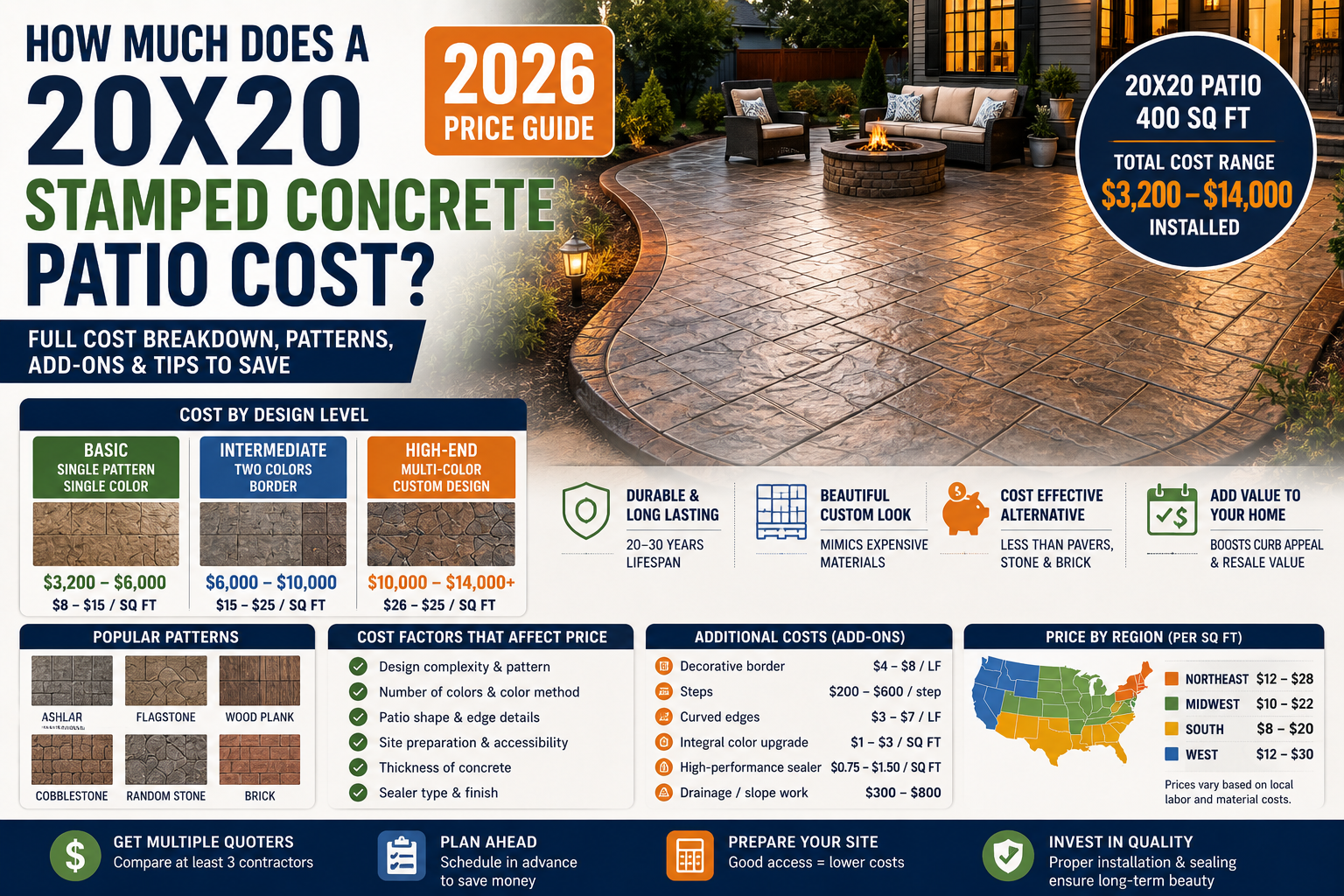
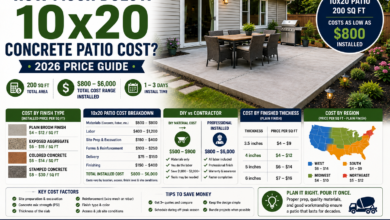
A 20×20 stamped concrete patio costs $3,200 to $14,000 in 2026, that is $8 to $35 per square foot for the same 400 square feet depending entirely on how complex you go with the design. A basic single-color cobblestone stamp runs toward the low end. A hand-colored custom flagstone with a contrasting border and curved edges pushes toward the high end. Everything in between depends on pattern, color count, site conditions, and where you live. This guide breaks every cost layer down so you can build an accurate budget for your specific project before calling a single contractor.
20×20 Cost at a Glance
A 20×20 patio is 400 square feet a comfortable size for outdoor dining and seating for 6 to 8 people. Here are the three real price tiers for 2026 for a fully installed stamped concrete patio at this size:
Basic (Single Pattern, One Color)
$8–$15/sq ft — simple stamp, one integral color, broom-finish border
Intermediate (Two Colors + Border)
$15–$25/sq ft — two colors, antiquing stain, contrasting decorative border
High-End (Custom / Multi-Pattern)
$26–$35+/sq ft — hand-coloring, multiple patterns, curved edges, integrated steps
Comparable Plain Concrete Patio
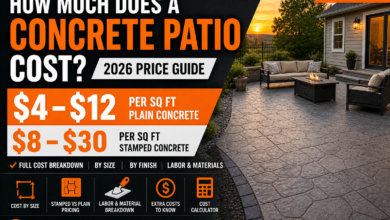
$4–$12/sq ft — standard broom finish, no decorative work
Before getting quotes, get your exact square footage confirmed and calculate your concrete volume with the Concrete Patio Calculator or the 20×20 Concrete Slab Calculator. Then use the Stamped Concrete Cost Calculator to estimate your full project cost based on your design choices.
Cost by Design Level
The clearest way to understand stamped concrete pricing is by design level. Each tier up in complexity adds labor time, skilled crew requirements, additional materials, and longer installation days — all of which raise the cost.
| Design Level | Cost Per Sq Ft | 20×20 Total (400 sq ft) | What’s Included |
|---|---|---|---|
| Single color, no pattern | $8 – $10 | $3,200 – $4,000 | Integral color only, broom finish — not technically stamped |
| Basic stamp — 1 color, 1 pattern | $10 – $15 | $4,000 – $6,000 | One stamp pattern, one base color, simple border |
| Intermediate — 2 colors, 1-2 patterns | $15 – $19 | $6,000 – $7,600 | Base + highlight color, antiquing release, contrasting border |
| Mid-high — 2+ colors, border, texture | $19 – $25 | $7,600 – $10,000 | Multiple colors, hand-broadcast release agent, detailed edging |
| High-end — custom, multi-pattern | $26 – $35 | $10,400 – $14,000 | Hand-colored, custom pattern layout, carved details, curved edges |
| Luxury / artistic | $35+ | $14,000+ | Faux stone, 3D effects, acid stain washes, medallion inlays |
For most residential homeowners, the intermediate tier ($15–$19/sq ft) delivers the best balance of visual impact and cost. It gives you the look of natural stone or brick with two-tone coloring and a decorative border without entering the custom-labor price range. The Concrete Patio Cost Calculator lets you model costs at each tier for your specific square footage.
Cost by Stamp Pattern
The stamp pattern you choose affects both the material cost (stamp rental or purchase) and the labor cost (how many stamps fit simultaneously, how complex the alignment is, and how long each section takes). Simple, large-scale repeating patterns are the most affordable. Random or multi-directional patterns that require the crew to reposition stamps continuously cost more.
How Color Adds to the Cost
Color is what makes stamped concrete look like real stone, brick, or wood rather than gray concrete with a texture pressed into it. There are two primary coloring methods and each adds differently to the price.
Integral Color (Base Color)
Integral color pigment is mixed directly into the concrete at the plant or job site. It colors the entire slab uniformly from top to bottom — not just the surface. This is the base color you see in almost every stamped patio. Integral color adds $15 to $40 per cubic yard of concrete to the material cost. For a 20×20 patio at 4 inches thick (approximately 5 cubic yards), that is $75 to $200 in additional material cost. Popular choices are buff, tan, terra cotta, charcoal, and slate gray.
Release Agent / Antiquing Color
This is the second color applied to stamped concrete that gives it dimension and realism. A powder or liquid release agent is broadcast onto the surface before stamping. It settles into the low points of the stamp pattern, creating a two-tone aged effect that mimics grout lines, vein patterns, or weathering. Release agent adds $1 to $3 per square foot to the labor and material cost. For a 20×20 patio, that is $400 to $1,200 in additional cost. It is the single most impactful upgrade for visual realism.
Acid Stain or Acetone Dye (Post-Pour Color)
Applied after the concrete has cured, acid stain creates translucent, marbled color effects that penetrate the surface rather than sitting on top. It is used on top of an already-stamped surface for high-end artistic results. Acid staining adds $2 to $4 per square foot for materials and application labor — $800 to $1,600 more on a 20×20 patio.
| Color Method | When Applied | Added Cost (20×20) | Visual Effect |
|---|---|---|---|
| Integral color (1 color) | At batching / mix | $75 – $200 | Uniform base tone throughout |
| Release agent (antiquing) | Before stamping | $400 – $1,200 | Two-tone depth, grout-line effect |
| Broadcast color hardener | After screeding | $600 – $1,600 | Rich surface color + added strength |
| Acid stain or acetone dye | After curing (28 days) | $800 – $1,600 | Translucent, marbled, artistic effect |
| Multiple colors combined | Various stages | $1,500 – $3,500 | Highest realism, custom look |
Full Cost Breakdown for a 20×20 Stamped Patio
Here is how the total cost breaks down component by component for a typical 20×20 stamped concrete patio at the intermediate design level. This is the most common residential project level in 2026.
| Cost Component | Estimated Cost | Notes |
|---|---|---|
| Concrete material | $700 – $900 | ~5 cubic yards of 4,000 PSI mix at $140-$175/yard |
| Integral color pigment | $100 – $200 | Added at plant; $20-$40 per yard premium |
| Release agent / antiquing | $400 – $800 | Powder broadcast before stamping |
| Base preparation | $500 – $900 | 4 in compacted gravel sub-base; excavation |
| Forming and stripping | $200 – $400 | Lumber or steel forms set and removed |
| Wire mesh or rebar | $150 – $400 | Wire mesh: $0.40/sq ft; Rebar: $1/sq ft |
| Labor — pour, stamp, and finish | $2,400 – $5,600 | $6–$14/sq ft stamping labor; requires skilled decorative crew |
| Saw-cut control joints | $80 – $160 | Cuts placed every 10-12 ft; $1-$2 per linear foot |
| Sealer (first application) | $200 – $600 | Solvent-based acrylic sealer recommended for stamped work; $0.50–$1.50/sq ft applied |
| Concrete delivery | $50 – $150 | Fuel surcharge and short-load fee if under 10 yards |
| TOTAL (intermediate design) | $4,780 – $9,110 | $12–$23 per sq ft fully installed |
Real-World Example: 20×20 Flagstone-Pattern Stamped Patio in Austin, TX
Size: 20×20 ft = 400 sq ft, 4 inches thick = 4.9 cubic yards
Concrete (5 yards x $150 per yard): $750
Integral color buff pigment: $150
Powder release agent (antiquing): $600
Base prep and gravel sub-base: $700
Forming and stripping: $300
Wire mesh reinforcement: $180
Stamping labor — flagstone pattern ($10/sq ft x 400): $4,000
Control joints (4 x 20 ft x $1.50): $120
Acrylic sealer applied: $400
Concrete delivery and fuel: $100
Total: $7,300
Per square foot: $18.25
For this specific patio size and mix, the 20×20 Concrete Slab Calculator confirms the material volume. Use the Stamped Concrete Cost Calculator and the Concrete Patio Cost Calculator for side-by-side estimates.
Cost by Patio Size
If you are comparing the 20×20 to other common patio sizes, the table below covers the full range at basic and intermediate design levels using 2026 pricing.
| Patio Size | Square Feet | Concrete Needed | Basic Stamp Cost | Intermediate Cost |
|---|---|---|---|---|
| 10×10 | 100 sq ft | ~1.2 yards | $1,000 – $1,500 | $1,500 – $2,500 |
| 12×12 | 144 sq ft | ~1.8 yards | $1,400 – $2,200 | $2,200 – $3,600 |
| 12×16 | 192 sq ft | ~2.4 yards | $1,900 – $2,900 | $2,900 – $4,800 |
| 16×16 | 256 sq ft | ~3.2 yards | $2,600 – $3,800 | $3,800 – $6,400 |
| 16×20 | 320 sq ft | ~4.0 yards | $3,200 – $4,800 | $4,800 – $8,000 |
| 20×20 ✅ | 400 sq ft | ~5.0 yards | $4,000 – $6,000 | $6,000 – $10,000 |
| 20×24 | 480 sq ft | ~6.0 yards | $4,800 – $7,200 | $7,200 – $12,000 |
| 24×24 | 576 sq ft | ~7.2 yards | $5,800 – $8,600 | $8,600 – $14,400 |
| 20×30 | 600 sq ft | ~7.5 yards | $6,000 – $9,000 | $9,000 – $15,000 |
For non-standard shapes, the Concrete Volume Calculator handles irregular patio footprints. Related size-specific calculators include the 16×16 Concrete Slab Calculator, 24×24 Concrete Slab Calculator, and 20×30 Concrete Slab Calculator.
Add-Ons That Raise the Price
Several common project additions push the total above the base patio cost. Each one is optional, but many homeowners add at least one of these when building an outdoor living space.
- Decorative border. A contrasting stamp pattern or color used as a frame around the perimeter of the patio. Adds $5 to $10 per linear foot — approximately $400 to $800 for a standard 20×20 perimeter. Borders dramatically improve the finished look without adding much cost.
- Steps. If your patio is elevated or connects to a back door, concrete steps add $300 to $2,000 depending on the number of treads, width, and whether they are stamped to match the patio. Use the Concrete Steps Calculator for volume estimates.
- Curved or freeform edges. Straight-edged patios are faster to form and finish. Custom curved or freeform edges require bender board forming and add $2 to $5 per linear foot — approximately $160 to $400 on a 20×20 perimeter.
- Exposed aggregate border. Washing a 12-inch band of aggregate around the perimeter of a stamped patio creates a natural-looking frame. Adds $3 to $6 per linear foot for the washing and finishing labor.
- Integrated seating wall. A low concrete wall around part of the patio perimeter doubles as seating. Adds $150 to $400 per linear foot depending on height and finish, plus the structural cost of the footing.
- Built-in fire pit pad. A separate stamped or plain circular concrete pad for a fire pit area adds $500 to $1,500 depending on size and whether it is connected to the main patio or a separate pour.
- Pump truck. If the ready-mix truck cannot reach the backyard directly, a concrete pump is needed. Adds $300 to $800 per project. Use the Concrete Pumping Cost Calculator to estimate this separately.
- Permit. Some cities and counties require a permit for new patio construction, especially on lots with HOAs or in flood-zone areas. Permit costs range from $50 to $350.
Cost by Region
Labor rates are the biggest regional variable in stamped concrete pricing. The same design costs more in California or New York than in Ohio or Texas purely because of contractor wage differences and local demand. Material costs vary less but fuel and delivery distance also factor in.
| Region | Cost Per Sq Ft (Intermediate) | 20×20 Patio Total | Key States |
|---|---|---|---|
| California | $22 – $35 | $8,800 – $14,000 | LA, Bay Area, San Diego |
| New York / Northeast | $20 – $32 | $8,000 – $12,800 | NYC metro, Boston, NJ |
| Pacific Northwest | $18 – $28 | $7,200 – $11,200 | Seattle, Portland |
| Florida | $15 – $25 | $6,000 – $10,000 | Miami, Orlando, Tampa |
| Illinois / Midwest (Urban) | $16 – $26 | $6,400 – $10,400 | Chicago, Minneapolis |
| Texas | $14 – $22 | $5,600 – $8,800 | Dallas, Houston, Austin |
| Arizona | $14 – $22 | $5,600 – $8,800 | Phoenix, Tucson |
| Southeast | $12 – $20 | $4,800 – $8,000 | GA, NC, TN, AL, SC |
| Midwest (Rural) | $10 – $18 | $4,000 – $7,200 | OH, IN, IA, MO, KS |
For state-level pricing, use the dedicated calculators: California, Texas, Florida, New York, Ohio, Georgia, and Arizona.
Stamped vs. Plain Concrete Patio Cost
Plain concrete is still a strong choice for many homeowners. Here is how the two options compare head-to-head for a 20×20 (400 sq ft) patio in 2026.
| Factor | Plain Concrete Patio | Stamped Concrete Patio |
|---|---|---|
| Cost per sq ft | $4 – $12 | $8 – $35 |
| 20×20 total cost | $1,600 – $4,800 | $3,200 – $14,000 |
| Visual appeal | Functional, clean, minimal | High — mimics stone, brick, or wood |
| Sealing requirement | Every 3–5 years | Every 1–3 years |
| Lifespan | 25–50 years | 20–30 years (surface); 50+ years structurally |
| Resale value boost | Moderate | High in mid-to-upper price homes |
| Crack visibility | Very visible on plain gray surface | Less noticeable — pattern and color mask cracks |
| Repair complexity | Straightforward patch | Difficult to match pattern and color on repairs |
The $1,600 to $3,200 gap between a basic plain patio and a basic stamped patio is the real decision point for most homeowners. If curb appeal and outdoor living aesthetics are priorities, that premium is almost always worth it. If the patio is purely functional — a workspace, storage area, or utility pad — plain concrete serves equally well at lower cost. See the full comparison at Stamped Concrete vs. Plain Concrete.
Stamped Concrete vs. Pavers Cost
Homeowners choosing between stamped concrete and pavers often get surprised by the real price difference. Pavers consistently cost more to install than stamped concrete for the same visual result.
| Factor | Stamped Concrete | Concrete Pavers | Natural Stone Pavers |
|---|---|---|---|
| Cost per sq ft installed | $8 – $35 | $12 – $25 | $20 – $40+ |
| 20×20 total (400 sq ft) | $3,200 – $14,000 | $4,800 – $10,000 | $8,000 – $16,000+ |
| Lifespan | 20-30 years (surface) | 25-40 years | 50+ years |
| Crack risk | Moderate — whole slab cracks propagate | Low — individual units replaced | Very low |
| Repair ease | Difficult to match pattern/color | Easy — replace individual pavers | Easy — replace individual stones |
| Weed growth | None (sealed solid surface) | Yes — in joints | Yes — in joints |
| Freeze-thaw performance | Good with air-entrained mix | Excellent — flexible joints | Excellent |
| Annual maintenance cost | $50 – $200 (sealer) | $100 – $300 (joint sand, sealer) | $100 – $400 |
For most mid-range residential budgets, stamped concrete gives you 80% of the visual impact of pavers at 50-70% of the cost. The main advantage of pavers is repairability — you can lift and replace an individual paver, whereas a cracked section of stamped concrete is difficult and expensive to match for repair. For a full comparison, see Stamped Concrete vs. Pavers.
Maintenance Costs to Budget For
Stamped concrete requires more maintenance than plain concrete. The color and pattern live in and on the surface, and the sealer that protects them degrades from UV exposure, foot traffic, and weather. Skipping resealing is the single most common reason stamped patios fade, chalk, or delaminate prematurely.
| Maintenance Task | Frequency | DIY Cost (400 sq ft) | Contractor Cost (400 sq ft) |
|---|---|---|---|
| Resealing | Every 1-3 years | $60 – $120 (materials) | $300 – $700 |
| Crack repair | As needed | $20 – $80 (filler kit) | $300 – $800 per crack |
| Cleaning (pressure wash) | Annually | $0 (own equipment) – $50 rental | $100 – $300 |
| Color restoration / staining | Every 5-10 years | $150 – $400 (materials) | $800 – $2,000 |
For sealing product guidance, read When to Seal Concrete and use the Concrete Sealer Calculator to calculate exactly how much sealer you need for your patio size.
How to Save Money on a Stamped Concrete Patio
Stamped concrete is a labor-intensive premium product, so the savings opportunities are different from plain concrete. You cannot cut corners on skilled labor without affecting quality, but there are several smart ways to reduce total cost without downgrading the result.
- Choose a simpler pattern. Moving from flagstone ($20/sq ft) to running bond brick ($12/sq ft) on a 400 sq ft patio saves $3,200. The brick pattern still looks excellent — it is just faster to stamp and requires less repositioning.
- Use one color instead of two. Dropping the antiquing release agent saves $400 to $1,200 on a 20×20 patio. A single integral color with a good stamp pattern still looks far better than plain concrete. You can always add a stain later.
- Get three itemized quotes. Decorative concrete contractor pricing varies widely — sometimes $5 to $10 per square foot between bidders in the same city. Always get at least three quotes, and ask each to list labor, materials, and sealer separately.
- Skip the pump truck if possible. If the concrete truck can reach your backyard directly, you save $300 to $800. Clear a direct path to the pour site before contractors come to quote — some automatically include pump costs in bids without checking access.
- Plan your pour for fall. Concrete contractors are typically slower from September through November in most of the US. Scheduling off-peak can get you 5 to 15% off the summer rate, and cooler temperatures are actually better for stamped concrete work — slower setting time gives the crew more working window for stamping.
- Seal it yourself. The first contractor-applied sealer coat is often built into the quote. All subsequent sealings every 1 to 3 years can be done yourself with a pump garden sprayer and a solvent-based acrylic sealer from a concrete supply store. This saves $200 to $600 per application over 20+ years.
- Combine with a walkway pour. If you also need a front walkway or side path, adding it to the same contractor visit and concrete order saves a delivery fee, a mobilization charge, and typically gets you a lower per-square-foot labor rate for the second pour.
Calculate Your 20×20 Stamped Patio Budget
Use these tools to build a complete estimate before talking to contractors:
- Stamped Concrete Cost Calculator — Full installed cost by design level
- 20×20 Concrete Slab Calculator — Exact cubic yards for your patio
- Concrete Patio Cost Calculator — Plain vs. decorative cost comparison
- Concrete Patio Calculator — Volume and material estimation
- Concrete Delivery Cost Calculator — Material delivery and fees
- Concrete Labor Cost Calculator — Labor cost by project and region
- Concrete Sealer Calculator — How much sealer to buy
- Concrete Pumping Cost Calculator — Pump truck cost if needed