Cold Weather Concrete: 2026 ACI 306 Guide
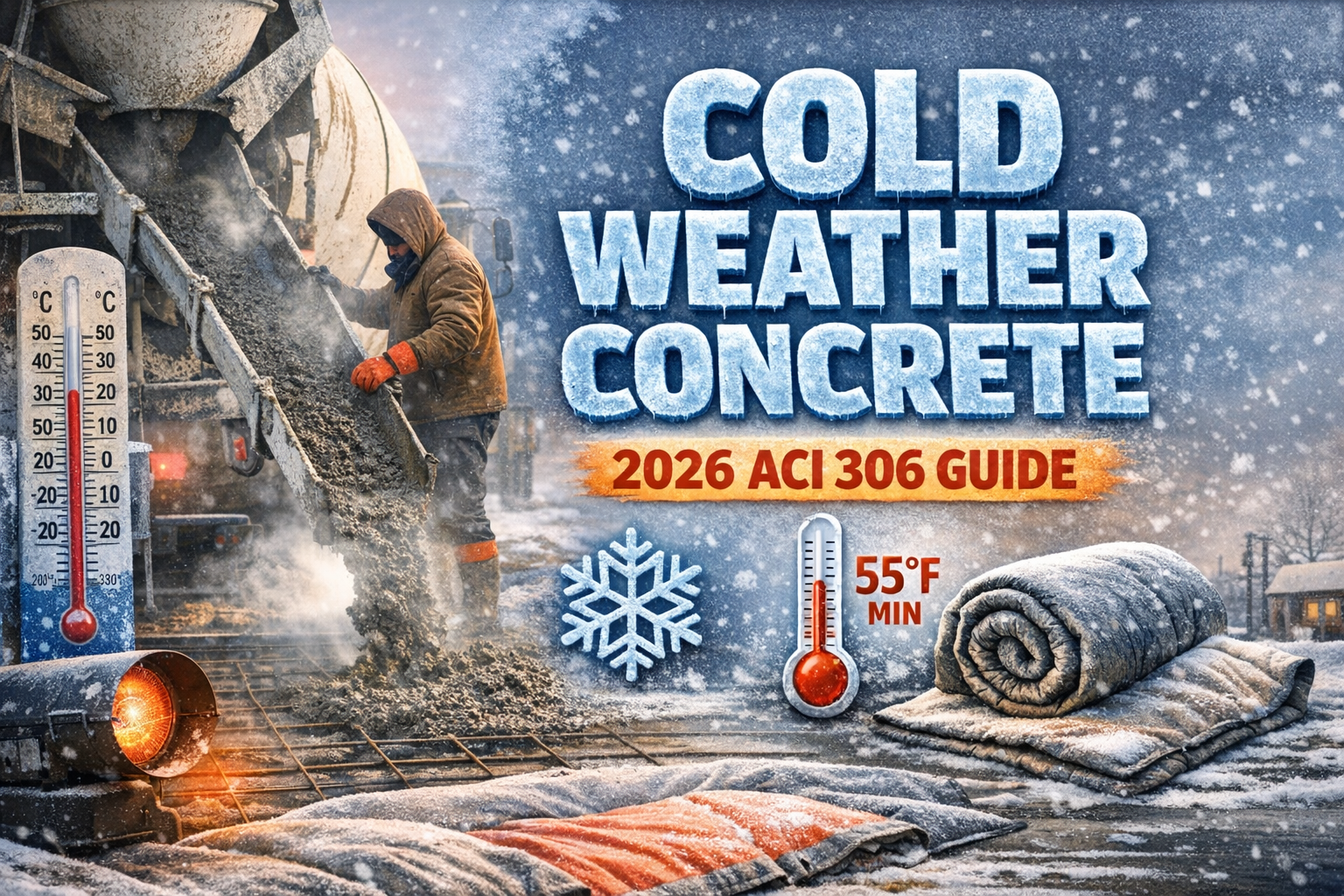
Cold weather concrete isn’t a gamble – it’s a procedure. Every year, thousands of residential slabs are poured in freezing temperatures and perform perfectly for decades. And every year, thousands more are ruined because the crew skipped one step: keeping the concrete warm long enough to reach 500 PSI. This guide covers every step of the cold weather concrete process per ACI 306 – minimum temperatures, heated mix water, the right admixtures, insulated curing blankets, protection periods, and how much all of it costs in 2026. Follow it exactly and your cold-weather pour will outlast any summer slab from a crew that didn’t care.
What ACI 306 Calls “Cold Weather Concrete”
The American Concrete Institute’s standard for cold weather concreting – ACI 306R – defines cold weather as any period when the mean daily air temperature drops below 40°F for more than three consecutive days. You can read the full standard at concrete.org. This isn’t just a guideline – for commercial and structural work, ACI 306 compliance is a contractual requirement. For residential projects, it’s simply the difference between a slab that lasts 30 years and one that fails in 3.
Cold weather concrete applies to every concrete pour – driveways, patios, footings, slabs, walls – whenever ambient temperatures meet the definition. It doesn’t matter whether the project is residential or commercial, simple or structural. The chemistry of hydration doesn’t care about project size, and neither should you.
When Does Cold Weather Concrete Season Start?
For most of the Northern US, cold weather concrete season runs roughly November through March, though specific dates vary significantly by region. In Minneapolis, Minnesota, cold weather concrete practices may be needed from October through April. In Nashville, Tennessee, cold weather precautions may only be needed for a few weeks each winter. Check the best time to pour concrete guide for a region-by-region seasonal breakdown before you schedule any winter pour.
ACI 306R is the guide (recommendations and explanations), while ACI 306.1 is the specification (enforceable requirements for project specs). For residential work with no formal project specification, follow ACI 306R. For commercial, bridge, or government work, the project specification will typically cite ACI 306.1 as a mandatory requirement. Both are available from concrete.org.
What Cold Does to Fresh Concrete
Concrete gains strength through hydration – water chemically reacting with cement particles to form interlocking crystals. This reaction is temperature-sensitive. Below 50°F, hydration slows dramatically. Below 40°F, it nearly stops. And if the concrete temperature drops below 27°F before it reaches 500 PSI, the water in the mix freezes, expands by roughly 9%, and physically tears apart the crystal structure that was forming.
The damage from early freezing is permanent and invisible. The slab looks normal after it thaws. It may even pass a visual inspection. But a compressive strength test will reveal a slab that reached 1,400 PSI instead of its designed 3,000 PSI. Over the next few winters, that weakness shows up as surface scaling, cracking from corners, and progressive deterioration that no sealer or patch can stop.
The 27°F Freeze Point
Fresh concrete freezes at approximately 27°F (-3°C) – slightly below the standard 32°F water freezing point because dissolved salts in the mix water depress the freezing point. This means even mild overnight lows below 30°F can damage unprotected concrete in its first days. Don’t wait for a hard freeze to cover your slab – protect it whenever the forecast shows overnight lows below 35°F during the protection period.
Concrete must reach 500 PSI compressive strength before it can safely survive even one freeze-thaw cycle. Under ideal 70°F conditions, this takes about 24-48 hours. In cold weather at 40-50°F, it can take 3-5 days. In temperatures near 32°F with protection, up to 7 days or more. The entire purpose of cold weather concrete protection is to keep the slab above 50°F long enough to reach this threshold. Every cold-weather protection decision you make traces back to this single number. Use the PSI strength calculator to project when your specific mix reaches 500 PSI.
How Cold Affects Set Time and Workability
Cold temperatures slow the hydration reaction, which means cold weather concrete takes longer to set and reach finishing conditions. A mix that would be ready to trowel in 3-4 hours on a 65°F day may take 5-7 hours at 45°F. This gives you more working time – which sounds like a benefit – but it also means the slab is in the plastic phase longer, exposed to cold air, and more dependent on your protection system staying intact overnight.
Use the concrete set time calculator to see exactly how your pour temperature shifts the initial and final set clock. Knowing this number lets you schedule the right crew size and have protection materials ready at exactly the right time.
Subgrade Preparation – Never Pour on Frozen Ground
This is the single rule with no exceptions in cold weather concrete: never pour on frozen ground. Frozen subgrade pulls heat from the bottom of the slab faster than any insulation on top can compensate. The bottom inch of the concrete can reach freezing temperature within hours of placement even when the top surface looks fine under a curing blanket.
How to Thaw the Subgrade
You need the subbase thawed to a depth of at least 12-18 inches before the truck arrives. Here are the options used on residential and light commercial projects in 2026:
- Propane torpedo heaters under a tarp enclosure: Set up a temporary poly tent over the pour area and run propane heaters for 24-48 hours before placement. Most effective for areas under 1,000 sq ft. Heater rental: $75-150/day. Propane: $80-120 for a 48-hour thaw of a 600 sq ft area.
- Hydronic ground-thaw blankets: Electric or hot-water-circulating blankets laid directly on the ground. More expensive to rent ($200-400/day for 500 sq ft) but more uniform. Often available from concrete supply houses and equipment rental yards.
- Pre-cover before freeze: If you know the pour date in advance, cover the subgrade with insulated tarps 3-5 days before placement to prevent it from freezing in the first place. Cost: $0.05-0.10/sq ft of poly plus labor. The cheapest method by far.
Before the truck leaves the plant, push a 1/2-inch steel rebar or pointed stake into the subgrade by hand. It should penetrate at least 18 inches with hand pressure and no resistance. If you hit frozen ground at 8 or 10 inches, keep heating – don’t pour. A partial thaw is almost as bad as a full freeze because the bottom 2-3 inches of your slab will cool rapidly against the still-cold soil below the thawed layer.
Form and Rebar Temperature
Steel rebar and metal forms can be well below freezing even when air temperature is at 38°F, especially after a clear cold night. Cold reinforcement chills the concrete around it and creates localized freeze-risk zones inside the slab. Before the pour, use a propane torch or heat gun to warm all rebar and metal forms to above 32°F – ideally above 40°F. For a typical residential driveway with rebar or wire mesh, this takes 15-20 minutes and makes a measurable difference in edge and corner performance.
🧮 How Many Yards Do You Need for Your Winter Pour?
Get accurate cubic yard estimates and 2026 ready-mix pricing before you call the supplier. Know your quantities and cold-weather admixture costs upfront.
Calculate My Slab →Cold Weather Mix Design and Admixtures
Your summer mix is not your best option for cold weather concrete. A few targeted adjustments – most costing under $30/yard – can dramatically shorten the time to 500 PSI, reduce the protection period, and lower your total cold-weather project cost. Order these when you call the ready-mix plant, not after the truck arrives.
Heated Mixing Water
The most fundamental cold weather concrete tool is heated mixing water. Because water has a much higher heat capacity than aggregate or cement, heating it to 140-180°F at the plant produces a mix that arrives at 55-75°F at discharge even on a 20°F day. Most ready-mix plants in cold-climate states include heated water in winter at no extra charge. Call ahead and confirm – and specify a minimum discharge temperature of 55-65°F when you place the order.
Type III High-Early Strength Cement
Type III Portland cement is ground much finer than standard Type I/II. The finer particle size means faster hydration, more internal heat generated per hour, and much faster early strength gain. A slab using Type III cement can reach 500 PSI in 24-36 hours at 40°F – vs. 3-5 days for Type I. This dramatically shortens the protection period and cuts your cold-weather overhead costs. Ask for Type III when ordering and expect a premium of $20-35 per yard in 2026.
Accelerating Admixtures
Accelerating admixtures speed up the hydration reaction independently of cement type, generating more early heat and shortening the time to the 500 PSI threshold. There are two types you need to know:
| Admixture Type | Best For | Cost Per Yard (2026) | Key Note |
|---|---|---|---|
| Calcium Chloride (CaCl2) – 2% | Plain, unreinforced concrete only | $8-15 | Most effective accelerator – never use with rebar or wire mesh |
| Non-Chloride Accelerator (NCA) | All reinforced concrete | $18-30 | Safe with all steel – slightly less effective than CaCl2 |
| Type III Cement (alone) | Both reinforced and plain | $20-35 premium | High-early strength without chemical admixtures |
| Type III + NCA (combined) | Severe cold (below 25°F air temp) | $38-65 total premium | Maximum early strength gain – best option for tough conditions |
Use the concrete admixture calculator to calculate dosage rates and total admixture costs for your specific pour volume. For mix proportions and cement type comparisons, the concrete formula calculation reference covers every ratio for cold-weather applications.
Air-Entrained Concrete for Freeze-Thaw Durability
Air entrainment is not just for winter pours – it’s for any exterior concrete that will experience freeze-thaw cycles during its service life, which in most of the US means every driveway, patio, sidewalk, and flatwork surface. Air-entrained concrete contains millions of microscopic air bubbles – typically 4-7% total air content for exterior flatwork – that act as tiny pressure relief valves when pore water freezes and expands. Without entrained air, repeated freeze-thaw cycling breaks down concrete from the inside out over 10-20 years. With it, the same slab can outlast the house.
ACI 318, the primary structural concrete standard, requires air entrainment for all concrete exposed to freezing and thawing in a moist condition or to de-icing chemicals. For most US residential driveways and flatwork, this means air-entrained concrete is not optional – it’s a code requirement in all freeze-thaw exposure zones. The National Ready Mixed Concrete Association (NRMCA) recommends 6% air content (plus or minus 1.5%) for exterior flatwork in severe exposure zones. Ask your ready-mix supplier to confirm total air content on the batch ticket.
💼 Example: Cold Weather Pour in Minneapolis, MN
You’re pouring a 24×28-foot driveway (672 sq ft, ~8 yards at 4 inches thick) in late November. Forecast: highs of 34°F, lows of 18°F for the next 5 days.
Standard summer mix: 8 yards x $170/yd = $1,360
Cold-weather upgrades:
– Type III cement: +$28/yd = +$224
– Non-chloride accelerator (rebar slab): +$22/yd = +$176
– Air entrainment (6%): +$10/yd = +$80
– Heated mixing water: included by plant
Upgraded mix total: $1,840
Protection materials:
– R-8 insulated blanket rental (7 days): ~$350
– Propane heater + subgrade thaw: ~$250
Total cold-weather premium over summer: approximately $1,080
Calculate exact volumes with the slab calculator and get 2026 cost estimates with the cost calculator.
Protection Methods – Blankets, Enclosures, and Heat
Once the concrete is placed and finished, your only job is keeping it above 50°F long enough to reach 500 PSI. The method you choose depends on how cold it gets and how long it stays cold.
Insulated Curing Blankets
Insulated concrete curing blankets are the standard tool for cold weather concrete protection on residential and light commercial projects. They trap the heat generated by hydration and prevent the slab surface from cooling to ambient temperature. Apply them within 20 minutes of finishing – not when you’re packing up for the day. Every minute of exposed, unprotected concrete in cold air is heat loss you can’t get back.
- R-4 blankets: Adequate for overnight lows of 25-35°F. Cost to rent: $0.40-0.70/sq ft per week.
- R-8 blankets: Required for overnight lows below 25°F. Cost to rent: $0.60-1.00/sq ft per week.
- To buy: $80-160 each for a 6×25-foot blanket. Worth purchasing if you pour concrete regularly in cold climates.
- Edge coverage: Extend blankets at least 12 inches past all slab edges and overlap adjacent blankets by at least 12 inches. Corners and edges are the coldest parts of any slab and set last – they need the most protection, not the least.
Heated Enclosures
For temperatures below 20°F, or for projects where the forecast shows extended periods below 25°F, a heated enclosure is required. This is a temporary structure – plywood panels, scaffold frames, or poly sheeting on lumber frames – that completely surrounds the pour area and is heated with propane torpedo heaters or electric space heaters.
- Propane torpedo heaters: Most common for residential cold weather concrete enclosures. Output: 50,000-200,000 BTU/hr. Rental: $75-150/day per unit. Never use propane heaters inside a sealed enclosure without ventilation – carbon monoxide risk is real and serious.
- Electric heaters: Safer for enclosed spaces but require adequate electrical capacity at the job site. No CO risk. Less common for large residential pours.
- Enclosure construction cost: $200-600 for materials (poly, lumber, stakes) for a typical 600-700 sq ft residential driveway.
Propane and diesel heaters produce carbon monoxide. In a tightly sealed heated enclosure, CO can build up to dangerous levels within minutes. Always provide ventilation openings at the low and high ends of any heated enclosure. Never work inside a closed heated enclosure without CO detection. Multiple contractors and workers are killed or seriously injured each year in cold weather concrete operations from CO poisoning in heated enclosures – this warning is not precautionary, it’s a documented risk.
ACI 306 Protection Period – How Long to Keep It Warm
The ACI 306 protection period is the minimum time you must maintain the concrete above 50°F before removing insulation or heating. The specific duration depends on the concrete’s exposure condition and the strength required before removal of protection.
Protection Periods by Exposure and Application
| Application Type | Required Strength Before Removal | Standard Type I Cement (40-50°F) | Type III / Accelerator |
|---|---|---|---|
| Slab not exposed to freezing (interior) | 500 PSI (no freeze risk) | 2-4 days | 1-2 days |
| Driveway, patio, exterior slab (freeze-thaw exposed) | 70% of design strength (~2,100 PSI for 3,000 PSI mix) | 5-7 days | 3-4 days |
| Structural elements (columns, beams, walls) | 70% of design strength or per engineer | 7-14 days | 5-7 days |
| Prestressed elements | Per transfer strength requirement | Per engineer specification | Per engineer specification |
Use the curing temperature calculator to get a day-by-day strength projection for your specific mix and forecast temperatures. It accounts for actual temperature history rather than just ambient air temp – giving you a much more accurate read on when protection can safely be removed.
How to Remove Protection Safely
Both ACI 306 and engineering practice prohibit removing cold-weather protection suddenly. Pulling blankets on a 15°F morning from a 55°F slab creates a 40°F surface temperature shock in seconds. The surface contracts sharply while the interior stays warm, generating tensile stress that can crack an otherwise sound slab. ACI 306 recommends limiting the surface temperature drop to no more than 5°F per hour when removing protection. Lift one edge for 30 minutes. Then fold back half the blanket for 30 minutes. Then remove completely. The total “removal sequence” for a well-protected slab takes 2-3 hours – not 2 minutes.
📅 When Can You Walk and Drive on Your Winter Slab?
Cold weather extends every milestone. Get adjusted foot traffic and vehicle load timelines based on your actual pour temperature and forecast with the curing calculator.
Get My Curing Timeline →Real 2026 Cost of Cold Weather Concrete
Cold weather concrete costs more than a summer pour – typically $1.50-3.50 per square foot extra for a residential slab, depending on how severe the conditions are. Here’s a complete breakdown of every cold-weather cost line for 2026 so you can budget accurately before signing a contract or placing an order.
Cold Weather Mix Premiums Per Cubic Yard
| Cold Weather Item | Cost Per Cubic Yard (2026) | Total for 10-Yard Pour | Notes |
|---|---|---|---|
| Heated mixing water | Usually included | $0 | Standard at most plants in cold-climate states |
| Type III high-early cement | $20-35 | $200-350 | Best ROI for cold weather mixes |
| Non-chloride accelerator | $18-30 | $180-300 | For reinforced slabs; use CaCl2 only for plain concrete |
| Air entrainment (if not standard) | $5-15 | $50-150 | Many plants include this standard; confirm with supplier |
| 4,000 PSI upgrade (vs. 3,000 PSI) | $15-25 | $150-250 | Optional – gains strength faster, improves winter durability |
Cold Weather Protection Material Costs
| Protection Item | Cost (2026) | For 600 sq ft Driveway | When Needed |
|---|---|---|---|
| R-4 insulated blanket rental (7 days) | $0.40-0.70/sq ft | $240-420 | Overnight lows 25-40°F |
| R-8 insulated blanket rental (7 days) | $0.60-1.00/sq ft | $360-600 | Overnight lows below 25°F |
| Subgrade thaw (propane + heater) | $200-400 total | $200-400 | Any frozen subgrade |
| Heated enclosure (materials + heater) | $400-900 total | $400-900 | Air temps below 20°F |
Quick Cold Weather Cost Estimate
Use the concrete cost calculator and the yardage calculator to get exact 2026 pricing for your specific project dimensions
Common Cold Weather Concrete Mistakes
Every contractor who has poured cold weather concrete long enough has made at least one of these mistakes. Knowing them before you pour means you don’t have to learn them the hard way.
Mistake 1: Removing Blankets Too Soon
What happens: The slab looks hard at 48 hours. The crew pulls the blankets. The temperature that night drops to 22°F. The slab has only reached 800-900 PSI – below the 500 PSI threshold for freeze safety and far below the 2,100 PSI (70% of design) required before removing protection from an exterior freeze-thaw exposed slab. By morning, the surface has frosted and the damage is done.
The fix: Don’t remove protection based on how the slab looks. Remove it based on projected strength, calculated from the actual temperature history using the curing temperature calculator. When in doubt, leave the blankets on for an extra day. The rental cost is trivial compared to the cost of a failed slab.
Mistake 2: Accepting a Cold Mix at Discharge
What happens: The ready-mix truck arrives but the plant didn’t heat the water sufficiently. The mix temperature at the chute is 45°F. The contractor accepts it anyway to avoid delaying the job. A 45°F mix in 30°F air cools below 40°F within the first 30-60 minutes of placement. The concrete essentially stops gaining strength for hours – right when it needs to build the most.
The fix: Measure concrete temperature at the chute per ASTM C1064 before discharge begins. Specify a minimum discharge temperature of 55-65°F in your order. If the load arrives below spec, reject it and call the plant for a properly heated replacement. Most plants can quickly remedy a temperature issue if caught at delivery. See the full guidance in the concrete temperature limits guide.
Mistake 3: Using Calcium Chloride in a Reinforced Slab
What happens: A contractor uses calcium chloride as a cheap accelerator in a driveway slab with wire mesh. CaCl2 is the most effective accelerator available – but chloride ions in contact with steel reinforcement initiate and accelerate corrosion. Over the next 5-10 years, the rusting mesh expands, causes cracking, and pushes the surface layer off in large sections. The damage can affect the full slab area.
The fix: Use calcium chloride only in plain, unreinforced concrete. For any slab with rebar, wire mesh, or fiber reinforcement, use a non-chloride accelerator. The added cost ($8-15 more per yard) is far less than the cost of removing and replacing a corroding slab. The admixture calculator shows the cost difference for your exact pour volume.
Mistake 4: Skipping Air Entrainment on Exterior Slabs
What happens: A homeowner orders standard mix without confirming air content. The plant delivers non-air-entrained concrete. The slab survives the first winter fine. By year 3 or 4, the surface starts to scale – first in small patches, then across the full surface. The scaling accelerates every year as the damaged surface absorbs more water and undergoes more freeze-thaw damage. By year 8, the slab looks 30 years old.
The fix: For every exterior flatwork surface in a freeze-thaw climate, confirm air-entrained concrete with 5-7% total air content when placing your order. Ask for it explicitly – don’t assume it’s included. Request the total air content value on the batch ticket when the truck arrives. For the slab thickness and structural requirements for your project, use the slab thickness calculator and the load bearing calculator.
Calculators for Your Winter Pour
Good planning before any cold weather concrete pour can save you hundreds in unnecessary protection costs and thousands in repair costs from avoidable failures. These calculators cover every planning need before you schedule the truck.
Temperature and Strength Planning
- Curing Temperature Calculator – Day-by-day strength projections based on actual forecast temperatures
- Concrete Set Time Calculator – How cold temperatures extend your working window and finishing timeline
- Concrete PSI Strength Calculator – Project when your mix reaches 500 PSI, 2,100 PSI, and design strength
- Water-Cement Ratio Calculator – How mix adjustments and admixtures affect design strength
- Concrete Admixture Calculator – Dosage rates and total cost for accelerators and air-entraining agents
Material and Project Quantities
- Concrete Slab Calculator – Cubic yards for driveways, patios, and general flatwork
- Slab Thickness Calculator – Correct depth for your application, soil, and load conditions
- Concrete Mix Calculator – Full batch proportions for your cold-weather mix design
- Ready-Mix Truck Calculator – Number of loads and minimum order planning for your project
- Concrete Yardage Calculator – Quick volume conversion from your measurements
Cost Estimation
- Concrete Cost Calculator – Full project cost with 2026 USA ready-mix pricing and cold-weather premiums
- Concrete Load Bearing Calculator – Verify your slab can handle vehicle loads after cold-weather curing
For the complete pouring process with cold-weather notes at every step, see how to pour a concrete slab and how to pour a concrete driveway. For walk-on and drive-on timing after cold weather pours, see when can you walk on concrete and when can you drive on concrete. For the complete seasonal curing guide, see concrete curing and drying time guide.
🎯 Key Takeaways
- ACI 306 cold weather concrete procedures apply any time air temperature is below 40°F or expected to drop below 40°F within 24 hours of placement.
- Minimum placement temperature for thin slabs is 55°F – specify this as a discharge temperature requirement when ordering from your ready-mix plant.
- Never pour on frozen ground. Thaw the subbase at least 12-18 inches deep with propane heaters or hydronic blankets before the truck arrives.
- Concrete must reach 500 PSI before it can survive a freeze-thaw cycle. The entire cold weather protection system exists to buy enough time for the slab to reach this threshold.
- Fresh concrete freezes at approximately 27°F – not 32°F. Protect whenever overnight lows are forecast below 35°F during the protection period.
- Type III cement + non-chloride accelerator is the most effective combination for severely cold conditions. It can halve the protection period vs. standard Type I cement.
- Never use calcium chloride in reinforced concrete. Use non-chloride accelerators for any slab with rebar, wire mesh, or steel fiber.
- Air-entrained concrete (5-7% air content) is required for all exterior flatwork in freeze-thaw zones per ACI 318 – confirm this with your supplier when ordering.
- Apply insulated blankets within 20 minutes of finishing – not hours later. Blankets trap hydration heat; they can’t restore heat that’s already been lost.
- Remove protection gradually – no more than 5°F surface drop per hour – to prevent thermal shock cracking on the finished surface.
- Cold weather concrete adds $1.50-3.50/sq ft over a summer pour in 2026. Budget for it before signing the contract, not after the truck arrives.
Frequently Asked Questions
Per ACI 306, the minimum fresh concrete temperature at placement is 55°F for thin sections under 12 inches (which covers most residential driveways and slabs), 50°F for sections 12-36 inches, and 45°F for large sections 36-72 inches. These aren’t just pour-day temperatures – the in-place concrete must be maintained at or above 50°F for the entire ACI 306 protection period until it reaches the required strength. Air temperature alone doesn’t tell you enough – measure actual mix temperature at the truck chute using a calibrated thermometer per ASTM C1064.
Yes – cold weather concrete can be placed successfully at air temperatures between 20°F and 40°F when you follow ACI 306 procedures. This means heated mixing water to achieve 55-65°F at discharge, thawed subgrade, immediate R-8 insulated blanket coverage after finishing, and a heated enclosure for air temperatures below 20°F. Below 20°F, cold weather concrete is not recommended for residential projects without a full professionally managed heated enclosure. At these temperatures, the cost and complexity of proper cold weather concrete often makes waiting for spring the more practical choice.
If concrete freezes before reaching 500 PSI compressive strength, the water in the mix expands roughly 9% as it turns to ice, physically disrupting the forming calcium silicate hydrate crystal structure. The result is permanently weakened concrete that can lose 50% or more of its design strength. The damage is invisible at the surface and irreversible – the slab looks normal after thawing but performs like a much weaker mix for its entire service life. The only fix is removal and replacement. This is why cold weather protection is not optional and why the ACI 306 protection period requirements exist.
Cold weather slows every milestone significantly. At 40-50°F with proper protection, the 7-day foot traffic milestone typically extends to 10-14 days and the full 28-day design strength target may take 35-45 days. Below 40°F with protection, add another 7-14 days to each benchmark. Type III cement or a non-chloride accelerator can recover 3-5 days off these timelines by speeding up early strength gain. Use the curing temperature calculator for day-by-day projections based on your actual forecast temperatures and mix design – much more accurate than rule-of-thumb estimates.
The two primary admixture categories for cold weather concrete are accelerators and air-entraining agents. Accelerators speed up hydration, generate more early heat, and shorten time to 500 PSI: use calcium chloride (2%) for plain unreinforced concrete ($8-15/yd) and non-chloride accelerators for any reinforced concrete ($18-30/yd). Air-entraining admixtures create microscopic bubbles that protect the hardened concrete from long-term freeze-thaw damage – required by ACI 318 for all exterior flatwork in freeze-thaw zones ($5-15/yd). Use the admixture calculator to calculate dosage and cost for your specific project volume.
The main methods for keeping cold weather concrete warm are: insulated curing blankets (R-4 for lows above 25°F, R-8 for lows below 25°F) applied immediately after finishing; propane or electric heated enclosures for temperatures below 20°F; heated mixing water (delivered at 55-65°F) to start the slab warm; and accelerating admixtures to generate more internal heat from the hydration reaction. For most residential cold weather pours in the 25-40°F range, insulated blankets plus a well-specified warm mix are sufficient. The blankets must go down within 20 minutes of finishing – not hours later – to capture the hydration heat before it dissipates.
Yes – and not just in winter. Air-entrained concrete is required by ACI 318 for all exterior concrete exposed to freezing and thawing during its service life, which includes driveways, patios, sidewalks, and all exterior flatwork in freeze-thaw climate zones. The entrained air (4-7% for most exterior applications) creates tiny pressure-relief voids that absorb the expansion pressure when pore water freezes. Without it, repeated freeze-thaw cycling breaks down the paste matrix from the inside over 10-20 years – the failure that causes the ubiquitous surface scaling on non-air-entrained driveways. Air entrainment costs $5-15 per cubic yard – negligible on a full project budget but essential for durability. Confirm total air content on the batch ticket when the truck arrives.
The ACI 306 protection period – the time you must maintain concrete above 50°F before removing insulation – depends on exposure condition and required strength. For exterior flatwork subject to freezing and thawing (driveways, patios), protection continues until the concrete reaches approximately 70% of design strength: about 5-7 days with standard Type I cement at 40-50°F, or 3-4 days with Type III cement or accelerators. For interior slabs not exposed to freezing, protection to 500 PSI is sufficient – typically 2-4 days. Always remove protection gradually (no more than 5°F surface temperature drop per hour) to prevent thermal shock cracking. Use the curing temperature calculator for your specific timeline.
🧮 Plan Your Cold Weather Concrete Pour Today
Free calculators for cubic yards, curing timelines, admixture dosing, and 2026 ready-mix costs. Everything you need before the truck leaves the plant.
View All Free Calculators →🔗 Related Calculators and Guides
- → Curing Temperature Calculator – Day-by-day cold weather strength projections based on actual forecast
- → Concrete Set Time Calculator – How cold temperatures extend your finishing and protection window
- → Concrete PSI Strength Calculator – Project when your mix hits 500 PSI and protection period end
- → Concrete Admixture Calculator – Dosage rates and cost for accelerators and air-entraining agents
- → Water-Cement Ratio Calculator – How w/c ratio adjustments affect cold weather strength
- → Concrete Slab Calculator – Cubic yards for driveways, patios, and general winter flatwork
- → Concrete Cost Calculator – Full project cost with 2026 pricing including cold-weather premiums
- → Concrete Curing and Drying Time Guide – Complete seasonal curing methods and timelines
- → When Can You Walk on Concrete – Adjusted foot traffic timelines for cold weather pours
- → When Can You Drive on Concrete – Cold weather vehicle load timelines and driveway readiness