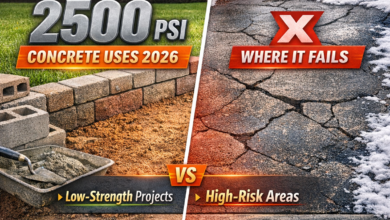
Concrete PSI Guide 2026: Strength Ratings for Every Application
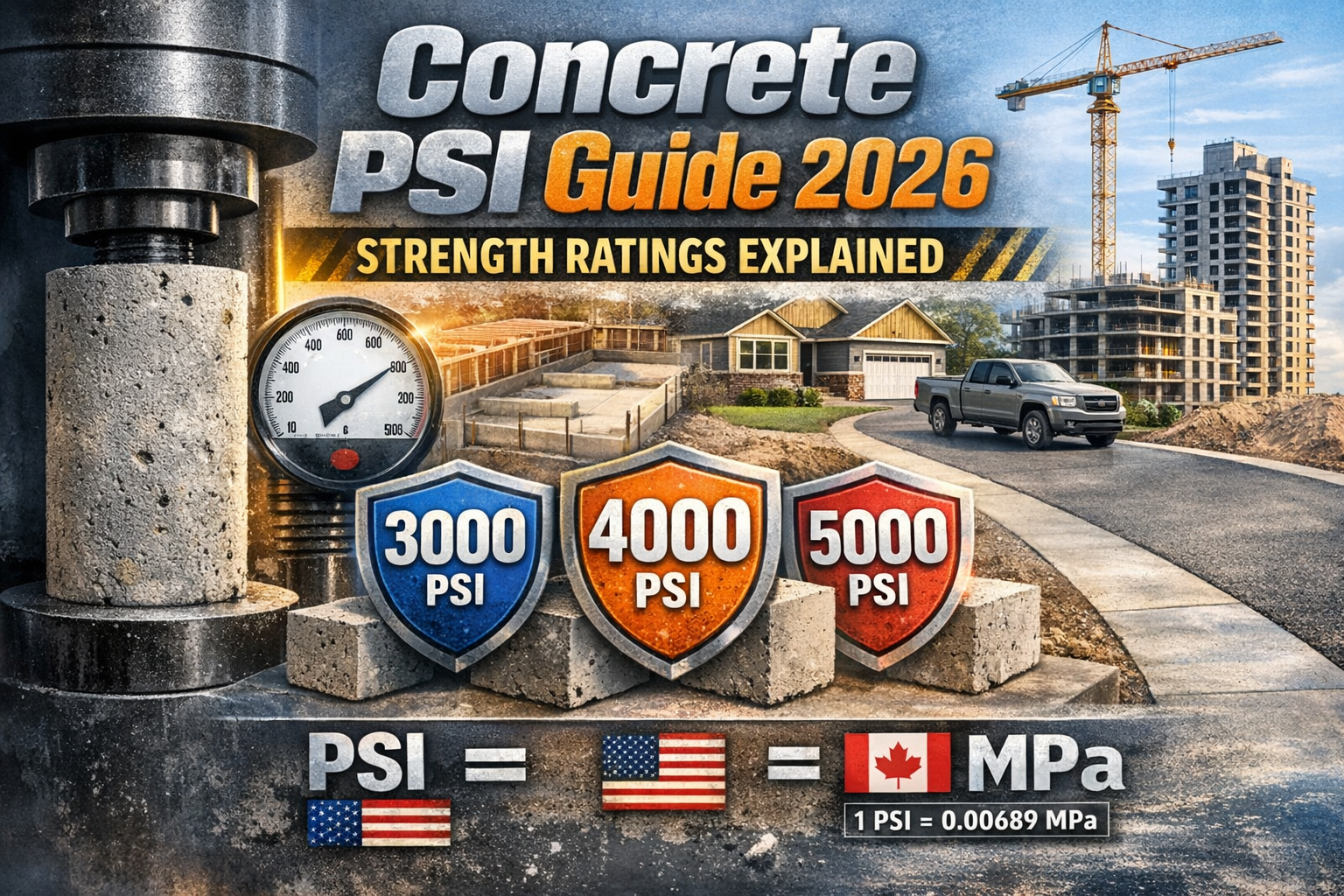
Picking the wrong concrete PSI is one of the most common and expensive mistakes in construction. Use too low a PSI and your driveway cracks in year two. Overpay for unnecessary strength and you’ve wasted money on every cubic yard. This concrete PSI guide covers exactly what PSI means, which strength rating you need for each application, how PSI develops over time, and what your local building codes require in 2026.
What Is Concrete PSI and How Is It Measured?
PSI stands for pounds per square inch. In concrete, it measures compressive strength – how much crushing force the hardened concrete can resist before it fails. A slab rated at 3000 PSI can withstand 3,000 pounds of force applied to every square inch of its surface.
This is the single most important performance specification for concrete in the United States. It tells you how strong the concrete will be after it fully cures at 28 days. Every structural calculation, building code minimum, and ready-mix order references PSI as the primary quality benchmark.
How PSI Is Tested
The standard test for concrete compressive strength is ASTM C39, performed on cylindrical specimens. Technicians pour concrete into 4-inch by 8-inch or 6-inch by 12-inch cylinders at the job site, cure them under controlled conditions, then crush them in a hydraulic press at 7 days and 28 days.
The press records the maximum load before failure. Divide that load by the cross-sectional area of the cylinder and you get the PSI value. A cylinder that fails at 84,800 pounds of force with a 28.27 square inch area equals 3,000 PSI.
Design Strength vs Specified Strength
When you order 3000 PSI concrete, the ready-mix plant actually targets a slightly higher strength to account for normal variation. ACI 318 requires producers to add a statistical margin (typically 400-600 PSI) so that no more than 1 in 10 tests falls below the specified value.
This means 3000 PSI concrete is actually mixed to achieve around 3500-3600 PSI average strength. You’re getting more than you pay for – built-in quality control that protects structural integrity.
When a supplier or engineer says “3000 PSI concrete,” that means the concrete reaches 3000 PSI at 28 days of age under standard curing conditions (70°F, moist curing). At 7 days, that same concrete is typically only 65-75% of final strength. Use our PSI strength calculator to predict strength at any age.
Common Concrete PSI Grades Explained
Ready-mix suppliers offer concrete in standard strength grades. Each grade is formulated with a specific water-cement ratio and aggregate blend to consistently hit the target PSI. Here’s what each grade is designed for and when you’d choose it.
2000-2500 PSI: Light-Duty Concrete
This is the lowest strength grade you’ll find from most ready-mix suppliers. It’s suitable for non-structural, low-load applications where strength isn’t critical. The high water-cement ratio makes it easier to place and finish, but durability suffers.
Typical uses include temporary pads, fill applications, pre-cast garden ornaments, and sidewalks in mild climates. Avoid this range for driveways, foundations, or anything exposed to freeze-thaw cycles in northern states. Typical cost in 2026: $130-145 per cubic yard delivered.
3000 PSI: The Standard Residential Grade
This is the most common concrete grade for residential projects. It’s the sweet spot between workability, cost, and adequate performance for most home applications. Nearly every ready-mix plant stocks this grade and can deliver it without special ordering.
Suitable for sidewalks, patios, interior floors, residential foundations in mild climates, and light-duty driveways in frost-free areas. Not ideal for heavy vehicle traffic or freeze-thaw exposure. Typical cost in 2026: $155-175 per cubic yard delivered.
3500 PSI: The Better Choice for Most Homeowners
For just $10-15 more per cubic yard, 3500 PSI gives you meaningfully better performance. The reduced water-cement ratio creates a denser, less permeable concrete that handles freeze-thaw better and resists surface scaling from road salts.
This is the grade most experienced contractors default to for residential work in the northern US. It handles light truck traffic, typical residential loads, and modest freeze-thaw exposure without issue. Typical cost in 2026: $165-185 per cubic yard delivered.
4000 PSI: The Upgrade Worth Paying For
The ACI 318 specifies 4000 PSI for concrete exposed to freezing and thawing in a moist condition or to deicing chemicals. If you live anywhere that gets below freezing in winter, this is the minimum for driveways and exterior flatwork.
Also required or strongly recommended for garage floors, driveways with heavy vehicle use, basement floors, and structural slabs. The water-cement ratio drops to around 0.44, making it significantly denser and more durable than 3000 PSI. Typical cost in 2026: $175-195 per cubic yard delivered.
5000 PSI and Above: Commercial and Structural Grades
High-strength concrete starts at 5000 PSI and goes up to 12,000 PSI or more for specialty applications. These mixes require careful quality control, sometimes include silica fume or other supplementary cementitious materials, and cost significantly more.
You’ll need 5000+ PSI for heavily loaded industrial floors, parking structures, bridge decks, structural columns in multi-story buildings, and pre-stressed concrete elements. Most residential contractors never need to order above 4500 PSI. Typical cost in 2026: $195-250+ per cubic yard depending on strength and market.
| PSI Grade | Water-Cement Ratio | Typical Applications | 2026 Cost/CY | Freeze-Thaw Rating |
|---|---|---|---|---|
| 2000-2500 PSI | 0.65-0.75 | Fill, temporary pads, garden walls | $130-145 | Poor |
| 3000 PSI | 0.55-0.60 | Sidewalks, patios, interior slabs | $155-175 | Fair |
| 3500 PSI | 0.50-0.55 | Driveways (mild climate), foundations | $165-185 | Good |
| 4000 PSI | 0.44-0.50 | Driveways, garages, structural slabs | $175-195 | Excellent |
| 4500 PSI | 0.40-0.44 | Heavy commercial floors, beams | $190-215 | Excellent |
| 5000+ PSI | Below 0.40 | Structural columns, bridges, parking decks | $210-250+ | Superior |
💪 Calculate Concrete Strength for Your Project
Get precise PSI development predictions at 7, 14, and 28 days based on your mix, temperature, and curing conditions.
Use PSI Strength Calculator →Concrete PSI Requirements by Application
This is the most practical part of any concrete PSI guide. Here’s the right PSI for each common residential and commercial application, along with the code basis and performance reasoning.
Driveways
Residential driveways in mild climates (no freeze-thaw): 3000-3500 PSI minimum. Driveways in northern states or those exposed to deicing salts: 4000 PSI minimum per ACI 318. Heavy vehicles or RVs on the driveway: 4000-4500 PSI.
The upgrade from 3000 to 4000 PSI on a typical two-car driveway (600 sq ft, 5 inches thick) adds about $25-30 to total material cost. That’s a negligible investment for significantly better durability over a 25-30 year lifespan.
Patios and Walkways
Standard residential patios: 3000 PSI minimum. Patios in freezing climates: 3500-4000 PSI. Stamped or decorative concrete patios: 4000 PSI for better surface hardness and reduced cracking risk during the stamping process.
Foundations and Footings
Residential footings and foundations: 3000 PSI minimum (most building codes). Most structural engineers specify 3500-4000 PSI for better performance and code compliance margin. In areas with expansive soils, high water table, or heavy structural loads: 4000-4500 PSI.
Never use less than 3000 PSI for any foundation element. Below that threshold, moisture penetration and freeze-thaw damage can compromise structural integrity within a few years. Our concrete foundation calculator factors in PSI requirements automatically.
Garage Floors
Interior residential garage floors: 3500-4000 PSI. Garage floors exposed to road salt tracked in from vehicles: 4000 PSI minimum. Commercial garages, repair shops, or floors with heavy vehicle traffic: 4000-5000 PSI.
Garage floors take significant abuse – vehicles, tool drops, hydraulic jacks, chemical spills. The $15-20 upgrade per cubic yard to 4000 PSI is always worth it for a garage application.
Basement Floors
Basement slabs typically carry light loads and aren’t exposed to weather, so 3000-3500 PSI is usually adequate. However, if you’re finishing the basement as living space, going to 3500-4000 PSI improves surface hardness and moisture resistance.
Structural Beams and Columns
Structural concrete elements designed to carry loads require minimum 4000 PSI per ACI 318. Many engineers specify 5000 PSI for beams and columns in residential construction to provide adequate safety margins. For post-tensioned slabs or pre-stressed elements, 5000-6000 PSI is standard.
Never downgrade structural PSI to save money. The loads carried by beams and columns have no margin for error. Use our beam calculator and always defer to your structural engineer’s specification.
Pool Decks and Water Features
Pool decks: 4000 PSI minimum. Constant moisture exposure, cleaning chemicals, and bare feet make durability critical. Swimming pool shells (gunite or shotcrete): typically 4000-5000 PSI. Retaining walls with hydrostatic pressure: 4000 PSI minimum.
💼 Example: Selecting PSI for a New Home Build
Location: Chicago, Illinois (USDA Zone 5b – heavy freeze-thaw)
Footings and foundation walls: 4000 PSI (ACI 318, exposure class F2)
Basement floor slab: 3500 PSI (protected from weather)
Garage floor: 4000 PSI (deicing salt exposure likely)
Driveway: 4000 PSI (freeze-thaw + deicing salt)
Sidewalks and patio: 4000 PSI (freeze-thaw exposure)
Total cost premium over using 3000 PSI everywhere: approximately $350-500 on a typical new home project. The durability benefit over 30 years far exceeds this upfront cost.
| Application | Mild Climate PSI | Cold Climate PSI | Code Reference |
|---|---|---|---|
| Residential driveway | 3000-3500 | 4000 minimum | ACI 318 Table 19.3 |
| Patio / walkway | 3000 | 3500-4000 | Local building code |
| Garage floor | 3500 | 4000 | ACI 318 / local code |
| Foundation / footings | 3000 min | 3500-4000 | ACI 318 Section 19.3.3 |
| Basement slab | 3000 | 3500 | Local building code |
| Structural beams/columns | 4000 min | 4000-5000 | ACI 318 Section 19.2.1 |
| Pool deck | 4000 | 4000-4500 | ACI 350 |
| Commercial floor | 4000-5000 | 4500-5000 | ACI 360 / project specs |
PSI vs MPa: Converting Concrete Strength Units
The United States uses PSI as the standard unit for concrete strength. Most other countries use MPa (megapascals). If you’re working with international specifications, foreign-sourced equipment, or engineering calculations that reference metric standards, you need to know how to convert between them.
The Conversion Formula
PSI to MPa Conversion
PSI = MPa × 145.04
Example: 4000 PSI = 4000 ÷ 145.04 = 27.6 MPa
Quick Reference Conversion Table
| PSI (US Standard) | MPa (Metric) | Common Application |
|---|---|---|
| 2500 PSI | 17.2 MPa | Light-duty, non-structural |
| 3000 PSI | 20.7 MPa | Standard residential |
| 3500 PSI | 24.1 MPa | Better residential |
| 4000 PSI | 27.6 MPa | Cold climate, structural slabs |
| 5000 PSI | 34.5 MPa | Structural, commercial |
| 6000 PSI | 41.4 MPa | High-strength structural |
| 8000 PSI | 55.2 MPa | High-rise columns |
If you’re importing equipment or working with an engineering firm that uses metric specs, always clarify which unit system the specifications use before ordering concrete. A mistake here – ordering 3000 PSI when the spec calls for 30 MPa (4,350 PSI) – can cause a serious structural deficiency. See our full engineering calculators for unit conversion and structural checks.
Concrete Strength Development Timeline
Concrete doesn’t reach its design PSI the moment it hardens. Strength builds gradually through the hydration process – the chemical reaction between cement and water that forms the crystal structure giving concrete its strength.
PSI Gain by Day
At standard curing conditions (70°F, moist curing), concrete gains strength following a predictable curve. The first 7 days see rapid gains. Days 7-28 add more slowly. Beyond 28 days, strength continues increasing slightly for months.
| Age | % of 28-Day PSI | 3000 PSI Mix Achieves | 4000 PSI Mix Achieves |
|---|---|---|---|
| 1 day | 10-15% | 300-450 PSI | 400-600 PSI |
| 3 days | 40-45% | 1,200-1,350 PSI | 1,600-1,800 PSI |
| 7 days | 65-75% | 1,950-2,250 PSI | 2,600-3,000 PSI |
| 14 days | 85-90% | 2,550-2,700 PSI | 3,400-3,600 PSI |
| 28 days | 100% | 3,000 PSI | 4,000 PSI |
| 56 days | 105-110% | 3,150-3,300 PSI | 4,200-4,400 PSI |
Temperature Effects on Strength Gain
Temperature dramatically affects how quickly concrete gains PSI. Cold weather slows hydration significantly. At 40°F, concrete may reach only 40% of design strength at 7 days. At 85°F, early strength gain accelerates but long-term strength may drop slightly due to poor crystal formation.
This matters for scheduling. If you need to remove forms, load the slab, or apply traffic within the first week, know your actual PSI based on site temperature – not just calendar days. Our curing temperature calculator adjusts strength predictions based on your actual conditions. For more on timing, see our full concrete curing and drying time guide.
What Stops Strength Gain Early
Concrete that dries out stops gaining strength permanently. The hydration reaction requires water to continue. Concrete that loses surface moisture too fast in hot, dry, or windy weather may reach only 50-60% of design PSI before hydration halts.
This is why proper curing – keeping concrete moist and at the right temperature for at least 7 days – is non-negotiable for achieving your specified PSI. Don’t assume the number on the order ticket guarantees performance without proper curing. Also check our guide on when you can walk on concrete for timing guidelines.
⚖️ Check Load Capacity for Your Slab
Calculate how much weight your specific PSI concrete slab can safely support before you pour or load it.
Use Load Bearing Calculator →Factors That Affect Concrete PSI Strength
Your concrete mix design targets a specific PSI, but final strength depends on several variables you can control. Understanding them helps you protect your investment from low-strength failures.
Water-Cement Ratio: The Most Critical Variable
This is the single biggest driver of PSI strength. More water means lower strength. The relationship is almost linear – increasing water-cement ratio from 0.45 to 0.60 drops compressive strength by roughly 25-30%.
Contractors sometimes add water to ready-mix on site to improve workability. Every gallon of water added to a cubic yard of concrete reduces PSI by approximately 200-300 PSI. A 3000 PSI mix watered down at the site may cure at only 2400-2500 PSI. Never add water to ready-mix without authorization. Use our water-cement ratio calculator to check how mix adjustments affect target PSI.
Cement Content and Type
Higher cement content generally produces higher strength, up to a point. Most residential mixes use 5-7 bags of cement per cubic yard. Reducing cement content to save cost reduces PSI proportionally.
Cement type also matters. Type I/II (normal Portland cement) is standard for most applications. Type III (high-early-strength) gains strength faster and reaches design PSI in 3-7 days. Type V (sulfate-resistant) is used where soil chemistry requires it but doesn’t offer higher PSI than Type I.
Aggregate Quality and Gradation
Aggregate makes up 60-75% of concrete volume. Weak, porous, or poorly graded aggregate limits how high PSI can go regardless of cement content. High-strength concrete above 8000 PSI often requires specially selected aggregates with high compressive strength.
For normal residential work, standard crushed stone or gravel from reputable suppliers is fine. Watch for projects using recycled aggregate or local materials not meeting ASTM C33 gradation standards.
Air Entrainment
Air-entrained concrete intentionally includes microscopic air bubbles (4-7% by volume) that give water room to expand when it freezes. This is mandatory for concrete exposed to freeze-thaw cycles in the northern US.
Air entrainment reduces strength slightly – every 1% of added air reduces PSI by roughly 200-300 PSI. This is why 4000 PSI air-entrained concrete is specified (not 3500 PSI) for freeze-thaw exposure: you need the higher starting strength to offset the air entrainment effect and still meet minimum requirements.
Curing Quality
Even perfect mix design fails if curing is poor. Studies show concrete that isn’t cured can reach only 50% of the strength of properly cured concrete from the same mix. Wet curing, plastic sheeting, or curing compounds maintain moisture and temperature for proper hydration.
Placement and Consolidation
Under-vibrated concrete contains voids and honeycombing that dramatically reduce effective strength. Proper consolidation with internal vibrators is required for structural elements. Over-vibration causes segregation (aggregate sinks, water rises) and creates weak zones.
Mix Design and Water-Cement Ratio
Every concrete PSI target starts with mix design. The mix design specifies the proportions of cement, water, fine aggregate (sand), coarse aggregate (gravel or stone), and any admixtures. Getting this right determines whether your concrete hits the target PSI.
How Mix Design Targets PSI
The primary lever is water-cement ratio. Lower w/c means higher PSI. Concrete suppliers use the ACI 211.1 mix design standard and statistical production records to dial in mixes that consistently exceed the specified design strength.
For each target PSI, there’s a corresponding maximum water-cement ratio:
- 3000 PSI – maximum w/c ratio: 0.58
- 3500 PSI – maximum w/c ratio: 0.53
- 4000 PSI – maximum w/c ratio: 0.44
- 4500 PSI – maximum w/c ratio: 0.38
- 5000 PSI – maximum w/c ratio: 0.35
Supplementary Cementitious Materials
Fly ash (a coal combustion byproduct) replaces 15-25% of cement in many mixes. It improves workability, reduces heat of hydration, and can enhance long-term strength. Slag cement (ground granulated blast-furnace slag) replaces 25-50% of cement. Both reduce cost slightly and improve durability, though they slow early strength gain.
Silica fume is used in high-strength concrete above 6000 PSI. It fills the tiny voids between cement particles, dramatically increasing density and strength. Expect to pay a premium for silica fume concrete.
Admixtures That Affect PSI
Chemical admixtures modify concrete behavior without changing PSI directly, but they can enable lower w/c ratios that increase strength. Water reducers (plasticizers) allow less water while maintaining workability, effectively boosting strength 200-400 PSI for the same mix design. Superplasticizers used in high-strength concrete enable w/c ratios below 0.30 that would otherwise be unplaceable.
💼 Example: Calculating Mix for 4000 PSI Driveway
Target PSI: 4000 (with statistical margin, plant targets 4500-4600 PSI)
Maximum water-cement ratio: 0.44
Cement content: 564 lbs per cubic yard (6.2 bags)
Water content: 248 lbs per cubic yard (29.8 gallons)
Fine aggregate (sand): 1,280 lbs per cubic yard
Coarse aggregate (3/4″ stone): 1,750 lbs per cubic yard
Air entrainment: 5-7% for freeze-thaw exposure
Result: Durable, freeze-thaw resistant driveway slab meeting ACI 318 requirements. Use our concrete mix ratio calculator to fine-tune proportions for your project.
Testing Concrete Compressive Strength
Specifying the right PSI is only half the job. You need to verify the concrete actually achieved target strength. This matters for structural applications, warranty purposes, and troubleshooting problems after the fact.
Cylinder Break Testing (ASTM C39)
The standard method is casting 4×8-inch or 6×12-inch cylinders at the job site from the same concrete going into the structure. Cylinders are cured under controlled lab conditions (ASTM C31) and tested at 7 and 28 days in a hydraulic press.
Testing cost in 2026: $75-150 per set of three cylinders, including lab curing, testing, and reporting. For most residential projects, this is optional but recommended for any structural elements. Commercial projects and public works require cylinder testing by code.
Core Drilling (ASTM C42)
When there’s a question about existing concrete strength – for a renovation, load change, or dispute – core drilling extracts cylindrical samples directly from the hardened concrete for testing. This gives actual in-place strength readings.
Core drilling cost in 2026: $200-500 per core depending on thickness and accessibility, plus $75-125 per core for lab testing. Worth it when structural capacity needs verification before adding loads to existing slabs.
Rebound Hammer (ASTM C805)
The Schmidt hammer is a non-destructive tool that estimates surface hardness. A spring-loaded plunger impacts the concrete and the rebound distance correlates to approximate compressive strength. Results are rough estimates, with accuracy of plus or minus 20-30%.
Useful for quick field screening, comparing relative strength across a slab, or checking if a suspicious area differs from the rest. Not accurate enough for structural decisions. Rebound hammers cost $250-500 in 2026 and are standard in a contractor’s toolkit.
When to Test
Always test structural concrete. For residential work, testing provides peace of mind and documentation. Key times to test:
- Before removing structural forms (compare 7-day results to required minimum)
- Before applying designed loads to slabs or structural elements
- When concrete looks wrong – unusual color, texture, or surface defects
- When delivery tickets show unusual slump or batch times
- For any dispute resolution with contractors or suppliers
If cylinder tests come back below the specified PSI at 28 days, don’t panic immediately. First, verify the cylinders were cured and tested correctly. If testing is confirmed valid, core drill the actual structure – in-place strength is often higher than companion cylinders due to better curing conditions in the mass concrete. Contact your concrete supplier’s technical department. ACI 318 provides procedures for evaluating low-strength test results before condemning concrete.
Common PSI Mistakes and How to Avoid Them
These PSI errors cost homeowners and contractors thousands of dollars in repairs and replacements. Most are avoidable with basic knowledge and upfront planning.
1. Using 3000 PSI in Freeze-Thaw Climates
This is the number one driveway mistake in the northern US. The ACI 318 requires 4000 PSI for concrete exposed to freezing and thawing in a moist condition or to deicing chemicals. Using 3000 PSI in Chicago, Minneapolis, or Boston is a cost-cutting shortcut that results in surface scaling, spalling, and cracking within 3-5 years.
The fix is always more expensive than doing it right the first time. Resurfacing a spalled 600 sq ft driveway costs $3,000-8,000 in 2026. The upgrade to 4000 PSI on the original pour costs $30-40 extra.
2. Adding Water to Ready-Mix on Site
The concrete arrives stiff because it was designed that way. Adding water to make it easier to work destroys PSI strength. A single 5-gallon bucket of water added to a 10-yard load drops PSI by 150-250 PSI across the entire pour.
If concrete workability is a concern, use a water-reducing admixture (plasticizer) ordered with the mix. This maintains workability without increasing w/c ratio and without compromising PSI.
3. Not Specifying Air Entrainment in Cold Climates
Standard concrete without air entrainment in a freeze-thaw climate will fail at the surface. Specify 5-7% air entrainment for all exterior flatwork in regions with freezing winters. Ask your ready-mix supplier specifically about air content – it must be listed on the delivery ticket.
4. Confusing 28-Day Strength with Early Strength
Contractors sometimes load slabs, remove shores, or drive on concrete at 3-5 days because it “feels hard.” A 4000 PSI mix at 5 days might only be at 2,200-2,400 PSI. Structural loads applied before adequate strength is reached can cause immediate or delayed cracking. Check our walk-on concrete guide for safe traffic timing.
5. Buying the Lowest PSI to Save Money
The cost difference between 3000 and 4000 PSI concrete is $15-20 per cubic yard. For a 20-cubic-yard driveway, that’s $300-400 total upfront. The cost of replacing a failed 3000 PSI driveway at year 5 is $6,000-12,000. Always buy the right PSI for the application, not the cheapest available grade.
6. Skipping the PSI Verification for Structural Work
For footings, foundations, and structural slabs, always require cylinder testing. If a contractor pushes back on testing, that’s a red flag. Reputable concrete suppliers and contractors welcome verification because they’re confident in their product. The $150-300 in testing cost is cheap insurance on a $15,000-50,000 structural pour.
🎯 Key Takeaways: Concrete PSI Guide
- PSI measures concrete compressive strength – how much crushing force it withstands per square inch before failing
- Standard residential concrete PSI ranges from 2500 to 4500, with 3000-4000 covering most applications
- Use 4000 PSI for any exterior concrete in freeze-thaw climates per ACI 318 requirements
- The cost difference between 3000 and 4000 PSI is only $15-20 per cubic yard in 2026 – a small price for significantly better durability
- Concrete reaches 100% of its design PSI at 28 days, about 65-75% at 7 days under standard conditions
- Adding water to ready-mix on site reduces PSI by 200-300 PSI per gallon per cubic yard – never do it
- Air-entrained concrete (5-7% air) is required for freeze-thaw resistance in northern states
- Low water-cement ratio is the primary driver of high PSI strength – below 0.45 for 4000 PSI concrete
- Structural beams and columns require minimum 4000 PSI per ACI 318, many engineers specify 5000 PSI
- Poor curing can reduce actual PSI to 50-60% of the design strength even with a perfect mix
- To convert PSI to MPa: divide PSI by 145. 4000 PSI = 27.6 MPa
- Always verify structural concrete PSI with cylinder testing – it costs $150-300 and provides critical protection
Frequently Asked Questions
🔧 Get the Right Concrete for Every Part of Your Project
Use our full suite of engineering and planning calculators to specify, estimate, and schedule with confidence.
Explore All Calculators →