Aggregate Size Chart 2026 – Sieve Sizes & ASTM Reference
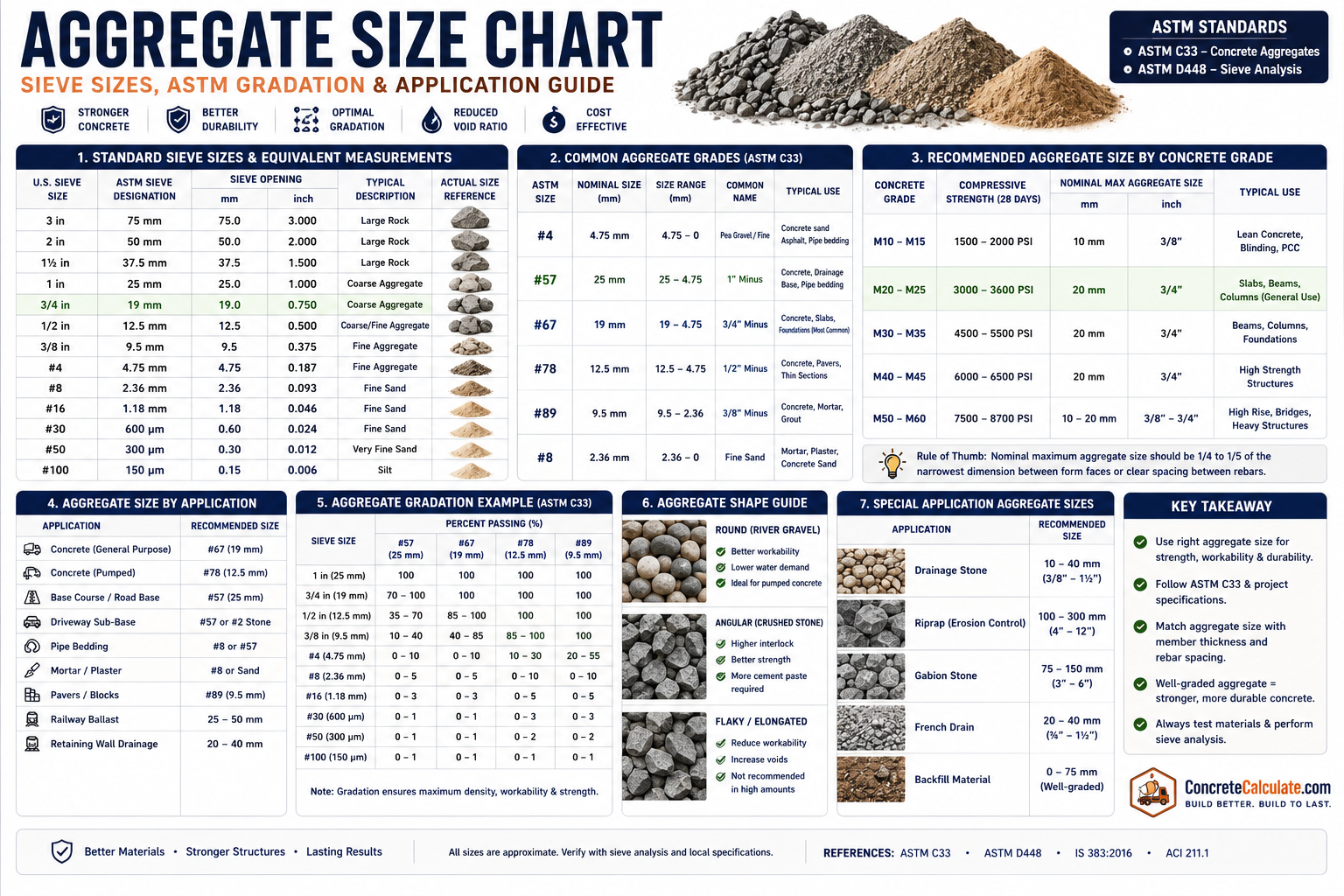
Aggregate Size Chart
Sieve Sizes & ASTM Reference
The complete aggregate sizing reference — sieve sizes, ASTM #1-#10 gradation, concrete grade, and drainage/landscaping applications.
 Reviewed by Muhammad Ramzan Babar, PhD Researcher (Plasma Physics) & Calculator Developer — View Profile
⭐ Master Aggregate Size Chart
Complete reference showing aggregate sizes, sieve sizes, nominal dimensions, and recommended applications for concrete, drainage, and landscaping.
How to Read This Chart
Sizes follow ASTM C33 (concrete aggregates) and ASTM D448 (standard sizes of coarse aggregate). Estimate quantities with our Concrete Aggregate Calculator.
| Aggregate Type | Nominal Size | Common Use |
|---|---|---|
| Stone Dust | 0-4.75mm (passes No. 4) | Paver bedding, joint fill |
| #8 Stone | 9.5-2.36mm (3/8″-No.8) | Pipe bedding, drainage, thin concrete |
| #67 Stone | 19-4.75mm (3/4″-No.4) | General concrete, driveways, foundations |
| #57 Stone | 25-4.75mm (1″-No.4) | Concrete, drainage, base material |
| #4 Stone | 37.5-19mm (1.5″-3/4″) | Drainage, French drains, large fill |
| Riprap | 150-700mm+ (6″-28″+) | Erosion control, shoreline protection |
| Gabion Stone | 90-180mm (3.5″-7″) | Retaining wall baskets, erosion control |
Source: ASTM C33 nominal size gradation table and ASTM D448 stone size classifications.
⭐ Aggregate Size Chart by Sieve Size
Standard ASTM size numbers with corresponding sieve gradation and nominal dimensions.
| Aggregate Size | Sieve Size | Nominal Size (mm) | Nominal Size (in.) |
|---|---|---|---|
| Stone Dust | Passes No. 4/No. 8 | 0-4.75 | 0″-3/16″ |
| #10 | No. 4 to No. 100 | 4.75-0.15 | 3/16″-No.100 |
| #8 | 3/8″ to No. 8 | 9.5-2.36 | 3/8″-No.8 |
| #67 | 3/4″ to No. 4 | 19-4.75 | 3/4″-No.4 |
| #57 | 1″ to No. 4 | 25-4.75 | 1″-No.4 |
| #4 | 1½” to 3/4″ | 37.5-19 | 1½”-3/4″ |
| #3 | 2″ to 1″ | 50-25 | 2″-1″ |
| #2 | 3″ to 1½” | 75-37.5 | 3″-1½” |
| #1 | 4″ to 1½” | 100-37.5 | 4″-1½” |
| Riprap | Varies by class | 150-700+ | 6″-28″+ |
| Gabion Stone | Varies by class | 90-180 | 3.5″-7″ |
Source: ASTM C33/D448 standard aggregate size number gradation tables.
⭐ Aggregate Size by Construction Application
Selecting the correct aggregate size depends on section thickness, reinforcement, and finish requirements.
| Project | Recommended Aggregate Size |
|---|---|
| Concrete Slabs | 20mm (#67 stone) |
| Foundations | 20mm (#67 stone) |
| Footings | 20mm-25mm (#67/#57 stone) |
| Driveways | 20mm (#67 stone) |
| Sidewalks | 10mm-20mm (#8/#67 stone) |
| Patios | 10mm-20mm (#8/#67 stone) |
| Columns | 10mm-20mm (dense rebar, #8/#67 stone) |
| Beams | 10mm-20mm (#8/#67 stone) |
| Bridge Decks | 19mm-25mm (#67/#57 stone) |
| Retaining Walls | 20mm-25mm (#67/#57 stone) |
Aggregate Size by Concrete Strength
Higher-strength mixes generally favor smaller maximum aggregate size to improve paste-aggregate bond quality.
| PSI | Recommended Aggregate Size |
|---|---|
| 2500 PSI | 25mm-40mm |
| 3000 PSI | 20mm-25mm |
| 3500 PSI | 20mm |
| 4000 PSI | 19mm-20mm |
| 5000 PSI | 12.5mm-19mm |
| 6000 PSI | 10mm-12.5mm |
Verify your target with our Concrete PSI Chart.
Fine Aggregate vs Coarse Aggregate Chart
The dividing line between fine and coarse aggregate is the 4.75mm (No. 4) sieve.
| Property | Fine Aggregate | Coarse Aggregate |
|---|---|---|
| Particle Size | Passes 4.75mm (No. 4) sieve | Retained on 4.75mm (No. 4) sieve |
| Materials | Natural sand, manufactured sand | Gravel, crushed stone |
| Typical Uses | Mortar, plaster, concrete paste matrix | Concrete bulk volume, base material |
| Advantages | Fills voids, improves finish/workability | Reduces paste demand, improves economy |
| Limitations | Excess fines increase water demand | Oversized aggregate risks segregation |
Aggregate Size by Concrete Grade
Recommended nominal maximum aggregate size for common Indian/international concrete grades.
| Grade | Recommended Nominal Max Aggregate Size |
|---|---|
| M10 | 40mm |
| M15 | 20mm-40mm |
| M20 | 20mm |
| M25 | 20mm |
| M30 | 10mm-20mm |
| M35 | 10mm-20mm |
| M40 | 10mm-12.5mm |
| M50 | 10mm |
Cross-reference with our Concrete Mix Design Chart.
Aggregate Size by Reinforcement Spacing
Nominal maximum aggregate size should not exceed three-quarters of the minimum clear spacing between rebar, per ACI 318 guidance.
| Rebar Clear Spacing | Concrete Cover | Max Recommended Aggregate Size |
|---|---|---|
| 1 inch (25mm) | 3/4″-1″ | 3/4″ (19mm) |
| 1.5 inches (38mm) | 1″-1.5″ | 1″ (25mm) |
| 2 inches (50mm) | 1.5″-2″ | 1.5″ (37.5mm) |
| 3+ inches (75mm+) | 2″-3″ | 2″ (50mm) |
Cross-check reinforcement cover requirements in our Concrete Cover Chart.
Aggregate Size vs Slab Thickness
Aggregate size is generally limited to about one-third to one-quarter of the slab thickness.
| Slab Thickness | Recommended Aggregate Size |
|---|---|
| 3″-4″ | 10mm-20mm (#8/#67) |
| 5″-6″ | 20mm (#67) |
| 7″-8″ | 20mm-25mm (#67/#57) |
| 9″+ | 25mm-37.5mm (#57/#4) |
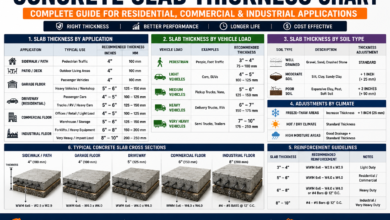
See our Concrete Slab Thickness Chart for full thickness recommendations.
Aggregate Size by Structural Member
Different structural elements favor different aggregate sizes based on section geometry and reinforcement density.
| Member | Recommended Aggregate Size |
|---|---|
| Footings | 20mm-25mm |
| Columns | 10mm-20mm |
| Beams | 10mm-20mm |
| Slabs | 20mm |
| Walls | 10mm-20mm |
| Pavements | 25mm-40mm |
Aggregate Size by Pumped Concrete
Placement method significantly influences the ideal maximum aggregate size for smooth flow and finishability.
| Placement Method | Suitable Aggregate Size |
|---|---|
| Pumped Concrete | 10mm-20mm (#8/#67 stone) |
| Conventional Placement | 20mm-40mm (#67/#4 stone) |
| Self-Consolidating Concrete | 10mm-16mm (smaller, well-rounded) |
Aggregate Size vs Workability Chart
Increasing aggregate size affects fresh concrete properties in several interconnected ways.
Workability
Larger aggregate can reduce workability if not paired with adequate paste volume
Water Demand
Decreases with larger aggregate due to reduced surface area needing coating
Finishability
Decreases with larger aggregate; harder to achieve smooth surface finish
Segregation Risk
Increases with larger aggregate, especially in high-slump or pumped mixes
Aggregate Size vs Concrete Strength Chart
Aggregate size influences strength indirectly through its effect on paste requirement and bond quality.
Aggregate Size
Larger size reduces surface area per unit volume needing paste coverage
Paste Requirement
Decreases as aggregate size increases, improving mix economy
Strength
Can increase with optimized paste-aggregate ratio, but excessive size weakens bond
Durability
Well-graded, appropriately sized aggregate improves long-term durability
Aggregate Size vs Water-Cement Ratio
Aggregate grading directly influences how much water and cement paste is needed to achieve target workability.
How Grading Affects Mix Economy
Well-graded aggregate with larger maximum size reduces void space between particles, lowering the paste volume needed to fill gaps and coat surfaces — this allows a lower effective water-cement ratio for the same workability, improving both strength and cost efficiency.
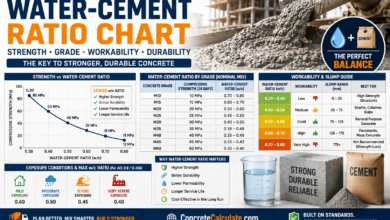
For full ratio guidance by exposure and grade, see our Water-Cement Ratio Chart or the Water-Cement Ratio Calculator.
⭐ Aggregate Grading Chart
Gradation pattern affects void content, paste demand, and overall concrete performance.
| Grading Type | Advantages | Typical Applications |
|---|---|---|
| Well-Graded Aggregate | Minimizes voids, reduces paste demand, best workability/economy balance | Standard structural concrete |
| Uniformly Graded Aggregate | Predictable particle interlock, consistent void ratio | Drainage layers, pervious concrete |
| Gap-Graded Aggregate | Can improve certain workability/finish characteristics | Exposed aggregate finishes, specialty mixes |
Aggregate Shape Comparison
Particle shape affects how aggregate interacts with cement paste and influences both fresh and hardened concrete properties.
| Shape | Bond Strength | Workability | Pumpability | Typical Uses |
|---|---|---|---|---|
| Rounded Aggregate | Moderate | High | High | Pumped concrete, general use |
| Angular Aggregate | High | Moderate | Moderate | High-strength structural concrete |
| Crushed Stone | High | Moderate | Moderate | General concrete, roadbase |
| Gravel | Moderate | High | High | Pumped mixes, general use |
Aggregate Size by ASTM Classification
ASTM designations provide standardized sizing terminology across the construction industry.
| ASTM Size No. | Nominal Size | Typical Use |
|---|---|---|
| #1 | 4″-1½” | Riprap, large fill, drainage |
| #4 | 1½”-3/4″ | Drainage, French drains |
| #57 | 1″-No.4 | Concrete, drainage, base |
| #67 | 3/4″-No.4 | Concrete aggregate, surface applications |
| #8 | 3/8″-No.8 | Pipe bedding, thin concrete, drainage |
| #10 | No.4-No.100 | Stone dust, screening, joint fill |
Source: ASTM D448 standard sizes of coarse aggregate.
Aggregate Size by Road Construction
Road layers use progressively smaller aggregate from base to surface course.
| Layer | Recommended Aggregate Size |
|---|---|
| Base Course | 40mm-63mm |
| Subbase | 53mm-80mm |
| Asphalt Mixes | 10mm-20mm |
| Surface Course | 6.3mm-12.5mm |
Source: gradation size ranges for base/subbase materials.
Drainage Aggregate Size Chart
Drainage applications favor clean, uniformly graded aggregate to maximize permeability and prevent clogging.
| Application | Recommended Aggregate Size |
|---|---|
| French Drains | #57 stone (25mm-4.75mm) |
| Drainage Trenches | #4/#57 stone (37.5mm-4.75mm) |
| Retaining Wall Drainage | #57 stone, clean/washed |
| Foundation Drainage | #57 stone, clean/washed |
Landscaping Aggregate Size Chart
Landscaping aggregate is chosen primarily for appearance and walkability rather than structural performance.
| Application | Recommended Aggregate Size |
|---|---|
| Decorative Stone | 10mm-40mm, varied colors |
| Walkways | 6.3mm-20mm (pea gravel/fines) |
| Garden Paths | 6.3mm-12.5mm |
| Rock Gardens | 40mm-150mm+ (larger decorative rock) |
| Xeriscaping | 10mm-40mm, decorative gravel |
⭐ Visual Aggregate Size Comparison
Relative particle size comparison across common aggregate types, drawn to the same scale.
Note: circle sizes are proportionally scaled for visual comparison, not to exact millimeter dimensions.
Common Aggregate Selection Mistakes
These errors are the most frequent causes of aggregate-related concrete problems.
Aggregate too large
Oversized aggregate relative to section thickness or rebar spacing causes voids and weak zones around reinforcement.
Aggregate too small
Undersized aggregate increases paste demand and water requirement, reducing economy and increasing shrinkage.
Poor gradation
Gap-graded or poorly distributed particle sizes increase void content and reduce strength efficiency.
Dirty aggregate
Silt, clay, or organic contamination on aggregate surfaces weakens the paste-aggregate bond significantly.
Excessive fines
Too much fine material increases water demand and shrinkage while reducing overall strength.
Incorrect moisture correction
Failing to account for aggregate moisture content skews the actual water-cement ratio in the batched mix.
Unsuitable aggregate shape
Using flat, elongated, or overly angular particles for pumped concrete can cause blockages and poor flow.
Contractor Worked Examples
Real-world aggregate selection decisions for common job scenarios.
Residential Driveway
House Foundation
Structural Slab
Concrete Column
Retaining Wall
Parking Lot
Decorative Concrete
Frequently Asked Questions
📥 Download Aggregate Size Chart PDF
Use your browser’s print function to instantly save this page as a PDF — a printable engineering reference with aggregate size tables, sieve size chart, ASTM classifications, construction application guide, grading reference, and visual particle size comparison.