How to Write a Professional Concrete Estimate + Example
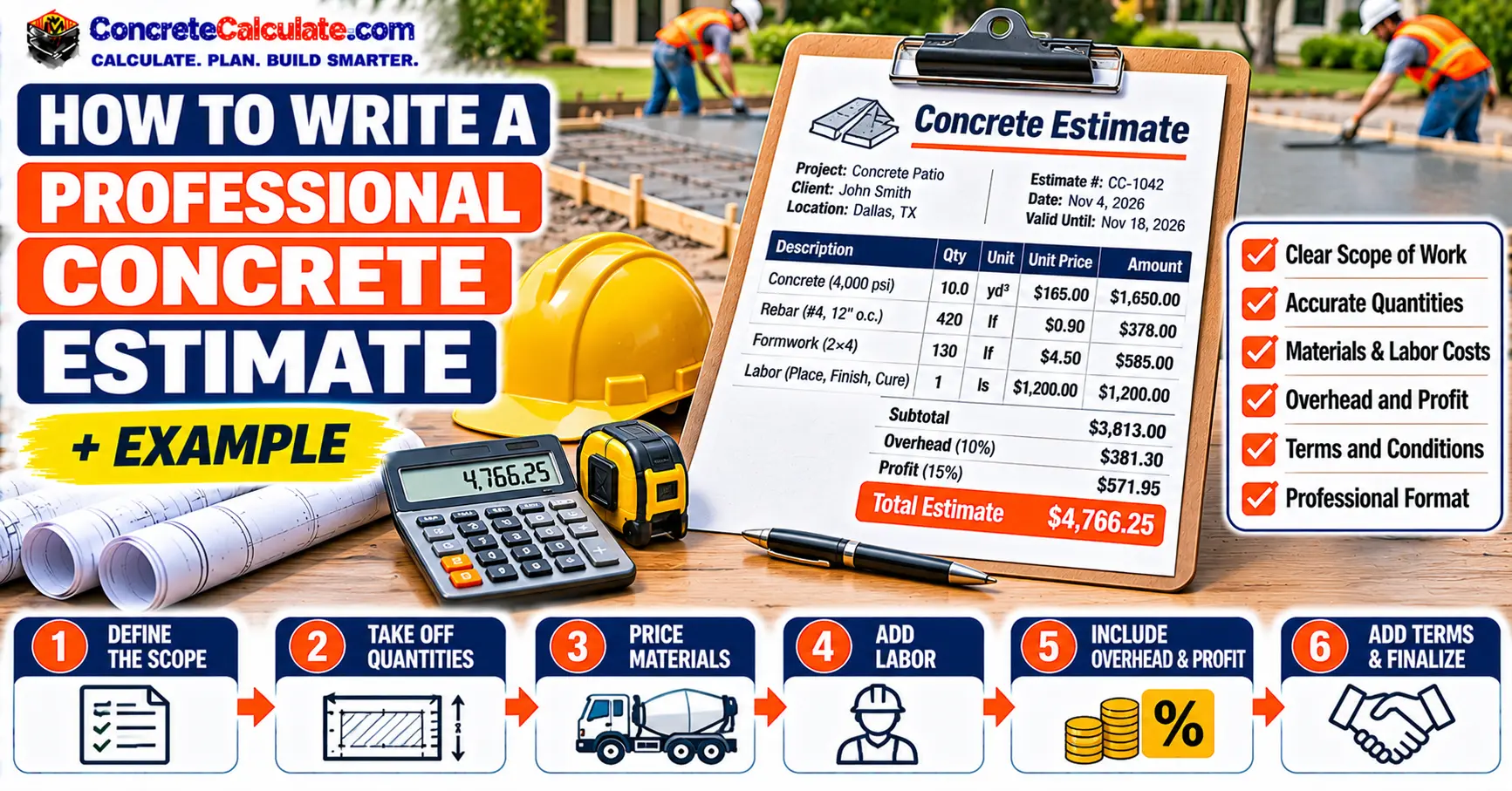
How to turn a finished bid price into a clear, complete customer-facing estimate, with scope, quantities, assumptions, exclusions, payment terms and a change-order process.
To write a professional concrete estimate, define the scope before the price. List the customer and project details, the basis of the estimate, measurable quantities, pricing, assumptions, exclusions, schedule conditions, payment terms, a change-order process, a validity period and an acceptance line, so both sides understand exactly what is being priced.
- Identify the contractor, customer, project and estimate number.
- State the basis: site visit, plans or measurements used.
- Write a measurable scope with quantities and units.
- Present pricing, allowances and options clearly.
- List assumptions and exclusions.
- Add schedule, payment, tax, permit and validity terms.
- Describe the change-order process and the acceptance step.
A. Understand the document
- What Is a Professional Concrete Estimate?
- Estimate vs. Quote vs. Proposal vs. Contract
- What Should a Concrete Estimate Include?
- Use a Professional Estimate Number and Revision System
B. Identify the parties and project
- Contractor Information to Put at the Top
- Customer and Project Information
- Estimate Date and Validity Period
- State the Basis of the Estimate
C. Write the scope clearly
- How to Write a Clear Concrete Scope of Work
- Describe Concrete Thickness, Strength and Finish
- Include Demolition and Disposal Scope
- Include Base, Subgrade and Compaction Scope
- Include Forms, Reinforcement and Joints
- Include Placement, Finishing, Curing and Cleanup
D. Present quantities and pricing
- Should a Concrete Estimate Show Unit Prices?
- How to Present Concrete Quantities
- How to Show Allowances
- How to Show Alternates and Optional Upgrades
E. Assumptions and exclusions
- What Assumptions Should a Concrete Estimate Include?
- What Should Be Listed as Exclusions?
- How to Handle Unknown Conditions
F. Schedule and payment
G. Control changes and risk
What Is a Professional Concrete Estimate?
A professional concrete estimate is a customer-facing document that describes the scope, quantities, price, assumptions, exclusions and commercial terms of a job. It should be clear enough that both sides know exactly what is being priced.
This guide is about presenting a price, not building one. For calculating the internal cost and bid price, read how to estimate a concrete job first, then come back to turn that number into a document the customer can follow.
FHWA’s cost estimating guidance asks that estimates be built on a clearly identified scope and that assumptions and what is and is not included be documented so the estimate can be understood, checked and verified (FHWA).
A good customer estimate applies the same discipline to a driveway or patio.
It should communicate scope before price. An estimate that opens with “600 sq. ft. driveway, $8,500” skips the part that prevents disputes.
Estimate vs. Quote vs. Proposal vs. Contract
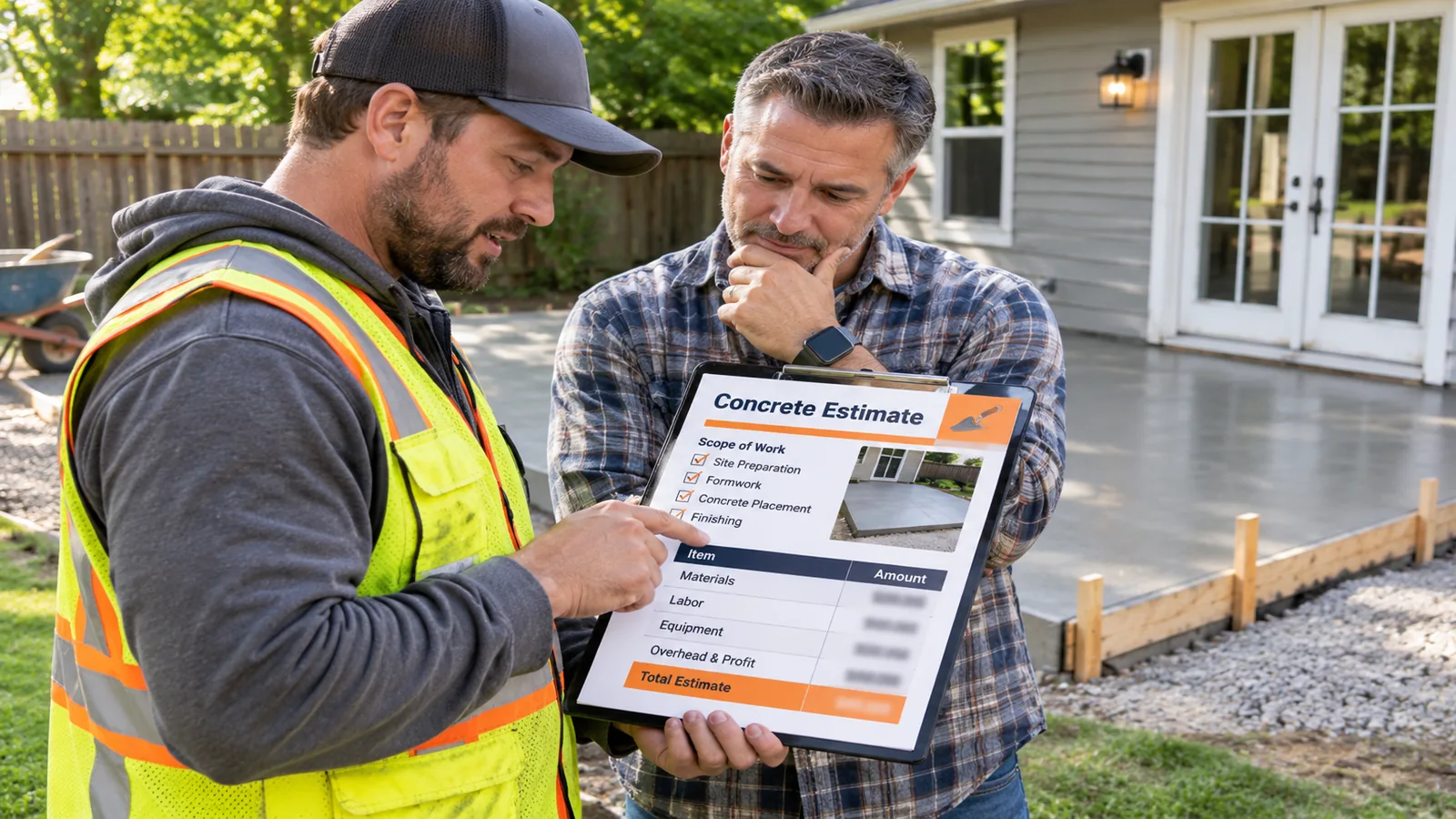
These four words overlap in daily use, but they do different jobs. Company habits and state law vary, so the title of a document alone does not decide its legal effect.
| Document | Main purpose | Typical content | Key caution |
|---|---|---|---|
| Estimate | Projected price | Scope, assumptions, estimated price | May change if scope or conditions change |
| Quote | More definite offer | Defined scope, price, validity | Terms determine its effect |
| Proposal | Formal commercial offer | Scope, method, price, terms | Often broader than an estimate |
| Contract | Binding agreement | Rights, duties, price, time, terms | State and local law applies |
A bid is a formal offer to perform defined work, common in competitive procurement. GSA treats a contractor bid proposal as its own project stage, based on drawings and specifications, separate from the earlier cost estimates (GSA).
Do not assume every signed estimate is a legally sufficient contract. Licensing, home-improvement contract and consumer-protection rules differ by state, so check what applies where you work.
What Should a Concrete Estimate Include?
A complete concrete estimate includes the parties, the project, a clear scope, quantities, pricing, assumptions, exclusions, schedule, payment terms, a change-order process, a validity period and an acceptance line. Table 2 shows the structure.
| Section | What it should contain |
|---|---|
| Header | Contractor, customer and project information |
| Estimate details | Number, date, revision, validity |
| Basis | Plans, site visit or measurements used |
| Scope | Detailed work included |
| Quantities | ft², yd³, LF, each |
| Price | Line items or lump sum |
| Assumptions | Conditions the price is based on |
| Exclusions | Work not included |
| Schedule | Start and duration conditions |
| Payment | Payment timing and method |
| Changes | Change-order procedure |
| Acceptance | Signature and date |
A professional concrete estimate combines measurable scope, price, assumptions, exclusions and commercial terms in one clear document.
Use a Professional Estimate Number and Revision System
Give every estimate a unique number and a revision level, such as EST-2026-104 Rev 0. A revision system makes it obvious which version the customer approved.
- Thickness changes
- Reinforcement changes
- Area changes
- Owner-added scope
Any of these should produce a new revision, not a quiet edit. FHWA stresses that estimates be kept up to date, documented and easy to check and verify as the scope becomes clearer (FHWA cost estimating process).
Contractor Information to Put at the Top
The top of the estimate should show who is making the offer and how to reach them. Customers and licensing boards both expect it.
- Business name and logo
- Contact name, phone and email
- Business address
- License number where applicable
- Insurance or bonding statements, only if accurate
Never claim a license, insurance or bond you do not hold. Check your state’s rules on what must appear on an estimate or contract.
Customer and Project Information
Identify the customer and the jobsite exactly, so there is no doubt where the work is and who is paying.
- Customer name
- Jobsite address
- Billing address, if different
- Contact details
- Project name, if there is one
Repeat the jobsite address and the estimate number on every page, so pages cannot be separated or mixed with another job’s paperwork.
Estimate Date and Validity Period
State the issue date and how long the price is valid. Concrete pricing can move, so an open-ended price puts all the risk on the contractor.
Formal proposals commonly include a validity period. A GSA checklist for proposals lists a proposal validity period along with the period of performance, price and a signature and date (GSA). That checklist is for unsolicited government proposals, so use it only as an example of formal elements.
Prices for ready-mix concrete, cement, steel, fuel, hauling and pump services can all change. Pick a validity period that fits your supplier quotes, and state it as an expiration date.
State the Basis of the Estimate
The basis of the estimate says what information the price came from. It is one of the simplest ways to look more professional and one of the best protections against later confusion.
- Site visit on a stated date
- A plan sheet and its date or revision
- Dimensions supplied by the customer
- An addendum or revision used
- A verbal scope later confirmed in writing
Quantities should trace back to measurements. If you built them with the concrete material takeoff guide, say which drawing or measurement set you used.
How to Write a Clear Concrete Scope of Work
A clear scope lists the work in the order it will happen, with enough detail that the customer could picture each step. Use an activity sequence.
- Demolition
- Excavation
- Subgrade and base
- Forms
- Reinforcement
- Concrete
- Finish
- Joints
- Curing and sealing
- Cleanup
GSA’s cost guidance names a well-defined scope and a shared understanding of expectations and constraints as key to getting expected and actual costs to match (GSA). For a concrete job, that means describing existing conditions, working hours and any restrictions.
Describe Concrete Thickness, Strength and Finish
Put the key concrete specifications in the estimate when they apply. These are the fields customers and inspectors ask about.
- Slab thickness
- Specified concrete strength
- Air entrainment, if required
- Reinforcement
- Broom, trowel or stamped finish
- Slope or drainage requirements
Do not invent specifications the project does not give you. If the customer has not chosen a strength or finish, say what you are assuming. The Concrete Slab Thickness Chart is helpful background, but local requirements control.
Include Demolition and Disposal Scope
State exactly what will be removed and whether hauling and disposal are included. Demolition is one of the easiest places to lose money on a vague estimate.
- Area to be removed
- Assumed thickness of existing concrete
- Whether haul-off is included
- Whether disposal fees are included
If you do not know the thickness or reinforcement of the old slab, say so, and state how an unexpected condition will be handled.
Include Base, Subgrade and Compaction Scope
Say whether the estimate includes excavation, subgrade correction, a granular base and compaction. These items affect both price and performance.
Avoid wording such as “all bad soil included.” Instead, state the soil condition you assumed and how unsuitable material found during the work will be handled.
Include Forms, Reinforcement and Joints
Describe forms, reinforcement and joints in short, measurable lines. The customer does not need a lecture, but the scope should be specific.
- Edge forms
- Rebar, mesh or fibers
- Dowels where specified
- Contraction joints
- Isolation joints
Joint layout affects cracking, so state the plan. See concrete control joints for the reasoning, and the Rebar Size Chart if you need to name bar sizes.
Include Placement, Finishing, Curing and Cleanup
Finish the scope with how the concrete will be placed, finished, cured and left. Customers notice cleanup, so write it down.
- Placement method, such as direct chute or pump
- Finish type
- Curing or sealer, if included
- Form removal
- Normal site cleanup
If the sealer is optional or priced separately, show it as an option rather than burying it in the main price.
Should a Concrete Estimate Show Unit Prices?
It can, and the right format depends on the job and the customer. Four formats are common, and each has a place.
- Lump sum: simple for the customer.
- Line-item lump sums: clearer scope tracking.
- Unit price: useful when quantities may change.
- Quantity times unit price: strongest traceability.
FHWA’s guidelines call for a description of each item, an estimated quantity, a unit and a price (FHWA PS&E guidelines). You do not have to expose labor or margin, but the scope should stay measurable.
To price each line, use your internal estimate and supplier quotes. The concrete labor cost per square foot guide and the concrete cost per yard page explain two of the main inputs, and the Concrete Project Estimator helps you assemble them.
The contractor’s internal cost estimate and the customer’s estimate or proposal serve different purposes.
How to Present Concrete Quantities
Present each quantity with a unit that fits the work item, and keep the unit consistent from line to line. A professional estimate mixes units only when the work demands it.
- ft² for slab area, demolition and finishing
- yd³ for base or concrete volume
- Linear feet for forms and saw cuts
- Each for items counted individually
- Lump sum for work that is not measured
Quote the volume only if the customer will see it. Use the Concrete Volume Conversion Chart or the Concrete Coverage Chart to check conversions.
How to Show Allowances
An allowance is a stated amount for an item that is not fully selected or defined at the time of the estimate. Label it as an allowance, with a clear description.
- State what the allowance covers, such as material only or material and labor.
- State whether tax and markup are included.
- Explain what happens if the final cost is higher or lower.
For example, “Decorative sealer allowance: $X” tells the customer a figure is a placeholder. Do not write “Miscellaneous” when the real issue is uncertain excavation or disposal.
AIA defines a contingency as an amount held for unpredictable changes and unknown conditions, and stresses that there is no one-size-fits-all amount (AIA). Keep allowances and contingency distinct in your own thinking.
How to Show Alternates and Optional Upgrades
List options separately from the base price so the customer can choose without re-pricing the whole job. Show each alternate with its own description and amount.
- Standard broom finish versus an upgraded decorative finish
- Sealer option
- Additional reinforcement
- A thicker slab alternative
The base price should stand on its own. Label alternates as additions or deductions so the totals are easy to follow.
What Assumptions Should a Concrete Estimate Include?
Assumptions are the conditions your price depends on. FHWA’s guidance asks estimators to document assumptions and uncertainties so the basis of a price can be checked.
- Normal, excavatable soil
- Utilities marked before work starts
- Clear access for trucks and equipment
- Normal working hours
- No hazardous material
- Existing grades suitable unless stated otherwise
| Item | Assumption example | Exclusion example |
|---|---|---|
| Soil | Normal excavatable soil | Rock or unsuitable fill removal |
| Utilities | Marked before work | Relocation not included |
| Access | Truck or pump access available | Crane access not included |
| Demolition | Existing slab assumed X in. thick | Unknown buried concrete |
| Drainage | Existing grades usable | New drainage system |
| Permits | Owner provides | Permit fees excluded |
| Weather | Normal seasonal conditions | Extraordinary delays |
What Should Be Listed as Exclusions?
Exclusions list the work that is not in the price. FHWA says good estimate documentation should state what is and is not included.
- Permits, unless included
- Utility relocation
- Unforeseen rock
- Hidden structural repair
- Landscaping beyond the work limits
- Electrical and plumbing work
- Testing, unless specified
Keep exclusions truthful and tailored to the job. Boilerplate written to dodge normal responsibility damages trust and may not hold up in a dispute.
How to Handle Unknown Conditions
Handle unknown conditions with a defined mechanism, not vague language. There are four common options.
- Allowance: a stated amount for the unknown item.
- Unit price: an agreed price per unit if the quantity changes.
- Time and material: pay for the actual work as it is done.
- Written change order: document the change when it is found.
Do not hide an unknown condition inside a lump contingency. Name it, such as “buried concrete found during demolition,” and say how it will be priced.
How to Write the Project Schedule Section
Describe the schedule as an estimated window with stated conditions, not a guarantee. Weather, access, curing and material availability all affect real timing.
- Estimated start window
- Estimated working duration
- Weather dependency
- Curing and traffic restrictions
- Material availability
FHWA lists project access, timing and work restrictions among the factors that legitimately affect cost and uncertainty. Avoid unconditional promises such as “completed in exactly three days regardless of weather.”
Use the Concrete Pour Duration Calculator to check placement time, and make sure the schedule matches the capacity of your crew.
How to Write Payment Terms
State when payments are due and what triggers them. Payment rules for home-improvement work differ by state, so check yours before you copy any structure.
| Milestone | Amount |
|---|---|
| Contract execution or mobilization | $___ |
| Completion of prep and forms | $___ |
| Concrete placement | $___ |
| Final completion | $___ |
- Deposit, if lawful
- Payments tied to milestones
- Final payment trigger
- Accepted payment methods
- Late-payment terms, if lawful
Consumer-protection and contractor licensing rules can limit deposits and require certain notices. This guide gives no national deposit percentage, because none applies everywhere.
Taxes, Permits and Fees
Say plainly whether taxes, permits, inspections and testing are in the price. Leaving them vague is a common source of disagreements.
- Sales or use tax
- Permit fees
- Inspection fees
- Testing
- Bonds
If the owner is responsible for the permit, say so. If you pull it, state whether the fee is included or billed at cost.
Write a Clear Change-Order Clause
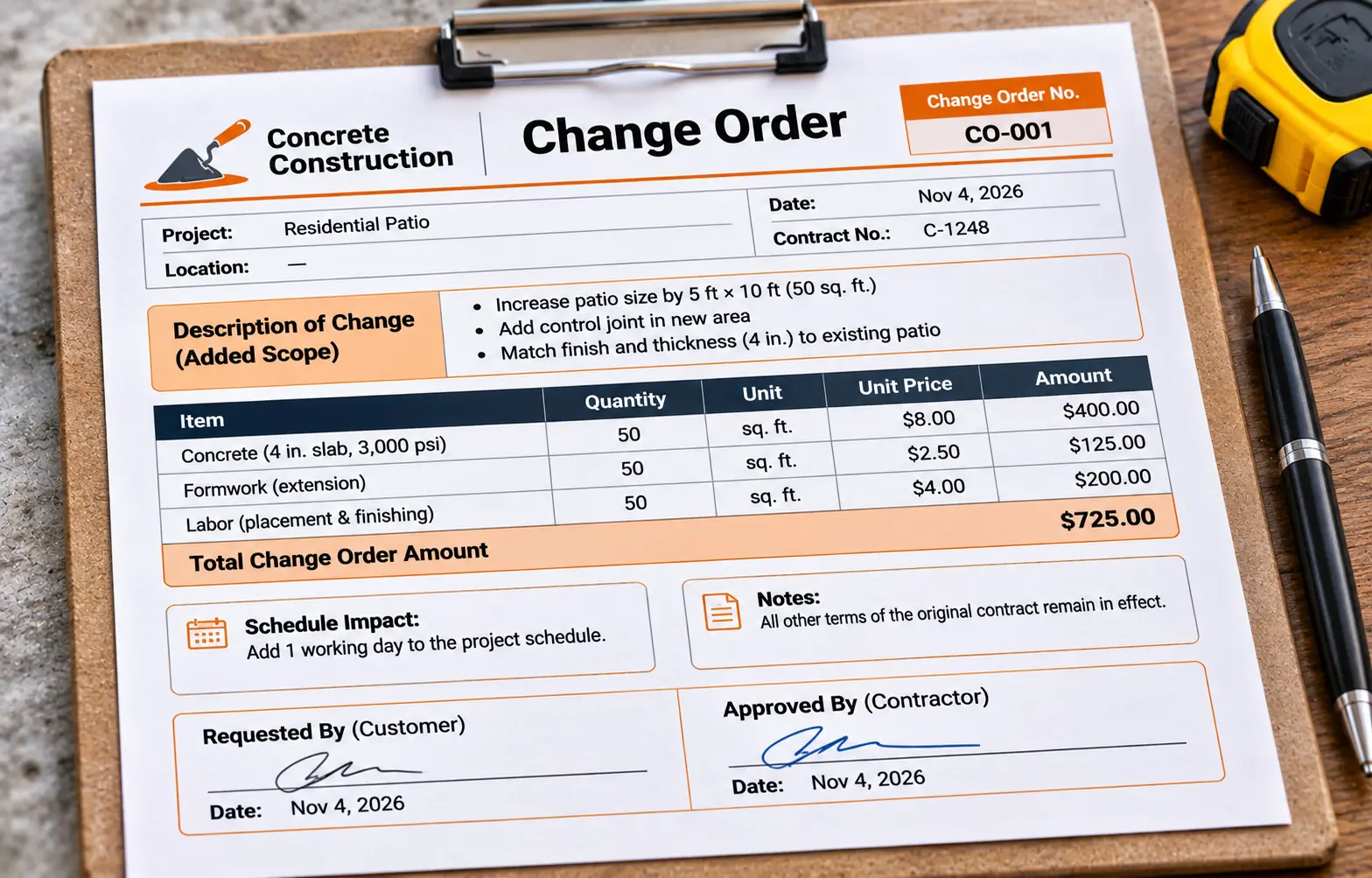
A change-order clause says that changes to the work will be documented before they are performed. A good change record states the changed work, the price effect, the schedule effect and who approved it.
Federal highway rules for engineering contracts offer a useful model: a modification is needed when a change affects cost, scope, complexity, duration or conditions, and it must clearly document the change and the method of adjusting payment (23 CFR 172.9).
That rule does not govern private residential jobs, so use it only as a documentation practice.
AIA notes that change orders are among the most contentious parts of a project, and that once a change order is signed, its amount is the only cost for that work (AIA). Write the process down before anyone needs it.
| Field | Example |
|---|---|
| Change order number | CO-002 |
| Date | [date] |
| Requested by | Owner, contractor or designer |
| Description | Extend patio by 120 ft² |
| Added quantity | 120 ft² |
| Price change | +$___ |
| Time change | +___ days |
| Approved by | Owner and contractor |
| Approval date | [date] |
Changes should be documented before they become disputes over scope, price or schedule.
How to Write Price-Escalation or Material-Availability Language
The simplest approach is a firm price during a stated validity window, with repricing after it expires. Use a formal escalation clause only where it is legal and appropriate for the contract.
- Concrete price changes after the estimate expires
- Steel price increases
- Supplier surcharges
- Fuel charges
FHWA notes that cement, steel and fuel price volatility is a real estimating risk, and its guidelines say escalation clauses should be considered because they can change the estimate considerably (FHWA).
Keep the language short and specific, and check with a local attorney or trade association before using an escalation clause.
Acceptance, Signature and Next Steps
End the estimate with a clear acceptance line and tell the customer what happens next. A signed acceptance shows the customer reviewed the scope and price.
- Customer acceptance, signature and date
- Contractor signature, where used
- Deposit and a request to schedule, if applicable
- A final contract, if the estimate is not itself the contract
Do not assume an electronic signature or any particular estimate format has the same legal effect in every state. If you are unsure, have a local attorney review your template once.
Example: fictional customer-facing estimate
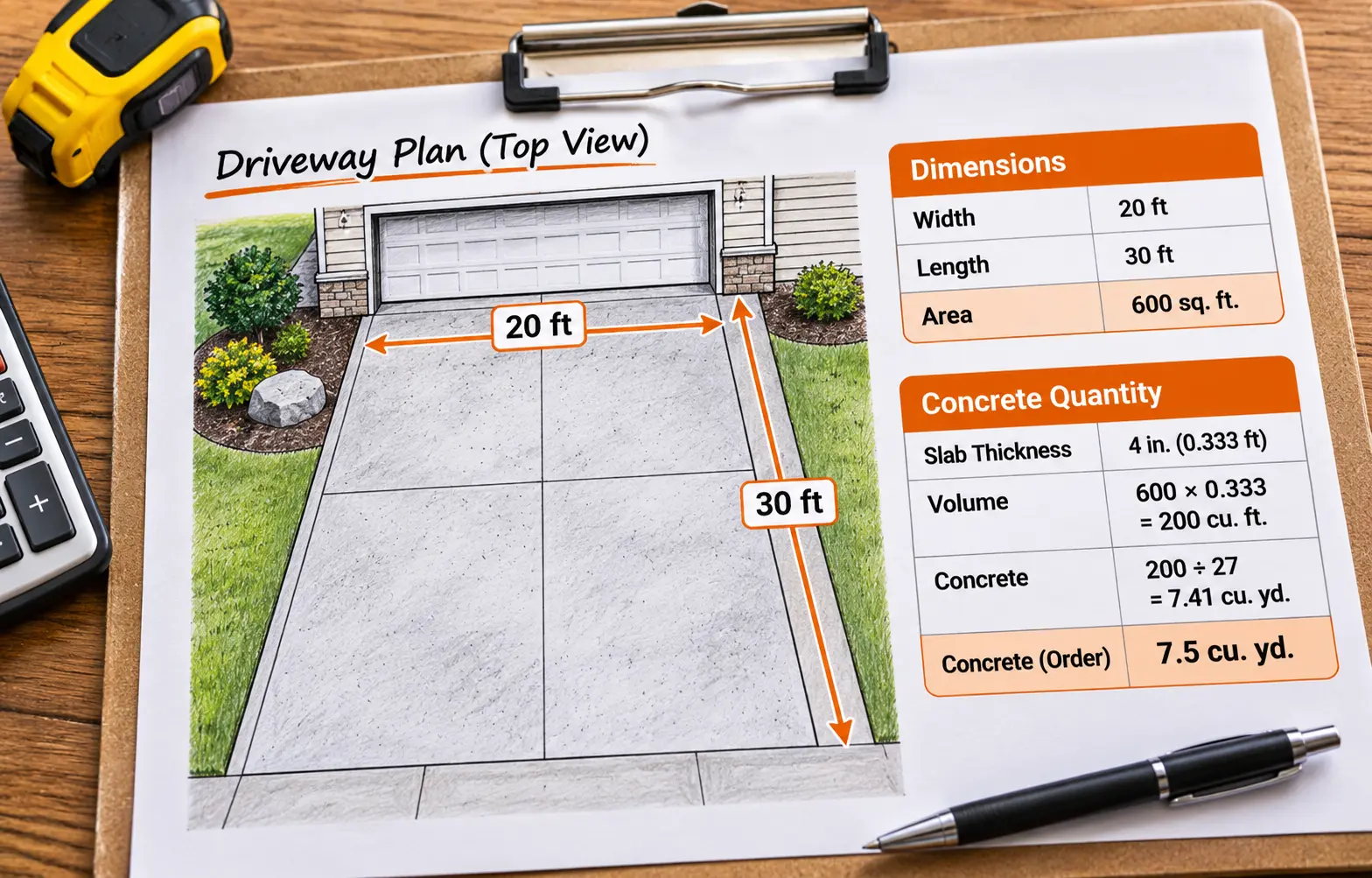
This sample shows how the parts fit together for a 20 ft × 30 ft driveway replacement. All names, dates and prices are placeholders to fill in with your own numbers.
Customer: [Name], [jobsite address]
Basis of estimate
Site visit on [date]. Dimensions measured on site: 20 ft × 30 ft (600 ft²).
Scope and pricing
1. Remove existing concrete, assumed 4 in. thick, no reinforcement: 600 ft², $____
2. Haul-off and disposal of removed concrete: lump sum, $____
3. Compacted aggregate base, assumed 3 in. thick: 5.6 yd³, $____
4. Edge forms: 100 LF, $____
5. Reinforcement as described in the scope notes: 600 ft², $____
6. Concrete slab, 5 in. thick, [strength] psi, air-entrained if required: 600 ft², $____
7. Broom finish and control joints: 600 ft², $____
8. Curing and cleanup: lump sum, $____
Total: $____. Option A, decorative sealer allowance (material and labor, tax included): $____
Assumptions
Normal excavatable soil, marked utilities, truck access, normal working hours.
Exclusions
Permits, utility relocation, rock or unsuitable fill, landscaping beyond the work limits, drainage correction not shown.
Schedule, payment and changes
Estimated start window [dates], about [__] working days, weather permitting. Payment per the milestone schedule. Changes require a written change order before the work is done.
Acceptance
Customer signature ____________ Date ______
The 5.6 yd³ of base is 600 ft² × 0.25 ft ÷ 27, an assumption of 3 in. of compacted base. Replace it with the depth your plan or site conditions call for.
Before the estimate goes out, run through the quality-control checklist in Table 6.
| Check | Complete? |
|---|---|
| Customer and project correctly identified | ☐ |
| Current plan or site basis listed | ☐ |
| Scope measurable and complete | ☐ |
| Thickness, finish and reinforcement stated | ☐ |
| Demolition defined | ☐ |
| Base and subgrade defined | ☐ |
| Quantities checked | ☐ |
| Pricing checked | ☐ |
| Allowances clearly labeled | ☐ |
| Assumptions listed | ☐ |
| Exclusions listed | ☐ |
| Schedule conditions stated | ☐ |
| Payment terms included | ☐ |
| Permit and tax responsibility stated | ☐ |
| Change-order procedure included | ☐ |
| Validity period included | ☐ |
| Revision number correct | ☐ |
| Customer acceptance section present | ☐ |
| Contract and legal requirements checked locally | ☐ |
Professional Concrete Estimate FAQs
What should be included in a concrete estimate?
Include contractor and customer details, the jobsite address, an estimate number and date, the basis of the estimate, a clear scope, quantities and pricing, assumptions, exclusions, schedule conditions, payment terms, a change-order procedure, a validity period and an acceptance line. Together they define the work and the price.
Should I show unit prices?
It depends on the job. Lump sums are simple for the customer, line-item prices help track scope, and unit prices help if quantities may change. Quantity times unit price gives the most traceability. You do not have to reveal labor or margin, but keep the scope measurable.
Is an estimate legally binding?
It depends on the wording, the signatures and your state’s law. An estimate is usually a projected price, while a signed quote or contract can bind both sides. Licensing and home-improvement contract rules vary, so have a local attorney review your template.
What is the difference between a quote and an estimate?
An estimate is a projected price based on stated scope and assumptions and may change if conditions change. A quote is usually a more definite offer with a defined scope, price and validity. Company habits differ, so define the terms you use on the document itself.
Should I include exclusions?
Yes. Listing what is not included prevents misunderstandings and supports a fair price. Keep exclusions specific to the job, such as rock, utility relocation or permits, and avoid blanket boilerplate that tries to avoid ordinary responsibility. If a limitation is hard to word, ask a local attorney or trade association for guidance.
How long should a concrete estimate be valid?
There is no single period. Set it by how long your supplier and subcontractor prices hold, how fast material costs move and your schedule. State a clear expiration date, and reprice after it passes if concrete, steel, fuel or hauling costs have changed.
Should I collect a deposit?
Many contractors do, but deposit rules vary by state and sometimes limit the amount. Check your state and local contractor and consumer-protection laws before setting terms, and state any deposit and payment milestones clearly on the estimate or contract. Avoid copying a percentage from another state.
How do I handle extra work?
Use a written change order before doing the work. Describe the change, the added or deleted quantity, the price effect, the schedule effect and who approved it. Do not assume extra work is authorized without approval, except in emergencies or where your contract says otherwise.
What is an allowance?
An allowance is a stated amount for an item that is not fully selected or defined at the time of the estimate, such as a decorative sealer. Label it clearly and say what it covers, whether tax or markup is included, and how any difference will be settled.
Should overhead and profit be shown separately?
Not necessarily. Many contractors build overhead and profit into the line prices or the total, and show the customer only the scope and price. You can show them separately if you prefer, or if a contract or procurement rule requires it.
Should taxes be included?
State clearly whether sales or use tax is included, who pays it and how it is calculated. Tax rules vary by state and by the type of work, so confirm how they apply to your jobs, and avoid leaving the question open on the estimate.
Can I revise an estimate after the customer changes scope?
Yes. Issue a new revision with a new number or revision level, update the scope, quantities and price, and restate the validity period. Keep earlier versions on file so you can show exactly what each version covered and what the customer approved.
Conclusion
A professional concrete estimate defines the proposed work, the basis of the price, what is included, what is excluded and how changes will be handled. Build the numbers first, then present them in a document the customer can follow.
Price the job, then turn the approved number into a clear written estimate.
Open the Contractor Bid Calculator