Ready Mix Concrete Prices 2026: Cost Per Yard by State and PSI
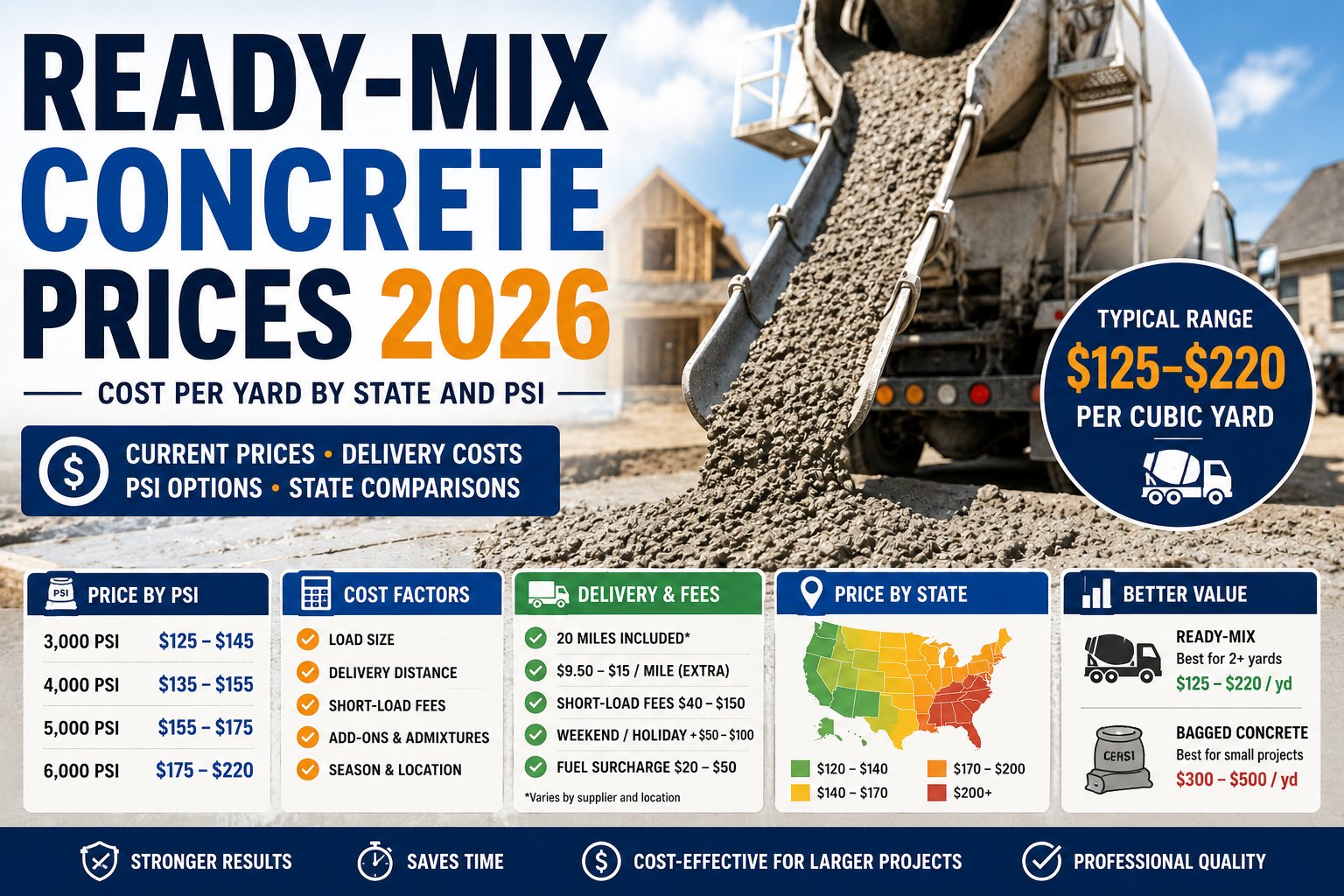
Ready-mix concrete costs $125 to $175 per cubic yard for standard residential mixes in 2026, but what you actually pay depends on where you live, how much you order, what PSI you need, and how far the truck has to travel. This guide breaks down current prices by state, strength grade, and project type – plus every fee that suppliers add that most price guides leave out.
2026 National Average Prices
The national average for ready-mix concrete in 2026 sits at approximately $140 to $180 per cubic yard for a standard 3,000-4,000 PSI mix delivered within 20 miles of the plant. A full 10-yard truckload runs $1,200 to $1,800 before add-on fees. These figures are for the concrete itself plus standard delivery – they do not include labor, finishing, reinforcement, or pumping.
Standard Mix (3,000 PSI)
Patios, walkways, general residential slabs
Structural Mix (4,000 PSI)
Driveways, garage floors, foundations
High Strength (5,000+ PSI)
Commercial slabs, columns, post-tensioned work
Full Truckload (10 yds)
Best price per yard – minimize fees
Prices in 2026 are running slightly higher than 2024-2025 levels due to higher diesel fuel costs, increased cement production costs, and continued demand from infrastructure spending. Urban markets in California, New York, and the Pacific Northwest are seeing the biggest increases.
Before you call a supplier, use the Concrete Volume Calculator or the Concrete Cubic Yard Calculator to get your exact yardage. Knowing your number before you call prevents over-ordering and avoids short-load fees on small jobs.
Price by PSI and Concrete Strength
PSI (pounds per square inch) is the compressive strength rating of concrete at 28 days. Higher PSI requires a lower water-cement ratio, which means more cement per yard and a higher price. The jump from 3,000 PSI to 4,000 PSI typically adds $10-$20 per cubic yard. From 4,000 PSI to 5,000 PSI adds another $15-$30 per yard.
| Concrete Strength | Price Per Cubic Yard | Best For | Water-Cement Ratio |
|---|---|---|---|
| 2,500 PSI | $115 – $140 | Light-duty slabs, blinding concrete | 0.67 |
| 3,000 PSI | $125 – $150 | Patios, walkways, residential footings | 0.58 |
| 3,500 PSI | $130 – $160 | Garage floors, basement slabs | 0.53 |
| 4,000 PSI | $140 – $170 | Driveways, foundations, freeze-thaw areas | 0.44 |
| 4,500 PSI | $150 – $180 | Heavy-duty commercial slabs, columns | 0.38 |
| 5,000 PSI | $160 – $200 | Structural beams, post-tensioned slabs | 0.33 |
| 6,000+ PSI | $180 – $225+ | High-rise columns, precast elements | Below 0.30 |
For most residential work – driveways, patios, and slabs – the practical choice is between 3,000 PSI and 4,000 PSI. In northern states with freeze-thaw cycles, ACI 318 recommends 4,000 PSI minimum for exposed slabs. In mild climates like Texas and the Southeast, 3,000 PSI is acceptable for most residential applications. Read the full Concrete PSI Guide for a deeper breakdown of which strength to use on each application type.
Specialty mixes add further to the base price:
- Fiber-reinforced concrete: $150 to $200 per yard – polypropylene or steel fibers added to the mix reduce cracking
- Stamped concrete mix: $160 to $210 per yard – often a 4,000 PSI base mix with color pigment added
- Self-consolidating concrete (SCC): $175 to $240 per yard – high-flow mix for tight rebar spacing
- Lightweight concrete: $180 to $250 per yard – uses lightweight aggregate; reduces structural dead load
- Air-entrained concrete: $5 to $15 per yard premium over base price; required for freeze-thaw exposure per ACI 318
Use the Concrete PSI Strength Calculator to verify your required strength before ordering, and the Concrete Mix Ratio Calculator to confirm your cement, water, and aggregate proportions.
Ready-Mix Prices by State
Ready-mix concrete prices vary significantly across the US. The biggest drivers are local labor costs, distance from cement plants, aggregate availability, and fuel costs. Western and Northeast markets are consistently the most expensive. The Midwest and Southeast tend to be the cheapest.
| State / Region | Average Price Per Yard | Major Metro Range | vs. National Average |
|---|---|---|---|
| California | $195 – $215 | LA: $195-$245, SF Bay Area: $205-$250 | +30% |
| New York | $185 – $210 | NYC: $210-$270, Upstate: $155-$185 | +25% |
| New Jersey | $185 – $200 | $188 – $220 | +20% |
| Florida | $165 – $185 | Miami: $185-$210, Orlando: $160-$180 | +10% |
| Texas | $135 – $165 | Dallas/Houston: $135-$160, Austin: $145-$170 | +5% |
| Georgia | $135 – $160 | Atlanta: $140-$165, Rural: $125-$145 | 0% |
| Ohio | $130 – $155 | Columbus: $135-$160, Cleveland: $140-$165 | -5% |
| Arizona | $145 – $170 | Phoenix: $145-$170, Tucson: $140-$165 | +5% |
| Illinois | $150 – $185 | Chicago: $165-$210, Downstate: $140-$165 | +10% |
| Midwest (general) | $125 – $155 | Indiana, Iowa, Missouri, Kansas | -5% to -10% |
| Southeast (general) | $130 – $160 | Alabama, Mississippi, Tennessee, Carolinas | 0% to -5% |
| Pacific Northwest | $165 – $200 | Seattle: $180-$210, Portland: $165-$195 | +15% to +25% |
The site has dedicated cost calculators for the highest-volume states. If your project is in one of these states, use the specific calculator for the most accurate local pricing:
- Texas Concrete Cost Calculator
- California Concrete Cost Calculator
- Florida Concrete Cost Calculator
- New York Concrete Cost Calculator
- Ohio Concrete Cost Calculator
- Georgia Concrete Cost Calculator
- Arizona Concrete Cost Calculator
Extra Fees That Affect Your Total
The per-yard price is only part of what you pay. Ready-mix suppliers charge several additional fees that can add 20-50% to a small order. Know these before you call for a quote.
Short-Load Fee
This is the biggest surprise fee for homeowners. If you order less than a full truckload – typically under 8-10 cubic yards depending on the supplier – you pay a short-load surcharge of $40 to $150 per order. Some suppliers charge it as a flat fee; others charge per yard on the missing volume. For a 3-yard order, a short-load fee can increase your effective cost per yard by $15-$50. If your project is under 1 cubic yard, strongly consider using bagged concrete instead.
Delivery Distance Fee
Most suppliers include delivery within 20 miles of their plant in the base price. Beyond that, expect to pay $9.50 to $15 per additional mile. If you’re 30 miles from the plant, that’s an extra $95 to $150 on top of your order. Always confirm your supplier’s included delivery radius before comparing quotes.
Weekend and Holiday Delivery
Saturday delivery adds $50 to $100 to a typical order. Sunday and holiday delivery costs even more – some suppliers simply don’t offer it. If you can schedule a Monday-Friday pour, you’ll save money. If you must pour on a weekend, call your supplier at least a week in advance to confirm availability.
Fuel Surcharge
Most suppliers add a fuel surcharge that fluctuates monthly with diesel prices. In 2026, this runs $20 to $50 per load. It applies to every order regardless of size, so it hits small orders proportionally harder than large ones.
Overtime and Wait Time Charges
If you keep the truck on site longer than the allotted time (usually 7-10 minutes per yard of concrete), suppliers charge a wait-time or demurrage fee of $1 to $3 per minute. This adds up fast if your pour runs slow. Have your crew, forms, and equipment completely ready before the truck arrives.
Pump Truck
If the truck can’t back up to the pour location – common for backyard patios, pool decks, or pours with limited access – you’ll need a concrete pump. Pump truck rental adds $300 to $800 per day for a standard boom pump. Line pumps for smaller jobs run $150 to $300. Use the Concrete Pumping Cost Calculator to estimate this separately.
| Fee Type | Typical Amount | When It Applies |
|---|---|---|
| Short-load fee | $40 – $150 per order | Orders under 8-10 cubic yards |
| Delivery distance | $9.50 – $15 per mile | Beyond the supplier’s free delivery radius |
| Weekend delivery | $50 – $100 per order | Saturday and Sunday pours |
| Fuel surcharge | $20 – $50 per load | Almost all orders in 2026 |
| Wait time / demurrage | $1 – $3 per minute | After the allotted unloading time |
| Pump truck | $150 – $800 per day | When truck can’t reach the pour site |
| Color pigment | $15 – $30 per yard | Colored or stamped concrete mixes |
| Admixture (plasticizer) | $5 – $20 per yard | When workability needs to be increased without water |
Full Project Cost Estimates
Material cost is one part of your total project budget. For a complete picture, you also need to factor in labor, forming, reinforcement, and finishing. The table below gives real-world total installed costs for common residential projects using 2026 pricing. These are material-plus-labor estimates for a professional pour, not DIY.
| Project | Typical Size | Concrete Needed | Material Cost | Total Installed Cost |
|---|---|---|---|---|
| Concrete patio | 12×16 ft, 4 in thick | ~2.4 yards | $350 – $450 | $1,200 – $2,400 |
| Driveway (2-car) | 20×22 ft, 5 in thick | ~6.7 yards | $900 – $1,200 | $3,000 – $6,000 |
| Garage floor | 20×22 ft, 4 in thick | ~5.4 yards | $750 – $950 | $2,500 – $5,000 |
| Concrete sidewalk | 4×50 ft, 4 in thick | ~2.5 yards | $350 – $450 | $900 – $2,000 |
| Stamped patio | 20×20 ft, 4 in thick | ~5 yards | $900 – $1,200 | $4,000 – $9,000 |
| Full basement floor | 30×40 ft, 4 in thick | ~15 yards | $2,100 – $2,700 | $5,000 – $10,000 |
| Foundation (perimeter) | 1,500 sq ft house | ~18-25 yards | $2,500 – $4,000 | $8,000 – $20,000+ |
For project-specific cost estimates, use the calculators below. Each one is built for the project type and uses current US pricing:
- Concrete Patio Cost Calculator
- Concrete Driveway Cost Calculator
- Concrete Garage Floor Cost Calculator
- Concrete Sidewalk Cost Calculator
- Stamped Concrete Cost Calculator
- Concrete Foundation Cost Calculator
- Concrete Slab Cost Calculator
Example: Pricing a 20×22 Driveway in Dallas, TX (2026)
Dimensions: 20 ft x 22 ft x 5 inches thick = 6.7 cubic yards
Concrete (4,000 PSI at $145/yard): $972
Delivery (within 15 miles, included): $0
Fuel surcharge: $30
Short-load fee (under 10 yards): $75
Total material cost: ~$1,077
Labor and finishing (contractor): $1,800 – $2,400
Rebar (4 rebar grid at $0.65/linear ft): ~$200
Total project estimate: $3,000 – $3,700
Ready-Mix vs. Bagged Concrete
The right choice depends entirely on project size. Ready-mix is cheaper for large pours; bagged concrete makes sense for small patch jobs and projects under about 0.5 cubic yards.
| Factor | Ready-Mix | Bagged Concrete |
|---|---|---|
| Cost per cubic yard | $125 – $175 delivered | $300 – $500 (bags + labor) |
| Best project size | 1 cubic yard and up | Under 0.5 cubic yard |
| Minimum order | Usually 1 yard minimum; full truck preferred | No minimum – buy exactly what you need |
| Consistency | Plant-mixed, very consistent | Varies with mixing technique |
| Pour speed | Fast – one truck, one pour | Slow – batch by batch |
| Equipment needed | Truck access to site | Mixer rental or hand mixing |
| Cold joint risk | Low – full pour in one shot | High – batching causes cold joints on large pours |
Bagged concrete from Quikrete, Sakrete, or similar brands costs $6 to $10 per 80 lb bag at Home Depot, Lowe’s, or Menards. One 80 lb bag covers about 0.60 cubic feet. You need 45 bags to make one cubic yard – which works out to $270 to $450 per yard before labor and mixer rental, versus $125 to $175 delivered for ready-mix. For anything over 20 bags, ready-mix wins on cost every time.
Read the full comparison at Ready-Mix vs. Bagged Concrete. To calculate how many bags your project needs, use the Concrete Bag Calculator or brand-specific calculators for Quikrete, Sakrete, Home Depot, and Menards.
What Drives Concrete Prices Up or Down
Ready-mix concrete prices are not fixed. Several factors push them up or down between suppliers, seasons, and regions.
Cement Cost
Cement is the most expensive ingredient in concrete and the biggest driver of mix price. In 2026, US cement prices have risen modestly due to energy costs at cement kilns and ongoing infrastructure demand from the IIJA (Infrastructure Investment and Jobs Act) projects. Cement accounts for roughly 40-60% of the raw material cost in a standard mix.
Fuel and Transportation
Ready-mix trucks run on diesel. When diesel prices spike, suppliers pass the cost on through fuel surcharges. In high-fuel-cost years, this can add $30-$80 per load. Projects far from a batching plant always pay a distance premium on top of base fuel costs.
Aggregate Availability
Sand, gravel, and crushed stone make up 60-75% of concrete by weight. Areas with abundant local aggregate – Texas, the Midwest, the Southeast – have lower base concrete prices. Coastal markets and areas where aggregate must be transported long distances pay more.
Seasonal Demand
Spring and early summer are peak concrete season across most of the US. Prices and lead times increase from April through July when every contractor is trying to pour. You can often negotiate better pricing for late fall or winter pours in mild-climate states, though cold-weather requirements (heated water, insulated blankets) add their own costs in the North.
Order Volume
Larger orders get lower per-yard prices. If you have multiple jobs lined up or can combine a driveway and a patio pour into one truck, you’ll pay less per yard and avoid additional short-load and delivery fees. Contractors with open accounts also get $5-$20 per yard off retail pricing at most plants.
Get Your Quantities Right Before You Call a Supplier
Ordering too much or too little both cost money. Use these calculators to nail your quantities before you call:
- Concrete Slab Calculator – Slabs, patios, floors
- Concrete Driveway Calculator – Any driveway shape or thickness
- Concrete Foundation Calculator – Full perimeter foundations
- Concrete Footing Calculator – Strip and pad footings
- Ready-Mix Truck Calculator – How many loads you need
- Concrete Yards to Bags Calculator – If bags are the better option
- Concrete Price Per Yard Calculator – Estimate your total material cost
How to Order Ready-Mix Concrete
Getting a good price and a smooth delivery takes a little preparation. Follow these steps for a clean order.
- Calculate your volume first. Use the appropriate calculator for your project type. Add 10% to your calculated volume for waste and uneven subgrade. Always round up to the nearest quarter yard when ordering.
- Decide on PSI. Check your local building code, project specs, or the Concrete PSI Guide for the minimum strength required. Ordering the right PSI from the start saves you from paying for mix design changes later.
- Get at least three quotes. Call three local ready-mix suppliers and ask for an itemized price – concrete per yard, delivery fee, fuel surcharge, and short-load fee if applicable. Plants within 10-15 miles of your project are usually the best option for price and scheduling.
- Confirm lead time. During peak season (April-July), some plants book out 2-3 days in advance. Call at least 48-72 hours before your pour date. Confirm the truck arrival window and make sure your crew, forms, and equipment are ready before the truck pulls in.
- Check access. Tell the supplier exactly where the truck will need to drive. Ready-mix trucks weigh 40,000+ pounds fully loaded. They need a firm, level surface with no overhead obstructions and at least 12 feet of clearance. If truck access is limited, ask about pump truck options or volumetric mixer service.
- Have a backup plan. If the pour goes over your estimated volume, you need to reorder quickly. Know your supplier’s minimum re-order size and what the turnaround time for a second truck would be. Running short mid-pour creates a cold joint that weakens the finished slab.
Ways to Lower Your Concrete Cost
You can’t negotiate the base price per yard much, but you can significantly cut total project cost by reducing fees and optimizing your order.
- Order a full truckload. If your project is 7-8 yards, round up to 10 yards to avoid the short-load fee. The extra concrete can go toward a small path, a pad, or a step repair. This often costs less total than paying the short-load surcharge.
- Pour on a weekday. Skip Saturday delivery fees by scheduling Monday through Friday. This alone saves $50-$100.
- Pick up the concrete yourself. Some plants allow contractors to pick up concrete in a personal concrete mixer trailer. This eliminates the delivery fee entirely but requires the right equipment and a driver familiar with handling fresh concrete.
- Choose the right PSI – not the highest. A residential patio in Georgia does not need 5,000 PSI concrete. Ordering the correct strength for your application – not the next tier up – saves $15-$40 per yard with no performance downside. Use the Concrete PSI Guide to pick the right strength.
- Combine pours. If you need a driveway and a patio poured in the same season, schedule them the same day. One delivery fee instead of two, and a single short-load charge instead of two.
- Improve site access. Every minute the truck sits waiting costs money. Clear the path to the pour site, remove gates or fences if needed, and have your crew in position before the truck arrives to avoid demurrage charges.
- Use the Concrete Delivery Cost Calculator to estimate total delivered cost including all fees before you call for quotes.