Wood Screw Size Chart – #0 to #24 Diameter, Length & Heads
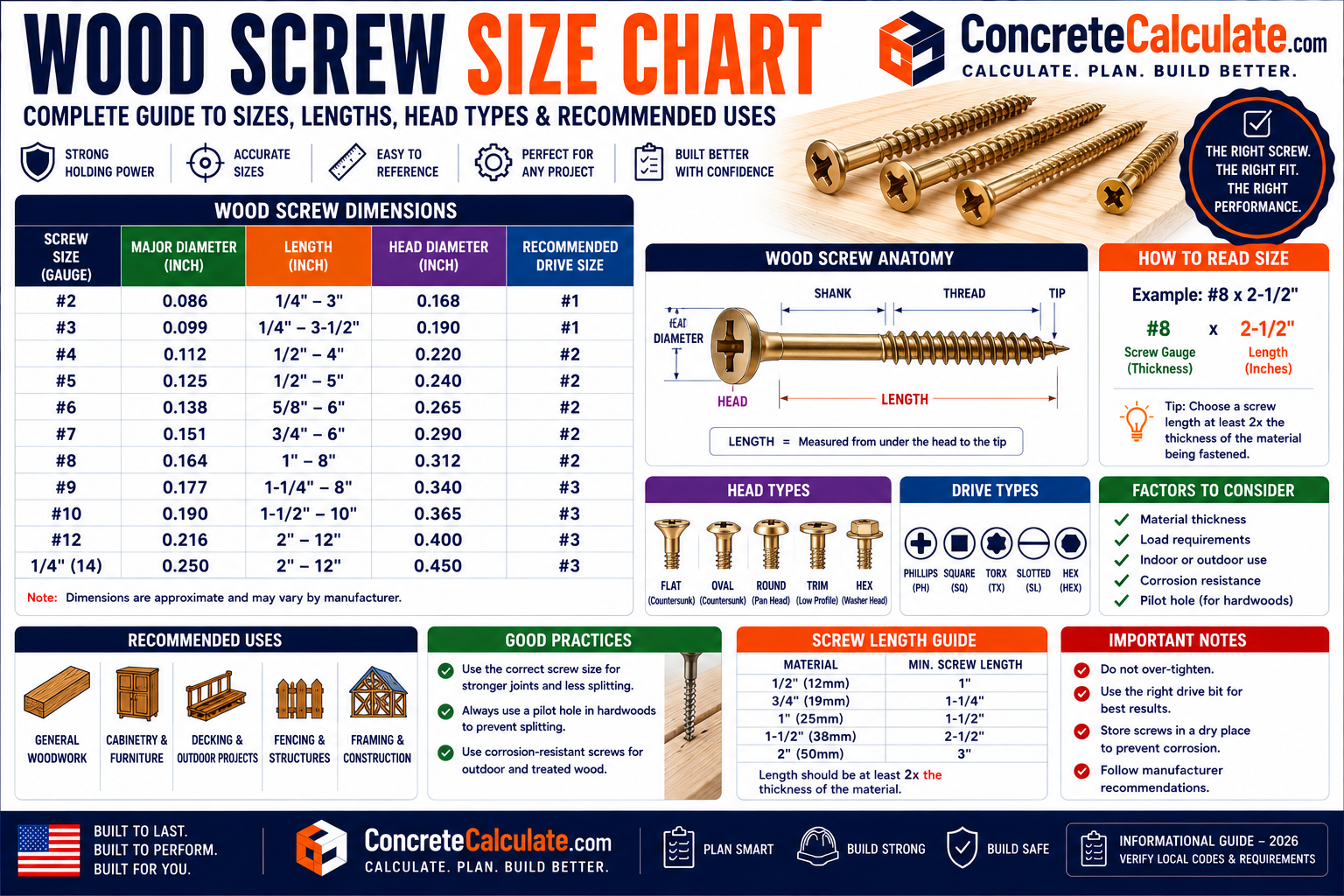
Wood Screw Size Chart
#0 to #24 Diameter, Length & Heads
Traditional wood screw dimensions, head types, drives, materials, length measurement and pilot-hole guidance, anchored to ASME B18.6.1 inch-series wood screw geometry.
 Reviewed by Muhammad Ramzan Babar, PhD Researcher & Calculator Developer · View Profile
Traditional ASME wood screws are organized around numbered sizes and wood-engaging thread/body dimensions, not as an interchangeable UNC/UNF machine-thread system. Modern commercial wood screws can also use proprietary or application-specific thread and drive designs, so standard dimensions should be distinguished from individual product availability and performance data.
⭐⭐⭐ Wood Screw Size Chart: Quick Reference
Basic nominal thread diameter and common length/application context. Head style, drive, material and availability remain product-specific.
| Wood Screw Size | Basic Thread Diameter | Approx. Decimal Diameter | Common Lengths | Common Head Types | Common Drives |
|---|---|---|---|---|---|
| #0 | 0.060″ | 0.060″ | 1/4″–1/2″ | Flat, oval, pan | Slotted, Phillips |
| #1 | 0.073″ | 0.073″ | 1/4″–3/4″ | Flat, oval, pan | Slotted, Phillips |
| #2 | 0.086″ | 0.086″ | 1/4″–1″ | Flat, oval, pan | Slotted, Phillips |
| #3 | 0.099″ | 0.099″ | 3/8″–1″ | Flat, oval, pan | Slotted, Phillips |
| #4 | 0.112″ | 0.112″ | 3/8″–1-1/2″ | Flat, oval, pan | Slotted, Phillips |
| #5 | 0.125″ | 0.125″ | 1/2″–1-1/2″ | Flat, oval, pan | Slotted, Phillips |
| #6 | 0.138″ | 0.138″ | 1/2″–2″ | Flat, pan, round | Phillips, square |
| #7 | 0.151″ | 0.151″ | 1/2″–3″ | Flat, pan, oval | Phillips, square |
| #8 | 0.164″ | 0.164″ | 1/2″–3″ | Flat, pan, oval | Phillips, square, star |
| #9 | 0.177″ | 0.177″ | 3/4″–3″ | Flat, pan, oval | Phillips, square |
| #10 | 0.190″ | 0.190″ | 3/4″–4″ | Flat, pan, oval | Phillips, square, star |
| #12 | 0.216″ | 0.216″ | 1″–4″ | Flat, pan, hex | Phillips, square, star |
| #14 | 0.242″ | 0.242″ | 1″–5″ | Flat, pan, hex | Phillips, square, star |
| #16 | 0.268″ | 0.268″ | 1-1/2″–6″ | Flat, hex | Manufacturer-specific |
| #18 | 0.294″ | 0.294″ | 1-1/2″–6″ | Heavy-duty styles | Manufacturer-specific |
| #20 | 0.320″ | 0.320″ | 2″–8″ | Heavy-duty styles | Manufacturer-specific |
| #24 | 0.372″ | 0.372″ | 2″–8″ | Heavy-duty styles | Manufacturer-specific |
ASME B18.6.1 dimensional inclusion does not mean every size, head type, length or drive is a current stock production item. Consult manufacturers and suppliers for actual availability, coatings, material options and application-specific products.
⭐⭐⭐ What Is a Wood Screw?
A wood screw is a pointed fastener designed to penetrate and engage wood fibers.
Thread design
Traditional wood screw thread geometry is designed to grip wood fibers, generally with a sharp point and deeper, wider-spaced thread profile than machine threads.
Shank/body
Wood screws may have a body/shank portion and threaded portion; the standardized thread and body dimensions are distinct under ASME B18.6.1.
Typical applications
Furniture, cabinetry, woodworking, trim, hardware installation, general construction and exterior use when correct material/coating is selected.
Modern product designs
Modern “wood screws” also include proprietary construction, cabinet and deck screw designs beyond traditional ASME inch-series geometry, with product-specific threads, coatings and drives.
⭐⭐⭐ What Does Wood Screw Size Mean?
Wood screw selection combines number size, length, head, drive, material, coating and application.
| Example | Part | Meaning |
|---|---|---|
| #8 × 1-1/2″ Phillips wood screw | #8 | Nominal numbered wood screw size, 0.164″ basic thread diameter |
| 1-1/2″ | Nominal screw length, measured according to head style | |
| Phillips | Drive/recess type | |
| Wood screw | Wood-engaging thread/point design | |
| Material/finish | Must be specified separately, such as zinc-plated steel or stainless |
The number sign identifies a standardized numbered wood screw size. #8 means approximately 0.164 inch basic thread diameter, not a direct fraction or metric dimension.
⭐⭐⭐ Wood Screw Number Sizes
Traditional ASME B18.6.1 wood screw sizes extend from #0 through #24.
| Size | Basic Thread Diameter (in) | Approx. Diameter (mm) | Traditional TPI (±10%) |
|---|---|---|---|
| #0 | 0.060 | 1.52 | 32 |
| #1 | 0.073 | 1.85 | 28 |
| #2 | 0.086 | 2.18 | 26 |
| #3 | 0.099 | 2.51 | 24 |
| #4 | 0.112 | 2.84 | 22 |
| #5 | 0.125 | 3.18 | 20 |
| #6 | 0.138 | 3.51 | 18 |
| #7 | 0.151 | 3.84 | 16 |
| #8 | 0.164 | 4.17 | 15 |
| #9 | 0.177 | 4.50 | 14 |
| #10 | 0.190 | 4.83 | 13 |
| #12 | 0.216 | 5.49 | 11 |
| #14 | 0.242 | 6.15 | 10 |
| #16 | 0.268 | 6.81 | 9 |
| #18 | 0.294 | 7.47 | 8 |
| #20 | 0.320 | 8.13 | 8 |
| #24 | 0.372 | 9.45 | 7 |
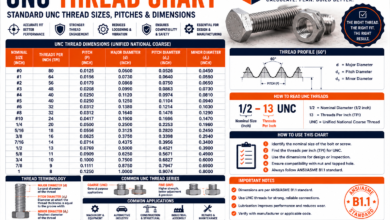
The TPI shown here describes ASME B18.6.1 traditional wood screw thread geometry and is not an instruction to mate these screws with UNC/UNF machine screw nuts or tapped holes. Wood screws are designed to engage wood fibers, not standardized machine-threaded nuts.
⭐⭐⭐ Wood Screw Diameter and Body Chart
ASME distinguishes thread diameter from body diameter.
| Screw Size | Basic Thread Dia. | Cut Thread Body Dia. Range | Rolled Thread Body Dia. Range |
|---|---|---|---|
| #2 | 0.086″ | 0.090″–0.079″ | 0.075″–0.064″ |
| #4 | 0.112″ | 0.116″–0.105″ | 0.095″–0.084″ |
| #6 | 0.138″ | 0.142″–0.131″ | 0.118″–0.107″ |
| #8 | 0.164″ | 0.168″–0.157″ | 0.140″–0.129″ |
| #10 | 0.190″ | 0.194″–0.183″ | 0.162″–0.151″ |
| #12 | 0.216″ | 0.220″–0.209″ | 0.184″–0.173″ |
| #14 | 0.242″ | 0.246″–0.235″ | 0.201″–0.190″ |
| #16 | 0.268″ | 0.272″–0.261″ | 0.224″–0.213″ |
Thread diameter is measured at the outer thread crests, while body diameter refers to the shank beneath the thread. Cut-thread and rolled-thread wood screws can have different body dimensions, so do not measure the head or bare shank and assume it is the basic major thread diameter.
⭐⭐⭐ Wood Screw Length Chart and Measurement
Wood screw length is measured differently depending on head style.
| Head Type | Length Measurement Method |
|---|---|
| Flat / countersunk head | Measure from top of head to tip, because head is intended to sit flush in the material |
| Oval head | Measure overall length from tip to top of the raised countersunk head |
| Pan / round head | Measure from underside of head to tip, because head sits above the material surface |
| Screw Size | 1/2″ | 3/4″ | 1″ | 1-1/4″ | 1-1/2″ | 2″ | 2-1/2″ | 3″ | 4″ |
|---|---|---|---|---|---|---|---|---|---|
| #4 | Common | Common | Common | Common | Possible | Product-specific | — | — | — |
| #6 | Common | Common | Common | Common | Common | Common | Product-specific | Product-specific | — |
| #8 | Common | Common | Common | Common | Common | Common | Common | Common | Product-specific |
| #10 | — | Common | Common | Common | Common | Common | Common | Common | Common |
| #12/#14 | — | — | Common | Common | Common | Common | Common | Common | Common |
The table shows common retail/product availability patterns, not a guaranteed ASME stock list. The standard specifically notes that inclusion of dimensions does not mean every described size/length/head combination is a stock production item; always check the selected manufacturer product.
⭐⭐⭐ Common Wood Screw Sizes: #6 Through #14
These are common retail and woodworking sizes, without implying they are the only standard sizes.
#6 Wood Screw ⭐⭐⭐
Basic thread diameter 0.138″. Common for lighter trim, small hardware, hinges and thinner materials. Common lengths about 1/2″ through 2″.
#8 Wood Screw ⭐⭐⭐
Basic thread diameter 0.164″. One of the most common general woodworking/cabinet sizes. Available in flat, pan and oval styles with Phillips, square and modern star drives depending on product.
#10 Wood Screw ⭐⭐⭐
Basic thread diameter 0.190″. Used where greater diameter and holding capacity are needed, with common lengths from about 3/4″ through 4″.
#12 Wood Screw ⭐⭐⭐
Basic thread diameter 0.216″. Heavier-duty applications, longer fastening requirements and larger hardware.
#14 Wood Screw ⭐⭐⭐
Basic thread diameter 0.242″. Larger wood screw applications, commonly selected where longer or heavier fastening is needed.
#16 and larger
Traditional standard sizes extend further through #24, though modern availability and product designation become increasingly manufacturer/application specific.
⭐⭐⭐ Wood Screw Head Types
Traditional ASME B18.6.1 tables include multiple wood screw head configurations.
Flat / countersunk head
Countersunk profile designed to sit flush with the wood surface. Head angle, countersink geometry and drive/recess matter for proper seating.
Oval head
Raised countersunk profile, providing a decorative rounded top while still seating into a countersunk hole.
Pan head
Raised rounded top and broad bearing underside, useful where the head remains visible above the surface.
Round head
Traditional rounded configurations with different dimensional and aesthetic characteristics from pan heads.
Recessed head variations
Traditional standard tables address several slotted and recessed configurations, while modern commercial drives can be manufacturer-specific.
Head diameter, head height, slot/recess dimensions, countersink geometry and bearing surface vary by selected head type. Do not assume every #8 wood screw shares the same head dimensions.
⭐⭐⭐ Wood Screw Drive Types
Traditional ASME dimensions and modern commercial drive systems should be distinguished.
Slotted
Traditional slot drive; driver blade width and depth must match the head slot to avoid damage.
Phillips ⭐⭐⭐
Common cross recess. Use the correct driver size to reduce cam-out and recess stripping; manufacturer head tables may identify driver size references.
Square / Robertson ⭐⭐⭐
Common modern construction and decking drive, offering positive engagement. Product-specific dimensions and availability are manufacturer-defined rather than a complete catalog of traditional B18.6.1 head tables.
Torx/star ⭐⭐⭐
Modern star drive common in decking and construction screws, valued for positive engagement and reduced cam-out when correct bit is used. Drive dimensions are product-specific.
Combination drives
Some commercial wood screws provide multi-drive recesses for installation convenience; verify the selected product’s required bit.
⭐⭐⭐ Wood Screw Thread Dimensions and Thread Length
Traditional wood screw thread geometry is designed around wood engagement rather than machine-threaded nut compatibility.
Thread diameter
Basic major thread diameter is measured across the outer thread crests and defines the numbered screw size.
Body diameter
Underlying shank diameter differs from the major thread diameter and may differ for cut versus rolled threads.
Thread length
Traditional wood screws may have cut or rolled threads with standard thread-length requirements. Modern commercial wood screws can be fully threaded or partially threaded based on product/application design.
Thread profile
Wood screw threads are designed to engage wood fibers and should not be treated as UNC/UNF machine threads meant to engage standardized metal nuts.
ASME-derived traditional wood screw tables state that cut-thread wood screws have thread length approximately two-thirds of nominal screw length, while rolled threads have thread length at least four times basic screw diameter or two-thirds of nominal length, whichever is greater. Modern product designs can differ, so check manufacturer data.
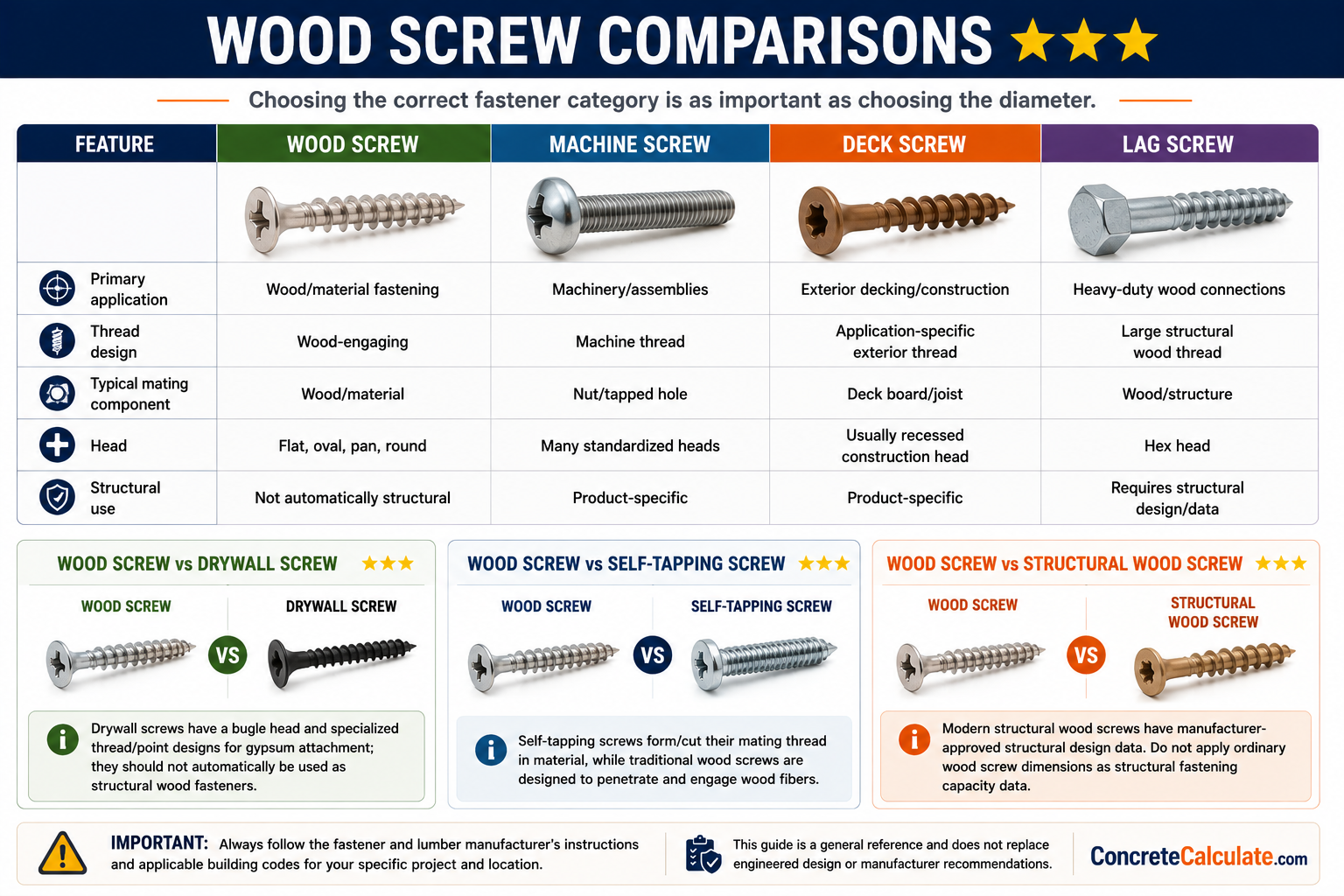
⭐⭐⭐ Wood Screw Comparisons
Choosing the correct fastener category is as important as choosing the diameter.
| Feature | Wood Screw | Machine Screw | Deck Screw | Lag Screw |
|---|---|---|---|---|
| Primary application | Wood/material fastening | Machinery/assemblies | Exterior decking/construction | Heavy-duty wood connections |
| Thread design | Wood-engaging | Machine thread | Application-specific exterior thread | Large structural wood thread |
| Typical mating component | Wood/material | Nut/tapped hole | Deck board/joist | Wood/structure |
| Head | Flat, oval, pan, round | Many standardized heads | Usually recessed construction head | Hex head |
| Structural use | Not automatically structural | Product-specific | Product-specific | Requires structural design/data |
Wood screw vs drywall screw
Drywall screws have a bugle head and specialized thread/point designs for gypsum attachment; they should not automatically be used as structural wood fasteners.
Wood screw vs self-tapping screw
Self-tapping screws form/cut their mating thread in material, while traditional wood screws are designed to penetrate and engage wood fibers.
Wood screw vs structural wood screw
Modern structural wood screws have manufacturer-approved structural design data. Do not apply ordinary wood screw dimensions as structural fastening capacity data.
⭐⭐⭐ Wood Screw Materials, Coatings and Finishes
Material and finish affect corrosion resistance, strength, appearance and suitability.
Carbon / steel screws
Plain, zinc-plated, coated and hardened steel options are common. Exterior use requires a finish/coating suited to exposure and treated lumber compatibility.
Stainless steel wood screws ⭐⭐⭐
18-8/304 and 316 stainless provide corrosion resistance for exterior and coastal applications. Stainless grade is not synonymous with screw strength; verify product specifications.
Brass wood screws
Common for decorative work, electrical applications and corrosion resistance, but softer and lower strength than many steel screw products.
Bronze and specialty materials
Used in marine, restoration or specialty applications where corrosion performance and appearance justify the material choice.
| Finish / Coating | General Use |
|---|---|
| Zinc plating | Indoor/mild exposure corrosion protection |
| Ceramic/exterior coatings | Exterior/decking applications where rated by manufacturer |
| Black oxide | Appearance and limited corrosion resistance, usually requiring oil |
| Stainless | Material-based corrosion resistance |
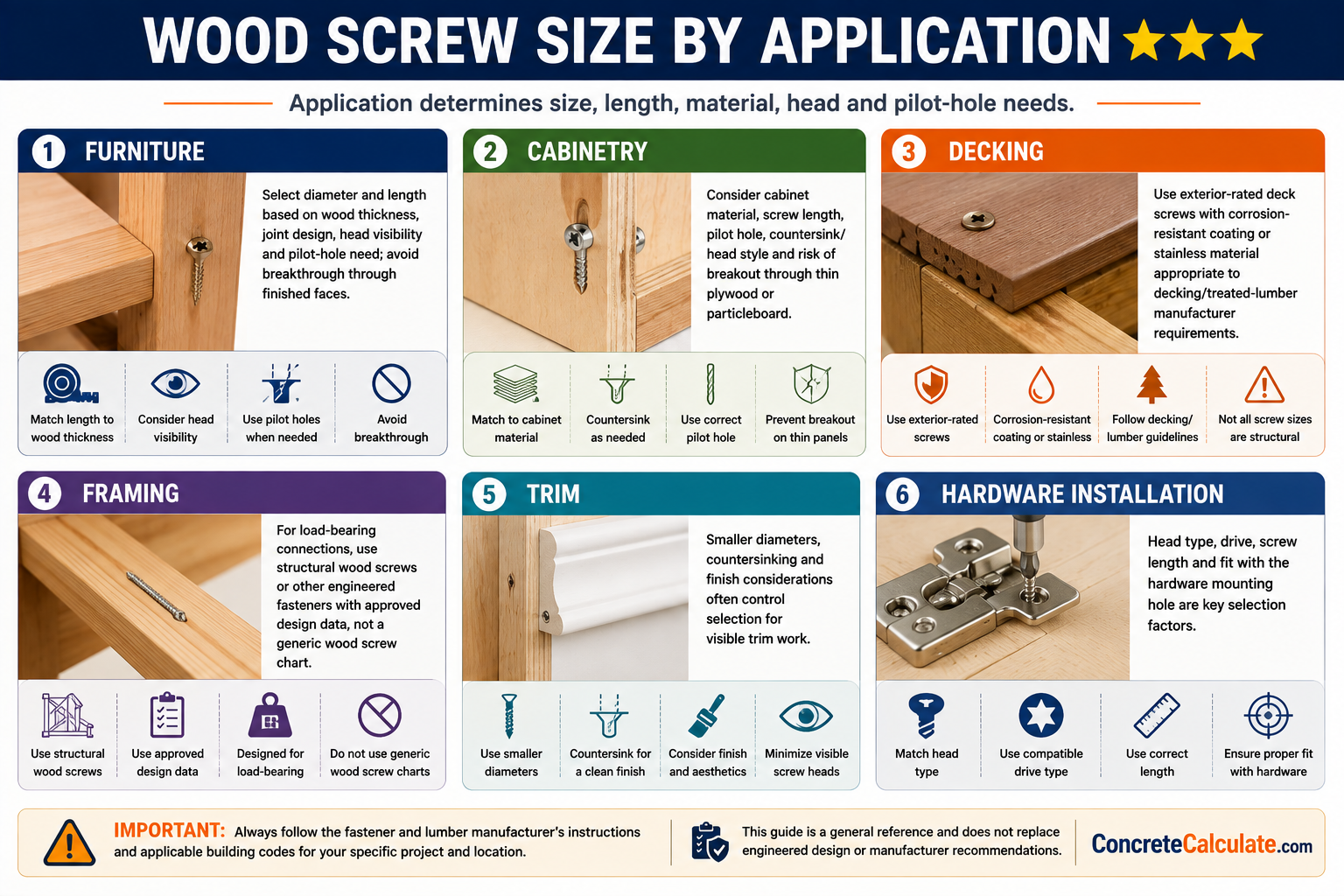
⭐⭐⭐ Wood Screw Size by Application
Application determines size, length, material, head and pilot-hole needs.
Furniture
Select diameter and length based on wood thickness, joint design, head visibility and pilot-hole need; avoid breakthrough through finished faces.
Cabinetry
Consider cabinet material, screw length, pilot hole, countersink/head style and risk of breakout through thin plywood or particleboard.
Decking
Use exterior-rated deck screws with corrosion-resistant coating or stainless material appropriate to decking/treated-lumber manufacturer requirements. Ordinary traditional wood screw dimensions do not automatically establish structural deck connection suitability.
Framing
For load-bearing connections, use structural wood screws or other engineered fasteners with approved design data, not a generic wood screw chart.
Trim
Smaller diameters, countersinking and finish considerations often control selection for visible trim work.
Hardware installation
Head type, drive, screw length and fit with the hardware mounting hole are key selection factors.
⭐⭐⭐ Wood Screw Pilot Hole vs Clearance Hole
These holes serve different functions and should not be confused.
| Hole | Function |
|---|---|
| Pilot hole | Guides screw into receiving wood and reduces splitting risk |
| Clearance hole | Allows screw body/threads to pass freely through upper material while threads engage lower material |
| Countersink | Recesses flat/countersunk screw head flush with surface |
| Counterbore | Recesses a screw head deeper below the wood surface |
Pilot-hole recommendations vary with wood species, density, screw geometry, screw length, distance from edges and application. Softwood and hardwood often require different pilot hole selection. Use manufacturer guidance and test pieces for critical finished work.
Softwood pilot holes
Often smaller relative to screw body than hardwood pilot holes, because softwood fibers compress more readily.
Hardwood pilot holes
Often larger to reduce driving torque, splitting and screw breakage in dense wood, particularly near edges or ends.
⭐⭐⭐ Wood Screw Holding Power, Withdrawal and Shear
Holding capacity depends on the complete connection, not screw size alone.
Holding power
Influenced by screw diameter, embedment, wood density, grain direction, thread geometry, pilot hole, member thickness and installation quality.
Withdrawal strength
Resistance to pulling the screw out of the wood, strongly affected by wood density, penetration depth, thread engagement and grain orientation.
Shear strength
Lateral capacity depends on fastener diameter, wood species, member thickness, connection geometry, fastener type and load direction.
Structural applications
For structural fastening, use manufacturer-approved structural screw data and the applicable design standard rather than extrapolating from a general wood screw size chart.
⭐⭐⭐ How to Identify and Measure a Wood Screw
A practical process for wood screws without packaging.
Use a caliper across external thread crests, not the head, to determine candidate numbered size.
Use the correct head-style measurement method: flat head includes head, pan/round uses under-head measurement.
Flat, oval, pan, round, hex or other configuration.
Slotted, Phillips, square, star/Torx or combination drive.
Note traditional versus modern proprietary thread pattern, full/partial thread, point and shank style.
Steel, stainless, brass or coated exterior product.
Confirm intended use, pilot hole need, corrosion exposure and structural/approved fastener requirements.
Converting # size to decimal inch or millimeters helps identify diameter, but does not make a traditional numbered wood screw thread interchangeable with a metric or machine screw thread system.
⭐⭐⭐ Wood Screw Size in Metric and Imperial Systems
Modern wood screws may be sold with metric dimensions, but dimensional conversion is not thread interchangeability.
| Imperial Wood Screw | Basic Diameter (in) | Approx. Diameter (mm) |
|---|---|---|
| #6 | 0.138 | 3.51 |
| #8 | 0.164 | 4.17 |
| #10 | 0.190 | 4.83 |
| #12 | 0.216 | 5.49 |
| #14 | 0.242 | 6.15 |
A #8 wood screw is approximately 4.17 mm in basic diameter, but it is not automatically interchangeable with a 4 mm or 4.5 mm metric wood screw. Modern thread geometry, head dimensions, drive and product design can differ substantially.
⭐⭐⭐ ASME B18.6.1 Wood Screw Standard
The primary traditional inch-series standard for recognized wood screw dimensions.
Current maintained edition
ASME lists B18.6.1-1981 (S2021), Wood Screws (Inch Series), as a maintained stabilized standard covering data for slotted and recessed head wood screws.
Dimensional structure
The standard includes threads and body diameters, flat countersunk, oval countersunk and pan head dimensions, slotted/recessed configurations, plus penetration and wobble gaging procedures.
Penetration gaging
The standard includes a procedure for penetration gaging, reflecting the importance of standardized wood screw geometry and driving behavior.
Wobble gaging
Recessed-head screw wobble gaging helps evaluate recess/drive quality and alignment, separate from basic thread/body dimensions.
ASME B18.6.1 provides a traditional dimensional framework. Modern commercial deck, construction and structural screws may use proprietary threads, coatings, drives and design data beyond the traditional standard tables; consult manufacturer documentation for those products.
⭐⭐⭐ Wood Screw Visual Guide
Original diagrams explaining wood screw anatomy, size comparison and measurement.
⭐⭐⭐ Wood Screw Size Worked Examples
Examples show how to decode common wood screw selections.
1. #8 × 1-1/2″ Wood Screw
2. #10 × 2″ Wood Screw
3. #6 × 1″ Wood Screw
⭐⭐⭐ Common Wood Screw Sizing Mistakes
Most wood-screw mistakes trace back to one of these assumptions.
❌ Thinking #8 means 8 mm
#8 is an inch-series numbered size with 0.164 inch basic thread diameter.
❌ Measuring head instead of thread/body diameter
Head dimensions are larger and type-specific; measure external thread crests for diameter.
❌ Choosing length without material thickness
Top material, bottom material, desired penetration and breakthrough risk all matter.
❌ Confusing pilot hole with clearance hole
They perform different functions in a wood joint.
❌ Using machine screw thread charts
Traditional wood screw threads are not the same as UNC/UNF machine threads.
❌ Assuming every wood screw has standardized TPI
Traditional B18.6.1 dimensions differ from modern product-specific screw designs.
❌ Ignoring exterior corrosion requirements
Coating, stainless material and treated-lumber compatibility matter outdoors.
❌ Using ordinary wood screws for structural connections
Use approved structural fasteners and manufacturer design data where structural capacity is required.
❌ Assuming metric and imperial screws are interchangeable
Dimensional similarity does not establish matching thread/head/product geometry.
❌ Using one pilot-hole chart for every wood species
Hardwood, softwood and engineered wood products can require different pilot-hole approach.
Wood Screw Size FAQs
📄 Download Wood Screw Size Chart PDF
This PDF is a complete wood fastener field reference, preserving traditional ASME dimensions while clearly separating modern product-specific availability and structural data.
Cite or Embed This Chart
Copy the page-wide citation to reference the complete Wood Screw Size Chart.